Vision of Daniel 10-12

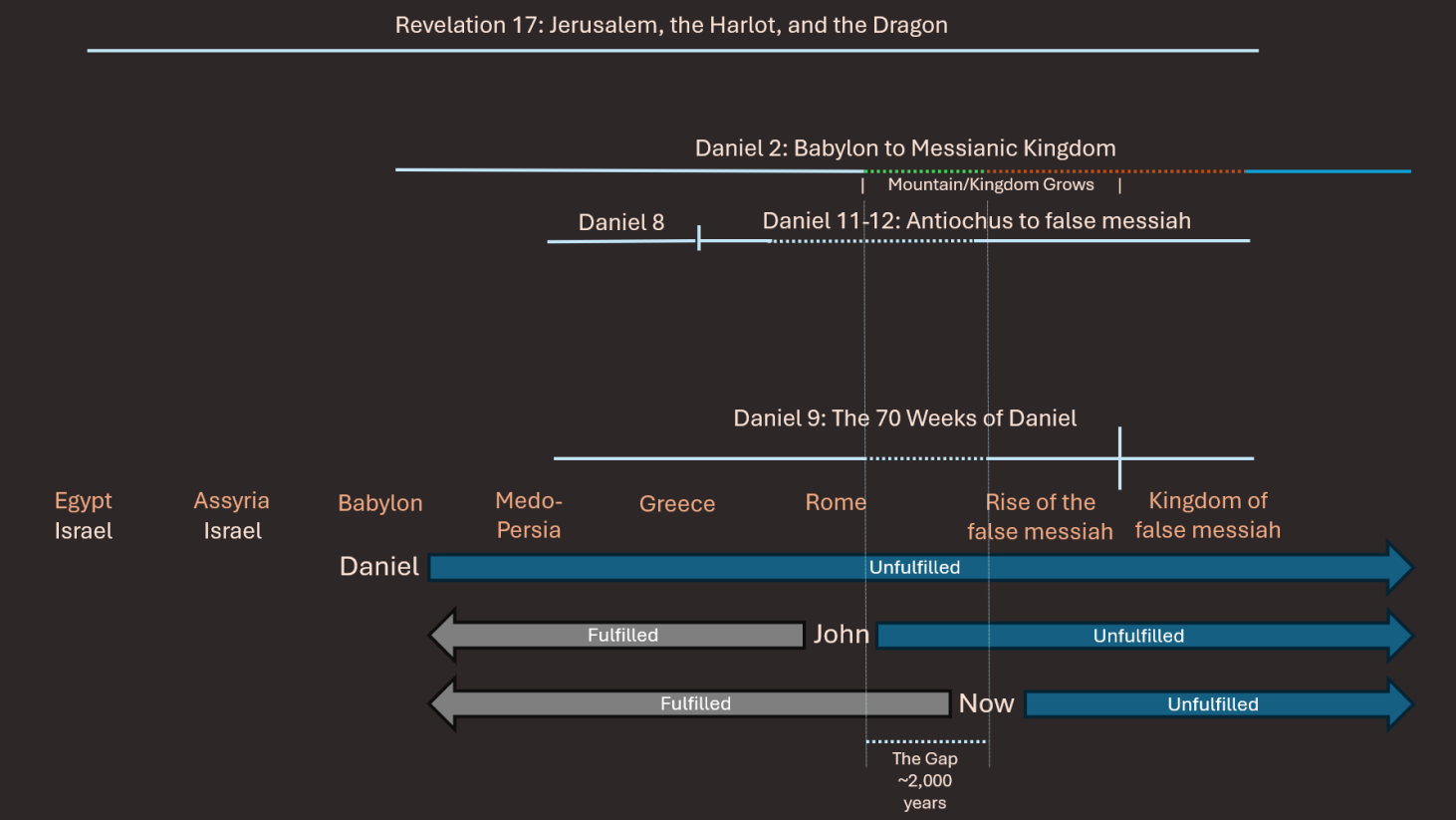
Medo-Persia to Antiochus IV To False Messiah
TL;DR
Daniel’s vision laid out in chapters 11-12 is an extremely detailed list of political intrigue that would follow from his time to the end of the age of the rule of men over the earth. The first half matches up so well with recorded history that many scholars believe it to be written not by Daniel as stated, but by an author around the time of the Maccabees.
As it skips quickly through the remaining time of the Medo-Persian Empire, it focuses in on conflict between kings of the North and South of the divided Grecian Empire through time, ultimately leading to the third mention by Daniel of the stopping of the daily and abomination of desolation, matching his depiction in the Vision of Daniel 8 of the actions of Antiochus IV “Epiphanes”.
But something changes, the narrative shifts, and a new king is introduced. What was once a back and forth between the king of the North and South now sees a seemingly united front by both against this new king as the enemy of my enemy becomes my friend. But none are able to stand against this new king as he goes forth to utterly destroy all those that come against his kingdom.
His luck running out, he returns to Jerusalem where he dies. What would seem to be the end of that story as the chapter comes to a close is really the transition from the rise of his kingdom to the full power of it in the next chapter. An unparalleled time of Jacob’s trouble in Judea follows his death, yet he likewise seems to be the focus of a three and a half year period in which the power of the holy people is scattered.
Daniel is given all of this information in his vision, yet he rightly doesn’t understand. But he is explicitly told that it is not for him to understand, that his job is to seal up this vision in the book that we’re reading and that the understanding of the vision would be for those at the time of the end, by which time knowledge would be increased. And so as we go through these visions of Daniel and John, having the whole council of God in one tidy package and searchable online with free tools like Blue Letter Bible, and the hindsight of history, understanding is opening up more and more clearly as time marches on toward the inevitable conclusion.
What is hinted at in Daniel’s various visions of the depictions of the stopping of the daily and abomination of desolation by two characters is now brought together in one vision. The historical mention in chapter 11 is now mirrored to the future mention in chapter 12. Furthermore, we have the king Antiochus IV who was associated with the first mention followed by a new king hated by both the kings of the North and South who is associated with the future mention.
It’s almost as if Yeshua pointing us to Daniel to understand the abomination of desolation was meant to show both the historical and future events not as identical, but call out the similarities, just as can be done with the men responsible for them. This vision completes the four mentions of the abomination of desolation by Daniel, one in the Vision of Daniel 8 from our past, one in the Vision of Daniel 9 in our future, and Daniel 11-12 linking both of them together across time and solidifying the spiritual influence of the same Dragon’s mystery of iniquity on two kings across time.
Prophetic Scope
This vision introduced and presented in Daniel 10-12 covers the time from Daniel all the way to the end of the Messianic Kingdom, with an implied gap in time spanning from the time of Antiochus IV around 167 BC into our future. It is split into three main parts, the first thirty five verses of chapter eleven covering the time from Daniel’s day until Antiochus IV leading to the gap. The second part is in the last nine verses of chapter eleven that introduce the future king at the end of the gap and his future war against several Middle Eastern kingdoms leading to his death in Jerusalem. The final part is depicted in the thirteen verses of the twelfth chapter as beginning an unparalleled time of trouble for Daniel’s people from which the faithful will be saved out of and ending with the eternal life of the kingdom after.
It should be noted that Daniel’s vision is in the third year of Cyrus the Great and first year of Darius the Mede just after the fall of Babylon in 539 BC to the Medo-Persians, the Achaemenid Empire. It would not be until 334 BC, 200 years after his vision, that Alexander the Great would begin to conquer the empire that had just risen to power as the instrument of God to return Israel to the promised land after 70 years of exile in Babylon.
Prophetic Characters
This format will be somewhat more complicated given the scale of things discussed in great detail. The prophetic characters will focus on the sequence of characters presented in the passage.
- Medo-Persia
- From Daniel’s time with Cyrus as king, there will be four other kings of Persia, the last being wealthy and stir up trouble against Greece.
- Greece
- A mighty king will come to power from Greece and do according to his will.
- Shortly after he comes to power, his kingdom will divided in four and not given to his posterity or rule in his power. The main focus from these four is on just two of them whose wars bring them into constant contact with, and domination over, the land of Israel.
- The king of the South will defeat the king of the North and take captives back to Egypt. This relationship continues through the vision to the time of the Seleucid king of the North, Antiochus IV.
- The king of the North will likewise come against the king of the South and over the course of time will fight against the king of the South through the vision to the time of the Seleucid king of the North, Antiochus IV.
- A vile person will come in peaceably and take the kingdom of the North by flatteries. In one of his campaigns against the king of the South, he is notified of a Roman decree of support for the king of the South that dashes his plans. He takes out his rage on Israel. He decrees death to those who do not cease to worship their God according to His statutes and forces idolatry in the land. Many comply, but many are killed for continuing to follow the God of Abraham, Isaac, and Jacob.
- The Maccabean Revolt resulted following the abomination of desolation of 167 BC. An army was raised from amongst the faithful Jews who desired to keep God’s statutes and overthrow their oppressor.
- The King
- A new king is introduced according to his actions and characteristics at the time of the end. While in the first part of the chapter the king of the South and king of the North are at war with each other, we now see both of them turn against this new king who then utterly defeats them and conquers Egypt, Israel, a threat to the North and East, and the peoples of the surrounding areas that come against him. Yet upon arriving to Jerusalem he comes to his end and none are able to help him.
- At the time of the end when the king dies, Israel enters into an unparalleled time of trouble in history from which those faithful to God are saved out of into an eternal kingdom of everlasting life.
Trusting the Source
The detail with which scripture depicts the time before the gap has led many scholars to believe that it was actually written by someone after Daniel and after the events had already transpired, lending to its accuracy. However, the text of Daniel in the Dead Sea Scrolls and the large number of manuscripts in the community suggests both the preservation of the original text and the authorship of that text prior to the suggested Maccabean hypothesis. (English translation of Daniel 11 from Dead Sea Scroll fragments published) There are currently no copies of Daniel 12 discovered, but there are rabbinical commentaries that mention aspects of it.
As usual, God seemingly leaves just enough space for ones desire for scripture not to be true to take hold if they let it. As for me, I have chosen to believe God’s Word in which He ensured preservation of the prophets’ writings through the ages. This is not based on blind faith, but recognized fulfillment of prophecy throughout scripture, some of which has been covered already. But we’re not even close to being done with the scale of fulfillment and tight-knit interwoven scripture laying out the future.
As Wes Huff points out in an interesting talk he gave, Is the Bible we have what the original authors even wrote?, sometimes the historians working off non-Biblical histories can miss what the Bible documents as history. They cast to the side what they see as a dusty old religious text, not taking it seriously for the historical record it represents. As we will see, this comes into play with Darius the Mede much like Wes’s example from Luke. We must remember that the Biblical authors had a faithful desire to present reality not only in their relationship with the God of creation, but with the events they were witnesses to, whether in their lives or their visions given them by God.
We’ve been given enough detail about the future that when events begin to happen that fulfill it, those who have understanding will have an unshakeable faith and deep anticipation for what that means in our transition to eternity. What is most important for each of us individually now is to grow in our relationship with the Messiah who saved us from ourselves. Trust in God, speak to Him in prayer, vocalize your doubts and ask for understanding according to His Word. I have found personally that He is faithful to reveal Himself according to His Word.
Defining the Start of the Vision
The vision given to Daniel regarding a long appointed time in his people’s future is contained in chapters ten through twelve. Though the content of the vision as it relates to prophecy is more in chapters eleven and twelve, some interesting points defining its beginning are made clearer when including chapter ten.
Daniel 5:29-31
Then commanded Belshazzar, and they clothed Daniel with scarlet, and [put] a chain of gold about his neck, and made a proclamation concerning him, that he should be the third ruler in the kingdom. In that night was Belshazzar the king of the Chaldeans slain. And Darius the Median took the kingdom, [being] about threescore and two years old.
Daniel 6:1-2, 28
It pleased Darius to set over the kingdom an hundred and twenty princes, which should be over the whole kingdom; And over these three presidents; of whom Daniel [was] first: that the princes might give accounts unto them, and the king should have no damage. … So this Daniel prospered in the reign of Darius, and in the reign of Cyrus the Persian.
While it is clear that Cyrus the Great conquered Babylon from the historical record, this Darius the Median, or Mede, is not found in history by that name apart from scripture as of today. This has caused many to discount the Bible’s historical account of what happened from the perspective of those present in Babylon at the time of its conquering. However, it is clear that Daniel regards both Darius the Mede and Cyrus the Persian as reigning at the same time.
It is possible that for someone as highly elevated as Cyrus the Great, the governors whom he appointed over his conquered territories might not be likewise elevated in title and stature, overshadowed by him as the ultimate king over all. This is one view of some who look at the Nabonidus Chronicle, where someone named Ugbaru governed over Babylon after its capture. There are others that don’t put a name from the historical record, but ultimately align with scripture is stating a second person ruling over Babylon under Cyrus the Great is in view here. (Biblehub) This seems the most logical view to me, accepting scripture as written.
So from the perspective of those being ruled over the Achaemenid Empire, the Medo-Persians, Cyrus was the king, but in their little corner of the world, Darius the Mede was their immediate ruler, though he ultimately took his orders from his king Cyrus. This brings us to our vision of Daniel 10-12.
Daniel connects his vision to the third year of Cyrus and later to the first year of Darius the Mede.
Daniel 10:1
In the third year of Cyrus king of Persia a thing was revealed unto Daniel, whose name was called Belteshazzar; and the thing [was] true, but the time appointed [was] long: and he understood the thing, and had understanding of the vision.
As Chris White points out in his book Daniel (A Commentary), we can see that chapter ten is part of the same vision of eleven and twelve. In the past I didn’t put much emphasis on chapter ten because it seemed to lack some content as related to prophetic events, yet it helps set the stage for the time of the vision and is important in this way.
In chapter ten, Daniel is in mourning for three weeks and on the twenty fourth day of the first month of Abib, or Nisan, he encounters a man in linen at the river. This clearly supernatural man, whose face is like lightning, eyes like fire, and the voice of a multitude, is not seen by any but Daniel, but his presence is felt as everyone else flees. Daniel is weakened in his presence and unable to stand as he is told by this man in linen that he was sent to Daniel because he is beloved and has come to give him understanding about what would befall his people in the latter days. This is similar to the Vision of Daniel 9 where Daniel sets his heart to understand and chastens himself before God.
The identity of this man in linen is not explicitly stated, but it seems clear from the context this is not the pre-incarnate Yeshua because he states that the prince of the kingdom of Persia withstood him twenty one days and Michael the archangel came to help him. Just as with the Vision of Daniel 8 and the Vision of Daniel 9 this would appear to be the messenger, the archangel Gabriel, who is delivering the vision and understanding of it to Daniel. From his weakened state, he is strengthened and we see the connection and flow from Daniel 10 to Daniel 11.
Daniel 10:19-11:2a
And said, O man greatly beloved, fear not: peace [be] unto thee, be strong, yea, be strong. And when he had spoken unto me, I was strengthened, and said, Let my lord speak; for thou hast strengthened me. Then said he, Knowest thou wherefore I come unto thee? and now will I return to fight with the prince of Persia: and when I am gone forth, lo, the prince of Grecia shall come. But I will shew thee that which is noted in the scripture of truth: and [there is] none that holdeth with me in these things, but Michael your prince. Also I in the first year of Darius the Mede, [even] I, stood to confirm and to strengthen him. And now will I shew thee the truth. Behold, there shall stand up yet three kings in Persia…
In Daniel 10:8 he “saw this great vision, and there remained no strength in me: for my comeliness was turned in me into corruption, and I retained no strength.” This is in line with what begins in the next chapter as Daniel’s vision that he saw is documented for us. We can see in the comment on the man in linen returning to fight with the prince of Persia, that the prince of Grecia is to come after, exactly what is laid out in greater detail in the vision itself.
Furthermore, it is in Daniel’s weakness from the vision that he is given strength. Note the person who is talking at the end of chapter ten and beginning of chapter eleven, the man in linen. It is he that will return to Persia to fight with Michael, he that will show Daniel what is in the scripture of truth, he that stood to confirm and strengthen Daniel, and he that showed Daniel the truth.
What Daniel calls the third year of Cyrus king of Persia the man in linen equates to the first year of Darius the Mede, when he confirmed and strengthened Daniel. Babylon was conquered by Cyrus the Great in 539 BC, three years before that would have been 542 BC. Cyrus succeeded to the throne in 559 BC, soon after consuming the Median Empire and the Lydian Empire prior to turning focus on the Babylonian Empire. According to Herodotus it was in 542 BC that Cyrus the Great ended his conquest of most of modern Turkey, the Median and Lydian Empires, and returned to Persia. (Herodotus, A. Barguet. L’Enquête (in French). Bibliothèque de la Pléiade. pp. 111-124.) This would place his kingship over the expanded empire now including two previous other empires three years before his conquer of Babylon.
Recall from Daniel 8:3-4, 20 that the ram had two horns representing Media and Persia and that the horns are interpreted explicitly for us as the kings of Media and Persia. This explains what we see in the timing of this vision, the idea of two kings in the Achaemenid Empire commonly referred to as Medo-Persia in prophecy for this reason. So the greater king Cyrus who consumes the Median and then Lydian Empires ties into the beginning of the reign of Darius the Mede who is made king over Babylon upon its conquering.
Thus it would seem that even though “Darius” is not recorded in any known historical records of the time by name, the survived writings of the time likely saw Cyrus overshadowing others since it is the victor who writes the history. And though Cyrus had been king of Persia for much longer than three years prior to the capture of Babylon, he had only been king of his expanded kingdom responsible for the capture of Babylon just three years prior. And so the third year of Cyrus the Persian and first year of Darius the Mede fits with what Daniel and Gabriel say is the time at which this vision has been given, around 539 BC after Babylon has been conquered.
A View of History
Not being a historian, I relied on several sources to tie in the prophecy with history. The original source I relied on long ago, Eschatology in the Prophecies of Daniel, is no longer an active website as of 2008, but through Internet Archive’s Wayback Machine, the content is still present. There is no author stated that I could find, but I appreciated the concise presentation of the historical tie in and so it is primarily what is quoted.
The second source is from Chris White’s research in his book Daniel (A Commentary), which is likewise very helpful and clarified the connection between Daniel 10 and 11 for me. He goes into a little more detail on some things and is definitely worth the read regardless.
The final source is from a partial preterist commentary Daniel 11 - Prophecy Fulfilled that I include for their historical perspective on the fulfillment of the first thirty five verses. Seeing prophecy as primarily fulfilled historically, it is interesting to check across multiple perspectives for variations. While I disagree with how they handle the later part of chapter eleven, it is important to be aware of how some view the historical fulfillment of what I see as yet future. I will explain my reasoning in this article. What seems to be common across these various perspectives is the agreement that the historical fulfillment of Antiochus IV ends at Daniel 11:35.
In addition I have checked some of these conclusions across non-religious sources just to see if there is consensus outside of a Biblical perspective on names and dates. If you know history, feel free to comment on any corrections you believe should be made.
The goal is to present fulfilled prophecy through the eyes of history in short, focusing more on the connection between the first fulfilled abomination of desolation by Antiochus IV and how this vision connects it to the unfulfilled abomination of desolation by the future king. I think it’s important to build faith in what was already foreseen as a foundation of trust for what is foreseen but not yet accomplished. This is a rare vision that brings the two together for us, highlighting the reason Yeshua points us in the Olivet Discourse to look back to Daniel’s visions to understand the abomination of desolation. Matthew 24:15-22 | Mark 13:14-20
The Kings of the North and South
Daniel 11:2
And now will I shew thee the truth. Behold, there shall stand up yet three kings in Persia; and the fourth shall be far richer than [they] all: and by his strength through his riches he shall stir up all against the realm of Grecia.
“The three Persian kings after Cyrus (539-529 BC) were Cambyses (529-522 BC) who was the son of Cyrus, Gaumata (522 BC), and Darius I Hystaspes (522-486 BC). Xerxes I Ahasuerus (486-465 BC) was the fourth Persian king after Cyrus, who lived an opulent life style, married a Jewess named Esther, and attempted to conquer Greece in 480 BC. Subsequent Persian kings after Xerxes I included Artaxerxes I Longimanus (465-424 BC) who was the son of Xerxes I, Xerxes II (424 BC), Darius II Nothius (423-404 BC), Artaxerxes II Mnemon (404-358 BC), Artaxerxes III Ochus (358-338 BC), Arses (338-336 BC), and Darius III Codomanus (336-331 BC).” | Eschatology in the Prophecies of Daniel
The focus of this vision is not on the entire list of kings of the Achaemenid Empire, but up to the one that stirred up the realm against Greece that would lead to their future defeat. It was in 480 BC the famous Battle of Thermopylae was fought over three days as Spartan warriors fought, and were defeated by, the much larger invading Persian army. They advanced and eventually stopped the campaign, but in this action began a continuing conflict between these two empires that would last for almost 150 years. It was this attack that had Philip II, father of Alexander the Great, planning a campaign against the Achaemenid Empire.
Daniel 11:3-4
And a mighty king shall stand up, that shall rule with great dominion, and do according to his will. And when he shall stand up, his kingdom shall be broken, and shall be divided toward the four winds of heaven; and not to his posterity, nor according to his dominion which he ruled: for his kingdom shall be plucked up, even for others beside those.
“Alexander the Great (336-323 BC) at the age of 20, assumed command of the Grecian army, swept through Assyria, Babylon, Persia, and Egypt, as the first king of the Grecians. In 332 BC, he conquered Palestine, showing great consideration to the Jews. With Alexander’s premature death in 323 BC, the Grecian Empire was broken into four separate divisions under the control of four former generals who became kings sixteen years later, after considerable political wrangling and the murder of all of Alexander’s heirs. Known as the Diadochi, the four Grecian division heads were Cassander who ruled over Macedonia and Greece, Lysimachus who ruled over Thrace and Asia Minor, Seleucus I Nicator (311-280 BC) who ruled over Syria, and Ptolemy I Soter (323-285 BC) who ruled over Libya, Ethiopia, Egypt and Palestine.” | Eschatology in the Prophecies of Daniel
Daniel 11:5
And the king of the south shall be strong, and [one] of his princes; and he shall be strong above him, and have dominion; his dominion [shall be] a great dominion.
“Ptolemy I ruled over Egypt and Palestine for 38 years and Seleucus I ruled over Babylonia, adding extensive territories both east and west. Ultimately, Seleucus I united three of the four kingdoms under his control as king of the North.” | Eschatology in the Prophecies of Daniel
Daniel 11:6
And in the end of years they shall join themselves together; for the king’s daughter of the south shall come to the king of the north to make an agreement: but she shall not retain the power of the arm; neither shall he stand, nor his arm: but she shall be given up, and they that brought her, and he that begat her, and he that strengthened her in [these] times.
“Ptolemy Ceraunus, younger brother of Ptolemy II Philadelphus (285-246 BC), killed Seleucus I. Antiochus I Soter (280-261 BC) succeeded his father Seleucus I and was succeeded by his son Antiochus II Theos (261-246 BC). Berenice, daughter of the king of Egypt, Ptolemy II Philadelphus (285-246 BC), married Antiochus II. Ptolemy II died and Laodice, former wife of Antiochus II, then killed him with poison, and placed her son Seleucus II Callinicus (246-226 BC) on the throne. Afterwards, Seleucus II killed Berenice and her son near Antioch.” | Eschatology in the Prophecies of Daniel
Daniel 11:7-8
But out of a branch of her roots shall [one] stand up in his estate, which shall come with an army, and shall enter into the fortress of the king of the north, and shall deal against them, and shall prevail: And shall also carry captives into Egypt their gods, with their princes, [and] with their precious vessels of silver and of gold; and he shall continue [more] years than the king of the north.
“The death of Berenice resulted in war between Seleucus II and Berenice’s brother Ptolemy III Euergetes (246-221 BC), who became the king of Egypt after the death of his father. He attacked Syria, Phoenicia, Cilicia, Babylonia, and Mesopotamia, capturing each. Ptolemy III overtook Antioch and/or Seleucia, the port of Antioch, where he recovered 2,500 Egyptian gods and 40,000 talents of sliver which had been carried off to Syria by the Persian king Cambyses, when he conquered Egypt in 525 BC.” | Eschatology in the Prophecies of Daniel
Daniel 11:9-10
So the king of the south shall come into [his] kingdom, and shall return into his own land. But his sons shall be stirred up, and shall assemble a multitude of great forces: and [one] shall certainly come, and overflow, and pass through: then shall he return, and be stirred up, [even] to his fortress.
“In 240 BCE, the king of the North, Seleucus II, attempted to invade Egypt in response to the humiliation he had suffered at the hands of Ptolemy III. However, he had to return in defeat after his fleet perished in a storm.” | Daniel 11 - Prophecy Fulfilled
“Seleucus III Ceraunus (226-223 BC) and Antiochus III Magnus (223-187 BC), respectively, succeeded their father Seleucus II. Ptolemy IV Philopater (221-203 BC) succeeded Ptolemy III as king of Egypt, and, he was attacked by Antiochus III, who beat the army of Ptolemy IV near Berytus. Fighting with an army of 78,000 men, Antiochus III (the Great) took the battle as far as the fortress of the city of Raphia in southern Palestine.” | Eschatology in the Prophecies of Daniel
Daniel 11:11-12
And the king of the south shall be moved with choler, and shall come forth and fight with him, [even] with the king of the north: and he shall set forth a great multitude; but the multitude shall be given into his hand. [And] when he hath taken away the multitude, his heart shall be lifted up; and he shall cast down [many] ten thousands: but he shall not be strengthened [by it].
“The historian Polybius recorded that during the battle for Raphia in 217 BC, the raging defensive forces of Ptolemy IV which numbered 75,000 men defeated the attacking forces of Antiochus III and killed 10,000 infantrymen. However, subsequently, a force of Egyptians fought internally against Ptolemy IV who was puffed up with pride and living in luxury after his victory over Antiochus III. The civil battles resulted in the death of 60,000 Egyptian citizens.” | Eschatology in the Prophecies of Daniel
Daniel 11:13-14
For the king of the north shall return, and shall set forth a multitude greater than the former, and shall certainly come after certain years with a great army and with much riches. And in those times there shall many stand up against the king of the south: also the robbers of thy people shall exalt themselves to establish the vision; but they shall fall.
“After the death of Ptolemy IV, he was succeeded by his son Ptolemy V Epiphanes (203-181 BC), who proceeded to battle with Antiochus III over Syria and Phoenicia. Palestinian Jews joined the forces of Antiochus III in the battle against Ptolemy V, but were defeated by the Ptolemaic general Scopas in 200 BC.” | Eschatology in the Prophecies of Daniel
Daniel 11:15
So the king of the north shall come, and cast up a mount, and take the most fenced cities: and the arms of the south shall not withstand, neither his chosen people, neither [shall there be any] strength to withstand.
“The next year, Antiochus III defeated general Scopas, capturing the port city of Sidon, recovering Syria and Phoenicia.” | Eschatology in the Prophecies of Daniel
Daniel 11:16-17
But he that cometh against him shall do according to his own will, and none shall stand before him: and he shall stand in the glorious land, which by his hand shall be consumed. He shall also set his face to enter with the strength of his whole kingdom, and upright ones with him; thus shall he do: and he shall give him the daughter of women, corrupting her: but she shall not stand [on his side], neither be for him.
“Antiochus III was in command of a very large army, easily conquering Palestine, and obtaining the voluntary loyalty of the Jews without any resistance. While preparing for war with the Romans, Antiochus III came to the city of Raphia on the Palestinian border of Egypt and made peace with Ptolemy V. In an effort to gain control in Egypt, Antiochus III offered his daughter Cleopatra I in marriage to Ptolemy V in 194 BC, however, after the marriage Cleopatra I became loyal to her husband, who sustained his control over Egypt.” | Eschatology in the Prophecies of Daniel
Daniel 11:18-19
After this shall he turn his face unto the isles, and shall take many: but a prince for his own behalf shall cause the reproach offered by him to cease; without his own reproach he shall cause [it] to turn upon him. Then he shall turn his face toward the fort of his own land: but he shall stumble and fall, and not be found.
“The following year, Antiochus III turned his attention to Asia Minor and mainland Greece where some Grecian cities were under Roman control. The fleet of Antiochus III was twice defeated at sea by the Roman fleet near Phoceia and near Ephesus. Ptolemy V and Cleopatra I then sent an embassy to Rome to congratulate the Romans on their victory and to encourage the Romans to press on with the war in Asia. According to the First Book of Maccabees 1:10, during the war, Epiphanes, son of Antiochus III was captured and was taken to Rome as a hostage. Ultimately defeated in 190 BC by the Roman consul Lucius Cornelius Scipio Asiaticus in the battle of Magnesia in Asia Minor, Antiochus III retired to the remainder of his kingdom and was killed three years later by the Persians, as he was robbing the temple of Jupiter Belus in Elymais, to raise money to pay the tributes imposed by the Romans.” | Eschatology in the Prophecies of Daniel
“In the peace treaty of Apamea in 188 BCE, Roman general Publius Scipio set a high cost on Antiochus III for peace. He demanded twenty hostages (including his son, Antiochus IV), a reduction of naval ships to twelve, and payment to Rome for the cost of the war totaling 15,000 talents over the next twelve years. The all-consuming ambition of Antiochus III had finally brought defeat to the kingdom of the North.” | Daniel 11 - Prophecy Fulfilled
Daniel 11:20
Then shall stand up in his estate a raiser of taxes [in] the glory of the kingdom: but within few days he shall be destroyed, neither in anger, nor in battle.
“Antiochus III was succeeded by his son Seleucus IV Philopator (187 - 175 BC). As a tributary of the Romans, Seleucus IV sent his tax collector, Heliodorus, to rob the temple of Jerusalem to obtain money, however, Heliodorus engineered a conspiracy against Seleucus IV and killed him. Shortly before the death of Seleucus IV, he sent his son Demetrius to Rome in a hostage swap for his brother Antiochus IV Epiphanes (175-164 BC), who succeeded him.” | Eschatology in the Prophecies of Daniel
Daniel 11:21-23
And in his estate shall stand up a vile person, to whom they shall not give the honour of the kingdom: but he shall come in peaceably, and obtain the kingdom by flatteries. And with the arms of a flood shall they be overflown from before him, and shall be broken; yea, also the prince of the covenant. And after the league [made] with him he shall work deceitfully: for he shall come up, and shall become strong with a small people.
“According to the Second Book of Maccabees 3:1, Jerusalem was in complete peace under Seleucus IV who provided kingdom revenues in support of the daily sacrificial services. After the murder of Seleucus, Heliodorus, treasurer of the kingdom, assumed interim leadership. Antiochus IV who was in Athens at the time of his brother’s death, negotiated directly with the Romans, convincing them to keep Demetrius, rightful heir to the throne, in Rome as hostage. Through the Romans, as a part of a private friendship agreement with the king of Pergamus, who was given a portion of the kingdom of Antiochus III in return for assisting the Romans, it was determined that Antiochus IV would become king, in return for annual tribute to the Romans and the king of Pergamus. The king of Pergamus expelled Heliodorus and placed Antiochus IV on the throne. Not the direct heir to the throne, Antiochus IV distinguished himself, as more of a commoner, by stealing from the palace treasury, rambling around town in Roman officer disguise, and drinking and carousing with people of the lowest rank. Taken for a madman by many in Syria, he deposed Onias the Jewish high-Priest, and sold the priesthood to Jason, the younger brother of Onias for 440 talents of silver. Onias was subsequently killed by Andronicus, deputy to Antiochus IV in Antioch. While Antiochus IV was away in Egypt, a false rumor spread that he was dead, sending Judea into revolt. Antiochus IV returned to Jerusalem with his vast army and indiscriminately killed 80,000 Jews from young to old, and sold another 40,000 Jews into slavery.” | Eschatology in the Prophecies of Daniel
Daniel 11:24
He shall enter peaceably even upon the fattest places of the province; and he shall do [that] which his fathers have not done, nor his fathers’ fathers; he shall scatter among them the prey, and spoil, and riches: [yea], and he shall forecast his devices against the strong holds, even for a time.
“Antiochus IV exacted tributes from the Palestinian nations, advanced the Grecian ideals and worship of pagan gods throughout his kingdom, appointed his cronies to positions of power as tribute collectors, allowed his friends to plunder the temple wealth, and he set his sights on capturing all of Egypt. He allowed the position of Jewish high-Priest to be bought and sold by the highest apostate bidder, and, according to the Second Book of Maccabees 4:30, he gave the peoples of Tarsus and Mallus to his mistress, as a gift.” | Eschatology in the Prophecies of Daniel
Daniel 11:25-26
And he shall stir up his power and his courage against the king of the south with a great army; and the king of the south shall be stirred up to battle with a very great and mighty army; but he shall not stand: for they shall forecast devices against him. Yea, they that feed of the portion of his meat shall destroy him, and his army shall overflow: and many shall fall down slain.
“Upon the death Antiochus’s sister Cleopatra I, the eunech Eulaeus, personal governor of Cleopatra’s son, claimed Phoenicia and Coelosyria from Antiochus IV as a dowery for the young boy king. In 170 BC, Antiochus IV attacked and overtook the Egyptian army between Pelusium and the mountain Casius. Capable of destroying the whole Egyptian army, Antiochus IV spared many as a friendly gesture, and, soon after, he captured all of the Egyptian cities, which he also befriended. Antiochus IV blamed the war on Eulaeus, personal governor to Ptolemy VI Philometer (181-146 BC), so as to make friends with the young boy king.” | Eschatology in the Prophecies of Daniel
Daniel 11:27
And both these kings’ hearts [shall be] to do mischief, and they shall speak lies at one table; but it shall not prosper: for yet the end [shall be] at the time appointed.
“Antiochus IV entered into an outward, sycophant uncleship with the young king Ptolemy VI and let him assist with affairs of the kingdom, from the Egyptian city of Memphis. Egyptians in the city of Alexandria, seeing that Ptolemy VI was in the custody of Antiochus IV, declared Euergetes, younger brother to Ptolemy VI, to be the next king of Egypt. Pretending to establish Ptolemy VI on the Egyptian throne, Antiochus IV made war upon Euergetes and beseiged him and Euergetes’s sister in Alexandria, defeating the Egyptian navy at sea. At the same time, the Egyptians in Alexandria sent emissaries to Rome to request assistance.” | Eschatology in the Prophecies of Daniel
Daniel 11:28
Then shall he return into his land with great riches; and his heart [shall be] against the holy covenant; and he shall do [exploits], and return to his own land.
“Antiochus IV returned to Syria in the spring of 169 BC, leaving Ptolemy VI to rule from Memphis. During the winter, Ptolemy VI and his brother Euergetes reconciled and were reunited in Alexandria, where Ptolemy VI assumed the role of the king of Egypt. While in Judea on the way to Syria, Antiochus IV directed his captains to make spoil of the Judean and Jewish wealth, capturing 1,800 talents of gold and silver, including the gold altar from the temple in Jerusalem, to be taken to Antioch. He ordered Apollonium, a captain of 22,000 men, to enter Jerusalem on the sabbath in a parade of arms, killing grown men who came out to see them, taking young men and women captive, and selling them as slaves for money.” | Eschatology in the Prophecies of Daniel
Daniel 11:29-30
At the time appointed he shall return, and come toward the south; but it shall not be as the former, or as the latter. For the ships of Chittim shall come against him: therefore he shall be grieved, and return, and have indignation against the holy covenant: so shall he do; he shall even return, and have intelligence with them that forsake the holy covenant.
“Returning to Egypt in the spring of 168 BC to besiege Alexandria and the two young boy Egyptian kings, Antiochus IV was met by the Roman ambassadors, Popilius Loena, C. Decimius, and C. Hostilius. Prior to accepting a kiss on the hand from Antiochus IV, Popilius gave written tables to Antiochus IV upon which the Roman Senate had issued a decree of support for Egypt. Popilius drew a circle on the ground around Antiochus IV, and directed him to immediately offer his decision regarding his intentions toward the Egyptians, before leaving the circle he was standing in. Shocked by the approach of Popilius, Antiochus IV acknowledged the Roman demands and then he kissed the hand of Popilius, with the agreement to retreat to Syria. Antiochus IV returned to Syria, sulked at his treatment by the Romans, and vented his anger on his subjects the Jews by setting up the worship of heathen gods in all Judea, and, he killed those who would not worship his gods.” | Eschatology in the Prophecies of Daniel
“The fact that he is twice referred to as being kind to those who got with the program is evidence that he was not acting in blind rage, but with a sense of political savvy. This also perhaps gives up some insight into the Antichrist, who also will cause a great apostasy, not just by deception, but also by providing incentives to apostatize. In the case of the Antichrist, the ones who leave their faith will have their lives spared, but they will also be able to buy and sell again. This is a deal that is hard to refuse, and will require steadfast faith on the part of the saints to do so. Though it will not be until verse 36, five verses later, that the future Antichrist will be in view, I do think that about here we start to see the beginnings of the “fade effect”, where certain elements apply to one or both Antiochus and the Antichrist.” | Daniel (A Commentary)
The Abomination of Desolation
I agree with Chris’s statement of this kind of fade effect from the first part of the chapter to the last, this is what I consider the glue that connects the actions and characteristics of the historically fulfilled person behind the abomination of desolation to that of the future unfulfilled person who isn’t necessarily identical, but acts in the same spirit. It has become clear to me, however, that the assumption of Gentile lineage for the future man of sin is a potential blinder to the realities of what Yeshua states in the Olivet Discourse about the time surrounding the abomination of desolation. It is a time of great deception surrounding false messiahs and false prophets, claiming the anointing of Yeshua as the prophesied king of Israel, that is what the Messiah is. And for a deception to be any good, the wolf in sheep’s clothing must be very well dressed, deceit wrapped in truth, darkness cloaked in light. But eventually the mask must come off.
In Daniel 8 we saw the first historical mention of the taking away of the daily and the abomination of desolation that was tied to the historical figure Antiochus IV in 167 BC. The aftermath and the Maccabean Revolt led to the rededication of the temple still celebrated today as Hanukkah. This is the second of two of the historical references by Daniel of an abomination of desolation tied to the same person, event, and time. What was in isolation from future prophecy in one vision is seen here in this vision tied to it.
Daniel 11:31
And arms shall stand on his part, and they shall pollute the sanctuary of strength, and shall take away the daily [sacrifice], and they shall place the abomination that maketh desolate.
“According to the First Book of Maccabees 1:44 - 1:57, Antiochus IV sent word to Jerusalem to stop all burnt offerings and sacrifices. He ordered an end to circumcision, burned the books of the Law, erected altars in the sacred precincts of the temple of Jerusalem for the sacrifice of hogs and unclean cattle, erected a dreadful desecration upon the altar in the temple of Jerusalem, erected pagan altars in all Judean towns, and ended the burning of incense. And, according to the Second Book of Maccabees 6:2 - 6:6, the forces of Antiochus IV forbade Sabbath worship, covered the altar of the temple in Jerusalem with abominable offerings, amused themselves by lying with prostitutes in the sacred precincts of the temple, and renamed the temple as Zeus Olympius. The dreadful desecration, known as the abomination that causes desecration, set up in the location of the altar in the temple of Jerusalem in 168 BC, was an altar and statue to the pagan god Jupiter (Zeus Olympius).” | Eschatology in the Prophecies of Daniel
I’m not sure where the 168 BC year comes into play as 1 Maccabees 1:54 states, “Now the fifteenth day of the month Casleu, in the hundred forty and fifth year, they set up the abomination of desolation upon the altar, and builded idol altars throughout the cities of Juda on every side;”. The 145th year of the Seleucid Era, according to the Babylonian Calendar Converter is 167 BC. Regardless, unlike the future abomination of desolation we will get to, it is not Antiochus IV himself performing these things according to the writings of the Maccabees, it is done by others on his orders from Syria.
Daniel 11:32-33
And such as do wickedly against the covenant shall he corrupt by flatteries: but the people that do know their God shall be strong, and do [exploits]. And they that understand among the people shall instruct many: yet they shall fall by the sword, and by flame, by captivity, and by spoil, [many] days.
“The Jews were forced underground in order to keep the sabbath and Antiochus IV openly rewarded apostate Jews with positions of responsibility. In chapters 6 & 7 of the Second Book of Maccabees, the stories of the deaths of Eleazar, a leading scribe, and a mother and her seven sons are told. Eleazar set an example for others by refusing to eat pork and voluntarily submitting to the torture wheel. The mother and her seven sons each refused to submit and were skinned alive, dismembered, and boiled in a hot pan. Despite attempts by Antiochus IV to convince the youngest son with flattery and promised riches, the son set an example for other youths to follow the laws of their fathers and forefathers, even unto death.” | Eschatology in the Prophecies of Daniel
Daniel 11:34
Now when they shall fall, they shall be holpen with a little help: but many shall cleave to them with flatteries.
“Observing the cruelties of Antiochus IV, Judas, who was called Maccabeus, and his followers secretly entered the villages of Judea and called on their kinsmen to join them in revolt. By enlisting those who had clung to the Jewish religion, they mustered 6,000 men, and were joined by the Hasideans, who were war-like Israelite volunteers. At the same time, Judas selected Eupolemus and Jason to go to the Roman Senate as emissaries to request assistance. The Roman Senate was sympathetic and sent brass tablets to Jerusalem with a written testimony of Roman support for the Jews.” | Eschatology in the Prophecies of Daniel
Daniel 11:35
And [some] of them of understanding shall fall, to try them, and to purge, and to make [them] white, [even] to the time of the end: because [it is] yet for a time appointed.
“The story of the death of the elderly scribe Eleazar in the Second Book of Maccabees, Chapter 6, is the most poignant story regarding the willingness of the wise to stumble under the Law. Given the choice of violating his conscience by eating pork to extend his natural life, or violating Jewish law by submitting to obvious suicidal death, Eleazar went straight to the torture wheel and ordered his oppressors to send him down to Hades at once. As he was dying, he said, ‘The Lord, in his holy knowledge, knows that, though I might have escaped death, I endure dreadful pains in my body from being flogged; but in my heart I am glad to suffer this, because I fear Him.’ Similarly, one of the seven tortured sons, at the point of death, said to his oppressors, ‘Do not be falsely deceived; for we suffer these things because of ourselves, for we sin against our own God, so these amazing things have happened. But you must not suppose that you will go unpunished for having attempted to fight against our God.’” | Eschatology in the Prophecies of Daniel
“When the Gentile nations around Judea heard of their victory over the Seleucids, they became very angry. They began to kill those Jews who lived among them. Judas Maccabee and his brother Simon went out to fight against those Gentiles who sought to kill the Jews and defeated them. After the death of Judas Maccabee in battle in 161 BCE, persecution continued upon the Jews, as history records. Many wicked Jews who had opposed Judas and his goals took opportunity after his death to persecute and kill righteous Jews. Beginning with Mattathias’ leadership of the rebellion against Antiochus IV, the rule of the Hasmoneans (named after Mattathias’ grandfather, Asmoneus) lasted from 168 until 37 BCE. The words “until the time of the end” refer to the end of this second period of Jewish sovereignty. The “appointed time” refers to the 70 weeks of years that Gabriel had earlier told Daniel about (Dan. 9:24-27), which led to the appearance of the Messiah.” | Daniel 11 - Prophecy Fulfilled
In both the views listed above, the partial preterist being the latter, there is a recognition of persecution and testing, but my view is more in line with that of Chris White. We saw from verses 21-35 the rise of a vile person who would press upon the children of Israel a time of temptation where they must choose between loyalty to God or being able to continue to live. But in the context of this vision, the end of the trying and purging of those of understanding is not tied only to the time of the reign of Antiochus IV. Now we must examine the meaning of the time of the end in the context of the whole vision given to Daniel.
The Gap
We’ve seen in Daniel 11:1-35 a foretelling of events so accurate that most non-believers say it had to be written after the events it prophesied about, yet the Dead Sea Scrolls dated to around the time of the Maccabean Revolt contain matching fragments to what we have today. It covers the Medo-Persian time from Cyrus and Darius of Daniel’s time through Alexander the Great (336-323 BC), Ptolemy I Soter (323-285 BC), Ptolemy III Euergetes (246-221 BC), Battle for Raphia in 217 BC, Ptolemy V Epiphanes (203-181 BC), Fall of Antiochus III Magnus in 187 BC, Seleucus IV Philopator (187 - 175 BC), and Antiochus IV Epiphanes (175-164 BC), who is depicted in verses 31-35 as the same time as Daniel 8’s 2,300 days following the abomination of desolation caused by him. This is a series of wars between the king of the North and South and the effect on Israel stuck in the middle.
But the final verse of this section makes a statement that carries us into to the distant future from Antiochus IV and the rebellion against the king of the North that came out of his actions. As we will see Daniel 11:36-12:13 depicts a different time, far removed from the verses that lead up to it. And there are two reasons that solidify this understanding, the first of which is “the time of the end.”
The Time of The End Part 1
This phrase is made up of two words, ayth (H6256 time) and kates (H7093 end) that occur 296 and 67 times respectively in the Old Testament. But it is the phrases in which they are used together that become very interesting because we are looking at a very specific phrase talking about a particular time. Now the phrase translated “the time” occurs 168 times in the Old Testament while “of the end” occurs just 5 times in the Old Testament, which is consistent across the various translations. What is interesting here is just where those 5 occurrences of this combined phrase of “the time of the end” are located.
Daniel 8:17
So he came near where I stood: and when he came, I was afraid, and fell upon my face: but he said unto me, Understand, O son of man: for at the time of the end [shall be] the vision.
The first of the five occurrences we’ve already covered in the vision of Daniel 8, and is tied to the context of the vision given. That context was the time following the ram and the goat, explicitly tied to the time of Medo-Persia and Greece. It was the end of this time that the events of the vision would be fulfilled, including the abomination of desolation we just read several verses earlier in Daniel 11:31. So contextually the time of the end in this case is the end of the remaining power of Greece over Israel not long after Antiochus IV’s abomination of desolation, and Daniel 11:31-35 speaks to that very time as well.
Daniel 11:35, 40, 12:4, 9
And [some] of them of understanding shall fall, to try them, and to purge, and to make [them] white, [even] to the time of the end: because [it is] yet for a time appointed. ... And at the time of the end shall the king of the south push at him: and the king of the north shall come against him like a whirlwind, with chariots, and with horsemen, and with many ships; and he shall enter into the countries, and shall overflow and pass over. … But thou, O Daniel, shut up the words, and seal the book, [even] to the time of the end: many shall run to and fro, and knowledge shall be increased. ... And he said, Go thy way, Daniel: for the words [are] closed up and sealed till the time of the end.
All the remaining occurrences of this phrase in the Old Testament exist within this one vision and prophecy of Daniel 11-12. This is significant because they also all likewise speak of a different time of the end than the first mention. All four of these speak to an end point for this vision, but when in time that is will be revealed later based on context within this vision. First, let’s look at how this phrase ties all these passages, and the events that take place in them, together.
First notice that this phrase is an end point where events will be happening. It is at, to, or till, the time of the end. This places the events prior to, and leading up to it, at some unspoken distance in time from “the time of the end.” Since there is no definitive time given, there is no scope to the duration and it could be days or millennia. That context must come from somewhere else. That is where the last two instances come into play, because they clue us in to when this end is.
Both of these times Daniel is confused by his vision and asks what will be the end of these things he is seeing. The response is a statement twice that the words should be shut up and sealed in the book until the time of the end. Along with this is the statement that knowledge will be increased. In general this is a continuing trend as time progresses, but this is in the context of the vision and prophecy.
For almost two millennia, the central nature of Israel and Jerusalem made no sense in prophecy because Israel didn’t exist and Jerusalem and Judea were desolate of her people. Unless one just believed God’s Word and that sometime in the future that would change, they could have no understanding of what was given in parables, symbols, and spread throughout scripture because the critical pieces were missing. But the printing press brought scripture to everyone, technology advanced to where we have tools that can search the whole Bible in milliseconds, and the benefit of hindsight in history has caused knowledge and understanding to increase.
The idea of shutting up the words and sealing the book cannot speak to the same kind of sealing we see in Revelation 5 with the seven sealed scroll. That cannot be read because the seals prevent it from being opened and it can only be opened and read by the Lamb of God. We’ve been reading the words of this vision and prophecy from Daniel for millennia and the contents are well known, even if not fully understood.
This points to the codifying of it in text, preserved and locked from changes for those millennia. God has preserved this vision and prophecy, diligently written down by Daniel, copied, and preserved through the centuries until the time of the end. Since the events that we will examine have not yet happened, we know the time of the end in the context of this prophecy is still yet future, and so are the events of it. I understand that there are views which see the verses to follow as being tied to our history, though it was Daniel’s future, but I ask that you continue reading the whole article for the logical reasoning for seeing this as yet future.
Daniel 11:35
And [some] of them of understanding shall fall, to try them, and to purge, and to make [them] white, [even] to the time of the end: because [it is] yet for a time appointed.
This rare phrase in the Bible gives us a big clue as to the temporal context of this prophecy. It’s first used in the end of verses 31-35 that speak of the time of Antiochus IV and the Maccabean Revolt that followed, though many would be killed during that time. But this last phrase could be a statement of much of Israel’s journey both before and since that time. It would be a matter of centuries after the time of Antiochus IV that the Messiah would arrive in Judea and the wise and learned of Israel would not see Him. In fact, in their blind zealotry they would play right into God’s plan and have Him crucified so He could become sin for us, nailed and hung from a tree, that we might gain His righteousness.
Deuteronomy 32:21
They have moved me to jealousy with [that which is] not God; they have provoked me to anger with their vanities: and I will move them to jealousy with [those which are] not a people; I will provoke them to anger with a foolish nation.
Romans 11:11
I say then, Have they stumbled that they should fall? God forbid: but [rather] through their fall salvation [is come] unto the Gentiles, for to provoke them to jealousy.
For almost 2,000 years the children of Israel have been in tribulations. Scattered into the nations, they have been hated and persecuted there just as God told them they would be because of their rebellion. But He loves them and desires for them to desire Him. And they will, though through a time of trying and purging that will leave a remnant of faithful Israel that will be saved. And so all Israel will be saved.
Now there are three cases where events lead up to or till the time of the end, but there is one stating it is “at the time of the end,” indicating when the end comes the following events will take place. After the introduction of a new king, we are told that the king of the South will push at him and the king of the North will come against him like a whirlwind. While we haven’t defined from this vision and prophecy when exactly “the end” is, we can be assured that this event will happen at the time of the end.
Finally, there is one New Testament use of the rare phrase “of the end” that shows up in the Olivet Discourse that I find interesting in this context. The question is asked and in the Olivet Discourse Yeshua lays out the answer culminating in His return to gather His elect, seal the 144,000, and tread the winepress of the wrath of God once His people are removed from the destination of that wrath.
The King
Daniel 11:36-39
And the king shall do according to his will; and he shall exalt himself, and magnify himself above every god, and shall speak marvellous things against the God of gods, and shall prosper till the indignation be accomplished: for that that is determined shall be done. Neither shall he regard the God of his fathers, nor the desire of women, nor regard any god: for he shall magnify himself above all. But in his estate shall he honour the God of forces: and a god whom his fathers knew not shall he honour with gold, and silver, and with precious stones, and pleasant things. Thus shall he do in the most strong holds with a strange god, whom he shall acknowledge [and] increase with glory: and he shall cause them to rule over many, and shall divide the land for gain.
These are the defining characteristics of this new king that is introduced at the time of the end.
The king will do according to his will. This is the same that is said of the mighty king in verse three, speaking of Alexander the Great. We saw this phrase also used in Daniel 8:4 of the ram, speaking of Cyrus the Great. Nebuchadnezzar, in Daniel 4:35, uses this phrase in speaking of the power of God in heaven whose hand cannot be stayed. It speaks to the unstoppable nature of the power of this king, as we will see.
The king will exalt himself above every god and speak marvelous things against the God of gods. This is pretty self-explanatory, and a common trait with another character introduced in John’s visions that we will get to in later studies. However, there seems to be a caveat to this we’ll get to. He clearly addresses the God of Abraham, Isaac, and Jacob and stands in opposition to Him, speaking against Him. It’s easy to expect him to display this outright from his initial arrival on the scene in the future, but we must remember the deceptive nature of the end of the age as warned of by Yeshua regarding false messiahs claiming Yeshua’s anointing as Messiah. While his heart may always be against God, he may yet hide his true nature under sheep’s clothing to do according to his will.
The king will prosper until the indignation is complete and that determined shall be done. This speaks to a time of indignation and a determined set of actions to be accomplished. The word indignation H2195 is used 22 times in the Old Testament and speaks almost exclusively of the wrath of God. It can be accomplished through other nations to judge Israel such as Isaiah 10:5, or an indication of the wrath of God to come at the end of the age. Isaiah 26:19-21 It seems clear that the context of this being the time of the end, that the wrath of God characterized by the beginning of the day of the Lord is in view here, but we will see later if that fits the context of the time of the end in this vision.
The king will not regard the God of his fathers. I think some may look at this phrase too generically and not keep it within the scope of the vision and prophecy in question. As with most prophecy that comes from a Hebrew book written by Hebrews about Hebrews’ relationship with the God of creation, it has a particular focus. And the idea of genealogy and lineage is central to the culture. The Messiah, the King of Israel, is to come from a very specific lineage of David. When Jacob (Israel) died, he told Joseph that God would be with him and bring him to the land of his fathers. Genesis 48:21 Later, Moses asks God who he should say sent him when he comes to the children of Israel and says the God of their fathers sent him to them.
Exodus 3:13-16
And Moses said unto God, Behold, [when] I come unto the children of Israel, and shall say unto them, The God of your fathers hath sent me unto you; and they shall say to me, What [is] his name? what shall I say unto them? And God said unto Moses, I AM THAT I AM: and he said, Thus shalt thou say unto the children of Israel, I AM hath sent me unto you. And God said moreover unto Moses, Thus shalt thou say unto the children of Israel, The LORD God of your fathers, the God of Abraham, the God of Isaac, and the God of Jacob, hath sent me unto you: this [is] my name for ever, and this [is] my memorial unto all generations. Go, and gather the elders of Israel together, and say unto them, The LORD God of your fathers, the God of Abraham, of Isaac, and of Jacob, appeared unto me, saying, I have surely visited you, and [seen] that which is done to you in Egypt:
This is very telling identifying information about this king that appears at the time of the end. If he does not regard the God of his fathers, then the implication is that his lineage identifies with a particular God and the most clear answer as to who his fathers would be, ties him to Israel. This phrase “God of your fathers” occurs 11 times and “your fathers” occurs 88 times, both speaking to Israel. As we will see later this is not a coincidence, this prophecy is tied directly to Israel.
Yet we also must not forget the overarching narrative of deception regarding an anointed king of Israel, a wolf in sheep’s clothing. While he may not regard the God of his fathers, indicating his lineage is likewise tied to Abraham, Isaac, and Jacob, that doesn’t mean he can’t use that lineage to rise to a place of rule amongst his people to his ultimate end. The end is a time of great deception, and the best deceptions come cloaked in some truth. If the reality were laid bare most would reject it. He is not alone in his desire to rule nor is he going to accomplish that solely in his own power.
Isaiah 14:12-15
How art thou fallen from heaven, O Lucifer, son of the morning! [how] art thou cut down to the ground, which didst weaken the nations! For thou hast said in thine heart, I will ascend into heaven, I will exalt my throne above the stars of God: I will sit also upon the mount of the congregation, in the sides of the north: I will ascend above the heights of the clouds; I will be like the most High. Yet thou shalt be brought down to hell, to the sides of the pit.
Another has desired to be like the most High, the Accuser, the Serpent, the Dragon. The mount of the congregation in the sides of the North is Zion, where Israel was to meet with God at His tabernacle. The language directed at this fallen angel speaks to his desire to sit in God’s tabernacle and receive worship from God’s people, replacing the relationship of them with God to himself. The great deception of the end is tied to this, replacing God with not God, an idol to be worshiped and a return to idolatry. But that ultimate end sees this dragon brought to hell, the sides of the pit. In the Septuagint the phrase is used “into the foundations of the earth.” We will see that ultimate end tied to the abyssos, the abyss or bottomless pit.
And let us not forget that Yeshua, the true Messiah, was tempted in the wilderness to bow down to the Devil and receive the kingdoms of the earth. He rejected the offer by the Word of God, but another could be offered the same and betray His God and deceive his people for power and great authority.
John 5:43
I am come in my Father’s name, and ye receive me not: if another shall come in his own name, him ye will receive.
The king will not regard the desire of women. This has been interpreted by some as not being interested in having a family, being celibate, gay, speaking to women’s desire for the Messiah, or hinting a return to Biblical patriarchy. However, this is connected to the portion above about not regarding the God of his fathers. It is likewise connected to those after it that he will not regard any god but exalt himself above all. It seems best to keep this in the same context of this idea of rejection of all gods except self, a kind of self-idolatry.
But what does the desire of women have to do with that? I found a good explanation in line with this context by Dr. Robert D. Luginbill here.
“In the history of Israel’s other kings, it was more often than not their (often foreign) wives that led them astray into the worship of other gods. That was notably true of all of Solomon’s wives and of Jezebel in the case of Ahab (cf. also the idolatrous behavior of the women of Jerusalem generally outlined in Jer.44).
“Therefore I am inclined to understand the phrase hemdath nashiym as the natural balance to the phrase “God of his fathers” and as contrasting that phrase so that I would translate as follows:
“He (i.e., antichrist) will have no regard for the God of his fathers (i.e., the Lord), nor those favored by their wives, nor will he have regard for any god [at all], for he will exalt himself above them all. Daniel 11:37”
This seems the most consistent interpretation in the context of this passage. This king knows what he wants and what he believes in, himself. Nothing is going to be able to draw him toward any other gods because he considers himself to be God. But again, there is a caveat because in reality he has help.
The king will honor a god of forces in his estate. The word for estate means foot, base, pedestal, or office. It’s mostly used as foot, but the phrase “his estate” is only found four times in the Old Testament, all in Daniel 11:7, 20, 21, and 38. This context always speaks of the kingdom over which the king rules, his estate is his kingdom.
The phrase “of forces” is used only once here, but the word forces means strength, strong, fortress, and is used scripturally as a place or means of safety, protection, refuge, or stronghold. This is used figuratively as God’s protection and human protection.
Psalm 37:39
But the salvation of the righteous [is] of the LORD: [he is] their strength in the time of trouble.
Joel 3:16
The LORD also shall roar out of Zion, and utter his voice from Jerusalem; and the heavens and the earth shall shake: but the LORD [will be] the hope of his people, and the strength of the children of Israel.
Isaiah 30:1-3
Woe to the rebellious children, saith the LORD, that take counsel, but not of me; and that cover with a covering, but not of my spirit, that they may add sin to sin: That walk to go down into Egypt, and have not asked at my mouth; to strengthen themselves in the strength of Pharaoh, and to trust in the shadow of Egypt! Therefore shall the strength of Pharaoh be your shame, and the trust in the shadow of Egypt [your] confusion.
In context, this god of strength and security is a god his fathers didn’t know. God desired to be Israel’s King, but they wanted a king from among them that they could see and touch and would go out and fight their battles for them. Knowing the failure that would come from this, yet the ultimate end, God allowed it and the lineage of the house of David was promised a Seed that would be the strength and salvation of Israel and the world. This was the combination of God ruling over Israel, yet in human form that could be seen and touched. Yeshua is the King promised to Israel throughout the prophetic narrative who will rule with a rod, or scepter, of iron.
But while Yeshua is the God of their fathers, this new king honors a god their fathers didn’t know. This king brings safety and security to his kingdom through this god that strengthens him to do so. In this we see a coin representing the kingdom of Israel. On one side is the God of creation reigning in power and providing security for His people. On the dark underside is another king that rejects God and elevates himself to a place of providing that strength and security for his kingdom.
The common element is the coin itself, the children of Israel, who must make a choice as to which king they will serve. One has placed a stumbling block and a door to refine a stiff-necked people and allow only those that will love and obey God to find Him. The other opens the doors wide and clearly calls because his desire is to pull God’s people away from God to himself to receive worship, to bring them to the same destruction that awaits him. He knows the prophecies too and works to use them as proof of who he claims to be. That this self-proclaimed god draws on a god of forces for his strength and power and great authority highlights the cloaked deception, that he may be the king in this supernatural game of chess, but he’s being played by someone else.
The king will honor this god with gold, silver, precious stones, and pleasant things. This same god of forces that the king honors for his strength and authority is honored with material wealth. It was not uncommon for temples to be the destination of valuable things to honor various gods. In fact Israel did the same thing and were plundered many times.
The king will acknowledge and increase the glory of this god of forces. While this king elevates himself above all gods, it would seem that he recognizes and gives glory to this invisible god of forces from which he draws his strength, power, and great authority. It seems an odd thing to elevate oneself as God yet honor another god. Of course we saw this with Yeshua as well. He claimed the anointing of God and that He is God. He made Himself subservient to the Father to do His will, yet He and the Father are One.
So I think we see the same thing happening here, the unoriginal Dragon must once again copy God to have any relevance himself amongst God’s people. The unseen Dragon, spiritually providing the authority to a man who claims to be God, is honored by the man and in turn the man continues in his authority. However, what appears one way on the outside might just be a cloak of deception hiding this darker truth. As we all know, it is possible to speak the language of faith very well yet have nothing in common with it. Deception and lies are at the heart of this destructive relationship between man and the Devil.
In the context of Israel, this would be a hard pill to swallow because Yeshua already came in this manner and so the Oral Law and all the rabbinical interpretations explicitly reject the Messiah being anything but a man. However, when the trap has been set and the time is right, signs and lying wonders can do a lot to change the minds of those already head over heels believing the Messiah has finally arrived. Perhaps that is why some who still have rejected Yeshua will also reject this king when he elevates himself to the level of God. And so in this consistency they will remain faithful to God until His return when they see Him whom they pierced coming on the clouds of heaven with great power and glory. Zechariah 12:10-14
The king will do all these things in the most strong holds with a strange god. This is an interesting phrase and the same word translated as forces is used here as strong, but is combined with a second word, holds, speaking of fortified cities. Bringing this all together, it would seem that this king draws power and authority from this god of strength by which he is able to fortify his kingdom and give it strength to bring security to his people.
But as we will see, this time is defined by conflict and war, how can that speak to peace and safety? The answer comes in the power and authority given this king to go forth conquering and to conquer.
Revelation 6:1-4
And I saw when the Lamb opened one of the seals, and I heard, as it were the noise of thunder, one of the four beasts saying, Come and see. And I saw, and behold a white horse: and he that sat on him had a bow; and a crown was given unto him: and he went forth conquering, and to conquer. And when he had opened the second seal, I heard the second beast say, Come and see. And there went out another horse [that was] red: and [power] was given to him that sat thereon to take peace from the earth, and that they should kill one another: and there was given unto him a great sword.
If a king of a kingdom has all power over the enemies of that kingdom, peace for the kingdom comes through that strength to defeat all their enemies. This is how both war and peace coexist at the same time, it depends which side you’re on as to whether you dwell in your land peacefully or are overcome by war. While at war with his enemies, the king will take the fight out of his land and into theirs.
The king will divide the land for gain. The king will divide, or apportion, the land for gain. The phrase “shall divide” is used 12 times in the Old Testament and used to speak of dividing the spoil and the division caused by the veil in the temple between the most Holy and the holy. What I find most fascinating are the six times it is used in speaking of dividing the land of Israel by lot for an inheritance. Numbers 34, Joshua 18, Ezekiel 45, 47:13-48:29
Numbers 33:52-56
Then ye shall drive out all the inhabitants of the land from before you, and destroy all their pictures, and destroy all their molten images, and quite pluck down all their high places: And ye shall dispossess [the inhabitants] of the land, and dwell therein: for I have given you the land to possess it. And ye shall divide the land by lot for an inheritance among your families: [and] to the more ye shall give the more inheritance, and to the fewer ye shall give the less inheritance: every man’s [inheritance] shall be in the place where his lot falleth; according to the tribes of your fathers ye shall inherit. But if ye will not drive out the inhabitants of the land from before you; then it shall come to pass, that those which ye let remain of them [shall be] pricks in your eyes, and thorns in your sides, and shall vex you in the land wherein ye dwell. Moreover it shall come to pass, [that] I shall do unto you, as I thought to do unto them.
The dividing of the land in Ezekiel 45-48 speaks to the future reign of the Messiah from Jerusalem, an expectation from both Jews and Christians. This involves the final division of the land according to the promises God made to Israel to dwell in His land, for He is the King of it.
Once again, because he must copy God to deceive, we see a dividing of the land by this king for a price, or gain. Strongs depicts this “as that which is placed in front of one, presented, offered,” a reward or gain.
Genesis 15:18
In the same day the LORD made a covenant with Abram, saying, Unto thy seed have I given this land, from the river of Egypt unto the great river, the river Euphrates:
Exodus 23:30-33
By little and little I will drive them out from before thee, until thou be increased, and inherit the land. And I will set thy bounds from the Red sea even unto the sea of the Philistines, and from the desert unto the river: for I will deliver the inhabitants of the land into your hand; and thou shalt drive them out before thee. Thou shalt make no covenant with them, nor with their gods. They shall not dwell in thy land, lest they make thee sin against me: for if thou serve their gods, it will surely be a snare unto thee.
It should be noted that Israel has never fully inhabited the land to the scale promised to Abraham by God. Even now Israel struggles with borders created to appease and try to bring peace in the land. Gaza and Judea, the “West Bank,” are not run by Israel and there are zones where Jews are all but guaranteed death if they go there. This is clearly not the picture of a kingdom in control of the land that prophecy says they will control.
How that control comes about, as usual, is through war. October 7, 2023 triggered a spiritual and mental shift in the hearts and minds of many in Israel. The expectations of the Messiah arriving grew as He is expected to come when Israel is in trouble to save her. And this will be one of many expectations fulfilled by a new king on the scene with power and authority from a god of strength his fathers did not know. In his strength he will defeat the enemies of his kingdom out of the land and reward his people with the spoils of that strength bringing peace once again in the land through strength. What will appear as the fulfillment of the Messianic Kingdom restored to Israel will in reality be a great deception by a false messiah.
Wars of the King
Daniel 11:40-41a
And at the time of the end shall the king of the south push at him: and the king of the north shall come against him like a whirlwind, with chariots, and with horsemen, and with many ships; and he shall enter into the countries, and shall overflow and pass over. He shall enter also into the glorious land, and many countries shall be overthrown:
Recall that the end of verse 35 into verse 36, before introducing this new king, that we see a span of over 2,000 years leading to the appointed time of the end. We were given some details about this king that help us to recognize him when he comes and how he comes on the scene, but these are more characteristics that happen at various times of his reign.
This however brings us back to the time of the end once again, sometime in our future. We are told in this case that it is at the time of the end, not until or to it, that the king of the South and North attack this new king. This is the last mention of the kings of the North and South and it’s telling that their final act in the vision has them both attacking this new king that arises and starting wars. The whole first part of this prophecy was these kings battling each other for power and territory and it defined where their territories were. Yet at the time of the end those territories are connected in such a way as to point to their involvement in the future wars. Historically these were Egypt in the South and the Seleucid Empire in the North, covering modern Southern Turkey, Syria, Iraq, and Iran.
We know there are three kings at the time of the end because of the grammar used. Both the king of the South and North are separately described as pushing at and coming against “him.” Some take this to mean these two are back at it again, fighting with each other. But that ignores the whole introduction of this king at the time of the end, the antecedent noun to the pronoun “him” that is this king that was described. It is him that both the kings of the South and North come against at the time of the end. I would recommend reading Daniel (A Commentary) by Chris White as he goes into greater detail with references regarding this three king view.
In response to this attack by these two against this new king, he enters into the countries and overflows and passes over, like a tsunami flowing over land, nothing can stop him in his response to this attacks. One of these places is the glorious land. We saw this same phrase used in verse sixteen when Antiochus III conquers Israel without resistance. And we will see in a coming verse that Jerusalem is also mentioned in the phrase “the glorious holy mountain.”
But if this king is of Israel, why would he attack and overflow his own land? As I mentioned before, Israel is not in control of the whole land given to them by God. Just as they have enemies outside the land looking to destroy them, they have enemies living in the land that are waiting for the opportunity to attack and remove Israel from the Jordan River to the Mediterranean Sea. In order to bring safety to his kingdom, these enemies must be defeated, removed from it, and the war taken out of his land to that of their enemies.
Daniel 11:41b
but these shall escape out of his hand, [even] Edom, and Moab, and the chief of the children of Ammon.
While this king is strong and overflows many countries, he is clearly not able to do so everywhere. Edom, Moab, and Ammon are lands within modern Jordan and indicate that when this king is defeating Egypt and then coming to the North and East to squelch the troubling tidings from there, the territory just to the East of Israel will remain untouched by him. This hints at the promised wilderness that will house and protect the faithful of Israel when they flee Judea, which we’ll cover later in the Vision of Revelation 12.
Daniel 11:42-43
He shall stretch forth his hand also upon the countries: and the land of Egypt shall not escape. But he shall have power over the treasures of gold and of silver, and over all the precious things of Egypt: and the Libyans and the Ethiopians [shall be] at his steps.
It is clear from this that Egypt, the king of the South, will be overthrown and plundered by this new king. In the modern context it seems odd to consider that Egypt has any treasures of gold, silver, or any precious things as it’s considered fairly poor. With high public debt, currency devaluation, and one third of the population living in poverty, this seems counterintuitive. However, we should also consider that the elite in power typically live a separate life from the general population and Egypt has a substantial growing reserve of precious metals, which as of late 2025 was over $18 billion. Additionally, the Sukari (sugar) gold mine produces 450 thousand ounces of gold annually, holding and estimated 6.7 million ounces in reserves. He who controls the power controls the wealth.
We also see that Libya and Ethiopia are “at his steps.” This is H4703 from the root H6805 meaning to step or march. It’s defined as at his heals or in his train, implying that they are not defeated by him because they are in league with him in some way. This doesn’t necessarily mean they are in agreement with him, as it’s hard to believe that they would both fight against Egypt, but in the face of Egypt’s clear defeat by this king, they might feign friendship to escape the same fate.
Daniel 11:44
But tidings out of the east and out of the north shall trouble him: therefore he shall go forth with great fury to destroy, and utterly to make away many.
Some unknown news during the course of his campaign to take the fight to the nations that attack him in the South causes the king to turn his ire to the East and North. Now whether this is saying the Northeast as one direction or two nations to the North and East is up for debate, but what is clear is that he utterly destroys in fury. This could also highlight that he doesn’t just travel East into Jordan, but goes the North and East into the lands that represented the king of the North historically, covering modern Southern Turkey, Syria, Iraq, and Iran. This is interesting in light of another prophecy that does not appear to have been fulfilled as of yet.
Isaiah 17:1-3, 9
The burden of Damascus. Behold, Damascus is taken away from [being] a city, and it shall be a ruinous heap. The cities of Aroer [are] forsaken: they shall be for flocks, which shall lie down, and none shall make [them] afraid. The fortress also shall cease from Ephraim, and the kingdom from Damascus, and the remnant of Syria: they shall be as the glory of the children of Israel, saith the LORD of hosts. ... In that day shall his strong cities be as a forsaken bough, and an uppermost branch, which they left because of the children of Israel: and there shall be desolation.
While conquered by many throughout time, it is said that Damascus is the oldest continually inhabited city. So the idea that it will be taken away from being a city would point to a future fulfillment. Further, that it the cities are forsaken because of the children of Israel causing desolation would point to an utter destruction in her future for some reason by Israel.
In looking at all of these enemies of the king and his tie to Israel something becomes very clear, the modern state of Israel has been in conflict with these same groups since becoming a nation again in 1948. In the quarter of the earth that comprises the Middle East, there is one Jewish state surrounded by many larger Islamic kingdoms. The conflict described here is neither foreign to the modern mind nor unexpected in the future as wars and rumors of wars continue.
One thing is clear, on October 7, 2023 an attack on the population of Israel by those Muslims in Gaza, was termed the “Al Aqsa Flood” and was stated by Hamas spokesman Abu Ubaida to be partially a response to the Jews “bringing red cows.” CBS News The mystery of iniquity has been at work through the millennia setting his pawns on the board. A war against the Dajjal has been decreed in sacred Islamic texts, providing the perfect enemy for the king to show his strength against. And a clear catalyst has been defined in any sign of Israel returning to their ancient roots under the Mosaic Covenant and all the statutes that entails. The requirement of the temple on land Islam cannot allow to be overtaken is just the trigger to spark the war. And the anointed king of Israel is prophesied to build that very temple.
Zechariah 6:11-13
Then take silver and gold, and make crowns, and set [them] upon the head of Joshua the son of Josedech, the high priest; And speak unto him, saying, Thus speaketh the LORD of hosts, saying, Behold the man whose name [is] The BRANCH; and he shall grow up out of his place, and he shall build the temple of the LORD: Even he shall build the temple of the LORD; and he shall bear the glory, and shall sit and rule upon his throne; and he shall be a priest upon his throne: and the counsel of peace shall be between them both.
Daniel 11:45
And he shall plant the tabernacles of his palace between the seas in the glorious holy mountain; yet he shall come to his end, and none shall help him.
Jerusalem sits between the Dead Sea and the Mediterranean Sea and in returning to the capital of Israel in the glorious holy mountain, the king comes to his end. The king that has been crowned, and went out to fight the battles for his kingdom to bring peace, has fallen in the very place that is his capital, the center of his power on Zion. Imagine, after all the sacrifice made to bring peace to his people, the dashing of the hope of his people in his death. He has done so much to provide peace and safety in a world that is against them, but now he is gone, mortally wounded and no longer present to ensure their safety.
Chapter Breaks
About 800 years ago Stephen Langton, the Archbishop of Canterbury, put the chapter divisions in place that are just about universal in the various Bible versions. Later verse divisions were developed that further subdivided scripture. While this is a great tool to quickly reference passages of scripture, those divisions can sometimes be somewhat arbitrary and, whether we realize it or not, cause the reader to mentally separate the content and context of the chapters. This can lead to missing key connections if those chapters are being used in a reading plan that does just a chapter a day or causes context to be lost.
In this case, Daniel 10 through 12 are all part of the same vision given to Daniel in the third year of Cyrus the Great and the first year of Darius the Mede. And so, in studying the meaning of the vision, it is important to make a point that we cannot disconnect Daniel 11:45 from Daniel 12:1 mentally, and instead we must recognize there were originally no chapter breaks and that the grammar used connects these two chapters in time. As we’ve seen “the time of the end” is used twice in chapter eleven and twice in chapter twelve, yet all four of these uses are tied to a time yet future to us as of this writing.
Unparalleled Trouble
Daniel 12:1
And at that time shall Michael stand up, the great prince which standeth for the children of thy people: and there shall be a time of trouble, such as never was since there was a nation [even] to that same time: and at that time thy people shall be delivered, every one that shall be found written in the book.
This is one of four passages that I’ve found which combine an unparalleled time for Israel from which the righteous will be saved. I would note first that the nature of something being unparalleled in all of history makes it a uniquely singular event. Therefore any other statements of like manner must logically be speaking of the same time. Likewise, that all other statements of this unparalleled time include that it is determined for Israel and that Israel will be delivered from that time add two other data points that solidify the connection of these passages to each other in time.
In the case of Daniel 12:1, it is when Michael stands up that this unparalleled time of trouble from which Daniel’s people that are written in the book are saved. This speaks not to all of Israel, but the faithful of Israel as they are written in the book. This idea of Michael standing can be seen elsewhere in this vision regarding other people. In Daniel 11:2-4, 7, 20-21 we see this in terms of the arising of kings to their reign. In the case of Michael the archangel, it would seem that while he was not in focus, he suddenly has an important role in the events about to play out. It is clear that this unparalleled time of trouble, set apart from any other previous time a nation has existed, is focused on the nation of Israel.
The Time of the End Part 2
Daniel 11:45-12:1
And he shall plant the tabernacles of his palace between the seas in the glorious holy mountain; yet he shall come to his end, and none shall help him. And at that time shall Michael stand up, the great prince which standeth for the children of thy people: and there shall be a time of trouble, such as never was since there was a nation [even] to that same time: and at that time thy people shall be delivered, every one that shall be found written in the book.
I’m being repetitive here, but the point is important to understand. The king of Daniel 11:36-45 exists at the same time as the unparalleled time of trouble for Israel in Daniel 12:1. We know this because the king comes to his end “at that time” the unparalleled tribulation begins. This reinforces the view that Daniel 11:35 stating, “to the time of the end: because it is yet for a time appointed” is looking at a span of time from the events of the Maccabean Revolt to the unparalleled time in all of history. From Daniel 11:36 for the remainder of the vision, we are looking at a time in our future.
This is important to understand because it gives us a huge flashing neon sign when we see what is depicted happening with the wars of this king that builds up to the end’s arrival. This is much more explicit than Yeshua’s statement of wars and rumors of wars, this is existing nations like Egypt being depicted as attacking and being conquered by a king in the Middle East.
It is difficult to not get into the other prophecies tied to this because they are central to understanding. I will definitely be doing a focused post on these parallels in other prophecies in the future as it clarifies the whole foundation of much of what is misunderstood about the time of the end and the great tribulation.
However, I think it is important to recognize when Yeshua stated the end would come in context with Daniel’s statement of the time of the end. Having the word “end” in both statements is not what connects them, rather it is the nature of an unparalleled time for Israel that they are saved out of. Our defining that pivotal one-time event as “the end” flows from that direct logical connection.
Matthew 24:3, 14-16, 21-22
And as he sat upon the mount of Olives, the disciples came unto him privately, saying, Tell us, when shall these things be? and what [shall be] the sign of thy coming, and of the end of the world? … And this gospel of the kingdom shall be preached in all the world for a witness unto all nations; and then shall the end come. When ye therefore shall see the abomination of desolation, spoken of by Daniel the prophet, stand in the holy place, (whoso readeth, let him understand:) Then let them which be in Judaea flee into the mountains: … For then shall be great tribulation, such as was not since the beginning of the world to this time, no, nor ever shall be. And except those days should be shortened, there should no flesh be saved: but for the elect’s sake those days shall be shortened.
It is Yeshua’s words that clinch the understanding of “the time of the end” because it is His account of an unparalleled tribulation for Israel in Judea that matches with Daniel 12:1. While Daniel doesn’t speak of an abomination of desolation in the this same verse, the unparalleled nature of the great tribulation, that Yeshua states follows the abomination of desolation, lets us know that the daily has been stopped and the abomination of desolation has taken place to lead up to the unparalleled time in Judea.
Yeshua’s account states that the end will come once the Gospel reaches all the world as a witness to the nations. This is immediately followed by the unparalleled time of trouble in Judea.
Daniel 12:8-10
And I heard, but I understood not: then said I, O my Lord, what [shall be] the end of these [things]? And he said, Go thy way, Daniel: for the words [are] closed up and sealed till the time of the end. Many shall be purified, and made white, and tried; but the wicked shall do wickedly: and none of the wicked shall understand; but the wise shall understand.
Daniel did not understand what he was seeing in part, but he faithfully documented it as told for our benefit. This vision about the time of the end is clearly stated to be understood by those at the time of the end, this is that time! For millennia people have desired to understand the meaning of so much of prophecy, but while it foretold what would come to pass, it is not always clear to the understanding of the reader.
What makes it even more difficult is when paradigms built on misunderstanding create mental blocks that seal the understanding from us. This is one reason why I feel it is very important to break down the paradigms built by others in our own minds and turn to the Word of God with faith, trusting He says what He means and means what He says. Then we can build from a solid foundation ourselves according to that Word and see where the Spirit and Author of the Word leads us in His Word. But we must be willing to allow our presuppositions to be dismantled and replaced with God’s Word. This is not to say I’m right, I don’t care if you agree with me or not. I just want to share what I’ve learned from God’s Word as I’ve dismantled my own previous misconceptions to arrive at a place where what was confusing makes more sense to me. Acts 17:11 should always be your guiding principle, search the scriptures to see what is so. You have direct communication with God by His Spirit and Author of prophecy, ask Him for guidance through His Word.
The time of the end for both Daniel and Yeshua comes with the taking away of the daily and the abomination of desolation. That means the necessary elements for that to be true must be in place. This will be covered in greater detail in the next Vision of Revelation 11.
Daniel 11:35
And [some] of them of understanding shall fall, to try them, and to purge, and to make [them] white, [even] to the time of the end: because [it is] yet for a time appointed.
I want to bring to remembrance the gap between the time of the Maccabean Revolt and the time of the end. Daniel 12:10 speaks to the same point as Daniel 11:35, where we see the trying of those with understanding to the time of the end. It then introduces a new king in Daniel 11:36-39 and at verse 40 states that at the time of the end the king of the South and North will go after him and he will conquer several lands and people. The final verse of chapter 11 sees this king come to his end in Jerusalem and it is at that time the unparalleled trouble begins.
Here we see this repeated regarding the time of the end, where many will be tried, purified, and made white. The promise of general tribulation could be wrapped up in the statement that the wicked will do wickedly in this context, but the promise of understanding is hidden from the wicked and revealed to the wise.
Proverbs 25:2
[It is] the glory of God to conceal a thing: but the honour of kings [is] to search out a matter.
Revelation 1:5-7
And from Jesus Christ, [who is] the faithful witness, [and] the first begotten of the dead, and the prince of the kings of the earth. Unto him that loved us, and washed us from our sins in his own blood, And hath made us kings and priests unto God and his Father; to him [be] glory and dominion for ever and ever. Amen. Behold, he cometh with clouds; and every eye shall see him, and they [also] which pierced him: and all kindreds of the earth shall wail because of him. Even so, Amen.
Exact Day Prophecies
It is in this vision that we saw the second of two historical mentions of the abomination of desolation in Daniel 11:31, and now we see the second of two future mentions of the abomination of desolation, the other being Daniel 9:27. This is one of several places that speaks to an exact day period tied to events that take place. We’ve seen 2,300 evenings and mornings in the Vision of Daniel 8 tied to the missed daily sacrifices after first abomination of desolation and to the rededication of the temple. And the Vision of Daniel 9 sees a specific period of seventy weeks of years split between sixty nine fulfilled and one awaiting fulfillment. However, as we move into the visions of Daniel and John that are focused on the time of the end, we begin to see a pattern of 3.5 years, 42 months, and 1,260 days emerge. While it is tempting to jump to connecting them all as the same period of time, we must be patient and see where the visions take us first.
The context of exact-day prophecy is the time of the end and the unparalleled time for Israel that comes with that end. We have two men clothed in linen having a conversation Daniel’s meant to hear regarding the vision he is having.
Daniel 12:5-13
Then I Daniel looked, and, behold, there stood other two, the one on this side of the bank of the river, and the other on that side of the bank of the river. And [one] said to the man clothed in linen, which [was] upon the waters of the river, How long [shall it be to] the end of these wonders? And I heard the man clothed in linen, which [was] upon the waters of the river, when he held up his right hand and his left hand unto heaven, and sware by him that liveth for ever that [it shall be] for a time, times, and an half; and when he shall have accomplished to scatter the power of the holy people, all these [things] shall be finished. And I heard, but I understood not: then said I, O my Lord, what [shall be] the end of these [things]? And he said, Go thy way, Daniel: for the words [are] closed up and sealed till the time of the end. Many shall be purified, and made white, and tried; but the wicked shall do wickedly: and none of the wicked shall understand; but the wise shall understand. And from the time [that] the daily [sacrifice] shall be taken away, and the abomination that maketh desolate set up, [there shall be] a thousand two hundred and ninety days. Blessed [is] he that waiteth, and cometh to the thousand three hundred and five and thirty days. But go thou thy way till the end [be]: for thou shalt rest, and stand in thy lot at the end of the days.
Daniel is confused and doesn’t understand, but he is told that his job is to write down what he has seen for those who will read and understand at the time of the end. The purpose of his vision was for God’s glory and to codify what was seen for thousands of years, sealed and unchanged, for the time of the end.
What we learn from the question how long to the end of these wonders is that the power of the holy people will be scattered by these wonders and that the end of their scattering is at the end of a time, times, and half a time. This is moed singluar, moed plural, and khay-tsee’, or half/middle. Now this is very interesting because what many Christians refer to as the feasts of Israel are the moedim, meaning the appointed times. These are Pesach (Passover), Chag HaMatzot (Unleavened Bread), Yom HaBikkurim (Firstfruits), and Shavuot (Pentecost) in the spring and early summer. In the fall are Yom Teruah (Feast of Trumpets or Rosh Hoshannah), Yom Kippur (Day of Atonement), and Sukkot (Tabernacles).
These are all based on a lunisolar calendar that averages about 360 days a year, but realistically goes through a 19-year Metonic Cycle where lunar months must be added every so often, intercalary months, to keep the first month of Abib, or Nisan, in line with the readiness of the harvest that’s tied to the Vernal Equinox that is stable in the solar year. Since Israel’s appointed times are determined by the lunar months, we end up with about a 30 day month and the appointed time of Firstfruits is tied to the offering of the first of the harvest to God.
What this all means is that time, times, and half a time is speaking to a 3.5 year cycle of appointed times. So if we were to anchor the spring appointed times such that within a three year cycle there are no intercalary months added, 3.5 years would be 42 months, or 1,260 days. There are other exact-day prophecies that tie these values together that are outside the scope of this study, but we will cover those later as well.
When you understand how precisely Yeshua fulfilled the four spring/summer feasts in His first coming, some amazing parallels are seen in the final three fall feasts and how they are tied to His second coming. And all of this precision about the end is tied to the appointed times given to Israel! And given our last examination of the Vision of Daniel 9, let me plant the seed that two periods of 3.5 years is 7 years, or one week of years. I will also be going into detail on the spring moedim and fall moedim in the next posts after this series on the visions of Daniel and John. I believe they are critical to fully understanding the meaning behind the exact-day prophecies and some other very fascinating things.
So Daniel is told that the end of the scattering of the power of the holy people is also the end of a 3.5 year period. This means that 3.5 years prior to that end was the beginning of it and Daniel 12:1 introduced the beginning of an unparalleled time of trouble for Daniel’s people, Israel.
But an even more precise value of time is then given, tied to the beginning of this time at the stopping of the daily and the abomination of desolation. We are told that from those events there will be 1,290 days, 30 days more than 1,260 days, 42 months, or 3.5 years. Perhaps this speaks to an intercalary month being added at some point, or perhaps something far more interesting that we’ll cover in the later study of the Vision of Revelation 12.
Finally, we have a period of 1,335 days that likewise starts when the 1,290 days does, at the stopping of the daily and abomination of desolation. Tied to this is a blessing to those that wait and come to the end of that period of time. The word wait, châkâh H2442, carries with it the idea of faithful adherence in patience. It’s interestingly tied to châqâh H2707, which means to carve or entrench. This all points to the idea of being sealed by God through obedience and faithfulness through times of great tribulation and wait on His promises to be fulfilled. And to the end of that time there is a blessing awaiting those who wait on the Lord.
In the end time narrative, there is a time of joyous celebration in the coming kingdom. At the last supper on Passover, Yeshua stated from that point on He would not drink of the vine until He drinks it new with the disciples in His Father’s kingdom. Matthew 26:26-29 | Mark 14:22-25 | Luke 22:14-20 His first miracle was to turn water into wine at a marriage supper celebrating a marriage. John 2:1-12 When He returns from the marriage of the Lamb, the Bridegroom and the bride will be introduced and celebrated in the kingdom of God fulfilled in the earth.
Revelation 19:9
And he saith unto me, Write, Blessed [are] they which are called unto the marriage supper of the Lamb. And he saith unto me, These are the true sayings of God.
Resurrection to Eternity
Daniel 12:2-3
And many of them that sleep in the dust of the earth shall awake, some to everlasting life, and some to shame [and] everlasting contempt. And they that be wise shall shine as the brightness of the firmament; and they that turn many to righteousness as the stars for ever and ever.
Following the unparalleled time we are told of a resurrection of the dead. However, the way it is presented would seem to cover an over one thousand year period of time. To examine passages about the resurrection of the dead we must look outside Daniel’s vision to the New Testament, including the relevant parts at the end of John’s vision.
Acts 24:14-15
But this I confess unto thee, that after the way which they call heresy, so worship I the God of my fathers, believing all things which are written in the law and in the prophets: And have hope toward God, which they themselves also allow, that there shall be a resurrection of the dead, both of the just and unjust.
We are told that there are two types of resurrections, the just and unjust. But we are also told that there is an order to these resurrections. What Daniel describes is that of those in the dust of the earth that awake, some go to everlasting life and some to everlasting shame and contempt.
1 Corinthians 15:20-26
But now is Christ risen from the dead, [and] become the firstfruits of them that slept. For since by man [came] death, by man [came] also the resurrection of the dead. For as in Adam all die, even so in Christ shall all be made alive. But every man in his own order: Christ the firstfruits; afterward they that are Christ’s at his coming. Then [cometh] the end, when he shall have delivered up the kingdom to God, even the Father; when he shall have put down all rule and all authority and power. For he must reign, till he hath put all enemies under his feet. The last enemy [that] shall be destroyed [is] death.
Under the category of resurrection of the just, we have the firstfruits of the resurrection that happened on Firstfruits in 30 AD, Yeshua. There were also those who came out of their graves in 30 AD after His resurrection. Matthew 27:52-53 But aside from these we are told the next set of just resurrections will take place at His coming.
1 Corinthians 15:50-54
Now this I say, brethren, that flesh and blood cannot inherit the kingdom of God; neither doth corruption inherit incorruption. Behold, I shew you a mystery; We shall not all sleep, but we shall all be changed, In a moment, in the twinkling of an eye, at the last trump: for the trumpet shall sound, and the dead shall be raised incorruptible, and we shall be changed. For this corruptible must put on incorruption, and this mortal [must] put on immortality. So when this corruptible shall have put on incorruption, and this mortal shall have put on immortality, then shall be brought to pass the saying that is written, Death is swallowed up in victory.
1 Thessalonians 4:13-18
But I would not have you to be ignorant, brethren, concerning them which are asleep, that ye sorrow not, even as others which have no hope. For if we believe that Jesus died and rose again, even so them also which sleep in Jesus will God bring with him. For this we say unto you by the word of the Lord, that we which are alive [and] remain unto the coming of the Lord shall not prevent them which are asleep. For the Lord himself shall descend from heaven with a shout, with the voice of the archangel, and with the trump of God: and the dead in Christ shall rise first: Then we which are alive [and] remain shall be caught up together with them in the clouds, to meet the Lord in the air: and so shall we ever be with the Lord. Wherefore comfort one another with these words.
So we see at Yeshua’s return in glory to both save His people and judge the world, that the dead in Christ will be resurrected into their immortal bodies, those alive at that time will be changed into their immortal bodies, and together all of the bride of Christ will be caught up to meet Him at His coming. And it is this time at the end when Daniel is told to wait for after he rests in death until the end comes, only then to stand in his lot at the end.
Daniel 12:13
But go thou thy way till the end [be]: for thou shalt rest, and stand in thy lot at the end of the days.
This is now three resurrections of the just, but there is still a time of judgement, the wrath of God that is to be poured out on the earth, the cause of the clothes of the Messiah dipped in blood when He returns after the marriage to defeat the gathered enemies and establish His kingdom. Isaiah 63:1-6 | Revelation 19:11-16 And it is after that return that we see a fourth resurrection of the just, which is called the first resurrection. It is clearly not the first such that none happened before it, which is where the distinction of the resurrection of the just comes into play.
Revelation 20:1-6
And I saw an angel come down from heaven, having the key of the bottomless pit and a great chain in his hand. And he laid hold on the dragon, that old serpent, which is the Devil, and Satan, and bound him a thousand years, And cast him into the bottomless pit, and shut him up, and set a seal upon him, that he should deceive the nations no more, till the thousand years should be fulfilled: and after that he must be loosed a little season. And I saw thrones, and they sat upon them, and judgment was given unto them: and [I saw] the souls of them that were beheaded for the witness of Jesus, and for the word of God, and which had not worshipped the beast, neither his image, neither had received [his] mark upon their foreheads, or in their hands; and they lived and reigned with Christ a thousand years. But the rest of the dead lived not again until the thousand years were finished. This [is] the first resurrection. Blessed and holy [is] he that hath part in the first resurrection: on such the second death hath no power, but they shall be priests of God and of Christ, and shall reign with him a thousand years.
We have the introduction of a thousand year period of time that covers the Messianic Kingdom on earth. The Dragon is locked away for this time so he can’t deceive the nations. Those who were not taken to meet Yeshua at His coming and were killed, remaining faithful to Yeshua during great tribulation, are resurrected to reign with Him for one thousand years. The rest of the dead that were not just do not live again until the thousand years are finished.
Revelation 20:11-15
And I saw a great white throne, and him that sat on it, from whose face the earth and the heaven fled away; and there was found no place for them. And I saw the dead, small and great, stand before God; and the books were opened: and another book was opened, which is [the book] of life: and the dead were judged out of those things which were written in the books, according to their works. And the sea gave up the dead which were in it; and death and hell delivered up the dead which were in them: and they were judged every man according to their works. And death and hell were cast into the lake of fire. This is the second death. And whosoever was not found written in the book of life was cast into the lake of fire.
The great white throne judgement is the final judgement of all the dead, it is the last resurrection for those to stand before the throne and be judged according to their works. So the first resurrection is that of the just and the last resurrection is that of the unjust. The last resurrection is followed by death and hell being cast into the lake of fire, which is then followed by the destruction of this heavens and earth to create a new heaven and new earth in perfection, not being touched by corruption.
2 Peter 3:7-10
But the heavens and the earth, which are now, by the same word are kept in store, reserved unto fire against the day of judgment and perdition of ungodly men. But, beloved, be not ignorant of this one thing, that one day [is] with the Lord as a thousand years, and a thousand years as one day. The Lord is not slack concerning his promise, as some men count slackness; but is longsuffering to us-ward, not willing that any should perish, but that all should come to repentance. But the day of the Lord will come as a thief in the night; in the which the heavens shall pass away with a great noise, and the elements shall melt with fervent heat, the earth also and the works that are therein shall be burned up.
So for this reason, since Daniel speaks to the resurrection of the just and unjust in this one short sentence, he seems to be covering an expanse of time over one thousand years long, covering the entirety of the day of the Lord and speaking of the Messianic Kingdom and eternal nature of the resurrected just shining as the brightness of the firmament forever.
Conclusion
This fascinating vision, given to Daniel at the beginning of the reign of Medo-Persia over Israel, foretells events that would come to pass with great precision leading to the events of Antiochus IV’s desolations of Israel and their response eventually ending Persian reign over them until Rome took their place.
Through a time of some remaining faithful and training the next generations, there would also follow sword, fire, captivity, and spoiling of Israel. The stumbling blocks put before a stiff-necked people have caused many of those with understanding to fall, even close their eyes to the arrival of their Messiah. And for that reason, the Gospel went to the Gentiles, even to the time of the end.
And out of this one sentence gap that introduces over 2,000 years of history leading to the end, a king arises on the scene. Not the king of the North that ended the daily and placed the abomination of desolation just a few verses prior, but one separated by time, yet connected in spirit, the mystery of iniquity. One against whom the final kings of the South and North come against, to their own destruction. This king goes forth conquering and to conquer, ending his time of war at Jerusalem where he comes to his end.
What is the end of one head of the kingdom is the beginning of another as an unparalleled time that Yeshua connects to the end. This false messiah, a wolf in sheep’s clothing, claiming the anointing of king of Israel is given power for three and a half years to scatter the power of the holy people.
Daniel 10-12 is a vision that ties the foreshadow of the man of sin to its ultimate end. It’s like the glue that ties history ending with Antiochus IV across a gap of time to the introduction of a new king with a familiar spirit. And is it any wonder since we saw the eight heads through history were all part of the same Dragon?
Ephesians 6:10-20
Finally, my brethren, be strong in the Lord, and in the power of his might. Put on the whole armour of God, that ye may be able to stand against the wiles of the devil. For we wrestle not against flesh and blood, but against principalities, against powers, against the rulers of the darkness of this world, against spiritual wickedness in high [places]. Wherefore take unto you the whole armour of God, that ye may be able to withstand in the evil day, and having done all, to stand. Stand therefore, having your loins girt about with truth, and having on the breastplate of righteousness; And your feet shod with the preparation of the gospel of peace; Above all, taking the shield of faith, wherewith ye shall be able to quench all the fiery darts of the wicked. And take the helmet of salvation, and the sword of the Spirit, which is the word of God: Praying always with all prayer and supplication in the Spirit, and watching thereunto with all perseverance and supplication for all saints; And for me, that utterance may be given unto me, that I may open my mouth boldly, to make known the mystery of the gospel, For which I am an ambassador in bonds: that therein I may speak boldly, as I ought to speak.


“Be not overcome
of evil, but overcome evil with good.” Romans 12:21 In accordance with Title 17 U.S.C. Section 107, any copyrighted work herein is archived under fair use without profit or payment to those who have expressed a prior interest in reviewing the included information for personal use, non-profit research and educational purposes only. Ref.
Watchman Bible Study | 2005 - 2026