Vision of Daniel 2

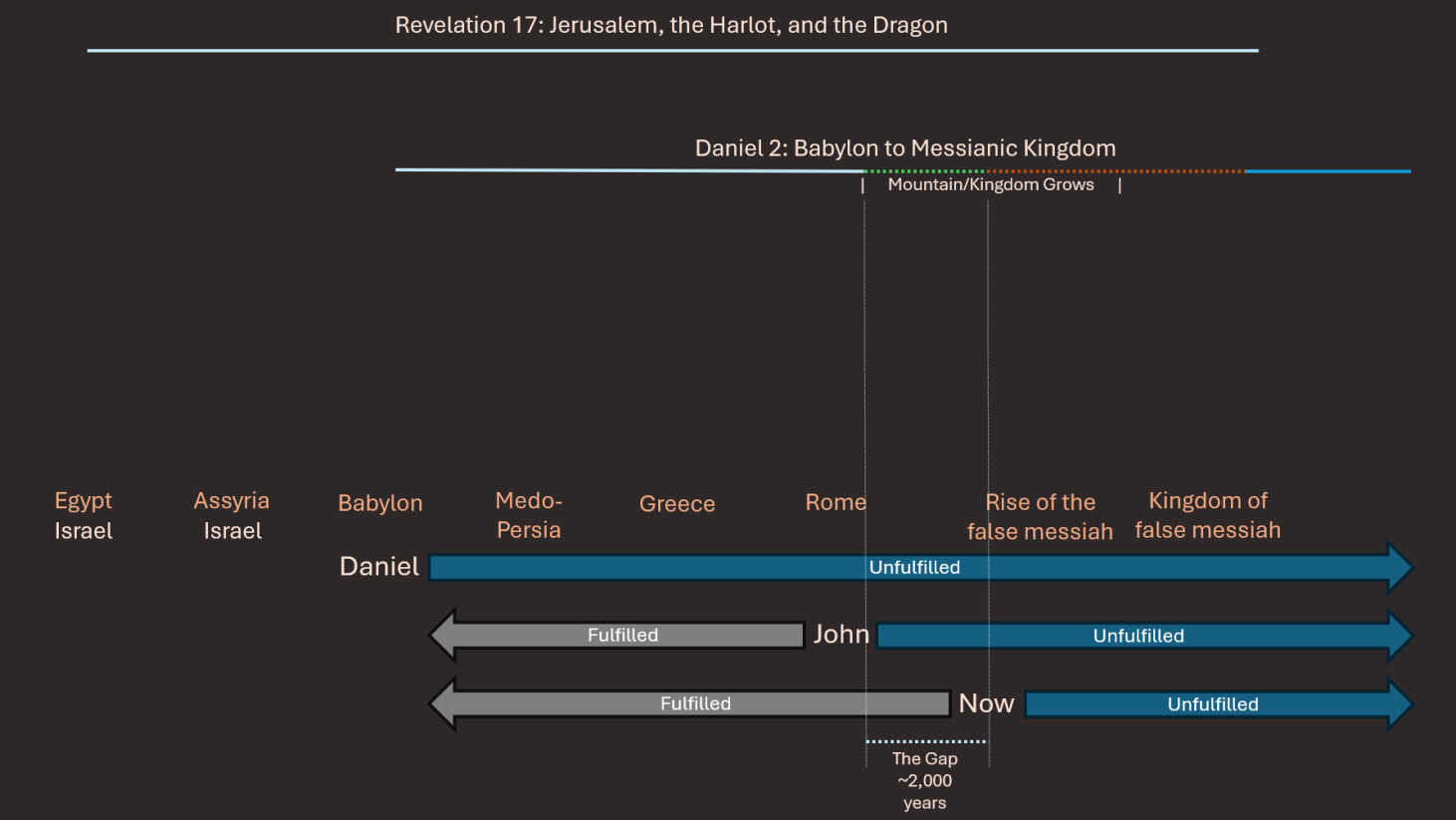
Babylon to the Messianic Kingdom
TL;DR
Daniel 2 is a fascinating look at mankind and the work of their hands as opposed to God’s design for mankind in terms of the kingdoms set up to rule over subjects of those kingdoms.
Nebuchadnezzar has a dream that he could not remember. This is a rare case of a non-Hebrew, non-prophet receiving a prophecy about God’s designs for the future, though I suppose in reality the king was helpless to know it so really it comes from Daniel’s relationship with God. Daniel, brought captive to Babylon from the land of Israel, has the understanding of the king’s dream and interpretation revealed to him in a night vision.
We are the beneficiaries of the documentation and preservation of this and other scriptures to fulfill the promise that we would not be in darkness about God’s designs. It is through these, and other prophecies, that our faith is built up in God’s Word, that we can trust what He says through His prophets and take Him at His Word. This interpreted dream looking to the unknown future, from the time it was given, matches up with known history as we look back in time and it reveals how God is in control. With the Dead Sea Scrolls, we know these prophecies predated the time of Yeshua and therefore the events around the fifth kingdom are proven to be documented before they occurred.
Often tied to some form of divinity, the kings of the Gentiles build their kingdoms in pride and glorified themselves and their works. These are depicted as an image of varying metals progressing through time as kingdom overtakes kingdom, but this is contrasted with the fifth kingdom that is not built with hands, which destroys and consumes the image and stands forever.
In this Bible study we will examine the image and the stone, a little of their history, and how we fit into this prophetic narrative.
Prophetic Scope
Nebuchadnezzar’s dream that Daniel interprets covers the Gentile kingdoms of men ruling over God’s chosen people from Babylon to Rome. However, the overarching point of the interpreted dream is that the kingdom of God will be established and consume the kingdoms of men to stand as the sole, everlasting kingdom. The language places its establishment during Yeshua’s first coming and ministry, but a continual growing into the final state at the end of the age, an already but not yet prophecy.
It should be noted that at the time Daniel received the interpretation for this prophecy, only the head of gold existed, everything after was unknown, yet fulfilled with extreme accuracy.
Prophetic Characters
- The great image
- Head - Kingdom 1
- The head is made of fine gold.
- God gave this kingdom to Nebuchadnezzar, with power, strength, and glory.
- His kingdom covers wherever men dwell, where beasts and birds are, he is ruler over them all.
- Nebuchadnezzar is the head of gold.
- Breast and arms -
Kingdom 2
- The breast and arms are made of silver.
- This is a second kingdom that will rise after Babylon and is inferior to it.
- Belly and thighs -
Kingdom 3
- The belly and thighs are made of brass.
- This is a third kingdom after Babylon that will rule over the earth.
- Legs and feet -
Kingdom 4
- The legs made of iron.
- This is a fourth kingdom that is strong as iron, just as iron breaks in pieces and subdues all things.
- The feet and toes made of iron mixed with clay.
- This fourth kingdom will also be divided, even though it
has the strength of iron. It will be partly strong and partly
broken.
- Those in this kingdom will mingle themselves with the seed of men to strengthen themselves, but will not remain together like iron and clay cannot be.
- Head - Kingdom 1
- The Stone cut without hands -
Kingdom 5
- Strikes the feet of iron and clay and breaks the whole image into pieces like chaff that is blown away by the wind never to be found again.
- The stone becomes a great mountain and fills the whole earth.
- In the days of these kings, God will setup a kingdom that will never be destroyed.
- This kingdom will not be left to other people.
- This kingdom will break in pieces and consume all these kingdoms and stand forever.
- This dream of the stone cut without hands from the mountain destroying the image is God’s message to Nebuchadnezzar about what will come to pass hereafter, and the dream is certain and the interpretation is sure.
The Image and the Stone
We see in Nebuchadnezzar’s dream an image of various metals representing kingdoms. The Hebrew word ṣelem, translated as image, is used 17 times in 15 verses in the Old Testament, all of them in Daniel 2 and 3. This is interesting because while Daniel 2 is a prophetic dream given to Nebuchadnezzar and recalled and interpreted by Daniel for him, Daniel 3 uses this same word for the idolatrous image of gold Nebuchadnezzar had created.
Now his dream was in the second year of his reign and it seems that this interpretation of him being the head of gold might have gone a little to his head. While the text doesn’t say whether this image of gold was a visage of Nebuchadnezzar himself, its idolatrous nature is clear in that at its dedication he commanded that all would bow down to it or die.
Daniel 3:1, 4-6
Nebuchadnezzar the king made an image of gold, whose height [was] threescore cubits, [and] the breadth thereof six cubits: he set it up in the plain of Dura, in the province of Babylon. ... Then an herald cried aloud, To you it is commanded, O people, nations, and languages, [That] at what time ye hear the sound of the cornet, flute, harp, sackbut, psaltery, dulcimer, and all kinds of musick, ye fall down and worship the golden image that Nebuchadnezzar the king hath set up: And whoso falleth not down and worshippeth shall the same hour be cast into the midst of a burning fiery furnace.
So it would seem that scripture is subtly pointing not only to an image representing the kingdoms of men through time, but an idolatrous pride of men in the kingdoms they built. And many times this is paired with the worship they expect of the subjects of their kingdoms. While God’s focus on Israel’s idolatry and going after other gods is evident in scripture, the idolatrous image and kingdoms made by any man are not acceptable as this image is destroyed in the dream.
Daniel 4:30
The king spake, and said, Is not this great Babylon, that I have built for the house of the kingdom by the might of my power, and for the honour of my majesty?
Micah 5:13
Thy graven images also will I cut off, and thy standing images out of the midst of thee; and thou shalt no more worship the work of thine hands.
If you do a search for altar in scripture, it becomes apparent that this was a form of relationship with God, a place of meeting and offering.
Genesis 12:6-8
And Abram passed through the land unto the place of Sichem, unto the plain of Moreh. And the Canaanite [was] then in the land. And the LORD appeared unto Abram, and said, Unto thy seed will I give this land: and there builded he an altar unto the LORD, who appeared unto him. And he removed from thence unto a mountain on the east of Bethel, and pitched his tent, [having] Bethel on the west, and Hai on the east: and there he builded an altar unto the LORD, and called upon the name of the LORD.
Isaac likewise built an altar to call upon the name of the Lord. Genesis 26:25 Jacob likewise built an altar to the Lord in Bethel where the Lord had appeared to him when he fled Esau. Genesis 35:1-7
The idolatrous image made by men is contrasted with the stone cut without hands. This odd phrase has a meaning behind it that contrasts man’s kingdoms from God’s. Anything that has not been manipulated by the works of men is by nature an original creation of God. And we see in God’s command to Moses that this was important when building an altar to meet with God.
Exodus 20:22-26
And the LORD said unto Moses, Thus thou shalt say unto the children of Israel, Ye have seen that I have talked with you from heaven. Ye shall not make with me gods of silver, neither shall ye make unto you gods of gold. An altar of earth thou shalt make unto me, and shalt sacrifice thereon thy burnt offerings, and thy peace offerings, thy sheep, and thine oxen: in all places where I record my name I will come unto thee, and I will bless thee. And if thou wilt make me an altar of stone, thou shalt not build it of hewn stone: for if thou lift up thy tool upon it, thou hast polluted it. Neither shalt thou go up by steps unto mine altar, that thy nakedness be not discovered thereon.
Moses was commanded to build altars of earth for sacrifice in the places God placed His name. The kingdoms of men made idols of wood and stone to their false gods, but the children of Israel were not to make gods of silver and gold, these idols were pollutants for God’s chosen people.
And so likewise would the work of their hands pollute an altar of stone that was hewn with the tools of men. God wanted any altar of stone with which He was to meet with His people to be made of naturally occurring stone, not cut by human hands.
Exodus 3:2-6
And the angel of the LORD appeared unto him in a flame of fire out of the midst of a bush: and he looked, and, behold, the bush burned with fire, and the bush [was] not consumed. And Moses said, I will now turn aside, and see this great sight, why the bush is not burnt. And when the LORD saw that he turned aside to see, God called unto him out of the midst of the bush, and said, Moses, Moses. And he said, Here [am] I. And he said, Draw not nigh hither: put off thy shoes from off thy feet, for the place whereon thou standest [is] holy ground. Moreover he said, I [am] the God of thy father, the God of Abraham, the God of Isaac, and the God of Jacob. And Moses hid his face; for he was afraid to look upon God.
Moses was told to remove the shoes from his feet because he stood on holy ground. Man was created by God in the image of God, as is the ground upon which they stand. That ground, at that time, was set apart and holy because God was meeting with Moses to initiate the salvation of His chosen people from Egypt and establish them in His land of promise. It would seem that Moses was to have nothing made by the hands of men between the feet God created and the holy ground on which they stood. As we saw in Exodus 20:26, there is clearly a limitation to this in that we are not to fully disrobe, but the connection of God to the ground to Moses was a moment set apart and holy according to His purposes.
There is another distinction made by Yeshua at the end of His ministry when speaking of His death and resurrection and relating that to the physical temple that had been built by men as opposed to His temple made by God.
Matthew 12:38-42
Then certain of the scribes and of the Pharisees answered, saying, Master, we would see a sign from thee. But he answered and said unto them, An evil and adulterous generation seeketh after a sign; and there shall no sign be given to it, but the sign of the prophet Jonas: For as Jonas was three days and three nights in the whale’s belly; so shall the Son of man be three days and three nights in the heart of the earth. The men of Nineveh shall rise in judgment with this generation, and shall condemn it: because they repented at the preaching of Jonas; and, behold, a greater than Jonas [is] here. The queen of the south shall rise up in the judgment with this generation, and shall condemn it: for she came from the uttermost parts of the earth to hear the wisdom of Solomon; and, behold, a greater than Solomon [is] here.
John 2:18-21
Then answered the Jews and said unto him, What sign shewest thou unto us, seeing that thou doest these things? Jesus answered and said unto them, Destroy this temple, and in three days I will raise it up. Then said the Jews, Forty and six years was this temple in building, and wilt thou rear it up in three days? But he spake of the temple of his body.
Mark 14:57-59
And there arose certain, and bare false witness against him, saying, We heard him say, I will destroy this temple that is made with hands, and within three days I will build another made without hands. But neither so did their witness agree together.
In the false witness against Yeshua, stating that He claimed He would destroy the temple, His accusers made use of this idea of the physical temple made by the hands of men for the past forty six years as opposed to the temple of His body made without hands, by God. Given that Yeshua is the firstfruits of the resurrection, His body was raised incorruptible from His mortal terrestrial body to His eternal celestial body He resurrected into. 1 Corinthians 15:12-58
In Genesis 28:10-22, Jacob took stones for pillows and had a dream of a ladder from earth to heaven with angels ascending and descending on it. And from heaven the Lord told Jacob the land he was lying on would be given to him and his seed, which would be as the dust of the earth spread across the land. Upon waking, Jacob tied this place to the house of God and the gate of heaven.
Genesis 28:17-22
And he was afraid, and said, How dreadful [is] this place! this [is] none other but the house of God, and this [is] the gate of heaven. And Jacob rose up early in the morning, and took the stone that he had put [for] his pillows, and set it up [for] a pillar, and poured oil upon the top of it. And he called the name of that place Bethel: but the name of that city [was called] Luz at the first. And Jacob vowed a vow, saying, If God will be with me, and will keep me in this way that I go, and will give me bread to eat, and raiment to put on, So that I come again to my father’s house in peace; then shall the LORD be my God: And this stone, which I have set [for] a pillar, shall be God’s house: and of all that thou shalt give me I will surely give the tenth unto thee.
Genesis 35:10-15
And God said unto him, Thy name [is] Jacob: thy name shall not be called any more Jacob, but Israel shall be thy name: and he called his name Israel. And God said unto him, I [am] God Almighty: be fruitful and multiply; a nation and a company of nations shall be of thee, and kings shall come out of thy loins; And the land which I gave Abraham and Isaac, to thee I will give it, and to thy seed after thee will I give the land. And God went up from him in the place where he talked with him. And Jacob set up a pillar in the place where he talked with him, [even] a pillar of stone: and he poured a drink offering thereon, and he poured oil thereon. And Jacob called the name of the place where God spake with him, Bethel.
Eventually, the Ark of the Covenant would rest in Bethel until eventually moved to the temple, the future tabernacle of God on earth amongst His people on Mount Zion. So we see the stone as a pillar in the house of God as setup by Jacob, Israel. Later in Israel’s history, oil was poured on the heads of kings to anoint them. That Jacob poured oil on these stones he connected with his communication with God is interesting given the symbology in Daniel 2.
On a side note related to this, those who believe and obey Yeshua are the body of Christ and as this stone anointed with oil and set as a pillar in God’s house we see the symbolism in Christ. But in the letter to the church in Philadelphia, Revelation 3:7-13, we see that those who overcome will be made a pillar in the temple of God. As fellow heirs, kings, and priests with Him, the body of Christ has been given the promise of personal relationship in the presence of the God of creation forever as pillars of His temple where He lives.
Coming back to the idea of this phrase without hands, we can see this as well in the virgin birth of Yeshua.
Luke 1:26-28, 31-35
And in the sixth month the angel Gabriel was sent from God unto a city of Galilee, named Nazareth, To a virgin espoused to a man whose name was Joseph, of the house of David; and the virgin’s name [was] Mary. And the angel came in unto her, and said, Hail, [thou that art] highly favoured, the Lord [is] with thee: blessed [art] thou among women. ... And, behold, thou shalt conceive in thy womb, and bring forth a son, and shalt call his name JESUS. He shall be great, and shall be called the Son of the Highest: and the Lord God shall give unto him the throne of his father David: And he shall reign over the house of Jacob for ever; and of his kingdom there shall be no end. Then said Mary unto the angel, How shall this be, seeing I know not a man? And the angel answered and said unto her, The Holy Ghost shall come upon thee, and the power of the Highest shall overshadow thee: therefore also that holy thing which shall be born of thee shall be called the Son of God.
Matthew 1:18
Now the birth of Jesus Christ was on this wise: When as his mother Mary was espoused to Joseph, before they came together, she was found with child of the Holy Ghost.
While we are all created in the image of God, we are born of the seed of men, with the exception of one who was born of God without the works of men, the seed of the woman. Yeshua is the promised seed of Abraham, Galatians 3:16, the seed of the woman who will bruise the head of the serpent. Genesis 3:15 He has been given the kingdoms and will reign over Israel forever.
Genesis 49:22-26
Joseph [is] a fruitful bough, [even] a fruitful bough by a well; [whose] branches run over the wall: The archers have sorely grieved him, and shot [at him], and hated him: But his bow abode in strength, and the arms of his hands were made strong by the hands of the mighty [God] of Jacob; (from thence [is] the shepherd, the stone of Israel:) [Even] by the God of thy father, who shall help thee; and by the Almighty, who shall bless thee with blessings of heaven above, blessings of the deep that lieth under, blessings of the breasts, and of the womb: The blessings of thy father have prevailed above the blessings of my progenitors unto the utmost bound of the everlasting hills: they shall be on the head of Joseph, and on the crown of the head of him that was separate from his brethren.
While Yeshua is the Son of God and seed of the woman of the line of David, His earthly father was named Joseph. There is a view of two distinct perspectives of the Messiah and His mission, that of Messiah ben Joseph and Messiah ben David. One suffering servant that gives His life for His people, and one conquering King that defeats their enemies and reigns forever with a rod of iron. In reality, these speak to the parousia, or coming, of Yeshua, both His first in the first century and second yet to come. He is the stone of Israel who will bear the crown that separates Him from His brethren.
There is an important stone that is set apart from all others, the chief cornerstone and a stumbling stone, the rock of offense. This stone is tied to the salvation of mankind and the foundation of that sanctuary that is of God.
Psalm 118:21-23
I will praise thee: for thou hast heard me, and art become my salvation. The stone [which] the builders refused is become the head [stone] of the corner. This is the LORD’S doing; it [is] marvellous in our eyes.
Isaiah 8:14-15
And he shall be for a sanctuary; but for a stone of stumbling and for a rock of offence to both the houses of Israel, for a gin and for a snare to the inhabitants of Jerusalem. And many among them shall stumble, and fall, and be broken, and be snared, and be taken.
Isaiah 28:14-18
Wherefore hear the word of the LORD, ye scornful men, that rule this people which [is] in Jerusalem. Because ye have said, We have made a covenant with death, and with hell are we at agreement; when the overflowing scourge shall pass through, it shall not come unto us: for we have made lies our refuge, and under falsehood have we hid ourselves: Therefore thus saith the Lord GOD, Behold, I lay in Zion for a foundation a stone, a tried stone, a precious corner [stone], a sure foundation: he that believeth shall not make haste. Judgment also will I lay to the line, and righteousness to the plummet: and the hail shall sweep away the refuge of lies, and the waters shall overflow the hiding place. And your covenant with death shall be disannulled, and your agreement with hell shall not stand; when the overflowing scourge shall pass through, then ye shall be trodden down by it.
Zechariah 3:8-10
Hear now, O Joshua the high priest, thou, and thy fellows that sit before thee: for they [are] men wondered at: for, behold, I will bring forth my servant the BRANCH. For behold the stone that I have laid before Joshua; upon one stone [shall be] seven eyes: behold, I will engrave the graving thereof, saith the LORD of hosts, and I will remove the iniquity of that land in one day. In that day, saith the LORD of hosts, shall ye call every man his neighbour under the vine and under the fig tree.
Revelation 5:6
And I beheld, and, lo, in the midst of the throne and of the four beasts, and in the midst of the elders, stood a Lamb as it had been slain, having seven horns and seven eyes, which are the seven Spirits of God sent forth into all the earth.
Yeshua is the stone cut without hands, the BRANCH of Jesse, son of David, and the Word of God made flesh to accomplish the salvation intended from before the world began. He is the King of a kingdom represented in Nebuchadnezzar’s dream.
Daniel 2:44-45
And in the days of these kings shall the God of heaven set up a kingdom, which shall never be destroyed: and the kingdom shall not be left to other people, [but] it shall break in pieces and consume all these kingdoms, and it shall stand for ever. Forasmuch as thou sawest that the stone was cut out of the mountain without hands, and that it brake in pieces the iron, the brass, the clay, the silver, and the gold; the great God hath made known to the king what shall come to pass hereafter: and the dream [is] certain, and the interpretation thereof sure.
Man’s Kingdoms vs. God’s Kingdom
Nebuchadnezzar’s dream is contrasting the temporary kingdoms of men, comprising the image made with hands and built by men, to the eternal kingdom of God begun by the stone cut without hands and established by God.
Nebuchadnezzar of Babylon is explicitly interpreted to be the first kingdom and the next three are generally accepted as those which took over the previous, including their control of the land of Israel.
We see in Daniel 5 the transition of power from Babylon to the Medo-Persians, the Achaemenid Empire, when Belshazzar sees the writing on the wall. It could also be seen in the two arms connected to the chest, the idea of the combination of the Median and Persian Empires into one. While Cyrus conquered Babylon, we see it ruled by Darius the Mede after. Political control of Israel and the land transitioned to the Medo-Persians and through this the kingdom Israel would see the promise to return to the land after seventy years of captivity fulfilled, though some of Israel remained out of the land still.
In Daniel 8, which we’ll examine in the next post, we see the transition of power from Medo-Persia to Greece with the imagery of the ram and goat. Here we are back to a single belly from the chest, representing Alexander the Great, that moves to the thighs toward its end. This actually split into four kingdoms under Greece, yet political power over Israel and the land was ultimately under the Seleucid and Ptolemaic Empires, the kings of the North and South, the thighs.
There was a short time after the stopping of the daily sacrifice and abomination of desolation caused by Antiochus IV “Epiphanes” where the political rule over the land of Israel fell under a vassal Hasmonean state. From 141 BC until 63 BC when the Roman Republic took control, Israel ruled herself in varying degrees, even minting their own coinage. In 37 BC Herod the Great replaced the last Hasmonean king. This is interesting because in the sequence of Nebuchadnezzar’s dream, this self-rule is not addressed when looking at the kingdoms. His dream is focused on Gentile kingdoms and their relationship with Israel.
It follows that the kingdom that followed Greece and consumed their authority over much of the Middle East, especially including the land of Israel, would be the fourth kingdom of iron and from history we know that to be Rome. For a long time Rome was a strong kingdom, enforcing its rule and power and bringing Pax Romana, Roman Peace, that provided the infrastructure that would facilitate the later growth of the fifth and final kingdom. As the image had two legs of iron, we saw that with the growth of the Roman Empire, it divided into the Western and Eastern legs. This division and weakening first of the Western leg of the empire brought about royal intermarriages in an attempt to bring the two back together stronger, but this failed and the Roman Empire weakened and ultimately no longer had power in the earth.
There are views that would skip over Rome and look to future kingdoms such as the Islamic Caliphate to be representative of the fourth kingdom of iron, or its feet and toes. However, I believe the centrality of Israel’s silent part in the dream can be seen in the unmentioned Hasmonean Kingdom and the last study of Revelation 17-18, whose heads cover the span of Nebuchadnezzar’s dream where Mount Zion is central to it.
It is from Israel that the promised seed of Abraham came and established His kingdom at first in Israel. As we will see, the establishment of this kingdom that destroys and consumes the four established before it happens in the first century. It therefore follows that it cannot destroy a kingdom established well after it that was said to have come before it.
Each of these kingdoms likewise controlled the land and Jerusalem while Israel was in it. It is my contention that any kingdom after Rome is irrelevant prophetically because Israel didn’t exist in the land, which is why there are gaps, or seemingly silent years, in prophecy, but we’ll get to that later. And since Rome was the last kingdom to see and remove Israel from the land and Jerusalem in 70 AD and beyond, the fourth kingdom must be Rome.
The fact that there are four kingdoms made up of different metals representing different kingdoms that consumed the previous kingdoms, points to the temporary nature of the kingdoms built by men. The life of the men who build their kingdoms is very short and in this fallen world betrayal and war can bring down a king and his kingdom even sooner than natural death can. Even so, in the kingdoms of men we see that even in the death of the king the kingdom can live on in those that take the leadership from the king before them. In this way the life of a kingdom built by men can be maintained over a much longer period and is why prophetically kingdoms and kings are usually synonymous unless called out such as Nebuchadnezzar. Yet even there, his kingdom didn’t fall until his kingdom was passed to several kings.
This brings us to the eternal nature of God’s kingdom that destroys and consumes the image, grows to fill the whole earth, and will never be destroyed forever. Daniel makes a point contrasting the nature of earthly kingdoms to that of God’s.
Daniel 2:44
And in the days of these kings shall the God of heaven set up a kingdom, which shall never be destroyed: and the kingdom shall not be left to other people, [but] it shall break in pieces and consume all these kingdoms, and it shall stand for ever.
It should first be noted when this kingdom setup by God is begun, in the days of these kings. The verse prior was speaking of the iron mixed with clay, the mingling of the seed of men that does not hold the kingdom together. However, from scripture we know when the stone the builders rejected began His ministry, and it was then that the kingdom of heaven, or kingdom of God, had arrived.
Matthew 3:1-3
In those days came John the Baptist, preaching in the wilderness of Judaea, And saying, Repent ye: for the kingdom of heaven is at hand. For this is he that was spoken of by the prophet Esaias, saying, The voice of one crying in the wilderness, Prepare ye the way of the Lord, make his paths straight.
Mark 1:14-15
Now after that John was put in prison, Jesus came into Galilee, preaching the gospel of the kingdom of God, And saying, The time is fulfilled, and the kingdom of God is at hand: repent ye, and believe the gospel.
Matthew 12:26-28
And if Satan cast out Satan, he is divided against himself; how shall then his kingdom stand? And if I by Beelzebub cast out devils, by whom do your children cast [them] out? therefore they shall be your judges. But if I cast out devils by the Spirit of God, then the kingdom of God is come unto you.
Mark 12:32-34
And the scribe said unto him, Well, Master, thou hast said the truth: for there is one God; and there is none other but he: And to love him with all the heart, and with all the understanding, and with all the soul, and with all the strength, and to love [his] neighbour as himself, is more than all whole burnt offerings and sacrifices. And when Jesus saw that he answered discreetly, he said unto him, Thou art not far from the kingdom of God. And no man after that durst ask him [any question].
Matthew 11:11-15
Verily I say unto you, Among them that are born of women there hath not risen a greater than John the Baptist: notwithstanding he that is least in the kingdom of heaven is greater than he. And from the days of John the Baptist until now the kingdom of heaven suffereth violence, and the violent take it by force. For all the prophets and the law prophesied until John. And if ye will receive [it], this is Elias, which was for to come. He that hath ears to hear, let him hear.
It is clear that the stone that established His kingdom did so at His ministry around the summer/fall of 27 AD, as we’ll examine later when looking at Daniel 9. His kingdom arrived and existed prior to the complete destruction of the image and the number of the subjects of this new kingdom that began with just twelve began to grow from that point on.
I think it is significant that Daniel states this kingdom will not be left to other people. It speaks to the idea that the king who establishes his kingdom will not die. The very fact that it’s suggested could be contrasting it with the kingdoms of men, but I believe it is also a prophetic message about the death of the King after His kingdom is established, though He is the firstfruits of the resurrection to eternal life. The kingdom of God must be established in order to be left to other people at the death of the king. And while it would, at one time, seem to need to be left to other people, it is not because the King lives!
Once God’s kingdom was begun, it would never cease and so the kingdoms of men were then irrelevant, consumed by the kingdom of God. The idea of being cut without hands hearkens back to the superiority of God’s creation over man’s creation often tied to idolatry. Deuteronomy 4:28 | Isaiah 37:19 | Revelation 9:20 The stone cut without hands speaks to the virgin birth initiated by the Holy Spirit of the rock of our salvation. 2 Samuel 22:2-4, 47-49 | Psalm 18:1-3 | Psalm 62:1-8 | Psalm 89:26-27 | Psalm 95:1-3
A kingdom does not exist without a king and a king without a kingdom is no king at all. The stone that is a kingdom is identified with the King who established it and from whom the leadership of this eternal kingdom will never be transferred. In my mind the two are inextricably linked and the growth of this stone into a mountain is representative of the nature of the body of Christ. 2 Corinthians 11:2 | Romans 7:1-4
The work Yeshua started is continued in us to both refine each member of the body in obedience, but also to grow the body of Christ as imagers of God in the world. We also see the idea of the growth of the kingdom of God in the parable of the mustard seed and leaven. Matthew 13:31-35 | Mark 4:30-32 | Luke 13:18-21
The stone the builders rejected established the body of Christ by the Holy Spirit, which helped it to grow over time. Not a kingdom based on control of land and people by a king, but a silent kingdom whose subjects are dual citizens, living in the world but not of the world. John 17:13-21 They are each the temple of God, indwelt by the Holy Spirit, experiencing the continual personal relationship with God that Israel had to travel to Jerusalem to experience at a distance and through many works.
Luke 17:20-21
And when he was demanded of the Pharisees, when the kingdom of God should come, he answered them and said, The kingdom of God cometh not with observation: Neither shall they say, Lo here! or, lo there! for, behold, the kingdom of God is within you.
This current state is not the end of the fulfillment of the kingdom of God. This is an “already but not yet” kind of fulfillment, as Dr. Michael Heiser would say. While the kingdom is established, its fullness will not be realized until the prophesied end comes when Yeshua establishes His eternal kingdom on earth during the one thousand year Messianic Kingdom. This is the ultimate end of much of prophecy that points to this promise and highlights, for those watching, the events leading up to it.
Destruction of the Kingdoms of Men
It is obvious that the kingdoms of men have continued to lord over those who reside within their boundaries even today. This is why it’s important to recognize the context of this vision and prophecy being tied to Israel, Daniel’s people. Though it’s not explicitly stated, the whole scope of nations in the vision begins and ends with Israel being removed from the land.
It was Babylon that first destroyed Jerusalem, the whole reason Daniel was interpreting the kings dream. After the 70 years they would return under the Medo-Persian rule as prophesied. And it was the fourth and final kingdom of Rome that would accomplish the second desolation of Jerusalem and cause an almost 2,000 year diaspora of the Jews out of the land.
By the focus of these kingdoms of men being on just four kingdoms who all ruled over Israel, their land, and their holy city, we are given the scope of this prophecy when it comes to the kingdoms of men. It is also interesting that Israel is now back in the land, yet they rule themselves. Given the image is gone and never coming back, it would see that Israel will remain in political control of her own destiny as the kingdom of God continues to grow to its ultimate fulfillment.
It should also be recognized that the sequence of the image starts at the head and ends at the feet, moving through time. The head, a single representation of Babylon ruled by Nebuchadnezzar who had the dream, destroyed Jerusalem and brought about the captivity of her children. A combined Median and Persian kingdom as arms and united as the chest move to the belly of a united Greece that then divides in four, two of which are the thighs that interact with Israel. Finally Rome, at first united, later splits in two. And while they are strong at first, their end is divided and unable to cleave together leading to their ultimate end.
Daniel 2:40-43
And the fourth kingdom shall be strong as iron: forasmuch as iron breaketh in pieces and subdueth all [things]: and as iron that breaketh all these, shall it break in pieces and bruise. And whereas thou sawest the feet and toes, part of potters’ clay, and part of iron, the kingdom shall be divided; but there shall be in it of the strength of the iron, forasmuch as thou sawest the iron mixed with miry clay. And [as] the toes of the feet [were] part of iron, and part of clay, [so] the kingdom shall be partly strong, and partly broken. And whereas thou sawest iron mixed with miry clay, they shall mingle themselves with the seed of men: but they shall not cleave one to another, even as iron is not mixed with clay.
Some might say that the feet and toes of iron and clay represent a fifth kingdom, however a fifth kingdom is not mentioned. A third and then fourth kingdom are explicitly numbered and the introduction of the feet and toes is tied to that fourth kingdom. It’s a symbolic connection, still containing iron, of the same kingdom in a weakened state. And because this image represents kingdoms over time, we see in this depiction of the image that this fourth kingdom will, in its later days, become divided and weak before being destroyed by that rock that grows into a mountain and consumes the image.
The way the other metals are described include multiple body parts, the breast and arms of silver, the belly and thighs of brass, so the legs of iron and feet of iron and clay is not odd when reading on to understand the iron and clay is explaining a weakness and division of the fourth kingdom of iron. In chapter 2 of Daniel (A Commentary) by Chris White, he goes into the historical fulfillment at the end of the Roman Empire and how, unlike the successive defeat of each previous kingdom of metal like the one before it, the Roman Empire that dominated and destroyed Israel out of the land died the death of a thousand cuts and disappeared into history with the kingdoms of men that came before it. I believe he accurately points out the mingling of the seed of men being a last-ditch effort to stabilize the failing kingdom by royal intermarriage.
All 4 kingdoms in Daniel 2 are destroyed, never to be found again, after the stone cut without hands strikes the feet. Daniel 2:34-35a,44-45 As mentioned, we know the kingdom of God was established before its King’s death and resurrection. Additionally it is said to be setup “in the days of these kings” of the fourth kingdom. Yeshua’s ministry was indeed in the days of the kings of the Roman Empire and the final fourth kingdom of Western Rome, centuries after they destroyed Jerusalem, was no more and according to the prophecy are never found again, meaning there can be no revived Roman Empire according to scripture.
And even more correlation between history and the interpretation of Nebuchadnezzar’s dream, the kingdoms of men were consumed by the mountain filling the whole earth. While Christianity began to spread throughout the Roman Empire, the consuming of the empire happened quite literally in 380 AD when Christianity became the state religion of Rome prior to the political empire’s fall. For all of its failings, the true believers within the Roman Catholic Church advanced the Gospel throughout the world and utilized the resources of the Roman Empire to do so until it was no more. The establishment of the kingdom of God on earth grew slowly over time with the Gospel, consuming the Western Roman Empire in control of Jerusalem at its establishment and thereby spreading throughout the world. A great 25 minute overview of this can be viewed in the video by Epic History on YouTube, How did Christianity become the most popular religion on Earth?
This has not been without stumbling along with its false adherents and apostasy. Yet Christianity has been morphing through time and affecting even the nature of governance in some parts of the world where it took hold and will continue to do so until the future fullness of the Gentiles. Romans 11
Yeshua’s death and resurrection put the nail in the coffin of the kingdoms of men’s sole control of the souls of their subjects with the establishment of the kingdom of God. It superseded all earthly kingdoms, converting many of the kings of kingdoms in the world, and could not be stamped out by those that tried. This kingdom is not limited by land or genealogy, but is one established by faith in the unseen King yet to return and trust in His Word.
There are no other people in the promised land besides Israel that God focuses on in prophecy. The Gentile Christians are not connected to the land prophetically until the end when we reside with Yeshua, only the children of Israel are the focus until then. The four kingdoms of men are in focus because of their relationship with Israel and the land. The fifth kingdom, the stone that grows into a mountain, fills the whole earth. It does not just fill the land of Israel, though the center of this physical kingdom when established will be in Jerusalem.
Yeshua told the parable of the land owner when the husbandman beats, kills, and stones the servants that the land owner sends. Finally he sends his son, expecting that they will honor him, but they kill him too. Even the chief priests and Pharisees recognized their wickedness and agree that the land owner should destroy those wicked men.
Matthew 21:42-45
Jesus saith unto them, Did ye never read in the scriptures, The stone which the builders rejected, the same is become the head of the corner: this is the Lord’s doing, and it is marvellous in our eyes? Therefore say I unto you, The kingdom of God shall be taken from you, and given to a nation bringing forth the fruits thereof. And whosoever shall fall on this stone shall be broken: but on whomsoever it shall fall, it will grind him to powder. And when the chief priests and Pharisees had heard his parables, they perceived that he spake of them.
Yeshua associates the stone the builders rejected as Himself and His kingdom being taken from Israel to give to the Gentiles that would show the fruits of the Spirit of that kingdom of God within them. In like manner, while the image of metals were built and ruled by men, God’s kingdom is fully His, not built in any way by the works of man but by God. And this stone that grows into a mountain, like the stone that brought down Goliath, 1 Samuel 17:50, is shown falling on the image made by the works of man and grinding it to powder, the wind blowing it away like chaff, never to be found again.
Daniel 2:35, 44
Then was the iron, the clay, the brass, the silver, and the gold, broken to pieces together, and became like the chaff of the summer threshingfloors; and the wind carried them away, that no place was found for them: and the stone that smote the image became a great mountain, and filled the whole earth. ... And in the days of these kings shall the God of heaven set up a kingdom, which shall never be destroyed: and the kingdom shall not be left to other people, [but] it shall break in pieces and consume all these kingdoms, and it shall stand for ever.
Destruction of the Image and Its Extended Life
If the stone that struck the feet and broke the image was Yeshua during His ministry, why did Rome, and therefore the image itself remain until 476 AD for the Western Empire or 1,453 AD for the Eastern Empire?
It is clear that the kingdom of God was established in the early first century through Yeshua’s ministry. It is also clear that the stone strikes the feet that are iron and clay. However, I think the last part of Daniel 2:44 should be taken into account where the divinity of the stone is confirmed.
In earthly kingdoms, the king would die and the kingdom would be left to another person. Of this kingdom it is said, “the kingdom shall not be left to other people.” The inclusion that the kingdom will not be left to other people indicates that it is headed by one who died, but yet eternally exists and there is no need to leave the everlasting kingdom to another because of this. Yeshua rose from the dead and lives forever so there is no requirement to pass His eternal kingdom on to another and He will reign forever. This also points to the king/kingdom being established before Yeshua’s death and resurrection because the kingdom had to exist before His death and resurrection in order that it not be left to another.
The result of this stone striking the feet is that, “it shall break in pieces and consume all these kingdoms.” It is also said that the broken pieces are blown away like chaff and found no more. So were the pieces blown away or consumed?
I believe we can see the distinction in that of the king and his subjects. The king represents the kingdom that is comprised of his subjects and he has power over them in that he proclaims and they obey. That’s not so different than being under laws of nations today, but in the ancient times kings were upheld as kinds of gods to be worshiped, something that is rare today. What is blown away and found no more is the power of the king over his subjects, the kingdom.
But what is consumed by the fifth kingdom is the most important part of the kingdom, the subjects. Their loyalty, upon becoming subjects of the kingdom of God, changes and the earthly kings lose their power over the subjects. Of course we are told by our King to be subject to our earthly kingdoms while we are in the world, but ultimate loyalty is to a greater kingdom within each of us yet not fully realized.
So while the image is blown away, it is not fully consumed until the growing mountain consumes the kingdoms of the image. Since those previous kingdoms no longer exist while the mountain grows, it must be focused on their generations and the growth of Christianity throughout the region and world.
Daniel 2:35
Then was the iron, the clay, the brass, the silver, and the gold, broken to pieces together, and became like the chaff of the summer threshingfloors; and the wind carried them away, that no place was found for them: and the stone that smote the image became a great mountain, and filled the whole earth.
So the way I’ve come to understand this is that Yeshua during His ministry, until His death and resurrection in 30 AD, established the kingdom of God in the hearts of His people, invisible as a kingdom in the traditional sense, yet ever present. This kingdom was not passed to another in His death because of His resurrection and eternal nature at the right hand of the Father forever.
The stone struck the feet of the image and broke it, but it took time for the stone to grow into a mountain, the growth of the church. Eventually, it consumed the Roman Empire in becoming the kingdom that shapes the hearts of men into the image of God. It had plenty of faults, but the idea of kings of men controlling the population in an idolatrous way were gone as subjects of the kingdom of God dwelling within kingdoms of men had an allegiance higher than any earthly kings. And so the mountain continued to grow after consuming the subjects of the image, which later “became like the chaff of the summer threshing floors; and the wind carried them away, that no place was found for them.”
The fourth kingdom of Rome, the political control over the subjects of the kingdom, ended centuries after the stone struck the image, but once the image was gone, it would never again return. This is a key point that excludes any connection to the end times for the kingdoms of men represented by the image in Daniel 2. Once the Roman Empire no longer had spiritual or political control over anyone and were consumed by the kingdom of God they are permanently gone, along with Greece, Medo-Persia, and Babylon, never to rise again.
Hardness and Value of Metals
I’m not sure if this is relevant to the prophetic narrative, it may be nothing. When thinking about the metals represented in the image, I noticed that they all went from the most valuable to the least valuable as time progressed. Gold has historically been used as a store of wealth. Silver has likewise been used for wealth, but less valuable than gold. Brass is an alloy that was used for tools, decorative items, musical instruments, etc. While the item made of it may hold value, it was not as high as that of silver and gold. In the case of gold, silver, and even brass, they were used as coinage in the ancient Middle East in that order of value. Iron was used in coinage at times, but its primary use was in tools and weapons of war, partially due to their lower cost and higher availability.
At the same time, in terms of hardness on the Mohs scale, they start at the softest metals and progress to the strongest. The head was made of fine gold, the softest, and followed by the silver, then brass, and finally iron. Each of these get successively stronger. The strength of the metals is relevant to the strength of the kingdom it represents, at least in the case of the iron kingdom.
Daniel 2:40
And the fourth kingdom shall be strong as iron: forasmuch as iron breaketh in pieces and subdueth all [things]: and as iron that breaketh all these, shall it break in pieces and bruise.
And it is this iron kingdom that, once strong and broke in pieces, is seen weakened in its later state before the image is destroyed and blown away, never to be found again.
|
Metal |
Mohs (Hardness) |
Perceived Value |
|
Fine Gold |
2.5 |
Highest |
|
Silver |
2.5 - 3 |
Less than gold |
|
Brass |
3 |
Less than silver |
|
Iron |
4 |
Lowest |
What is interesting is that Nebuchadnezzar is told that the kingdom that would follow his is primarily translated as inferior.
Daniel 2:39
And after thee shall arise another kingdom inferior[H772] to thee, and another third kingdom of brass, which shall bear rule over all the earth[H772].
What is translated as “inferior,” ʼăraʻ, is only done so here and is actually translated everywhere else as “the earth.” This figurative translation is seeing the next kingdom compared to the ground and therefore not as high and lifted up as the kingdom before it, in other words inferior. In terms of the strength of the metal, silver is actually greater, while in value it is less. While strength would seem to tie the metals to the kingdoms, the opposite in terms of value could be very subjective. Is there something about the earlier kingdoms’ metal value that translates to some other kind of characteristic that becomes more inferior over time? Perhaps it speaks to the self-deification of kings decreasing over time or something?
But there’s another interesting, and more literal, possibility that is encoded in this statement which is the method by which the head of fine gold would be replaced by the next kingdom. Daniel 5 depicts Belshazzar’s great feast, where the gold and silver vessels taken from the temple in Jerusalem by Nebuchadnezzar were used by the king, and his princes, his wives, and his concubines, to drink their wine from. It was the very night of that feast that he sees the writing on the wall and is killed. This is confirmed Histories 1.191, by Herodotus, depicting of the fall of Babylon.
“Cyrus was now reduced to great perplexity, as time went on and he made no progress against the place. In this distress either some one made the suggestion to him, or he bethought himself of a plan, which he proceeded to put in execution. He placed a portion of his army at the point where the river enters the city, and another body at the back of the place where it issues forth, with orders to march into the town by the bed of the stream, as soon as the water became shallow enough: he then himself drew off with the unwarlike portion of his host, and made for the place where Nitocrisnote dug the basin for the river, where he did exactly what she had done formerly: he turned the Euphrates by a canal into the basin, which was then a marsh, on which the river sank to such an extent that the natural bed of the stream became fordable. Hereupon the Persians who had been left for the purpose at Babylon by the, river-side, entered the stream, which had now sunk so as to reach about midway up a man’s thigh, and thus got into the town. Had the Babylonians been apprised of what Cyrus was about, or had they noticed their danger, they would never have allowed the Persians to enter the city, but would have destroyed them utterly; for they would have made fast all the street gates which gave access to the river, and mounting upon the walls along both sides of the stream, would so have caught the enemy, as it were, in a trap. But, as it was, the Persians came upon them by surprise and so took the city. Owing to the vast size of the place, the inhabitants of the central parts (as the residents at Babylon declare) long after the outer portions of the town were taken, knew nothing of what had chanced, but as they were engaged in a festival, continued dancing and reveling until they learnt about the capture. Such, then, were the circumstances of the first taking of Babylon.” | Histories 1.191, by Herodotus - Herodotus on Cyrus’ capture of Babylon, Livius.org
Like Herodotus, Xenophon’s account in Cyropaedia, 7.5.15 also describes the Persian strategy of diverting the river to enter the city in addition to the execution of king of Babylon. The Nabonidus Chronicle, a Babylonian text, records that Babylon fell “without battle” on the night of the 16th of the month Tishri. For the Jews there, this would have been the second day of Sukkot.
So was the Medo-Persian kingdom that followed Babylon inferior in value in some way, or could it be that this indication of the next kingdom being tied to the earth speaks to the way in which the kingdom overtook Babylon, by diverting the Euphrates River running into Babylon and entering into the city from the river bed running through the earth? Perhaps it is both in some way, I just thought it was interesting.
The Gap
In presenting my understanding of this dream, an implied gap of time has been mentioned, but given how similar gaps are seen in prophecy that cover about the same period of time, I wanted to go into this a little more.
I feel confident in saying that the stone that struck the image can be interpreted as Yeshua and that happening at the establishment of His kingdom with His ministry in the summer/fall of 27 AD. This was the beginning of the end of the kingdoms of men, solidified in the death and resurrection of the Messiah in 30 AD. For almost 2,000 years that kingdom has been growing, enduring much tribulation and persecution by men.
What began as an image representing the Gentile kingdoms that ruled over Israel, transitioned in the first century to the subjects of those Gentile kingdoms being consumed by the kingdom of God. Focus transitioned from Israel under Gentile rule to Gentiles under kingdom rule. The kingdom of God was taken from Israel and given to a people not chosen by God as Israel had been, a people not given the Law, yet hearts open to having it written on them.
Deuteronomy 32:16-21
They provoked him to jealousy with strange [gods], with abominations provoked they him to anger. They sacrificed unto devils, not to God; to gods whom they knew not, to new [gods that] came newly up, whom your fathers feared not. Of the Rock [that] begat thee thou art unmindful, and hast forgotten God that formed thee. And when the LORD saw [it], he abhorred [them], because of the provoking of his sons, and of his daughters. And he said, I will hide my face from them, I will see what their end [shall be]: for they [are] a very froward generation, children in whom [is] no faith. They have moved me to jealousy with [that which is] not God; they have provoked me to anger with their vanities: and I will move them to jealousy with [those which are] not a people; I will provoke them to anger with a foolish nation.
Romans 10:18-21
But I say, Have they not heard? Yes verily, their sound went into all the earth, and their words unto the ends of the world. But I say, Did not Israel know? First Moses saith, I will provoke you to jealousy by [them that are] no people, [and] by a foolish nation I will anger you. But Esaias is very bold, and saith, I was found of them that sought me not; I was made manifest unto them that asked not after me. . But to Israel he saith, All day long I have stretched forth my hands unto a disobedient and gainsaying people.
Romans 11:25-32
For I would not, brethren, that ye should be ignorant of this mystery, lest ye should be wise in your own conceits; that blindness in part is happened to Israel, until the fulness of the Gentiles be come in. And so all Israel shall be saved: as it is written, There shall come out of Sion the Deliverer, and shall turn away ungodliness from Jacob: For this [is] my covenant unto them, when I shall take away their sins. As concerning the gospel, [they are] enemies for your sakes: but as touching the election, [they are] beloved for the fathers’ sakes. For the gifts and calling of God [are] without repentance. For as ye in times past have not believed God, yet have now obtained mercy through their unbelief: Even so have these also now not believed, that through your mercy they also may obtain mercy. For God hath concluded them all in unbelief, that he might have mercy upon all.
In Daniel 2 we see this gap of time from the first century when Israel closed their eyes to the Messiah before them and the Gospel was sent to the Gentiles to provoke Israel one day to jealousy, that they would open their eyes and finally see their Messiah and accept Him and be saved.d.
The fullness of the Gentiles speaks to a number, known by God from outside time, that will hear His voice from among the Gentiles, a people that were not His people. As with so many things, the second coming of Yeshua will be that dividing line where the bride of Christ, waiting obediently and desiring His presence, will be caught up to the marriage and the door shut. Matthew 25:1-13 | Revelation 19:7-8
Revelation 1:7
Behold, he cometh with clouds; and every eye shall see him, and d they [also] which pierced him: and all kindreds of the earth shall wail because of him. Even so, Amen.
Zechariah 12:10
And I will pour upon the house of David, and upon the inhabitants of Jerusalem, the spirit of grace and of supplications: and d they shall look upon me whom they have pierced, and they shall mourn for him, as one mourneth for [his] only [son], and shall be in bitterness for him, as one that is in bitterness for [his] firstborn.
Matthew 23:37-39
O Jerusalem, Jerusalem, [thou] that killest the prophets, and stonest them which are sent unto thee, how often would I have gathered thy children together, even as a hen gathereth her chickens under [her] wings, and ye would not! Behold, your house is left unto you desolate. For I say unto you, Ye shall not see me henceforth, till ye shall say, Blessed [is] he that cometh in the name of the Lord.
When Yeshua returns to gather His bride, He is also coming to tread the winepress of the fierceness of the wrath of God. But not before His people, jealous of those not of Israel who are called to meet Israel’s Messiah at His coming, are protected in the wilderness where the personal relationship with God they have long desired will be fulfilled prior to them coming out of the wilderness into the promised land with Yeshua ruling from Jerusalem.
Hosea 2:14-20
Therefore, behold, I will allure her, and bring her into the wilderness, and speak comfortably unto herr. And I will give her her vineyards from thence, and the valley of Achor for a door of hope: and she shall sing there, as in the days of her youth, and as in the day when she came up out of the land of Egypt. And it shall be at that day, saith the LORD, [that] thou shalt call me Ishi; and shalt call me no more Baali. For I will take away the names of Baalim out of her mouth, and they shall no more be remembered by their name. And in that day will I make a covenant for them with the beasts of the field, and with the fowls of heaven, and [with] the creeping things of the ground: and I will break the bow and the sword and the battle out of the earth, and will make them to lie down safely. And I will betroth thee unto me for ever; yea, I will betroth thee unto me in righteousness, and in judgment, and in lovingkindness, and in mercies. I will even betroth thee unto me in faithfulness: and thou shalt know the LORD.
This gap that began with the Gospel going to the Gentiles will end with the fullness of the Gentiles and the faithful remnant of Israel realizing the fullness of the promise of salvation through Yeshua and a return to faithful relationship with God forever after that. The mountain that grew from a stone will realize the physical fulfillment in the Messianic Kingdom headed by Yeshua on the earth for a thousand years.
Conclusion
Nebuchadnezzar’s dream, as recalled and interpreted by Daniel, is a story about five kingdoms. Four of these kingdoms are built by men and their kingdoms ruled over the land of Israel. The fifth kingdom was established by the Messiah of Israel, the Rock of our salvation, who was not made with human hands nor was His kingdom. It was established in the first century and has and will continued to grow until the return of the King to complete it in its fullness after His return.
When saying this kingdom will continue to grow, that is not to say it will take over the world before the events of the end of the age come to pass. Even in death the faithful of the kingdom of God grow it, waiting for that blessed hope, the appearing of the Lord to raise His bride into their celestial temples to dwell with Him forever from that day forward. The kingdom of God will only truly fill the whole world when Yeshua is ruling from Jerusalem in His Messianic Kingdom.
The entire image, built by men and comprised of all their kingdoms, is broken into pieces and both blown away, never to be found again and consumed by the fifth kingdom. The fourth kingdom being Rome, which does not exist as a political entity anymore, gives us a very important piece of information, that there will not be a revival of the Roman Empire in the last days. The future final kingdom will be something different, more powerful, and like Yeshua’s kingdom that will be established in the earth after it, global.
Unlike Revelation 17-18, the scope of this prophecy is not about all the kingdoms ruling over Israel and Jerusalem through time, but is really about the transition from the kingdoms built with hands to the kingdom not built by hands. And so it’s scope is different in terms of the first four kingdoms. It covers about the same period of time, but does not go into the details of the end of the age and the kingdom ruling over Israel and Jerusalem at that time. This prophecy will be completely fulfilled in the established mountain over which Yeshua reigns in all the earth, the Messianic Kingdom. †
May God continue to bless you as you remain in Him.


“Be not overcome
of evil, but overcome evil with good.” Romans 12:21 In accordance with Title 17 U.S.C. Section 107, any copyrighted work herein is archived under fair use without profit or payment to those who have expressed a prior interest in reviewing the included information for personal use, non-profit research and educational purposes only. Ref.
Watchman Bible Study | 2005 - 2026