Vision of Daniel 7

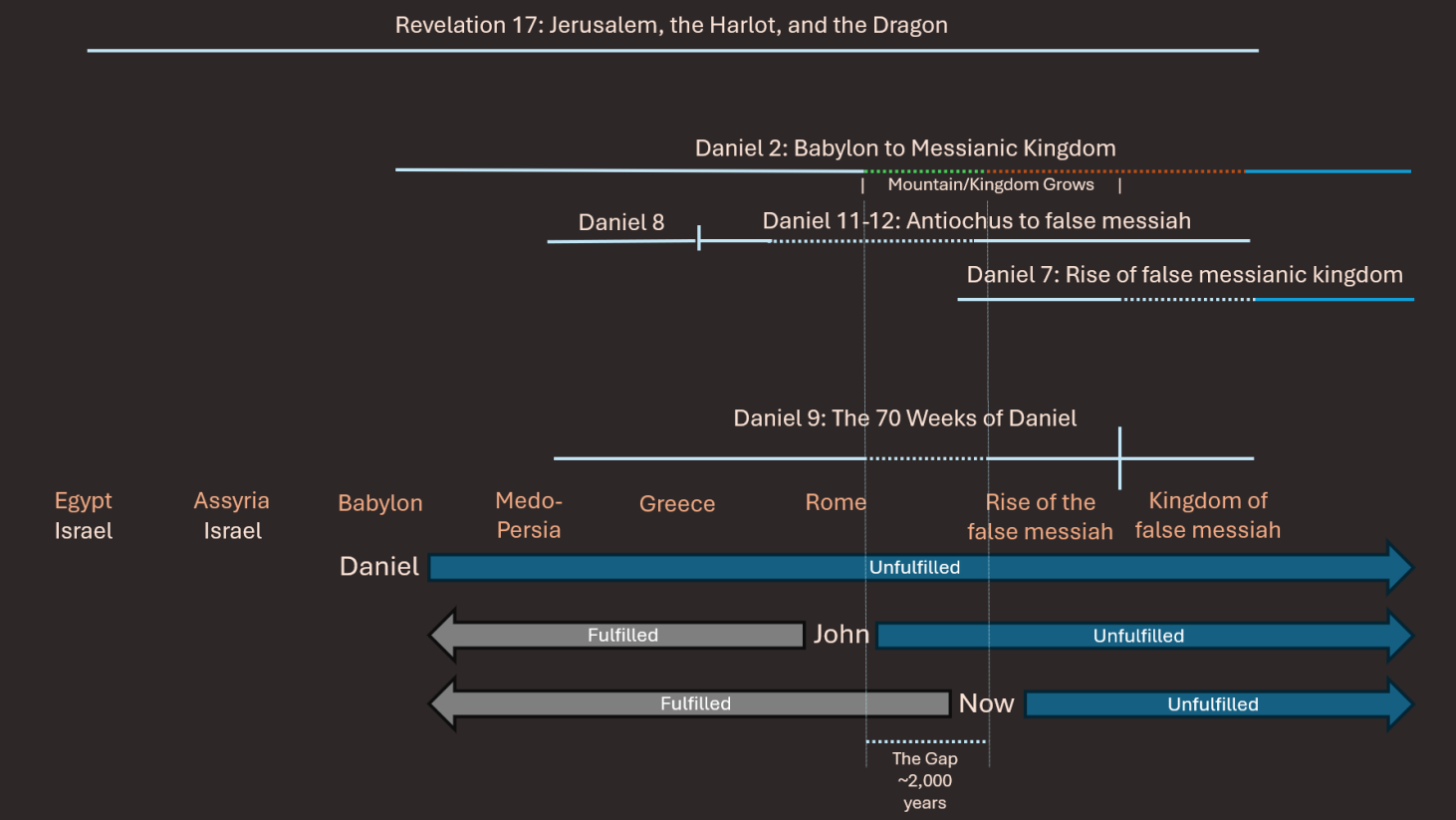
Rise of the False Messianic Kingdom
TL;DR
Prior to Babylon’s fall at the hands of the Medo-Persians, Daniel has a dream, a vision of four beasts coming from the great sea and the earth. These speak to a time echoed elsewhere in Bible prophecy of the time of the end and a global power unbeatable that consumes the whole earth.
But this vision speaks more to the rise to power of the prophetic characters of this story, providing clues as to what to watch for as the time of the end approaches. Stated within the plain text are many clues that define the context and timing of the vision, yet these are often glossed over as established paradigms lead to other conclusions. This is the reasoning and benefits of approaching Daniel’s vision within its own context first, allowing it to speak for itself regarding the interpretation and meaning behind it. I feel that everything we can glean from each vision should be first defined within the vision itself before attempting to make further connections.
These four beasts that come into being find themselves together on the end time stage, set and ready for the unveiling of God’s plan to unfold upon the world. While the symbolic nature may not be something we can look to history to understand, Daniel himself often did not understand because it was not for him to understand. This is the nature of Bible prophecy, cloaked in symbology. There may be some things that we can make logical guesses based on other uses, but it isn’t until events being depicted unfold that true clarity comes.
That doesn’t mean that nothing can be learned from this dream and vision, quite the contrary. We are given enough interpretation to discern quite a bit as to the meaning of this vision, and recognizing the nature of kings, kingdoms, and the land upon which they sit, a picture is painted of the arrival of the end, the geopolitical changes, and the rise of the false messianic kingdom.
And as we move beyond the individual examinations of each vision and look to how they are interconnected, what is clarified in each vision can be further expanded upon through connecting the larger narrative, the differing perspectives provided by the expounded vision of the time of the end.
Prophetic Scope
This vision is focused on the time of the end and the rise of four kings. We get a glimpse of the rise to power of four kings which exist at the same time of the end together and give over their power to the fourth king that consumes them. But this consuming power has a limited lifespan that ends with the arrival of the kingdom of God on earth, the physical establishment of the eternal kingdom ruled by Yeshua and those that subjects of His kingdom that obey Him.
Prophetic Characters
- Beast King 1: Lion with plucked eagle’s wings that is made to stand on its feet as a man with a man’s heart given it. When the fourth beast is destroyed, this beast’s dominion is taken away, but its life preserved for a season and time.
- Beast King 2: Bear raised on one side with three ribs in its teeth who devours much flesh. When the fourth beast is destroyed, this beast’s dominion is taken away, but its life preserved for a season and time.
- Beast King 3: Leopard with four wings on its back like a bird and four heads is given dominion. When the fourth beast is destroyed, this beast’s dominion is taken away, but its life preserved for a season and time.
- Beast King 4: Diverse dreadful beast
with ten horns, iron teeth, and nails like brass who devours the whole
earth and breaks in pieces. When the thrones in the earth are cast down,
the body of this slain beast will be given to the burning flame.
- Little horn, a king, comes up amongst the ten horns, which are ten kings, and three of those are plucked up by the roots and fall before the little horn. He has eyes like a man and a mouth speaking great things against the most High and making war against, and prevailing over, the saints of the most High who are given into his hand for a time, times, and dividing of time. He is ultimately destroyed when cast into the burning flame.
- Ancient of days sits on His throne, which looks like a flame and his wheels as burning fire, as all others are cast down. His garment is white as snow and hair like pure wool.
- Son of man comes to the Ancient of days on the clouds of heaven and He is given everlasting dominion that will not pass away, glory, and a kingdom that will never be destroyed. All people, languages, and nations will serve Him.
- Saints of the most High, who are overpowered and persecuted by the little horn for a time, times, and dividing of time, will after that be given and take the kingdom and possess it forever with the Son of man.
The Four Beasts
Prior to delving into the depictions of these four beasts, I think it’s important to jump to the interpretation given to us so that as we review these characters, we have their explained meaning in mind.
Daniel 7:17
These great beasts, which are four, [are] four kings, [which] shall arise out of the earth.
This is not an uncommon theme where beasts, heads, or horns are kings. And paired with this is the idea that a king is not a king without a kingdom, just as a kingdom does not exist without a king to lead it. In this way, the two are somewhat synonymous and interchangeable when thinking about the symbolic representations. When a king is in view, so are his subject that dwell on his land and follow him, these are his kingdom.
What is interesting is that the way several of these beasts are depicted suggest a kind of kingdom of kingdoms. Each of the four beasts are clearly defined as individual kings, but the way it’s described is outside the traditional view of a kingdom with a single king over a single kingdom and would seem to point to a different and larger scope of the idea of what a kingdom represents.
Daniel 7:2-3
Daniel spake and said, I saw in my vision by night, and, behold, the four winds of the heaven strove upon the great sea. And four great beasts came up from the sea, diverse one from another.
Aside from their definition as four kings, the reason that there are four represented would seem to be tied to this idea of the four winds of heaven. If we look to other scriptures with this phrase, a theme becomes apparent.
Jeremiah 49:35-36
Thus saith the LORD of hosts; Behold, I will break the bow of Elam, the chief of their might. And upon Elam will I bring the four winds from the four quarters of heaven, and will scatter them toward all those winds; and there shall be no nation whither the outcasts of Elam shall not come.
We have depicted here the judgement of Elam and their being scattered toward the four winds, or four quarters, of heaven. This is the Southwestern part of modern Iran and speaks of both the destruction of their kings and princes, but also a regathering of the people in the latter days. The point is that the four winds of heaven is depicted as a quartering of the earth into which the people of Elam are scattered.
As a side note, this is interesting in light of what began on February 28, 2026 and still unfolding as of this writing. Strikes on Iran took out much of the leadership of the IRGC, including Ali Khamenei. Since the revolution in 1979 Iranians that rejected the regime left into the nations. Could we be seeing the beginning of the regathering following the fall of the Islamic Republic of Iran? Time will tell, check out the full context of Jeremiah 49:34-39.
I also find the timing interesting in light of the season of Purim, the celebration of Israel in Persia, or modern day Iran, when the king decreed the Jews could preemptively kill those he previously decreed could wipe the Jews out. Esther 3-10
Zechariah 2:6
Ho, ho, [come forth], and flee from the land of the north, saith the LORD: for I have spread you abroad as the four winds of the heaven, saith the LORD.
Ezekiel 37:9
Then said he unto me, Prophesy unto the wind, prophesy, son of man, and say to the wind, Thus saith the Lord GOD; Come from the four winds, O breath, and breathe upon these slain, that they may live.
A kind of reverse of Elam, we see Ezekiel and Zechariah use the term four winds in light of the scattering of Israel in the context of her promised regathering. Zechariah is speaking of Israel’s regathering to the land following the Babylonian captivity while Ezekiel speaks to the same idea in different prophetic symbolism. The dried bones of Israel, cut off from the land, are breathed back to life by the four winds, symbolizing the scattered of Israel coming back into the land and no longer being cut off from it.
Daniel 8:8
Therefore the he goat waxed very great: and when he was strong, the great horn was broken; and for it came up four notable ones toward the four winds of heaven.
Daniel 11:4
And when he shall stand up, his kingdom shall be broken, and shall be divided toward the four winds of heaven; and not to his posterity, nor according to his dominion which he ruled: for his kingdom shall be plucked up, even for others beside those.
We saw in the Vision of Daniel 8 and Vision of Daniel 10-12 this same phrase used in regards to Alexander the Great’s death and the dividing of his kingdom in four toward the four winds of heaven. We can see from history what was one kingdom ruling all the land became four kingdoms ruling divided parts of the original kingdom. It speaks to a physical separation across the earth.
Matthew 24:31
And he shall send his angels with a great sound of a trumpet, and they shall gather together his elect from the four winds, from one end of heaven to the other.
Mark 13:27
And then shall he send his angels, and shall gather together his elect from the four winds, from the uttermost part of the earth to the uttermost part of heaven.
Finally, we see in the Olivet Discourse this same idea representing the catching away of the bride of Christ at His coming. We are told in 1 Thessalonians 4:13-18 that following the resurrection of the just at Yeshua’s coming, the dead and living together will be changed and caught up to meet the Lord in the air.
Acts 1:9-11
And when he had spoken these things, while they beheld, he was taken up; and a cloud received him out of their sight. And while they looked stedfastly toward heaven as he went up, behold, two men stood by them in white apparel; Which also said, Ye men of Galilee, why stand ye gazing up into heaven? this same Jesus, which is taken up from you into heaven, shall so come in like manner as ye have seen him go into heaven.
We see here that wherever on the planet one sits, at His coming they will be gathered from that place on earth to where He is on the clouds of heaven. Again, the four winds of heaven speaks to a kind of quartering of the earth.
So when Daniel makes the point that the four winds burst forth on the great sea and then four beasts come up out of the sea, the symbolism should not be lost on us. Even more so that while he states that these four beast kings rise out of the great sea, the interpretation is that these are four kings that arise out of the earth. So the symbolism of the great sea would seem to align with the idea we see elsewhere of representation of peoples, while their rise from the earth would suggest the more literal existence over parts of the earth. This will become more relevant in interpreting this vision as we look more at the timing of what is described for us from the words of the vision themselves.
The First Beast
Daniel 7:4
The first [was] like a lion, and had eagle’s wings: I beheld till the wings thereof were plucked, and it was lifted up from the earth, and made stand upon the feet as a man, and a man’s heart was given to it.
The vision does not interpret for us anything about this beast except that it represents a king over a kingdom. The idea of eagle’s wings is not new in scripture, it’s symbolic for protection by God of His people in Deuteronomy 32:7-14, Exodus 19:4-6, and Revelation 12:14. The latter two speaking to a kind of first and second Exodus. It’s also symbolic of domination in Jeremiah 48:35-40 and Jeremiah 49:19-22, and a warning in Proverbs 23:3-7 against laboring for riches and the pride of life that comes with it.
That this lion had eagle’s wings that were plucked and made to stand on the feet like a man suggests a transition from a proud beast of strength in domination and protection being suddenly humbled and changed. While it’s not stated that the lion was airborne, it’s suggested in the idea of the wings.
The idea of a man’s heart being given to the lion is likewise not necessarily a good thing.
Proverbs 6:16-19
These six [things] doth the LORD hate: yea, seven [are] an abomination unto him: A proud look, a lying tongue, and hands that shed innocent blood, An heart that deviseth wicked imaginations, feet that be swift in running to mischief, A false witness [that] speaketh lies, and he that soweth discord among brethren.
Proverbs 21:4
An high look, and a proud heart, [and] the plowing of the wicked, [is] sin.
Jeremiah 17:9-10
The heart [is] deceitful above all [things], and desperately wicked: who can know it? I the LORD search the heart, [I] try the reins, even to give every man according to his ways, [and] according to the fruit of his doings.
The heart of beasts do not sin, they were not made in the image of God, nor did they eat from the tree of the knowledge of good and evil. The introduction of a man’s heart to this beast could go either way, perhaps in humility this king turns from pride and sin. But the more likely direction is a turn toward wickedness, because as we will see the dreadful beast will devour the whole world and the only other place these four beasts are represented symbolically suggest that they become part of that global domination, willing participants in it and giving over their power.
This is really all speculation at this point however. I believe we can discern from the vision itself that this depiction is of a future king and kingdom, meaning that like other unfulfilled prophecy, we risk walking down the wrong path in speculating. Rather, we need to watch and pray to see what may arise on the stage that could fit the potential symbolic representation of Daniel’s vision.
The Second Beast
Daniel 7:5
And behold another beast, a second, like to a bear, and it raised up itself on one side, and [it had] three ribs in the mouth of it between the teeth of it: and they said thus unto it, Arise, devour much flesh.
Again, the vision does not interpret for us anything about this beast except that it represents a king over a kingdom. A bear being raised up on one side suggests an attack posture swiping at its target. That is has three ribs and devours much flesh suggests it has great power as a king and kingdom to consume others. Bears attack because they are surprised, feel threatened, are protecting their cubs, or are hungry and desperate for food. That this vision depicts the bear eating three ribs and devouring flesh might point to the latter reasoning.
But again, this is just speculation of the meaning of this symbolic representation and is less important than recognizing this king of a kingdom is one of four.
The Third Beast
Daniel 7:6
After this I beheld, and lo another, like a leopard, which had upon the back of it four wings of a fowl; the beast had also four heads; and dominion was given to it.
Again, the vision does not interpret for us anything about this beast except that it represents a king over a kingdom. Leopards are known for their speed, and that this one has four wings like a bird on its back would seem to suggest great speed and loftiness. It also has four heads and dominion is given to it. We’ve seen elsewhere in prophecy that, like beasts and horns, heads likewise represent kings many times. However, this is not explicitly stated in the vision that these heads represent kings so it’s a working assumption as to the meaning.
Based on what little is interpreted for us regarding these first three beasts, any determination as to their identities carries with it a lot of speculation. For that reason, and what we will cover shortly, I do not feel comfortable attempting to identify any of these first three beasts outside of them representing kings of kingdoms and in some cases kings of kings of kingdoms. And it is the fourth beast that we see a similar situation representing a conglomeration of kingdoms headed by a king, something different than previous representations.
The Fourth Beast
Daniel 7:7, 19, 23-24a
After this I saw in the night visions, and behold a fourth beast, dreadful and terrible, and strong exceedingly; and it had great iron teeth: it devoured and brake in pieces, and stamped the residue with the feet of it: and it [was] diverse from all the beasts that [were] before it; and it had ten horns. ... Then I would know the truth of the fourth beast, which was diverse from all the others, exceeding dreadful, whose teeth [were of] iron, and his nails [of] brass; [which] devoured, brake in pieces, and stamped the residue with his feet; ... Thus he said, The fourth beast shall be the fourth kingdom upon earth, which shall be diverse from all kingdoms, and shall devour the whole earth, and shall tread it down, and break it in pieces. And the ten horns out of this kingdom [are] ten kings [that] shall arise: ...
The fourth beast is the fourth kingdom upon the earth. Here we see what was interpreted as a king also being interpreted as a kingdom. This kingdom has ten horns, which are interpreted for us as ten kings that will arise. Keeping the theme of a king of kings and kingdom of kingdoms, we now have a single kingdom with ten kingdoms contained within it, yet they would seem to act in some kind of unified way being under the umbrella of the fourth kingdom on the earth. All four beast kings are said to be diverse from each other, yet this fourth beast king is said separately to be diverse from the other three before it. And it is evident from Daniel’s focus on this fourth beast that it is certainly diverse.
We’re not really given an animal to associate with this fourth beast, but it has some very distinctive identifying features that will become important as we start to look outside the vision itself to understand how what is presented to Daniel here fits in with the larger prophetic scope. The ten horns are definitely a telling feature as are the iron teeth and brass claws. The strength of iron to devour and break in pieces combined with the brass claws in this dreadful beast that breaks up and consumes speaks to an unstoppable conquering kingdom, at least until it meets its end.
Contemporaneous Diversity
Daniel 7:3, 7b
And four great beasts came up from the sea, diverse one from another. ... and it [was] diverse from all the beasts that [were] before it; and it had ten horns.
It is made clear that the four beasts that come out of the great sea and the earth are diverse from each other. They are their own kings of kingdoms, some of which contain multiple other kingdoms. This will become important to recognize as we look outside of this vision for similarities because it speaks to an order of events. In Daniel’s vision here, these four are diverse and distinct from each other, both in presentation and rule.
It is said that the fourth beast was diverse from all the beasts that were before it. It’s easy to look at the presentation of the beasts in an order from first to fourth and look at these as successive kingdoms. But is that what Daniel really sees? While it is true that the fourth kingdom will devour the whole earth, implying the other beast kings, that is not what we see at the beginning.
The word “before” is quodam and is used 46 times in 38 verses, 42 of which are Daniel. In every case it is spacial, not temporal. Each beast king is introduced in an order, but not necessarily in different times or as successive kingdoms because upon their introduction, they are all standing together and diverse from each other at the same time. Here is a selection of some examples of how this word is used by Ezra and Daniel.
Ezra 4:18
The letter which ye sent unto us hath been plainly read before me.[H6925]
Daniel 2:9
But if ye will not make known unto me the dream, [there is but] one decree for you: for ye have prepared lying and corrupt words to speak before me,[H6925] till the time be changed: therefore tell me the dream, and I shall know that ye can shew me the interpretation thereof.
Daniel 7:8, 10, 13
I considered the horns, and, behold, there came up among them another little horn, before whom[H6925] there were three of the first horns plucked up by the roots: and, behold, in this horn [were] eyes like the eyes of man, and a mouth speaking great things. ... A fiery stream issued and came forth from before him:[H6925] thousand thousands ministered unto him, and ten thousand times ten thousand stood before him:[H6925] the judgment was set, and the books were opened. ... I saw in the night visions, and, behold, [one] like the Son of man came with the clouds of heaven, and came to the Ancient of days, and[H6925] they brought him near before him.[H6925]
And to confirm this, we see later in the final end of this fourth beast king that its judgement is also diverse from that of the first three that were presented.
Daniel 7:11b-12
… I beheld [even] till the beast was slain, and his body destroyed, and given to the burning flame. As concerning the rest of the beasts, they had their dominion taken away: yet their lives were prolonged for a season and time.
We see an important statement made about the future destruction of the fourth beast, but the other three beasts at that same time are not destroyed as the fourth is, they just lose their dominion, but their lives were prolonged. In order for the lives of the first three beast kings to be prolonged at the same time as the fourth beast king is destroyed, they must all be alive and coexist at the same time of that destruction.
This eliminates a kind of sequential consuming of kingdoms such that the second beast consumes the kingdom of the first beast and so on until the fourth beast consumes the last. Not only are the four beasts standing before each other and diverse from each other, they were introduced by the four winds suggesting different physical locations from each other under the four winds of heaven.
These statements suggest four contemporaneous kingdoms that are separate and distinct from each other not in time, but in space. And this makes sense when understanding that kingdoms require space to exist and if the fourth kingdom is destroyed and the other three are not, then the space in which their kingdoms reside is different. If this were not the case, then all would have been destroyed with the fourth beast that consumed the whole earth.
The Kingdoms and the Land
While it seems an obvious point, I know I did not really think of this vision in these terms and I think it is telling if we want to objectively understand what this vision is saying about a literal future. I’ve made the point that a king is over a kingdom and that kingdom is made up of subjects that obey the king that leads them. However, the subjects require physical space upon which to exist and a king’s responsibility is to preserve that space for his subjects and provide them security to dwell on it under the king’s rule.
We’ve seen with several of these beast kings that either the symbology of four heads on the third leopard beast king or the stated ten kings on the fourth dreadful beast king speaks to a kingdom of kingdoms. Each of these have their own subjects under their kings that require land upon which to dwell.
So not only can we understand these kingdoms of kingdoms to be authority over kingdoms much like modern geopolitical agreements between nations whose actions are dictated or limited by a uniting power, but they each also cover areas of land mass in the earth.
Quartering of Power in the Earth
While it doesn’t necessarily have to be, it would seem that the collections of kingdoms are likely tied together in physical regions in order for them to be represented as a single beast king containing multiple other kings. As discussed above, this idea of the four winds introducing these four beasts suggests a kind of quartering of political power in the earth.
The combination of how kingdoms were understood by Daniel in his day with his vision of kingdoms of kingdoms is perhaps how I might try to depict the modern political landscape. There are groups of alliances in the countries on the earth, not necessarily kingdoms in the ancient sense, but all ruled by some kind of political methodology that controls the populations as a traditional kingdom would.
It is money that rules the world, allows and limits trade amongst nations, and is controlled by many for power. It is the influence behind many attempts to unify nations under agreements, such as the EU, and so it is my estimation that a future unification into four primary areas of political control will likely be tied to finance in some way.
We are on the verge of a complete transformation of the way money is handled with the potential move toward Central Bank Digital Currencies (CDBC), which have the potential to allow or disallow participation in the financial system and offer greater control over those that do. (CBDC Spells Doom for Financial Privacy by Nicholas Anthony) What administrative government couldn’t be convinced of the great benefits in a world of theft and insecurity than to tighten control over monetary systems and integrate them further together? It’s the next step in greater monetary control.
I believe what Daniel is seeing is the geopolitical landscape at the time of the end, one of the first clues of what we are to watch for. The four winds representing the whole earth upon which the four beasts rise, tie kingdoms of kingdoms and the land upon which they dwell together and each beast representing one corner of the earth with their control over it. Each is diverse from the other, yet will ultimately be devoured by the fourth beast kingdom at some point. And the thing that runs the world, money, may be on the verge of changing how we look at currency and use it.
CDBC Tracker keeps tabs on advancement toward CDBCs globally. What you’ll notice is that very few countries in the world are doing nothing toward this end while just about everyone is researching in some way. We may be seeing the foundation being laid for the digital safety net meant to transition suddenly at the next big financial crisis. But once implemented, it may just be the tool for global unification by the devouring fourth beast king.
Is this something that can be stopped? Not if you trust God’s Word. We are called to watch for events that are inevitably going to come to pass. But we have not been given a spirit of fear, but of power, love, and a sound mind. We must stand in faith, trusting that God will be holding us whether in the resurrection or standing alive looking up at His coming.
The Little Horn
Daniel 7:8, 20-21, 24-25
I considered the horns, and, behold, there came up among them another little horn, before whom there were three of the first horns plucked up by the roots: and, behold, in this horn [were] eyes like the eyes of man, and a mouth speaking great things. ... And of the ten horns that [were] in his head, and [of] the other which came up, and before whom three fell; even [of] that horn that had eyes, and a mouth that spake very great things, whose look [was] more stout than his fellows. I beheld, and the same horn made war with the saints, and prevailed against them; ... And the ten horns out of this kingdom [are] ten kings [that] shall arise: and another shall rise after them; and he shall be diverse from the first, and he shall subdue three kings. And he shall speak [great] words against the most High, and shall wear out the saints of the most High, and think to change times and laws: and they shall be given into his hand until a time and times and the dividing of time.
We have seen the four beast kings rise to power in the earth and the fourth with ten horns is the focus of Daniel’s attention. These ten horns out of this fourth kingdom are ten kings that arise. This points to a rise to power of ten kingdoms within the fourth kingdom at some point. These ten aren’t really distinguished from each other, but they are all present together for the rise of the little horn.
This king rises to power from among the ten pre-existing ten kings, speaking to a sequence of time. So in watching we should see a quartering of power in the earth, the rise of ten kings in generally the same quarter of the earth, followed by the rise of another king from amongst them in that quarter of the earth.
We are told this horn has eyes like a man and a mouth speaking very great things that captured Daniel’s attention. His appearance was greater and more imposing than his companions and he will think to change the times and laws. While this doesn’t seem like much to go on, it actually paints a pretty good picture of this king.
His appearance being greater and more imposing than his companions suggests that he rises to the place of king of the kingdom as a member of the people over which he will rule, his companions. And we know in Daniel’s vision that he rises to power after the ten kings in his quarter of the earth already have.
He will think, or intend, to change the times and laws, meaning that something about his reign as king initiates a shift in times and laws. But what does that mean to change the times? The Aramaic word used is zem-awn’, the same as H2165, from H2163, a set time or appointed time. It holds the same meaning to the Hebrew mo’ed, appointed time, used heavily regarding God’s appointed times to meet with His people at the appointed place, Zion.
What does it mean to intend to change the laws? The Aramaic word used is dawth, corresponding to H1881, a decree of the king or law of God. The Hebrew equivalent of the law from God would be torah, law.
Exodus 13:9-10
And it shall be for a sign unto thee upon thine hand, and for a memorial between thine eyes, that the LORD’S law [torah] may be in thy mouth: for with a strong hand hath the LORD brought thee out of Egypt. Thou shalt therefore keep this ordinance in his season [mo’ed] from year to year.
Nehemiah 10:34
And we cast the lots among the priests, the Levites, and the people, for the wood offering, to bring [it] into the house of our God, after the houses of our fathers, at times appointed [zaman] year by year, to burn upon the altar of the LORD our God, as [it is] written in the law: [torah]
One thing that is true about Daniel’s visions, and really much of Bible prophecy, is the centrality of Israel. This shouldn’t be a surprise because of God’s chosen people, the church has been growing in personal relationship with God for almost two millennia while Israel closed their eyes to Yeshua and were blinded. The main events surrounding the time of the end are God’s plan to open the eyes of the remnant faithful of Israel in their time of great tribulation.
Israel as a nation is not following God’s statutes fully according to the Law they are under, not having accepted the atoning sacrifice of the New Covenant in Christ. Since they are not in compliance now, it would seem logical that the changing of the times and laws related to their little kingdom and new king would be a return of compliance to the Mosaic Covenant by changing current secular laws to conform to that covenant, thereby strengthening it.
Likewise, while Orthodox Jews keep the appointed times, a transition to ancient statutes long neglected as a kingdom would see a changing of how time is tracked according to God’s statutes, the appointed times. This would likewise make sense in terms of the exact-day prophecies of Daniel and John tied to the lunisolar calendar.
We must not forget that the time of the end, according to Yeshua in the Olivet Discourse, is a time of great deception surrounding an anointed king of Israel, a wolf in sheep’s clothing that is attempting to replace Yeshua with himself in the hearts of God’s people. Many of the actions prophecy says Yeshua will accomplish will be attempted by this deceiver to lead the blind of Israel to destruction. So it’s not difficult to see that he will first come cloaking his lies in truth as he has done from the beginning. Even leading the blind back to obedience to the Mosaic Covenant will work toward his purpose if he can convince them when he is allowed to reveal himself that he is the anointed one prophesied to come. As soon as they accept him in idolatry they will be doomed with him as their false god.
This horn king is a man with eyes like a man and a mouth speaking very great things against the most High. We don’t know what he’s saying, but that it is directed against the God of Abraham, Isaac, and Jacob. This further solidifies his identity when looking outside this vision, but that is for a later post. That his blasphemous words are against the God of Daniel is probably what drew his attention to this little horn.
So this king has risen to power in one quarter of the earth from amongst his own people. Because of his unique greatness he’s the kind of king that the people would want to rule over them, fight for them, and bring peace and safety to the kingdom. In his reign, appointed times and laws would be changed, a fairly unique pattern in scripture regarding God’s statutes for Israel to keep on His appointed times according to the Mosaic Covenant established at Sinai after escaping from Egypt. But this king will also be in opposition to the God of Israel, speaking against Him in some way.
War on the Saints
We also know that he is at odds with God’s people, the saints of the most High. There is debate over who the saints refer to, is that a distinctly Hebrew term referring to Israel or in the New Covenant does it refer to the church? The answer is for me is yes. The whole council of God must be taken into account from a perspective outside of time. Of those that are Yeshua’s He will lose none. John 6:35-40 And there is no difference between Jew or Greek, we are all one in Yeshua. Romans 10:9-13 Yeshua is the way, the truth, and the life, none come to the Father except through Him. John 14:6
Romans 2:7-12
To them who by patient continuance in well doing seek for glory and honour and immortality, eternal life: But unto them that are contentious, and do not obey the truth, but obey unrighteousness, indignation and wrath, Tribulation and anguish, upon every soul of man that doeth evil, of the Jew first, and also of the Gentile; But glory, honour, and peace, to every man that worketh good, to the Jew first, and also to the Gentile: For there is no respect of persons with God. For as many as have sinned without law shall also perish without law: and as many as have sinned in the law shall be judged by the law;
To focus on defining the saints beyond this is pointless in my opinion because as we will see in further studies, those who remain obedient to God are the target of the little horn who makes war on God and His faithful people, whether they be of Israel or Gentiles. It further forces division in the body of Christ where there need not be. There are many of Israel who are part of the church and to attempt to force some arbitrary distinction that would separate them from the church is contrary to scripture. The saints are simply defined as those faithful to God unto death, awaiting the promised resurrection and eternity with Him.
Daniel 7:21, 25
I beheld, and the same horn made war with the saints, and prevailed against them; ... And he shall speak [great] words against the most High, and shall wear out the saints of the most High, and think to change times and laws: and they shall be given into his hand until a time and times and the dividing of time.
This war on the saints is not something the saints will prevail over in the traditional sense. Rather, it is their faithfulness unto death that will lead to their resurrection and reign with Yeshua in His kingdom, finding the ultimate victory through His death and resurrection.
These faithful to God, hated and persecuted by the little horn, are given into his hand for a time, times, and dividing of time. This is another exact-day prophecy that defines the time that the little horn will be given power over the saints of the most High. This period would begin with the beginning of his persecution of God’s people until his ultimate destruction.
Similar to the other exact-day prophecies, this idea of three and a half times points back to the appointed times on God’s lunisolar calendar that Israel was to keep. By this we see that 1,260 days is equated to 42 months and 3.5 years because each month is just about 30 days long. So when seeing these exact-day prophecies tied to appointed times, we can see God’s design around the time of the end according to His celestial clock set in motion long ago.
The Eleven Horns
Daniel 7:8a, 20a, 24
I considered the horns, and, behold, there came up among them another little horn, before whom there were three of the first horns plucked up by the roots: ... And of the ten horns that [were] in his head, and [of] the other which came up, and before whom three fell; ... And the ten horns out of this kingdom [are] ten kings [that] shall arise: and another shall rise after them; and he shall be diverse from the first, and he shall subdue three kings.
The little horn is seen coming up and rising to become king after the ten larger horns are already established in the land. This is an important understanding in watching for the signs of the end. It means that events will unfold to reveal some kind of alliance of ten kingdoms in a quarter of the earth prior to the rise of the little horn. Ten regional kingdoms aligning at a point in time would be a significant event that would likely be understood by those watching if we are looking in the right place.
It seems clear that at least three of the ten horns are not on good terms with the little horn, yet not all ten are plucked up by the roots and fall before him. This is clearly interpreted for us as the subduing of three of the ten kings by the little horn, who is likewise a king.
Another point of distinction comes in the sizes of the eleven horns. The first ten that arise aren’t distinguished from each other in any way except that there are ten distinct kings that arise. It is the little horn that comes up after them that is smaller in size than those around it. What could this distinction point to?
A smaller horn would seem to logically point to a less powerful or strong king in comparison to the ten he comes up amongst. However, the context of his rise to power would seem contrary to this idea because this smaller king is able to defeat three of the larger ones and the other seven don’t even seem to get involved.
If not strength or power, then the size difference must be related to the size of the kingdoms over which the kings rule. While a smaller kingdom in population doesn’t seem likely to be able to defeat three larger populations, it’s really not about the number of subjects as much as it is about the strength of resolve, skill and tactics of the actual army doing the fighting, and tools and capabilities available to them.
Finally, it is said that this little horn is diverse from the first ten horns amongst which he rose to power. This is a similar statement made about the diversity of the four beast kings that rose from the sea and land. However, these eleven horns are all on the fourth diverse beast and the little horn is said to be diverse from the first ten that existed prior to him.
If we put all of this together, we see a sequential shift in power of a region of the earth over which ten kings arise. These ten are not said to be distinct from each other in any way, suggesting some sort of similarity in comparison to the little king that rises after and from amongst them. His kingdom is different from the ten in some discernible way, one of which is being smaller than any of the other ten in size. The king over a smaller kingdom is placing himself in opposition to God and speaking great things against Him. He is also responsible for overcoming the saints of the God who he is speaking against and is given power for three and a half appointed time cycles.
Destruction of the King and His Kingdom
Daniel 7:9a, 11-14, 22, 26-27
I beheld till the thrones were cast down, and the Ancient of days did sit, ... I beheld then because of the voice of the great words which the horn spake: I beheld [even] till the beast was slain, and his body destroyed, and given to the burning flame. As concerning the rest of the beasts, they had their dominion taken away: yet their lives were prolonged for a season and time. I saw in the night visions, and, behold, [one] like the Son of man came with the clouds of heaven, and came to the Ancient of days, and they brought him near before him. And there was given him dominion, and glory, and a kingdom, that all people, nations, and languages, should serve him: his dominion [is] an everlasting dominion, which shall not pass away, and his kingdom [that] which shall not be destroyed. ... Until the Ancient of days came, and judgment was given to the saints of the most High; and the time came that the saints possessed the kingdom. ... But the judgment shall sit, and they shall take away his dominion, to consume and to destroy [it] unto the end. And the kingdom and dominion, and the greatness of the kingdom under the whole heaven, shall be given to the people of the saints of the most High, whose kingdom [is] an everlasting kingdom, and all dominions shall serve and obey him.
It is the Son of man that is given dominion, glory, and a kingdom for all people under Him that will never be destroyed. The establishment of this kingdom in His land necessitates the elimination of the kingdoms residing in His land and fighting against Him.
Isaiah 13:6-13
Howl ye; for the day of the LORD [is] at hand; it shall come as a destruction from the Almighty. Therefore shall all hands be faint, and every man’s heart shall melt: And they shall be afraid: pangs and sorrows shall take hold of them; they shall be in pain as a woman that travaileth: they shall be amazed one at another; their faces [shall be as] flames. Behold, the day of the LORD cometh, cruel both with wrath and fierce anger, to lay the land desolate: and he shall destroy the sinners thereof out of it. For the stars of heaven and the constellations thereof shall not give their light: the sun shall be darkened in his going forth, and the moon shall not cause her light to shine. And I will punish the world for [their] evil, and the wicked for their iniquity; and I will cause the arrogancy of the proud to cease, and will lay low the haughtiness of the terrible. I will make a man more precious than fine gold; even a man than the golden wedge of Ophir. Therefore I will shake the heavens, and the earth shall remove out of her place, in the wrath of the LORD of hosts, and in the day of his fierce anger.
Hebrews 12:25-29
See that ye refuse not him that speaketh. For if they escaped not who refused him that spake on earth, much more [shall not] we [escape], if we turn away from him that [speaketh] from heaven: Whose voice then shook the earth: but now he hath promised, saying, Yet once more I shake not the earth only, but also heaven. And this [word], Yet once more, signifieth the removing of those things that are shaken, as of things that are made, that those things which cannot be shaken may remain. Wherefore we receiving a kingdom which cannot be moved, let us have grace, whereby we may serve God acceptably with reverence and godly fear: For our God [is] a consuming fire.
2 Peter 3:5-7
For this they willingly are ignorant of, that by the word of God the heavens were of old, and the earth standing out of the water and in the water: Whereby the world that then was, being overflowed with water, perished: But the heavens and the earth, which are now, by the same word are kept in store, reserved unto fire against the day of judgment and perdition of ungodly men.
The wrath of God will lay the land desolate and destroy the sinners out of it. We can see in this vision of Daniel that the fourth beast that is slain and his body destroyed and given to the burning flame. Understanding that this beast is a king over a kingdom of kingdoms that resides in a region of the earth, it becomes clear where Daniel is speaking of.
Genesis 15:18
In the same day the LORD made a covenant with Abram, saying, Unto thy seed have I given this land, from the river of Egypt unto the great river, the river Euphrates:
Galatians 3:16
Now to Abraham and his seed were the promises made. He saith not, And to seeds, as of many; but as of one, And to thy seed, which is Christ.
The Middle East belongs to God, to Abraham’s seed Yeshua. It is upon His return that His physical kingdom will be established upon it and He will rule from Jerusalem over His kingdom with His saints dwelling in His land and reigning with Him over the kingdom that is built over the ashes of that which was destroyed in the day of the Lord.
Malachi 4:1-3
For, behold, the day cometh, that shall burn as an oven; and all the proud, yea, and all that do wickedly, shall be stubble: and the day that cometh shall burn them up, saith the LORD of hosts, that it shall leave them neither root nor branch. But unto you that fear my name shall the Sun of righteousness arise with healing in his wings; and ye shall go forth, and grow up as calves of the stall. And ye shall tread down the wicked; for they shall be ashes under the soles of your feet in the day that I shall do [this], saith the LORD of hosts.
It is Yeshua that judges and destroys alone, we will just gain the abundance of His kingdom as the redeemed of the earth. Isaiah 63:1-6
Vision of the Future?
Translating this vision to modern geopolitics, with the fourth kingdom necessarily being a large area of land upon which eleven kingdoms coexist, is there any such region on earth where ten similarly aligned kings of kingdoms could exist together? And from their midst could a king of a smaller kingdom rise to power and provoke conflict and defeat three of the ten larger kingdoms? It is the king of the little kingdom that rises to power, but this doesn’t mean that the subjects of his kingdom couldn’t have already existed prior to his rule. Is there any place with ideological tensions that cause conflict in a ratio of one to ten in this region of the earth?
At this point, there is not a specific number of ten to one, but there is certainly an ideological divide between one nation and many others. The Middle East is a collection of nations, some actually kingdoms with kings, that are primarily ideologically tied together by Islamic beliefs. These vary in nature, primarily the distinction between Sunni and Shia Islam, but their religious text defines a religious war on the horizon that some take more seriously than others. It is directed toward a relatively new nation in the region, Israel. Born in a day on May 14, 1948, Israel has been surviving and thriving through much turmoil in the region from those who reject her existence and fight against it. They desire to remove Israel from the land between the Jordan River to the Mediterranean Sea.
However, we have seen lately that some of these nations are looking to take a different path in dealing with Israel, though they remain ideologically tied to their fellow Islamic nations. Even so, there is no doubt that if a king were to be crowned in Israel that at least some of those expecting a war against the Dajjal would be triggered by this anointing of a king and the suggested meaning behind that and respond according to their religious texts. And as we’ve seen historically when the surrounding nations come against Israel in her semi-restored state, it does not end well for them.
Zechariah 12:2-9
Behold, I will make Jerusalem a cup of trembling unto all the people round about, when they shall be in the siege both against Judah [and] against Jerusalem. And in that day will I make Jerusalem a burdensome stone for all people: all that burden themselves with it shall be cut in pieces, though all the people of the earth be gathered together against it. In that day, saith the LORD, I will smite every horse with astonishment, and his rider with madness: and I will open mine eyes upon the house of Judah, and will smite every horse of the people with blindness. And the governors of Judah shall say in their heart, The inhabitants of Jerusalem [shall be] my strength in the LORD of hosts their God. In that day will I make the governors of Judah like an hearth of fire among the wood, and like a torch of fire in a sheaf; and they shall devour all the people round about, on the right hand and on the left: and Jerusalem shall be inhabited again in her own place, [even] in Jerusalem. The LORD also shall save the tents of Judah first, that the glory of the house of David and the glory of the inhabitants of Jerusalem do not magnify [themselves] against Judah. In that day shall the LORD defend the inhabitants of Jerusalem; and he that is feeble among them at that day shall be as David; and the house of David [shall be] as God, as the angel of the LORD before them. And it shall come to pass in that day, [that] I will seek to destroy all the nations that come against Jerusalem.
Ironically, the perception of a false messiah, or Dajjal, is not incorrect. As I’ve pointed out before, Yeshua’s own warning about the time prior to His coming in the clouds of heaven with great power and glory is a time of great deception surrounding those coming in His anointing, claiming to be the long-awaited Messiah. This anointing is as king of Israel, a position of rule over the kingdom.
But God is allowing this time of testing to come upon the land prior to His return to try and prove His remnant that will remain faithful to Him. And so any enemy of His people Israel, He will protect them for that trial to happen according to His purposes. In fact, His protection of Israel will likely be seen by those without understanding as the new king’s protection of Israel, but God will be the strength of His people, even those that will ultimately reject Him as their judgement will be coming. And just a couple chapters later in Zechariah, Yeshua must save His faithful remnant from their own.
The secular nation of Israel we see today in the Middle East is much different than the ancient kingdom of Israel both in appearance and action. But something will change that, perhaps a central oracle of their religious and covenantal foundation or a shift in the spirit of the people to return to God, a promised person to prepare the hearts of the people for the promised Messiah. However it may come about, understanding Daniel’s vision will help us to understand what we should be watching for and why.
Conclusion
Examining the plain text of Daniel’s vision recorded in chapter seven, we see a picture of four kings at the time of the end just prior to the establishment of the eternal kingdom of God. Their kingdoms are not like those of ancient times where one king rules over one people, they have something more akin to modern geopolitics where the beasts are not so much focused on one kingdom as they are focused on control of areas of land.
It is the fourth kingdom that is the focus of the vision because it covers the land that is most relevant to the establishment of the kingdom of God on earth. It is His land, promised to Abraham’s seed, that must be dispossessed by Yeshua. And it is this same land that the little horn rises to prominence and establishes his kingdom in.
And while we see his short rule and persecution of God’s faithful remnant brought to an end with his destruction and the fourth beast representing him delivered to the burning flame, the desolation and destruction of this land is not the same fate as the other three beasts that once stood in the presence of the fourth diverse beast.
This whole vision is scoped to the future time of the end and depicts the geopolitical changes that must come to bring about the rise of the little horn and his control of the kingdom in the Middle East. His strength and power begins locally within the scope of the land of the fourth beast upon which ten horns exist, but that control of the fourth beast leads to it devouring the whole earth. As we will see in future studies, very telling features highlight this concept in a different vision speaking to the same events.
I feel this is one of the most important visions to understand as it highlights symbolic characters that precede the rise of the little horn and have just enough symbolic detail that one who is watching may be able to discern as it begins to come to pass, well before the more obvious signs that will follow. I encourage you to do your own study of this vision and some of the symbolism contained in it. Share any insights in the comments and keep watching! †
May God continue to bless you as you remain in Him.


“Be not overcome
of evil, but overcome evil with good.” Romans 12:21 In accordance with Title 17 U.S.C. Section 107, any copyrighted work herein is archived under fair use without profit or payment to those who have expressed a prior interest in reviewing the included information for personal use, non-profit research and educational purposes only. Ref.
Watchman Bible Study | 2005 - 2026