Vision of Daniel 8

Abomination of Desolation Foreshadowed
TL;DR
Daniel’s vision of the ram and the goat is full of symbolism, but like Nebuchadnezzar’s dream we are given some of the interpretations of it. Thanks to history, we are able to understand this symbolism in great detail, once again proving that the prophets of God had the future revealed to them and in their diligent documentation we gain insight from it and grow in faith, or trust, in God’s Word as being exactly what it claims to be.
In this vision we see some of the history of Medo-Persia and Greece given to bring us to an important historical reference that Yeshua would point to in the future. And like just about all the prophecies of scripture, Israel is central to it. This vision, given years before Medo-Persia would defeat the Babylonian Empire, leads us through the kingdoms to a particular king that causes an abomination of desolation that changes the course of Israel and brings about a short period of semi-autonomy following generations of Gentile rule.
And it is out of this event that we see the precision of the vision given to Daniel and its interpretation in the 2,300 days depicted in it. The sanctuary would be polluted as ministry at the temple was stopped to cause the covenant to be broken. But a people zealous to return to God would cause it to be cleansed and proper ministry re-instituted leading to what is celebrated today as Hanukkah, or Chanukah.
Prophetic Scope
This is a prophecy starting with Medo-Persia’s rise to power and conquering of surrounding kingdoms. This is followed by their defeat by Alexander the Great as Greece took over rulership of the lands until Alexander’s early death. His four generals then established the four kingdoms out of Greece that led to the rise of Antiochus IV from the Seleucid Empire, the abomination of desolation in 167 BC, and his death from illness in 164 BC. The prophecy is focused on the defiling of the temple and its missed 2,300 evening and morning sacrifices before its re-dedication, celebrated as Hanukkah today.
It should be noted that at the time Daniel received the vision for this prophecy, it was just three years into the reign of Belshazzar, who would be the last Babylonian king after seeing the writing on the wall in Daniel 5. Medo-Persia had not yet conquered Babylon and everything in this prophecy was fulfilled with great accuracy.
Prophetic Characters
- Ram
- It stands before the river Ulai with two horns that were both high. (tall, exalted, proud)
- The first horn was shorter than the second horn that came up higher after it.
- The ram, with its combined horns, is seen pushing West, North, and South with none to stand against it or deliver anyone from it, so it did according to its will and became great.
- This ram will later be utterly defeated by the goat that comes after it.
- Male Goat
- The goat comes from the West to go across the whole earth and didn’t touch the ground.
- It had one notable horn between its eyes that became very great.
- The goat ran to the ram in the fury of his power and in bitterness attacked the ram, breaking its two horns and utterly defeating the power of the ram such that none could deliver it out of the goats hands.
- Following the defeat of the ram, during its time of strength, the notable horn is broken and four horns come up from this broken horn toward the four winds of heaven.
- Little horn
- The little horn comes out of one of those four horns that came from the notable horn.
- It grows exceedingly great toward the South, East, and the pleasant land, Israel.
- It even grows great enough to reach the host of heaven and cast some of the host and the stars to the ground and stamps upon them. He even magnifies himself to the prince of the host and takes away the daily and casts down the sanctuary of the prince of the host and so in transgression the truth was cast to the ground and the transgression practiced and prospered.
- Several saints discuss the time that this vision of the daily and transgression of desolation will last, that the sanctuary and host will be trodden under foot. The answer is that after 2,300 evenings and mornings the sanctuary will be cleansed.
- Gabriel
- He is told by a man’s voice to make Daniel understand the vision.
- He places the timing of this vision at the time of the end, in the last end of the indignation, because at the appointed time the end will come.
- The ram with two horns is representative of the kings of Media and Persia.
- The male goat is the king of Greece and the notable horn the
first king.
- When that first king is broken, four kingdoms will stand up out of the nation, but not in the first king’s power.
- At the latter time of their kingdom, when the transgressors
are full, a king of fierce countenance will rise.
- He will understand dark sentences and be mighty, but not by his own power. He will prosper and practice as he destroys the mighty and holy people.
- Through his cunning and deceit he will bring treachery and through peace he will destroy many.
- He will magnify himself in his heart and stand up against the Prince of princes.
- He will be broken without hand.
- The vision of the evening and morning Gabriel revealed is true, but the vision is to be shut up because it won’t be for many days.
- As amazing as the vision was, neither Daniel nor anyone else understood it.
Kingdom Scope
This is one of the more clear definitions of scope interpreted for us within the text itself. What we can draw on from well-known history makes this one of the clearest historical prophecies that has been clearly fulfilled in scripture.
The Ram
Daniel 8:3-4,20
Then I lifted up mine eyes, and saw, and, behold, there stood before the river a ram which had [two] horns: and the [two] horns [were] high; but one [was] higher than the other, and the higher came up last. I saw the ram pushing westward, and northward, and southward; so that no beasts might stand before him, neither [was there any] that could deliver out of his hand; but he did according to his will, and became great. … The ram which thou sawest having [two] horns [are] the kings of Media and Persia.
The ram is defined as having two horns, the larger coming last, which are defined as Media and Persia for us. The Medes were an ancient people who inhabited what is between Western and Northern Iran. They did not document their history and so there is little to go on apart from others writings about them. The tribes of Media united around the 7th century and fought against the Assyrians. In 553 BC, Cyrus the Great revolted against the Median Empire and in 550 BC assumed control of the empire.
This fits with secular history of the Medes and Persians both being of the same origin (i.e. the ram, or modern day Iran) and the later kingdom, Persia led by Cyrus the Great, being greater than the former. It was this kingdom that conquered Babylon in Daniel’s day, leading to the eventual return of Israel to the land following the prophesied 70 years of captivity. Jeremiah 25:11-14, 29:10-14 In fact, as we see in the next study of Daniel 9, he petitions God for forgiveness and understanding of the fate of his people because he recognizes the 70 years had been fulfilled during the first year of the reign of Darius the Mede.
And so, in the third year of the reign of Belshazzar before Cyrus conquered Babylon and around the time he was coming to power, Daniel has a vision of this ram and its horns representing the a united Achaemenid Empire made up of the uniting of the Median and Persian Empires, Medo-Persia.
It would be around forty years after the capture of Babylon by Cyrus the Great that the Greco-Persian Wars would begin with the Ionian Revolt in 499 BC and continued through the Battle of Thermopylae and the sacking of Athens leading to the eventual Persian defeat in 469 or 466 BC and Macedonia becoming independent again. Philip II, the eighteenth king of Macedonia, having united the kingdom internally, laid the groundwork for its future expansion preparing for a war with Persia. Decades of conflict between the ram and goat that would come to a head as the goat comes with bitterness against the ram.
The Male Goat
Daniel 8:5-7, 21
And as I was considering, behold, an he goat came from the west on the face of the whole earth, and touched not the ground: and the goat [had] a notable horn between his eyes. And he came to the ram that had [two] horns, which I had seen standing before the river, and ran unto him in the fury of his power. And I saw him come close unto the ram, and he was moved with choler against him, and smote the ram, and brake his two horns: and there was no power in the ram to stand before him, but he cast him down to the ground, and stamped upon him: and there was none that could deliver the ram out of his hand. ... And the rough goat [is] the king of Grecia: and the great horn that [is] between his eyes [is] the first king.
The goat represents Greece and its first king that conquers the Middle East and beyond was Alexander the Great who conquered very quickly, from 336 BC to 323 BC. While he was not the first king of Macedonian Empire, in terms of overtaking the Medo-Persian Empire controlling the land of Israel he was. His father had laid the groundwork and Alexander took the reins, both in leading a united Grecian Empire and, as general, leading the already planned war with Persia. The speed with which his army was able to conquer is symbolized in the goat coming “from the west on the face of the whole earth, and touched not the ground.”
Daniel 8:8, 22
Therefore the he goat waxed very great: and when he was strong, the great horn was broken; and for it came up four notable ones toward the four winds of heaven. ... Now that being broken, whereas four stood up for it, four kingdoms shall stand up out of the nation, but not in his power.
Alexander the Great died in Babylon June of 323 BC at just thirty three years old, having reigned for only twelve years and eight months. The empire that he had built to that point was at its peak and was looking to expand even more. His sudden death over two hundred years after Daniel’s vision is depicted in this manner, the great horn being broken while it was still strong. But in his death the strength of the kingdom he built would quickly be divided and what grew out of the broken notable horn on the goat fought over control, but never had his power. And so the divided kingdom began its inevitable decline.
Through the Wars of the Diadochi, his kingdom was split into four under four of his generals. Kingdom of Macedonia, Ptolemaic Kingdom, Kingdom of Lysimachus, and the Seleucid Empire. Founded in 312 BC by Alexander’s general Seleucus I Nicator, the Seleucid Empire was eventually overthrown in 63 BC by the Roman general Pompey. But before its fall, it is from this fourth kingdom that the little horn rises.
The Little Horn
Daniel 8:9, 23
And out of one of them came forth a little horn, which waxed exceeding great, toward the south, and toward the east, and toward the pleasant [land]. ... And in the latter time of their kingdom, when the transgressors are come to the full, a king of fierce countenance, and understanding dark sentences(H2420 - double-dealing), shall stand up.
Of the four kingdoms that grew out of Greece, the Ptolemaic Empire to the South of Israel in Egypt and Seleucid Empire to the North controlled the land of Israel at various times in their history. These were the kings of the North and South that will become relevant again in the examination of Daniel 11-12. These empires were often at war with each other and Israel was stuck in the middle of the power struggle.
What we are given in the text itself about this little horn is that his power grows great to the South and East as well as the land of Israel, the pleasant land. Psalm 106:23-25 | Zechariah 7:8-14 This is best identified with the Seleucid Empire, whose capital was first in Seleucia, modern day Iraq, and then moved to Antioch in Southern Turkey around 240 BC. It held much of the same territory to the South and the East from Alexander’s conquests, including the land of Israel.
How we can narrow the identity of this little horn to Antiochus IV comes with both his actions and the clue given in scripture when speaking of the four horns that come up from the broken notable horn. It is said that this king of fierce countenance will come in the latter time of their kingdom, referring to the four kingdoms that would arise out of the breaking of the notable horn, Alexander the Great. The Seleucid Empire, which existed from 312 to 63 BC, was consumed by Rome and Antiochus IV’s reign was from 175 to 164 BC. This means he rose to power 137 years into its 248 year history. While this is technically over half by 13 years, it doesn’t seem quite what I would call the latter time of the Seleucid Empire.
I think the answer comes in the context in which we’re reading this, in relationship to Israel. From Israel’s perspective, Seleucid reign over her began to wane around 141 BC when the Hasmonean dynasty gained semi-autonomy, making the effective length of its reign over Israel 171 years, though it was also ruled by the Ptolemaic Empire during that time as well. Antiochus IV’s rise to power 137 years into the empires reign, and his death 148 years into its 171 year history would fit that quite well. In fact, it was the actions of Antiochus IV that gave rise to the Maccabean Revolt, from 167 to 160 BC, and the defeat of the Seleucid army. So his actions and Israel’s reaction were the catalyst for this being the latter time of their kingdom in terms of full control of the land of Israel.
But it wasn’t just Antiochus IV that ties to this time, it was also when the transgressors were come to fullness. Who were the transgressors and what were they transgressing? Contextually in scripture this speaks to those bound to a covenant breaking that covenant. While Antiochus IV certainly desired to Hellenize his lands, the book of Maccabees speaks to some of Israel rebelling against the covenant they were bound to and desiring to make a covenant with the heathen instead.
1 Maccabees 1:11-15
In those days went there out of Israel wicked men, who persuaded many, saying, Let us go and make a covenant with the heathen that are round about us: for since we departed from them we have had much sorrow. So this device pleased them well. Then certain of the people were so forward herein, that they went to the king, who gave them licence to do after the ordinances of the heathen: Whereupon they built a place of exercise at Jerusalem according to the customs of the heathen: And made themselves uncircumcised, and forsook the holy covenant, and joined themselves to the heathen, and were sold to do mischief.
So it would seem that the people of Israel were also somewhat divided in their faithfulness to following the statues of God, some transgressing their covenant with God to make one with the Greeks.
Daniel 8:24-25
And his power shall be mighty, but not by his own power: and he shall destroy wonderfully, and shall prosper, and practise, and shall destroy the mighty and the holy people. And through his policy(H7922 - cunning, craftiness) also he shall cause craft(H4820 - deceit, treachery) to prosper in his hand(H3027 - power, strength); and he shall magnify [himself] in his heart, and by peace shall destroy many: he shall also stand up against the Prince of princes; but he shall be broken without hand.
After Rome defeated his father in 190-189 BC, Antiochus IV was held hostage in Rome until 175 BC when he was traded for another. Even in this period of his reign, Rome held some power over the area as both the Ptolemaic and Seleucid kingdoms appealed to Rome for assistance in warring with each other.
Antiochus IV was said to be extravagant, taking money from the Seleucid treasury to scatter on the streets to the common people, giving unexpected gifts to people he didn’t know, holding banquets and parades, etc. He also attempted to maintain good relations with Rome, paying them the money they imposed on his father and, with the help of Eumenes II, securing a new treaty of friendship with Rome. It is said of this king that he will understand dark sentences. The pairing of the Hebrew words bîn (וּמֵבִין) and ḥîḏâ (חִידוֹת) is akin to saying skilled in double-dealing. It was likely through this political maneuvering, flattery, deceit, and cunning that he became as powerful as he did. In other words, he was a great politician.
After Antiochus IV had attacked Egypt in 169 BC, the 143rd year of the Seleucid Empire, he came through Israel and proudly entered the sanctuary and took the golden altar, menorah, table of shewbread, and many other temple instruments, gutting it of all its treasures and massacred a great many of Israel. In 167 BC he used his power and deceit to once again attack and kill many in Judea.
1 Maccabees 1:29-31
And after two years fully expired the king sent his chief collector of tribute unto the cities of Juda, who came unto Jerusalem with a great multitude, And spake peaceable words unto them, but all was deceit: for when they had given him credence, he fell suddenly upon the city, and smote it very sore, and destroyed much people of Israel. And when he had taken the spoils of the city, he set it on fire, and pulled down the houses and walls thereof on every side.
One might question how you destroy many by peace, and it was Antiochus IV’s strong desire to Hellenize his kingdom that I believe speaks to this idea. The persecution of God’s people by the world has always been tied to the unwillingness of the faithful to deny God and worship another. Furthermore, Israel was commanded by God to set themselves apart from the world and not go after the things of the world like their practices and their gods. This has always drawn persecution, but especially when confronting a king who desires his kingdom to be united and conform to his culture’s gods and dictates. A tyrant king would then force this rejection of the covenant on pain of death, which is what this particular tyrant did. And so to bring peace, security, and unity in his kingdom he destroyed many.
1 Maccabees 1:37-53
Thus they shed innocent blood on every side of the sanctuary, and defiled it: Insomuch that the inhabitants of Jerusalem fled because of them: whereupon the city was made an habitation of strangers, and became strange to those that were born in her; and her own children left her. Her sanctuary was laid waste like a wilderness, her feasts were turned into mourning, her sabbaths into reproach her honour into contempt. As had been her glory, so was her dishonour increased, and her excellency was turned into mourning. Moreover king Antiochus wrote to his whole kingdom, that all should be one people, And every one should leave his laws: so all the heathen agreed according to the commandment of the king. Yea, many also of the Israelites consented to his religion, and sacrificed unto idols, and profaned the sabbath. For the king had sent letters by messengers unto Jerusalem and the cities of Juda that they should follow the strange laws of the land, And forbid burnt offerings, and sacrifice, and drink offerings, in the temple; and that they should profane the sabbaths and festival days: And pollute the sanctuary and holy people: Set up altars, and groves, and chapels of idols, and sacrifice swine’s flesh, and unclean beasts: That they should also leave their children uncircumcised, and make their souls abominable with all manner of uncleanness and profanation: To the end they might forget the law, and change all the ordinances. And whosoever would not do according to the commandment of the king, he said, he should die. In the selfsame manner wrote he to his whole kingdom, and appointed overseers over all the people, commanding the cities of Juda to sacrifice, city by city. Then many of the people were gathered unto them, to wit every one that forsook the law; and so they committed evils in the land; And drove the Israelites into secret places, even wheresoever they could flee for succour.
So we have this picture of a king who ultimately answers to a power greater than him. He is crafty, subtle, deceitful, treacherous, and strong. He is willing to destroy anyone that gets in his way to establish the strength and unity of his kingdom. While he still worshiped the gods of his father, his title Epiphanes, meaning “God Manifest,” denotes a clear unearned level of pride not uncommon with ancient Gentile kings.
We also know from history that Antiochus IV died from a painful illness and not from war or being overthrown. 2 Maccabees 9:5-9 claims it was divine justice. In the study of Daniel 2, the stone cut without hands pointed us to an original creation by God without the pollution of man’s works to make it. In this context we see this little horn was broken without hand, that his death was God’s judgement and not by the hand of men. But before his death, his policies would lead to a pivotal event that would associate him with a future event central to the end of the age of the rule of men.
Abomination of Desolation
Matthew 24:15
When ye therefore shall see the abomination of desolation, spoken of by Daniel the prophet, stand in the holy place, (whoso readeth, let him understand:)
Yeshua points us to Daniel to understand what He calls the abomination of desolation, paired with a parenthetical statement that the reader should understand. This should pique our interest to see exactly what Daniel has to say about this event. What does it mean?
Daniel makes four references to this in various phrasings, but common elements are always present. The daily is stopped and there is some kind of transgression or abomination that causes the sanctuary to become desolate. Across these four reference Daniel makes, two are historic and two have no historical reference and so are yet future. This reference is one of the two historic references.
The Daily
Given the pairing of the abomination of desolation with stopping of the daily in all four references, it behooves us to understand that aspect of this pair of events.
Exodus 29:38-45
Now this [is that] which thou shalt offer upon the altar; two lambs of the first year day by day continually. The one lamb thou shalt offer in the morning; and the other lamb thou shalt offer at even: And with the one lamb a tenth deal of flour mingled with the fourth part of an hin of beaten oil; and the fourth part of an hin of wine [for] a drink offering. And the other lamb thou shalt offer at even, and shalt do thereto according to the meat offering of the morning, and according to the drink offering thereof, for a sweet savour, an offering made by fire unto the LORD. [This shall be] a continual burnt offering throughout your generations [at] the door of the tabernacle of the congregation before the LORD: where I will meet you, to speak there unto thee. And there I will meet with the children of Israel, and [the tabernacle] shall be sanctified by my glory. And I will sanctify the tabernacle of the congregation, and the altar: I will sanctify also both Aaron and his sons, to minister to me in the priest’s office. And I will dwell among the children of Israel, and will be their God.
Part of the works of the Law by which relationship with God was established with Israel was a daily sacrifice of two lambs, one in the evening and one in the morning. This was to be done day by day continually throughout their generations. This should clue us into the fact that Israel is not to end this as long as they have generations to perform it. This idea will rile many a Christian, but it need not because God Himself commanded it of Israel and after all, if “it is not possible that the blood of bulls and of goats should take away sins,” then the premise of the common objection is flawed in the first place. Hebrews 10
This is significant in understanding modern Orthodox Judaism, that whether through tradition or desire for relationship with God this is one of many statutes they are to follow throughout their generations continually in order to have that relationship. Of course they would have a much deeper, personal, and fulfilling relationship with God if they were to open their eyes to see Yeshua their Messiah, but these have closed their eyes to Him and know and accept only those statutes given at Sinai until the Messiah they will accept comes.
This evening and morning sacrifice to be done daily is simply referred to as the daily by Daniel. The Hebrew word for sacrifice is not referenced in any of the four times Daniel is speaking about the transgression or abomination of desolation, but in the translations it is often inserted because it is clear what is being spoken of. For any ancient Hebrew, the centrality and continuous nature of this daily is just a part of life, deeply ingrained there.
The purpose of this daily sacrifice was a purification, like many other animal sacrifices Israel was to perform, as a temporary covering to allow communion with the God of Israel dwelling in His temple in their midst. It was the work the priesthood had to perform for any nearness to God and in so doing God’s glory would sanctify them for ministry at the tabernacle of the congregation and altar. It was the responsibility of the priesthood to ensure this continual sacrifice was accomplished because without it communion with God would cease.
In the New Covenant, it is works of the Law like these that are done away with in establishing a better line of communication with the Spirit of God dwelling in each temple of the body of Christ. But there is a kind of sacrifice of the heart involved here as well. Not one of animal sacrifice, but of picking up of our cross and following Yeshua, dying to self so that we live for God and others, selfless love. It is this self-sacrifice that is clearly in Torah and pleasing to God, fulfilling the Law. It aligns with His Spirit that indwells the faithful that trust in Him and live lives showing the fruits of His Spirit working within them. And much like the temple sacrifices enabling communication and God’s presence filling His tabernacle, it is only when we are in obedience to Yeshua, loving God and our neighbors selflessly, that we remain in His presence.
We can fail in our own self-sacrifice in little and big ways and become more self-centered, lifting ourselves up in our pride against others and taking advantage of others, transgressing God’s Laws to love Him and others. In this we begin to lose communion with Him in our lives and by our transgressions, our temples are made desolate of His presence. What was once a thriving relationship where we heard that still small voice can become self-imposed separation where we go after the heart’s desire of the world over relationship with God and turn our eyes and close our ears.
It was in 167 BC that Antiochus IV ordered the ceasing of temple offerings, removing the statute of the evening and morning sacrifice, among the others, which was meant to purify, and so the sanctuary and holy people remained polluted in their ceasing of the daily.
1 Maccabees 1:44-46
For the king had sent letters by messengers unto Jerusalem and the cities of Juda that they should follow the strange laws of the land, And forbid burnt offerings, and sacrifice, and drink offerings, in the temple; and that they should profane the sabbaths and festival days: And pollute the sanctuary and holy people:
Transgression of Desolation
In the context of temple ministry at Jerusalem, the priesthood was usually very diligent in keeping the daily in place along with their other ministry, but there were times when the purification of the temple by sacrifice and transgressions that caused the presence of God to depart from His tabernacle took place, and this account is one of those.
Daniel 8:11-13
Yea, he magnified [himself] even to the prince of the host, and by him the daily [sacrifice] was taken away, and the place of his sanctuary was cast down. And an host was given [him] against the daily [sacrifice] by reason of transgression, and it cast down the truth to the ground; and it practised, and prospered. Then I heard one saint speaking, and another saint said unto that certain [saint] which spake, How long [shall be] the vision [concerning] the daily [sacrifice], and the transgression of desolation, to give both the sanctuary and the host to be trodden under foot?
This little horn is described with hyperbolic language reaching to the host of heaven and pulling down stars to the ground to stamp on them and magnifying himself to the prince of the host. Given the clear context of the prophecy, this language is clearly meant to cause an association to be made. While he clearly thought highly of himself, it was still an image of Zeus he placed and not himself. This was on Kislev 15, translated to the Gregorian calendar as December 3, 167 BC.
1 Maccabees 1:54-59
Now the fifteenth day of the month Casleu, in the hundred forty and fifth year, they set up the abomination of desolation upon the altar, and builded idol altars throughout the cities of Juda on every side; And burnt incense at the doors of their houses, and in the streets. And when they had rent in pieces the books of the law which they found, they burnt them with fire. And whosoever was found with any the book of the testament, or if any committed to the law, the king’s commandment was, that they should put him to death. Thus did they by their authority unto the Israelites every month, to as many as were found in the cities. Now the five and twentieth day of the month they did sacrifice upon the idol altar, which was upon the altar of God.
It was at Antiochus IV’s command that the daily was stopped and later the abomination of desolation was placed on the altar. These actions are described in celestial terms in standing against the God of heaven in His tabernacle on earth, His footstool. Furthermore, many of the host of Israel followed his command to reject their covenant with God and transgress or rebel against Him. In this the truth was cast to the ground and the rebellion prospered and the sanctuary and people of Israel were effectively trodden under foot by the Seleucid king’s power.
Characteristics of the Historical Little Horn
So it was during this reign that he took his army to Jerusalem and plundered the temple and killed many. 1 Maccabees 1:17-26 He later began to persecute the Jews, sacrificing pigs on the altar and sprinkling their blood on the holy books and instruments, causing the high priest and others to eat the pig meat sacrificed and putting out the eternal flame of the menorah. One account of this is recorded by Diodorus Siculus. We see this further in the account from 1 Maccabees 1:30-67 where we see a detailed depiction of what Antiochus did:
- When he arrived he spoke of peace deceitfully and suddenly attacked and killed many. Daniel 8:25
- Those in Jerusalem fled the city for the slaughter there.
- He changed the law, prohibiting the Law of Moses, circumcision, and feasts. Many in Israel consented and forsook the Sabbath, worshiping idols. Whoever did not comply was put to death.
- They built altars throughout all the cities of Judah round about: And they burnt incense, and sacrificed at the doors of the houses, and in the streets.
- Whoever was found with the books of the Law of God or was found following them was put to death.
- Kislev 15 (December 3) in 145 SE (167 BC) Antiochus set up the abominable idol of desolation upon the altar of God and on Kislev 25 (December 13) they sacrificed on the altar that was on the altar of God.
All of this points to a historical fulfillment of Daniel 8 in totality, yet we can gain some understanding of the character of this historical little horn that represents Antiochus IV that might be helpful in the future.
- Antiochus was deceitful.
- Antiochus forced a choice on pains of death to reject God or die for Him.
- Antiochus caused many of the faithful to flee Judea so as to not be killed.
- Antiochus did not believe in the God of Israel and blasphemed Him.
- Antiochus stopped the daily.
- Antiochus placed an idol on the altar after stopping the daily.
- Antiochus was broken without hand.
I believe when Yeshua pointed us to Daniel to understand the abomination of desolation, whether it was a historic event or one yet to come, it holds some relevance and gives us information to better understand that future event. The language of Daniel 8:9-14 clearly has a prophetic tone that seems beyond what Antiochus IV did in the natural, yet has very similar spiritual connections to blaspheming against God and persecuting His people, causing them to fall away from Him, and polluting His tabernacle.
I believe this is meant to solidify the reasons we look at Antiochus IV Epiphanes as a foreshadow and is why Yeshua points us there to understand the abomination of desolation in both the 2 historical mentions by Daniel and the 2 yet future.
The Appointed Times and the Lunisolar Calendar
Before getting to the final point, I’d like to bring up the lunisolar calendar that was prevalent in several cultures, including Israel. What I’ve found in my study of prophecy is that God gave Israel specific statutes for reasons that we may not fully realize until eternity, but at least one resulting appointed time for Israel determined the whole religious cycle of appointed times they were given. They were all determined by both the monthly lunar cycle and the agricultural cycle heavily influenced by the solar cycle.
The lunar cycle is based on the observation, so too should the solar cycle be, thus the tropical year based on the observable location of the sun returning each year to the same place in the Mazzaroth, the constellations, would be a tropical year of 365.242189 days. The lunar cycle being 29.53 days could be paired with the modern 12-month cycle for a year to reach the 354.36 days in a lunar year, but is that really how the ancient Hebrews following God’s statutes thought of it?
It is a whole separate series of studies to get into the moedim, appointed times, for Israel that I will likely do in the future. You’re welcome to check out the feasts of Israel on my site now to understand the statutes and prophetic significance of them both historically and in the future. In short, the first month was Abib, later called Nisan, and contained three of seven appointed times for Israel. Passover (Pesach) was on the Abib 14, followed the next day by a seven day Unleavened Bread (Chag HaMatzot). The important appointed time within that seven day period is Wave Sheaf, or Firstfruits (Yom HaBikkurim).
Leviticus 23:10-11
Speak unto the children of Israel, and say unto them, When ye be come into the land which I give unto you, and shall reap the harvest thereof, then ye shall bring a sheaf of the firstfruits of your harvest unto the priest: And he shall wave the sheaf before the LORD, to be accepted for you: on the morrow after the sabbath the priest shall wave it.
Because the lunar cycle was the determining factor for the month, the 14th of Abib/Nisan occurred in various days of the week but firstfruits always had to be on a Sunday. What’s important I think is the offering, the firstfruits of the harvest.
The readiness of the harvest had to be determined in conjunction with the fact that the first observed light after the new moon would have to be followed by at least 15 days, at which time the firstfruits of the harvest had to be offered to God. What if at 12 months the harvest wasn’t going to be ready? The harvests are somewhat tied to the mostly stable equinoxes of the solar year, in this case the vernal equinox, while the lunar months are all over the place.
There are battles over calendar systems, but what was important to ancient Israel following the statutes of God? To my knowledge it was being as precise as possible. If the grain was too young to be offered in 15+ days, wait another month. If it was ripe enough for the harvest in 15+ days that is the month of Abib. They didn’t care how many months were in a year, they cared about the readiness of the harvest to observe Torah properly.
What I do find interesting is that the average of the lunar year’s 354.36 days and solar year’s 365.242189 days is 359.8010945 days, or rounded up 360 days. But that’s not my point. None of this can really be definitively argued to six decimal precision because the cycle in the heavens isn’t the only factor determining the length of a year and both the lunar and solar cycles were observation based.
This is also important to understand in terms of several other prophecies containing exact day periods, which will definitely come up in later studies. While the average of the lunar and solar years is effectively 360 days, I think it’s more appropriate to understand that a time, times, and half a time is not necessarily 3 years of 12 months + 6 months. To be sure, after the third year’s month of Abib is determined, six months will follow that. And 42 months is likely not a mathematical calculation as much as an observation. The first of the month had to be observed, all of them. The new moon sets with the sun, sometimes the first light from the sun after a new moon could be observed before sunset, and sometimes they would have to wait until dawn to observe it. This meant that nobody really knew the day or hour of the first day of the month until it was observed. This is similar to not knowing the first month of the year until the harvest was observed to be ready in conjunction with the first day of the month being observed.
Additionally, the Metonic cycle is a 19-year period where the phases of the moon repeat on roughly the same dates. There is a cycle to even the lunisolar calendar, and estimations of crop ripeness based on lunar cycles around the vernal equinox, and the exact day prophecies has less to do exact calculations and more of a series of observations of God’s celestial clock. And what we see as a time, times and half a time, 42 months, and 1,260 days may all be much more connected to God’s appointed times for Israel than most people realize. That is for another time.
2,300 days
Daniel 8:13-14
Then I heard one saint speaking, and another saint said unto that certain [saint] which spake, How long [shall be] the vision [concerning] the daily [sacrifice], and the transgression of desolation, to give both the sanctuary and the host to be trodden under foot? And he said unto me, Unto two thousand and three hundred days; then shall the sanctuary be cleansed.
Daniel 8:26
And the vision of the evening and the morning which was told [is] true: wherefore shut thou up the vision; for it [shall be] for many days.
Daniel received this vision before the Medo-Persians took Babylon in 539 BC, over 370 years before this prophecy would be fulfilled, that is indeed many days. He was given a period of time, translated in many translations as 2,300 days. We know the beginning of this period of time is tied to the daily, transgression, and resulting trampling of the sanctuary and people of Israel because of Antiochus IV, the little horn. The end of this period of time is the cleansing of the sanctuary.
So the first thing to point out in relation to the 2,300 days spoken of in the vision of the evening and the morning is that it is related to the daily, that is the continual or perpetual sacrifice. In the Masoretic text, what is translated as “two thousand and three hundred days” is actually “two thousand and three hundred evening (ereb) morning (boqer).” So when it says 2,300 days, it is saying 2,300 evening and morning sacrifices in the context of this vision of the evening and morning.
I first learned this from Fred Miller at his moellerhaus.com site. I will go over the main points here. While I believe it is a little more nuanced, he pointed out some of the details like the dates given in Maccabees and the Hebrew underlying the evening and morning.
Since it is the daily in focus, the 2,300 is speaking of each sacrifice, two per day. Thus dividing this in two to get the actual number of days (yom), it is 1,150 actual 24 hour days. Thanks to the Maccabees, we have precise dates for the abomination of desolation and the later cleansing of the sanctuary beginning the daily once again.
I Maccabees 1:54
On the 15th day of the 9th month of the 145th year [of the kingdom of the Greeks] king Antiochus set up the abominable idol of desolation upon the altar of God.
I Maccabees 4:52-53
And they arose before the morning of the 25th day of the 9th month of the 148th year, and they offered sacrifices according to the law upon the new altar…
This translates from Kislev 15, 167 BC to Kislev 25, 164 BC. As covered in the lunisolar calendar from the Hebrew perspective, knowing exactly what years the harvest might have required an additional month or not, as well as the visual start of each month is not something we will be able to know for sure, but as pointed out, an average of the lunisolar calendar comes to 359.8 days, or 360 days rounded up.
We see this general idea also mentioned in the Greek culture. Fred also pointed out that Herodotus, in Histories 1.32, “discusses Solon who is speaking to Croesus, a Greek king in Asia Minor, about the relativity of happiness in life, Solon cites the usual length of a man’s life.”
“Take seventy years as the span of a man’s life. Those seventy years contain 25,200 days without counting intercalary months. Add a month every other year to make the seasons come round with proper regularity, and you will have 35 additional months which will make 1050 days. Thus the total days of your seventy years is 26,250 and not a single one of them is like the next in what it brings.”
25,200 / 70 = 360 days (without counting intercalary months)
1,050
/ 35 = 30 days (value of an intercalary month)
So the rounded 30 day month and rounded average of the lunisolar calendar is effectively how Herodotus approached the calendar as well in his writing. Fred then makes the calculation.
“Using the Greek calendar according to Herodotus and assuming that the years 146 and 148 were intercalary years, we come up with the following calculation: 9-15-145 to 9-25-148, the dates given in Maccabees from the desecration to the cleansing, is three years and ten days. Thus, the math sentence following the Greek calendar which was in use at the time the prophecy was fulfilled would be: (3 X 360) + (2 X 30) + 10 = 1,150.”
But there are some assumptions there. Was the daily even stopped on the same day as the abomination of desolation? 1 Maccabees 1:44-54 doesn’t make this clear, but the daily is central to the 2,300 days. It states the king sent letters forbidding burnt offerings at the temple without a specific date, but provides a specific date for the abomination of desolation, so there may be some variance there.
1 Maccabees 1:44-54
For the king had sent letters by messengers unto Jerusalem and the cities of Juda that they should follow the strange laws of the land, And forbid burnt offerings, and sacrifice, and drink offerings, in the temple; and that they should profane the sabbaths and festival days: And pollute the sanctuary and holy people: Set up altars, and groves, and chapels of idols, and sacrifice swine’s flesh, and unclean beasts: That they should also leave their children uncircumcised, and make their souls abominable with all manner of uncleanness and profanation: To the end they might forget the law, and change all the ordinances. And whosoever would not do according to the commandment of the king, he said, he should die. In the selfsame manner wrote he to his whole kingdom, and appointed overseers over all the people, commanding the cities of Juda to sacrifice, city by city. Then many of the people were gathered unto them, to wit every one that forsook the law; and so they committed evils in the land; And drove the Israelites into secret places, even wheresoever they could flee for succour. Now the fifteenth day of the month Casleu, in the hundred forty and fifth year, they set up the abomination of desolation upon the altar, and builded idol altars throughout the cities of Juda on every side;
This time prior to the mention of the abomination of desolation on Kislev 15 sounds like a whole process being carried out from city to city announcing and enforcing the new laws preventing sacrifice, burnt, and drink offerings, including at the temple. This is not something I would expect to be a single day event. And it is after this depiction that the abomination of desolation, a single day event, took place.
Looking at the Julian date for the re-dedication on Kislev 25, 164 BC (1661869), 1,150 days prior would actually be on Tishri 28, 167 BC (1660719), 47 days prior to the abomination of desolation on Kislev 15, 167 BC (1660766) and just five days after the end of Sukkot that year. I also verified these Julian dates by observation from Jerusalem using Stellarium, free astronomy software that allows us to roll back the clock of the Sun, Moon, and stars. I looked for the first light after a new moon from Jerusalem and counted the days forward to determine the days and this agreed within a day or so of Rosetta Calendar, a much faster way to determine these dates. Because the Julian days are a count of 24-hour periods and we know when the end of the 1,150 days is, we can just count back.
So while we know the 2,300 days are connected to this historical event and represent the number of evening and morning sacrifices that were missed, we don’t have enough definitive evidence to verify the exact days being fulfilled. However, the way the time leading up to the abomination of desolation is described, it does seem logical that in a time of sending letters and enforcement by horse or by foot throughout the land that it would have taken some time to accomplish prior to the actual abomination of desolation. We can’t quite get the precision we might like, but we can get close and will continue to see the precision of God’s Word throughout the prophetic record, especially in our next examination of Daniel 9.
It is at the end of this time on Kislev 25, 167 BC that the memorial of this re-dedication of the temple is celebrated annually ever since as Hanukkah, or Chanukah as depicted in 1 Maccabees 4:36-61.
Timing of the Vision
I feel it is important to address several elements that may cause some to forward aspects of this vision beyond the scope given and place them as prophecies yet to be fulfilled in our future.
Daniel 8:17,19
So he came near where I stood: and when he came, I was afraid, and fell upon my face: but he said unto me, Understand, O son of man: for at the time of the end [shall be] the vision. … And he said, Behold, I will make thee know what shall be in the last end of the indignation: for at the time appointed the end [shall be].
While this certainly sounds like it’s talking about the end of the age yet future, we must not forget the context of this whole prophecy and what it is talking about. Not only will the scope be defined as the time from Medo-Persia to the latter time of the Grecian kingdom, but the end of the vision to be interpreted was on the first Hanukkah in 164 BC.
Daniel 8:13-14
Then I heard one saint speaking, and another saint said unto that certain [saint] which spake, How long [shall be] the vision [concerning] the daily [sacrifice], and the transgression of desolation, to give both the sanctuary and the host to be trodden under foot? And he said unto me, Unto two thousand and three hundred days; then shall the sanctuary be cleansed.
So the “time of the end,” “last end of the indication,” and “the time appointed the end” are in this context. It is not the end of the age of men, but the completion of the scope of the vision with the re-dedication of the temple. It was at that time that the end of the transgression and indignation would be completed.
Another aspect has to do with the desire to equate the actions of Antiochus IV with the future man of sin as opposed to associating them. This has a lot to do with what I’m attempting to make a point of in these studies, that each vision stands on its own and leaps to equate apparently similar symbols can sometimes, not always, lead down the wrong path.
Daniel 8:23
And in the latter time of their kingdom, when the transgressors are come to the full, a king of fierce countenance, and understanding dark sentences, shall stand up.
Is this suggesting that this prophecy extends into the last days? As I mentioned previously, in context, we cannot ignore the verses just prior to this one where we are told the goat is the king of Grecia and the notable horn is the first king. It is broken and four horns come out of it from which the little horn then follows out of one of those. The four horns are the context for this being “in the latter time of their kingdom.”
When we attempt to tie contextual prophecies out of their context, confusion follows. We look for square pegs to fit in round holes and make leaps in logic to attempt to figure out something that was never stated or intended. I’ve followed this trend many times before and whole paradigms that kind of made sense, but never fully clicked, had to be thrown out as I approached with fresh eyes. When we take God at His Word in context and hold back from jumping to our own conclusions to equate, sometimes we discover that two things may not be equal, though they are related, a pattern meant to provide insight, but that’s all.
The last article in this series will focus on bringing all of these individual visions and prophecies together to see what fits and what does not. I think in many ways this both clarifies and makes things much simpler to understand. But ultimately you can be the judge as you must search these things out yourself in scripture to see if this paradigm is incorrect according to scripture.
Conclusion
The scope of this prophecy is very well defined for us within the prophecy itself. In taking this vision of Daniel as it was given, on its own, and with the interpretation of the characters given by the angel Gabriel I don’t believe we have to stretch it out to cover any more of the timeline of history than explicitly given.
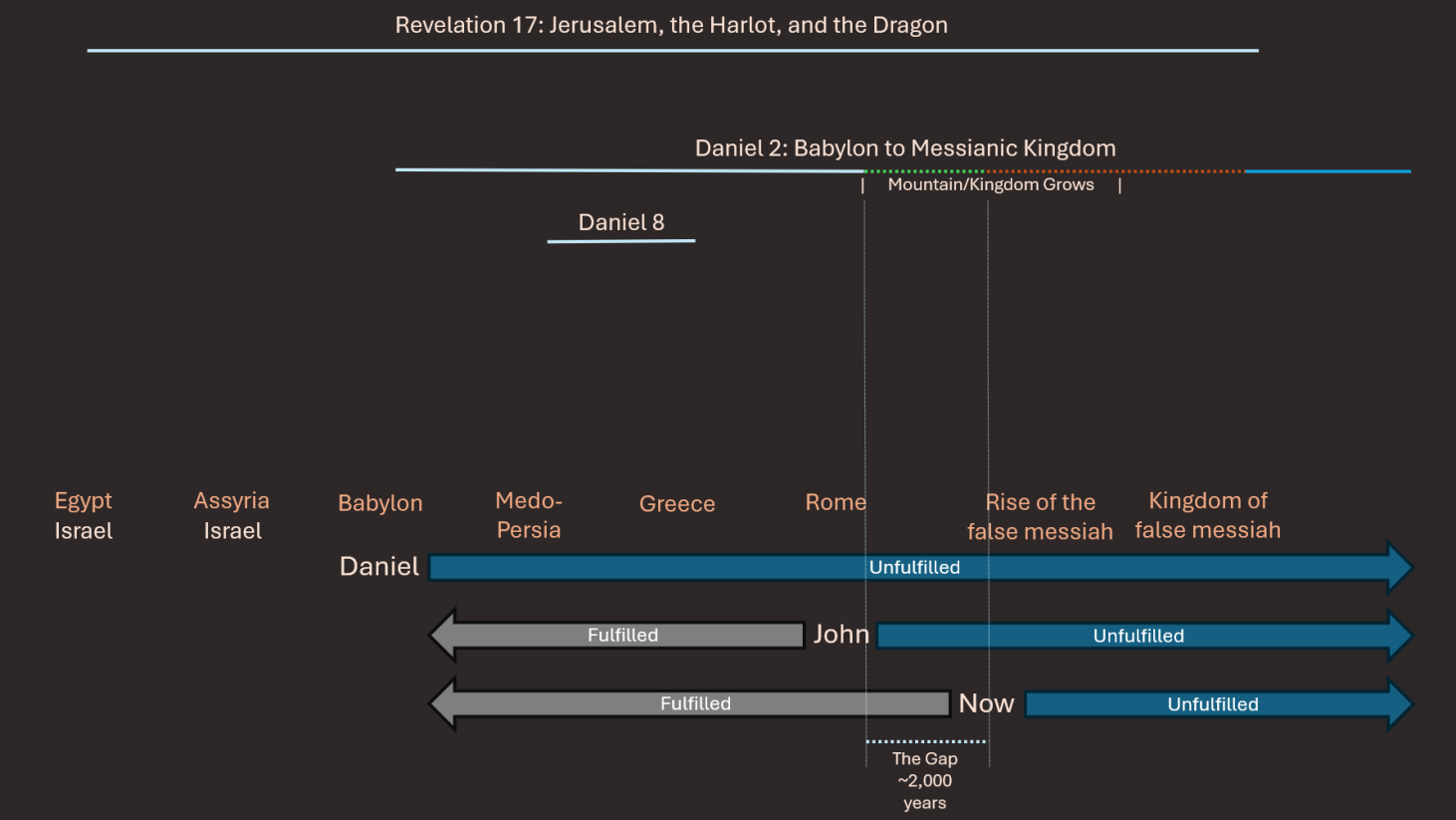
In terms of Revelation 17, it covers only the time from the fourth to fifth head, just prior to Rome as the sixth. In terms of Daniel 2 it covers the second kingdom of the arms and breast of silver through the third kingdom of belly and thighs of brass. It therefore has no literal connection to end time events, which would seem to include the 2,300 days. The documenting of the events in Maccabees is around the time period from the stopping of the daily and abomination of desolation to the re-dedication of the temple on Hanukkah, foretold centuries prior through Daniel’s vision and interpretation.
However, there are important foreshadows meant to give us greater understanding of the abomination of desolation and character of the one who causes it. Yeshua pointed us to Daniel to understand the event and since this vision is fulfilled historically, what can we derive from it is an example of what the term means and possible events that surround it? These include a stopping of the daily and placing of an idol in the temple. While we have the historical characters who participated in this, they are distinctly historical in nature so we cannot equate them to future events, but we can associate the characteristics. I personally limit the extent of the foreshadowing to these characteristics and not specifics that are tied to the historical nature, such as Antiochus IV being a Gentile king from Israel’s North. These kinds of details are not the focus of the prophecy, but rather the character and actions are what is the focus of the vision.
He was a proud and deceitful king who controlled the land of Israel politically and stood against God to force His chosen people to rebel from the everlasting statutes He gave them to perform. Many of the people were willing, whether through fear of death or lack of faithfulness to God, to abandon His Law to follow after other gods. In this apostasy, the daily was stopped and an idol of a false god took over God’s temple and He departed, leaving it desolate of His presence. Antiochus IV was later judged by God and his horn was broken without hand. This is the essence of the abomination of desolation that we see depicted by Paul regarding the time of the end.
2 Thessalonians 2:1-12
Now we beseech you, brethren, by the coming of our Lord Jesus Christ, and [by] our gathering together unto him, That ye be not soon shaken in mind, or be troubled, neither by spirit, nor by word, nor by letter as from us, as that the day of Christ is at hand. Let no man deceive you by any means: for [that day shall not come], except there come a falling away first, and that man of sin be revealed, the son of perdition; Who opposeth and exalteth himself above all that is called God, or that is worshipped; so that he as God sitteth in the temple of God, shewing himself that he is God. Remember ye not, that, when I was yet with you, I told you these things? And now ye know what withholdeth that he might be revealed in his time. For the mystery of iniquity doth already work: only he who now letteth [will let], until he be taken out of the way. And then shall that Wicked be revealed, whom the Lord shall consume with the spirit of his mouth, and shall destroy with the brightness of his coming: [Even him], whose coming is after the working of Satan with all power and signs and lying wonders, And with all deceivableness of unrighteousness in them that perish; because they received not the love of the truth, that they might be saved. And for this cause God shall send them strong delusion, that they should believe a lie: That they all might be damned who believed not the truth, but had pleasure in unrighteousness.
So when Yeshua points us back to Daniel we can see this future event foreshadowed in the falling away from the truth as it is cast to the ground and trampled and a man of sin who declares himself to be God, yet is a false god, sets himself up as an idol to be worshiped, killing those who refuse him, and will ultimately be broken without hand at the return of the Lord by Yeshua when cast into the lake of fire.
In all of this we see that from Daniel’s perspective this was all future while for us living at the time of the end it was all fulfilled historically. Yet even in this we gain insight to the characteristics of the future events that will unfold in similar fashion because the mystery of iniquity, the spirit of the Dragon, is working through deceit and treachery to destroy God’s people spiritually however he can. The end is written, now we must trust God’s Word and understand the truth so we are not deceived by the lie.
Amos 3:7
Surely the Lord GOD will do nothing, but he revealeth his secret unto his servants the prophets.
1 Thessalonians 5:1-4
But of the times and the seasons, brethren, ye have no need that I write unto you. For yourselves know perfectly that the day of the Lord so cometh as a thief in the night. For when they shall say, Peace and safety; then sudden destruction cometh upon them, as travail upon a woman with child; and they shall not escape. But ye, brethren, are not in darkness, that that day should overtake you as a thief.
Daniel 8 is one piece of that understanding and as we continue to look at the visions of Daniel and John, each piece will continue to highlight new perspectives of these events. Once we have all the puzzle pieces laid out upright on the table and sorted according to the images painted for us, we will see better how those pieces fit together and a more holistic picture will emerge showing us that God has not left us in darkness concerning His plans, He keeps His promises. †
May God continue to bless you as you remain in Him.


“Be not overcome
of evil, but overcome evil with good.” Romans 12:21 In accordance with Title 17 U.S.C. Section 107, any copyrighted work herein is archived under fair use without profit or payment to those who have expressed a prior interest in reviewing the included information for personal use, non-profit research and educational purposes only. Ref.
Watchman Bible Study | 2005 - 2026