Vision of Daniel 9

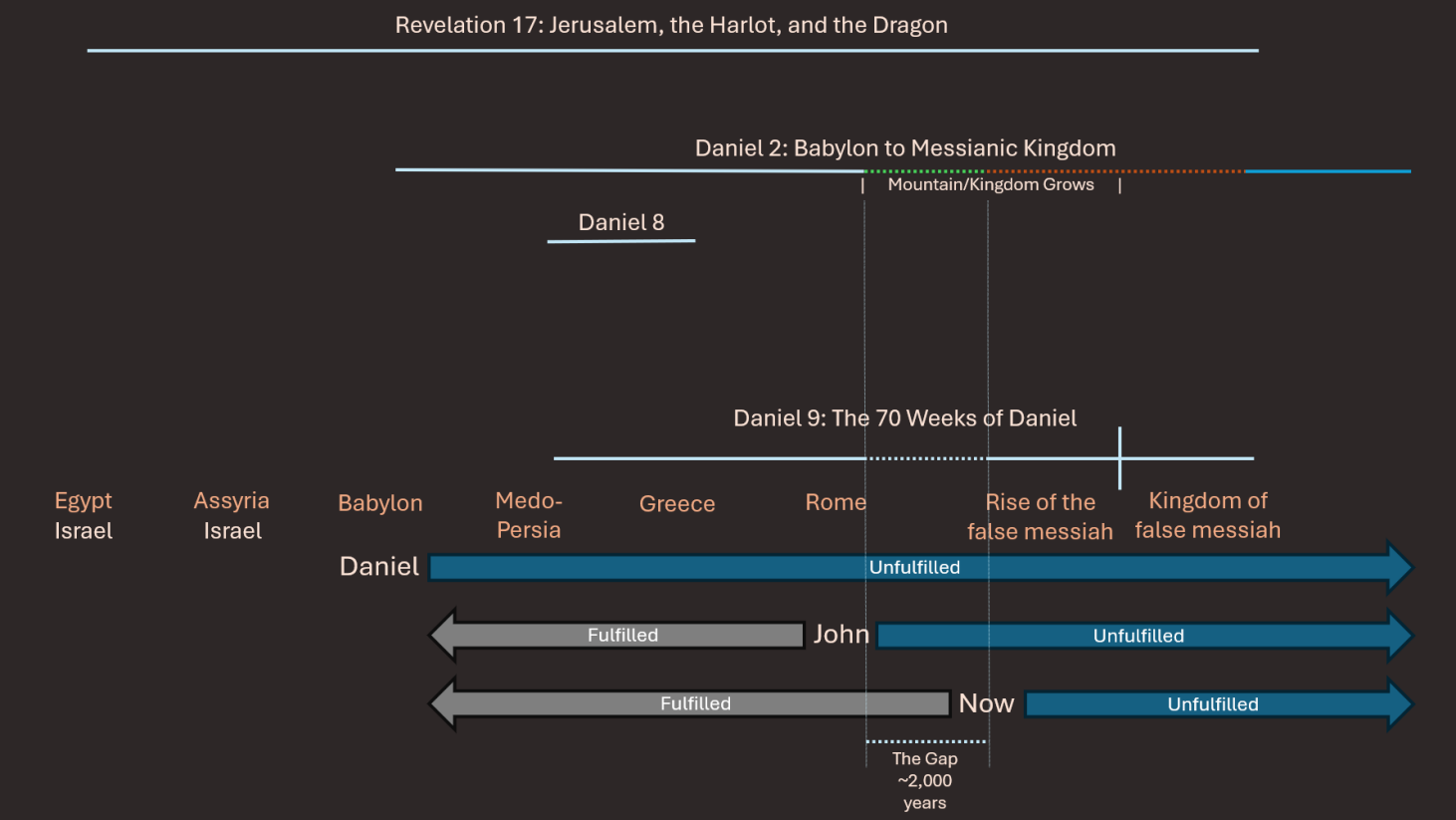
70 Weeks for Israel and Jerusalem
TL;DR
The Babylonian captivity coming to an end as prophesied by Jeremiah, Daniel prays with a spirit of repentance and supplication to God for the forgiveness of his people and Jerusalem. The answer comes to him through the angel Gabriel to provide one of the most precise and expansive prophecies tied to God’s plan for Israel and Jerusalem from the rebuilding of the city to the reign over it by the Messiah some 2,500 years later.
While the entire prophetic scope of the prophecy is delivered in just four short verses, we must not forget the context in which it was given and about whom it was given. This is a prophecy pointed explicitly to Israel, Jerusalem, and God’s relationship with them in terms of His footstool on Mount Zion from where He meets with them. This includes the timing of the arrival of the Messiah and the events around which He returns.
The recognized centrality of this prophetic passage has been interpreted through the lens of many paradigms to bolster different views of timing regarding its fulfillment. Its characters have been defined in many different ways and even the order of the verses have been switched around to support different views. My goal in this study is to take scripture as written, in the order written, accepting that God says what He means and means what He says. The interpretation will be focused on and taken from scripture itself to leave as much of my own interpretation out of it. My goal is not to support a paradigm, but to understand what God’s answer to Daniel regarding the future of his people and Jerusalem means, according to God.
While there is not a lot of text to the actual prophecy, there are a lot of detail embedded within it. And with the benefit of hindsight, we are witnesses to the glory of God’s Word and evidence of His atemporal nature and omnipotence. Unlike the great prophets that came before us and delivered to us God’s Word, we have a great gift in being able to look at history to see this prophecy, that is only partially fulfilled, and understand both what it meant historically and what it will mean in our future.
Prophetic Scope
While the scope of this prophecy covers a 490 year period of time appointed to Israel and Jerusalem, it is broken up into a 49 and 434 year period totaling 483 years from 457 BC to 27 AD. It is after this period that the death of the Messiah is prophesied as well as the destruction of Jerusalem prior to the completion of the prophecy with the final 7 years yet to begin.
It should be noted that at the time Daniel received the vision of this prophecy, Medo-Persia had just conquered Babylon and everything in this prophecy was yet future to Daniel. For us living within the time of partial fulfillment, we get to examine history and see the accuracy of what is fulfilled to bolster our faith in what is not yet fulfilled.
Prophetic Characters
- Daniel
- While not a character of the prophecy itself, the context of his prayer and supplication to God is.
- Daniel’s prayer is in the first year of Darius the Mede, made king over the realm of the Chaldeans (Babylon).
- Daniel understood by books the seventy years in the desolations of Jerusalem prophesied by Jeremiah were to be accomplished.
- Daniel turned to the Lord in prayer and supplications with fasting, sackcloth, and ashes.
- Daniel recognizes that God keeps His covenant, with mercy on those who remain obedient and keep His commandments.
- Daniel confesses the sin of his people.
- They have not kept His commandments, precepts, and judgements given to them to do.
- They have not listened to His servants the prophets who spoke to the kings, princes, fathers, and people on behalf of God.
- They do not present their prayers and supplications in repentance to God in accordance to what was foretold in the law of Moses.
- Daniel recognizes the distress that has come upon his people according to their sins, transgressions, and rebellion
- Daniel recognizes that, of the blessings and curses agreed to at Sinai and written in the law of Moses, they were receiving the appointed curses and great evil upon them and Jerusalem because of their sins.
- Daniel prays that God doesn’t turn away from Jerusalem, His holy mountain, forever because of their iniquity. That God would cause His face to shine on His desolate sanctuary for the Lord’s sake.
- Daniel calls God’s attention to the desolation of His people and the city called by His name, Jerusalem.
- Daniel begs the Lord’s forgiveness for his people and city that are called by His name not because of them, but for the sake of the Lord’s name. He desires God’s glory.
- The angel Gabriel is sent at the beginning of Daniel’s supplication to give him skill and understanding, to show him a vision of Israel’s and Jerusalem’s future.
- Daniel is greatly beloved by God due to the humility and repentance of his prayer for his people and Jerusalem to God’s glory.
- Israel and Jerusalem
- Seventy weeks (sevens) are determined upon them to accomplish
several things related to their combined time.
- To finish the transgression
- To make an end of sins
- To make reconciliation for iniquity
- To bring in everlasting Righteousness
- To seal up the vision and prophecy
- To anoint the most Holy
- A commandment to restore and build Jerusalem’s streets and walls will be given, though this will be done in troubled times. This will be the start of a period of 7 weeks and 62 weeks, a total of 69 weeks.
- After the Messiah is cut off, the people of a prince that will come will destroy the city and the sanctuary.
- Desolations are determined until the end of the war.
- Seventy weeks (sevens) are determined upon them to accomplish
several things related to their combined time.
- Messiah the Prince, Yeshua
- The Messiah the Prince will come at the end of the 69 weeks period.
- After the first 69 weeks have completed, He will be cut off, but not for Himself.
- Man of the 70th Week
- The covenant with many is strengthened for 1 week by a man.
- In the midst of the week, the sacrifice and oblation will be stopped by him and an overspreading of abominations he causes will make desolate. This will continue until the end as that determined is poured out on the desolate.
Fulfilled Prophecy Triggers Prophecy
Daniel recognized the prophesied 70 years was accomplished according to Jeremiah 25:1-13, 2 Chronicles 36:15-21, and Jeremiah 29:1-11 and he repented and gave glory to God. So it was given to Daniel to know the future of his people and holy city. It was his recognition of fulfilled prophecy that spurred recognition of sin, repentance, and calling on God’s mercy to keep His promises. Daniel trusted in God’s promise to reunite His appointed people and His appointed place once again after the 70 years had been accomplished. This is an example to us to trust in God’s Word and approach understanding with a heart of humility, repentance, and faith.
One of the great things about this vision is it provides a strong foundation upon which to stand in faith on His Word due to the fulfillment of part of this prophecy. And in seeing how precisely it was fulfilled, we can look confidently at what has not yet been fulfilled in this central prophecy around which much of end time prophecy revolves. And just as we can trust God’s Word here, we can take Him at His Word elsewhere in understanding our future.
What Daniel received was a prophecy of a coming 483 year period of time. This entire prophecy is clearly focused on Israel and Jerusalem, which is the context for everything it reveals. After this the promised Messiah would establish His kingdom and accomplish His mission to save those that love God by showing the greatest love possible, sacrificing His life for their salvation. This would then be followed by a final 7 year period in which the final trying of Israel would be accomplished and the remnant faithful would enter into the promise made under their anointed King.
The fulfillment of one prophecy in the 70 years of desolations for Jerusalem, focused on Israel and Jerusalem, was the trigger for understanding the remaining future of Israel in Jerusalem following God’s statutes given to them. And this is an important point of context in which to view the prophecy as seen in Daniel’s prayer.
Daniel’s Prayer
While it’s tempting to jump to the last four verses in Daniel 9, it’s important to understand the mindset of Daniel in his prayer for Israel and Jerusalem, God’s holy mountain. It also provides critical context for often debated terminology used in the prophecy that can change the whole paradigm of interpretation. I believe it is important that our paradigms be created as much as possible by the text interpreting itself.
Of first note is that Daniel was repenting on behalf of his people and recognizing God’s faithfulness in keeping the covenant that Israel had departed from.
Daniel 9:3-6, 9-13
And I prayed unto the LORD my God, and made my confession, and said, O Lord, the great and dreadful God, keeping the covenant and mercy to them that love him, and to them that keep his commandments; We have sinned, and have committed iniquity, and have done wickedly, and have rebelled, even by departing from thy precepts and from thy judgments: Neither have we hearkened unto thy servants the prophets, which spake in thy name to our kings, our princes, and our fathers, and to all the people of the land. ... To the Lord our God [belong] mercies and forgivenesses, though we have rebelled against him; Neither have we obeyed the voice of the LORD our God, to walk in his laws, which he set before us by his servants the prophets. Yea, all Israel have transgressed thy law, even by departing, that they might not obey thy voice; therefore the curse is poured upon us, and the oath that [is] written in the law of Moses the servant of God, because we have sinned against him. And he hath confirmed his words, which he spake against us, and against our judges that judged us, by bringing upon us a great evil: for under the whole heaven hath not been done as hath been done upon Jerusalem. As [it is] written in the law of Moses, all this evil is come upon us: yet made we not our prayer before the LORD our God, that we might turn from our iniquities, and understand thy truth.
Now there are many covenants that God made. Adamic Covenant - (Genesis 1:26-30, Genesis 2:16-17, Genesis 3:15), Noahic Covenant - (Genesis 9:8-17), Abrahamic Covenant - (Genesis 12:1-3, Genesis 13:14-17, Genesis 15:1-21, Romans 4:9-22), Mosaic Covenant - (Exodus 24:1-12, Deuteronomy 11, Deuteronomy 28:15-68, Leviticus 26:14-46), Land Covenant - (Deuteronomy 30:1-10), Davidic Covenant - (2 Samuel 7:8-16, Luke 1:31-35), and the New Covenant - (Jeremiah 31:31-34, Matthew 26:28, Hebrews 9:15)
Given the context of Daniel’s prayer, it is pretty clear what covenant was on Daniel’s mind that God upheld and Israel sinned against. This is an important context to hold onto for the rest of the study. Israel’s sin, iniquity, wickedness, and rebellion in departing from God’s precepts and judgements are directly tied to the law of Moses. And we can see the blessings and curses being referred to in Deuteronomy.
Deuteronomy 11:26-32
Behold, I set before you this day a blessing and a curse; A blessing, if ye obey the commandments of the LORD your God, which I command you this day: And a curse, if ye will not obey the commandments of the LORD your God, but turn aside out of the way which I command you this day, to go after other gods, which ye have not known. And it shall come to pass, when the LORD thy God hath brought thee in unto the land whither thou goest to possess it, that thou shalt put the blessing upon mount Gerizim, and the curse upon mount Ebal. [Are] they not on the other side Jordan, by the way where the sun goeth down, in the land of the Canaanites, which dwell in the champaign over against Gilgal, beside the plains of Moreh? For ye shall pass over Jordan to go in to possess the land which the LORD your God giveth you, and ye shall possess it, and dwell therein. And ye shall observe to do all the statutes and judgments which I set before you this day.
This is expanded upon in greater detail in Deuteronomy 28:15-68. These blessings and curses laid upon Israel according to their faithfulness to God follow Deuteronomy 9 where Israel worships the golden calf as they await Moses to return from atop Sinai and Moses breaks the first tablets written by God for His people. Deuteronomy 10 contains the rewriting of the tablets. The laws and statutes Israel has sinned against are clearly those of the Mosaic Covenant.
What is on Daniel’s mind in his prayer is the Mosaic Covenant to which Israel agreed to at Sinai. Exodus 19:7-8 | Exodus 24:3 He recognized Israel’s unfaithfulness and the promised curse being poured out upon Israel because of their unfaithfulness. Yet he also recognizes God’s faithfulness as well as God’s mercy and promise to return Israel in 70 years, according to prophecy. What is interesting for later in the prophecy is that Daniel states that “the curse is poured upon [Israel].” This word, nāṯaḵ H5413 (וַתִּתַּךְ), is also used in context of “that determined shall be poured upon the desolate.” We’ll get into that later.
But this isn’t just about Israel. He also recognizes Jerusalem, and Mount Zion, as directly tied to his people and desires God to remember His holy habitation and His promises. Why are these so tied together? The answer is relationship. The mercy seat, the footstool and earthly throne of God, within the tabernacle is where communion with God happened.
Exodus 25:21-22
And thou shalt put the mercy seat above upon the ark; and in the ark thou shalt put the testimony that I shall give thee. And there I will meet with thee, and I will commune with thee from above the mercy seat, from between the two cherubims which [are] upon the ark of the testimony, of all [things] which I will give thee in commandment unto the children of Israel.
At first it was a mobile tabernacle until Solomon built a house for the Lord on Mount Zion. While it was only the high priest who once a year entered the most Holy to sprinkle the blood of the offering on the mercy seat of the Ark of the Covenant where God’s presence rested, it was the door of the tabernacle before the altar of sacrifice where the appointed people were to meet at the appointed times at this appointed place. And this is tied to the daily to be done throughout Israel’s generations.
Exodus 29:42-46
[This shall be] a continual burnt offering throughout your generations [at] the door of the tabernacle of the congregation before the LORD: where I will meet you, to speak there unto thee. And there I will meet with the children of Israel, and [the tabernacle] shall be sanctified by my glory. And I will sanctify the tabernacle of the congregation, and the altar: I will sanctify also both Aaron and his sons, to minister to me in the priest’s office. And I will dwell among the children of Israel, and will be their God. And they shall know that I [am] the LORD their God, that brought them forth out of the land of Egypt, that I may dwell among them: I [am] the LORD their God.
This is why Israel and Jerusalem are tied together, because God does not forget His covenants and desires relationship with a humble, obedient, and repentant people that love Him and each other. Daniel’s humble and repentant heart of faithfulness is beloved by God, and Daniel’s love for God and his people brings skill and understanding of a vision regarding the future of Israel and Jerusalem.
Just as Daniel saw his people and city inextricably linked, so God’s response given to Daniel tied them together. This is an important context we will see in determining what periods of time the weeks can be applied to.
Scope of the 70 Weeks
Daniel 9:24
Seventy weeks are determined upon thy people and upon thy holy city, to finish the transgression, and to make an end of sins, and to make reconciliation for iniquity, and to bring in everlasting righteousness, and to seal up the vision and prophecy, and to anoint the most Holy.
70 Weeks
Seventy is pretty self-explanatory as is weeks, but most people really only deal with weeks of days, or seven days. The Hebrew word used is shâbûwaʻ H7620 (שָׁבוּעַ) a period of seven, a heptad, from where the weeks of days are derived and the Sabbath day of rest on the seventh day. In the appointed times for Israel, the heptad was also used of weeks for Shavuot, the feast of weeks. Christians know it as Pentecost, or pentēkostḗ G4005 (πεντηκοστή), the fiftieth day, though unfortunately the connection is lost on many to its Hebrew roots.
Leviticus 23:15-16
And ye shall count unto you from the morrow after the sabbath, from the day that ye brought the sheaf of the wave offering; seven sabbaths shall be complete: Even unto the morrow after the seventh sabbath shall ye number fifty days; and ye shall offer a new meat offering unto the LORD.
As I touched on in the Daniel 8 study, the central appointed time that determined the whole year to come was Firstfruits, or the Wave Sheaf offering (Yom HaBikkurim). This was because the firstfruits of the harvest had to be ripe to offer to the Lord and this had to be determined 15+ days earlier in order to determine the first month of the year. It always had to occur on the day after Sabbath within Unleavened Bread (Chag HaMatzot) because Pentecost (Shavuot) was to be on the day after the Sabbath after seven weeks of weeks had passed, 49 days. This made the day after the 50th day, or Pentecost. Interestingly, it is also celebrated as the time during the Exodus when Israel received the ten commandments at Sinai.
Exodus 19:1-2
In the third month, when the children of Israel were gone forth out of the land of Egypt, the same day came they [into] the wilderness of Sinai. For they were departed from Rephidim, and were come [to] the desert of Sinai, and had pitched in the wilderness; and there Israel camped before the mount.
Passover (Pesach) was on the 14th of the first month of Abib/Nisan when Israel began to flee Egypt. The same time in the midst of the third month would have been about two weeks of the first month, plus four weeks of the second month, plus a couple weeks of the third month. This would be around the time of Pentecost (Shavuot) following the flight from Egypt.
So here we see the first Pentecost where the Spirit of God descended on Mount Sinai like a fire and Moses went up to meet God and receive His commandments. About the same time over a millennia later, the Spirit of God descended as tongues of fire over the heads of the early church and the Gospel, the fulfillment of the Law, was conveyed in all languages that the hearers needed to hear. But I digress.
But we also have an example from scripture of a heptad being applied to years in the jubilee, which we will also see in the weeks of years coming up in this prophecy.
Leviticus 25:8-10
And thou shalt number seven sabbaths of years unto thee, seven times seven years; and the space of the seven sabbaths of years shall be unto thee forty and nine years. Then shalt thou cause the trumpet of the jubile to sound on the tenth [day] of the seventh month, in the day of atonement shall ye make the trumpet sound throughout all your land. And ye shall hallow the fiftieth year, and proclaim liberty throughout [all] the land unto all the inhabitants thereof: it shall be a jubile unto you; and ye shall return every man unto his possession, and ye shall return every man unto his family.
The point is that we can detach the counting of days from the term translated as weeks here because it more appropriately points to a group of seven, a heptad. What denomination of time is attached to those seven is determined by the context of the prophecy.
Seventy sevens of days is 490 days and will not fit as it is much too short a period of time. Seventy sevens of weeks is 490 weeks, or 3,430 days and is likewise too short. Months are not really calculated in this way while years are, and getting into decades and centuries is much too long a period of time. As we get into these seventy weeks, it will become clear that years is the time period being referred to with great accuracy.
Israel and Jerusalem
The most clearly stated yet sometimes overlooked context to this prophecy is that it’s explicitly stated to be for Daniel’s people, Israel, and Daniel’s holy city, Jerusalem. This means everything this prophecy contains is directly related to these two identities. This makes sense because Jerusalem is where Mount Zion is, God’s chosen habitation where He promised to meet with His people in their obedience to His statutes.
This frames everything that follows and explains why there is a gap in this prophecy between the first 69 weeks of it and the final 70th week, which we’ll get into shortly. But first let’s take a contextual look at the other scoping elements of this prophecy.
To Finish the Transgression
- kālā’ H3607 (לְכַלֵּא) “to restrict, by act (hold back or in) or word (prohibit):—finish, forbid, keep (back), refrain, restrain, retain, shut up, be stayed, withhold”
- pešaʿ H6588 (הַפֶּשַׁע) “a revolt (national, moral or religious):—rebellion, sin, transgression, trespass.”
The transgression is masculine singular absolute, and in the context of Israel and Jerusalem it is seen throughout the Old Testament as Israel, dwelling in Jerusalem, would waffle between faithfulness and unfaithfulness, obedience and rebellion. In the terms of the figurative marriage language of God’s covenant relationship with Israel, she was at times adulterous and playing the harlot going after false gods and transgressing the covenant she agreed to at Sinai.
Part of this transgression has to do with following the statutes God gave them to keep throughout their generations, the works of the Law. Yeshua made it clear that even in His time 2,000 years ago many of the religious leadership honored God with their lips, but their hearts were far from Him. Yet they followed the statutes that were only possible with a temple in Jerusalem. Since 70 AD this has not been possible, and even in 1967 when Israel first re-captured the Temple Mount, they gave up sovereign control of it to the Waqf and to this day they lack the location on Mount Zion to build the tabernacle required to keep Torah properly throughout their generations according to the Word of God.
But the action to this transgression speaks of a finishing of it. In other uses it implies an active restraining or withholding of it. In the context of Israel and Jerusalem, this implies a change of heart from both the secular state of Israel today and even an eternal faithfulness that would prevent future transgression of Israel against God. Hosea speaks to the contrasting of the unfaithfulness of Israel in Hosea 2:1-13 while the remainder of the chapter speaks to her future restoration.
Hosea 2:14, 16-17, 19-20, 23
Therefore, behold, I will allure her, and bring her into the wilderness, and speak comfortably unto her. ... And it shall be at that day, saith the LORD, [that] thou shalt call me Ishi[husband]; and shalt call me no more Baali[my lord]. For I will take away the names of Baalim out of her mouth, and they shall no more be remembered by their name. ... And I will betroth thee unto me for ever; yea, I will betroth thee unto me in righteousness, and in judgment, and in lovingkindness, and in mercies. I will even betroth thee unto me in faithfulness: and thou shalt know the LORD. ... And I will sow her unto me in the earth; and I will have mercy upon her that had not obtained mercy; and I will say to [them which were] not my people, Thou [art] my people; and they shall say, [Thou art] my God.
Ezekiel 37:21-23
And say unto them, Thus saith the Lord GOD; Behold, I will take the children of Israel from among the heathen, whither they be gone, and will gather them on every side, and bring them into their own land: And I will make them one nation in the land upon the mountains of Israel; and one king shall be king to them all: and they shall be no more two nations, neither shall they be divided into two kingdoms any more at all: Neither shall they defile themselves any more with their idols, nor with their detestable things, nor with any of their transgressions: but I will save them out of all their dwellingplaces, wherein they have sinned, and will cleanse them: so shall they be my people, and I will be their God.
Isaiah 35:4-5, 10
Say to them [that are] of a fearful heart, Be strong, fear not: behold, your God will come [with] vengeance, [even] God [with] a recompence; he will come and save you. Then the eyes of the blind shall be opened, and the ears of the deaf shall be unstopped. ... And the ransomed of the LORD shall return, and come to Zion with songs and everlasting joy upon their heads: they shall obtain joy and gladness, and sorrow and sighing shall flee away.
Zechariah 12:10
And I will pour upon the house of David, and upon the inhabitants of Jerusalem, the spirit of grace and of supplications: and they shall look upon me whom they have pierced, and they shall mourn for him, as one mourneth for [his] only [son], and shall be in bitterness for him, as one that is in bitterness for [his] firstborn.
Revelation 1:7
Behold, he cometh with clouds; and every eye shall see him, and they [also] which pierced him: and all kindreds of the earth shall wail because of him. Even so, Amen.
There is a time coming, yet future, when Israel will finally open their eyes and see Yeshua as their Messiah. The recognition is said to happen at Yeshua’s parousia, or second coming, but the ultimate fulfillment must include Jerusalem as well, which will not be perfected until the end of the 70th week. It is then, upon the ashes of the destruction of the harlot city, the eternally faithful city of the Messianic Kingdom will be built and Israel will no longer defile themselves with false gods and transgressions forever. They will come out of the wilderness into the Promised Land with the Son of Man ruling over them, their God and King.
To Make an End of Sins
- tāmam H8552 (וּלְהָתֵם) “to complete, be (make) perfect, be spent, sum, be (shew self) upright.”
- ḥaṭṭā’āṯ H2403 (חַטָּאת) “an offence (sometimes habitual sinfulness), and its penalty, occasion, sacrifice, or expiation; also (concretely) an offender:—punishment (of sin), purifying(-fication for sin), sin(-ner, offering).”
“And to make an end” is in the context of being paid off. When put together with the sins, it speaks to the completion of the judgements being accomplished according to the time God laid out for Israel if they were not obedient. It is used in similar context in Daniel 8:23 “when the transgressors are come to the full.”
So in the context of Israel and Jerusalem, the transgressions being judged for the determined period of time will one day have paid in full and if they don’t continue in rebellion, will stand upright before God again.
It may be said that Yeshua’s death on the cross is the making an end of sins, but because of the context of Israel and Jerusalem, as with the continuing in transgression and not accepting Yeshua as the Messiah, the end hasn’t been made to their sins. That is incumbent upon them to not continue in sin, yet their eyes remain closed.
So this would seem to be around the same time frame of the return of Yeshua and their blindness being lifted so that they accept the Messiah they have rejected for 2,000 years and enter into His rest. It is in this that the sins will cease and the judgement for them complete.
Romans 11:25-27
For I would not, brethren, that ye should be ignorant of this mystery, lest ye should be wise in your own conceits; that blindness in part is happened to Israel, until the fulness of the Gentiles be come in. And so all Israel shall be saved: as it is written, There shall come out of Sion the Deliverer, and shall turn away ungodliness from Jacob: For this [is] my covenant unto them, when I shall take away their sins.
To Make Reconciliation for Iniquity
- kāp̄ar H3722 (וּלְכַפֵּר) “a primitive root; to cover (specifically with bitumen); figuratively, to expiate or condone, to placate or cancel:—appease, make (an atonement, cleanse, disannul, forgive, be merciful, pacify, pardon, purge (away), put off, (make) reconcile(-liation).”
- ʿāôn H5771 (עָוֺן) “from H5753; perversity, i.e. (moral) evil:—fault, iniquity, mischeif, punishment (of iniquity), sin.”
A common theme in the first three statements of scope for these 70 weeks is transgression, sin, iniquity. Related to Israel and Jerusalem they are to be finished and made an end of, but a just God must deal with rebellion, sin, and iniquity in order to be just. We can see from even a secular point of view how when lawlessness is allowed, it quickly grows out of hand unless it is judged and sentenced. Yet there is an eternal nature to judgement of an eternal being, which mankind is. This is ultimately what mankind needed to be saved from, the eternal righteous judgement of a holy God.
But even though without the shedding of blood there is no remission of sin, Hebrews 9:19-28, it is also not possible for the blood of bulls and goats to take away sin, Hebrews 10:1-4, only temporarily cover them to allow communion with a holy God. The sacrificial system is not a reconciliation for iniquity, it is a remembrance of it. Therefore, in order to truly make a lasting atonement and pardon from judgement for iniquity all men bear, a New Covenant was required. Just as the animal sacrifice had to be without spot or blemish physically, the greater sacrifice had to be without spot or blemish spiritually. Hebrews 9:13-18 A man with no sin must offer Himself selflessly.
John 15:12-17
This is my commandment, That ye love one another, as I have loved you. Greater love hath no man than this, that a man lay down his life for his friends. Ye are my friends, if ye do whatsoever I command you. Henceforth I call you not servants; for the servant knoweth not what his lord doeth: but I have called you friends; for all things that I have heard of my Father I have made known unto you. Ye have not chosen me, but I have chosen you, and ordained you, that ye should go and bring forth fruit, and [that] your fruit should remain: that whatsoever ye shall ask of the Father in my name, he may give it you. These things I command you, that ye love one another.
When Moses pleaded for his people when God was going to disinherit them in their faithlessness, and we see Moses make a statement that speaks to ongoing judgement for iniquity through generations.
Numbers 14:17-19
And now, I beseech thee, let the power of my Lord be great, according as thou hast spoken, saying, The LORD [is] longsuffering, and of great mercy, forgiving iniquity and transgression, and by no means clearing [the guilty], visiting the iniquity of the fathers upon the children unto the third and fourth [generation]. Pardon, I beseech thee, the iniquity of this people according unto the greatness of thy mercy, and as thou hast forgiven this people, from Egypt even until now.
This is something quite different from what came with Yeshua’s sacrifice, where individuals have faith in His sacrifice and have a personal relationship where their iniquity is forgiven as they remain obedient and the Spirit of God dwells with them in their temples of flesh. The cleansing through the atonement of the blood of the Lamb of God was accomplished on the cross.
So I believe that this has been accomplished in 30 AD, though not fully realized by those of Israel that have closed their eyes to it. However, the reconciliation was made and is available to each individual at whatever time they come to believe and obey.
To Bring in Everlasting Righteousness
- bô’ H935 (וּלְהָבִיא) “a primitive root; to go or come (in a wide variety of applications):—abide, apply, attain, be, befall, besiege, bring (forth, in, into, to pass), call, carry, certainly, (cause, let, thing for) to come (against, in, out, upon, to pass), depart, doubtless again, eat, employ, (cause to) enter (in, into, -tering, -trance, -try), be fallen, fetch, follow, get, give, go (down, in, to war), grant, have, indeed, (in-) vade, lead, lift (up), mention, pull in, put, resort, run (down), send, set, (well) stricken (in age), surely, take (in), way.”
- ʿôlām H5769 (עֹלָמִים) “from H5956; properly, concealed, i.e. the vanishing point; generally, time out of mind (past or future), i.e. (practically) eternity; frequentatively, adverbial (especially with prepositional prefix) always:—alway(-s), ancient (time), any more, continuance, eternal, (for, (n-)) ever(-lasting, -more, of old), lasting, long (time), (of) old (time), perpetual, at any time, (beginning of the) world (without end).”
- ṣeḏeq H6664 (צֶדֶק) “from H6663; the right (natural, moral or legal); also (abstractly) equity or (figuratively) prosperity:—even, (that which is altogether) just(-ice), (un-)right(-eous) (cause, -ly, -ness).”
“To bring in” is to cause to come about and is pointing to perpetual moral uprightness. The finishing of transgression and making an end of sins is one side of the same coin as bringing in everlasting righteousness. One side views stopping the negative and the other is starting the positive.
In the context of Israel and Jerusalem I see them as pointing to the same time when rebellion ceases so that faithfulness can remain, and this doesn’t happen until after Israel sees and accepts Yeshua as the Messiah. When the kingdom is restored to Israel and led by their King, perpetual righteousness will begin in His reign.
To Seal Up the Vision and Prophecy
- ḥāṯam H2856 (וְלַחְתֹּם) “a primitive root; to close up; especially to seal:—make an end, mark, seal (up), stop.”
- ḥāzôn H2377 (חָזוֹן) “from H2372; a sight (mentally), i.e. a dream, revelation, or oracle:—vision.”
- nāḇî’ H5030 (וְנָבִיא) “from H5012; a prophet or (generally) inspired man:—prophecy, that prophesy, prophet.”
“To seal up” is meant to fasten up by sealing, in this case a book of vision and prophecy.
Isaiah 29:10-11
For the LORD hath poured out upon you the spirit of deep sleep, and hath closed your eyes: the prophets and your rulers, the seers hath he covered. And the vision of all is become unto you as the words of a book that is sealed[H2856], which [men] deliver to one that is learned, saying, Read this, I pray thee: and he saith, I cannot; for it [is] sealed[H2856]:
We will see in the next study a similar idea related to prophecy being sealed for a later time, a kind of shutting up of understanding of its meaning until the time in which it is revealed.
Daniel 12:4
But thou, O Daniel, shut up the words, and seal the book, [even] to the time of the end: many shall run to and fro, and knowledge shall be increased.
It’s likewise used both literally and as prophecy when Jeremiah was imprisoned by Zedekiah for prophesying the Babylonian capture and destruction of Jerusalem. God had Jeremiah literally purchase land as a sign of the prophesied return of Israel to the land after 70 years. This same concept of sealing of a document like a deed is used.
Jeremiah 32:9-15, 44
And I bought the field of Hanameel my uncle’s son, that [was] in Anathoth, and weighed him the money, [even] seventeen shekels of silver. And I subscribed the evidence, and sealed[H2856] [it], and took witnesses, and weighed [him] the money in the balances. So I took the evidence of the purchase, [both] that which was sealed[H2856] [according] to the law and custom, and that which was open: And I gave the evidence of the purchase unto Baruch the son of Neriah, the son of Maaseiah, in the sight of Hanameel mine uncle’s [son], and in the presence of the witnesses that subscribed the book of the purchase, before all the Jews that sat in the court of the prison. And I charged Baruch before them, saying, Thus saith the LORD of hosts, the God of Israel; Take these evidences, this evidence of the purchase, both which is sealed[H2856], and this evidence which is open; and put them in an earthen vessel, that they may continue many days. For thus saith the LORD of hosts, the God of Israel; Houses and fields and vineyards shall be possessed again in this land. … Men shall buy fields for money, and subscribe evidences, and seal[H2856] [them], and take witnesses in the land of Benjamin, and in the places about Jerusalem, and in the cities of Judah, and in the cities of the mountains, and in the cities of the valley, and in the cities of the south: for I will cause their captivity to return, saith the LORD.
The sealing of a document requires the completion of it, to document all that it is meant to have contained. In the context of Israel and Jerusalem and the sealing up of the vision and prophecy, we would be looking for the last vision of a prophet having completed the prophetic narrative intended for us to have.
There can be no doubt that John’s vision documented in the book of Revelation is that final vision and prophecy that completed the cannon of scripture. While understanding of the visions and prophecy were effectively sealed up, we do of course have a physically unsealed Bible from which we gain understanding.
While there is disagreement as to whether the 70 weeks was all fulfilled historically or is still waiting fulfillment, I feel it is very clear that the sealing up the vision and prophecy was not fulfilled until after 95 AD and I believe this is confirmed by Irenaeus and Eusebius, not because they were trying to, but because of off-hand comments made while making other points.
“We will not, however, incur the risk of pronouncing positively as to the name of Antichrist; for if it were necessary that his name should be distinctly revealed in this present time, it would have been announced by him who beheld the apocalyptic vision. For that was seen no very long time since, but almost in our day, towards the end of Domitian’s reign.” | Against Heresies (Book V, Chapter 30), Irenaeus (130-202 AD)
In speaking of not naming the antichrist, Irenaeus specifies that John received the vision recorded in Revelation toward the end of Domitian’s reign, who was emperor of Rome from 81 to 96 AD. This was a comment secondary to the focus of the message, he wasn’t trying to prove a dating for John’s vision.
“[70] The Greek Olympiads … [81] 215th [81 A.D.] - Hermogenes of Xanthus, stadion race. [During this Olympiad] Domitian became emperor of the Romans. …” | Chronicle (Book 1), Eusebius (260-339 AD)
“In the Chronicle, Eusebius lists these events in the fourteenth year of Domitian: ‘Persecution of Christians and under him the apostle John is banished to Patmos and sees his Apocalypse, as Irenaeus mentions.’ Eusebius also records that ‘ancient Christian tradition’ held that John had been banished under Domitian:” | 2.11.4.2 - External Evidence for a Late Date
“But after Domitian had reigned fifteen years, and Nerva had succeeded to the empire, the Roman Senate, according to the writers that record the history of those days, voted that Domitian’s honors should be cancelled, and that those who had been unjustly banished should return to their homes and have their property restored to them. It was at this time that the apostle John returned from his banishment in the island and took up his abode at Ephesus, according to an ancient Christian tradition.” | Church History (Book 3, Chapter 20:10-11), Eusebius (260-339 AD)
Irenaeus and Eusebius, decades to centuries after John’s vision, point to a time toward the end of Domitian’s reign of 15 years where John is banished to Patmos and later sees the vision written in Revelation. So if we give some space to that, say 94-96 AD, the final vision and prophecy was given to John.
There are views that make the claim that all of the 70 weeks was fulfilled historically. These range from having the 70th week centered at 167 BC to 30 AD to 70 AD and fully completed. However, since the temple was destroyed in 70 AD, there is no way that Daniel 9:27 could be fulfilled because that would mean the vision and prophecy had to be sealed up by 73 AD at the latest according to that view, yet it was 8 years later that Domitian’s reign started and the end of his reign was up to 22 years after the destruction.
It is my contention therefore that the final week of years could only have come after the first century had closed out, but the events depicted in it could not because Israel was not in the land, in control of Jerusalem, nor was there a temple to either start the daily nor take it away in the midst of the seven years. As we will get into later, there is also the case that the end of the wars depicted before the 70th week begins ended well after John’s vision was given.
So while the sealing up in terms of the final prophetic record being given was done around 95 AD, the fulfillment of what was written is yet to be completed, and the unsealing of understanding it is still unfolding. It is within the 70th week that much of Revelation will be fulfilled.
To Anoint the Most Holy
- māšaḥ H4886 (וְלִמְשֹׁחַ) “a primitive root; to rub with oil, i.e. to anoint; by implication, to consecrate; also to paint:—anoint, paint.”
- qōḏeš (x2) H6944 (קֹדֶשׁ קָדָשִׁים) “from H6942; a sacred place or thing; rarely abstract, sanctity:—consecrated (thing), dedicated (thing), hallowed (thing), holiness, (most) holy (day, portion, thing), saint, sanctuary.”
“To anoint” speaks to the smearing of anointing oil or blood, depending on the context. Mashach is the root of Mashiach, anointed one. Anointing oil was poured over the heads of priests and kings to anoint them in their roles and the blood of the sacrifices was smeared, anointed, on the horns of the altar and sprinkled on the mercy seat of the Ark of the Covenant on Yom Kippur, among other temple vessels.
“The most holy” is actually the masculine singular of qôdesh, or holy, followed by the masculine plural of that same word, in other words holy of holies. This phrase occurs 24 times in 23 verses and speaks of the most holy place behind the veil of the sanctuary where the Ark of the Covenant was and the consecrated most holy things offered and used to minister in the temple.
Holy means sacred, or set apart. The holy of holies is the most set apart place, or the inner chamber of the temple where the Ark of the Covenant rested, overshadowed by the two cherubim stretching their wings from wall to wall and the two stretching their wings over the mercy seat of the Ark. Only the high priest entered this with much incense once a year to sprinkle the blood of the Yom Kippur offering made for the people onto the mercy seat.
It would seem to me that since the sacrificial system existed well before the prophecy, and Yom Kippur continued until 69 AD, this particular scope has a different meaning. While never used physically for this purpose, the mercy seat of the Ark of the Covenant represented a copy of the Ark in heaven, it was the footstool of God on earth. Perhaps it is Yeshua consecrating the temple built after His return by taking His seat in the throne room on Mount Zion in Jerusalem to reign during the Messianic Kingdom. As we saw in Exodus 29:42-46, it was the presence of God that sanctified the sanctuary, priesthood, and people originally.
This doesn’t necessitate the original Ark of the Covenant that is said to be remembered no more at that time, just the King enthroned in His temple.
Jeremiah 3:16-18
And it shall come to pass, when ye be multiplied and increased in the land, in those days, saith the LORD, they shall say no more, The ark of the covenant of the LORD: neither shall it come to mind: neither shall they remember it; neither shall they visit [it]; neither shall [that] be done any more. At that time they shall call Jerusalem the throne of the LORD; and all the nations shall be gathered unto it, to the name of the LORD, to Jerusalem: neither shall they walk any more after the imagination of their evil heart. In those days the house of Judah shall walk with the house of Israel, and they shall come together out of the land of the north to the land that I have given for an inheritance unto your fathers.
So the anointing of the most Holy will see its ultimate fulfillment around the completion of the 70 weeks determined for Israel and Jerusalem, when Yeshua’s presence as King and High Priest will fill the temple once again on Mount Zion and consecrate it and His people with whom He is in relationship with perpetually.
These six actions set the scope for the prophecy, it cannot be finished until all six of them are finished. As you can see there is a definite sense that this is not fully accomplished yet and that some part of our future will bring about great changes that will fulfill God’s Word. While there is some fulfillment and partial fulfillment, the ultimate conclusion is that the 70 weeks will not be completed until Yeshua returns on the clouds of heaven and begins His reign on earth as recorded in the final vision and prophecy given to John.
69 Weeks
Daniel 9:25
Know therefore and understand, [that] from the going forth of the commandment to restore and to build Jerusalem unto the Messiah the Prince [shall be] seven weeks, and threescore and two weeks: the street shall be built again, and the wall, even in troublous times.
The three main parts of this prophecy are pretty well isolated in the final three verses given to Daniel. This first part covers a period of sixty nine sevens, or 483 years. We are given a definitive starting point, the going forth of the commandment to restore and to build Jerusalem’s streets and walls, and the end at the arrival of the Messiah the Prince.
Going Forth of the Commandment
In 539 BC, after learning his name had been prophesied around 150 years before in Isaiah 44:21-45:6, Cyrus ordered the building of the temple. Ezra 1:1-11
In 518 BC, the decree of Darius I was a recapitulation of the decree of Cyrus because of locals hindering the rebuilding. They wrote a letter to him asking if Cyrus had really allowed the rebuilding. Ezra 5:6-17 The search was made and the response given in Ezra 6:1-17. Again, this speaks only to the temple, although it does hint at the troublesome times the Jews were having in just building the temple at the time. It was in the sixth year of the reign of Darius I on the third day of Adar, February 19, 516 BC (Julian), that the temple was completed. Ezra 6:15
In the seventh year of Artaxerxes, 458-7 BC, the third decree was sent, but the significance of this requires going back a little earlier when the adversaries of Judah and Benjamin wrote a letter to Artaxerxes attempting to get him to stop their work building the city of Jerusalem. The temple had already been completed, but the city had not. Their scheme to get his command to stop was a warning of damage to the revenue of the kings.
Ezra 4:13, 20-21
Be it known now unto the king, that, if this city be builded, and the walls set up [again, then] will they not pay toll, tribute, and custom, and [so] thou shalt endamage the revenue of the kings. ... [Artaxerxes reply] There have been mighty kings also over Jerusalem, which have ruled over all [countries] beyond the river; and toll, tribute, and custom, was paid unto them. Give ye now commandment to cause these men to cease, and that this city be not builded, until [another] commandment shall be given from me.
It worked, they convinced the king to command the halting of all work to rebuild the city until another command was received by Artaxerxes. But then in the seventh year of Artaxerxes, fall of 458-7 BC, he sent Ezra with his decree, which explicitly reversed his previous decree to stop building the city because of toll, tribute, and custom.
Ezra 7:13-18, 24-26
I make a decree, that all they of the people of Israel, and [of] his priests and Levites, in my realm, which are minded of their own freewill to go up to Jerusalem, go with thee. Forasmuch as thou art sent of the king, and of his seven counsellors, to enquire concerning Judah and Jerusalem, according to the law of thy God which [is] in thine hand; And to carry the silver and gold, which the king and his counsellors have freely offered unto the God of Israel, whose habitation [is] in Jerusalem, And all the silver and gold that thou canst find in all the province of Babylon, with the freewill offering of the people, and of the priests, offering willingly for the house of their God which [is] in Jerusalem: That thou mayest buy speedily with this money bullocks, rams, lambs, with their meat offerings and their drink offerings, and offer them upon the altar of the house of your God which [is] in Jerusalem. And whatsoever shall seem good to thee, and to thy brethren, to do with the rest of the silver and the gold, that do after the will of your God. ... Also we certify you, that touching any of the priests and Levites, singers, porters, Nethinims, or ministers of this house of God, it shall not be lawful to impose toll, tribute, or custom, upon them. And thou, Ezra, after the wisdom of thy God, that [is] in thine hand, set magistrates and judges, which may judge all the people that [are] beyond the river, all such as know the laws of thy God; and teach ye them that know [them] not. And whosoever will not do the law of thy God, and the law of the king, let judgment be executed speedily upon him, whether [it be] unto death, or to banishment, or to confiscation of goods, or to imprisonment.
And so we see explicitly stated that Ezra left Babylon on the first day of the first month, Abib/Nisan, and arrived in Jerusalem on first day of the fifth month of Av, exactly 5 months to the day. He was to take the wealth and offerings to God at the temple in Jerusalem and the remainder of the money to be used for whatever they willed, without toll, tribute, or custom. The cause for the command to stop building Jerusalem in his previous decree was explicitly reversed in his second and even allowed for the financing of building the city up once again.
Ezra 7:6-10
This Ezra went up from Babylon; and he [was] a ready scribe in the law of Moses, which the LORD God of Israel had given: and the king granted him all his request, according to the hand of the LORD his God upon him. And there went up [some] of the children of Israel, and of the priests, and the Levites, and the singers, and the porters, and the Nethinims, unto Jerusalem, in the seventh year of Artaxerxes the king. And he came to Jerusalem in the fifth month, which [was] in the seventh year of the king. For upon the first [day] of the first month began he to go up from Babylon, and on the first [day] of the fifth month came he to Jerusalem, according to the good hand of his God upon him. For Ezra had prepared his heart to seek the law of the LORD, and to do [it], and to teach in Israel statutes and judgments.
If the seventh year of the king was from the fall of 458 to fall of 457 BC, the month of Abib that Ezra departed Babylon would be March 26, 457 BC. (Julian) And he would have arrived in the summer on July 22, 457 BC. (Julian) And while the decree of the king was made before Ezra’s arrival with it, the going forth of that decree is tied to Ezra’s delivery and regional execution of it. Until it arrived and was heard to be executed, it was not in effect.
Furthermore, Ezra was prepared to teach the statutes and judgements in Israel, which seems an appropriate time to mark the beginning of the 70 weeks prophecy with Judah and Benjamin back in the land with the temple and being taught and led according to the statutes of God. Just over two months after his arrival would begin the fall appointed times.
There is debate as to whether the Persian reckoning of the regnal year on Abib/Nisan is the reference point for the beginning of Artaxerxes reign or the Hebrew civil calendar of Tishri in the fall was. This fall to fall reckoning of regnal years is indicated in scripture itself as something Ezra and Nehemiah held to.
Nehemiah 1:1
The words of Nehemiah the son of Hachaliah. And it came to pass in the month Chisleu, in the twentieth year, as I was in Shushan the palace,
Nehemiah 2:1
And it came to pass in the month Nisan, in the twentieth year of Artaxerxes the king, [that] wine [was] before him: and I took up the wine, and gave [it] unto the king. Now I had not been [beforetime] sad in his presence.
From Nehemiah’s reckoning, both of these refer to the 20th year of Artaxerxes. The first reference was in the 9th month of the year, Kislev, when Nehemiah was grieving over the continued destruction of the walls and gates of Jerusalem. It is after hearing of this that Artaxerxes notices Nehemiah’s sadness in the 1st month of the year, Abib/Nisan. If the reckoning of Artaxerxes 20th year was in the spring, there is no way this order of events would fit because Nehemiah’s sadness would have been recognized in the 21st year of Artaxerxes if it was reckoned on Abib/Nisan 1 each year. It therefore follows that the Biblical authors of that time reckoned the reigns of the kings over them according to their fall to fall reckoning of regnal years.
I learned the above explanation from about a third of the way through The Going Forth of Artaxerxes’ Decree Part 1 and about half way through The Seraiah Assumption and the Decree of Daniel 9:25 article. These are part of a great and very detailed series of articles under the title The Daniel 9:24-27 Project by Rick Lanser, MDiv. There are other more complicated reasoning from history in addition to this one point from scripture itself regarding this timing that have convinced me of the validity of this dating. I would highly recommend their study for deeper understanding on the dating and other issues surrounding this prophecy. While some of the ultimate conclusions seem to contradict some of points leading to it regarding the year of the crucifixion, the scholarly details are nonetheless invaluable for study.
So the command of Artaxerxes would likely have been made in the seventh year of his reign, starting in the fall of 458 BC, at some point prior to Ezra’s departure from Babylon on Abib/Nisan 1, 457 BC. And “the going forth of the commandment to restore and to build Jerusalem” would have been upon delivery and dissemination after his arrival at Jerusalem on Av 1, 457 BC.
And as we can see from Nehemiah in the 20th year of Artaxerxes 13 years later, the walls and gates had still not been completed yet because of those coming against the Jews in their progress. And so “the street shall be built again, and the wall, even in troublous times” is an apt description of the time of the rebuilding of the walls and streets of Jerusalem after the first 69 weeks of years had begun.
Seven Weeks and Sixty Two Weeks
An interesting aspect of this first 69 weeks is that it’s divided into a period of 7 weeks, 49 years, and 62 weeks, or 434 years. These are tied together, but is there a reason that the text doesn’t just say threescore and nine weeks?
From Ezra’s trip to deliver the kings commandment allowing the rebuilding of the city in 457 BC plus another 49 years would bring us to 408 BC. The statement that “the street shall be built again, and the wall, even in troublous times” following the 7 and 62 weeks would seem the most logical reason to speak of the 49 years separate from, but part of, the first 69 weeks of this prophecy.
Nehemiah 5:14, 16
Moreover from the time that I was appointed to be their governor in the land of Judah, from the twentieth year even unto the two and thirtieth year of Artaxerxes the king, [that is], twelve years, I and my brethren have not eaten the bread of the governor. ... Yea, also I continued in the work of this wall, neither bought we any land: and all my servants [were] gathered thither unto the work.
Nehemiah 6:15
So the wall was finished in the twenty and fifth [day] of [the month] Elul, in fifty and two days.
While debated and not solidly known, Nehemiah speaks of being governor from the 20th to the 32nd year of Artaxerxes, translated to 444 - 432 BC during which he continued working on the wall. This seems a little early to be focused on just the rebuilding of Jerusalem’s streets and walls being completed, though it may be that construction wasn’t fully completed for another couple generations.
Perhaps there is another context that falls around this time, which is the writing of the prophets. Malachi is the last prophet before the 400 silent years, the intertestamental period. This is likewise not a clear timing, but is believed to be around the time of Nehemiah as well.
Matthew 17:1-3, 9-13
And after six days Jesus taketh Peter, James, and John his brother, and bringeth them up into an high mountain apart, And was transfigured before them: and his face did shine as the sun, and his raiment was white as the light. And, behold, there appeared unto them Moses and Elias talking with him. ... And as they came down from the mountain, Jesus charged them, saying, Tell the vision to no man, until the Son of man be risen again from the dead. And his disciples asked him, saying, Why then say the scribes that Elias must first come? And Jesus answered and said unto them, Elias truly shall first come, and restore all things. But I say unto you, That Elias is come already, and they knew him not, but have done unto him whatsoever they listed. Likewise shall also the Son of man suffer of them. Then the disciples understood that he spake unto them of John the Baptist.
Matthew 11:12-14
And from the days of John the Baptist until now the kingdom of heaven suffereth violence, and the violent take it by force. For all the prophets and the law prophesied until John. And if ye will receive [it], this is Elias, which was for to come.
It is an interesting idea that the last prophet of the Old Testament would point to the first of the New Testament as his very last statement before the silent years, and it being known through the land around the time of the completion of the first 49 years of the 490 years appointed to Israel and Jerusalem.
Malachi 4:4-6
Remember ye the law of Moses my servant, which I commanded unto him in Horeb for all Israel, [with] the statutes and judgments. Behold, I will send you Elijah the prophet before the coming of the great and dreadful day of the LORD: And he shall turn the heart of the fathers to the children, and the heart of the children to their fathers, lest I come and smite the earth with a curse.
So while I don’t have any precise answers for this distinction of the first 69 weeks, it does seem to coincide generally with Israel being back in the land with the city and temple rebuilt for the second time and the last Old Testament prophet pointing to the first New Testament prophet approximately defining the intertestamental period.
The Messiah the Prince
We’ve established the starting year of 457 BC, with Ezra’s departure on Abib/Nisan 1 and arrival on Av 1 with the command of Artaxerxes to no longer impose the toll, tax, or custom that prevented the building of Jerusalem by his previous command. The end of this period of time is said to be the Messiah the Prince, Mashiach Nagid.
If you do a study on the Messianic prophecies, the expectation is that an anointed King will be crowned from the line of David that will rule over Israel. 2 Samuel 7:12–16 | Isaiah 11:1 | Jeremiah 23:5–6 The Jewish expectation is founded in the Tanakh, the same Old Testament in which Christians see Yeshua, but it was written in such a way that it is both true and a stumbling block. Even His disciples, after His resurrection, expected Yeshua to establish His physical kingdom in Israel and throw off the shackles of Rome
Acts 1:6-7
When they therefore were come together, they asked of him, saying, Lord, wilt thou at this time restore again the kingdom to Israel? And he said unto them, It is not for you to know the times or the seasons, which the Father hath put in his own power.
Yeshua didn’t deny that the kingdom would be restored to Israel as prophesied, just that they need not concern themselves with that because their mission was focusing on building the kingdom several millennia before that time would come. But as we saw in the establishment of the kingdom of God during the ministry of Yeshua in Daniel 2, His first coming was as a suffering servant, to make reconciliation for iniquity.
Luke 17:20-21
And when he was demanded of the Pharisees, when the kingdom of God should come, he answered them and said, The kingdom of God cometh not with observation: Neither shall they say, Lo here! or, lo there! for, behold, the kingdom of God is within you.
So our expectation for the arrival of the Messiah the Prince would be tied to the beginning of His ministry when the kingdom of God, or kingdom of heaven, is established. If we add 483 solar years to 457 BC, we come to 27 AD. (BC-AD Calculator)
Now this is a fascinating thing because Ezra began his journey on the first day of Abib/Nisan in 457 BC and arrived on the first day of Av toward the end of July. 483 years later John the Baptist was likely beginning or in his ministry to prepare the way for the Messiah. Yeshua was about 30 years old when He began His ministry, Luke 3:23, and He was born in the fall. He was baptized and then went into the wilderness for 40 days. I find it interesting that the 40 days leading to Yom Kippur is called the season of teshuvah, or repentance. While He didn’t have anything to repent of, He was tested during this time, His hour of temptation, and it was after coming out of that time that His ministry began.
Luke 4:14-21
And Jesus returned in the power of the Spirit into Galilee: and there went out a fame of him through all the region round about. And he taught in their synagogues, being glorified of all. And he came to Nazareth, where he had been brought up: and, as his custom was, he went into the synagogue on the sabbath day, and stood up for to read. And there was delivered unto him the book of the prophet Esaias. And when he had opened the book, he found the place where it was written, The Spirit of the Lord [is] upon me, because he hath anointed me to preach the gospel to the poor; he hath sent me to heal the brokenhearted, to preach deliverance to the captives, and recovering of sight to the blind, to set at liberty them that are bruised, To preach the acceptable year of the Lord. And he closed the book, and he gave [it] again to the minister, and sat down. And the eyes of all them that were in the synagogue were fastened on him. And he began to say unto them, This day is this scripture fulfilled in your ears.
There are debates about the count of jubilee years, but the point of this time was to proclaim liberty throughout the land of Israel, returning of property and indentured servants to their families. What Yeshua left out of this prophecy from Isaiah when He stopped reading mid-sentence subtly speaks to the expectations they were to have regarding the Messiah.
Isaiah 61:1-3
The Spirit of the Lord GOD [is] upon me; because the LORD hath anointed me to preach good tidings unto the meek; he hath sent me to bind up the brokenhearted, to proclaim liberty to the captives, and the opening of the prison to [them that are] bound; To proclaim the acceptable year of the LORD, and the day of vengeance of our God; to comfort all that mourn; To appoint unto them that mourn in Zion, to give unto them beauty for ashes, the oil of joy for mourning, the garment of praise for the spirit of heaviness; that they might be called trees of righteousness, the planting of the LORD, that he might be glorified.
What follows the day of vengeance of our God is the restoration of the kingdom to Israel under their eternal King, the Word made flesh, Yeshua. Out of a terrible time of mourning, destruction, and ashes, Israel will come out of the wilderness into the promised land to dwell in the promised time of peace and joy they have long desired to see.
It’s almost as if He declared the two stages of His coming, first to set the captives of death free by making reconciliation for iniquity in His death and resurrection, and second to tread the winepress of the wrath of God in the day of vengeance. Isaiah 63:1-6 | Revelation 19:11-13 The purpose of that time is to eliminate the enemies of God that come against Him so that His kingdom will be established in peace. Through this time of destruction by fire, God’s people will be refined as gold is refined to come out of that time as His most precious possessions.
Isaiah 13:9-12
Behold, the day of the LORD cometh, cruel both with wrath and fierce anger, to lay the land desolate: and he shall destroy the sinners thereof out of it. For the stars of heaven and the constellations thereof shall not give their light: the sun shall be darkened in his going forth, and the moon shall not cause her light to shine. And I will punish the world for [their] evil, and the wicked for their iniquity; and I will cause the arrogancy of the proud to cease, and will lay low the haughtiness of the terrible. I will make a man more precious than fine gold; even a man than the golden wedge of Ophir.
And so we see from Ezra’s journey to Jerusalem to teach God’s statutes and properly follow them, the clock of weeks began ticking. The first 69 weeks paused at the arrival of the Messiah and beginning of His ministry, the stone cut without hands establishing His kingdom to be given to the Gentiles in the unbelief and closing of the eyes by His chosen people.
There are some popular interpretations that attempt to apply a 360 day prophetic year to determine this span of time. While there is clearly several exact-day prophecies that align 1,260 days with 42 months and 3.5 years giving an allusion to a 360-day year, I believe this misses the fundamental nature of the appointed times for Israel on a lunisolar calendar. Yes, the lunar calendar is shorter than the solar calendar and their average is about 360 days, but the harvest is more tied to the seasons determined by the solar calendar and the vernal equinox to which the grain crops are tuned. While there are variations in months in some years, the seasons to which the appointed times are determined are consistent and tied to the sun.
What is an even more fascinating study is seeing the precision with which these exact-day prophecies can fit within patterns of the Metonic cycle and tie appointed times for the spring and fall together across these to the day. For instance, did you know that over a fifteen year period 1,260 days before Yom Kippur will fall within a day of firstfruits ten times? And 1,260 days after falls on Abib/Nisan 1 about nine out of fifteen times? Because the three and a half years, or forty two months associated with this time period can span years with a thirteenth month, it’s not consistent, but it repeats within a cycle. So it may be that the lunisolar calendar to which the appointed times are tied, likewise ties events separated by exact days such that pivotal prophetic events will fall on these appointed times. But that is for another study.
So while we may not be able to define the first 69 weeks to the day with the information that we have, we can quite literally narrow it down to the season. Ezra’s arrival in the summer of 457 BC very likely coincides with John the Baptist’s ministry 483 years later in the summer of 27 AD. And the time following Ezra’s teaching of the statutes of God leading to Tishri 10, Yom Kippur, could very well tie in with Yeshua’s baptism, 40 days and nights in the wilderness, and the beginning of His ministry at the age of 30 that fall, 69 weeks of years later.
The Gap
Daniel 9:26
And after threescore and two weeks shall Messiah be cut off, but not for himself: and the people of the prince that shall come shall destroy the city and the sanctuary; and the end thereof [shall be] with a flood, and unto the end of the war desolations are determined.
As we will see, the final week begins in the next verse while we are left with the first 69 weeks having ended before several pivotal events take place. This implied gap of time in the weeks tells us that all 70 weeks are not contiguous. Rather, the first 69 heptads are split from the 70th by some unknown period of time.
Messiah Cut Off
It is important to recognize, in a plain reading sequentially through this prophecy, that it is after the 7 + 62 weeks have been completed that the Messiah is cut off. The first 69 weeks began with the command to rebuild the streets and walls of Jerusalem in the summer/fall of 457 BC and ended with the arrival of John the Baptist in the spirit of Elijah and the Messiah in the summer/fall of 27 AD. But we know His ministry lasted several years before His death and resurrection.
How long Yeshua’s ministry lasted gets into a whole other study that requires background on the appointed times of Israel and understanding the Biblical record and history. The common view is that Yeshua’s ministry was 3.5 years long, primarily due to a lack of belief He could have accomplished everything written in a shorter time and different dating of other Biblical events. What I discovered in my study is that the Passover of 30 AD is the only year within the appropriate range that can fulfill the only sign given that generation by Yeshua, the sign of the prophet Jonah.
Matthew 12:38-42
Then certain of the scribes and of the Pharisees answered, saying, Master, we would see a sign from thee. But he answered and said unto them, An evil and adulterous generation seeketh after a sign; and there shall no sign be given to it, but the sign of the prophet Jonas: For as Jonas was three days and three nights in the whale’s belly; so shall the Son of man be three days and three nights in the heart of the earth. The men of Nineveh shall rise in judgment with this generation, and shall condemn it: because they repented at the preaching of Jonas; and, behold, a greater than Jonas [is] here. The queen of the south shall rise up in the judgment with this generation, and shall condemn it: for she came from the uttermost parts of the earth to hear the wisdom of Solomon; and, behold, a greater than Solomon [is] here.
There are many misconceptions about what is commonly called good Friday. When John speaks of the body of Christ not remaining on the cross into a high Sabbath in John 19:31, it’s commonly taken to mean the weekly Sabbath, or Saturday, and therefore it is accepted by many that the crucifixion was on Friday. But what is a Sabbath really?
Exodus 20:8-11
Remember the sabbath day, to keep it holy. Six days shalt thou labour, and do all thy work: But the seventh day [is] the sabbath of the LORD thy God: [in it] thou shalt not do any work, thou, nor thy son, nor thy daughter, thy manservant, nor thy maidservant, nor thy cattle, nor thy stranger that [is] within thy gates: For [in] six days the LORD made heaven and earth, the sea, and all that in them [is], and rested the seventh day: wherefore the LORD blessed the sabbath day, and hallowed it.
The Sabbath is defined by God as a time of rest where no work is to be done. But Sabbath’s were not always determined by days of the week, that was only one of several times where no servile work was to be done. In the appointed times, the first and last day of Unleavened Bread were high Sabbath’s, and those are tied to the day of the month, which shifted each year throughout the days of the week in the lunisolar calendar. So no matter what day of the week Passover took place on, the next day was always a high Sabbath day because it was God’s appointed time for Israel in which they could do no work. Five of the appointed times contained seven additional high Sabbaths.
- Chag HaMatzot (Unleavened Bread) - Abib/Nisan 15 & 21 - Leviticus 23:6-8 | Numbers 28:17-25 | Deuteronomy 16:1-8
- Yom HaBikkurim (Wave Sheaf/Firstfruits) - Abib/Nisan varies (Sunday in Chag HaMatzot) - Leviticus 23:20-22 | Numbers 28:26-31
- Yom Teruah (Rosh Hashannah) - Tishri 1 - Leviticus 23:23-25
- Yom Kippur (Day of Atonement) - Tishri 10 - Leviticus 16:29-31 | Leviticus 23:26-32
- Sukkot (Tabernacles) - Tishri 15 & 22 - Leviticus 23:33-36 | Numbers 29:12-40 | Deuteronomy 16:13-17
We know Yeshua was raised on early Sunday morning. Matthew 28:1 | Mark 16:1 | Luke 24:1 | John 20:1 For Him to have been in the tomb for three days and three nights as He said He would be, His crucifixion would have had to have been on a Wednesday and the first day of Unleavened Bread, the high Sabbath, on Thursday. Several other things I won’t get into now point to this same timing.
John details only three Passovers during Yeshua’s ministry. The first is John 2:11-13, the second is John 6:1-4, and the third is the Passover of His crucifixion in John 11:55, John 12:1, John 13:1, John 18:28,39, John 19:14. Assuming no unmentioned Passovers by John, this would mark a two and a half year ministry from its beginning in the fall of 27 AD to Passover of 30 AD. There were a lot of Sabbaths that year over that week surrounding Yeshua’s death and resurrection, Thursday, Saturday, Sunday, and Wednesday. (See chart of crucifixion timeline) So we see that the Messiah is cut off for others 2.5 years after the first 69 weeks are complete, yet we have not gotten to the final week yet.
Isaiah 49:3-7
And said unto me, Thou [art] my servant, O Israel, in whom I will be glorified. Then I said, I have laboured in vain, I have spent my strength for nought, and in vain: [yet] surely my judgment [is] with the LORD, and my work with my God. And now, saith the LORD that formed me from the womb [to be] his servant, to bring Jacob again to him, Though Israel be not gathered, yet shall I be glorious in the eyes of the LORD, and my God shall be my strength. And he said, It is a light thing that thou shouldest be my servant to raise up the tribes of Jacob, and to restore the preserved of Israel: I will also give thee for a light to the Gentiles, that thou mayest be my salvation unto the end of the earth. Thus saith the LORD, the Redeemer of Israel, [and] his Holy One, to him whom man despiseth, to him whom the nation abhorreth, to a servant of rulers, Kings shall see and arise, princes also shall worship, because of the LORD that is faithful, [and] the Holy One of Israel, and he shall choose thee.
That the Messiah is cut off, not for Himself, after the first 69 weeks are over and before the final week is mentioned technically releases it from being part of the 70 weeks prophecy that is only determined for Israel and Jerusalem. It allows the going forth of the Gospel to the Gentiles as is consistent with the rest of scripture. If the New Covenant had been established within the context of that time determined for Israel and Jerusalem, there could be a perceived inconsistency in that covenant also being for the Gentiles.
Deuteronomy 32:21
They have moved me to jealousy with [that which is] not God; they have provoked me to anger with their vanities: and I will move them to jealousy with [those which are] not a people; I will provoke them to anger with a foolish nation.
Romans 11:11
I say then, Have they stumbled that they should fall? God forbid: but [rather] through their fall salvation [is come] unto the Gentiles, for to provoke them to jealousy.
The placement of the atoning sacrifice outside the scope of the 70 weeks remains consistent with scripture, it is for all who have faith, believe, and obey Yeshua. The seed of the woman, Genesis 3:15, and the seed of Abraham, Genesis 22:15-18 | Galatians 3:15-17, and the root of Jesse, Isaiah 11:10 | Romans 15:8-12, son of David, 2 Samuel 7:12-17, is born of Israel, but through Him and by Him all nations will be blessed.
And so the family structure is seen portrayed in the Father in heaven in a covenant relationship with the woman that is Israel. She bears the Son of God by which the unfaithful woman is ultimately redeemed to God and into which the Gentiles are married into the family of Abraham by a newer and greater covenant available to all who believe and obey.
Destruction of the City and Sanctuary
The beginning of this prophecy was promising a return of Israel to the land and re-establishment of the relationship between God and Israel on Mount Zion. Yet we see in this second event to take place in the gap is the destruction of the city and sanctuary. We are told that the people of the prince that will come are the ones that destroy them. Who is the prince that will come, and by implication his people?
First we must remember to whom this vision of the future is being given, Daniel. Every bit of this prophecy is yet future to him, and that is the context in which it is given to him. It is easy at times to read and personalize things, and in this case it has caused what I believe are incorrect interpretations. I used to agree with many of these teachers, holding the paradigms they explained that seemed to make sense. But the more I examined for myself and heard other perspectives, it became clear that I had to drop my paradigms and take God’s Word as seriously as possible.
In this case, we know from history what happened 40 years after Yeshua prophesied the destruction of the city and sanctuary, and that likewise came to pass as foretold.
Luke 19:41-44
And when he was come near, he beheld the city, and wept over it, Saying, If thou hadst known, even thou, at least in this thy day, the things [which belong] unto thy peace! but now they are hid from thine eyes. For the days shall come upon thee, that thine enemies shall cast a trench about thee, and compass thee round, and keep thee in on every side, And shall lay thee even with the ground, and thy children within thee; and they shall not leave in thee one stone upon another; because thou knewest not the time of thy visitation.
From history we can see that this prince to come in Daniel’s future was Titus, then general under his father Vespasian, Emperor of Rome. He was quite literally a prince of Rome. It is recorded by Josephus that in the siege of Jerusalem and battle for the temple it was not the desire of Titus to utterly destroy it at first. But the zealous rebellion of the Jews against the Romans rule ultimately led to that end. But especially in terms of the temple itself, Titus was not responsible for its utter destruction, his soldiers were, against his orders.
“But when Titus perceived that his endeavors to spare a foreign temple turned to the damage of his soldiers, and then be killed, he gave order to set the gates on fire. … And now the soldiers had already put fire to the gates, and the silver that was over them quickly carried the flames to the wood that was within it, whence it spread itself all on the sudden, and caught hold on the cloisters. Upon the Jews seeing this fire all about them, their spirits sunk together with their bodies, and they were under such astonishment, that not one of them made any haste, either to defend himself or to quench the fire, but they stood as mute spectators of it only. … But then, on the next day, Titus commanded part of his army to quench the fire, and to make a road for the more easy marching up of the legions, while he himself gathered the commanders together. … Titus said, that ‘although the Jews should get upon that holy house, and fight us thence, yet ought we not to revenge ourselves on things that are inanimate, instead of the men themselves;’ and that he was not in any case for burning down so vast a work as that was, because this would be a mischief to the Romans themselves, as it would be an ornament to their government while it continued. … So he commanded that the chosen men that were taken out of the cohorts should make their way through the ruins, and quench the fire. … these flames took their rise from the Jews themselves, and were occasioned by them; for upon Titus’s retiring, the seditious lay still for a little while, and then attacked the Romans again, when those that guarded the holy house fought with those that quenched the fire that was burning the inner [court of the] temple; but these Romans put the Jews to flight, and proceeded as far as the holy house itself. At which time one of the soldiers, without staying for any orders, and without any concern or dread upon him at so great an undertaking, and being hurried on by a certain divine fury, snatched somewhat out of the materials that were on fire, and being lifted up by another soldier, he set fire to a golden window, through which there was a passage to the rooms that were round about the holy house, on the north side of it. As the flames went upward, the Jews made a great clamor, such as so mighty an affliction required, and ran together to prevent it; and now they spared not their lives any longer, nor suffered any thing to restrain their force, since that holy house was perishing, for whose sake it was that they kept such a guard about it. … And now a certain person came running to Titus, and told him of this fire, as he was resting himself in his tent after the last battle; whereupon he rose up in great haste, and, as he was, ran to the holy house, in order to have a stop put to the fire; after him followed all his commanders, and after them followed the several legions, in great astonishment; so there was a great clamor and tumult raised, as was natural upon the disorderly motion of so great an army. Then did Caesar, both by calling to the soldiers that were fighting, with a loud voice, and by giving a signal to them with his right hand, order them to quench the fire. But they did not hear what he said, though he spake so loud, having their ears already dimmed by a greater noise another way; nor did they attend to the signal he made with his hand neither, as still some of them were distracted with fighting, and others with passion. But as for the legions that came running thither, neither any persuasions nor any threatenings could restrain their violence, but each one’s own passion was his commander at this time; and as they were crowding into the temple together, many of them were trampled on by one another, while a great number fell among the ruins of the cloisters, which were still hot and smoking, and were destroyed in the same miserable way with those whom they had conquered; and when they were come near the holy house, they made as if they did not so much as hear Caesar’s orders to the contrary; but they encouraged those that were before them to set it on fire. As for the seditious, they were in too great distress already to afford their assistance [towards quenching the fire]; they were every where slain, and every where beaten; and as for a great part of the people, they were weak and without arms, and had their throats cut wherever they were caught. Now round about the altar lay dead bodies heaped one upon another, as at the steps 16 going up to it ran a great quantity of their blood, whither also the dead bodies that were slain above [on the altar] fell down.” | Wars of the Jews Book 6 Chapter 4 Verses 1-6 (selected text), Josephus
So the city and sanctuary were destroyed by the army of Titus the prince in 70 AD, 40 years after the crucifixion and resurrection of Yeshua who prophesied it. What is interesting is that the siege began around Passover in 70 AD, so really almost exactly 40 years after. It was over 43 years after the first 69 weeks are complete, yet we have not gotten to the final week yet.
From 70 AD until now it is not possible that the 70th week could be fulfilled because this prophecy is for Israel and Jerusalem. Following the destruction and diaspora the people as a nation were no longer living in Jerusalem, no longer keeping Torah, and no longer had a city or sanctuary to do so. The final week not only ties Israel and Jerusalem together, but also the existence of a temple and daily sacrifice taking place in it.
Unto the End of the War
The Jewish-Roman Wars were a series of revolts by the Jews against Rome that began in 66 AD, leading to the destruction of the city, sanctuary, and the diaspora. They continued until 135 AD when the Jewish revolts against the Romans were put to an end. And so we can see in the statement following the destruction of the city and sanctuary, “the end thereof shall be with a flood, and unto the end of the war desolations are determined,” points to the ultimate completion of the diaspora of the Jews into the nations and crushing of the remaining rebellion by the Roman Empire.
While the Jewish-Roman Wars were over long ago, the aspects that were required to start the first 69 weeks have yet to exist for the final week. Israel had to be in the land and controlling Jerusalem. A temple had been built and dedicated, only then can God’s everlasting statutes for Israel to do be accomplished. So it is now over 108 years after the first 69 weeks are complete, and we are just now getting to the mention of the final week.
As things are today, Israel is back in the land and Jerusalem is their capital. However, control of the temple mount was ceded to the Waqf since taking control of Jerusalem after the Six-Day War in 1967 and fear of war in the Middle East due to building the third temple has held back the political forces from moving on this. Since October 7, 2023, it seems a shift in the political resolve has strengthened as a growing Messianic expectation is seen emerging from a largely secular nation.
The Orthodox community have been actively working to train the priesthood, build the temple instruments, and prepare everything needed to quickly assemble a tabernacle or temple to return to the statutes God gave them to keep throughout their generations. The red heifers that reportedly contributed to Al Aqsa Flood are a final piece to bring about the consecration necessary to purify the temple instruments and priesthood standing at the ready to return to the Mosaic Covenant in its fullness. The 70th week is a political and paradigm shift away.
70th Week
Daniel 9:27
And he shall confirm the covenant with many for one week: and in the midst of the week he shall cause the sacrifice and the oblation to cease, and for the overspreading of abominations he shall make [it] desolate, even until the consummation, and that determined shall be poured upon the desolate.
We’ve been left up to this point with only 69 of 70 weeks defined for us. It is in this final verse of the prophecy that the final week is defined. It is separated from the first 69 weeks in verse 25 by the 43-year span from Christ’s ministry to the destruction of Jerusalem and the temple depicted in verse 26. But even further than that, the end of the Jewish-Roman Wars for which desolations were determined was 108 years after the end of the 69th week. From that point on, Israel has been incapable of returning to Torah fully.
Here we see someone confirming the covenant with many for one week. This is defining the context of the completion of this prophecy and the 70 weeks appointed to Israel and Jerusalem. As we will see, the events that are contained within this week point back to echoes from the past, but have not yet taken place. To really prove that out is beyond the scope I’m trying to keep, in focusing on each vision of Daniel and John in isolation, but as the pieces come together in future studies it will become very clear that we have not yet seen the start of the final week of years.
Some claim this final week has been fulfilled already, that the whole of this prophecy is complete, tying it to Antiochus IV from 171 to 164 BC, or Yeshua from 27 to 34 AD, or Vespasian and Titus from 66 to 73 AD. There are also partial historical views tying it to Yeshua while only half of the week was fulfilled historically and the other half is yet to come. However, I believe there are serious problems with these various views that I’ve touched on and a prophetic narrative in scripture too broad for this study likewise eliminates that possibility. That the vision and prophecy was sealed up around 95 AD, over two decades after the latest claimed historical fulfillment, is a problem in my view.
Perhaps the most obvious issue with these historical fulfillments from a plain reading of the prophecy is that all of these historical times happen before the final week is even mentioned. Gabriel walks through events in time sequentially, meaning all the events from the end of the war in 135 AD and before are historically prior to the final week beginning. There is too much that has not yet happened, events that will not be deniable, that are directly tied to this final week that completes the six scopes that define the duration of this prophecy.
He
I’ve come to accept that “he” doesn’t have to be defined by any previous mention in this prophecy and stands alone based on the context and purpose of this verse, depicting the completion of the weeks. If the 70th week stands apart after the gap, so too would the character so pivotal in the events within it.
The common view, and one I once held, was to look to the previous person that “he” would seem to point to. That would be the prince that shall come from the previous verse. However, that is reading our place on the timeline into the vision given to Daniel. We are not whom Gabriel was speaking to, Daniel was. The prince that is to come already came, future to Daniel, history to us.
In the three cases of “he” being used within the context of the final week of years, something is being done and “he” is implied.
What is translated in the KJV as “and he shall confirm,” is in Hebrew gâbar H1396 (וְהִגְבִּיר) “a primitive root; to be strong; by implication, to prevail, act insolently:—exceed, confirm, be great, be mighty, prevail, put to more (strength), strengthen, be stronger, be valiant.” It is written in the causative third person masculine singular, implying the he that is doing the confirming.
“He” is also implied in the middle of the verse, likewise written in the third person masculine singular, with what is translated in the KJV as “he shall cause,” which in Hebrew is shâbath H7673 (יַשְׁבִּית) “a primitive root; to repose, i.e. desist from exertion; used in many implied relations (causative, figurative or specific):—(cause to, let, make to) cease, celebrate, cause (make) to fail, keep (sabbath), suffer to be lacking, leave, put away (down), (make to) rest, rid, still, take away.” Similarly someone would need to cause the ceasing of the sacrifice and oblation.
Slightly different is “he shall make desolate,” which in Hebrew is šāmēm H8074 (מְשֹׁמֵם) “a primitive root; to stun (or intransitively, grow numb), i.e. devastate or (figuratively) stupefy (both usually in a passive sense):—make amazed, be astonied, (be an) astonish(-ment), (be, bring into, unto, lay, lie, make) desolate(-ion, places), be destitute, destroy (self), (lay, lie, make) waste, wonder.” This is in the masculine singular absolute, again pointing to a man taking an action bringing desolation.
I won’t get into all the details here, but Chris White addresses the solitary nature of “he” in Daniel 9:27 in greater detail in his book Daniel (A Commentary), you can just do a search for “he” with the quotes to jump to it.
In this one verse we have a man who confirms the covenant, causes the sacrifice and oblation to cease, and causes desolation with abominations. It is disconnected from both the first 69 weeks and the gap that follows it and all three occurrences are within this final week of years determined for Israel and Jerusalem. This should inform us on who he is relating to and where.
We are also told in the context of this prophecy for Israel and Jerusalem that once the final week is completed transgression of Israel and Jerusalem will be finished, an end of sins related to Israel and Jerusalem, everlasting righteousness will be brought in, and the most Holy will be anointed. None of these things have been fully accomplished as of today as we are not living in the reign of Yeshua from Jerusalem. There are events that precede that time which every eye will see and judgement will be poured out. We are clearly not yet there.
Additionally, one we know as the man of sin will one day stop the daily and sets up the abomination of desolation. As we saw in the historical example in 167 BC, both of these events require a temple on Mount Zion and since 70 AD none has existed. Since the destruction of 70 AD is prophesied in the gap prior to the 70th week, we are left with no Biblical option but to place this week yet future, and so likewise the man who causes the events in this week to take place.
Is there a need to attempt to connect this future week back to almost 2,000 years ago if the week was clearly prophesied to stand on its own from the first 69 weeks at least 108 years after they had ended? Does the one who confirms the covenant, ends the associated sacrifice and oblation, and brings desolation in this set apart time of the end require some association with history if other prophecy connect him to the end? Just as verse 27 is separated by a gap of time, so is the “he” it is speaking of separated by several thousand years.
Finally, Daniel 9:27 is not the first time a character has been introduced out of the blue after a gap of thousands of years in prophecy. Daniel 11 similarly introduces a third party part way through the chapter out of the blue that becomes the focus of the remainder of the chapter and covers a gap of time as well. And I believe both the gap and identity are tied together between Daniel 9 and 11. We’ll get to that in the later study on Daniel 11-12 and the similarities and differences of the visions of Daniel and John.
So let’s not forget the context of Daniel 9:24-27, it is speaking of 70 weeks appointed to Israel and Jerusalem. The first 69 weeks have been depicted in Daniel 9:25-26 leaving only one week of seven years left to account for. Daniel 9:27 stands on its own as that final week we would expect to complete the prophecy of 70 weeks. It’s a short, concise, and critical puzzle piece in the prophetic narrative that tells us the time when many of the other prophecies of the end will be fulfilled within. And the central character causing all these events to happen likewise stands on his own as the man tied to the completion of events in the final week appointed to Israel and Jerusalem. The context and focus of verse 27 is the confirmed covenant.
Strengthen the Covenant
So what does it mean for this future man to “confirm the covenant?” We saw confirm means to strengthen, but this would imply something that is already there. What is the subject of this strengthening? Translated as the covenant, the next Hebrew word is ber-eeth H1285 (בְּרִית) “from H1262 (in the sense of cutting [like H1254]); a compact (because made by passing between pieces of flesh):—confederacy, (con-) feder(-ate), covenant, league.” There are several covenants in the Bible, which of them could be considered in a weakened state and able to be strengthened or made to prevail?
Recall previously when we went over the covenants and commandments, as well as the context of Daniel’s prayer and confession. The language was all about Israel failing to keep the commandments and breaking the covenant that God had kept. Judah had turned from God and failed to keep the law of Moses and so were receiving the curses that were part of departing from God’s statues. The most logical and contextual possibility of an existing covenant being strengthened is the one Daniel was praying about and repenting for his people breaking and weakening, the one that ties Israel and Jerusalem together, God’s appointed people and God’s appointed place. And that’s what the appointed times were all about, relationship between God and His chosen people.
What’s more is that for the Mosaic Covenant and all the statutes given to Israel to be followed properly, it requires both the building of the tabernacle or temple and ministering at it with the daily sacrifice and oblation. Remember that when God gave these statutes to Israel to follow, they were everlasting statutes throughout their generations. Their generations have not ceased from the earth, to the dismay of way too many on the earth, and so neither have the required statutes ceased. And so we look back to what started the first 69 weeks.
Ezra 7:8-10
And he came to Jerusalem in the fifth month, which [was] in the seventh year of the king. For upon the first [day] of the first month began he to go up from Babylon, and on the first [day] of the fifth month came he to Jerusalem, according to the good hand of his God upon him. For Ezra had prepared his heart to seek the law of the LORD, and to do [it], and to teach in Israel statutes and judgments.
The temple had been completed years prior, many of the Jews had returned to Jerusalem and attempted to rebuild it amidst the constant complications of their enemies trying to stop them. But it wasn’t until Ezra delivered the command from Artaxerxes in the summer of 457 BC that the clock started ticking. But furthermore, it was at that same time that Ezra taught the proper statutes and judgements to the people at Jerusalem to follow Torah properly.
The 69 weeks ended with the arrival of the kingdom of God and its King, put on pause for the times of the Gentiles and the spread of the kingdom like a mountain, like leaven, like a mustard seed in the earth. It is my belief that the 70th week will begin for much the same reason the first 69 weeks did, Israel is back in the land, the temple has been built, and the statutes are being properly followed.
Deuteronomy 4:27-31
And the LORD shall scatter you among the nations, and ye shall be left few in number among the heathen, whither the LORD shall lead you. And there ye shall serve gods, the work of men’s hands, wood and stone, which neither see, nor hear, nor eat, nor smell. But if from thence thou shalt seek the LORD thy God, thou shalt find [him], if thou seek him with all thy heart and with all thy soul. When thou art in tribulation, and all these things are come upon thee, [even] in the latter days, if thou turn to the LORD thy God, and shalt be obedient unto his voice; (For the LORD thy God [is] a merciful God;) he will not forsake thee, neither destroy thee, nor forget the covenant of thy fathers which he sware unto them.
God made a promise here and, like Daniel, I believe it behooves us to believe Him and take Him at His Word. A time is coming when Israel will sincerely seek God with all their hearts amidst much tribulation. God will not forget the Mosaic Covenant made with their fathers. This is said to be in the latter days, and ever since Israel became a nation in the land again her neighbors and most of the world have been against her. Yet as Zechariah 12:1-9 foretold, we’ve seen the tents of Judah saved time and again and Jerusalem once again inhabited. This will eventually lead to their unblinding. What this says is that God will meet Israel where they are at in their blindness, continuing to remember the Mosaic Covenant as they return to obeying it once again.
However, there is a critical element not directly in this prophecy that is revealed by Yeshua in the Olivet Discourse. Matthew 24:4-5,11,23-27 | Mark 13:5-6,21-23 | Luke 17:23-24 | Luke 21:8 A great deception is tied to the end before His coming and a great falling away from God to follow another, who is attempting to deceive the elect by claiming the anointing of the Messiah. He is taking the mantle of leadership of the kingdom of Israel, a wolf in sheep’s clothing, and the one who will facilitate the return to God according to His statutes is also the one who will hijack and stop it to steal God’s blind people away from Him.
Stopping the Daily
We’ve now seen the apparent initiation of the 70th week in the return to the Mosaic Covenant tied to Israel and Jerusalem in the context of this prophecy. A return to full obedience of God’s statutes necessitates the building of a tabernacle or temple for Him and the statutes toward purification of it through animal sacrifice. But we are told that in the midst of the seven years this man who facilitated the return of the Mosaic Covenant will now cause what he started to cease.
What is the subject of this ceasing in the midst of the week? Translated in English as sacrifice and oblation, the next Hebrew words are zebach H2077 (זֶבַח) “from H2076; properly, a slaughter, i.e. the flesh of an animal; by implication, a sacrifice (the victim or the act):—offer(-ing), sacrifice.” and minchâh H4503 (וּמִנְחָה) “from an unused root meaning to apportion, i.e. bestow; a donation; euphemistically, tribute; specifically a sacrificial offering (usually bloodless and voluntary):—gift, oblation, (meat) offering, present, sacrifice.”
In all four cases of Daniel’s mention of the abomination that causes desolation, it is paired with the stopping of the daily, or evening and morning sacrifice. But we just saw this “he” was responsible for strengthening the Mosaic Covenant, why would he do that just to stop it later?
The common refrain to why this person would start the daily to keep the temple ritually pure and then stop the daily and cause the abominations that make the temple desolate has been a nefarious one. Most view some outside Gentile force deceitfully allowing Israel to return to the sacrificial system only later coming in and persecuting the Jews like Antiochus IV did. This makes sense on the surface, if he was a foreshadow, shouldn’t we expect a repeat? As I pointed out in the Daniel 8 study, I believe we are meant to understand the actions and the spirit behind them. Equating the foreshadow and future echo in every sense is going too far. The actions done in 167 BC as stated were stopping the daily and the abomination of desolation. As Paul points out in 2 Thessalonians 2:1-11, where that person comes from is less relevant than the spirit of the mystery of iniquity behind him.
Given the great deception behind the future time, certain expectations must be met. A wolf is immediately recognized by the sheep and they flee. A wolf in sheep’s clothing gives a false sense of safety, making the meal that much easier to attain. So too is a lie most effective when wrapped in truth. The deception surrounds the long awaited anointed king of Israel, the Messiah. This isn’t an expectation without legitimate scripture defining this person, and so to pull off the deception the wolf must appear to be the lamb.
Recall that Yeshua warned of deception surrounding a false messiah claiming His authority as the anointed king of Israel and that false prophets would look like a lamb, but speak like a dragon. The whole premise is that to those who have closed their eyes to Yeshua being the Messiah, they are looking at the prophecies and expecting another, which the deceitful Dragon is more than willing to provide. If he can convince them his acolyte is their messiah, then what Yeshua fulfilled takes on a whole new light. Especially when you recognize a death and resurrection is tied to this false messiah.
Jeremiah 31:31-34
Behold, the days come, saith the LORD, that I will make a new covenant with the house of Israel, and with the house of Judah: Not according to the covenant that I made with their fathers in the day [that] I took them by the hand to bring them out of the land of Egypt; which my covenant they brake, although I was an husband unto them, saith the LORD: But this [shall be] the covenant that I will make with the house of Israel; After those days, saith the LORD, I will put my law in their inward parts, and write it in their hearts; and will be their God, and they shall be my people. And they shall teach no more every man his neighbour, and every man his brother, saying, Know the LORD: for they shall all know me, from the least of them unto the greatest of them, saith the LORD: for I will forgive their iniquity, and I will remember their sin no more.
This was already fulfilled by Yeshua in His death and resurrection, it is the reconciliation He made for iniquity. But imagine one who appears to fulfill Messianic prophecy, not 2,000 years ago, but right here in front of the world. He is killed, but rises from the dead. He claims the authority as the anointed head of Israel and now that he has died for them and lived again, he is their false god living amongst them, the seventh head over Israel is now the eighth. And the mystery of iniquity will be written on the hearts of those who accept him as it is claimed the daily is no longer required because their sins are no more. Just as Christians look to Yeshua as accomplishing this and devoting their worship and lives to Him as God, they will believe and accept this lie and devote their worship and lives to this false god, sealing their fate.
If this is truly how the strong deception plays out, it is strong indeed. I can’t imagine the power it will have to pull in the children of Israel, and even some who claim relationship with Yeshua, but their hearts are far from Him. If you think it’s hard to witness to Orthodox Jews now, just wait until they are convinced their promised Messiah is in their midst. They will become clay in his hands to mold to whatever purpose he desires and in their zeal they will follow him and do his will.
Those who point this out will be called all kinds of names at first, but that will grow into violence and testing of faith as they are tempted to give up their eternal inheritance for a bowl of stew, or even their mortal lives. True Christians have no enemies they hate, though there are many that will hate them for His namesake. But we are told how we are to live.
Matthew 5:43-45
Ye have heard that it hath been said, Thou shalt love thy neighbour, and hate thine enemy. But I say unto you, Love your enemies, bless them that curse you, do good to them that hate you, and pray for them which despitefully use you, and persecute you; That ye may be the children of your Father which is in heaven: for he maketh his sun to rise on the evil and on the good, and sendeth rain on the just and on the unjust.
Romans 12:21
Be not overcome of evil, but overcome evil with good.
Revelation 12:11
And they overcame him by the blood of the Lamb, and by the word of their testimony; and they loved not their lives unto the death.
The first step to removing the purity from the temple complete, abominations are yet to come that will cause the temple to be desolate of the presence of God so it can be replaced by the presence of another.
Overspreading of Abominations Make it Desolate
What does Gabriel mean by stating that “for the overspreading of abominations he shall make it desolate”? While word searches don’t resolve all things, understanding the context of words used can sometimes introduce clues. Abominations that destroy the holiness, or setting apart, of God’s tabernacle, causes it to be a place where His holiness cannot dwell as it is no longer set apart as He is. To remain set apart He must depart. But what does the idea of overspreading speak to?
Overspreading is the Hebrew kānāp̄ H3617 (כְּנַף), “from H3670 (to withdraw, be removed); an edge or extremity; specifically (of a bird or army) a wing, (of a garment or bedclothing) a flap, (of the earth) a quarter, (of a building) a pinnacle.” This is taken by some to be the altar, some the temple, suggesting various locations. But perhaps we can take from the contextual clues and other uses of this word to see another possibility.
Isaiah 14:12-15
How art thou fallen from heaven, O Lucifer, son of the morning! [how] art thou cut down to the ground, which didst weaken the nations! For thou hast said in thine heart, I will ascend into heaven, I will exalt my throne above the stars of God: I will sit also upon the mount of the congregation, in the sides of the north: I will ascend above the heights of the clouds; I will be like the most High. Yet thou shalt be brought down to hell, to the sides of the pit.
The mount of the congregation in the sides of the North speaks to Mount Zion, God’s holy hill. It’s tied to the appointed place where God would meet with His chosen people Israel at His appointed times. The Dragon has always desired to elevate himself to that position at that place, to be like the most High in the chosen habitation of the most High. We see this depicted by Paul regarding the end.
2 Thessalonians 2:1-4
Now we beseech you, brethren, by the coming of our Lord Jesus Christ, and [by] our gathering together unto him, That ye be not soon shaken in mind, or be troubled, neither by spirit, nor by word, nor by letter as from us, as that the day of Christ is at hand. Let no man deceive you by any means: for [that day shall not come], except there come a falling away first, and that man of sin be revealed, the son of perdition; Who opposeth and exalteth himself above all that is called God, or that is worshipped; so that he as God sitteth in the temple of God, shewing himself that he is God.
At the abomination of desolation depicted in 167 BC, it was an idol on the altar. This was outside the temple itself, yet in the temple complex and likewise caused the destruction of purity facilitating God’s departure from His tabernacle. However, a future time will see the ultimate iteration of this abomination not just placing an idol of a god on God’s altar, but taking the seat on God’s footstool in the most Holy and the man of sin declaring himself to be God and to rule over Israel as the appointed king in God’s chosen appointed place to abide on earth. This place is depicted with the same word for overspreading in the appointed place.
1 Kings 6:23-28
And within the oracle he made two cherubims [of] olive tree, [each] ten cubits high. And five cubits [was] the one wing(H3620) of the cherub, and five cubits the other wing(H3620) of the cherub: from the uttermost part of the one wing(H3620) unto the uttermost part of the other(H3620) [were] ten cubits. And the other cherub [was] ten cubits: both the cherubims [were] of one measure and one size. The height of the one cherub [was] ten cubits, and so [was it] of the other cherub. And he set the cherubims within the inner house: and they stretched forth the wings(H3620) of the cherubims, so that the wing(H3620) of the one touched the [one] wall, and the wing(H3620) of the other cherub touched the other wall; and their wings(H3620) touched one another in the midst of the house. And he overlaid the cherubims with gold.
2 Chronicles 3:10-13
And in the most holy house he made two cherubims of image work, and overlaid them with gold. And the wings(H3620) of the cherubims [were] twenty cubits long: one wing(H3620) [of the one cherub was] five cubits, reaching to the wall of the house: and the other wing(H3620) [was likewise] five cubits, reaching to the wing(H3620) of the other cherub. And [one] wing(H3620) of the other cherub [was] five cubits, reaching to the wall of the house: and the other wing(H3620) [was] five cubits [also], joining to the wing(H3620) of the other cherub. The wings(H3620) of these cherubims spread themselves forth twenty cubits: and they stood on their feet, and their faces [were] inward.
1 Kings 8:5-7
And king Solomon, and all the congregation of Israel, that were assembled unto him, [were] with him before the ark, sacrificing sheep and oxen, that could not be told nor numbered for multitude. And the priests brought in the ark of the covenant of the LORD unto his place, into the oracle of the house, to the most holy [place, even] under the wings(H3620) of the cherubims. For the cherubims spread forth [their] two wings(H3620) over the place of the ark, and the cherubims covered the ark and the staves thereof above.
These depictions of the most Holy clearly sees a set of cherubims with wings overspreading from wall to wall. What they cover is likewise depicted with the same word for overspreading.
Exodus 25:17-22
And thou shalt make a mercy seat [of] pure gold: two cubits and a half [shall be] the length thereof, and a cubit and a half the breadth thereof. And thou shalt make two cherubims [of] gold, [of] beaten work shalt thou make them, in the two ends of the mercy seat. And make one cherub on the one end, and the other cherub on the other end: [even] of the mercy seat shall ye make the cherubims on the two ends thereof. And the cherubims shall stretch forth [their] wings(H3620) on high, covering the mercy seat with their wings(H3620), and their faces [shall look] one to another; toward the mercy seat shall the faces of the cherubims be. And thou shalt put the mercy seat above upon the ark; and in the ark thou shalt put the testimony that I shall give thee. And there I will meet with thee, and I will commune with thee from above the mercy seat, from between the two cherubims which [are] upon the ark of the testimony, of all [things] which I will give thee in commandment unto the children of Israel.
Exodus 37:6-9
And he made the mercy seat [of] pure gold: two cubits and a half [was] the length thereof, and one cubit and a half the breadth thereof. And he made two cherubims [of] gold, beaten out of one piece made he them, on the two ends of the mercy seat; One cherub on the end on this side, and another cherub on the [other] end on that side: out of the mercy seat made he the cherubims on the two ends thereof. And the cherubims spread out [their] wings(H3620) on high, [and] covered with their wings(H3620) over the mercy seat, with their faces one to another; [even] to the mercy seatward were the faces of the cherubims.
Recall the context of the Dragon’s desire to replace God in His appointed place, deceive His appointed people, and receive worship as God in His temple. Combine that with where God’s presence dwelt, between the cherubims on the mercy seat of the Ark of the Covenant, the seat of God on the earth overshadowed by the cherubims stretching from wall to wall in the most Holy.
2 Thessalonians 2:4
Who opposeth and exalteth himself above all that is called God, or that is worshipped; so that he as God sitteth in the temple of God, shewing himself that he is God.
Then it seems that the overspreading of abominations speaks to the wings meant to represent the taking of God’s people under His wings and causing that to withdraw because of the abominations that eliminate the holiness, or setting apart, of God’s abode.
1 Chronicles 28:2
Then David the king stood up upon his feet, and said, Hear me, my brethren, and my people: [As for me], I [had] in mine heart to build an house of rest for the ark of the covenant of the LORD, and for the footstool of our God, and had made ready for the building:
Psalm 99:5
Exalt ye the LORD our God, and worship at his footstool; [for] he [is] holy.
Isaiah 66:1
Thus saith the LORD, The heaven [is] my throne, and the earth [is] my footstool: where [is] the house that ye build unto me? and where [is] the place of my rest?
Ezekiel 10:1-4, 18-19
Then I looked, and, behold, in the firmament that was above the head of the cherubims there appeared over them as it were a sapphire stone, as the appearance of the likeness of a throne. And he spake unto the man clothed with linen, and said, Go in between the wheels, [even] under the cherub, and fill thine hand with coals of fire from between the cherubims, and scatter [them] over the city. And he went in in my sight. Now the cherubims stood on the right side of the house, when the man went in; and the cloud filled the inner court. Then the glory of the LORD went up from the cherub, [and stood] over the threshold of the house; and the house was filled with the cloud, and the court was full of the brightness of the LORD’S glory. ... Then the glory of the LORD departed from off the threshold of the house, and stood over the cherubims. And the cherubims lifted up their wings(H3620), and mounted up from the earth in my sight: when they went out, the wheels also [were] beside them, and [every one] stood at the door of the east gate of the LORD’S house; and the glory of the God of Israel [was] over them above.
From all of this it would seem that the overspreading of abominations ties the appointed place of God’s footstool in the most Holy place to the abomination of an idol to be worshiped by God’s people in place of God Himself. This idea of the overspreading of wings was many times used in connection to God’s protection of His chosen people, an allusion to the eternal King ruling over His people.
The Israelites wanted a human king they could see to rule over them and fight their battles, which God allowed much to their own detriment. But the Messiah would be the combination of God and man, the Spirit of God in physical form, that would both redeem mankind from destruction and also physically exist in their form amongst them forever, someone they could see, touch, and speak to as a man. Yeshua is the fulfillment of the promised protection of God through His death and resurrection. Jeremiah 31:27-34
Psalm 17:6-9
I have called upon thee, for thou wilt hear me, O God: incline thine ear unto me, [and hear] my speech. Shew thy marvellous lovingkindness, O thou that savest by thy right hand them which put their trust [in thee] from those that rise up [against them]. Keep me as the apple of the eye, hide me under the shadow of thy wings(H3620), From the wicked that oppress me, [from] my deadly enemies, [who] compass me about.
Psalm 36:7
How excellent [is] thy lovingkindness, O God! therefore the children of men put their trust under the shadow of thy wings(H3620).
Matthew 23:37
O Jerusalem, Jerusalem, [thou] that killest the prophets, and stonest them which are sent unto thee, how often would I have gathered thy children together, even as a hen gathereth her chickens under [her] wings, and ye would not!
Psalm 61
[[To the chief Musician upon Neginah, [A Psalm] of David.]] Hear my cry, O God; attend unto my prayer. From the end of the earth will I cry unto thee, when my heart is overwhelmed: lead me to the rock [that] is higher than I. For thou hast been a shelter for me, [and] a strong tower from the enemy. I will abide in thy tabernacle for ever: I will trust in the covert of thy wings(H3620). Selah. For thou, O God, hast heard my vows: thou hast given [me] the heritage of those that fear thy name. Thou wilt prolong the king’s life: [and] his years as many generations. He shall abide before God for ever: O prepare mercy and truth, [which] may preserve him. So will I sing praise unto thy name for ever, that I may daily perform my vows.
What was once to symbolize God’s protection and covering of His people in their obedience to His statutes has been hijacked through a great deception to now symbolize the overshadowing of a new malevolent presence dressed in benevolence, a wolf in sheep’s clothing. The Dragon’s acolyte has replaced God’s promised Son, the Messiah, the Son of man, with the man of sin. This is the abomination of desolation.
What was once God’s protection is now the Dragon’s corruption, but many are deceived by it and willingly place themselves under that protection, the overspreading of abominations. This is the return to adultery and harlotry in the most severe and intense period of deception meant to draw away as many of God’s people to destruction as possible and eliminate the rest. But this deception and destruction is not limited to the chosen people, it is global.
Isaiah 1:21-28
How is the faithful city become an harlot! it was full of judgment; righteousness lodged in it; but now murderers. Thy silver is become dross, thy wine mixed with water: Thy princes [are] rebellious, and companions of thieves: every one loveth gifts, and followeth after rewards: they judge not the fatherless, neither doth the cause of the widow come unto them. Therefore saith the Lord, the LORD of hosts, the mighty One of Israel, Ah, I will ease me of mine adversaries, and avenge me of mine enemies: And I will turn my hand upon thee, and purely purge away thy dross, and take away all thy tin: And I will restore thy judges as at the first, and thy counsellors as at the beginning: afterward thou shalt be called, The city of righteousness, the faithful city. Zion shall be redeemed with judgment, and her converts with righteousness. And the destruction of the transgressors and of the sinners [shall be] together, and they that forsake the LORD shall be consumed.
The Consummation and Cutting Off Poured Out on the Desolate
Daniel 9:27
And he shall confirm the covenant with many for one week: and in the midst of the week he shall cause the sacrifice and the oblation to cease, and for the overspreading of abominations he shall make [it] desolate, even until the consummation, and that determined shall be poured upon the desolate.
“The consummation” is kâlâh H3617 (כָּלָה) “from H3615; a completion; adverb, completely; also destruction:—altogether, (be, utterly) consume(-d), consummation(-ption), was determined, (full, utter) end, riddance.” This points to a determined end of this time being depicted in the 70th week of Daniel.
“And that determined” is chârats H2782 (וְנֶחֱרָצָה) “a primitive root; properly, to point sharply, i.e. (literally) to wound; figuratively, to be alert, to decide:—bestir self, decide, decree, determine, maim, move.” We saw this same word used in the previous verse regarding the desolations determined to the end of the war, speaking of God’s use of the Romans to judge that generation.
This same phrase is used elsewhere to speak of a determined destruction on Israel and the land as part of God’s judgement.
Isaiah 10:22-25
For though thy people Israel be as the sand of the sea, [yet] a remnant of them shall return: the consumption[H3631] decreed[H2782] shall overflow with righteousness. For the Lord GOD of hosts shall make a consumption[H3617], even determined[H2782], in the midst of all the land. Therefore thus saith the Lord GOD of hosts, O my people that dwellest in Zion, be not afraid of the Assyrian: he shall smite thee with a rod, and shall lift up his staff against thee, after the manner of Egypt. For yet a very little while, and the indignation shall cease, and mine anger in their destruction.
Isaiah 28:21-22
For the LORD shall rise up as [in] mount Perazim, he shall be wroth as [in] the valley of Gibeon, that he may do his work, his strange work; and bring to pass his act, his strange act. Now therefore be ye not mockers, lest your bands be made strong: for I have heard from the Lord GOD of hosts a consumption[H3617], even determined[H2782] upon the whole earth.
This man, through his abominations, will make desolate until the completion of judgement that has been determined. We saw earlier in the sealing of the vision and the prophecy the idea of its sealing meaning all the prophecy from God would be considered completed and no more prophets would contribute to what God wanted us to know. It also pointed to the sealing in terms of not understanding or knowing the contents until it is unsealed for our understanding.
Ezekiel 2:9-3:4
And when I looked, behold, an hand [was] sent unto me; and, lo, a roll of a book [was] therein; And he spread it before me; and it [was] written within and without: and [there was] written therein lamentations, and mourning, and woe. Moreover he said unto me, Son of man, eat that thou findest; eat this roll, and go speak unto the house of Israel. So I opened my mouth, and he caused me to eat that roll. And he said unto me, Son of man, cause thy belly to eat, and fill thy bowels with this roll that I give thee. Then did I eat [it]; and it was in my mouth as honey for sweetness. And he said unto me, Son of man, go, get thee unto the house of Israel, and speak with my words unto them.
Revelation 5:1-5
And I saw in the right hand of him that sat on the throne a book written within and on the backside, sealed with seven seals. And I saw a strong angel proclaiming with a loud voice, Who is worthy to open the book, and to loose the seals thereof? And no man in heaven, nor in earth, neither under the earth, was able to open the book, neither to look thereon. And I wept much, because no man was found worthy to open and to read the book, neither to look thereon. And one of the elders saith unto me, Weep not: behold, the Lion of the tribe of Juda, the Root of David, hath prevailed to open the book, and to loose the seven seals thereof.
Revelation 10:8-11
And the voice which I heard from heaven spake unto me again, and said, Go [and] take the little book which is open in the hand of the angel which standeth upon the sea and upon the earth. And I went unto the angel, and said unto him, Give me the little book. And he said unto me, Take [it], and eat it up; and it shall make thy belly bitter, but it shall be in thy mouth sweet as honey. And I took the little book out of the angel’s hand, and ate it up; and it was in my mouth sweet as honey: and as soon as I had eaten it, my belly was bitter. And he said unto me, Thou must prophesy again before many peoples, and nations, and tongues, and kings.
Ezekiel saw an unsealed scroll written with lamentations, mourning, and woe on the inside and outside of it and was told to eat it to then speak to Israel, though they would not listen. John sees a similar scroll that none is worthy to open but Yeshua, and it is sealed with seven seals. That this is sealed speaks to the predetermined nature of what is decreed within the scroll. That John then eats the unsealed scroll as Ezekiel did to prophesy to Israel, speaks to the revelation of its contents that John is revealing through the completed testimony of God to the world.
This tells us that from the mist of the week until its completion, there will be some kind of pouring out on the desolate that cuts them off. While this may not make much sense on its own, ultimately prophecy is written here a little and there a little, pieces of the puzzle that need to be organized for understanding.
Ephesians 5:3-7
But fornication, and all uncleanness, or covetousness, let it not be once named among you, as becometh saints; Neither filthiness, nor foolish talking, nor jesting, which are not convenient: but rather giving of thanks. For this ye know, that no whoremonger, nor unclean person, nor covetous man, who is an idolater, hath any inheritance in the kingdom of Christ and of God. Let no man deceive you with vain words: for because of these things cometh the wrath of God upon the children of disobedience. Be not ye therefore partakers with them.
We know from Isaiah 63:1-6 that Yeshua will tread the winepress of the wrath of God alone, He is the only one worthy just as He is the only one worthy to break the seals and read what is decreed within the scroll full of lamentation, mourning, and woe.
When you look at the day of the Lord, it begins with a period of pouring out of destruction symbolized in censers being cast to the earth, Revelation 8:2-5, ultimately leading to the third woe, the seven bowls, vials, or censers. Recall also how Daniel spoke of the curse being poured upon his people earlier in the chapter. Judgement is depicted this way by John as well in his vision of bowls that fill up the wrath of God being poured out. Revelation 15:1,5-8
There is a determined judgement sealed in a scroll by seven seals that can only be opened by the one who is worthy to carry out the wrath of God. Ezekiel 2:9-10 | Revelation 5:1-7 | Isaiah 63:1-6 | Revelation 19:11-13 The destination of this wrath will be upon those who choose to reject God and accept a false idol, a false messiah, instead. They have put their trust in lies that replaced God, the presence of God they thought they were speaking to will turn out to be the desolation of that presence. In continuing to worship that desolation, they themselves become desolate of His presence, separated from God for time without end and receiving the determined wrath of God poured out on the children of disobedience.
2 Thessalonians 2:6-12
And now ye know what withholdeth that he might be revealed in his time. For the mystery of iniquity doth already work: only he who now letteth [will let], until he be taken out of the way. And then shall that Wicked be revealed, whom the Lord shall consume with the spirit of his mouth, and shall destroy with the brightness of his coming: [Even him], whose coming is after the working of Satan with all power and signs and lying wonders, And with all deceivableness of unrighteousness in them that perish; because they received not the love of the truth, that they might be saved. And for this cause God shall send them strong delusion, that they should believe a lie: That they all might be damned who believed not the truth, but had pleasure in unrighteousness.
Conclusion
The 70 weeks prophecy for Israel and Jerusalem that was given to Daniel is one of the most central to the time of the end. It is an encapsulating prophecy of the last seven years in which many of the other prophecies surrounding the return of Yeshua take place. It defines the context of this time, a time of Israel and Jerusalem reunited. It is God’s appointed people returning to God’s appointed place, and meeting with Him according to His appointed times according to the Mosaic Covenant and all that entails. That most of the other end time prophecies take place within this context sets the paradigm according to scripture that we need to view end time prophecy through.
It also shows Daniel’s faith in God’s Word, having looked at the promise that after 70 years of captivity in Babylon Israel would be restored. Daniel believed this and petitioned God for fulfillment of that promise and was given a vision of the future of His people and Jerusalem. In this we are given an example of how we should trust God’s Word regarding His timing in the precision of the first 69 week period, 483 years from the order to rebuilding the walls and city to the Messiah, even within the same season of the year!
The gap we are living in has an unknown length until the time comes that reveals its end. What I find fascinating is just how many other places in scripture speak of a similar gap covering a similar period of time, which I’ll be getting into in the similarities and differences post at the conclusion of this series. Israel, Jerusalem, and the return to the Mosaic Covenant to include a return of the tabernacle or temple are big signs to watch for. All the temple instruments are made and awaiting consecration. The priesthood has been in training for years and awaiting consecration. Rumors of the temple stones being prepared off-site mean the building could be assembled fairly quickly. What is missing now is the hearts of the people for God and the political will to deal with the repercussions of moving forward.
While we don’t necessarily know for sure when the 70th week will begin, we can be sure that it will be seven years, in the midst of which the daily will once again be stopped, and abomination of desolation will take place, and the wrath of God will be poured out on those trusting in the desolation that replaced the presence of God. That determined wrath will be completed after which time this appointed time for Israel and Jerusalem will come to a close as the Messianic Kingdom begins.
These four short verses, in context of the 23 that came before them, cover an expansive period of history from 457 BC to the Messianic Kingdom in our future. Just enough detail is encoded in these four verses for us to look back through history and see the fulfillment, giving us faith, or trust, in what is not yet fulfilled coming exactly in the way foretold.
If you’ve read the previous articles on Revelation 17-18, Daniel 2, and Daniel 8, then you understand how I believe the Bible clearly focuses on Israel and Jerusalem. This will only be reinforced as we continue through the visions of Daniel and John.
There is a lot more to come on the events that happen within the 70th week of Daniel, from the unparalleled time of Jacob’s trouble in Judea to the seals, trumpets and bowls and the second coming of Yeshua. I believe there are a lot of misunderstandings about these things and I look forward to sharing the insights I’ve gained from pieces of other’s insights into scripture and searching the scriptures, accepting them as stated in the context in which they are given, and with the whole council of God.
2 Peter 1:19-21
We have also a more sure word of prophecy; whereunto ye do well that ye take heed, as unto a light that shineth in a dark place, until the day dawn, and the day star arise in your hearts: Knowing this first, that no prophecy of the scripture is of any private interpretation. For the prophecy came not in old time by the will of man: but holy men of God spake [as they were] moved by the Holy Ghost.
The Bible interprets itself, and the more we approach it that way, the clearer things become as the pieces of the puzzle begin to build off each other and provide a view of the larger puzzle in greater clarity. I hope you will join me on this journey and share with those who are likewise interested in searching for truth. †
May God continue to bless you as you remain in Him.


“Be not overcome
of evil, but overcome evil with good.” Romans 12:21 In accordance with Title 17 U.S.C. Section 107, any copyrighted work herein is archived under fair use without profit or payment to those who have expressed a prior interest in reviewing the included information for personal use, non-profit research and educational purposes only. Ref.
Watchman Bible Study | 2005 - 2026