Differences of Daniel 2, 7, and 8

Distinctions of the historical fulfilled visions from the future
TL;DR
The visions and interpretations given to Daniel were of the future from his point of view in the sixth century BC during the Babylonian captivity. This collection of visions from Daniel cover two general periods of time. The first covered the events of the intervening time between the Babylonian captivity to the Messiah’s first coming, establishment of the spiritual kingdom in the hearts of His subjects, and the diaspora of the Jews. These will be primarily covered in this post. The second is the time leading to the spiritual captivity of Israel and the world in mystery Babylon to the Messiah’s second coming and physical establishment of His kingdom that will be covered in the next post.
The vision and interpretations given to John were of the future from his point of view around seven hundred years after Daniel, around 95 AD, as the kingdom of God was beginning to spread throughout the world. His unified vision focused primarily on the events that would shortly come to pass. It also expanded a framework against which both history and the future could be seen with the symbology of the Dragon’s influence in the world, the mystery of iniquity, as relating to Israel and Jerusalem. The vision God gave to Yeshua for us to understand compliments those given to Daniel and expands our understanding of the time of the end.
These two prophets are by no means the only ones that speak to future events from their perspectives nor the only ones who speak of the time of the end. However, many of the foundational elements of the time of the end are covered by them, such as the seventieth week of Daniel, the exact day prophecies that build the temporal framework within that final week, the contrasting between the kingdoms of men and the kingdom of God, and the identification of key players seen in different symbology.
The original purpose of this series has been to take away the scaffolding of traditional interpretations that have been built over time surrounding the prophetic visions of Daniel and John. With that clean slate, we’ve returned to the text with a fresh mind to examine each vision of Daniel and parts of John’s vision. In the case of Daniel, these were originally given separate from the others. We find in the text given, the bedrock foundations upon which we can then examine other visions in light of this firm foundation of scripture interpreting itself.
I’m not asking you to drop you previous interpretive frameworks you may have learned from prophecy teachers or come to on your own, simply to suspend the urge to make those connections as you read what the foundational text says. I hope it has become clear in reading through them that this methodology is not about complicated structures full of selective symbolic connections that cloud the mind and cause difficulty in understanding the meaning. Rather what we will review in these final posts in the series is the examination of words, grammar, and often interpreted symbols within the visions themselves that lay the foundation on solid bedrock from which we can build a framework. And from there I think we can more easily see what this says about where each of these visions fit within the timeline of history and our future.
Now that we’ve seen the characters, scope, and key points let’s look at the differences and, next time, similarities; examining the various frameworks that bring some to connect certain visions and prophecies together and what the foundation of scriptural self-interpretation means in comparison. I believe you will see, as I have, that a simple and straightforward reading of the text reveals much more about the prophetic timeline and how these diverse visions and prophecies are connected and how they are not. Ultimately, the choice is up to you what makes the most sense. I’m not claiming to be right while others are wrong, I’m simply trying to go back to the basics in every way possible to take my own interpretive framework out of the picture and put the burden on God’s Word to build that framework for me. He is able.
We will first review some of the similar characteristics across the visions of Daniel and John that have been studied as a refresher. It is several of these that have been the impetus of the various interpretive frameworks that are traditionally accepted by many who study Bible prophecy. We’ll then look at specific common connections made between visions and address why some frameworks are accepted and what the foundational study says about those connections and my conclusions on how Daniel 2, 7, 8, 9, 10-12, Revelation 11, 12, 13, and 17-18 are, and are not, connected.
This was going to be one long post and I decided to break it up to focus on differences first, then similarities. Regardless, for those who would rather not read, you can jump down in the headings to those marked “key differences” to see the main reasons in a more concise format. I really feel this is relevant for those interested in watching, which I know is not everyone, so the shorthand will express the basics of where I’m coming from in reading prophecy on how these visions are connected.
Daniel 2 and 7: Key Differences | Daniel 7 and 8: Key Differences
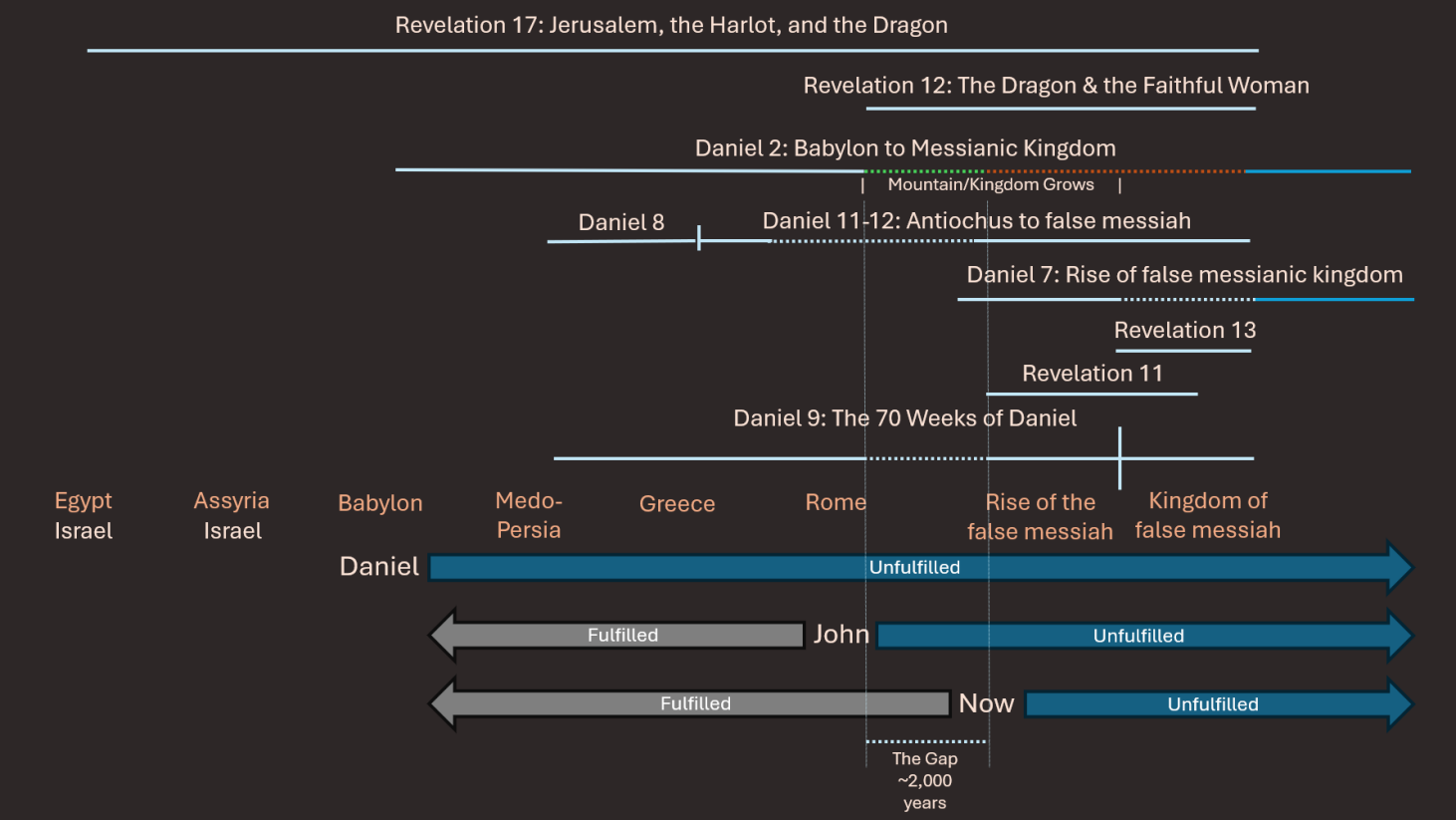
Characteristics Review
Certain symbolism is often used to make connections between these various visions. I want to just quickly review some these in light of the visions or parts of the visions that were part of this series since it’s been a minute. It gives an at-a-glance view of which chapters actually speak to these and which do not.
Four Kingdoms
In trying to understand where certain paradigms come from, it became clear that a value of four when looking at kingdoms was cause for many to associate the visions as pointing to the same time. This is exclusive to Daniel in this number, but John’s vision looking over the span of history does include them. Whether four metals, four horns, or four beasts, it is their number that seems at the heart of digging deeper to find other connections.
- Revelation 17-18 - There is no mention of 4 kingdoms, but the scope of this covers them all.
- Daniel 2 - Four metals comprise
the image of sequential kingdoms of men laid on the timeline of history.
These are historically kingdoms of kings who deify themselves in the
eyes of their subjects, thinking higher of themselves than they ought,
and also ruled over the land and people of Israel. This rule over Israel
was bookended by the first and fourth kingdoms destroying Jerusalem
and the temple and causing diaspora of the people pending future return.
- Gold head (Babylonian Empire)
- Silver arms/breast (Medo-Persian/Achaemenid Empire)
- Brass belly/thighs (Grecian/Macedonian Empire)
- Iron legs and iron/clay feet/toes (Roman Empire)
- Daniel 8 - Four horns come
out of the broken notable horn. (Alexander the Great) All four of these
kingdoms fit within the brass belly and thighs of the third kingdom
in Daniel 2.
- Horn 1 (Macedonian Kingdom)
- Horn 2 (Thracian Kingdom)
- Horn 3 (Ptolemaic Kingdom)
- Horn 4 (Seleucid Kingdom)
- Daniel 9 - No mention of 4 kingdoms or other characteristics.
- Daniel 10-12 - No mention of 4 kingdoms or other characteristics, but two of the horns from Daniel 8 feature prominently in the first half of Daniel 11.
- Daniel 7 - Four diverse beasts
come out of the great sea and stand before each other. Unlike
Daniel 2 and 8, we do not have these symbols explicitly defined
as historical kingdoms for us.
- Beast 1 (Lion with plucked eagle’s wings, lifted from the earth to its feet like a man and man’s heart given it.)
- Beast 2 (Bear raised on one side with three ribs in its teeth and devours much flesh.)
- Beast 3 (Leopard with four wings on its back, four heads, and is given dominion.)
- Beast 4 (Dreadful, terrible, and strong beast with great iron teeth that devoured, broke in pieces, and stamped the residue with its feet. It had ten horns with a little horn coming after the ten and uprooting three of them by the roots, which fall before him. It had the eyes of a man and spoke great things and made war with the saints for three and a half years.)
- Revelation 11 - No mention of 4 kingdoms or other characteristics.
- Revelation 13 - There is no mention of 4 kingdoms, but this is the only other place in scripture where the same animal symbolism of the four diverse beasts of Daniel 7 are seen united as parts of the same beast with ten horns.
- Revelation 12 - No mention of 4 kingdoms or other characteristics.
Kingdom of God Established
One cause for associating visions and prophecy together is the establishment of the kingdom of God. While multiple prophecies may end with the Messianic Kingdom being established that does not mean the scope of each are the same. It’s not surprising that different visions and prophecies that may have different scopes all end with the same common event that ends the rule of man on earth and brings in the everlasting kingdom in a tangible way prior to the new heavens and new earth.
- Revelation 17-18 - The Lamb is said to overcome those that make war with Him, but nothing specific in these chapters focuses on the kingdom of God being established, that occurs elsewhere throughout John’s vision.
- Daniel 2 - The kingdom of God is established by Yeshua during His ministry, symbolized as a stone cut without hands growing into a mountain that consumes the kingdoms of the statute and fills the whole earth. It’s suggestive of two phases of the kingdom, at first not visible like kingdoms of men yet growing until it ultimately consumes the whole earth. This could be suggestive of the times of the Gentiles, the age of grace, or the church age, but could also speak to the Messianic Kingdom with Yeshua ruling from Mount Zion in Jerusalem over the whole earth.
- Daniel 8 - No mention of the kingdom of God being established.
- Daniel 9 - No mention of the kingdom of God being established, but the scope of the prophecy suggests it.
- Daniel 10-12 - No mention of the kingdom of God being established, but there are some suggestive statements.
- Daniel 7 - The thrones are cast down and the Ancient of days sits on His throne and gives dominion to the Son of man coming on the clouds of heaven. When the fourth beast is slain and the other three beasts have their dominion taken away, the Son of man is given a kingdom that all people, nations, and languages should serve Him and His kingdom will not pass away or be destroyed.
- Revelation 11 - At the seventh trumpet sounding, great voices in heaven declare that the kingdoms of the world are now the Lord’s and His anointed, who will reign forever.
- Revelation 13 - No mention of the kingdom of God being established, but based on other prophecy, the physical establishment of the kingdom of God follows the destruction of the kingdom of the Dragon, which is ended forty two months after it begins.
- Revelation 12 - No mention of the kingdom of God being established, but given the man-child is caught up to God pointing to Yeshua’s ascension and the kingdom of God beginning with His ministry, it’s suggested in light of other prophecy.
Beasts
A heavily used theme in prophetic symbolism, beasts are referred to by this term, but also as specific types of beasts, or animals.
- Revelation 17-18 - Beast with seven heads and ten horns.
- Daniel 2 - No mention of animals.
- Daniel 8 - Ram with 2 horns and goat with notable horn between his eyes broken into four, from one a little horn. These are explicitly interpreted for us as the kings of Media and Persia for the ram and the great horn as the first king of Greece, Alexander the Great.
- Daniel 9 - No mention of animals.
- Daniel 10-12 - No mention of animals.
- Daniel 7 - Four diverse beasts
from the sea:
- Lion with eagle’s wings.
- Bear with three ribs in teeth devouring.
- Leopard with four heads and four wings.
- Dreadful beast with iron teeth, brass claws, and ten horns. A little horn rises among the ten.
- Revelation 11 - No mention of animals.
- Revelation 13 - One beast
from the sea, one beast from the earth. The Dragon gives both their
power and authority.
- Seven heads and ten horns.
- Leopard body.
- Bear feet.
- Lion mouth with iron teeth.
- Beast from the earth: two horns like a lamb, but speaks like a dragon.
- Revelation 12 - Great red Dragon with seven heads and ten horns. Blood of the Lamb, referring to the man child caught up to God and His throne by whom the Dragon is overcome.
The Scarlet Beast and the Red Dragon
One of the central characters in the war over mankind, he is defined by several symbols and called by many names. Primarily part of the vision given to John, he plays a central role throughout history and is behind the many deceptions and influence of mankind. I associate his identity to the spirit of the mystery of iniquity at work in the world, the Devil on the shoulder whispering thoughts to influence men to wickedness and accuse men before God. The connection of these symbols is primarily because of the association with seven heads and ten horns. The Beast, the false messiah, is equated to the Dragon because it is from the Dragon that this mouthpiece receives his power and great authority. He is the head of the Dragon.
- Revelation 17-18 - We see the scarlet colored beast with seven heads and ten horns.
- Daniel 2 - No mention of a beast or dragon.
- Daniel 8 - No mention of a beast or dragon.
- Daniel 9 - No mention of a beast or dragon.
- Daniel 10-12 - No mention of a beast or dragon.
- Daniel 7 - There is no mention of a dragon, but we see the fourth of four diverse beasts that has ten horns, and a later little horn. There are no heads mentioned, but since a headless beast is typically a dead one, it could be assumed a head is present. Discerning from Revelation 17 that the seven heads are sequential through time, only existing one at a time, we can see how Daniel would not call out heads since a single head is not abnormal, though ten horns and a little horn are.
- Revelation 11 - No mention of a beast or dragon.
- Revelation 13 - We see the beast with seven heads and ten crowned horns.
- Revelation 12 - We see a great red Dragon with seven crowned heads and ten horns. He is explicitly defined as that old serpent, the Devil, Satan, and deceiver of the whole world.
Seven Heads
Seven of something is not uncommon in the Bible, but in the context of prophecy seven heads is something to take note of. This occurs only five times in scripture, all as part of John’s vision of the Dragon representing the Devil and his puppet king used to receive worship. The Dragon is also called the Beast when focused on the eighth head of the Dragon ruling in his kingdom.
- Revelation 17-18 - We see the Beast with seven heads representing kings and tied to seven mountains through time. Five had fallen and one was at the time of John’s vision in 95 AD, a seventh would come for a short time, receive a mortal wound and live again to become the eighth head, a different Beast than the previous seven.
- Daniel 2 - No mention of seven heads.
- Daniel 8 - No mention of seven heads.
- Daniel 9 - No mention of seven heads.
- Daniel 10-12 - No mention of seven heads.
- Daniel 7 - There is no mention of seven heads, though some view the combined heads of the four beasts equaling seven as a relevant connection. (Lion = one head, bear = one head, leopard = four heads, fourth = one head for a total of seven heads)
- Revelation 11 - No mention of seven heads.
- Revelation 13 - We see the Beast with seven heads.
- Revelation 12 - We see the Dragon with seven heads representing kings through time.
Ten Toes and Horns
Ten horns appear nine times in scripture together, exclusively in Daniel and John’s visions. The ten horns appear together in four out of five of those scriptures with the seven heads. It is these seven heads combined with the ten horns that makes a solid picture that allows interconnecting of visions and prophecies as being related. It is also this number ten in relation to the normalcy of toes in that number which cause many to bring Nebuchadnezzar’s dream into this vision Daniel and John have of this dreadful Dragon and Beast.
- Revelation 17-18 - The beast has ten horns, which are interpreted as ten kings that receive power for an hour with the Beast and ultimately hate the harlot, apostate Jerusalem following the Beast, and later destroy her with fire.
- Daniel 2 - Though the number of toes are not stated, it is a valid assumption there are five toes on each of the two feet of the image, for a total of ten toes, that are part of the fourth kingdom. These are said to be kings in whose time the kingdom of God will be set up and consume those four kingdoms.
- Daniel 8 - While there are 8 horns mentioned, 1 (goat), 2 (ram), 4 (after 1 goat horn), and one little, there is no mention of 10 horns found in this vision of Daniel.
- Daniel 9 - No mention of ten anything.
- Daniel 10-12 - No mention of ten anything.
- Daniel 7 - has ten horns on the head of the fourth beast/kingdom which are interpreted as ten kings that will arise out of this fourth kingdom.
- Revelation 11 - No mention of ten anything, but after the two witnesses are resurrected, one tenth of the city falls in a great earthquake.
- Revelation 13 - The Beast has ten horns with ten crowns on them.
- Revelation 12 - The Dragon has ten horns.
Little Horn
This term appears only twice in the Bible regarding two visions of Daniel. In one it is related to the ten horns amongst whom the little horn rises. In the other it’s a little horn that rises from one of four horns.
- Revelation 17-18 - No mention of a little horn.
- Daniel 2 - No mention of a little horn.
- Daniel 8 - A little horn comes (Antiochus IV) from the 4th horn/kingdom (Seleucid Empire) that came after the broken notable horn (Alexander the Great).
- Daniel 9 - No mention of a little horn.
- Daniel 10-12 - No mention of a little horn.
- Daniel 7 - A little horn comes from the head of the 4th beast/kingdom that is destroyed by Yeshua in the end in order to setup His kingdom on earth.
- Revelation 11 - No mention of a little horn.
- Revelation 13 - No mention of a little horn.
- Revelation 12 - No mention of a little horn.
Metals
Certain metals make an appearance in prophecy, typically tied to value or strength. There is really only one vision, that of Nebuchadnezzar that Daniel is shown, where kingdoms are associated with metals, though some characteristics of those same metals are mentioned related to other kingdoms.
- Revelation 17-18 - Woman decked with gold and golden cup and at her destruction, the merchants of gold, silver, brass, and iron all weep for the city decked in gold.
- Daniel 2 - Head of gold, breast and arms of silver, belly and thighs of brass, legs of iron, and the feet and toes representing the end of that same kingdom are iron mixed with clay.
- Daniel 8 - No mention of metals.
- Daniel 9 - No mention of metals.
- Daniel 10-12 - Silver and gold are taken from the king of the North and the king of the end will have power over the silver and gold of Egypt and honor a god of forces his fathers didn’t know with gold and silver.
- Daniel 7 - The dreadful fourth beast has brass nails and iron teeth.
- Revelation 11 - No mention of metals.
- Revelation 13 - No mention of metals.
- Revelation 12 - The man child will rule with a rod of iron.
Actions
There are main actions taken in prophecy that not all of these visions touch on. This can be helpful in seeing what each vision does and does not explicitly speak to.
- Revelation 17-18
- Abomination of desolation - No
- Blasphemy - Revelation 17:3 - Scarlet colored beast is full of names of blasphemy.
- Global conquest - Revelation 17:2,6 - Implied since the inhabitants are also drunk with the wine of her fornication.
- War on the saints - Revelation 17:6 - Harlot has a golden cup in her hand full of abominations and filthiness of her fornication and is drunken with the blood of the saints, and with the blood of the martyrs of Jesus. Revelation 18:24 in her was the blood of prophets, saints, and all slain on the earth.
- 3.5 years - No
- Divine Destruction - Revelation 17:14 - Lamb overcomes the 10 horns. Revelation 17:16-18, Revelation 18:4-8 - God rewards the harlot city double for her sins, using the 10 horns that hate the harlot city, which He put in their hearts to do His will.
- Daniel 2
- Abomination of desolation - No
- Blasphemy - No
- Global conquest - Daniel 2:39-44 In the sense of each successive kingdom consuming the next in taking over the known world at the time, this may be considered global conquest. Ultimately it is only the kingdom of God that truly consumes the world.
- War on the saints - No
- 3.5 years - No
- Divine Destruction - Daniel 2:34-35 Stone cut without hands strikes the image’s feet, the end of the fourth kingdom, breaking the whole image and blowing the pieces like chaff so that no place is found for them anymore and consumes all four kingdoms.
- Daniel 8
- Abomination of desolation - Daniel 8:11-13 - “by him the daily sacrifice was taken away, and the place of his sanctuary was cast down. And an host was given him against the daily sacrifice by reason of transgression” [167 BC]
- Blasphemy - Daniel 8:10-13, 25 - While blasphemy is not explicitly stated, the little horn magnifies himself to the prince of the host of heaven and stands up against the Prince of princes. He also causes the abomination of desolation, which is implying blasphemy as this action is tied to it elsewhere.
- Global conquest - No
- War on the saints - Daniel 8:24 - Out of one of those (Seleucid Empire), in the latter time of their kingdom, comes a little horn who will destroy the mighty and the holy people.
- 3.5 years - No, but there is 2,300 evenings and mornings = 1,150 days (3.14 years).
- Divine Destruction - Daniel 8:25 - Antiochus IV is “broken without hand” from a painful illness that included symptoms like severe abdominal pain and infestation by worms. His death is often attributed to divine retribution for his persecution of the Jews and desecration of their temple.
- Daniel 9
- Abomination of desolation - Daniel 9:27 - “he shall cause the sacrifice and the oblation to cease, and for the overspreading of abominations he shall make it desolate”
- Blasphemy - Implied in overspreading of abomination and connections to other prophecies of this time.
- Global conquest - No
- War on the saints - No, the Romans destroy the city and sanctuary, but this is prophesied judgement for not recognizing the time of the Messiah’s arrival. Luke 19:41-44
- 3.5 years - Daniel 9:27 - Abomination of desolation is in the midst of 7 years, implying 3.5 years.
- Divine Destruction - Daniel 9:27 - Implied in the determined judgement being poured out on the desolate.
- Daniel 10-12
- Abomination of desolation - Daniel 11:31 - “…shall take away the daily sacrifice, and they shall place the abomination that maketh desolate.” [167 BC] - Daniel 12:1 - Implied because of unparalleled time they’re saved out of. (Matthew 24:15-22, Mark 13:14-20, Jeremiah 30:4-7) Daniel 12:11 - “And from the time that the daily sacrifice shall be taken away, and the abomination that maketh desolate set up, there shall be a thousand two hundred and ninety days.”
- Blasphemy - Daniel 11:36-37 - “he shall exalt himself, and magnify himself above every god, and shall speak marvellous things against the God of gods”
- Global conquest - Daniel 11:40-44 - Conquest seems limited to the area of the Middle East. Daniel 12:7 - Implied if the holy people are global. (Revelation 12:17)
- War on the saints - Daniel 12:1 - Unparalleled trouble for Daniel’s people they are delivered from. Daniel 12:7 - three and a half years to accomplish the scattering of the power of the holy people.
- 3.5 years - Daniel 12:7 time, times, and a half.
- Divine Destruction - No
- Daniel 7
- Abomination of desolation - No
- Blasphemy - Daniel 7:8,11,20,25 - The little horn has “a mouth speaking great words against the most High”.
- Global conquest - Daniel 7:7,23 - The fourth beast “had great iron teeth: it devoured and brake in pieces, and stamped the residue with the feet of it” and will “devour the whole earth.”
- War on the saints - Daniel 7:21,25 - The little horn makes war with the saints and wears them out.
- 3.5 years - Daniel 7:25 - Saints given into the little horn’s hand until a time and times and the dividing of time.
- Divine Destruction - Daniel 7:11 - Because of the great words the little horn spoke, the fourth beast is slain, body destroyed, and given to the burning flame.
- Revelation 11
- Abomination of desolation - No
- Blasphemy - No
- Global conquest - No
- War on the saints - Revelation 11:7-8 - Specifically the two witnesses who belong to God are killed in Jerusalem after completing their ministry.
- 3.5 years - Revelation 11:2 - Gentiles will tread Jerusalem under foot forty two months. Revelation 11:3 - Two witnesses prophesy one thousand two hundred thirty days.
- Divine Destruction - Revelation 11:14-19 - The second woe, the sixth trumpet, is part of God’s wrath being poured out and when the seventh trumpet, the third woe, is sounded, there is an earthquake and great hail leading into the seven bowls that fill up the wrath of God.
- Revelation 13
- Abomination of desolation - No
- Blasphemy - Revelation 13:1,5-6 - The Beast with seven heads with the name of blasphemy is given mouth speaking great things and blasphemies against God, His name, His tabernacle, and those that dwell in heaven.
- Global conquest - Revelation 13:7-8 - Power was given to the Beast over all kindreds, and tongues, and nations that will worship him.
- War on the saints - Revelation 13:7 - The Beast makes war with the saints and overcomes them.
- 3.5 years - Revelation 13:5 - Power is given to the Beast to continue for forty two months.
- Divine Destruction - Not in this chapter, but within the vision in Revelation 19:20-21 the Beast and false prophet are cast into the lake of fire at Armageddon.
- Revelation 12
- Abomination of desolation - No, implied in that “the dragon gave him his power, and his seat, and great authority” (Revelation 13:2) and he is cast out when Michael casts him out and he knows he has a short time. Likely the Dragon’s arrival to earth after being cast out is tied to the abomination of desolation, which is the revealing of the man of sin when the restrainer departs to cast the Dragon out. (2 Thessalonians 2:1-12, Daniel 12:1)
- Blasphemy - No
- Global conquest - No, but implied in transition from Judea (Revelation 12:13-16) to the remnant of her seed (Revelation 12:17)
- War on the saints - Revelation 12:13-17 - Dragon persecutes the woman until she is protected in the wilderness, then he goes after the remnant of her seed outside Judea and not protected in the wilderness and those holding the testimony of Yeshua.
- 3.5 years - Revelation 12:6, 14 - The woman is protected for one thousand two hundred sixty days which is equated to time, times, and half a time.
- Divine Destruction - Revelation 12:16 - The earth swallows up the flood of the Dragon sent after the woman.
Daniel 2 and 7: The Four Kingdoms
Chances are you either held or still hold the traditional paradigm that Daniel 2 and 7 are speaking of the same four kingdoms in different symbology. But there is another paradigm that sees an underlying foundation from scripture that is different and I believe undercuts the reasoning of the traditional view. It helps explain several other aspects of prophecy and what we should be watching for as signs of the times. For those new to Bible prophecy, I will cover the main reasoning behind both ideas for your consideration.
On a basic level, what might cause one to want to make this connection in the first place? Probably the most obvious starting point is that both visions speak of four kingdoms. This distinction is also found in Daniel 8, which will be covered later.
There is also a connection from history, a common theme of prophecy focusing on Gentile kings of kingdoms that are clearly stated to have ruled over Israel in Daniel 2. We see this also in Revelation 17, where seven heads representing seven kings through history can be similarly tied to the kingdoms of Daniel 2. As of the time of John’s vision, around 95 AD, he sees five of those seven kings have fallen, one is, and one is yet to come. Understanding Rome ruled the land at the time of his vision, one can logically deduce that the third, fourth, fifth, and sixth kingdoms correspond to Nebuchadnezzar’s dream of himself representing Babylon, followed by Medo-Persia, then Greece, and finally Rome. I likewise feel this is a valid connection between Daniel 2 and Revelation 17. In addition, I also agree with the explicit connections to those kingdoms laid out in Daniel 8, representing the time of the fourth and fifth kingdoms.
From there, some interesting similarities can be discerned from the symbols used. Chris White probably has the most convincing argument for the connection of these visions that he laid out in the appendix of his book A Bible Prophecy Timeline, which you can purchase on Amazon.com. He lays out the arguments against a contemporaneous view of Daniel 7 based on Charles Cooper’s series “Daniel 2 and Daniel 7: Equal or Not Equal.” I would recommend you read those for yourself as I will just touch on some main points here from my own study of scripture since I don’t agree in the entirety with either, yet more heavily toward Charles Cooper with some differences. I should also point out that neither Chris White nor Charles Cooper may be associated with some of the points I will counter, but I believe they both have the strongest arguments, which is why they are the focus.
As he lays out in chapter 13 of his book, Appendix - A Re-Evaluation of My Position on Daniel 2 and 7, Chris now takes the traditional view and adds the element of the historical representation in Daniel 8 as an interpretive key of two of these same historical kingdoms represented there, Medo-Persia and Greece. This would seem to further strengthen the interpretive connections made between Daniel 2 and 7. While I’m presenting the four kingdoms in order below, it’s really just the second and third kingdoms that represent the strongest connection based on the explicit calling out of Medo-Persia and Greece in Daniel 8.
- The Lion and Babylon (The “Man’s
Heart” Connection)
- Daniel 7:4 states, “the wings thereof were plucked, and it was lifted up from the earth, and made stand upon the feet as a man, and a man’s heart was given to it.” This is equated to Daniel 4:6 stating, “Let his heart be changed from man’s, and let a beast’s heart be given unto him.” Given Daniel 4 depicts Nebuchadnezzar himself going through his change of heart, it follows that the beast whose wings are plucked and stood up with a man’s heart given it in Daniel 7, while reversed, suggest a symbolic link.
- The Bear and the Ram (Medo-Persia)
- Daniel 7:5 sees three ribs in the mouth of a bear. This is equated to the ram, which is explicitly stated to be the kings of Media and Persia in Daniel 8:20, charging in three directions “westward and northward and southward” in Daniel 8:4. In the connection of three ribs and three directions with the explicit identification of the ram, there is a connection made from that identified ram to the unidentified bear.
- Daniel 7:5 also sees this bear raised up on one side. This is equated to the second horn of the ram higher than the other with the higher coming last in Daniel 8:3. In the connection of one side of the bear raised higher than the other and one horn being higher than the other, the bear is believed to have a second level of connection to the named historical Medo-Persian Empire.
- The Leopard and the Goat (Greece)
- Daniel 7:6 depicts a “leopard, which had upon the back of it four wings of a fowl”. These four wings of a foul should be expected to lift the leopard off the ground as a foul and enhance the speed of an already naturally fast animal. This is equated to Daniel 8:5, where the “he goat came from the west on the face of the whole earth, and touched not the ground.” In the connection of a winged leopard and a goat not touching the ground, there is a connection made that the identified goat of Greece to the unidentified winged leopard.
- Daniel 7:6 also states that “the beast had also four heads; and dominion was given to it.” These four heads are equated to Daniel 8:8 where it is stated, “when he was strong, the great horn was broken; and for it came up four notable ones toward the four winds of heaven.” The great horn is identified in Daniel 8:21-22 as Greece’s first king, and the “four stood up for it, four kingdoms shall stand up out of the nation, but not in his power.” In the connection of four heads, often representing kings of kingdoms prophetically, with the four horns explicitly representing kingdoms, the second level of connection is proffered to see the leopard as the named historical Grecian Empire.
- The Ten Horns and the Ten Toes
- Though not explicitly stated, the logical assumption is made that there are ten toes on the two feet. This is equated to the ten horns, both of which exist on their respective fourth kingdoms and thus suggesting a parallel. Furthermore, a fourth kingdom in both visions each with ten associated to them and which are all destroyed at the coming of Christ in the form of a Stone and the Son of man on the clouds of heaven makes a strong connection between the two built on the combination of two symbols and the coming of Christ.
He sees the comparison of these two visions as a near/far dial focusing the lens on two perspectives of the kingdom of God. In his view, it’s not so much a comparison of the empires these four kingdoms represent, but a theological focus.
The near dial focuses on the establishment of the kingdom of God at Yeshua’s first coming in Daniel 2. It emphasizes the timeline for the first coming of the Messiah as the stone that strikes the statue and turns into a mountain as the parable of the mustard seed and leaven bread compared to the kingdom of heaven or God. Matthew 13:31-35 | Luke 13:18-21 This establishment was in the days of the Roman Empire.
I agree with this connection of the kingdom of God arriving at Yeshua’s first coming under Rome. Admittedly there is no clear end time false messianic kingdom language, but he holds the ten toes suggest this and the focus is on the kingdom of God being consummated in the mountain filling the whole earth, not the kingdom of the false messiah. Like Chris, I would agree that Daniel 2 is not completely fulfilled yet. As Yeshua stated in the Olivet Discourse, the abomination of desolation will not come until this Gospel of the kingdom is preached in all the world. Therefore, Daniel 2 is not yet completely fulfilled.
Matthew 24:14-15
And this gospel of the kingdom shall be preached in all the world for a witness unto all nations; and then shall the end come. When ye therefore shall see the abomination of desolation, spoken of by Daniel the prophet, stand in the holy place, (whoso readeth, let him understand:)
The far dial focuses on the consummation of the kingdom of God at Yeshua’s second coming in Daniel 7. Here, Daniel sees the same historical progression of the lion, bear, and leopard representing Babylon, Medo-Persia, and Greece respectively, but is more focused on the detail of the final fourth kingdom with the ten kings seen in the ten horns. This contains missing elements from Daniel 2 regarding the little horn with eyes like a man who speaks boastful words and wars against the saints. The far dial focus is not on the first kingdoms, but rather on the final conflict at the time of the end. In this, both Daniel 2 and 7 culminate in the destruction of the fourth kingdom by the kingdom of God that destroys and consumes it with the establishment of the Messianic Kingdom for one thousand years.
The idea of a revived Roman Empire necessitated by tying these together is seen not as the ethnicity of the rulers, but the geographic region the text states. The “Great Sea” is speaking of the Mediterranean Sea in Numbers 34:6, Joshua 1:4, and Ezekiel 47:10, tying these four empires controlling Israel over time to it. As Chris states in A Bible Prophecy Timeline, “A revived Roman Empire does not require the resurrection of ancient Caesars. It requires the resurrection of the geographic footprint of the fourth beast. The fourth beast represents the geopolitical entity that achieves total dominance over the Mediterranean basin.” (A Bible Prophecy Timeline, p. 311) The ten horns rise from this “sea” territory in Revelation 13:1, consolidating the first three beasts into a single dominion around the “Great Sea.”
Confusion with the Tradition and Contemporaneous Views
For many who have held the traditional view in the past, or hold it now, the attempt to merge the contemporaneous view into that traditional view brings with it confusion and apparent inconsistencies. There are numeric connections and apparent similitudes that seem to equate different aspects of the two visions, but there are also things glossed over in the attempt to preserve the traditional acceptance of these two visions as connected.
For some, this might make it seem that the contemporaneous view cannot be right because it has seemingly brought in confusion to what once made sense. I would posit another idea that I will detail here and that you may have picked up on if you read the individual studies leading up to this, though I wasn’t always explicit about it. The reason the contemporaneous view brings confusion to the traditional view is because they are mutually exclusive. Ultimately one must decide which paradigm holds the stronger foundation from scripture interpreting itself.
This series was meant to start at the foundation of each vision that was given in its own context first, before attempting to make connections to other visions. I believe this foundation takes precedence over interpretive structures built upon other foundations, such as the pattern of four kingdoms pointing to a link between them. From that foundation, apparent similarities have made some interesting arguments while other symbolism without similarities are explained on shaky terms or ignored for lack of relevance to the interpretive structure.
What I would like to do now is explain why I think this foundation undercuts that of the traditional view by means of a firmer foundation built on the most basic meaning of the text as accepted to be true and as interpreted by the text itself. And the foundation of this is first accepting each vision and interpretation on its own, as was originally given, before attempting to make connections between the different visions.
I should say that while I believe I read Charles Cooper’s series some time back, I do not recall all of its details and it is only the elements I mention here that build the foundation I’ve come to rely upon based upon the studies presented in the visions of Daniel and John series. I do appreciate his work in highlighting these fundamental aspects that made sense of these things for me and Chris White’s presentation of them in the past by which I learned much of it. I similarly value Chris White’s thoughtful examination of scripture and, though I disagree with his perspective in this case, likewise appreciate his work on the whole from which I have and will continue to learn much. I have found it’s very difficult to find someone with which I agree 100%, which is great because it is digging into the details that we find greater understanding.
Daniel 2
Returning to the thesis of this series, let us for a moment set aside the foundational interpretive structure that defines Daniel 2 and 7 as being connected in any way as we go back to Daniel 2 by itself. It is a dream of Nebuchadnezzar that bothered him but he couldn’t remember and nobody else knew. Daniel sees his dream in a vision and receives the interpretation of it.
Daniel 2:29-30
As for thee, O king, thy thoughts came [into thy mind] upon thy bed, what should come to pass hereafter: and he that revealeth secrets maketh known to thee what shall come to pass. But as for me, this secret is not revealed to me for [any] wisdom that I have more than any living, but for [their] sakes that shall make known the interpretation to the king, and that thou mightest know the thoughts of thy heart.
Daniel claims that the context of this vision is made known to him and the interpretation of it, revealed by God. This means to understand we need not look outside the meaning provided within this chapter itself. To do so could invite personal interpretation to it that might steer us off course. There are several very important statements made that define the scope of the four kingdoms this prophecy.
In his book, Chris suggests Daniel 2 is considered fully fulfilled in the contemporaneous view. While this may be the case for some who hold this view, it is certainly not what the text would suggest. I see the same thing that he does in Daniel 2, that the consummation of the kingdom of God in its fulfillment after Yeshua’s return is seen in the mountain (Zion) filling the whole earth. In this way, Daniel 2 is covering the scope from Babylon to the Messianic Kingdom yet future. I would also agree that the focus of Daniel 2 is on the first coming of Christ, even though I also see the results of the second coming and fulfillment of Daniel 9 anointing the most Holy in Him establishing His throne on Zion.
The difference is that my view sees the focus of Daniel 2 as being the distinction between the kingdoms of men and the kingdom of God. Each one consumed the next, but God’s kingdom is eternal and so it is the final one to consume all. The reason there are only four kingdoms when there have clearly been many throughout history is that this vision is given in the context of Israel in the land. It is the natural conclusion when looking at the four kingdoms before that were consumed by the next. A kingdom cannot be considered fully established unless the King controls the land upon which His subjects reside as He provides them peace and security.
A kingdom is built on a king, his land, and his subjects. The church are His subjects and the whole earth is His, but we must not ignore the multitude of promises regarding His kingdom upon the land given the Seed of Abraham and the tribes of Israel whose King will come from the root of David. It is when He is ruling from Jerusalem with a rod of iron that He will also rule over the whole earth and enforce justice instead of letting men do according to their own will.
In Daniel 2 we see two bookends of Gentile control over Israel with Babylon destroying Israel and bringing about her diaspora into Babylon through to Rome destroying Israel and bringing about her diaspora into the world. Having established the fifth kingdom of God is not yet fully fulfilled, since Yeshua is not yet ruling from Jerusalem, let’s examine the plain language. The following two verses speak of what is to be expected from the kingdom of God and when it can be expected to happen.
Daniel 2:35, 44b
Then was the iron, the clay, the brass, the silver, and the gold, broken to pieces together, and became like the chaff of the summer threshingfloors; and the wind carried them away, that no place was found for them: and the stone that smote the image became a great mountain, and filled the whole earth. ... and the kingdom shall not be left to other people, [but] it shall break in pieces and consume all these kingdoms, and it shall stand for ever.
First, the kingdom of God breaks the image into pieces when struck by the stone. This began with the arrival of His kingdom during His ministry and the establishment of the growth of His kingdom in His death and resurrection. The New Testament, established by His blood, allowed those who believe and obey Him to be born again as subjects of that eternal kingdom regardless of any jurisdiction they may have been previously subject to because they have chosen another King to follow. They would live peaceably in the world, but no longer of the world. This was the beginning of the end of the ancient god-kings worshiped by their subjects. The Spirit of God now had a home with His subjects individually within their temples of flesh and their complete devotion as they await His return. That would ripple into the very societal structures that did not accept Yeshua, but were influenced by His hands and feet, the body of Christ.
But we are also told that not only will this kingdom of God break the image, but will consume all the kingdoms it represented. This is just what we saw with each successive kingdom of man defeating and consuming the kingdom before it. While the image on the timeline of history retained their memory, the old kingdom was gone and replaced by a new kingdom. And to that end I want to share a passage from Zechariah that I think may speak directly to this idea of both the kingdoms used to judge Israel and the progressive consuming of those kingdoms.
The Four Horns and Four Craftsmen
Zechariah 1:18-21
Then lifted I up mine eyes, and saw, and behold four horns. And I said unto the angel that talked with me, What [be] these? And he answered me, These [are] the horns which have scattered Judah, Israel, and Jerusalem. And the LORD shewed me four carpenters. Then said I, What come these to do? And he spake, saying, These [are] the horns which have scattered Judah, so that no man did lift up his head: but these are come to fray them, to cast out the horns of the Gentiles, which lifted up [their] horn over the land of Judah to scatter it.
This is at the end of the seventy years of captivity in Babylon, the second year of Darius, and God’s mercy is declared on Jerusalem and Zion and the rebuilding of the temple. There are some very interesting points spelled out for us here. The four horns of the Gentiles have lifted up each of their horns over the land of Judah and scattered Judah, Israel, and Jerusalem.
While Judah is a tribe of Israel, Israel is not a tribe of Judah. Jerusalem is in the land of Judea and so the context of this is tied to Judah of Israel and Jerusalem, as much of Bible prophecy is regarding the end as well. It is also clear that the focus of this are the horns of the Gentiles being over the land of Judah to scatter it. This is interesting in light of Daniel 2 in which four successive Gentile kingdoms rule over Israel and Jerusalem.
So what does it mean to scatter Judah and Jerusalem? The clear indication would be Assyria, Babylon, and Rome as they were the only ones responsible for removing Israel from the land. However, while Assyria scattered the northern kingdom of Israel that was not tied to Jerusalem, it never did control Jerusalem in the sense that Babylon, Medo-Persia, Greece, and Rome did. They began to siege her, but were defeated and scattered off themselves. 2 Kings 19 (Taylor Cylinder) Babylon and Rome clearly both lorded over Jerusalem and resulted in the desolation of Jerusalem of her children.
So could Medo-Persia and Greece be considered part of this? Medo-Persia seems the least likely since they were responsible for allowing Israel to return to Jerusalem in Judea and build the temple. This allowed the Israel-Judah-Jerusalem connection to continue. At the same time, they did not force them to go and so while their horn was over the land of Judah, they also inherited the scattered of Israel that did not return to the land and remained a part of the country to which they had been scattered, such as Daniel himself.
Greece likewise was a horn over Judea, quite literally in the prophetic sense of the little horn representing Antiochus IV. I’m not aware of a particular “scattering,” aside from the inevitable fleeing the cities during the times of conflict, particularly with the little horn. But at the same time, we’re running out of Gentile kingdoms that ruled over Judea and scattered them, we really only have four Gentile kingdoms that did. And these have an interesting parallel to Nebuchadnezzar’s dream.
Horn 1: Babylon
Horn 2: Medo-Persia
Horn 3: Greece
Horn 4: Rome
Anything after Rome until the past century generally doesn’t fit the context of the prophecy because Judah was not in Jerusalem as a people. This would include the Islamic Caliphate because while they did rule over Jerusalem, there was no Judah or Israel to scatter. Rome had already accomplished the destruction of Jerusalem, which was already desolate of her children.
One could argue it is still not true today given the context of the seventy weeks prophecy. The first sixty nine began once Israel was back in Judea from Babylon with the temple at least partially rebuilt and Ezra teaching them the statutes of God to properly minister at God’s tabernacle. If Israel isn’t in the land following God’s statutes are they not spiritually scattered still? Being in the land of promise worshiping the God of Abraham, Isaac, and Jacob, according to the eternal commands God gave them is something that has not been seen again since 70 AD. Those eternal commands require the presence of the temple of God. Additionally, the promise at the end is for Judah and Ephraim to be joined back together in the land. So it seems these four Gentile “horns” are the only ones that fit within the context of what is described in this prophecy.
That brings us to the four craftsmen, which are God’s instruments to overthrow the horns. A craftsman is a fabricator, maker, worker that brings something into being. I like the KJV rendering of the craftsmen as carpenters in light of Daniel 2. Just as each kingdom of man comes after the previous to fray and cast out the previous Gentile horn, Daniel 2 walks through the kingdoms of men from the head of gold followed by the arms and chest of silver that frayed it.
Craftsman 1: Medo-Persia frays
and casts out Babylon
Craftsman 2:
Greece frays and casts out Medo-Persia
Craftsman 3: Rome frays and casts
out Greece
Carpenter 4: Yeshua’s
Kingdom of God frays and casts out Rome
In each case, just as depicted in Daniel 2, the next kingdom to come followed the previous, causing fear and defeat as they swallowed up the previous kingdom’s power with their own. Each kingdom was built by their kings to this ultimate end of conquering the previous nations.
But the stone cut without hands destroys the entire image, representative of the kingdoms of men across their timeline, when He establishes the kingdom of God on earth. This carpenter from Nazareth brought His eternal kingdom into being, becoming the final craftsman that would consume the fourth Gentile horn, establishing His invisible and eternal kingdom at His first coming and will establish it physically upon His return to defeat those that call themselves His enemy.
Each craftsman fraying and casting out the previous is not complete physical destruction of the king, land, and people, though that is partially what happens in the process of transfer of reign through war. It is the elimination of the line of kings tied to the ownership of the land and reign over the people in it. The new craftsman, or king, now replaces the previous in reigning over his expanded territory and people. The final kingdom that is breaking in pieces and consuming the image representing the four previous kingdoms is simply taking the land and people from the leadership before, which is exactly what we have seen the kingdom of God do when it became the national religion of Rome just prior to its collapse.
Further strengthening this paradigm, it is the fifth kingdom that consumes the fourth and is said to not be left to other people. Traditional kingdoms of men did not see a single man reigning over hundreds of years because men die. So royal lineage was important to pass the kingdom on to the next in line. The promise is made of a future return of scepter to Judah through the Messiah, the root of David. He came before the scepter departed from Judah as prophesied in Genesis 49:10, but the establishment of that promise in its fullness is yet future.
Daniel 2:44
And in the days of these kings shall the God of heaven set up a kingdom, which shall never be destroyed: and the kingdom shall not be left to other people, [but] it shall break in pieces and consume all these kingdoms, and it shall stand for ever.
And this is where the idea of the kingdom not being left to other people points directly to the death and resurrection of the King of that kingdom. The kingdom of God existed before the King died yet was not passed on because He lives! The kingdom of God is eternal and consumes all the kingdoms of men by stealing their subject’s allegiance from men to God. They may still reside in the land of other kings and obey their authority, but their heart belongs to God even if the kings of men bring death on them for that allegiance. The power the god-kings once reveled in has been made impotent by the power of God.
So these four horns would seem to speak in agreement that the only Gentile kingdoms ruling over and scattering Israel, when they were not ruling themselves, were these four horns that line up with Daniel 2’s image of four kingdoms destroyed by the kingdom of God and heads three through six of Revelation 17-18.
So from a very plain reading of the text of Daniel 2, the symbols are interpreted for us from the vision itself, the 20/20 hindsight of history, and the objective reality that the Roman Empire no longer exists. It is clear that the fall of Western Rome is the consuming of the four kingdoms represented by the image Nebuchadnezzar dreamt of and Daniel interpreted through God’s revelation. The fifth kingdom of God that consumed it has continued to grow from a mustard seed or like a loaf of bread with leaven to this day. It is all the faithful subjects of the kingdom of God, regardless of denomination, who in obedience and by their actions are the hands and feet that grow the kingdom until His return.
Matthew 24:14
And this gospel of the kingdom shall be preached in all the world for a witness unto all nations; and then shall the end come.
Daniel 2 will not ultimately be fulfilled until the mountain fills the whole earth at the consummation of the Messianic Kingdom with His return. That mountain is Zion, the place chosen by God for His tabernacle from where He will rule with a rod of iron. But the four kingdoms of Babylon, Medo-Persia, Greece, and Rome to which Daniel 7 is traditionally tied are gone as of at least the fifth century AD and no place is found for them to return.
Daniel 7
Similar to our approach of Daniel 2, let us put aside even what we have just seen there, in addition to any preconceived structures of interpretation, and look at the text within the vision given in Daniel 7.
Daniel 7:3, 7, 19, 23-24
And four great beasts came up from the sea, diverse one from another. ... After this I saw in the night visions, and behold a fourth beast, dreadful and terrible, and strong exceedingly; and it had great iron teeth: it devoured and brake in pieces, and stamped the residue with the feet of it: and it [was] diverse from all the beasts that [were] before it; and it had ten horns. … Then I would know the truth of the fourth beast, which was diverse from all the others, exceeding dreadful, whose teeth [were of] iron, and his nails [of] brass; [which] devoured, brake in pieces, and stamped the residue with his feet; ... Thus he said, The fourth beast shall be the fourth kingdom upon earth, which shall be diverse from all kingdoms, and shall devour the whole earth, and shall tread it down, and break it in pieces. And the ten horns out of this kingdom [are] ten kings [that] shall arise: and another shall rise after them; and he shall be diverse from the first, and he shall subdue three kings.
The word “diverse” is used in verses 3, 7, 19, 23 and 24 meaning to be other, or different. This is followed by “from” in comparing to the others. In all but verse 24, this is comparing the four beasts to each other and in verse 24 it is comparing the little horn as being different from those ten that were present first. This diversity is confirmed in the description of these four beasts, which clearly distinguishes them as not like each other.
Daniel 7:4-7
The first [was] like a lion, and had eagle’s wings: I beheld till the wings thereof were plucked, and it was lifted up from the earth, and made stand upon the feet as a man, and a man’s heart was given to it. And behold another beast, a second, like to a bear, and it raised up itself on one side, and [it had] three ribs in the mouth of it between the teeth of it: and they said thus unto it, Arise, devour much flesh. After this I beheld, and lo another, like a leopard, which had upon the back of it four wings of a fowl; the beast had also four heads; and dominion was given to it. After this I saw in the night visions, and behold a fourth beast, dreadful and terrible, and strong exceedingly; and it had great iron teeth: it devoured and brake in pieces, and stamped the residue with the feet of it: and it [was] diverse from all the beasts that [were] before it; and it had ten horns.
We need to also take note of what is not present in this chapter, any clear interaction between these four beasts. The only possible suggestion of this might be that the second beast devours much flesh, the third beast has dominion given to it, and the fourth beast devours and breaks in pieces. But unlike Daniel 2, 8, or 11, we don’t see these symbolic beasts locked in struggle with each other or coming after each other, they exist in each other’s presence.
They are presented in a sequence, but note the wording used restating that the fourth beast was diverse from all the beasts before it. That word before is quodam and is used 46 times in 38 verses, 42 of which are Daniel. In each use in scripture it is spatial, not temporal. This is distinctly different from the idea of progressive kingdoms consuming each other as Daniel 2 depicts because these four beasts don’t follow each other in time, they are present before each other in space and time, in each other’s presence.
There is a counterargument presented to this idea that quodam should be used to view these four existing together at the same time. It arises from the fact that this spatial detail appears exclusively in the vision, not the angelic interpretation of that vision where the symbols are decoded for us. Since this is the symbolic and allegorical part of the dream and not the given interpretation where they are connected to history, this depiction of the beasts spatially before each other should be likewise disregarded as allegorical.
It seems to me irrelevant to separate the vision from the interpretation in regard to the use of this word because Daniel is simply writing about what he saw in his vision. Daniel doesn’t need angelic interpretation to know they stand before each other and he watches until the thrones are cast down, implying the dominion is taken away from each of the four. Though the four beasts are introduced in sequence, they are four diverse beasts, not connected as one on a clear timeline of sequential kingdoms. They are introduced one by one and then seen standing before each other as four beasts diverse from each other. This whole time the four beasts stand before each other they are also before Daniel, who is observing them. The only reason to assume these four cover an expanse of time outside the time of the end the vision places them in is the assumed connection to Daniel 2. Since the text of the actual vision does not indicate that, I do not presume that connection. I presume that Daniel wrote down what he witnessed, and while interpretation of what the beasts represent, it is not needed for the manner in which they were presented. However, that manner is relevant to the meaning in my opinion.
Additionally, Daniel 2 has this same parallel where the great image “stood before” Nebuchadnezzar. If we are holding to this spatial logic, then the image seen with four parts would be coexisting as well, but it is clearly defined in the text of the vision as temporal kingdoms in succession.
In Daniel 2, a single united image clearly representing four progressive kingdoms is indeed spatially before Nebuchadnezzar, and Daniel is observing this in his vision. Just as Daniel saw four beasts standing before each other and himself, he is also seeing one image of four kingdoms before Nebuchadnezzar, both before him. The one image was comprised of four metals in sequence and ending in weakness of the fourth iron mixed with clay. The four metals are diverse from each other as the four beasts are said to be, but are presented through time as consuming the previous and thereby uniting them as one image representing the kingdoms of men that is destroyed by a fifth kingdom from without. This image representing the time from the kingdom of Babylon under Nebuchadnezzar to the end of the Roman Empire, about one thousand years, is before those two observing it. While the observers are spatially before both the image and the four beasts, likewise before each other, none of that suggests the rest of the text of Daniel 2 showing the kingdoms as consuming each other is made null and void, it’s all true.
There is also a connection between Daniel 7:4-7 and Revelation 13:1-2, the only place in scripture where five distinct defining characteristics coexist. These will be covered later, but the point is that the events of John’s vision that cover the time of the end are linked by these five distinct characteristics, a beast with ten horns, it’s rising out of the sea, lion mouth, bear feet, and leopard body. This ties Daniel 7 to the time of the end as well as providing detail that distinguishes the rise of the false messiah before the abomination of desolation in Daniel 7 from the reign of the false messiah after, the seventh head from the eighth, in Revelation 13. This equates the fourth beast that devours the earth with ten horns as the Beast of Revelation. While diverse in Daniel’s vision, those four are not in John’s vision of the end.
The Four Winds of Heaven
Why does the number four turn up as the number of kingdoms in both Daniel 2 and 7? It’s one of the foundations for those seeking to understand prophecy to build a framework of interpretation that ties these two visions together. But is there another reason for this apparent connection of four kingdoms?
Daniel 7:2-3
Daniel spake and said, I saw in my vision by night, and, behold, the four winds of the heaven strove upon the great sea. And four great beasts came up from the sea, diverse one from another.
The four kingdoms of Nebuchadnezzar’s dream are explicitly stated to begin with him and Babylon then move through time to view the successive kingdoms that devoured the previous, which we know controlled Israel and Jerusalem. As covered for Daniel 2, I believe Zechariah 1:18-21 speaks to this sequential devouring of those four kingdoms of men.
Daniel 7 sees the origin of these four kingdoms with less specificity. Here the four winds of heaven blow over the great sea and four beasts come up from it. As covered in the vision of Daniel 7, this symbology of the four winds is consistent in scripture and I believe speaks to the reason there are four kingdoms apart from any connection to Daniel 2. While some, like Charles Cooper, might take a view of these four winds being like cardinal points on a compass, I believe it is a more general representation of the whole world. As Chris points out in his book, “Ironically, Revelation 20:8 validates this geography but places it at the end of the millennium. When Sata is released, the text state that he goes out to deceive the nations which are in the four quarters of the earth, Gog and Magog.” (A Bible Prophecy Timeline, p. 308)
However, just because this same terminology is used after the millennium doesn’t mean it holds no meaning within other contexts. I would argue that the common meaning across all of its uses points to the very idea that the birth of the four diverse beasts from the great sea when the four winds of heaven blow upon it points to a diverse quartering of kingdoms in the whole world.
Jeremiah 49:36
And upon Elam will I bring the four winds from the four quarters of heaven, and will scatter them toward all those winds; and there shall be no nation whither the outcasts of Elam shall not come.
Here in this prophecy on Elam, or southwest Iran, the four winds from the four quarters of heaven are used to speak of the scattering of the people toward all those winds. This is explicitly stated to represent their scattering into every nation in the world.
Ezekiel 37:9, 11-14
Then said he unto me, Prophesy unto the wind, prophesy, son of man, and say to the wind, Thus saith the Lord GOD; Come from the four winds, O breath, and breathe upon these slain, that they may live. ... Then he said unto me, Son of man, these bones are the whole house of Israel: behold, they say, Our bones are dried, and our hope is lost: we are cut off for our parts. Therefore prophesy and say unto them, Thus saith the Lord GOD; Behold, O my people, I will open your graves, and cause you to come up out of your graves, and bring you into the land of Israel. And ye shall know that I [am] the LORD, when I have opened your graves, O my people, and brought you up out of your graves, And shall put my spirit in you, and ye shall live, and I shall place you in your own land: then shall ye know that I the LORD have spoken [it], and performed [it], saith the LORD.
Ezekiel goes on to prophecy that in addition to being returned to the land as the whole house of Israel, it will not only be Judah, but also Ephraim representing the northern kingdom that was scattered by Assyria prior to the Babylonian captivity of Judah in the south. Ephraim has never returned since then, meaning this is a prophecy of a future time when the whole house of Israel, the twelve tribes, will be back in the land. And this would seem to be a necessity since the one hundred forty four thousand which are sealed in the future are from the twelve tribes of Israel. Revelation 7:1-8
Note that the four winds blowing on the whole house of Israel is symbolically bringing them up from their graves, but this is before they are brought into the land of Israel. This speaks to a diaspora throughout the world of Israel to the four winds and a revival of the people to be brought back into the land. I believe this would encompass the kind of rebirth we saw in the land blossoming, the Hebrew language being resurrected, and other such miracles seen since the Jews began to return to the land leading to the rebirth of a nation in a day. Deuteronomy 4:25-31 | Isaiah 66:5-14 | Zechariah 12:3-9
Daniel 8:8-9
Therefore the he goat waxed very great: and when he was strong, the great horn was broken; and for it came up four notable ones toward the four winds of heaven. And out of one of them came forth a little horn, which waxed exceeding great, toward the south, and toward the east, and toward the pleasant [land].
Daniel 11:4
And when he shall stand up, his kingdom shall be broken, and shall be divided toward the four winds of heaven; and not to his posterity, nor according to his dominion which he ruled: for his kingdom shall be plucked up, even for others beside those.
When Alexander the Great died, his kingdom eventually settled into four and what was once a single ruler of the known world was now four. These are said to go toward the four winds of heaven symbolizing the global power of one kingdom split into four kingdoms, in the context of Israel. Charles Cooper use this to tie the cardinal points to the four winds, but if you look at a map of the dividing of the kingdom of Greece, it seems somewhat of a stretch to me. Over the past millennia the earth has gotten much bigger and smaller at the same time. These some four centuries before Christ, on a smaller scale, echo the four kingdoms of Daniel 7 at the time of the end where four beasts represent the global power divided into four. The scale of the known world has just grown from the middle east to the entire globe.
Zechariah 2:4-6
And said unto him, Run, speak to this young man, saying, Jerusalem shall be inhabited [as] towns without walls for the multitude of men and cattle therein: For I, saith the LORD, will be unto her a wall of fire round about, and will be the glory in the midst of her. Ho, ho, [come forth], and flee from the land of the north, saith the LORD: for I have spread you abroad as the four winds of the heaven, saith the LORD.
Again, the four winds of heaven under which the people have been spread abroad, though explicitly called out from the north.
Matthew 24:30-31
And then shall appear the sign of the Son of man in heaven: and then shall all the tribes of the earth mourn, and they shall see the Son of man coming in the clouds of heaven with power and great glory. And he shall send his angels with a great sound of a trumpet, and they shall gather together his elect from the four winds, from one end of heaven to the other.
Mark 13:26-27
And then shall they see the Son of man coming in the clouds with great power and glory. And then shall he send his angels, and shall gather together his elect from the four winds, from the uttermost part of the earth to the uttermost part of heaven.
The elect are gathered from the four winds, which is explicitly stated to be from one end of heaven to the other and from the uttermost part of the earth to the uttermost part of heaven. As I would certainly hope, this is a global collection from the four winds of heaven and not just a select few of the faithful from a smaller region.
Revelation 7:1
And after these things I saw four angels standing on the four corners of the earth, holding the four winds of the earth, that the wind should not blow on the earth, nor on the sea, nor on any tree.
Here we see a switch to the four winds of the earth as opposed to heaven, but the same principle is explicitly stated. Four angels are standing on the four corners of the earth holding the four winds. The result of this is that the wind does not blow throughout the whole earth. The four winds express a global state. That can be seen elsewhere in the unleashing of what is held back, the wrath of God, on all them that dwell on the face of the whole earth. This fits with the statement that the day of the Lord comes as a snare on all them that dwell on the face of the whole earth.
Luke 21:34-36
And take heed to yourselves, lest at any time your hearts be overcharged with surfeiting, and drunkenness, and cares of this life, and [so] that day come upon you unawares. For as a snare shall it come on all them that dwell on the face of the whole earth. Watch ye therefore, and pray always, that ye may be accounted worthy to escape all these things that shall come to pass, and to stand before the Son of man.
That is fulfilled in Revelation 7:9-10 where John sees “a great multitude, which no man could number, of all nations, and kindreds, and people, and tongues, stood before the throne, and before the Lamb” who have been gathered from the four winds of heaven before the wrath of God that starts the day of the Lord.
Revelation 20:7-8
And when the thousand years are expired, Satan shall be loosed out of his prison, And shall go out to deceive the nations which are in the four quarters of the earth, Gog and Magog, to gather them together to battle: the number of whom [is] as the sand of the sea.
We see at the end of the thousand year reign of Christ in the quarter of the earth that is His, and from there over all the earth, that the Dragon is loosed from the bottomless pit to deceive the nations one last time and gather them to battle against God. The nations in the four quarters of the earth speaks to this whole idea we saw with the four winds and four beasts. Though it speaks of events after the thousand years are finished, the principle is still the same and we see that the whole world is tempted once again by the deceiver to battle against the Messiah. And where do they go to battle Him? The beloved city of the saints from which He rules, but they are devoured by fire from heaven. Similar to how the lion, bear, leopard, and ten horned beast are only mentioned in two places together in scripture, this is likewise the only other place where Gog and Magog are mentioned together besides Ezekiel 38:2.
This all points to the four kingdoms being representative of a quartering of political power in the world over the lands and subjects on those lands. This is the four corners of the earth, the four winds of heaven or earth, one end of heaven and earth to the other. This is confirmation of the four beasts being presented together in only two places in all of scripture, Daniel 7:4-7 and Revelation 13:1-2. The whole world gives over their power to the Beast in his kingdom once the seventh head has become the eighth. This is therefore one of the first signs we are given to watch for where the details of the symbolism given is not provided, but the fact that these four are kings that rise out of the earth, Daniel 7:17, though they are seen coming from the great sea, points to a global view of four kingdoms.
As we see in the vision, the symbology of heads being kings or kingdoms could represent the kinds of political alliances we see in the world today, where a beast being represented is not one kingdom, but a kingdom of kingdoms. The leopard has four heads, so it could represent one quarter of the earth’s power comprised of four primary nations which are tied together as one in political agreements.
The same can be seen in the fourth beast with ten horns, which are also used symbolically to represent kings or kingdoms. In this case a quarter of the earth is represented by some kind of group of ten kingdoms together and a little kingdom comes up amongst them.
So what Nebuchadnezzar sees as successive kingdoms that devour the previous, taking their land and subjects into the new kingdom, Daniel sees as parallel kingdoms representing political power in the whole earth at the time of the end. The only one clearly defined for us is the fourth beast with eleven horns, which is centered in the Middle East because the little horn takes his seat of authority in the temple of God in Jerusalem. This means that the ten horns that were present before the little horn came to power represent ten kingdoms also in the Middle East distinct from the smaller kingdom that comes after them.
Seventh and Eighth Heads
Those parallel kingdoms at the time of the end are seen as diverse in Daniel 7 and are a lion, bear, leopard, and ten horned beast.
Daniel 7:3-7
And four great beasts came up from the sea, diverse one from another. The first [was] like a lion, and had eagle’s wings: I beheld till the wings thereof were plucked, and it was lifted up from the earth, and made stand upon the feet as a man, and a man’s heart was given to it. And behold another beast, a second, like to a bear, and it raised up itself on one side, and [it had] three ribs in the mouth of it between the teeth of it: and they said thus unto it, Arise, devour much flesh. After this I beheld, and lo another, like a leopard, which had upon the back of it four wings of a fowl; the beast had also four heads; and dominion was given to it. After this I saw in the night visions, and behold a fourth beast, dreadful and terrible, and strong exceedingly; and it had great iron teeth: it devoured and brake in pieces, and stamped the residue with the feet of it: and it [was] diverse from all the beasts that [were] before it; and it had ten horns.
The fourth beast that is diverse from the other three before it, is the seventh and eighth heads of Revelation 17 and 13 where the other three beasts representing the rest of the world are seen as parts of the fourth beast worshipping him.
Revelation 13:2-4
And the beast which I saw was like unto a leopard, and his feet were as [the feet] of a bear, and his mouth as the mouth of a lion: and the dragon gave him his power, and his seat, and great authority. And I saw one of his heads as it were wounded to death; and his deadly wound was healed: and all the world wondered after the beast. And they worshipped the dragon which gave power unto the beast: and they worshipped the beast, saying, Who [is] like unto the beast? who is able to make war with him?
A rebuttal to the idea that the four diverse beasts of Daniel 7 are the same united to the Beast of Revelation 13 lies in this idea that Revelation 17 is covering history in motion and not a single point in time at the end. This chronological framework is believed to be the strongest refutation of simultaneity since the sixth head of the Roman Empire being present at the time of John’s vision locks it to the first century.
I absolutely agree with the sixth head being the Roman Empire and the time of John’s vision likely being around 95 AD at the end of Domitian’s reign. That means the five previous heads were going back from Rome, Greece, Medo-Persia, Babylon, Assyria, and Egypt. The latter two potentially representing apostate kings of Israel because the woman riding the beast on seven mountains tied temporally to the seven heads represents Jerusalem and Israel, which were not united until David took Jerusalem around 1010 BC. This was well after Egypt, which never really controlled Jerusalem with Israel in it, and Assyria who never controlled Jerusalem and whose army was decimated when they tried to take it.
Chris goes on to state, “If the four beasts of Daniel 7 are contemporaneous end-time kingdoms, how can Revelation 17 declare that five of the heads have already fallen by the first century? If the lion, bear, and leopard are future kingdoms that arise simultaneously with the Antichrist, they cannot also be listed as fallen almost two thousand years before the Antichrist arrives. There is no textual basis for splitting a contemporaneous coalition across thousands of years. The only logical reading is that the heads represent a sequential progression of empires spanning history, not a cluster of kingdoms appearing at the end.” (A Bible Prophecy Timeline, pp. 312-313)
From the contemporaneous view, the lion, bear, and leopard are not connected to Daniel 2 and therefore are not seen as having fallen prior to Rome. Neither are they seen as having fallen two thousand years before the Antichrist arrives. Neither is there a contemporaneous coalition across thousands of years. This argument has presumed the connection of Daniel 2 and 7 that the contemporaneous view says is mutually exclusive. If one believes these two visions are the same characters, then of course this is preposterous, which is why they are mutually exclusive views.
This is what I mentioned earlier about the confusion with the traditional and contemporaneous views. The tradition is so engrained in our thinking that we have a hard time detaching ourselves from it to see another perspective. Incorrect tradition has been a stumbling block for many in history, including Israel. It’s like trying to press two magnet’s north poles together to make it work. You may appear to make it happen after some struggle, but it just doesn’t work because it’s not meant to. The only way it naturally works is to view the traditional and contemporaneous views as polar opposites that have little but the ending to do with each other, then the magnets just snap together and you have to struggle to separate them again.
While Revelation 17 is clearly covering a large swath of history in the seven heads, the ten horns do not exist across all the heads, they are specific to the time of the end as seen on the seventh and eighth heads. And both Revelation 17 and 13 are focused on the time after the sixth head is fallen, a time future to John at the time of his vision. So while history is in view for our understanding, it is used to point to the events of our future more relevant for our personal understanding at the time of the end.
The Beast of Revelation is the Dragon, the Devil, who gives his power and great authority to the little horn rising to power on the seventh head to later promote him to become the eighth head.
Revelation 17:10-13
And there are seven kings: five are fallen, and one is, [and] the other is not yet come; and when he cometh, he must continue a short space. And the beast that was, and is not, even he is the eighth, and is of the seven, and goeth into perdition. And the ten horns which thou sawest are ten kings, which have received no kingdom as yet; but receive power as kings one hour with the beast. These have one mind, and shall give their power and strength unto the beast.
There are no ten horns mentioned for the first six heads that are now fallen. It is only after the seventh head representing the Beast is killed and comes back to life to become the eighth that we see the ten kings without a kingdom receiving power as kings with the Beast. The head of that Beast is now the eighth and final head, the Dragon-powered false messiah. But we know those ten horns existed prior to the eighth head as well because the little horn came to power after they already existed.
This view does not discount or mistake the historical aspect of Revelation 17, but rather it fits perfectly within it and in harmony with Daniel 7. Only when one attempts to take the contemporaneous idea and merge it with the Daniel 2 and 7 connection is there an issue. But as I have stated, I don’t see them connected.
What I see will be covered in greater detail in the next post where Daniel 7 represents the time of the seventh head, the first half of the seventieth week of Daniel before the abomination of desolation. It is the time of the ten horns sitting on the head of the fourth beast of Daniel 7, which is the seventh head of Revelation 12, 13 and 17. This is the time in Daniel 7 when the little horn rises to power and plucks the three larger horns that were before him temporally and spatially. This is echoed in Daniel 11:40-44 in the wars of the false messiah where he defeats Egypt and enemies to the north and east. Daniel 7 then jumps to the defeat following a three and a half year period of persecution of the saints.
Daniel 11:45-12:1 shows us the intervening time of Daniel 7 in the midst of the week of Daniel 9. Here the king goes to Jerusalem where he dies. This is immediately followed by an unparalleled time when Michael stands aside as Paul depicts in 2 Thessalonians 2 when the restrainer goes to fight the Dragon in heaven, as seen in Revelation 12:7-17, and cast him down to earth for the duration of the persecution of the faithful. This death of the king is the mortal wound of the seventh head and his resurrection is the beginning of the eighth head. Both the seventh and eighth heads are at the time of the end when the ten horns exist together, but the division between the heads is the abomination of desolation, the dividing line between a king of Israel leading them to God and the false messiah of Israel claiming to be God in His temple.
Those three kingdoms that coexist with the seventh and eighth heads at the time of the end represent the rest of the four corners of the earth not in the Middle East region represented by the fourth beast of Daniel 7. The Beast of Revelation 13 is under the power of the Dragon behind all eight heads through history. The fate of the fourth beast is destruction because the true Messiah is going to purge His land of all that offends to establish His kingdom on His land and bring His faithful subjects into it and dwell with them in peace and safety. This is the final state of both Daniel 2 and 7, but within the context of each vision they are not the same in the lead up to that end.
Prolonged Lives
There is a second passage that compliments the Daniel 7:7 statement that the four beasts are spatially before each other at the same time and confirms the idea of the beasts being representative of political power in the whole earth. Daniel 7 ends with the Messianic Kingdom just as Daniel 2 does, however its beginning does not appear to be of ancient origin.
Daniel 7:11-12
I beheld then because of the voice of the great words which the horn spake: I beheld [even] till the beast was slain, and his body destroyed, and given to the burning flame. As concerning the rest of the beasts, they had their dominion taken away: yet their lives were prolonged for a season and time.
We know from Revelation that this parallels the ultimate end of the fourth beast when his forty two months are over. Yeshua returns with His wife from heaven, and the beast and false prophet are cast into the lake of fire and their army slain, removing them from Yeshua’s land. Revelation 19:11-21 If the other three beasts not in His land are allowed to live without dominion because Yeshua is going to be ruling all nations with a rod of iron, then we know the beasts as presented in this vision must coexist at the time of the end. Revelation 12:5; 19:15
There is an argument for proponents of the traditional view that what is meant is that the nations and peoples represented by those ancient territories of Babylon through Rome will enter into the Messianic Kingdom. However, while the nations and people will continue to live, “[t]hese nations are stripped of their ability to wage war or dominate, which fulfills the condition stated in Daniel 7:12 that their dominion is taken away. They are nevertheless allowed to exist and are required to make pilgrimages to Jerusalem to honor the King, which fulfills the parallel condition that their lives are prolonged for a season and a time. Zechariah is unambiguous on this point.” Zechariah 14:16-19 (A Bible Prophecy Timeline, pp. 305-306)
I agree with the premise from scripture that the people on the land of kingdoms that once had their own authority of self-governance can have their lives extended under the authority of the new leadership. This is the whole underlying reality of the four kingdoms of Daniel 2. The conquering king did not completely wipe out all people previously living on the land that was conquered and fill it with people from his own original lands. The people were allowed to live on under the new king who now owned the land through victory in war. This reality only ties the three kingdoms to Babylon, Medo-Persia, and Greece if one has already accepted that paradigm as valid.
I would proffer that this same principle is more logically tied to the idea of the four beasts representing all of the world’s governance in four quarters of the earth given the global nature of the prophetic narrative of the end. As mentioned before, a king is not a king unless he has land and subjects allegiant to him. A man with land and no subjects is a man with land and a man with subjects and no land is dependent on a land owner for any authority over space in which he has no legal control.
The very nature of the successive kingdoms in Daniel 2 eliminates the authority of the kingdom before that which consumes it. The consumed kingdom no longer exists at that point if all their land, authority, and subjects have been passed onto the victor. This was the case with all four of the kingdoms that ruled over Judah and Jerusalem while she was in the land. Can the subjects of a conquered kingdom said to remain as subjects of that kingdom, or do they now give allegiance to a new kingdom and its king?
By that standard, does Babylon, Medo-Persia, Greece, or Rome still exist as kingdoms ruling over the people? Certainly not in the state of the monarchic kingdoms of ancient times. The land of Babylon still exists with people now ruled by a different kind of kingdom, a federal democratic parliamentary republic with a prime minister and president. Same people and land? Yes, but a very different kingdom. The same can be said for the rest as well, but at present time approximately 30 modern nations exist on the land that was once the Western Roman Empire. This is compared to 195 recognized nations in the world today.
Each of the four beasts of Daniel 7 represent kings that rise in the earth which is their kingdoms, land and subjects. If we tie these to the kingdom, land and subjects of Babylon, Medo-Persia, Greece, and Rome then there are some inconsistencies. Since each consumed the previous and expanded their territory to include the previous, when the fourth beast that comprises them all is destroyed, wouldn’t that by nature destroy the three smaller kingdoms that made up the larger final kingdom that consumed them all? What exact geographical region would the first beast people of Babylon reside on as separate from the second of Medo-Persia, third of Greece, or fourth of Rome? If a general connection, then why distinguish the beasts at all in Daniel 7?
Daniel 7:27
And the kingdom and dominion, and the greatness of the kingdom under the whole heaven, shall be given to the people of the saints of the most High, whose kingdom [is] an everlasting kingdom, and all dominions shall serve and obey him.
Revelation 11:15
And the seventh angel sounded; and there were great voices in heaven, saying, The kingdoms of this world are become [the kingdoms] of our Lord, and of his Christ; and he shall reign for ever and ever.
Zechariah 14:9
And the LORD shall be king over all the earth: in that day shall there be one LORD, and his name one.
I believe the answer is that each beast represents a different physical area of the world under the four winds of heaven. Though the armies destroyed at Armageddon may be comprised of people from all the nations of the world drawn into battle, three of those beast kingdoms have land outside that land that God has chosen in the Middle East from the river in Egypt to the Euphrates River. They also have people not gathered to fight God that remained on that land who will be allowed to live on it through the Messianic Kingdom under the reign of Yeshua with a rod of iron.
Daniel 7:24
And the ten horns out of this kingdom [are] ten kings [that] shall arise: and another shall rise after them; and he shall be diverse from the first, and he shall subdue three kings.
The ten similar horns and one little horn that rises after them are all on the head of the fourth beast. These ten horns are tied to Revelation 13, reinforced by the combining of the animals as well, and therefore also tied to Revelation 12 and 17. Within this vision we also have interpreted for us that the eleven horns represent kings. We see in the symbology of the eleven kings that they would seem to exist on the same head and represent in this way a kind of kingdom of kingdoms. With eleven of these on one head, this would seem to be a lot of real estate.
From this I think we can logically deduce that the fourth beast of Daniel 7 represents some political control over ten kingdoms by this little horn that all sit on an area of land together that comprises one quarter of power in the earth at the time of the end. Perhaps not so surprisingly, we see this echoed of the ten horns seen on the eighth head of John’s Dragon.
Revelation 17:11-13
And the beast that was, and is not, even he is the eighth, and is of the seven, and goeth into perdition. And the ten horns which thou sawest are ten kings, which have received no kingdom as yet; but receive power as kings one hour with the beast. These have one mind, and shall give their power and strength unto the beast.
This fourth beast is just one of four and its kingdom of kingdoms would seem to cover a geography upon which all the eleven horns reside in a ratio of ten to one. Ten horns exist before an eleventh horn rises from amongst them. Ten horns are undistinguished in size to each other, but an eleventh horn is smaller. It doesn’t make sense that this size would represent strength or power because the smaller horn plucks three of the bigger horns that fall before it. It must therefore be tied to size as suggested by the wording.
The eleven all exist in the same general area over which the little horn will eventually take control. The little horn establishes his seat of authority as God in the temple of the God of Abraham, Isaac, and Jacob. The land that will be taken by Yeshua upon His return is the land given Him as the Seed of Abraham from the river in Egypt to the Euphrates River. Is there a possible geographic location on earth that may be represented here?
Following the diaspora in 70 AD, the Jews were dispersed into the world and eventually the Islamic Caliphate consumed all the territory held by the previous world power, Rome. It held that until just recently, yet there are still kingdoms with kings in the Middle East that are tied together by religious belief. It’s not a tie without its weaknesses, but it is a foundational tie nonetheless. Aspects of that belief system are anticipating the arrival of the Dajjal, who will claim to be the Messiah of Israel and they are supposed to fight against him.
On May 14, 1948 Israel became a nation in a day, not a kingdom with a king, but a modern secular nation ruled by more modern political system. While there is no king yet, Yeshua warned time and again in the Olivet Discourse of those coming in His name saying they are the anointed, or Messiah. To say they come as the anointed of God is the same as taking the mantle of king of Israel from the root of David, but we are warned Yeshua comes not on the earth, but in the clouds with great power and glory. Matthew 24:23-27 | Mark 13:21-23
The four beasts are not kingdoms sequentially conquering the previous through time like Daniel 2 and Revelation 17 depict, they are contemporaneous with each other. They coexist on the world stage at the time of the end and while they begin separate from each other, the three eventually give over their power and join the fourth kingdom to become parts of the Dragon in his kingdom. It is only the fourth kingdom of Daniel 7 that is tied to the seventh and eighth heads of the Dragon in Revelation. And this fits with the prerequisite for the kingdom of God to be established according to the promises made to Israel. Yeshua is King of Israel and the land is His.
Genesis 15:17-18
And it came to pass, that, when the sun went down, and it was dark, behold a smoking furnace, and a burning lamp that passed between those pieces. In the same day the LORD made a covenant with Abram, saying, Unto thy seed have I given this land, from the river of Egypt unto the great river, the river Euphrates:
Galatians 3:16
Now to Abraham and his seed were the promises made. He saith not, And to seeds, as of many; but as of one, And to thy seed, which is Christ.
This promise has never been fulfilled before. Israel never fully obeyed God and the enemies of God and of Israel have not allowed it. But there is an aspect of the second coming that is to resolve this in the hatred of God and futile desire to make war with Him.
Isaiah 13:9-11
Behold, the day of the LORD cometh, cruel both with wrath and fierce anger, to lay the land desolate: and he shall destroy the sinners thereof out of it. For the stars of heaven and the constellations thereof shall not give their light: the sun shall be darkened in his going forth, and the moon shall not cause her light to shine. And I will punish the world for [their] evil, and the wicked for their iniquity; and I will cause the arrogancy of the proud to cease, and will lay low the haughtiness of the terrible.
Depending on which river in Egypt one chooses, there are roughly anywhere from seven to sixteen modern nations existing on that land. In order to give Israel the promised land in its fullness, the sinners that come against God must be destroyed out of it.
Yeshua warned of a false messiah before His return, and you might notice that the conquering king of Revelation 6:2. The land he is seen conquering in Daniel 11:40-44 is just before his death in Daniel 11:45 and the abomination of desolation leading to the unparalleled time of Jacob’s trouble in Judea in Daniel 12:1. This is eerily echoing Yeshua’s taking of His land in war to establish His kingdom in it.
The false messiah is attempting to fulfill the true Messiah’s destiny in the eyes of the blind of Israel to deceive them away from God into apostasy, idolatry, and harlotry. It is in their state of wickedness against God and His faithful that Yeshua will return to judge them and establish His eternal Messianic Kingdom physically in that land over the ashes of their judgement that began with the day of the Lord as heralded by the breaking of the sixth seal. Revelation 6:12-17
Kingdom of God Established
The kingdom of God is already but not yet, as Dr. Michael Heiser would say. Both Daniel 2 and 7 end with the physical establishment of the kingdom of God on earth.
Daniel 2:35b
the stone that smote the image became a great mountain, and filled the whole earth.
Daniel 7:9,13-14, 18
I beheld till the thrones were cast down, and the Ancient of days did sit, whose garment [was] white as snow, and the hair of his head like the pure wool: his throne [was like] the fiery flame, [and] his wheels [as] burning fire. … I saw in the night visions, and, behold, [one] like the Son of man came with the clouds of heaven, and came to the Ancient of days, and they brought him near before him. And there was given him dominion, and glory, and a kingdom, that all people, nations, and languages, should serve him: his dominion [is] an everlasting dominion, which shall not pass away, and his kingdom [that] which shall not be destroyed. … But the saints of the most High shall take the kingdom, and possess the kingdom for ever, even for ever and ever.
Psalm 132:13
For the LORD hath chosen Zion; he hath desired [it] for his habitation.
Joel 3:16-17
The LORD also shall roar out of Zion, and utter his voice from Jerusalem; and the heavens and the earth shall shake: but the LORD [will be] the hope of his people, and the strength of the children of Israel. So shall ye know that I [am] the LORD your God dwelling in Zion, my holy mountain: then shall Jerusalem be holy, and there shall no strangers pass through her any more.
The throne of God on earth is where God chose, Mount Zion upon which Jerusalem sits. It is also where the Dragon desires to pretend he is like God and receive worship as God. Isaiah 14:12-15 It is also why we see the seven heads of the Dragon tied to these seven mountains on which the great city of Jerusalem sits. Revelation 17:9-10,18 His land was promised to Abraham’s Seed from the river in Egypt to the Euphrates River and it is upon this land His subjects will dwell in His kingdom when it is established physically on earth for one thousand years.
In Daniel 2 the stone becoming a mountain ties the Messiah to His throne on Mount Zion and from there He rules over the whole earth. His kingdom is not left to another because, though He died, He was raised immortal as the firstfruits of the resurrection and lives forever. The subjects of His kingdom are in the world, but they are not of the world and have been chosen out of it for a greater eternal kingdom. Through the spread of the Gospel, the subjects of this kingdom have pledged their allegiance to the King in expectation of His return to rule over it.
Luke 19:11-13
And as they heard these things, he added and spake a parable, because he was nigh to Jerusalem, and because they thought that the kingdom of God should immediately appear. He said therefore, A certain nobleman went into a far country to receive for himself a kingdom, and to return. And he called his ten servants, and delivered them ten pounds, and said unto them, Occupy till I come.
Daniel 7 explicitly states that when the thrones of men are cast down that the Ancient of days will sit on His throne and His Son will rule amongst His people. Furthermore, the saints take the kingdom with Him and possess it forever as He promised, they would rule and reign with Him.
Revelation 2:26-28
And he that overcometh, and keepeth my works unto the end, to him will I give power over the nations: And he shall rule them with a rod of iron; as the vessels of a potter shall they be broken to shivers: even as I received of my Father. And I will give him the morning star.
Revelation 3:20-21
Behold, I stand at the door, and knock: if any man hear my voice, and open the door, I will come in to him, and will sup with him, and he with me. To him that overcometh will I grant to sit with me in my throne, even as I also overcame, and am set down with my Father in his throne.
Revelation 5:9-10
And they sung a new song, saying, Thou art worthy to take the book, and to open the seals thereof: for thou wast slain, and hast redeemed us to God by thy blood out of every kindred, and tongue, and people, and nation; And hast made us unto our God kings and priests: and we shall reign on the earth.
However, the only part that I see as related between Daniel 2 and 7 is that Daniel 2 ends with the same transition that Daniel 7 reviews in greater detail regarding the lead up to the fulfillment of the establishment of the kingdom in Jerusalem at His return. But first He must judge the world, end the reign of the false messiah that took His place in a great deception, and destroy the sinners out of the land. Isaiah 13:9-11
They both end with the Messianic Kingdom being established, but that does not mean the scope of each are the same. This is a theme all through scripture that God’s kingdom will eventually be headed by its King and exist forever and consume man’s rule. Much of the yet unfulfilled prophetic narrative is about the buildup to this conclusion. Is it any wonder that many different prophecies might cover different scopes in the lead up but always agree on the ending?
Ten Horns, Ten Toes, Ten Kings
Both Daniel 2 and 7 have four kingdoms and both have a value of ten ascribed to an aspect of that fourth kingdom. While ten is not literally ascribed to the count of the number of toes in the dream, two feet will have ten toes the majority of the time. And those ten in both visions are explicitly stated to be kings. Additionally, those ten kings are destroyed with the destruction of the fourth kingdom in both visions. This sounds like an open and shut case, I certainly see why so many associate the two visions. But each vision takes place within its own context and are separate so it’s important to regard them first in their delivery before jumping to conclusions.
While there are ten toes and ten kings, there are also some differences between these two visions too. The ten horns are introduced without any discernible difference in size between them, yet the little horn that comes up after them is. While the toes are likewise not called out as being different from each other, the association to human anatomy clearly shows two pairs of different sized toes.
Then there is the lack of an eleventh toe that uproots three others. The reasoning for this not being included in Nebuchadnezzar’s dream, besides the oddity of it given the symbolism used, is that these visions have two different focuses, the dream on the first coming of Christ and the vision of the second coming. The false messiah is therefore not mentioned in the dream because he’s only the focus of the second coming.
However, the traditional view sees the ten toes of Daniel 2 being explicitly tied to the time of the end and is often cited as being a direct relation to the ten horns of Daniel 7. “The ten horns are ten kings who arise from this specific sea territory. The final little horn is identified as part of this succession not because he is Roman by blood but because he finally succeeds in reuniting the fractured territories of the Mediterranean rim under one authority.” (A Bible Prophecy Timeline, p. 311) If the ten horns and ten toes are so closely equated, why is such a central character as the eleventh little toe left out? If the focus of Daniel 2 is not on the time of the end, why are the ten toes part of the vision given their centrality to the time of the end?
What distinguishes these two groups of ten kings destroyed with the fourth kingdom on which they exist is in the text of Nebuchadnezzar’s dream and its interpretation for us. By its very nature, the image he sees is one that progresses through time representing the kingdoms of men. It is anchored with Nebuchadnezzar at the time of the dream and each second of time is traveling down the statue through history until the very end of the fourth kingdom.
The feet and toes are of iron and clay, therefore the feet are the time just before the very end of the image and the ten toes are the very end of the fourth kingdom. This iron and clay is defined within the dream as the fourth kingdom being divided, partly strong and partly broken. Furthermore, it’s defined as the mingling with the seed of men to attempt to bind, yet they will not cleave to each other. This attempted binding to save the broken fourth kingdom is defined as being done by kings.
Daniel 2:41-44
And whereas thou sawest the feet and toes, part of potters’ clay, and part of iron, the kingdom shall be divided; but there shall be in it of the strength of the iron, forasmuch as thou sawest the iron mixed with miry clay. And [as] the toes of the feet [were] part of iron, and part of clay, [so] the kingdom shall be partly strong, and partly broken. And whereas thou sawest iron mixed with miry clay, they shall mingle themselves with the seed of men: but they shall not cleave one to another, even as iron is not mixed with clay. And in the days of these kings shall the God of heaven set up a kingdom, which shall never be destroyed: and the kingdom shall not be left to other people, [but] it shall break in pieces and consume all these kingdoms, and it shall stand for ever.
One kingdom, the fourth kingdom, began as legs of iron and as seen throughout the image, time progresses from the head to the toes. The toes are the very end of the fourth kingdom on the timeline of history. Beginning at the feet it is shown in a weakened state, ultimately ending with the toes of which it is stated, “the kingdom shall be partly strong and partly broken.” The iron and clay is the mingling of the seed of men tied to feet and ten toes. It then says, “in the days of these kings shall the God of heaven set up a kingdom,” pointing to the ten toes of iron and clay at the end of the Roman Empire as it attempted to strengthen itself in intermarriage, yet would not cleave.
If we look at the last ten emperors of Rome, whose reign was from 425 to 476 AD and the records of intermarriage in an attempt to prevent the collapse of a weakened kingdom of Rome, we see this exact thing play out. Chris White, in chapter two of his book Daniel (A Commentary), pointed out three of these from history, occurring within those last 51 years of the “days of these kings.” It’s the only place I’ve heard this argument and I agree with his conclusion on this, that it represents the events at the end of the divided Roman Empire.
Leo’s daughter Leontia and Anthemius’ son Marcian in 469 AD, Anthemius’ daughter Alypia and Ricimer in 467 AD, and in Leo’s niece and Julius Nepos in 474 AD. These were desperate measures to strengthen a kingdom whose military and financial power had already collapsed with not much left to save. Now this is a very profound point in light of the kingdom of God consuming the statue it broke in the days of these kings, the ten toes, such that no place was found for it.
It is in the days of these kings that the God of heaven sets up a kingdom that is never destroyed and breaks the image in pieces, blowing them away and consuming them. The kings are the ten toes, the ten toes are the very end of the fourth kingdom. When the tenth toe is reigning as king and the progression of time passes by as that last toe falls, no other toes come after it, the statue on the timeline of human history has reached its end. During each of those periods of four kingdoms, the kings of them often viewed themselves as gods and expected their subjects to obey them as such. What would come with the Gospel and changing of the hearts of those influenced by it would destroy that self-deified king motif as the subjects of all kingdoms switched their allegiance to the King of kings.
Daniel 2:34
Thou sawest till that a stone was cut out without hands, which smote the image upon his feet [that were] of iron and clay, and brake them to pieces.
That last king falling sees the end of the fourth kingdom forever with no place found for it. That last king falling sees the consumption of that kingdom that consumed the three before it by the kingdom of God as it’s struck by the Stone that breaks the kingdom apart. The feet prior to the final ten king toes of the fourth kingdom would then seem to be the time prior to those ten kings as the fourth kingdom was coming to its end and growing in weakness. It is on the feet of the image, not the toes, that the Stone strikes.
And prior to these ten final kings, in the feet of 380 AD, the Roman Catholic Church was recognized as the state religion of the Roman Empire with the Edict of Thessalonica issued by Emperor Theodosius I, declaring Nicene Christianity as the official religion. As the Roman Empire was collapsing, the flawed church, yet founded on scripture, was growing in strength. The former fell within a century while the latter is still around today and was responsible for much of the early spreading of the kingdom of God throughout the world. Given official status and seeing kings bow the knee to Yeshua over time, the very nature of the Western world was changing as the Spirit of God influenced the true believers, even as the wolves in sheep’s clothing tried to destroy the church from within and without. If you did not watch Epic History’s video on YouTube, How Did Christianity Spread? A Global History AD 30 - 2025, I recommend you check it out with this in mind.
If this does not perfectly describe Nebuchadnezzar’s dream of the final state of the kingdoms of men that ruled over Israel I don’t know what would. What the vision and interpretation lays out regarding the end of the fourth kingdom of Rome applies to the image as a whole, that from the sequence of consumed kingdoms being broken up and blown as chaff, no place was found for them after. Rome had consumed the previous kingdom such that it did not exist and the fourth horn of Rome that also brought God’s judgement on Israel and removed them from their land fell to the fourth carpenter almost four hundred fifty years after His kingdom arrived.
Therefore, one thousand five hundred fifty years after it, we should not expect in any way for this kingdom defined by its rule over subjects in the land to come back. The land has been divided into other kingdoms and the people are either subjects to those kingdoms and their rulers or to the kingdom of God now awaiting the return of their King.
Having said that, I am not Catholic and, as with many church denominations, there are some pretty big doctrinal issues I take issue with both historically and in the present. To expect absolute perfection from any religious institution is to ignore the desperately wicked state of the human heart. We can see these same problems in the original Hebrew religious leaders, and really all religious leaders, struggling with selfishness, wealth, power, and pride. I’m not saying there are no issues with the sins of the Catholic church when they departed from the fruits of the Spirit and took the name of their Messiah in vain, falsely representing Him to the world.
But the religious structure also housed the meek and silent followers who were responsible for much of the spread of Christianity to the Gentiles. And as education and the printing press brought the Word of God to the people for personal study, the church that quite literally consumed the Roman Empire lost some of its adherents to likewise flawed denominations that continued to wean more and more from the milk of the Word to the meat of it. All Christian religious institutions and denominations have their continued flaws as well as sincere adherents to the Word of God, He knows who are His and of them will lose none.
Even so, Yeshua warns in the parable of the ten virgins that half of those who consider themselves to be waiting for His return will be shut out of the marriage because He doesn’t know them. Matthew 25:1-13 | Isaiah 29:10-14 So each individual is responsible for themselves in their relationship with God by His Spirit to remain obedient to His ways of selfless love toward God and others.
Daniel 2:35
Then was the iron, the clay, the brass, the silver, and the gold, broken to pieces together, and became like the chaff of the summer threshingfloors; and the wind carried them away, that no place was found for them: and the stone that smote the image became a great mountain, and filled the whole earth.
The ten horns of Daniel 7 are likewise ten kings, but in a different context over fifteen hundred years after those kings that attempted to save the Western Roman Empire before its collapse in 476 AD.
Daniel 7:23-24
Thus he said, The fourth beast shall be the fourth kingdom upon earth, which shall be diverse from all kingdoms, and shall devour the whole earth, and shall tread it down, and break it in pieces. And the ten horns out of this kingdom [are] ten kings [that] shall arise: and another shall rise after them; and he shall be diverse from the first, and he shall subdue three kings.
Revelation 17:12-13, 16-17
And the ten horns which thou sawest are ten kings, which have received no kingdom as yet; but receive power as kings one hour with the beast. These have one mind, and shall give their power and strength unto the beast. ... And the ten horns which thou sawest upon the beast, these shall hate the whore, and shall make her desolate and naked, and shall eat her flesh, and burn her with fire. For God hath put in their hearts to fulfil his will, and to agree, and give their kingdom unto the beast, until the words of God shall be fulfilled.
It’s not really disputed by many that Daniel 7 is focused on the events at the time of the end yet future, which is where Daniel and John’s visions of the ten horns meet. Daniel 7 sees the rise of the little horn amongst the ten contemporaneous horns, before they give their power over to him. In fact, it may be the defeat of three of the ten by the little horn, along with God putting it in their hearts to do so, that brings them to give their power to the head of the Beast upon which they sit.
As covered in the vision of Revelation 17-18, the harlot riding the Dragon on seven mountains is representative of Jerusalem on Mount Zion at seven points in history where Israel is in apostasy, playing the harlot, and the Dragon has some sort of influence over the children of Jerusalem. This is also the seat of the false messiah, who declares himself to be God in the temple of God on Mount Zion. And so we see the ten kings represented by horns do not actually like him or his seat of authority. It is only after God’s wrath is completed with the seventh bowl that the words of God are fulfilled and the ten horns destroy the harlot in a day.
Daniel sees ten horns with no mention of seven heads. But given the nature of the seven heads representing seven points in history, Daniel is not seeing the scale of all that time. Daniel is seeing the time of the end, a singular point in the time of the seventh head. Since most beasts have at least one head, calling that out in his vision would be odd, while calling out a leopard with four heads is notable.
The little horn rising amongst the ten already present horns is the rise to power of the false messiah, the seventh head who continues for a short space before dying. Daniel 11:45 | Revelation 13:3,12,14 | Revelation 17:11 It is at this time he is raised from the dead, becoming the eighth head of the Dragon, leading it as the Beast for his forty two month reign over the earth and overcoming of the saints. Jeremiah 30:4-7 | Daniel 12:1 | Matthew 24:15-22 | Mark 13:14-20 What was one among ten horns becomes the head upon which all ten derive their authority, the eighth that is of the seven, their father the Devil.
There is no eleventh toe plucking three. While this may be explained away by the focus of each vision, the presentation of the ten toes and the ten horns lays out a very different scenario that, like the four kingdoms, make them mutually exclusive. By nature of the depiction of the image as four kingdoms through time, the ten toes of that same weakened kingdom in the days of those kings, points to a successive reign of ten kings leading to the fall of the fourth kingdom.
The ten horns are presented entirely differently, an echo of the difference between the four kingdoms. The ten horns all exist together prior to the rise of the little horn amongst them. These ten are seen all through John’s vision of the time of the end and they coexist with the Beast and receive power as kings together for one hour with the Beast. We know the ten from Daniel and the ten from John are the same because they both depict the time just before the kingdom of God is established on earth at the time of the end. Daniel 7:11-14 | Revelation 19:19-20
Similar to the four kingdoms having two different paradigms from the text of the visions themselves, the ten toes and ten horns do as well. They may be tied to a fourth kingdom and they may all ten be kings, but does that equate them? What seems to be compounding aspects of each vision that would point to direct association on a surface level, breaks down upon closer inspection. In each case if we begin with the foundation of each vision in isolation to build the paradigm through which we view these prophecies, we see a less confusing, scripturally founded, and historically explainable reason to see Daniel 2 and 7 as separate visions with different purpose and focus.
Metal and Beast
In Nebuchadnezzar’s dream four consecutive kingdoms are represented by metals. What begin as weak yet valuable metals of gold and silver become stronger and less valuable metals of brass and iron with the consumption of each kingdom by the next. It is the final two brass and iron kingdoms that are sometimes associated with characteristics of the fourth beast of Daniel’s vision with brass nails and iron teeth.
Daniel 2:32-33
This image’s head [was] of fine gold, his breast and his arms of silver, his belly and his thighs of brass, His legs of iron, his feet part of iron and part of clay.
Daniel 7:19
Then I would know the truth of the fourth beast, which was diverse from all the others, exceeding dreadful, whose teeth [were of] iron, and his nails [of] brass; [which] devoured, brake in pieces, and stamped the residue with his feet;
It is this fourth beast in Daniel’s vision that is exceedingly strong and devours with its iron teeth. The idea of iron is connected to strength, which is why it’s used symbolically in several places, including the reign of Yeshua during the Messianic Kingdom. Deuteronomy 33:25, 28:48 | Leviticus 26:18-20 | Numbers 35:16 | Psalm 2:9 | Job 40:18 | Isaiah 48:4 | Jeremiah 15:12 | Amos 1:3 | Micah 4:13 | Revelation 2:27, 12:5, 19:15 Making the existence of iron a reason to connect Daniel 2 and 7 when there are multiple reasons not to, and it holds symbolic value for strength, does not hold as much weight for me as the other reasons.
It also highlights a weakness in making that connection because what Daniel sees as an exceedingly strong fourth kingdom, Nebuchadnezzar saw as one that started out strong as iron, but toward its end was mixed with clay and unable to cleave in intermarriage. There are two polar opposite visions of the end of the fourth kingdom, a weak end with royal marriages attempting to prop it up from collapse and an exceedingly strong and devouring beast that is only stopped by the return of Yeshua to destroy it and cast its head into the lake of fire.
I do believe that the fourth beast of Daniel’s vision can be associated with John’s vision of the end, but it is less to do with metals matching kingdoms and more to do with the strength the metals represent. The iron in the teeth and brass nails are the strength of the fourth beast, which is the seventh and eighth heads upon which the ten horns receive their power. It is the region in which the little horn rises to power in, the land of the future king who will go from a little horn to become the eighth head itself that leads the Beast at the peak of his power. The world wonders at the Beast that was and was not yet is, giving their power over to him in recognition that none can make war with him because he is exceedingly strong and only God will stop him.
Some may consider that perhaps the three of ten kings being plucked and falling before the little horn as he rises to power is suggestive of a weakened kingdom, however even if that were the case that weakness becomes exceedingly strong after, ending in a consolidation of all power over kingdoms of the world. The ten horns have no kingdom except through the little horn, now eighth head on which they sit. The weakness of the iron and clay mixed represents the end of the fourth kingdom of iron, Rome.
Different Purpose and Times, Same End
Daniel 2 is four successive kingdoms proven historically to be identified with kingdoms that all controlled Jerusalem. Revelation 17 ties the heads of the Dragon to Mount Zion through history with an apostate Jerusalem sitting atop Zion. The statue ends at Rome because that was the last kingdom to control Jerusalem while her children were within her. The apple of God’s eye once again focused on Israel when she was back in the land as promised and the final week appointed to her and Jerusalem will only begin when she turns her heart back to Him and follows His statutes in the land and on Zion. Deuteronomy 4:25-31 However, that too will end in great apostasy.
Daniel 7 is four contemporaneous kingdoms that are standing before and are diverse from each other. And these four are all tied to the end, which we know because when Yeshua destroys the fourth beast the other three beasts have their dominion taken away but continue to exist. The kingdom of the fourth beast is dwelling on the land given to the King and so He must destroy the sinners out of the land in order to establish His kingdom over the ashes. Since these other three are not in the land promised to the King and to His people Israel, their dominion is taken away, but these nations live on and are ruled over by the King of Israel from Jerusalem for His one thousand year reign.
These two chapters are mutually exclusive and while they both speak of the same ending, their scopes are completely different. Daniel 2 has a much larger scope from Babylon to the end while Daniel 7 is focused like a laser beam on the end only.
I believe the answer to whether Daniel 2 and 7 are connected comes from their own separate visions, with different scope and context. The visions were given separately about two different things and that’s OK, we don’t have to force the two together. The paradigms where they are brought together are built on symbolic associations or assumptions that admittedly sometimes seem to fit, but also at times do not stand up to the plain reading and introduce confusion. Here are some thoughts on a selection of those associations.
- The Lion and the Head of Gold (Babylon)
- Jeremiah 4:7 says, “The lion is come up from his thicket, and the destroyer of the Gentiles is on his way…” when speaking of Babylon coming to destroy Israel. This makes the head of gold/lion connection, but it’s also used elsewhere in terms of a lion going after its prey. Nonetheless, it is a symbolic connection. Is it intended to connect these two visions or connect the idea that Babylon devoured its prey like a lion?
- Nebuchadnezzar’s heart is changed from a man’s to a beast’s while the symbology of a lion is lifted to stand as a man and a man’s heart is given to it. These are different transitions, not the same. Is a man’s heart in both enough to equate the lion as being the same kingdom of Babylon as identified by Nebuchadnezzar?
- Nebuchadnezzar isn’t given a lion’s heart but that of a beast while the lion’s heart is replaced with a man’s. The one common point is a man’s heart, the lion is a beast, but a beast could be many different things. Is this just being picky? I think when trying to interpret symbology with scripture we need to be or we’ll go down the wrong path.
- Nebuchadnezzar, while being a beast, is said to have hair like eagle’s feathers. This is equated to the plucked eagles wings, yet his hair isn’t plucked, it grows like feathers and it’s his head, not wings. Jeremiah 4:13 speaking again of Babylon says, “his chariots shall be as a whirlwind: his horses are swifter than eagles.” But this is speaking of the swiftness of the army’s horses. Ezekiel 17:3 states of Babylon, “And say, Thus saith the Lord GOD; A great eagle with great wings, longwinged, full of feathers, which had divers colours, came unto Lebanon, and took the highest branch of the cedar:” Are these sufficient parallels to equate Babylon with the lion no longer having eagle’s wings?
- The Bear, the Ram, the Arms and
Chest of Silver (Medo-Persia)
- What characteristics can we match up with a ram and bear if they are speaking of the same kingdom? Are rams known for devouring much flesh?
- The three ribs being equated to three directions of conquest by the Medo-Persians seems like a stretch to me. Are ribs in the teeth devouring like conquering a kingdom? Sure. Are three directions used to describe Medo-Persia’s conquering? Sure. Do three ribs being devoured in the bear’s mouth and three directions of conquering equate the bear of Daniel 7 to the historical Medo-Persian empire?
- The bear raised up on one side does cause one of two front paws to be higher than the other, just as the ram’s horns are depicted. Does this equate the bear to the Medo-Persian empire? Could this also just be that the bear is devouring and a bear attacking can be standing with both front paws in the air or from all fours swiping with one paw, requiring it to be raised up to attack? It is said to devour much flesh, so an attacking posture and ribs in its teeth is consistent with this.
- Medo-Persia was comprised of two unequal powers as symbolized by the two horns of differing size and the paws raised to differing heights. Likewise the metal arms and chest of silver are comprised of two arms. We’re not told of these are differing length arms, is the fact that there are two sufficient to connect these?
- The Leopard, the Goat, and the Belly/Thighs
of Brass (Greece)
- What characteristics can we match up with a goat and leopard if they are speaking of the same kingdom? What is considered fast about a goat?
- Four wings being equated to the goat moving “without touching the ground” makes sense since wings cause flight. The historical conquering by Alexander the Great is well known for its speed. Is the goat not touching the ground and four wings causing flight enough to equate the leopard to Greece?
- It’s often said that wings symbolize speed in scripture. I suppose I can see in a few cases where that could be derived, such as the swiftness of an eagle, but the common ones seem more tied to other things. Wings are used as a symbol of protection used by God of His people and heavily used of the cherubim and the Ark of the Covenant. They’re also used to depict escape, bearing up, and soaring, like Israel being brought out of Egypt on wings of an eagle into the wilderness and the second Exodus when it will happen again out of great tribulation in Judea. Exodus 19:4 | Revelation 12:14 This could be seen as a speedy departure, could the four wings and the four heads just speak to a kingdom of kingdoms protective of their kingdoms or bear up away from the fray? This seems more symbolically consistent with the symbology of wings to protection or escape. Nonetheless, the argument that four wings and not touching the ground equate to the speed of Alexander the Great could be a relevant connection.
- Four heads equated to the four horns coming up out of the broken prominent horn seems like an interesting connection. Is the number four and horns and heads symbolically used to represent kings enough to equate the leopard to Greece? The four horns came out of the notable horn, which was on the ram whereas the four heads come straight out of the leopard. There is no indication of a predecessor to the four heads that would seem significant to keep symbolically. Does this matter?
- The Ten Horns and the Ten Toes
- Though not explicitly stated, the logical assumption is made that there are ten toes on the two feet. This is equated to the ten horns, both of which exist on their respective fourth kingdoms and are destroyed with those kingdoms.
- There are no distinctions between the sizes of the ten horns while the eleventh is smaller. Are all toes naturally the same size?
- Is it sufficient to say that the reason an eleventh toe that takes out three of the other toes is not mentioned on the statue is just because that dream was just not focusing on the events of the end? Should we expect more consistency between these symbols if they are speaking of the same destruction of the ten toes and horns at the time of the end? Is the little toe just not a central enough figure in events to be mentioned while the ten toes subservient to it are at the time of the end?
- The feet and toes making up the kingdom are said to be partly strong and partly weak, mingling in marriage to try and cleave together and remain strong, but failing. Meanwhile, the fourth beast with ten horns was strong exceedingly and broke in pieces and devoured. Nebuchadnezzar’s vision speaks to a kingdom that starts out strong and becomes weak before collapsing while Daniel’s vision speaks to a kingdom that dominates until it is slain, body destroyed, and cast into the flame. There is no intermarriage to save the kingdom in Daniel’s vision, but we see a parallel in the Beast and false prophet being cast into the lake of fire at the return of Yeshua to destroy the gathered armies of the kingdom of the fourth beast.
The bottom line is that while some of these suggested symbolic connections could have validity, and even seem to combine in confirmation they must be relevant, they sometimes break down upon deeper examination or bring up more questions than answers. They also do not consistently match up between the three places they’re being compared, Daniel 2, 7, and 8. I find I have to make more compromises and leaps than I’m comfortable with, even though some connections make some sense.
But more importantly, the underlying text of each vision makes Daniel 2 and 7 mutually exclusive while Daniel 2 and 8 do indeed have some relevant ties based on the text of each vision speaking of the same kingdoms. However, these suggested symbolic connections between Daniel 2 and 7 don’t have to exist for scripture to continue to agree with itself and fit a valid paradigm. In fact, not forcing them together removes the cloud of confusion and complicated symbolic association while strengthening other aspects of prophecy in terms of symbology, purpose, and timing. While it does mean I can’t speak to some of the symbology of Daniel 7, I’m fine with that because what those symbols represent have not come on the scene yet so I shouldn’t expect to understand what does not yet exist. But I have some symbolism to watch for.
While Daniel 2 was the transition of the kingdoms of men to the kingdom of God, Daniel 7 is locked to the time of the end. In this way I do agree that Daniel 2 is focused on this transition to the invisible kingdom of God at His first coming while Daniel 7 is more focused on the time leading to the establishment of the physical kingdom of God at His second coming.
The text of Daniel 2 itself limits the life of the four kingdoms in history to the fifth century while the life of the four beasts in Daniel 7 are tied to a time yet future. These are mutually exclusive, how can a fourth kingdom that is gone and never to be found again be the same fourth kingdom that has not yet arrived? And this doesn’t preclude the fifth kingdom of God from still bringing the ultimate fulfillment of Daniel 2 into the time of the end, in fact it necessitates it because the Stone that becomes a mountain is the anointing the most Holy, the establishment of the kingdom by its King on His throne on Zion to rule the whole earth.
“The concern with the contemporaneous view is not merely academic. It has practical implications for the watchman. Adopting that framework forces the student of prophecy to develop entirely new schemes of watching, and those schemes can become counterproductive in short order. When visions are detached from their historical anchors, the void is often filled with new and speculative structures. Complex geopolitical alliances must be invented to make the text fit. The interpreter becomes enamored with the novelty of the constructed system rather than with the plain reading of the text.” (A Bible Prophecy Timeline pp. 322-323)
What are we trying to do in studying Bible prophecy? I would say find the proper understanding in truth, wherever that leads. Could it be that centuries of tradition and interpretation are just wrong? Perhaps it was just as simple as the approach they took that makes their paradigm wrong. Perhaps just reading what is written and accepting that before acceptance of apparent connections is simply a stronger foundation.
This is not a new scheme if it can be plainly read from the text and it has been anything but counterproductive in my understanding. If I refused to release my grasp of the traditional connection between Daniel 2 and 7 while simultaneously attempting to make the text of Daniel 7’s contemporaneous language fit with the traditional view, then I could see why one might say it’s counterproductive, because it doesn’t work. But if one realizes they can let go of the traditional view while holding to the contemporaneous view, there is no conflict or confusion.
There is no detachment from historical anchors or additional speculative structures. I admit that the symbolism of three of the beasts in Daniel 7 is not really knowable until things start to happen. Sometimes Bible prophecy isn’t made completely clear until it has already come to pass. I’m not inventing the geopolitical alliances, I’m watching for them.
What I have presented here is not invented by imagination, it is observation of text that has been before our eyes for centuries. Daniel was told when he didn’t understand that knowledge would increase and his words were sealed until the time of the end. Daniel 12:4,8-10 This suggests that there may be things held by tradition, especially in the prophetic context, that will only be understood as the end draws near. Tradition can be solid and helpful in our understanding, but it can also put blinders on to reality, which is why those in Berea were commended for receiving the Word with readiness, but searching the scriptures daily to see whether what they were told was true. Acts 17:11
Scripture has been used to interpret scripture, meanings of the words have been dug into used to describe visions and shown how one little word can change the whole context and meaning. These words weren’t invented, they were read and accepted. Furthermore, no part of scripture has been thrown away to uphold the view, but rather through accepting all of scripture as written it removes confusion for those trying to force mutually exclusive visions together. I accept all the text says and every part of the vision and scripture’s interpretation of it and it harmonizes with all I know of scripture viewed in that same vein. Much more of that paradigm will be laid out in future articles for those interested.
“Reorienting back to the historical view provides a much safer harbor. It harmonizes effortlessly with the Book of Revelation, and specifically with Revelation 17, which explicitly depicts the beast as a chronological progression of empires (five are fallen, one is, and the other is not yet come). This does not strip the prophecy of its future power. Rather, it grounds the watching in reality, and gives the believer a clearer, scripturally consistent view of what to look for as the Day approaches. The fourth beast has not yet completed its work. The seventh head is not yet on the stage. But when he steps forward, he will not step out of nowhere. He will step out of a foot print two thousand years in the making, the same footprint Daniel saw stamped along the shores of the great sea.” (A Bible Prophecy Timeline pp. 322-323)
As I will cover more in the final post of this series, the Beast of Revelation 13 and 17 is the Dragon of Revelation 12. He is the head of the Dragon from whom he gains all his power and great authority. This distinction is made in the seventh head being killed and replaced by the eighth, which is the same person with his lamb’s clothing removed. The Dragon, Beast, and false prophet are like the opposite side of the coin of the Father, Son, and John the Baptist. The Father and Son were one in Spirit as the heads of the Dragon, called the Beast, are one with his father the Devil from whom he gets his power. The false prophet points to the false messiah to enforce apostasy like a false Elijah.
So the distinction can be made between the historical Revelation 17 Dragon spanning thousands of years as the mystery of iniquity, the tempter, the accuser, the spiritual wickedness in high places against which we wrestle. He’s whispered thoughts into the proud and lofty and used kingdoms to persecute God’s people as allowed. That this Dragon Beast has had heads in the past doesn’t take away from the future heads that will lead to his demise. History and future are in harmony with prophecy because the Author of it is outside of time and sees all.
The fourth beast and the seventh and eighth heads are not even on the stage yet, though they are likely very close. I agree he will not step out of nowhere, but he will step out into the light to appear to fulfill ancient prophecies that match the expectations of those holding to them that have closed their eyes to Yeshua. He will give them almost everything they expect in the way they expect it so they will be deceived into accepting a man who comes in his own name. John 5:39-47
I do agree that holding either the traditional view or contemporaneous view has implications for those watching to understand what will unfold in the years to come. By nature only one is right because they are mutually exclusive. If only one can be correct, I must choose the one based on a plain reading over sometimes questionable symbolic associations. This is trusting the Word to interpret itself over the interpretations and traditions of men. Nebuchadnezzar’s wise men could not interpret his dream in their own understanding and neither could Daniel, he had to rely on the Word of God to reveal the dream and the truth of its interpretation to him.
It is my goal to take God’s Word seriously and rely on that to interpret for me as well. Not just in quickly associating four kingdoms, each with ten kings, that are destroyed at the coming of Christ, but in examining each diverse vision in their own context first.
In so doing, I can see Daniel 2 showing four progressive kingdoms, the fourth of which ended in weakness during the time of the final ten kings as they attempted to intermarry and save the kingdom. The first coming of Christ ultimately destroyed this fourth kingdom, but not in the way the Jews expected in the defeat of Rome and the restoration of the kingdom to Israel. Rather the kingdom was established in the subjects regardless of land or physical presence of the King. Yet they have His Spirit in them, occupying His planet in their various kingdoms until He comes and consumes them all into His when He takes the land and is victorious in His war against His enemies.
I can also see Daniel 7 showing four contemporaneous kingdoms at the time of the end, the fourth of which also has ten kings that all reign together with the little horn, on the seventh and eighth heads of the Dragon Beast. It is defeated during its strength by the only One who can defeat him at the second coming of Christ.
Both of these visions are similar in four kingdoms, ten kings, and Christ’s coming, but their focus is on different two comings and they both end with the consummation of the kingdom of God in the earth for one thousand years.
Daniel 2 and 7: Key Differences
There are valid similarities that lead many to connect Daniel 2 and 7, such as both presenting four kingdoms of men and ending with the physical establishment of the kingdom of God on earth. There are also symbolic associations that lend some credence to equating them. However, I believe these key differences cut to the foundation of the paradigm that equates them in various ways and points to their distinct and mutually exclusive nature covering two different ideas about two different times. Daniel 2 speaks to the lead up to the establishment of the kingdom at Christ’s first coming leading to its ultimate physical establishment two thousand years later. Daniel 7 speaks to the beginning of the seventieth week of Daniel in the lead up to the physical establishment of the kingdom at Christ’s second coming and His ultimate defeat of His enemies to that end. While they both end with the same result, the meat of the vision is in getting there.
- Taking the Subjects for the Kingdom
of God vs. Taking the Land of the Kingdom of God for its Subjects:
- A kingdom is composed of subjects that live on the land of the king that rules his land and people. A kingdom ends when these three elements are no longer the case, whether consumed by another king’s rule or failing of a line of kings to continue rule. Historically, the kingdoms of men were led by kings that viewed themselves as gods reigning over their subjects. They took both land and subjects by force to expand their kingdoms and those subject to them gave their allegiance. Christ’s first coming was the establishment of a new kingdom, beginning in Israel, that was not focused on the land, but on the subjects regardless of what land they dwelt in, the whole earth is His. Yet almost all the prophetic narratives are focused on Israel in the land, Israel and Jerusalem. In the case of the promised Seed, Yeshua, the land from the river in Egypt to the great river Euphrates was given to Him, and from there He will rule the world with a rod of iron. Genesis 15:17-21 | Galatians 3:15-18
- Daniel 2: The number of those entering the kingdom of God are said to grow to become a mountain filling the earth over time. This process stole the allegiance of the subjects of all kingdoms in the world from men to put them toward God, even converting kings through time. In this, the subjects of the kingdoms of men in this world were stolen by the eternal kingdom of God regardless of the land they inhabited. This has been seen in the transition of types of governments over time, from monarchies where the order of allegiance was king and country to democratic republics where the order of allegiance became God, family, country. The first sixty nine weeks of Daniel 9 covered the last three kingdoms of men depicted in Daniel 2 leading to the arrival of the King to establish His kingdom at the time of Rome reigning over Israel. It spread from there in the first century to the Gentiles globally and will culminate in the physical establishment on Mount Zion of God’s kingdom in the future. Daniel 2 is focused on the two thousand years of the growth of the kingdom until the return of the King.
- Daniel 7: Four beasts representing the kingdoms of the world are seen in the lead up to their uniting in Revelation 13 with the Beast against God and His kingdom. They make war on the subjects of God’s kingdom and overcome them as opposed to Daniel 2’s growth through time. They meet their ultimate defeat at the Lord’s second coming when He judges them and takes the promised land of His kingdom to plant His subjects in. From here He rules the world in justice and brings peace and safety to His people in His land. The final week of Daniel 9 is tied to the events leading to that physical establishment of the kingdom of God in the land by its end. The image of growth of the subjects of God’s kingdom in Daniel 2 and overcoming of them in Daniel 7 are in opposition to each other.
- Sequential Devouring vs. Parallel
Coexistence and Cooperation:
- Daniel 2: Nebuchadnezzar stands before the image, as a whole, in his dream representing a sequence through time of four kingdoms starting explicitly with Babylon. The four metals are diverse in composition, but their presentation as Nebuchadnezzar with a kingdom coming after him, and another after that is a sequential progression through time at its heart. The next three parts of the image devour the kingdoms before them. The image represents these kingdoms of men on the timeline of history even though they don’t coexist but for a short time during the transition of kingdoms. Each kingdom is in focus because of the control over Israel and Jerusalem, representing the third through sixth heads of the Dragon from Revelation 17 where each kingdom falls successively to the next. Zechariah 1:18-21 lays this out in speaking of the four horns and four craftsmen, ruling over Israel and being used to cast out the horns of the Gentiles that ruled over Israel respectively.
- Daniel 7: The result of the four winds blowing on the great sea from which they arise, each of the four diverse and separate kingdoms are seen together standing before, in front of, each other. The four wind are representative of the four corners of the earth in the sense of a global nature and so the four beasts are representative of the kingdoms of the world at the time of the end. They are introduced in series, yet exist in parallel. When looking to Revelation 13 and seeing the same animal types described as giving their power to the Beast with ten horns, the fourth kingdom, we see they are not just coexisting, but in cooperation with each other in support of the fourth beast. This is mutually exclusive to the sequential devouring nature of the four kingdoms in Nebuchadnezzar’s dream.
- Weak Fourth Kingdom vs. Strong Fourth
Kingdom:
- Daniel 2: The fourth kingdom begins as legs of iron, representing strength, but decays into feet and toes of iron mixed with clay at the end of the kingdom before it’s destroyed. In verse 44 it is stated that “in the days of these kings shall the God of heaven set up a kingdom,” speaking of the toes of the statue. The context from verses 42-43 states, “the toes of the feet were part of iron, and part of clay, so the kingdom shall be partly strong and partly broken.” The iron and clay is then likened to the mingling of seed, intermarriage, in an effort to prevent its growing weakness. This exact thing can be seen in the historical record of the decay of the Roman Empire, including examples of intermarriage that took place during the last ten kings of the empire. This image representing all four kingdoms is ultimately destroyed slowly over time because of Yeshua’s first coming and establishment of His kingdom spiritually. It was within a century of the Roman Empire making Christianity the state religion that the final emperor of Western Rome fell. Not without its faults, the Roman Catholic Church has remained to this day while the Roman Empire has no place found for it. The church grew, learned, failed, succeeded, and changed through corruption and evil to a point that the Word of God is available for just about anyone, regardless of denomination, to read for themselves to understand God’s desire for relationship with them as subjects of His eternal kingdom.
- Daniel 7: There is no hint of weakness prior to the destruction of the fourth kingdom. In fact the opposite is seen when the dreadful and exceedingly strong beast is seen with iron teeth that devours and breaks in pieces, stamping the residue. Some see the three horns plucked as weakness, but the ultimate power is in the king to which the ten submit to. The four diverse beasts, before the global false messianic kingdom, are then seen in Revelation 13 as being aspects of the Dragon itself. The three diverse beasts become part of the fourth and “wear out the saints of the most High” and “make war with the saints, and to overcome them: and power was given him over all kindreds, and tongues, and nations.” It is only the second coming of Yeshua that destroys this unified Beast allied to make war against Him. Once He defeats them at Armageddon very quickly with the Word of His mouth, the spiritual kingdom He established two thousand years before will be physically established in the land. This is not a depiction of a weakened state of the fourth kingdom, but a fourth beast that brings the whole world to itself in strength, power, and great authority under the Dragon. It is stopped only by the return of Yeshua.
- All Four Kingdoms Destroyed vs.
Fourth Kingdom Only:
- Daniel 2: The stone striking this weakened state at the end of the image representing the kingdoms of men caused the whole of the image to be broken together and blown as chaff in the wind and never to be found again. All four kingdoms are destroyed forever when the fourth kingdom is. None of those kingdoms, Babylon, Medo-Persia, Greece, or Rome, exist anymore today as kingdoms. A kingdom has meaning, it is a king with land over which he rules subjects on that land. Without these things there is no kingdom.
- Daniel 7: The dreadful Beast with ten horns is strong up until the point that it is defeated at Armageddon. Revelation 19:20-21 The other three beasts that were diverse but later joined to the Beast, the lion, bear, and leopard, have their power taken away but lives prolonged. This can’t represent the people because when the Beast and false prophet are cast into the lake of fire, the remnant of their army are slain. The king and subjects have just been destroyed, leaving the land and the remnant of the subjects not at Armageddon living in it that will now be subjects of the kingdom of God established in Jerusalem. This is the definition of dominion being taken away and the final consuming of the kingdoms of this world by the kingdom of God. If the first three beasts are equated to the first three metals of the statue, then they would have been destroyed with the fourth kingdom, not have their lives prolonged. The sequential and devouring nature that eliminated the first three kingdoms leaving only the fourth in existence makes this mutually exclusive from the three kingdoms giving their power to the fourth and being allowed to exist beyond the fourth’s complete destruction.
- Ten Toes vs. Ten Horns
- Daniel 2: The ten toes, as the image itself, is a progression through time from Nebuchadnezzar to the fourth kingdom of Rome. The Western Roman Empire that had ruled over Israel only had one king at any given time, a line of Caesars that ruled. So the ten toes are the final kings of Rome that ruled until its collapse in 476 AD. We have historical records of at least three royal marriages attempting to save the collapsing kingdom during the time of those final ten kings. It is in the days of those kings that Daniel 2:44 states in the interpretation of the dream that God will setup a kingdom that will never be destroyed. The Stone that breaks and consumes the image strikes it on the feet prior to the ten toe kings and in 380 AD Christianity became the state religion of the fourth kingdom that would collapse in under a century. The church remains, Rome does not and there is no place found for it.
- Daniel 7: Daniel 7:11-14 and Revelation 19:19-20 both connect the ten horns in Daniel and John’s visions to the time of the end. It is at that time ten kings coexist with each other prior to the rise of the little horn. And those ten receive power as kings for one hour with the Beast.
- Revelation 17: Fourth Kingdom/Sixth
Head vs. Fourth Beast/Seventh and Eighth Heads:
- Daniel 2: The fourth iron kingdom is clearly the Roman Empire. In John’s vision, it is also associated with the sixth of eight heads. The Roman Empire, the sixth head, fell around 476 AD at the end of a series of ten kings , toes, in which intermarriage was attempted to save the dying empire, which will never come back as detailed in Nebuchadnezzar’s dream. A kingdom consists of a king, subjects, and land of which only land presently exists in many divisions from the original. This means the sixth head has fallen and seventh head is the next to come on the scene.
- Daniel 7: The fourth beast kingdom is clearly the kingdom of the false messiah at the time of the end. It’s little horn rising amongst the ten will become the eighth head on which the ten sit following his defeat of three. The fourth beast is associated with the seventh and eighth heads. The seventh prior to the abomination of desolation in the first half of the seventieth week during the rise of the little horn, and the eighth after the abomination of desolation in the second half of the seventieth week once he declares himself to be God and rules over the earth. The sixth head is nowhere said to be associated with the seventh one except that the heads come in order after the previous has fallen, which the sixth has. Additionally, the ten toes were the weakened state at the end of the fourth kingdom of iron on the image that is no more. The ten horns are central to events at the time of the end. This makes these two visions mutually exclusive.
Daniel 7 and 8: The Little Horn
The vision of Daniel 7 is focused on the time of the end. One of the key aspects of it is the mention of the little horn that rises from amongst the ten horns. This little horn and the other ten are part of the fourth beast from the sea, the fourth kingdom at the time of the end.
The little horn in Daniel 8 comes from one of four horns and rises to prominence on its own, without ten other horns mentioned in the vision. What is explicitly stated is that the ram in the vision is Medo-Persia and the goat with the notable horn from which the four and later little horn come is Greece. This should be sufficient to define these as two different visions with different purpose.
However, Daniel is told in verse 17, “at the time of the end shall be the vision.” This is often used to point to some aspect of Daniel 8 being part of the events at the time of the end in our future. Additionally, the hyperbolic language regarding the little horn sees him growing great to the host of heaven and casting down some of the host and stars to the ground and stamping on them, magnifying himself to the prince of the host.
The language of Daniel 8:9-14 clearly has a prophetic tone that seems beyond what Antiochus IV did in the natural, yet has very similar spiritual connections to blaspheming against God and persecuting His people, causing them to fall away from Him, and polluting His tabernacle. I believe this is meant to solidify the reasons we look at Antiochus IV as a foreshadow because Yeshua would later point us to Daniel to understand the abomination of desolation in both the two historical mentions by Daniel and the two yet future. This language, the little horn also seen in Daniel 7, and the statement that the vision is of the time of the end all sounds reasonable to place in our future.
As covered in the vision of Daniel 8, however, the time of the end is contextual. The interpretation given to Daniel of the vision says of the notable horn being broken and the four horns coming up out of the nation is the context of the statement that “in the latter time of their kingdom, when the transgressors are come to the full, a king of fierce countenance, and understanding dark sentences, shall stand up.” The little horn in this vision is at the latter time of the power of Greece over the land and, in the context of Bible prophecy focus, Israel.
It was the vile king Antiochus IV Epiphanes (God Manifest) who broke with traditional respect of Jewish culture and practice to persecute the Jews, forbid keeping God’s statutes, and ultimately murder many of them, stopping the daily and having the abomination of desolation placed. This triggered the Maccabean Revolt that ultimately led to a period of semi-autonomous rule by the Hasmonean Dynasty until Rome, the fourth kingdom with legs of iron, consumed Greece, the third kingdom with a belly and thighs of bronze. Their power, land, and subjects were consumed by the final kingdom before the establishment of the kingdom of God.
Little Horn Parallels
All of this points to a historical fulfillment of Daniel 8 in totality. And while I fail to see any prophetic fulfillment of this vision in the future, there are parallels between Antiochus IV and the future false messiah. However, that excludes any necessity of the future character foreshadowed here being from any particular nation such as Greece or the area of the Seleucid Empire.
Having said that, Israel has been in diaspora for almost two thousand years and it is possible the false messiah could come from one of these areas, but the prophetic character is not defined by what land he was born in, he is defined by what family he is born into.
A great deception surrounding someone claiming the authority of the anointed king of Israel comes with certain genetic requirements according to scripture, being from the line of David. That is the only Messiah those expecting him would accept because the scriptures demand it. And a subtle serpent will have his man to give his power and authority to in order to deceive those waiting with anxious anticipation, to give them just what they expect and how they expect it so they accept it. It seems to me that Yeshua had his temptation during his forty days in the wilderness where he was offered all the kingdoms of the world and so it fits that another son of David would fail the test and accept the offer.
In my opinion, the limit to the associations between Antiochus IV and the future man of sin are those of character. Sometimes we can be too quick to equate the two rather than associate the two. I believe the common points are the point, not everything about them.
Daniel 8 & 11: Four horns representing four kingdoms toward the four winds of heaven. Out of one of those comes a little horn. Daniel 11:21-35 speaks to this same person. This little horn has the following characteristics:
- Antiochus was deceitful, coming in peaceably and obtaining the kingdom by flatteries.
- Antiochus forced a choice on Israel to reject their God in apostasy or die for Him.
- Antiochus did not believe in the God of Israel and blasphemed Him.
- Antiochus became strong with a small people.
- Antiochus changed the laws of Israel to outlaw the religious practices of Israel.
- Antiochus caused many of the faithful to flee Judea so as to not be killed. Those who remained and kept God’s Word were killed for it.
- Antiochus stopped the daily and placed an idol on the altar.
- Antiochus was broken without hand, divine judgement.
Daniel 7, 9, 11-12, Revelation 12-13 & 17: Four beasts representing four kingdoms come when the four winds of heaven blow on the great sea and out of the fourth beast with ten horns comes a little horn. Daniel 11:36-12:12 speak to this king, his rise, and the result of his reign. The fourth beast is the Beast of John’s vision, the seventh then eighth head of the Dragon.
- The Dragon is the father of lies, the Beast claims the authority of the Messiah to become king, and the false prophet will deceive the world by miracles. Bearing the signs expected of the Messiah, he will obtain the kingdom peaceably, a Dragon in Lamb’s clothing.
- The Dragon is a murderer from the beginning, the Beast will cause all that do not reject God to worship him to be killed, and the false prophet causes all that don’t worship the Beast to be killed by an idol of the Beast that is made.
- The Dragon’s seven heads have the name of blasphemy, the Beast king is given a mouth speaking blasphemies against God, His name, His tabernacle, and those dwelling in heaven. He will blaspheme God and attempt to replace Him in the minds and hearts of Israel and become an idol shepherd to be worshipped, forcing the people into apostasy.
- The king has more strength than his people, more stout than his fellows. He is represented as a little horn rising amongst ten larger horns, each a king of a kingdom. His kingdom is smaller than the others, yet plucks three of the ten that fall before him.
- The king will change the times and laws, this would appear to be in two phases. The first to bring the secular State of Israel into alignment with the Mosaic Covenant, confirming the covenant with many. The second to bring the faithful kingdom of Israel into alignment with accepting him as God establishing the new covenant of Jeremiah 31:31-34.
- Yeshua warns those in Judea to flee to the mountains when they see the abomination of desolation Daniel spoke of. That begins the war against the saints by the king who prevails over them for a time, times, and dividing of time.
- The king will stop the daily and sit in the temple of God showing himself to be God. He will place himself as an idol to be worshipped after stopping the daily.
- The king will have his dominion taken away and destroyed by the Son of man when the Beast and false prophet will be cast alive into the lake of fire by Yeshua, divine judgement.
The foreshadows of the end are sufficiently present to make the association, and the abomination of desolation is the paradigm shift that begins in Judea and spreads to the world shortly after. I believe the associations were meant to see the Dragon’s influence behind a historical event and the future event with a common theme and result. Some will be lured into apostasy while the rest become the enemy of the mystery of iniquity and face the wrath of the Dragon.
Daniel 8 adds detail to the abomination of desolation by Antiochus IV of the Seleucid Empire. Yeshua points us to this for understanding the abomination of desolation spoken of by Daniel the prophet. Furthermore, it’s explicitly stated that the four horns come out of the notable broken horn, Alexander the Great, and it’s the little horn from that fourth horn that is the focus of this prophecy. Daniel 8 is laying out the foreshadow of the one who will likewise stop the daily and set himself up as an idol to be worshipped at his revealing. Similar to Daniel 2, this prophecy is mutually exclusive from Daniel 7 in that it is fulfilled historically. However, in this case there is still a parallel in the symbology highlighted by the abomination of desolation.
To say since Antiochus IV was from Greece, therefore the Antichrist will be a Gentile from Greece, has no Biblical foundation I can see and opens one up to going degrees down the wrong path. And even one degree off at the beginning can leave you miles from reality down the road. That’s not to say it isn’t possible, given the diaspora had all of Israel sent into other countries, but typically it is the Gentile nature of the kingdoms outside Israel leads away from recognizing that a false christ, or messiah, that Yeshua warned about in the Olivet Discourse requires a Jewish lineage and is only expected by those whose religious writings foretell them of that Messiah.
One example of this is the expectation that the two thousand three hundred evenings and mornings somehow fits into the future time of the end. The rededication of the temple following the historical abomination of desolation is given in combination with the book of Maccabees to fit the two thousand three hundred evening and morning sacrifices missed from the abomination of desolation to the rededication at Channukkah. This is likewise historical in nature, though to Daniel it was yet future. Trying to fit this historically fulfilled prophecy into the future will just introduce confusion as it doesn’t belong there.
I think the associations we make should be commonalities that point to a foreshadow as seen from scripture only. Then we know we remain on the right path even if we may feel like we don’t know as much at the time. The important parts will be revealed as needed.
Four Horns, Four Kingdoms, Ten Horns, Little Horn
Similar to Daniel 2 and 7, Daniel 8 also speaks of four kingdoms. The introduction of the little horn in both Daniel 7 and 8 might lead some to view this as a connection between Daniel 8 and the time of the end. We’ve seen how Antiochus IV can be seen as a foreshadow to the future man of sin, but their origin stories are quite different.
Daniel 8:8, 21-23
Therefore the he goat waxed very great: and when he was strong, the great horn was broken; and for it came up four notable ones toward the four winds of heaven. ... And the rough goat [is] the king of Grecia: and the great horn that [is] between his eyes [is] the first king. Now that being broken, whereas four stood up for it, four kingdoms shall stand up out of the nation, but not in his power. And in the latter time of their kingdom, when the transgressors are come to the full, a king of fierce countenance, and understanding dark sentences, shall stand up.
Daniel 11:2-4
And now will I shew thee the truth. Behold, there shall stand up yet three kings in Persia; and the fourth shall be far richer than [they] all: and by his strength through his riches he shall stir up all against the realm of Grecia. And a mighty king shall stand up, that shall rule with great dominion, and do according to his will. And when he shall stand up, his kingdom shall be broken, and shall be divided toward the four winds of heaven; and not to his posterity, nor according to his dominion which he ruled: for his kingdom shall be plucked up, even for others beside those.
The little horn of Daniel 8 finds his origin from one of four kingdoms toward the four winds of heaven. However, there is a line of royalty that goes back to a single horn on a goat whose death led to the four kingdoms arising from him yet not in his power. That goat is explicitly defined as Greece and the notable horn as the first king that stamped out Medo-Persia, Alexander the Great.
So the origin story of the little horn of Daniel 8 is what we see in history as the Seleucid Empire that rose from the division of the united kingdom of Greece under Alexander the Great. The Seleucid Empire to the north and Ptolemaic Empire to the south would be the kingdoms most interacting with Israel in the vision of Daniel 10-12. It was at the latter time of Greece’s power that the little horn rose alone to become the king of the north.
Daniel 7:2-3, 17, 23-25
Daniel spake and said, I saw in my vision by night, and, behold, the four winds of the heaven strove upon the great sea. And four great beasts came up from the sea, diverse one from another. ... These great beasts, which are four, [are] four kings, [which] shall arise out of the earth. ... Thus he said, The fourth beast shall be the fourth kingdom upon earth, which shall be diverse from all kingdoms, and shall devour the whole earth, and shall tread it down, and break it in pieces. And the ten horns out of this kingdom [are] ten kings [that] shall arise: and another shall rise after them; and he shall be diverse from the first, and he shall subdue three kings. And he shall speak [great] words against the most High, and shall wear out the saints of the most High, and think to change times and laws: and they shall be given into his hand until a time and times and the dividing of time.
The little horn of Daniel 7 finds his origin from the fourth of four kingdoms from the four winds of heaven. We do not have defined for us in the vision who these four beasts represent, just that the little horn rises from the fourth beast. But his rise is quite different from that of the little horn of Daniel 8. He rises to power amidst ten other horns already present on the head of the fourth beast. This fourth beast isn’t tied to a previous king’s death either, in fact the four beasts representing four kingdoms are said to be diverse from each other, suggesting different origin stories themselves.
These are fairly severe differences between the two little horns that I would expect to be more in line with each other if indeed they are speaking of the same little horn. However, in terms of a spiritual foreshadow of a future character, these differences don’t really matter because the point of the visions is not to equate the two little horns such that they must both have the same origins. The point is to draw our attention to the spirit behind them, both in opposition to God and His people.
Furthermore, with Yeshua pointing us to Daniel to understand the abomination of desolation, we see an echo in history that resonates in our future through a different set of events enacted by different people, but with the same spirit of self-deification and hatred of God and His people. It is other prophecy that reveals the nuances of these differences and paints a picture of events unfolding much differently in the future than the past, though the same spirit is behind them both.
The Kings
In Daniel 11:21, the role of king of the north is taken by Antiochus IV, coming in peaceably and obtaining the kingdom by flatteries. He becomes strong with a small people and comes against the king of the south, later coming against the holy covenant and the people of Israel in their land. He will later take away the daily and place the abomination that makes desolate, an idol to be worshiped in the temple of God. This is the little horn of Daniel 8. Daniel 11:35 then speaks of a trying and purging to an appointed time of the end, a leap forward in time.
In Daniel 11:36, a new king is introduced. We know that he is neither king of the north or south, but something altogether different because upon his arrival, both the king of the north and south come against this new king. This king is described not as a king of the north that comes against Israel, but someone more familial.
Daniel 11:36-39
And the king shall do according to his will; and he shall exalt himself, and magnify himself above every god, and shall speak marvellous things against the God of gods, and shall prosper till the indignation be accomplished: for that that is determined shall be done. Neither shall he regard the God of his fathers, nor the desire of women, nor regard any god: for he shall magnify himself above all. But in his estate shall he honour the God of forces: and a god whom his fathers knew not shall he honour with gold, and silver, and with precious stones, and pleasant things. Thus shall he do in the most strong holds with a strange god, whom he shall acknowledge [and] increase with glory: and he shall cause them to rule over many, and shall divide the land for gain.
This king speaks against the God of gods, the God of Abraham, Isaac, and Jacob. Then in two places this God is made more personal to him through the idea that he won’t regard the God of his fathers and instead honors a god his fathers didn’t know. Variations of this idea occur 269 times in 115 verses, here’s a small selection of them.
Exodus 3:13-16
And Moses said unto God, Behold, [when] I come unto the children of Israel, and shall say unto them, The God of your fathers hath sent me unto you; and they shall say to me, What [is] his name? what shall I say unto them? And God said unto Moses, I AM THAT I AM: and he said, Thus shalt thou say unto the children of Israel, I AM hath sent me unto you. And God said moreover unto Moses, Thus shalt thou say unto the children of Israel, The LORD God of your fathers, the God of Abraham, the God of Isaac, and the God of Jacob, hath sent me unto you: this [is] my name for ever, and this [is] my memorial unto all generations. Go, and gather the elders of Israel together, and say unto them, The LORD God of your fathers, the God of Abraham, of Isaac, and of Jacob, appeared unto me, saying, I have surely visited you, and [seen] that which is done to you in Egypt:
Deuteronomy 1:21
Behold, the LORD thy God hath set the land before thee: go up [and] possess [it], as the LORD God of thy fathers hath said unto thee; fear not, neither be discouraged.
Deuteronomy 4:30-31
When thou art in tribulation, and all these things are come upon thee, [even] in the latter days, if thou turn to the LORD thy God, and shalt be obedient unto his voice; (For the LORD thy God [is] a merciful God;) he will not forsake thee, neither destroy thee, nor forget the covenant of thy fathers which he sware unto them.
Deuteronomy 12:1
These [are] the statutes and judgments, which ye shall observe to do in the land, which the LORD God of thy fathers giveth thee to possess it, all the days that ye live upon the earth.
Judges 2:12
And they forsook the LORD God of their fathers, which brought them out of the land of Egypt, and followed other gods, of the gods of the people that [were] round about them, and bowed themselves unto them, and provoked the LORD to anger.
God tied His name to Israel throughout all generations, spreading His Word through them to the Gentiles later on. The God of their fathers gave them His land promised to the Seed of Abraham, the seed of David, the seed of the woman, Yeshua. He did this because He is the King of Israel and it is His land over which He would rule His kingdom. The statutes and judgements were likewise given to Israel to perform in the land by the God of their fathers. And unfortunately, as will also be in the time of the end, Israel would forsake the God of their fathers by going after false gods and playing the harlot.
Furthermore, this king rules over many and divides the land for gain. It should first be noted that the promise to Abraham was from the river in Egypt to the great river Euphrates. Genesis 15:1-18 To complete this land of promise, much will need to be gained from the current borders of Israel, from Egypt in the south to the north and east. Interestingly, this is where the king of Daniel 11:36-45 is said to defeat and where three horns, or kingdoms may exist for him to pluck by their roots. But beside that there is the dividing up of the land, something that is expected for the kingdom of Israel under her king.
Ezekiel 47:13-14
Thus saith the Lord GOD; This [shall be] the border, whereby ye shall inherit the land according to the twelve tribes of Israel: Joseph [shall have two] portions. And ye shall inherit it, one as well as another: [concerning] the which I lifted up mine hand to give it unto your fathers: and this land shall fall unto you for inheritance.
The little horn, or king of Daniel 8 was a Gentile king antagonistic to a Jewish kingdom, also portrayed in Daniel 11:21-35. The king that comes after him in Daniel 11:36-45 is tied to those whose fathers followed the God of Abraham, Isaac, and Jacob, yet he rejects God to go after another god that gives him his power and great authority. He conquers those surrounding him that are on the land of his kingdom, dividing the increased land to the people of his kingdom. That division is expected of the kingdom of Israel in the future under their anointed King, the Messiah.
While we know this to be Yeshua and the millennial kingdom, those who have closed their eyes to Yeshua as His genetic family are still looking for another, a conquering king that will restore the kingdom to Israel and bring peace and safety and a return to the statutes given to them by the God of their fathers. This is how the deception will start, actually turning the hearts of Israel back to God as one of them and their leader. But that deception will lead to the worship of the king and a god his fathers didn’t know, darkness clothed in light, a Dragon in lamb’s clothing.
Daniel 7 and 8: Key Differences
- Time of the End of Greece vs. Time
of the End of the Age:
- Daniel 8: Daniel is told the vision is at the time of the end, the last end of the indignation. However, this is in the context of “the latter time of their kingdom, when the transgressors are come to full.” It is at this time Antiochus IV comes onto the scene and causes the people to fall away from God, many willingly, and has the abomination of desolation set up. This was in 167 BC. So the latter time of their kingdom at the time of the end in this context is toward the end of the Grecian reign over Israel and whose king triggered the Maccabean Revolt that would throw off some of the power of the Seleucid Empire leading to the Hasmonean dynasty.
- Daniel 7: The fourth beast with ten horns is led by the little horn that speaks great things. When that kingdom is destroyed, that destruction is complete. We then see a transition to an eternal kingdom that will never be destroyed and whose King is the Son of man coming with the clouds of heaven. Judgement is given to the saints of the most High and they possess the eternal kingdom. This is a clear transition to eternity that is not present in the vision that transitioned from Seleucid rule to sort of self-rule until the arrival of the Roman Empire.
- Ends with Temple Dedication vs.
Kingdom of God:
- Daniel 8: Not only is the whole context of the vision within the scope of Medo-Persia and Greece, there is no indication of any transition to the kingdom of God. There is language of the little horn magnifying himself and causing the desolation of the temple, but the end of the vision is the cleansing of the sanctuary after one thousand one hundred fifty days, or two thousand three hundred evenings and mornings. The scope of this at the time of Antiochus IV gets nowhere near the future end of the age, yet fits very well with the event celebrated annually since as Chanukkah.
- Daniel 7: A major theme is the casting down of the thrones and defeat of the four beasts to establish the kingdom of God. We see the Ancient of days sitting after casting down the thrones in an eternal kingdom. In Daniel 9 we can see this transition as well in the anointing of the most Holy, the throne of God on earth. It is the physical establishment of the Messianic Kingdom of God on earth in the one thousand years following the destruction of the Dragon’s kingdom that defines the end of this vision.
- Little Horn from Goat vs. Little
Horn from Dreadful Beast:
- Daniel 8: We are explicitly told that the ram is Medo-Persia and the goat is Greece. The notable horn on the goat is the first king of Greece, Alexander the Great. While clearly not the first king, as his father had been working on plans against Medo-Persia prior to his death, Alexander united the kingdom and conquered the Middle East. In his death we are told four notable horns come out of it. It is out of one of these the little horn arises. There is no mention of ten other horns amongst which he arises, he is alone and just one that comes out of one of four horns that came from the notable horn before them.
- Daniel 7: The little horn is introduced coming from the fourth of four diverse beasts from the sea. A comparison to Daniel 8 would require the sea to represent the notable horn and the four beasts coming from it as the four horns to the four winds. From the fourth beast comes the little horn. But aside from the numbers, there is no other common attributes. The horn (king) was on a goat (kingdom) while the sea produces four diverse beasts, or kingdoms. The fourth beast from the sea has ten horns itself, of which three are defeated by this little horn that comes on the scene after them. Outside of the traditional paradigm connecting Daniel 2 and 7, there is no reason to see Daniel 7’s beasts tied to the historical kingdoms, but if one accepts that view, the third leopard beast with four wings and four heads would represent Greece, not the fourth beast from which the little horn rises. It gets very convoluted and confusing because it doesn’t fit.
- Little Horn Dies vs. Little Horn
Slain:
- Daniel 8: The end of this little horn is that he is broken without hand, suggesting a divine cause. The Seleucid Empire over which he had reigned continued to live on without him until ultimately falling like the rest of the kingdoms of men do. There is no indication of the Son of man coming to destroy this man or his kingdom at the time of the end.
- Daniel 7: When the little horn is destroyed, it is equated with the fourth beast being slain, body destroyed, and given to the burning flame. The little horn that rose amongst the ten becomes the beast with ten horns, all of which are destroyed at His coming.
- Gentile King vs. King of Israel
- Daniel 11 & 8: What is clearly defined as the little horn from Daniel 8 that caused the daily to be stopped and the abomination of desolation setup is likewise seen in Daniel 11 as the king of the north, the Seleucid Empire in the second century BC. This Gentile king attempts to Hellenize Israel and sin against the covenant they made with God at Sinai. He is an outsider fighting against Israel from without. The end of his story introduces a gap from that time to the time of the end.
- Daniel 11 & 7: What is clearly defined as a third king against which both the king of the north and south attack at the time of the end, is seen fighting against these Gentile kingdoms that attack him and his kingdom. The language used to describe him ties him to the lineage of fathers who worshiped the God of Abraham, Isaac, and Jacob. Daniel 11:36-39 Upon responding to the attacks on his kingdom, he defeats Egypt and kingdoms to the north and east. This grouping of three defeated kingdoms would seem to match with Daniel’s description of three of ten horns being plucked and falling before the little horn. He is said to go through many lands, including the pleasant land, Israel. However, modern history shows us that not all who live in the land of Israel are friends of Israel. If a king intends to bring peace and safety to his kingdom, strength must be used to root out those antagonistic to his reign, even within his own land.
- Daniel 11-12 & Revelation 13, 17: At the time of the end this new king dies in Jerusalem, which is immediately followed by the unparalleled time of Jacob’s trouble in Judea at that same time. John’s vision describes a seventh head receiving a mortal wound and being resurrected to become the eighth head. This is that king that goes after God’s people and overcomes them, setting up his kingdom in Jerusalem where he declares himself to be God in God’s temple, setting himself up as an idol to be worshiped. And so the story of the king which the little horn represents comes into focus. He doesn’t worship the God of his fathers, but in apostasy worships another that gives him his power and great authority. He has a kingdom and to be a king of a kingdom you require land and subjects allegiant to you. Yeshua warns of false messiah’s coming in His authority saying they are the Christ (Anointed/Messiah). The Messiah is the prophesied King of Israel, of the line of king David and further back the seed of the woman, which Yeshua fulfills in every sense. But this king claiming to be king of Israel will come in with great deception, signs, and lying wonders, to deceive the blind of Israel into becoming his subjects of his kingdom. And many will, believing the Messianic Kingdom has finally arrived.
Conclusion
This journey through the visions of Daniel and John, taking each vision or part of vision on its own, helps to ground our understanding in what the Bible says about the prophetic narrative. Approaching it this way, before attempting to tie aspects of the visions together at a surface level, helps because we can see there are aspects of each that can make them mutually exclusive to others.
For instance, many people look at the exact day prophecies throughout scripture pointing to the end of the age and see the two thousand three hundred days of Daniel 8 and attempt to connect that to the end of the age as well. But when we take God at His Word and see that as future to Daniel and historic to us, we can also see the precision from 1 Maccabees in the two thousand three hundred evenings and mornings already fulfilled from history. This eliminates the equality of the historical little horn of Daniel 8 and the future one of Daniel 7. However, like the abomination of desolation both will have been a part of, it makes the connection of Antiochus IV and the future man of sin and the idolatry they both represent in opposition to God.
We can also recognize that Daniel 2 limits the scope of the successive kingdoms of men to history and with the destruction of the fourth they are never to be found again. This is opposed to Daniel 7, which sees all four beasts as contemporaneous at the end of the age and three of the four allowed to live after the fourth is totally destroyed. These are two mutually exclusive perspectives and so attempting to tie the beasts of Daniel 7 to the metals of Daniel 2 is doomed from the start. There may be four kingdoms in both visions, but that does not mean they are the same kingdoms and there are other separate scriptural reasons they each have four kingdoms.
Apparent similarities like ten toes and horns, four kingdoms, and a little horn can seem like connecting elements, especially when they coexist like the ten toes on one fourth kingdom and ten horns on the other. Each vision has important aspects of prophecy to reveal, and while there are definitely connections between them revealing the objective reality of the prophetic narrative there are also some stumbling blocks that can lead down fruitless paths that just cause confusion and misunderstandings.
That is not to say that my current understanding is absolute and correct, it is just the closest that I can get to taking God at His Word and trusting He means what He says while allowing the Bible to interpret itself as much as possible. I still have a lot to learn and understand, but God is faithful to give us what we need when we need it.
In the final post of this series, we’ll see how the primarily historical visions of Daniel 2 and 8 are connected to the end by Daniel 11 and how the similarities between much of what Daniel and John saw open up our understanding of the time of the end. While I recognize certain visions as being unrelated, the vast majority are very much related and critical to understand exactly what we are supposed to be watching for.
Mark 13:34-37
[For the Son of man is] as a man taking a far journey, who left his house, and gave authority to his servants, and to every man his work, and commanded the porter to watch. Watch ye therefore: for ye know not when the master of the house cometh, at even, or at midnight, or at the cockcrowing, or in the morning: Lest coming suddenly he find you sleeping. And what I say unto you I say unto all, Watch.
Keep watching! †
May God continue to bless you as you remain in Him.


“Be not overcome
of evil, but overcome evil with good.” Romans 12:21 In accordance with Title 17 U.S.C. Section 107, any copyrighted work herein is archived under fair use without profit or payment to those who have expressed a prior interest in reviewing the included information for personal use, non-profit research and educational purposes only. Ref.
Watchman Bible Study | 2005 - 2026