Islam In The News: 2008Here are some stories regarding Islam that I felt had prophetic significance. It is for each of you to read and pray about these things. Learn more about Islam here.I have begun to use a different site to share the Watchman Newsletter from December 2008 and on. Some stories will be archived there, but for the most part anything from November 2008 and before will remain here.
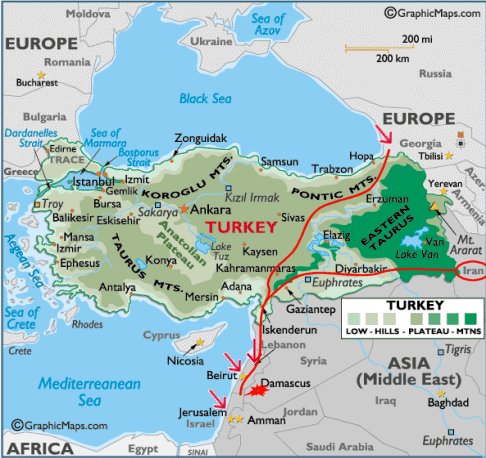
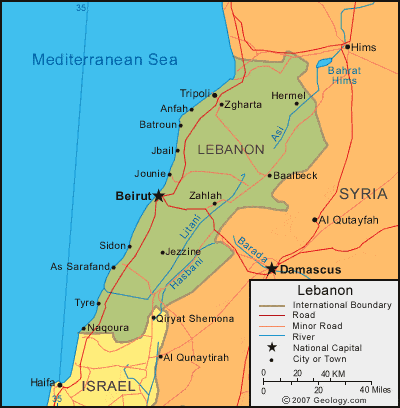
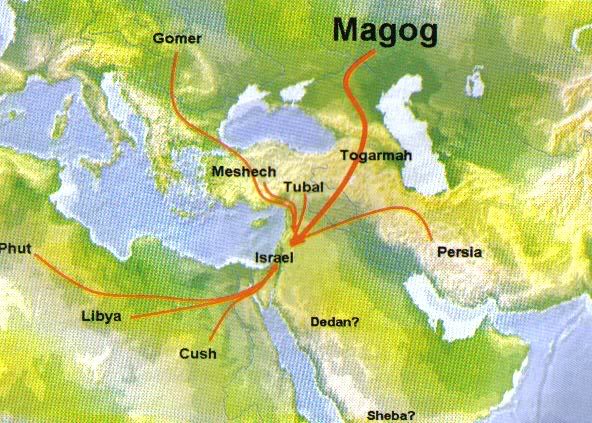
Lebanon recognizes 'state of Palestine' The Jerusalem Post (November 30, 2008) - The Lebanese government has approved forming full diplomatic relations with what it calls the "state of Palestine," and is elevating the office of the Palestine Liberation Organization (PLO) in Beirut to the status of an embassy. No date has been set to carry out the decision, which was announced by Lebanese Information Minister Tariq Mitri. The PLO is regarded by the Arab League as the sole representative of the Palestinian people. The organization is currently headed by Mahmoud Abbas, who is also president of the Palestinian Authority. Hilal Khashan, a professor of political science at the American University of Beirut, said he thought the move showed the government in Beirut was trying to show support for 'Abbas' administration. "He is facing tough times. There is a split in the Fatah movement and there's a running battle between Fatah and the Hamas in Gaza," Khashan told The Media Line. In addition, the Lebanese army is posted outside the 'Ein Al-Hilweh refugee camp and is contemplating military action if Palestinians in the camp do not surrender six members of the Islamist Fatah Al-Islam organization seeking refuge there. "I believe the Lebanese government wants to give the impression that it is not anti-Palestinian and it is welcoming diplomatic relations with the state of Palestine, which has not been declared yet," Khashan said. He added that the implementation of the decision requires a validating cabinet decision, so at the moment it "amounts to nothing." Lebanon accommodates nearly 400,000 Palestinian refugees who say they are discriminated against by the government. Khashan said the decision to upgrade relations with the PLO will not affect this situation, explaining that anti-Palestinian sentiments are deeply rooted in Lebanon. "What is needed is a change in a series of Lebanese laws that bar Palestinians from employment in Lebanon. They are not allowed to work in significant professions beyond manual labor. This is what lies at the heart of the problem," he said. "The Palestinians are treated as non entities in Lebanon and have no rights whatsoever. I believe there is a deliberate effort by the Lebanese government to keep their situation sub-human so they will never contemplate seeking permanent residency in the country." | Israel | Islam | Dividing the Land | Iran, Lebanon sign 5-year security pact The Jerusalem Post (November 27, 2008) - Iran and Lebanon have signed a security agreement, according to which Iran will supply the Lebanese army with weapons and equipment over the next five years, the London-based daily A-Sharq Al-Awsat reported. The agreement between the two nations was signed during Lebanese President Michel Suleiman's two-day visit to Teheran, which ended on Tuesday. The visit focused on security and defense cooperation, as well as on regional and international matters of mutual concern, an Iranian source revealed to the paper. "Iran announced its readiness to supply Lebanon with defensive weapons, to be agreed upon in the framework of a defensive strategic system the Lebanese will formulate," a Lebanese source said. The two sides agreed to conduct ministerial visits to Teheran and Beirut in the near future. Iranian President Mahmoud Ahmadinejad also promised to visit Beirut soon, added the Lebanese source. During his visit, Suleiman was accompanied by the ministers of foreign affairs, interior, labor, economy and trade, industry, and expatriates. Each of the ministers met with his Iranian counterpart to discuss mutual interests. By supplying the Lebanese army with weapons, Iran will thus be responsible for arming Lebanon's two major armed forces: the national army, and Hizbullah, The Media Line's analysts indicate. Since the summer war of 2006 between Israel and Hizbullah, the Lebanese Islamic resistance movement has tripled its force, Israeli Defense Minister Ehud Barak said earlier this week. Hizbullah now holds 42,000 missiles and rockets, which it received from Iran, some of which can reach Israel's nuclear reactor in Dimona, almost 300 kilometers south of the Israeli-Lebanese border, Barak said. | Iran | Israel | Islam | Gog/Magog |
Red Alert: Possible Geopolitical Consequences of the Mumbai Attacks
Stratfor
(November 27, 2008) - Summary Analysis Given this, the Indian government has two choices. First, it can simply say that the perpetrators are a domestic group. In that case, it will be held accountable for a failure of enormous proportions in security and law enforcement. It will be charged with being unable to protect the public. On the other hand, it can link the attack to an outside power: Pakistan. In that case it can hold a nation-state responsible for the attack, and can use the crisis atmosphere to strengthen the government’s internal position by invoking nationalism. Politically this is a much preferable outcome for the Indian government, and so it is the most likely course of action. This is not to say that there are no outside powers involved — simply that, regardless of the ground truth, the Indian government will claim there were. That, in turn, will plunge India and Pakistan into the worst crisis they have had since 2002. If the Pakistanis are understood to be responsible for the attack, then the Indians must hold them responsible, and that means they will have to take action in retaliation — otherwise, the Indian government’s domestic credibility will plunge. The shape of the crisis, then, will consist of demands that the Pakistanis take immediate steps to suppress Islamist radicals across the board, but particularly in Kashmir. New Delhi will demand that this action be immediate and public. This demand will come parallel to U.S. demands for the same actions, and threats by incoming U.S. President Barack Obama to force greater cooperation from Pakistan. If that happens, Pakistan will find itself in a nutcracker. On the one side, the Indians will be threatening action — deliberately vague but menacing — along with the Americans. This will be even more intense if it turns out, as currently seems likely, that Americans and Europeans were being held hostage (or worse) in the two hotels that were attacked. If the attacks are traced to Pakistan, American demands will escalate well in advance of inauguration day. There is a precedent for this. In December 2001 there was an attack on the Indian parliament in New Delhi by Islamist militants linked to Pakistan. A near-nuclear confrontation took place between India and Pakistan, in which the United States brokered a stand-down in return for intensified Pakistani pressure on the Islamists. The crisis helped redefine the Pakistani position on Islamist radicals in Pakistan. In the current iteration, the demands will be even more intense. The Indians and Americans will have a joint interest in forcing the Pakistani government to act decisively and immediately. The Pakistani government has warned that such pressure could destabilize Pakistan. The Indians will not be in a position to moderate their position, and the Americans will see the situation as an opportunity to extract major concessions. Thus the crisis will directly intersect U.S. and NATO operations in Afghanistan. It is not clear the degree to which the Pakistani government can control the situation. But the Indians will have no choice but to be assertive, and the United States will move along the same line. Whether it is the current government in India that reacts, or one that succeeds doesn’t matter. Either way, India is under enormous pressure to respond. Therefore the events point to a serious crisis not simply between Pakistan and India, but within Pakistan as well, with the government caught between foreign powers and domestic realities. Given the circumstances, massive destabilization is possible — never a good thing with a nuclear power. This is thinking far ahead of the curve, and is based on an assumption of the truth of something we don’t know for certain yet, which is that the attackers were Muslims and that the Pakistanis will not be able to demonstrate categorically that they weren’t involved. Since we suspect they were Muslims, and since we doubt the Pakistanis can be categorical and convincing enough to thwart Indian demands, we suspect that we will be deep into a crisis within the next few days, very shortly after the situation on the ground clarifies itself. | Islam | Iran Urges Lebanese to Unite Against Israel FOCUS News Agency (November 26, 2008) - Iran, a main backer of Lebanon's Shi'ite group Hezbollah, urged the Lebanese people Tuesday to unite to confront Israel, the Islamic Republic's arch foe, Reuters informed. Iran's Supreme Leader Ayatollah Ali Khamenei made the comments to Lebanese President Michel Suleiman during a visit to Iran that included touring an exhibition by the Defense Ministry, Iranian media reported. "Iran believes the capability of all Lebanese groups should be at the service of (Lebanon's) power and unity to confront the danger of the Zionist regime," Khamenei told Suleiman, the official IRNA news agency reported. Iranian officials often call Israel the Zionist regime. Suleiman, a Maronite Christian, was elected president in a May parliamentary vote after an 18-month standoff between the U.S.-backed government and the Hezbollah-led opposition. Under Lebanon's power-sharing system the presidency is held by a Christian while other top posts are taken by Sunni and Shi'ite Muslims and members of the Druze sect. "Holding talks among different Lebanese groups that are now led by the president is considered positive because Lebanon's bright future depends on national unity," Khamenei said. Suleiman, a former army chief, was elected as part of an agreement brokered by Qatar in May to defuse the political crisis that had pushed Lebanon to the brink of civil war. Tehran has often praised Hezbollah, which has formidable guerrilla army, for fighting Israel in a 34-day war in 2006. Israel has accused Iran of supplying weapons to Hezbollah but Iran insists it only provides moral and political support. "Lebanon as a friendly and brotherly country in the region will always enjoy Iran's spiritual support," Parliament Speaker Ali Larijani told Suleiman, Iran's ISNA news agency reported. Suleiman's trip included touring an exhibition showing off the Defense Ministry's capabilities, ISNA also said. Iranian Defense Minister Mostafa Mohammad Najjar announced Iran's readiness to "deepen and expand defensive ties between two states in line with the strengthening of Lebanon's security and increasing Lebanon's national and defensive capabilities." ISNA reported that Suleiman "expressed interest in expanding defensive cooperation and emphasized the need to strengthen the Lebanese army's defensive power in confronting any kind of threat, foreign aggression and terrorism." Khamenei said Iran would "always be on Lebanon's side" and said he hoped talks during the visit would strengthen ties. Suleiman, who left Tuesday, also met Iranian President Mahmoud Ahmadinejad during his two-day visit. | Iran | Israel | Islam | Gog/Magog | Faltering EU Deal Strengthens Islam Hurriyet News (November 26, 2008) - Turkey's bid for eventual European Union membership is likely to fail and this will further boost Islamist and nationalist tendencies already strong in the society. "Over the next 15 years, Turkey’s most likely course involves a blending of Islamic and nationalist strains, which could serve as a model for other rapidly modernizing countries in the Middle East," said the "Global Trends - 2025" report published Thursday by the National Intelligence Council, or NIC, which brings together all 16 U.S. spy agencies. Mathew Burrows, NIC counselor and principal organizer of the report, speaking at the Foreign Press Center here a day later, was asked how the U.S. intelligence community predicted that Turkey would be more Islamic and nationalist over the next 15 to 20 years. "We base this on quite a few talks we have had with experts both here and abroad, and our observations of trends happening now in Turkey," Burrows said. "What we see in Turkey today is the development of an Islamist, modernizing tradition that is very strong and successful, combined with what has always been a very strong nationalist tradition," he said. About Turkey's EU prospects, Burrows said, "we are cautious, I mean, and somewhat pessimistic, I would say, about whether Turkey will ever be in the EU." "And we are worried about that relationship going sour," he said. "We would expect that to reinforce some of this nationalist thinking and Islamist traditions and tendencies." Turkey's pro-secular state establishment, including the military and the ruling Justice and Development Party whose roots are in political Islam have been bickering over secularism-related matters in recent years. The party's votes in legislative elections have climbed from 36 percent in 2002 to 47 percent in 2007. Secularism to decline The NIC said it expected secularism in the Middle East to decline, in line with the Turkish example. "In the Middle East, secularism, which also has been considered an integral part of the Western model, increasingly may be seen as out of place as Islamic parties come into prominence and possibly begin to run governments," NIC said in the Global Trends report. "As in today’s Turkey, we could see both increased Islamization and greater emphasis on economic growth and modernization." The NIC report also said it expected to see the political and economic power of Indonesia, Iran, and Turkey, all non-Arab Muslim countries, increase over the next couple of decades. | Islam | Gog/Magog | EU/UN / 4th Kingdom | PM: Peace deal with Palestinians soon The Jerusalem Post (November 26, 2008) - It will soon be possible to reach a peace agreement with the Palestinians, Prime Minister Ehud Olmert said Tuesday, the morning after a farewell visit with US President George W. Bush and other administration officials who conceded a deal was not likely to materialize in the short term. "In principle there is nothing to prevent us from reaching an agreement on the core issues in the near future," Olmert said during a briefing with Israeli reporters. "I believe it is possible. I believe it is timely. A declaration is needed. I am ready to make it. I hope the other side is." He also stressed the US had not tied Israel's hands when it came to military operations in the waning days of the Bush administration, despite media reports to the contrary. "I don't remember that anyone in the administration, including the last couple of days, advised me or any of my official representatives not to take any action which we will deem necessary for the fundamental security of Israel, and that includes Iran," he said, in response to a question from The Jerusalem Post. He pointed to conversations with Bush and his deputies who are "so open, so candid, so personal, that they can say to me anything they feel, and they do... This was not one of the things they said." Speaking generally about his meetings with Bush, Vice President Dick Cheney, Secretary of State Condoleezza Rice and others, Olmert also said, "There is a deep, basic understanding between us about the Iranian threat and the need to act in order to remove that threat." There has been speculation that if Israel were going to attack Iran's nuclear sites it would do so before President-elect Barack Obama takes office on January 20. Time magazine also reported that the US had told Israel to refrain from a major invasion of Gaza, despite renewed rocket fire from the Strip, so as not to disrupt peace talks. But when it came to the Palestinians, during the briefing and in remarks before his meeting with Bush, Olmert focused on the possibility of reaching an agreement rather than on the renewed violence. The prime minister said there wouldn't be any written declaration of principles or other document spelling out the intermediate steps taken and agreements reached to date to prepare for a new American administration, because he was looking for a comprehensive peace deal. "You don't need months to make a decision," he said, noting the two years of intensive meetings with the Palestinians that he's overseen. Read full story... The two leaders exchanged expressions of friendship and appreciation, with Olmert praising Bush for removing the threat of Iraqi leader Saddam Hussein from Israel's eastern front. But Rice acknowledged earlier this month that the goal of a peace deal by the end of 2008, set at the Annapolis conference officially launching negotiations last year, was unachievable. Still, the subject was a major focus of Olmert's discussions with the secretary of state. "There are a number of issues that Prime Minister Olmert and the secretary discussed, obviously the Annapolis process being the key element," said Deputy State Department spokesman Robert Wood after their meeting Tuesday. It was a follow-up to talks Olmert held with Rice and National Security Adviser Stephen Hadley a day earlier. Olmert also said the economic crisis was a key point of discussion, though he didn't expect it to affect the $30 billion in military aid Israel is slated to receive from the US over the next decade. "We have an agreement with the United States for 10 years and no one has any doubts that it will be fulfilled," Olmert said. "America is wealthy, powerful and has integrity. No one has hinted this is up for discussion." He said the meetings also didn't touch on talk that the US might open a low-level interests section in Teheran to reenergize diplomatic efforts to limit its nuclear program. "This government has no interest in relations with Iran," Olmert said. Though Obama has indicated he favors engagement with the Islamic republic, Olmert said Israel would wait to see what he proposed before reacting. He said Obama shared the position that a nuclear-armed Iran was unacceptable. Olmert didn't speak with Obama while in the US, noting that Obama has pointed out that there's only one president at a time and that meeting with foreign leaders wouldn't be appropriate at this point. But the prime minister did speak to Obama by phone soon after his victory to congratulate him, reporting that "there's a comprehensive and orderly transition [being prepared], and this includes on issues related to Israel." Obama has called for more intense efforts to promote the Israeli-Palestinian peace process and pledged not to wait until late in his term, as Bush did, to step up engagement on the issue. In his conversation with reporters, Olmert also made the case for a resolution to the Israeli-Palestinian conflict. "The dispute is not between continuing the status quo or a two-state solution," he warned. "The dispute is between a two-state solution and the emergence of a new narrative - of one state." | Israel | Islam | Dividing the Land | America | Iran, Syria tauten grip on Lebanon, Tehran woos Christian president DEBKAfile (November 22, 2008) - Tehran and Damascus are going all out to get their hooks into Lebanon’s Christian politicians and wean them away from their’ traditional ties with the West. President Michel Suleiman this week accepted an Iranian invitation to visit Tehran this month, while another Lebanese Christian leader, Hizballah’s ally Gen. Michel Aoun, arranged to visit Damascus. DEBKAfile’s Middle East sources report that the Iranians are forging ahead with a campaign to bind the region’s Christian minorities to their Shiite wagon for challenging Sunni domination. Their first quarry is Lebanon’s powerful community. Arrangements were finalized Monday with the Iranian ambassador in Beirut Reza Shibani for president Suleiman to spend two days in Tehran on Nov. 24-25. Aoun will visit Damascus at the same time. Their country is meanwhile encircled by Syrian military forces, a factual pointer to Bashar Assad’s real intentions regarding peace. Although these developments bode ill for Israel too, they were left out of the sweeping 2009 prognosis which the Israeli Military Intelligence chief Maj. Amos Yadlin delivered in Tel Aviv Monday, Nov. 17. Neither did he look ahead to the likelihood that Iran would be able to assemble a nuclear weapon next year, notwithstanding more than a decade of international diplomacy and sanctions. Senior Israeli intelligence circles commented that the evaluations heard from Yadlin Monday were less attuned to reality than to the estimated positions of the incoming US president Barack Obama’s Middle East team and Olmert-Livni policies. Like them, he omitted to address the agendas which Tehran and Damascus are actively pursuing. Tehran launched its pursuit of Christian minorities by inviting the Lebanese Maronite leader Aoun to Tehran on Oct. 13, through Hizballah’s good offices. The gambit worked: The Lebanese leader returned home proclaiming Iran the strongest world power between the Persian Gulf and China and predicting that his trip would bear fruit in six months. In the first week of November, Tehran heaped full honors on the Lebanon’s ex-president, the pro-Syrian Christian Emil Lahoud, when he arrived with a 60-man retinue. Michel Sleiman can expect no less. The assumption in Israeli ruling circles that Syria as peace partner will deliver a “Lebanese dowry” is therefore fallacious. Assad plans to squeeze whatever he can from Israel and the new US administration in the coin of territory and backing for his regime, while not giving up an iota of his schemes with Tehran. For now, no one is paying attention to the Syrian-Iranian jaws snapping shut on Lebanon. | Iran | Israel | Islam | Isaiah 17 | Gog/Magog | Security forces brace as settlers arrive in droves to Hebron YNet News (November 21, 2008) - Security forces deployed throughout Hebron on Thursday evening in anticipation of another night of public disturbances in the West Bank city by extreme-right activists. Although the High Court's ruling on the evacuation of the disputed house near the Tomb of the Patriarchs has not yet been carried out, tensions between Jewish settlers and law enforcement are at a boiling point. The IDF, Border Guard and the police have all reinforced their men on the ground in preparation for the arrival of some 20,000 people to Hebron ahead of the reading of the 'Chayei Sarah' weekly portion (lit. 'The Life of Sarah,' Genesis 23:1-25:18). The army spread out in advance following the events of Wednesday night. Throughout the day several isolated incidents were noted, and in the evening settlers claimed a policeman had assaulted a boy in the Givat Avot neighborhood after charging the latter was in violation of a house arrest. Police confirmed a youth was detained for questioning after he insulted a policeman. Business as usual? But despite the apparent tensions Noam Arnon, a spokesman for Hebron's Jewish community, said there was hope the night would progress calmly. The Shabbat of 'Chayei Sarah' is one of ten days in the Jewish year when Jews are allowed into Isaac's Hall, the largest and most important chamber of those comprising the Tomb of the Patriarchs. For most of the year Jews are forbidden to enter it. Due to the rarity of the occasion, the city often sees an influx of tens of thousands during this time. "We expect about 20,000 people to come to Hebron, and we're preparing of that as we do every year. Every family will host several dozen guests and the schools and public institutions will also be filled with guests, and there are public mess halls and hostels that open up," said Arnon. Although most of those who come to Hebron to pray will leave with the conclusion of the Sabbath, Arnon realizes that some, mostly teenagers, will choose to stay and join numerous others at the disputed house in an attempt to prevent its evacuation. Internal Security Minister Avi Dichter pledged on Thursday that the High Court's ruling on the matter of the disputed house would be carried precisely as it was written. Dichter told Ynet that, as determined in the ruling, the house "will be evacuated within 30 days' time and guardianship of the property would be assumed by the state." Rioting caught on video A video sent to Ynet of the events of Wednesday night showcases just how far the situation has deteriorated, with extreme-right activists attacking military vehicles and rioting in the streets. An IDF soldier was lightly wounded in the mob assault, after he was doused with turpentine near the disputed house. In the video, shot with a video provided by the B'Tselem human rights organization, right-wing activists are seen swarming military cars and clashing with soldiers. Several military and police vehicles sustained varying degrees of damage. Thursday saw IDF soldiers spending several long hours painting over graffiti, hate slogans aimed at Muslims, from the walls of a local mosque. Settlers also desecrated a Muslim graveyard on Wednesday evening. Security officials issued a harsh condemnation of the events, and pledged they would throw the book at the perpetrators. However no suspects have been arrested thus far. Earlier this week the High Court of Justice upheld the state's decision to evacuate the four-storey building near the Tomb of the Patriarchs until the dispute over its ownership clears up. Settlers claim they lawfully purchased the property, but the state says it suspects the documents of being forged. Meanwhile right-wing activists continue to pour into the house, and have vowed to make their stand there. | Iran | Israel | Islam | Dividing the Land | Secret 'peace talks' exposed WorldNet Daily (November 20, 2008) - Despite media reports painting a dismal picture of negotiation prospects, Israel and the Palestinian Authority are still quietly working to conclude a major agreement before President Bush leaves office in January, informed Israeli and Palestinian sources told WND. The sources, including a senior Palestinian negotiator, said the aim is to reach a series of understandings to be guaranteed by the U.S. that would result in an eventual Israeli withdrawal from the vast majority of the West Bank. The understandings would also grant the PA permission to open official institutions in Jerusalem but would postpone talks on the future status of the capital city until new Israeli and U.S. governments are installed next year. The original plan, initiated at last November's U.S.-sponsored Annapolis summit, was to create a Palestinian state, at least on paper, by January. The summit launched talks aimed at concluding a final status agreement on all core issues – borders, the status of Jerusalem and the future of so-called Palestinian refugees. But a final agreement has been hampered by several recent events here, most notably Prime Minister Ehud Olmert's decision to resign amid corruption charges, leading to general elections scheduled for February that will see a new prime minister elected. The candidate for office from Olmert's Kadima party, Foreign Minister Tzipi Livni, is said to oppose reaching a deal on Jerusalem or refugees ahead of elections, fearing it will harm her prospects among center-right voters. Livni is Olmert's chief negotiator with the Palestinians. In spite of the upcoming elections and the Israeli government's subsequent political instability, teams of Israeli and Palestinian negotiators have been quietly meeting regularly the past few weeks in hope of concluding a series of understandings on key issues. Informed sources said any understandings reached will be backed up by Bush in an official letter. It is unclear how much weight such a letter will carry under a new U.S. administration. According to the sources, neither side expects to conclude any deal on the status of Jerusalem or Palestinian "refugees" before January, putting aside those issues for future talks. Instead, negotiations are focused on reaching an agreement emphasizing borders, particularly a pledged Israeli evacuation of the vast majority of the strategic West Bank, which borders central Israeli population centers. Read full story... Also being heavily negotiated is an agreement that would allow the PA to official open institutions in Jerusalem. WND previously reported the PA already has been quietly operating in Jerusalem, apparently with tacit approval from the Israeli government. But the expected agreement to be concluded before January would give the PA official operational status in the city, likely leading to the opening of scores of Palestinian institutions there. According to Israeli law, the PA cannot officially hold court in Jerusalem. The PA previously maintained a de facto headquarters in Jerusalem, called Orient House, but the building was closed down by Israel in 2001 following a series of suicide bombings in Jerusalem. Israel said it had information indicating the House was used to plan and fund terrorism. Thousands of documents and copies of bank certificates and checks captured by Israel from Orient House – including many documents obtained by WND – showed the offices were used to finance terrorism, including direct payments to the Al Aqsa Martyrs Brigades terror group. In parallel with an understanding on the West Bank and Jerusalem institutions, the PA is pushing for a massive prisoner release to be pledged before January. A senior Palestinian negotiator told WND the PA requested that all Palestinian prisoners – meaning even convicted terrorists responsible for murdering Israelis as well as members of the rival Hamas terror group – be freed as part of the deal. While the negotiator conceded such a massive release is unlikely, he said the PA's hope is that Israel will grant a large release, possibly including the freedom of convicted murderer Marwan Barghouti. Barghouti is a founder of Fatah's Al Aqsa Martyrs Brigades terror group, the most active Palestinian terror organization. He has boasted of planning the intifada, or Palestinian terror war, launched in September 2000, after then-PA President Yasser Arafat turned down an Israeli offer of a Palestinian state and instead attempted to "liberate" Palestine by force. Barghouti is serving five life sentences for his direct role in murdering Israelis. Other understandings that Israel and the PA are attempting to reach before January surround water and natural resources. While it wasn't clear whether any understanding would actually be reached, the timing apparently favors all involved leaders. With Bush set to depart office in January, sealing a deal between Israel and the Palestinians would bode well for his legacy, which some analysts say is hampered by what is described as an unpopular war in Iraq, an economic meltdown and a growing crisis with Russia. Olmert is Israel's most unpopular prime minister. Tainted by corruption charges and a heavily mismanaged war in Lebanon in 2006, Olmert would also like to depart office with a deal in hand. Also there is some concern in Jerusalem that President-elect Barack Obama may push Israel into further concessions during future negotiations, so some argue a deal on key issues while Bush is in office may be in Israel's interests. Abbas' term in office expires Jan. 10. His future leadership is sure to be contested by Hamas and by some in Fatah's young guard who want him to be replaced by Barghouti. Abbas' ability to tout an agreement in which Israel is compelled to retreat from the West Bank and release Palestinian prisoners could help his fading street popularity. Also, Abbas is said to be greatly concerned by the prospects of February's Israeli elections resulting in opposition leader Benjamin Netanyahu coming to power. Netanyahu has announced repeatedly, including as recently as yesterday, he would suspend negotiations with the PA. | Israel | Islam | Dividing the Land | America | Peres Says Peace Is Made by Closing the Eyes Israel National News (November 17, 2008) - President Shimon Peres told Diaspora Jewish leaders Monday, "You have to close your eyes" to make peace. He also reasoned that a peace agreement with the Palestinian Authority will encourage Sunni Muslims against Ahmadinejad. Speaking at the annual General Assembly of the United Jewish Committees, he said that "making peace is a little bit like marriage [and] you have to close your eyes and accept what is possible to accept." His audience laughed and applauded. He also explained his reasoning why surrendering Judea and Samaria to the PA and establishing a new Arab state in their place would have a domino effect on peace in the Middle East. Iran is the only regional country that wants to control the Middle East, President Peres stated. He reasoned that a peace pact with the PA would show Sunni Muslims it does not have to accept Shi'ite dominance by Iranian President Mahmoud Ahmadinejad's faction. He wants "to run the Middle East, in the name of religion", the octogenarian president continued. "The Persians in Iran are, all told, 35 million people. The Iranians are 70 million, half of them minorities, and half are Persians. And it is the Persians who are the producers of the ayatollahs and the fanatic people. They want to control 350 million people [of the Middle East], 90 percent of whom are Sunni." | Israel | Islam | Dividing the Land | Has the U.N. Found the Smoking Gun in the Syrian ‘Nuclear’ Incident? The Media Line (November 11, 2008) - There are widespread reports in the international media that the International Atomic Energy Agency’s (IAEA) inspectors found traces of weapons-grade uranium at a site in Syria, which Israel is believed to have destroyed in an air strike a year ago. The reports suggest the uranium was discovered in June, but the story has only just been leaked to the media. Confirmation is expected to come from the IAEA’s head Muhammad Al-Barade’i when the United Nations’ watchdog meets at the end of this month. Since the bombing, Syria has insisted the site was used for agricultural purposes, but media reports have persisted about North Korean involvement, as well as links to Iran’s nuclear program. | Iran | Israel | Islam | Isaiah 17 | EU/UN / 4th Kingdom | Russia to Sell Heavy Arms to Lebanon Israel National News (November 10, 2008) - Following a meeting last week between leading Lebanese legislator Sa'ad Hariri and Russian leaders, Hariri was quoted by Russian media this weekend as saying Russia will sell heavy weaponry to Lebanon. Previously, Hariri said that he hoped Russia would help Lebanon claim Mt. Dov from Israel. Russia is expecting Lebanon to recognize the independence of the breakaway Georgian districts of Abkhazia and South Ossetia. Hariri, the son of the assassinated popular former Prime Minister Rafik Hariri, represents the Western-backed majority in the Lebanese parliament. Russia will "help the Lebanese army," the Vremia Novosti newspaper quoted Hariri as saying, "which needs heavy weapons" such as tanks and artillery. American military aid, Hariri told Russian media, only consists of light arms. Lebanese Defense Minister Elias Murr is to visit Moscow in coming weeks, when the details of the arms deal will be finalized. The Russian state arms export firm, Rosoboronexport, has been boycotted by the United States government for arms deals with Iran, North Korea and Syria. In early October, Prime Minister Ehud Olmert met with Russian President Dmitry Medvedev and urged him not to approve the sale of weapons to Iran and Syria. It was imperative, he told the Russian leader, to "prevent weapons from Syria from reaching extremist elements in Lebanon, such as Hizbullah." Mt. Dov and Abkhazia-S. Ossetia - Quid Pro Quo? Last week, during an official visit to Moscow by Hariri and other legislators, Lebanese media strongly emphasized Hariri's expression of his appreciation for Russia's role in working towards an Israeli withdrawal from the Mt. Dov area (called "Shab'a Farms" in Lebanon) along the Israeli border with Lebanon. A report published by the Beirut-based English-language Daily Star was entitled, "Hariri Looks to Russia to Help Liberate Shab'a Farms", although the article itself did not present any direct quote on the matter from Lebanese or Russian officials. After his meeting with Hariri, Foreign Minister Sergei Lavrov said that Russia was against foreign interference in Lebanese domestic affairs. It was not clear if he was referring to actions by Syria, Israel or other foreign interventions. The Iran-controlled Lebanese terrorist organization Hizbullah, in the meantime, said recently that an Israeli withdrawal from Mt. Dov would only be a start. The group claims seven Arab villages in northern Israel are actually Lebanese. In any event, both Iran and Hizbullah have repeatedly made it clear that they do not believe Israel should exist at all, regardless of border demarcations. A Hizbullah spokesman said last week that the group would not give up it arms until Lebanon had another force capable of confronting Israel. Touching on Lebanese policy towards matters in the Slavic states, Hariri was quoted as saying that Lebanon may well recognize the independence of the breakaway Georgian districts of South Ossetia and Abkhazia. The Russian Vremya Novostei newspaper quoted Hariri as saying, "We will fine tune contacts with South Ossetia and Abkhazia now. For example, delegations of [Lebanese] businessmen will be leaving for there soon." Russia has backed the secession of the regions from Georgia, including launching a war in their defense in August of this year. Russia: A Future Radical Muslim Superpower? Front Page Magazine (November 9, 2008) - Frontpage Interview's guest today is Ilshat Alsayef, one of the founding members of Muslims Against Sharia. He was born in of the Asian republics of the former Soviet Union. A military officer for most of his adult life, Mr. Alsayef started his military career as a Second Lieutenant during the Soviet-Afghan war and retired as a Lieutenant-Colonel after the First Chechen War. FP: Ilshat Alsayef, welcome to Frontpage Interview. Alsayef: Thank you very much for having me here. FP: Tell us about the state of radicalization of Muslims in Russia and other ex-Soviet republics. Alsayef: There were two waves of radicalization of the ex-Soviet Muslims. The first wave started after the break-up of the Soviet Union in the early 1990s. After the fall of communism, former Soviet Asian republics, now independent countries (Kyrgyzstan, Tajikistan, Turkmenistan and Uzbekistan) as well as autonomous regions of Russia (Chechnya, Dagestan and Ingushetia), experienced a resurgence of religious freedom. Not being able to freely practice their religion for a few generations, some of the local Muslims went overboard. Salafi groups like Hizb-ut-Tahrir, and later al Qaeda, became popular among newly-minted religious zealots. While the conflicts in Asian countries were mostly religious vs. secular, the Chechen conflict also had the independence element. The second wave of radicalization started at the turn of the century. Some people claim that it was a result of the American War on Terror, which many Muslims interpret as the American War on Islam, but in reality the reason is skyrocketing oil revenues of Wahhabi states. Centuries-old local mosques are being replaced by modern, Wahhabi-built mosques. Old imams who survived the communists are being replaced by Wahhabi clerics. This is not only true for predominantly Muslim countries like Tajikistan, but also for autonomous regions inside of Russia like Bashkiria and Tatarstan, where most people consider themselves more Russian than Muslim. You can see similar developments in former Yugoslavia, where moderate imams with little financial backing are being replaced by radicals with virtually unlimited financing. If current demographic trends hold, Muslims in Russia may become a majority by the mid-century. And if current radicalization trends hold, Russia may become a war theatre comparable to Chechnya or Lebanon, but on a much larger scale. FP: Expand for us a bit please on the demographic trends in Russia. Muslims may be the majority in Russia by mid-century? What will this mean? Alsayef: The native Russian population is on the decline. About a year ago, the government started to provide a special subsidy for a second child; 250,000 rubles, which is about two average yearly salaries. Attracted by the economic opportunities, there is a steady stream of Muslims from the former Soviet republics and predominantly Muslim parts of the Russian Caucasus. Those Muslims tend to have much larger families than native Russian Muslims. Small Muslim communities of Moscow and St. Petersburg that comprised less 1% of the population 20 years ago have increased more than ten-fold. The new generation of Muslims is more religious. Unfortunately, since most of the mosques are either completely or partially funded by the Wahhabis, the new generation is also more radical. 20 years ago, Russian Muslims were completely assimilated, both culturally and linguistically. The new generation tends to create its own communities. Those "enclaves" are easier radicalized. If the trends of isolation and radicalization continue along with current demographic trends and rising oil prices, it is quite possible that by mid-century Russia will become a radical Muslim superpower. FP: How can the current radicalization trend be stopped? The key is to stop skyrocketing oil revenues for Wahhabi states, yes? But how? Alsayef: I could never understand why America spends a quarter of a trillion dollars a year on Persian Gulf oil while not using its own oil resources. Especially when some of this money goes to finance radical Islam worldwide (including in America itself) and the American economy suffers from high fuels prices. Luckily, Russia does not have oil dependency. The long-term solution to stop the flow of petro-dollars to the Wahhabis is to create a non-petroleum energy solution. It will probably not happen in our lifetime, but it doesn't mean that it shouldn't be worked on today. The short-term solution is to combat radical Islam inside every democratic country. One part is to enact legislation to criminalize the spread of radical Islam. It is not an easy task, especially in America where Freedom of Speech is the cornerstone of the Constitution. However, some of the speech could be criminalized, i.e., a death threat to an individual. Advocating Sharia is a death threat to Democratic society. If you can protect an individual, you should be able to protect the society as a whole. The other needed step is to empower moderate Muslims to combat Islamism in the public square. Unfortunately, neither the Russian nor the American government seems to distinguish between moderate Muslims and 'soft' Jihadis. In fact, Putin went so far as to condemn the publication of Prophet Mohammed cartoons. While Russia is empowering Iran, America is empowering Saudi Arabia, which is even worse. On top of that, America is legitimizing 'soft' Jihadis and advance of Sharia by putting them in charge of government and academic programs and inviting them to major political events. FP: Where exactly does Russia stand in the War on Terror? There is, for instance, much evidence that the Putin regime is in league with Islamists on many levels. (Click here to see Pavel Stroilov interview.) Alsayef: I wouldn't call this evidence. When someone portrays that "FSB blew up four apartment blocks in Russia, and then were caught red-handed attempting to blow-up the fifth" as a fact, the rest of his "facts" must be taken with a grain of salt. Did the FSB have the ability to blow up four buildings in Moscow? Absolutely. Would the FSB blow up those buildings? I find it highly improbable. Could the FSB get caught red-handed attempting to blow-up the fifth building? Absolutely not. Who would they get caught by? The cops? The cops can't touch them. By the FSB itself? Not bloody likely. The "fact" that the FSB blew up those buildings is as much of a fact as the "fact" that the CIA blew up the Twin Towers. It is nothing more than a conspiracy theory, and Mr. Stroilov should know better than present it as a fact. The claim that "The Putin-Medvedev regime is doomed" shows that Mr. Stroilov seems to prefer wishful thinking to reality. Barring an act of God, Putin will rule Russia for a long time, no matter what title he comes up with, president, prime minister, or Tzar. FP: Well, the connection between the FSB and the blow up of four buildings in Moscow appears to me to be pretty solid in terms of what I have studied, and the Twin Towers conspiracy theory analogy doesn’t match in anyway. But we’ll leave this for another forum. Pavel Stroilov is welcome to contribute to our pages on this issue if he wishes. Let’s get to Putin and the tie to Islamists. Alsayef: In terms of the tie between Putin to the Islamists, first, and pretty much the only one, is Bushehr. Everybody knows that the Iranian nuclear program, euphemistically speaking, goes beyond energy. The Russians know that. The Americans know that. Even the IAEA knows that. What the Russians don't seem to understand, or maybe simply don't care about, is that an Iranian-made nuke could be detonated in Moscow just as easily as it could be detonated in Washington. Since I'm not privy to the Russian-Iranian nuclear deal, I might not be aware of some safeguards. For example, the Russians might control the weaponized nuclear material production and would be able to match the bomb signature to the reactor. However it is unlikely for Iranians to use a nuclear weapon without plausible deniability, therefore it probably will be given to a third party. This third party most likely would be a radical Islamic group that might ignore the wishes of its masters and detonate the bomb anywhere. Second is Syria. Syria is a Muslim country and it has a fascist regime, but it is secular. However, Syria-Iranian proxy Hizballah is an Islamist group and weapons sold to Syria have been known to turn up in Hizballah arsenal. Third is Venezuela. Again, Venezuela's government is hardly Islamist, but Chavez offered Venezuelan passports to radical Muslims who want to go to the United States. As for al-Zawahiri, being the FSB secret agent, that's just another unsubstantiated and highly improbable rumor. FP: Russia’s stance on the War on Terror? Alsayef: If the terror is within Russian borders, Russia is very forcefully against it. The famous Putin's phrase about the terrorists is "budem mochit' v sortire" which roughly translates into "we'll whack them in the toilet." But if the terror is outside of Russia and it ties up American resources, then we have a different story. After all, Putin still sees America as Russia’s main rival; the fact that the feelings are not mutual, is somewhat of an insult to him. Russia doesn't mind that much. However, the biggest threat to Russia is not America, it is radicalizing Muslim population within its own borders as well as in Russia's former satellites. Putin is focusing on America while overlooking a growing Islamist threat at home. As the last decades show, radicalization of Muslims always translates into bloodshed, but Putin's government seems to think that it is immune. FP: Ilshat Alsayef, thank you for joining Frontpage Interview. Alsayef: Thank you Jamie. | Iran | Islam | Isaiah 17 | Gog/Magog | Iran Challenges Obama by Hiking Tensions on Israel’s Borders DEBKAfile (November 8, 2008) - The strategy the Islamic regime has charted for the new US president hinges on fanning tensions on Israel’s northern and southern borders while putting a damper on the various Middle East peace initiatives. Syria was therefore discouraged from returning to its indirect peace track with Israel and Hamas ordered to boycott Egypt’s bid to patch up the quarrel between the Palestinian factions Hamas and Fatah. Tehran’s object is to show Barack Obama who holds the whip hand in the Middle East and force him to seek urgent talks to defuse rising tensions. At his first news conference as president elect, Obama said Friday, Nov. 7, that Iran’s pursuit of nuclear weapons was “unacceptable” and its support for terrorist organizations “must cease.” He ducked a reporter’s question about whether he had read the letter of congratulation sent him by Mahmoud Ahmadinejad and when he would answer. But Iran had already laid out its strategy for the incoming president, jumping in the day before the US presidential election. Foreign minister Manouchehr Mottaki arrived in Damascus on Nov. 3 with a briefing for Syrian president Bashar Assad. According to our Middle East sources, Mottaki said Tehran would enter into dialogue with the new US president only from a position of political and military strength and did not propose to await Obama’s convenience until he took office in the White House on Jan. 20. Iran’s rulers want to force the new US president to seek them out for a back-door channel of communications, in the same way as Ronald Reagan did while Jimmy Carter was still president to solve the 1980 hostage crisis in Tehran. They plan to make him come to them by raising tensions to crisis level. While avoiding an explicit order to halt the Syrian-Israel talks, Mottaki gave Assad to understand that he must keep Tehran in the picture on their progress and goals. Better they should lead nowhere. This would fit in with Iran’s intention of putting on the table an impressive crisis package including Syria, Lebanon and the Palestinians and so force the new US administration to accept the Islamic republic as the prime power in the region. To drive this home, they are stirring the pot wherever they can. DEBKAfile’s Exclusive military sources disclose that Iranian agents, aided by Hizballah, are enlisting Palestinian militias in the big Lebanese Ain Hilwa refugee camp near Sidon and other camps for terrorist missions on Israel’s northern border. The Israeli government has watched what was going on but done nothing. But US military and intelligence were concerned enough to warn Palestinian leader Mahmoud Abbas that he had better act fast before his Fatah faction lost Ain Hilwa. This happened shortly before US Secretary of state Condoleezza Rice departed for the Middle East Quartet’s Sharm el-Sheikh meeting Sunday, Nov. 9. Abbas reacted by sacking Sultan Abu Al Aynayn, the veteran Fatah chief for all the refugee camps in Lebanon, and appointing the Palestinian general Kemal Midhath in his stead. But our counter-terror sources strongly doubt that the new man can stem the defections of Palestinian militias from Fatah and halt Iran’s and Hizballah’s takeover of the Ain Hilwa camp – especially since, according to the latest US intelligence information, Col. Al Aynayn had already been bought. In Gaza, Israeli forces last week pre-empted in the nick of time a Hamas cross-border kidnap operation by means of a tunnel leading under the border fence. Hizballah’s abduction of two Israeli soldiers, the late Ehud Goldwasser and Eldad Regev in July 2006 triggered a full-scale war with Israel. The tunnel was destroyed but Hamas and Jihad Islami have maintained a four-day missile barrage against Israel. In the diplomatic arena, Saturday, Nov. 8, Hamas suddenly announced a boycott of the oft-postponed Egyptian bid. It had been finally scheduled to take place in Cairo Monday, Nov. 9, to bring Hamas and Fatah together in Cairo for a power-sharing deal to bury the hatchet after three years. This event was also intended to demonstrate to the Middle East Quartet that Egypt was back at center stage in the Middle East and had succeeded in drawing Hamas out of the radical Iranian orbit to embrace Palestinian unity and give the Quartet’s peace effort a major boost. But Tehran was ahead of Cairo. Last Tuesday, Hamas leaders, including Khaled Meshaal, were given their orders from the Iranian foreign minister to boycott the Cairo talks. Following his script, a smiling Meshaal told a Sky interviewer: “If the new US president wants a role in the Middle East, he has no choice but to talk to us because we are the real force on the ground.” By Saturday, Nov. 8, therefore, with missiles already flying from Gaza, Tehran had managed to spoil the last Middle East journey to be undertaken by Condoleezza Rice as secretary of state, and tip over Egypt’s Palestinian mediation bid and the prospects of Syrian-Israel talks. Still to come is a Lebanese-Israeli border flare-up - for which Tehran has already enlisted Hizballah and Lebanese Palestinian militias. | Iran | Israel | Islam | America | Syria moves more tank-artillery forces south to Israel border Debkafile (November 5, 2008) - Lebanese sources and eye witnesses report Syrian tanks, artillery and commando units have taken up battle positions in four villages around Hasbaya opposite Mt. Hermon and northern Israel. According to DEBKAfile’s military sources, Syrian tanks and artillery units continued to move into their new positions Sunday and Monday, Nov. 2-3, so completing their deployment the full length of the Syrian-Lebanese border. Elements of the Syrian 10th, 12th and 14th Divisions and the 3rd Army - withdrawn last week from the 600-km long Syrian-Iraq border - are now poised opposite Israeli positions holding the disputed Shebaa Farms enclave on Mt. Hermon. Military sources say that whereas opposite the northeastern Tripoli region, Syrian forces are strung out in small clusters of 2 to 3 tanks one or more kilometers apart, their tank units are massed tightly opposite Mt. Hermon and northern Israel. There are other differences: Heavy Syrian armor is positioned well back from the front-line infantry and commando troops in the north, whereas tanks, artillery and special forces are deployed right up to the border opposite South Lebanon and Israel. Western and Lebanese military observers relate Syria’s military movements to Damascus’ threats, growing more strident Sunday, of “painful punishment” for the US Oct. 26 raid in northern Syria unless Washington apologizes, clarifies its action and pays compensation. These observers stress that Damascus has no real expectation of a US apology or clarification, because Syria knows as well as the US that the target was its own forward military base for terrorist strikes in Iraq. While insisting that an innocent farm was attacked and the 8 people killed were all civilians, the Syrians are taking advantage of the Bush administration’s silence to argue that Damascus has the same right as Washington to carry out cross-border attacks against “terrorist targets” i.e. in Lebanon and Israel. Damascus is winding the tensions up to a pitch where some military action against a US Middle East target or ally in Lebanon or Israel is becoming hard to avoid. Senior IDF officers and some Western military sources are perplexed by the Israeli government’s failure to pursue deterrent action against the Syrian tanks poised in battle array on its border. Instead, the outgoing prime minister Ehud Olmert is busy trying to reviving indirect talks with Syria before he quits, while defense minister Ehud Barak and Kadima leader Tzipi Livni appear unconcerned. | Israel | Islam | Isaiah 17 | More than 35 Qassams, mortars fired at Israel YNet News (November 5, 2008) - More than 35 Qassam rockets and mortar shells were fired at the western Negev communities early Wednesday, following an Israel Defense Forces operation in the Gaza Strip aimed at thwarting a terror attack. Two soldiers were moderately injured and four sustained light injuries after a mortar shell was fired at an IDF force during a raid in the Gaza Strip Tuesday night. Six Hamas operatives were killed in the operation, which concluded on Wednesday morning. At least one rocket landed in central Ashkelon, and two others landed near the city. The Color Red alert system was activated moments before the fall. Two women and a 13-year-old girl suffered from shock and were evacuated to the Barzilai Medical Center in the city. There were no reports of damage. At first, reports spoke of six rockets and several mortars fired at the Eshkol Regional Council, but later reports confirmed massive rocket fire. The resumption of the rocket fire caused great panic among parents in Ashkelon, who rushed to take out their children from the unfortified schools. "The parents are right, because we are simply abandoning our children who are exposed to missile fire," said the chairman of the parents committee in one of the schools. "I left my workplace and took my daughter home," one parent said. "I won't have her stay here one more minute, at least until she calms down." On Tueday, the local security officers of the Gaza vicinity communities were informed that a resumption of the rocket fire from Gaza should be expected. Six mortar shells were fired at the Kissufim crossing during an IDF operation in the area, but no injuries or damage were reported in the incident. Following a meeting of the Home Front Command to evaluate the situation it was decided not to call off the school day in Sderot and the Gaza vicinity communities. It was also agreed that the emergency procedures practiced by the civilian population in case of a rocket alert should be reviewed. Meanwhile, the Magen David Adom emergency services in the region have gone on high alert and will be operating in full capacity. more... U.S. Treasury teaches 'Islamic Finance 101' WorldNet Daily (November 5, 2008) - The Treasury Department has announced it will teach "Islamic finance" to U.S. banking regulatory agencies, Congress and other parts of the executive branch today in Washington, D.C. – but critics say it is opening a door to American funding of Islamic extremism. 'Islamic Finance 101' According to its announcement, the "Islamic Finance 101" forum is "designed to help inform the policy community about Islamic financial services, which are an increasingly important part of the global financial industry." The Treasury Department has collaborated with Harvard University's Islamic Finance Project to coordinate the event. The department says it expects about 100 people will attend the seminar. Some speakers include Assistant Secretary of the Treasury Neel Kashkari, senior adviser to Treasury Secretary Henry Paulson, Jr.; Harvard Business School professor Samuel Hayes; Mahmoud El-Gamal, chair of Islamic economics, finance and management at Rice University and Islamic finance adviser to the Treasury Department; Sarah Bell of the Federal Reserve Bank of New York; Yusuf Talal DeLorenzo, Shariah adviser and Islamic scholar; Michael McMillan, chair of the Islamic Legal Forum at the American Bar Association and professor of Islamic finance; and Rushdi Siddiqui, global director for the Dow Jones Islamic Market Indexes and vigorous advocate for Islamic finance. Islamic finance is a system of banking consistent with the principles of Shariah, or Islamic law. It is becoming increasingly popular, having reached $800 billion by mid-2007 and growing at more than 15 percent each year. Wall Street now features an Islamic mutual fund and an Islamic index. However, critics claim anti-American terrorists are often financially supported through U.S. investments – creating a system by which the nation funds its own enemy. Aiding the enemy In his essay, "Financial Jihad: What Americans Need to Know," Vice President Christopher Holton of the Center for Security Policy writes, "America is losing the financial war on terror because Wall Street is embracing a subversive enemy ideology on one hand and providing corporate life support to state sponsors of terrorism on the other hand." Holton refers to Islamic finance, or "Shariah-Compliant Finance" as a "modern-day Trojan horse" infiltrating the U.S. He said it poses a threat to the U.S. because it seeks to legitimize Shariah – a man-made medieval doctrine that regulates every aspect of life for Muslims – and could ultimately change American life and laws. Shariah-compliant finance is becoming a major movement, because American banks and investors are seeking wealth from oil profits in the Middle East. Some advocates claim Islamic finance is socially responsible because it bans investors from funding companies that sell or promote products such as alcohol, tobacco, pornography, gambling and even pork. However, Islamic financial institutions also require all industry participants to adhere to tenets of Shariah law. According to Nasser Suleiman's "Corporate Governance in Islamic Banking, "First and foremost, an Islamic organization must serve God. It must develop a distinctive corporate culture, the main purpose of which is to create a collective morality and spirituality which, when combined with the production of goods and services, sustains growth and the advancement of the Islamic way of life." Three nations that rule 100 percent by Shariah law – Iran, Saudi Arabia and Sudan – hold some of the most horrific human rights records in the world, Holton said. "This strongly suggests that Americans should strenuously resist anything associated with Shariah." Tenets of Shariah In his essay, "Islamic Finance or Financing Islamism," Alex Alexiev outlined the following tenets of Shariah taken from "The Reliance of the Traveler: The Classic Manual of Sacred Law":
'Useful idiots' Alexiev writes that many Islamic financial institutions claim Shariah-Compliant Finance "derives its Islamic character from the strict observance of the ostensible Quranic prohibition of lending at interest, the imperative of almsgiving (zakat), avoidance of excessive uncertainty (gharar) and certain practices and products considered unlawful (haram) to Muslims …" However, he said, "[E]ven a casual examination of the reality of Islamic finance today reveals it to be a bogus concept practiced by deceptive ploys and disingenuous means by practitioners that are or should be aware of that, but remain predictably silent." Shariah finance institutions that have funded militant Islamism for more than 30 years. Alexiev cites Islamic Development Bank's hundreds of millions of dollars in contributions to Hamas in support of suicide bombing. Bank Al-Taqwa and other banks and charities run by Saudi billionaires have funded al-Qaida activities. Additionally, Shariah law mandates that Muslims donate 2.5 percent of their annual incomes to charities – including jihadists. When 400 banks regularly contribute to such charities, potential financial sums can be virtually limitless. If Western banks endorse Shariah, they will "end up becoming what Lenin called useful idiots or worse to the Islamists," Alexiev writes. "And it is a very thin line between that and outright complicity in the Islamist agenda." | Islam | NewWorldOrder | America | Economic Crisis | Obama Tells Abbas: I Support Dividing Jerusalem Israel National News (November 4, 2008) - Democratic presidential candidate Senator Barack Obama privately expressed his support for a new Arab state within Israel's current borders, including eastern Jerusalem, during his meeting with Palestinian Authority Chairman and Fatah leader Mahmoud Abbas in Ramallah this summer. According to a report published Tuesday in the Lebanese newspaper al-Ahbar, Obama told Abbas that he supports a PA state, and Arab "rights to east Jerusalem" as well. The sources said Abbas and PA Prime Minister Salam Fayyad "heard the best things they ever heard from an American president" during the meeting. However, said sources quoted in the report, the candidate asked them to keep his declaration a secret. PA spokesman Nimar Hamad said he had no comment on the remarks, other than to describe the briefing Abbas and Fayyad had given to the presidential hopeful. Later official PA reaction to the report categorically denied that Obama had made the statements attributed to him. "The Palestinian Authority views the American elections as an internal matter and does not favor one person over another," he said in an official statement. "The PA hopes that the next American president will fulfill his commitment towards the Palestinians and pressure Israel." Abbas, Fayyad and the rest of the Arab world are clearly hoping for an Obama victory, however. Hamas sources quoted in the article said that Arabs fear new wars would break out in the Middle East if Republican candidate Senator John McCain wins, but they believe there will be an official peace agreement with an Obama White House. Mixed Messages in Gaza PA Arabs who live in Gaza were reportedly celebrating in the streets with impromptu demonstrations, waving Hamas flags in anticipation of an Obama win, according to Voice of Israel government radio. But officials for the terrorist group that controls the region were skeptical that a change in the White House would lead to a change in facts on the ground. Hamas spokesman Fawzi Barhum was quoted by Voice of Israel as saying that voters who would have to choose between Obama and McCain were being presented with two "awful" options. The group's Damascus-based political bureau chief, Khaled Mashaal, softened the statement by saying the group is prepared to work with any U.S. president and would welcome any change in American policy, especially if it corrected what he referred to as a "bias" toward the Jewish State. | Israel | Islam | Dividing the Land | America | Summary of remarks by Javier Solana, EU High Representative for the CFSP, at the Ministerial Meeting of the Barcelona Process: Union for the Mediterranean Council of the European Union (November 4, 2008) - On Tuesday, the plenary session was focussed on the concrete project areas on which the partners will work in priority: de-pollution of the Mediterranean, maritime and land highways, civil protection, alternative energies and the Mediterranean Solar Plan, higher education and research, the Mediterranean Business Development Initiative. During the working lunch, the Ministers discussed regional issues, including the Middle East Peace Process. The High Representative said: "Today we have made an important step forward. The world in which we live today is a globalized world in which we need global solutions for the common challenges we are facing. The Union for the Mediterranean will contribute to solve important issues. The qualitative change we have made today is very important and significant. We have six good project areas. We have now the responsibility to work quickly and efficiently. We will be judged on how we progress on those projects. It is very important to have adequate mechanisms that allow 43 countries to adopt decisions swiftly." FINAL DECLARATION The Paris Summit of the ‘Barcelona Process: Union for the Mediterranean’ (Paris, 13 July 2008) injected a renewed political momentum into Euro–Mediterranean relations. In Paris, the Heads of State and Government agreed to build on and reinforce the successful elements of the Barcelona Process by upgrading their relations, incorporating more co-ownership in their multilateral cooperation framework and delivering concrete benefits for the citizens of the region. This first Summit marked an important step forward for the Euro-Mediterranean Partnership while also highlighting the EU and Mediterranean partners’ unwavering commitment and common political will to make the goals of the Barcelona Declaration – the creation of an area of peace, stability, security and shared prosperity, as well as full respect of democratic principles, human rights and fundamental freedoms and promotion of understanding between cultures and civilizations in the Euro-Mediterranean region – a reality. It was decided to launch and/or to reinforce a number of key initiatives: De-pollution of the Mediterranean, Maritime and Land Highways, Civil Protection, Alternative Energies: Mediterranean Solar Plan, Higher Education and Research, Euro-Mediterranean University and the Mediterranean Business Development Initiative. Ministers propose that as from Marseille the “Barcelona Process:
Union for the Mediterranean’’ should be called “Union for the Mediterranean”. Ministers reaffirm their commitment to achieve a just, comprehensive, and lasting solution to the Arab-Israeli conflict, consistent with the terms of reference of the Madrid Conference and its principles, including land for peace, and based on the relevant U SC resolutions and the Road Map. Ministers also stress the importance of the Arab Peace Initiative and underline their support for efforts to promote progress on all tracks of the Middle East Peace Process. Ministers stress that the Barcelona Process: Union for the Mediterranean is not intended to replace the other initiatives undertaken in the interests of the peace, stability and development of the region, but that it will contribute to their success. Ministers welcome the positive role played by the EU in the Middle East Peace Process, notably in the framework of the Quartet. They reaffirm their commitment to support the ongoing Israeli-Palestinian negotiations in order to conclude a peace treaty resolving all outsanding issues, including all core issues without exceptions, as specified in previous agreements. They welcome the commitment of both parties to engage in vigorous, ongoing and continous negotiations making every effort to conclude a peace agreement based on the Annapolis process, as agreed in November 2007. They also encourage the parties to intensify their efforts on the path of direct dialogue and negotiation in the fulfilment of the two states solution: a safe and secure Israel, and a viable, sovereign and democratic Palestinian State, living side by side in peace and security. Final status issues have to be agreed upon by the parties. ... Ministers welcome and support the indirect peace talks between Israel and Syria under the auspices of Turkey and encourage all efforts deployed to achieve stability, peace and security in the region. Ministers welcome the establishment of diplomatic relations between Syria and Lebanon. Ministers reiterate their condemnation of terrorism in all its forms and manifestations, regardless of the perpetrators, and their determination to eradicate it and to combat its sponsors and reaffirm their commitment to fully implement the Code of Conduct on Countering Terrorism adopted in the Barcelona Summit on 28th ovember 2005 in order to enhance the security of all citizens within a framework that ensures respect for the rule of law and human rights, particularly through more effective counterterrorism policies and deeper cooperation to dismantle all terrorist activities, to protect potential targets and to manage the consequences of attacks. They also reiterate the complete rejection of attempts to associate any religion, civilization or culture with terrorism and confirm their commitment to do their utmost effort with a view to resolving conflict, ending occupation, confronting oppression, reducing poverty, promoting human rights and good governance, improving intercultural understanding and ensuring respect for all religions and beliefs. Ministers reaffirm their common aspiration to achieve peace as well as regional security according to the Barcelona Declaration of 1995, which, inter alia, promotes regional security by acting in favour of nuclear, chemical and biological nonproliferation through adherence to and compliance with a combination of international and regional non-proliferation regimes and arms control and disarmament agreements such as NPT, CWC, BWC, CTBT and/or regional arrangements such as weapons-free zones, including their verification regimes, as well as by fulfilling in good faith their commitments under arms control, disarmament and non-proliferation conventions. The parties shall pursue a mutually and effectively verifiable Middle East Zone free of weapons of mass destruction, nuclear, chemical and biological, and their delivery systems. Furthermore the parties will consider practical steps to prevent the proliferation of nuclear, chemical and biological weapons as well as excessive accumulation of conventional arms; refrain from developing military capacity beyond their legitimate defence requirements, at the same time reaffirming their resolve to achieve the same degree of security and mutual confidence with the lowest possible levels of troops and weaponry and adherence to CCW; promote conditions likely to develop good-neighbourly relations among themselves and support processes aimed at stability, security, prosperity and regional and sub-regional cooperation; consider any confidence and security-building measures that could be taken between the parties with a view to the creation of an "area of peace and stability in the Mediterranean", including the long term possibility of establishing a Euro-Mediterranean pact to that end. more... | Israel | Islam | Dividing the Land | EU/UN / 4th Kingdom | Solana | NewWorldOrder | 1st Seal |
Mediterranean Union agrees on HQ, Arab-Israeli role AFP (November 4, 2008) - Foreign ministers from the new Mediterranean Union struck a deal Tuesday for Barcelona to host the forum's headquarters and for Israel and the Arab League to take part side-by-side. The Union's 43 member states held two days of talks in the port of Marseille to end a four-month deadlock on the two contentious issues, which threatened to hamstring the fledgling organisation. French Foreign Minister Bernard Kouchner and Egyptian Foreign Minister Ahmed Abul Gheit, whose countries currently co-chair the forum, announced the breakthrough at a joint news conference in the southern French city. "It wasn't supposed to work, and yet it did," said Kouchner, adding: "The essential points were accepted completely and without reservation by all 43 states" in the Union for the Mediterranean. Ministers from the Mediterranean's mainly-Arab southern rim agreed to back the Spanish city of Barcelona's candidacy to host the Union in exchange for the post of secretary-general going to a southern member. They also clinched a deal on granting the Arab League a full-time seat at the forum -- a key demand of Arab members, strongly opposed by Israel which feared the pan-Arab group would try to block its involvement. "The Arabic participation will take place in every meeting with the right to speak at all levels," said Abul Gheit, although it will have no right to vote. Israel agreed to the Arab League's role in exchange for one of five deputy secretary-general posts for an initial three-year period, possibly renewable. The deputy posts will rotate between three European members and two southern ones, and will initially be held by the Palestinian Authority, Greece, Malta and Italy, alongside Israel, according to the final declaration. The text -- with likely technical amendments -- still has to be formally ratified however by the two co-presidents of the Union, French President Nicolas Sarkozy and his Egyptian counterpart Hosni Mubarak. Launched at a Paris summit in July, the new union brings together EU members with states from north Africa, the Balkans, the Arab world and Israel in a bid to foster cooperation in one of the world's most volatile regions. An Israeli diplomat said it agreed to the Arab League "compromise" on the basis it would be able to play a front-seat role in setting up the fledgling Union, and hopefully build bridges around the Mediterranean. But she warned "the Barcelona Process can never replace direct bilateral negotiations" to resolve Israel's conflicts with Arab nations. A spokesman for the Arab League also warned that its participation would not lead to normalisation with Israel, Egyptian state news agency MENA reported. EU foreign policy chief Javier Solana said he was "delighted" by the accord on Barcelona, while EU external relations commissioner Benita Ferrero-Waldner called it a "logical choice." The Mediterranean capital of Spain's Catalonia region, Barcelona lent its name to the 13-year-old Barcelona Process, a previous EU regional initiative that stalled in part over Arab-Israeli disputes. In exchange for hosting its headquarters, Spain also agreed to drop the tag "Barcelona Process" from the name of the new forum. France, which championed the Union, hoped that by basing it on modest regional projects, such as cleaning up pollution in the Mediterranean, it would be able to sidestep the trap of regional disputes. Priorities set out in the declaration include fighting pollution in the Mediterranean, solar energy, building land and sea highways and cooperation on higher education and research. The Marseille accord, clinched after months of tough negotiations, rescues the forum from the threat of looming deadlock, but it also amounts to formally recognising tensions over the Israeli-Palestinian conflict. And the highly-political compromise to create five deputies to the secretary-general is a far cry from the slimmed-down, nimble governing structure at first envisaged for the Union. | Israel | Islam | EU/UN / 4th Kingdom | Solana | NewWorldOrder | 1st Seal | Russia determined to broaden interaction with Islamic world - Medvedev Interfax-Religion (October 28, 2008) - President Dmitry Medvedev has sent greetings to the fourth meeting of the Russia - Islamic World strategic vision group in Jeddah, Saudi Arabia, the Kremlin reported on Tuesday. "Russia's developing cooperation with the Islamic states remains highly dynamic. Your Group is playing no small part in this," Medvedev writes. "Russia, a country with observer status in the Organization of the Islamic Conference, intends to abide firmly to its course to expand active interaction with the Islamic world. I think in connection with this, that a broad discussion of the initiative to further develop interregional dialogue, proposed by King Abdallah bin Abd al-Aziz Al Saudi of Saudi Arabia, is of crucial importance, taking into account a significant role the religious factor is playing in international affairs," he said. "I am also convinced, that the implementation of the Russia-proposed idea of forming a consultative council of religions under UN aegis, will help strengthen the moral principles of world politics, facilitate deeper inter-confessional communication and, in a broader context, promote the dialogue of civilizations," the Russian president writes. "The illusion of the uni-polar world is becoming a thing of the past in front of our eyes. Forums like yours can contribute significantly to the search for ways to make the situation in the world healthier and to attain a new level of global partnership," Medvedev said. "I am convinced that Russia's active interaction with the Islamic world will help build a fairer system of international relations, where the factor of force will finally stop playing the role of universal instrument of settling all emerging problems," he said. The message of greetings was read out at the meeting by Tatarstan President Mintimer Shaimiyev on behalf of the Russian president. Rebbetzin Esther Jungreis: Prepare for the Coming of Messiah Israel National News (October 27, 2008) - Internationally renowned Jewish inspirational speaker Rebbetzin Esther Jungreis warns that we are feeling the "birth pangs of the Mashiach," with limited time to save ourselves from dark prophecies surrounding his arrival. In an exclusive interview on Israel National Radio's popular new show Mah Nishma with host Gavriel Sanders, Rebbetzin Jungreis, who is the founder of the successful 'Hineni' Jewish outreach organization and author of many books including the recently published 'Life is a Test: How to Handle Life's Challenges Successfully', addressed the fear that people feel as turbulent global events begin to make their mark on Jews and their allies around the world. The birthpangs of the Messiah "Anyone who has been just looking around and has his or her
eyes open must be frightened. Things are happening that just don't make
sense. Overnight, our cherished institutions, our icons, have collapsed.
We don't understand it. People blame this one and that one. It's not
just in the United States, it's all over the world, and we have so many
natural disasters, and so much illness. What is happening?" 'The generation of the dog' Based on the writings of ancient Jewish sages, Jungreis concludes that this generation is replete with the signs that are prophesied to hail the coming of the Messiah, including endemic impudence, followership, idol worship, disasters, and war. "All our [sages] agree…they do not want to be present for the chevlei Mashiach, the birth pangs, because the birth pangs are going to be very painful… It's going to be a generation that will abound in chutzpah [audacity]. Chutzpah will be colossal. Families will be fragmented. Children will turn against parents, parents against children. The elderly will not be respected. Youth will be worshipped. "… The generation will be like the generation of the dog. What does that mean? The dog runs ahead but always looks back to see if the master is behind him. Similarly, people don't have their own opinions today. What is the media saying? The media is controlling the world…" According to Rebbetzin Jungreis, the greatest idol worship of this generation is money, an obsession which causes the Western world to ignore the lurking danger posed by Islamist terror against Israel and the United States. "We have been very blessed, perhaps there was never in history such a wealthy Jewish generation as ours was. But there was no Hakaras HaTov, no credit to Hashem. "My strength did all this". We became arrogant, we became chutzpahdik, we forgot Hashem… Imach shemam [their names be obliterated], the sons of Ishmael, every minute it's "Allah". The sons of Esav, "the Lord," every minute. Their leadership is always speaking the name of G-d. Am Yisrael … they heard the word of Hashem panim el panim, face to face - has forgotten its G-d." The propensity of the world to worship money is so great, says Rebbetzin Jungreis, that the murder of six million Jews during the Holocaust, Iran's effort to attain a nuclear weapon, and the rise of fascist and anti-Western powers can be attributed to it. "[Following the US stock market crash in 1929] America was so absorbed, Hitler had the playground of the world at his disposal, and no one stopped him," she says. "Too late did America and the world wake up. Early thirties – no one intervened with Hitler. They were all absorbed in a financial crisis. "Fast forward. We have a financial crisis now. Ahmadinejad has the entire world at his disposal, came to New York, made the most toxic, poisonous accusations… if you had made those accusations against Muslims they would have burned down New York City, everyone would have been apologizing. Jews? No problem. He says it, and nobody even looks up, no one looks up. And in addition to him, all the rogue nations, all the demagogues, all the new Hitlers got into the act. Russia woke up again, back to its old tricks, making treaties with Chavez of Venezuela, right here in our own hemisphere. And of course, there is always North Korea. And America is worried about the stock market." Ahmadinejad, Islamist terror - all part of prophecy Islamist terror, says Rebbetzin Jungreis, is also predicted in the 9th century (Gregorian calendar) Jewish work, ' Pirkei d'Rabbi Eliezer,' which prophesied that before the coming of Messiah in the end of days, Ishmael – who is described as a brutal, wild man – will rule the world. Rebbetzin Jungreis attributes Arab terror in Israel, the Islamization of Europe, and the welcoming of Iranian President and vocal anti-Zionist Mahmoud Ahmadinejad in New York to the ancient prophetic writing. "Ahmadinejad comes to New York, and he has the audacity, the chutzpah to proclaim … in public, at the UN, that it's Zionist Jews who are responsible for the financial crisis in the world, that they are manipulating the world, they're controlling the world… And guess what: The entire world is silent, no outcry, no outrage, no one says anything, and he – just for good measure – he adds that Israel is this cesspool that has to be destroyed, annihilated. No outcry, not a word." Ahmadinejad himself has a role in the unfolding arrival of the Messiah, says Jungreis, and was also predicted to wield lethal power during the end of days. "You know it says in Yalkut Shimoni that right before Mashiach will come, during Chevlei Mashiach, the king of Persia, now what is Persia? Persia is today's Iran. The king of Persia is going to have a weapon that is going to terrorize the entire world." 'Hashem is hiding' The current low spiritual state of the Jewish People has caused G-d to hide His face from them, says Rebbetzin Jungreis, who says this concealment is meant to provoke the Jewish People to search for Him. "In parshas Vayelech… Hashem tells Moshe Rabbeinu that in the future, there will come a generation who will forget Hashem, and terrible sufferings will come upon them. And finally they will say 'you know why this is happening? Ein Eloka, G-d is not with us. G-d is not in our midst.' And then it says … " I will continue to hide My face." Dichotomous. If we admit that G-d is not with us, then why is G-d hiding? … That puts the onus of responsibility upon G-d – it's Your fault. You are not with us. We have to say 'We are not with Hashem! We are not with our Torah! We are not with our Mitzvot! We are responsible."' Rebbetzin Jungreis says G-d's concealment is a crucial element in
developing the proper relationship with Him, with the key to understanding
it being found in the biblical story of Adam and Chava [Eve]. "When a mother goes with her toddler to the supermarket, let's say, and the toddler has a temper tantrum, and he doesn't want to go out unless he gets candy, what does the mother do? She says 'Okay, I'm leaving, you will have to stay here by yourself," and she goes away. Is she really going away? Of course not. She is keeping an eye on her baby, but she pretends to go away so the child should seek her out and run after her. So Hashem says 'I'm hiding' but if you're hiding, you want somebody to find you. There's a beautiful mashal [parable] from a Rebbe who was walking on the street and he sees a little boy crying, and he says 'why are you crying my little child?' 'I'm crying because I'm playing hide-and-seek and nobody's looking for me.'… Hashem is hiding, but He wants us to find Him. And we are not looking for Him, so what are we doing? Whose fault was it?" For part two of the article, click here. | Iran | Israel | Islam | Gog/Magog | America | Economic Crisis | The Third Temple Israel National News (August 31, 2008) - Rabbi Shlomo Riskin appeared so elated it seemed as if he would jump from his stationary standing position and sing praise to the Almighty right then and there. And all for the seemingly simple act of being fitted by a... tailor. Yet, the "tailor" wasn't just any tailor, but Rabbi Yisrael Ariel of the Temple Institute in Jerusalem. Rabbi Ariel and his colleagues carefully took the measurements of Rabbi Riskin and several other rabbis, all kohanim, to eventually outfit them with the priestly garments according to the exact specifications in the Torah. Yehuda Glick, the Temple Institute's Director, beamed, "Today, in this room, kohanim are being measured for the first time in 2,000 years for the type of garments they will be wearing in a rebuilt Temple." The Third Temple of the Third Jewish Commonwealth. This was the latest endeavor that the rabbis and yeshiva students of the Temple Institute have been working towards for years. Not if, but when (as they delight in proclaiming) the Third Temple is finally dedicated and construction has begun, they'll be ready to supervise the holy project down to every possible specification spelled out in the Torah. And they're quite serious about it. If tomorrow the Temple should suddenly appear by Divine intervention, they'll be ready to head in and begin their work. They've been ready for years. They've devoted their lives to creating the Third Temple. In the meantime they'll make all the necessary preparations, even to the point of taking clothing measurements of distinguished rabbis chosen from among the kohanim, so that when the day finally arrives they'll have the proper priestly attire to move into the Temple and initiate the rituals described in the Bible. It's easy to dismiss such rabbis as merely tilting at windmills, preparing for a distant time when there might be a Third Temple. To the student of history, or perhaps even to the chosen rabbis themselves, the physical reality of the Third Temple may seem distant, but it still appears a lot closer than it was a hundred years ago. A century ago there was no State of Israel. It was only a dream. The Jewish presence in the land was minimal, the country was desolate, the inhabitants hostile. And yet a small group of idealists decided to begin working towards the goal of a Jewish return and Jewish statehood at a time when few thought it was possible. "If you will it, it is no dream." Theodor Herzl internalized that ethos, then devoted his life to seeing it through. Everything he did towards the goal of creating a Jewish state, however small, insignificant or even utterly ridiculous it appeared at the time, ultimately mattered in the end. Herzl and his followers created what others had for centuries deemed impossible, a Jewish state in the ancient Jewish homeland. They weren't satisfied with simply waiting and praying and hoping, they worked and prepared for the Jewish state that they knew they could create. "The Maccabeans will rise again," declared Herzl in the last paragraph of his book The Jewish State. He didn't speculate or theorize. He used the phrase "will rise again" as a point of fact. And so it was. Yet, in retrospect, there were very few in the early 20th Century who would have seriously thought that a powerful affluent Jewish state, feared and respected by its neighbors, would become a reality in the decades to come. But Herzl believed it. He predicted it. He willed it. "In fifty years time everyone will know it," said Herzl of the future Jewish state. And now we have rabbis and yeshiva devotees working diligently to prepare for the rebuilding of the Third Temple. They see time as a sequence of events on their side - the Jews return to the Promised Land, the Jewish state is reborn; surrounding hostile nations try to destroy Israel, the Jewish people reclaim Jerusalem and the Temple Mount. Those are the obvious events. Less obvious are the more subtle realities that add up - the rebuilding of the Jewish Quarter; Jews steadily moving into the Old City; even the Temple Mount tunnel excavations. But alas, those big mosques are still situated on the Temple Mount. For now. So in the meantime, they pray and wait - and prepare for that inevitable day when the Third Temple will be rebuilt. They know. They've learned from history. If you will it, it is no dream. | Israel | Islam | Temple Mount |
Syria reportedly boosts troop deployment near Lebanese border
The Jerusalem Post
(October 31, 2008) - Syria has boosted
its troop deployment near the Lebanese border up to the Beka valley
region, the Lebanese As-Safir newspaper said Friday. Some 3,000 heavily
armed troops were reportedly deployed in the area. A Lebanese army official
was quoted as saying that Syria was deploying its troops along the border
with eastern Lebanon "like it did in September on the northern
border." However, he said the increased troop presence was aimed
at stopping smuggling and apprehending fugitives along the Syrian-Lebanese
border. Libya offers to host Russian military base Breitbart (October 31, 2008) - Libyan leader Moamer Kadhafi, who visits Moscow Friday for the first time since 1985, will offer to host a Russian naval base in his north African country, a Russian newspaper reported. "Libya is ready to host a Russian naval military base," the Kommersant reported, citing a source close to the preparations for Kadhafi's first visit here since the days of the Soviet Union. The base could be located at the port of Benghazi, the source said. "The Russian military presence will be a guarantee of non-aggression against Libya from the United States, which is not in a hurry to embrace Kadhafi despite gestures of reconciliation," the newspaper said. Kadhafi is scheduled to visit Russia from Friday to Sunday. Relations between Russia and Libya, a former pariah state that has pushed to get back into the international fold in recent years, showed signs of significant warming this year after a long chill. Earlier this month, a Russian warship docked in Tripoli as part of a global show of force that is to include joint naval exercises between Russia and Venezuela in the Caribbean in November. In April, during a visit to Tripoli by then-president Vladimir Putin,
Moscow agreed to cancel billions of dollars of Libyan Soviet-era debt
in exchange for multi-billion-dollar contracts with Russian companies.
During his visit, Russian gas giant Gazprom signed a cooperation agreement
with Libya's national energy company while Russia's rail monopoly signed
a 2.2-billion-euro contract to build a railway line in Libya. During
the Cold War, Libya bought many of its weapons from Moscow. Iranian Nuke Scientist: Weekend Quake was a Nuclear Test Israel National News (October 30, 2008) - A weekend 5.0 Richter earthquake in Iran was actually a nuclear bomb test, says an Iranian nuclear scientist claiming to be working on the project. The report is an Israel Insider exclusive. This past Saturday night, southern Iran experienced what was reported as a significant earthquake - a seismic event measuring 5.0 on the Richter scale. Its epicenter was just north of the strategic Straits of Hormuz, which separates Iran from Abu Dhabi and Oman and which is the gateway to the Persian Gulf. The report quotes an Iranian nuclear scientist who claims to be working in uranium enrichment for the project, and who said that the "quake" was actually an underground nuclear bomb test. Israel Insider adds that the test/quake was actually the second in a series. Nine days ago, a 4.8 Richter scale event occurred, with its epicenter only five kilometers away from the weekend tremor. The Israel Insider source reports that two nuclear rockets are currently ready - and are intended for use against Israel in the coming months. If the report is correct, it would belie previous speculation that Iran would not begin nuclear testing until it had more nuclear-bomb production capability. The geographical location of the test has several advantages. It is exposed to significant seismic activity, which could serve to mask nuclear tests; it is believed to be close to Iran's nuclear development facility; delivery and transport of material and personnel can be effected easily through the Hormuz Strait; and Iranian enemies would hesitate to bomb the area because that would threaten the flow of a substantial percentage of the world's oil. Reuters reports Thursday morning that Iran has begun building a line
of naval bases along its southern coast and up to the Straits of Hormuz. Solana’s speech to Institute for Security Studies Consilium Europa (October 30, 2008) - Dear friends, Let me start our "tour d'horizon" with the financial crisis. It has been the emblematic event of 2008, putting all else into the background. It is worth analysing, especially for its consequences for foreign policy. Allow me to make some observations: First, the diagnosis. This crisis has confirmed that globalisation remains the dominant force shaping our world. This really is a global crisis. It has spread at incredible speed. Functionally, from sub-prime mortgages to credit markets to the real economy. And geographically from the US to Europe to emerging markets. Not everyone is affected equally; but no one is immune. In its wake, the balance between markets, states and individuals will have to be adjusted. But globalisation itself - that is the global spread of goods, people, ideas and technology - will not stop. The crisis has highlighted globalisation's central dilemma. Today's big problems are global in nature. But the main resources and legitimacy are located at the national level. In a way, European integration is an attempt to resolve this core dilemma. Regarding, the policy response, the crisis has demonstrated - once more - the need for stronger global institutions. With goodwill and creativity a lot can and has been achieved. Through ad-hoc crisis management among political leaders, central bankers and others. But if we are honest we must admit that the existing architecture is not up to the task - neither in Europe, nor globally. I have been convinced, for some time, and I have underlined that in different fora, that the current international system is inadequate. Now the case for deep reform has become overwhelming. This must start with the international financial institutions. But we need to go further. From the UN and the G8 to the regimes and institutions dealing with the big issues of our time: nonproliferation, energy and climate change, migration. Hopefully, the obvious need to deepen cooperation in the area of finance will act as a catalyst for these necessary wider reforms. In any case, this effort cannot be handed by the US plus Europe alone. Even the talk of us "leading" is misleading. Apart from changing formats, the mindset needs changing too. We better not see this as the Western powers inviting the others for coffee after our discussions. We need all relevant players "present at the creation" of the new system, to use Acheson's famous phrase. And we need to be ready to engage them seriously. Read the full story... | Iran | Israel | Islam | Gog/Magog | EU/UN / 4th Kingdom | Solana | 1st Seal | America | Economic Crisis | Egyptian War Games Cause For Concern in Israel, Lawmaker Says CNS News (October 29, 2008) - Israel is upset over Egyptian military exercises in which the simulated “enemy” is Israel, and some are calling on the U.S. to reconsider its aid to Egypt because of it. Israel and Egypt – two U.S. regional allies – signed a U.S.-sponsored peace treaty in 1979 – Israel’s first with an Arab nation. The Egyptian navy reportedly carried out the largest exercise in its history last week. Dubbed Victory 41, the military maneuvers marked the Egyptian sinking of the Israeli Naval vessel Eilat 41 years ago, in which 47 Israeli sailors were killed and 91 wounded. According to the daily Ha’aretz, Oct. 20 was set aside as a holiday marking the sinking of the Israeli vessel for the Egyptian naval forces. The paper also quoted the Egyptian Navy commander in chief Vice Admiral Mohad Mamish in an interview with the Arabic newspaper Al Ahram, saying that the Egyptian Naval vessels were outfitted with advanced missiles and the Navy had supply contracts with Germany, Russia and the U.S. “Unfortunately now for more than 10 years most of the big [Egyptian] exercises are simulating war against Israel,” said Dr. Yuval Steinitz, member of the Israeli Knesset’s influential Foreign Affairs and Defense Committee. The first time was in 1996 when they imitated a war against “a little country that is bordering Egypt on the northeast,” Steinitz told CNSNews.com on Wednesday. Looking on the map, it’s clear who they were simulating the war against, he said. The only new thing this time is that it has been leaked to the press, said Steinitz. On Wednesday, Israeli Prime Minister Ehud Olmert telephoned Egyptian President Hosni Mubarak to apologize for comments made by a right-wing Knesset member, who noted that Mubarak has never come on a state visit to Israel. Olmert told Mubarak that Israel considered him to be “a strategic partner and a close friend.” But there are signs of other strains in relations. The Hebrew daily Maariv reported on Tuesday that on a recent trip to Egypt, the director of the military/political and policy bureau of Israel’s Ministry of Defense, told Egyptian Intelligence chief Omar Suleiman and Defense Minister Hussein Tantawi that Israel was concerned about Egypt carrying out of Egyptian army exercises "that are directed against an Israeli threat and that relate to it [Israel] as an enemy.” (A translation was provided by the Independent Media Review and Analysis.) Israel also is concerned that it has become the central focus for Egyptian officers in building their forces and by the lack of “any relations of any kind” between the Israeli and Egyptian armies, Gilad was quoted as saying. According to the paper, Tantawi said relations between the armies could improve in the future in tandem with progress in regional peace. He also said that security challenges obligate Egypt to build an effective deterrent force. Steinitz said the military exercises, combined with massive Egyptian force building plus indoctrination of the military against Israel, was “something to be concerned about.” He also said that despite the peace agreement between the two countries, Egypt is anti-Israel in most international bodies and is also educating the public “for hatred and not for peace.” Earlier this year, the Anti-Defamation League told the House Foreign Affairs Committee that its analysts had found the Egyptian press to be “a leading propagator of anti-Semitic images” for many years and that that trend was now spreading to other newspapers in the region. Egypt is considered one of America’s allies in the region and has been a mediator in the Israeli-Palestinian peace process. It is currently mediating reconciliation talks between the military Hamas group and the Fatah faction of Palestinian Authority Chairman Mahmoud Abbas. Read full story... Egypt has long been viewed by U.S. administrations as a “moderating influence” in the Middle East. Many congressmen see Egypt as a “stabilizing force” in the region, but others would like to see the U.S. pressure Egypt to, among other things, “take a more active role in reducing Arab-Israeli tensions,” the report said. The U.S. Embassy here had no comment on the military exercises. But the Zionist Organization of America criticized the Egyptian “celebration” of its past attacks on Israel and urged the U.S. to reconsider its massive aid to Egypt contingent on Egypt adopting “truly peaceful actions and policies toward Israel.” “Egypt has shown in a variety of ways that it remains a country deeply hostile to Israel and may indeed be a leading influence in Arab world hostility to Israel,” ZOA National President Morton A. Klein said in a statement. “In an era of peace that was meant to be ushered in by the 1979 Camp David peace treaty, Egypt should not be celebrating past military assaults on Israel which were fought in pursuit of a policy to eliminate Israel,” Klein said. “This is not a matter of a country simply honoring its war dead. It is matter of maintaining the hostility to Israel’s existence,” he said. The ZOA noted that the Egyptian celebrations were in the wider context of Egyptian political, cultural and media hostility toward Israel. Earlier this year, Egyptian Culture Minister Farouk Hosni said he would “burn Israeli books himself if found in Egyptian libraries.” In 2006, a poll found that 92 percent of Egyptians regarded Israel as an enemy nation, and 50 percent regarded the U.S. as an enemy, the ZOA reported. Mideast: Putting the 'Peace Puzzle' Together CBN News (October 28, 2008) - As U.S. presidential hopefuls John McCain and Barack Obama begin the last week of campaigning before next Tuesday's election, events shaping up in Israel, Syria and the Palestinian Authority will no doubt factor into the winning candidate's challenges in the White House. Syrian officials continue to express their outrage over a U.S. military attack on Sunday, which killed eight people. Syrian Foreign Minister Walid Moallem, who accused America of "terrorist aggression," said his country has a right to respond in kind against the U.S. "The Americans did it in the daylight," Moallem said during a visit to London Monday. "This means it is not a mistake. Therefore, we are treating the matter as a crime and a terrorist act," he said. While Syria claims the raid targeted civilians at a building construction site near the border with Iraq, the U.S. said the helicopter attack targeted the home of Abu Ghadiyah, the known head of a terrorist network funneling gunmen, weapons and cash across the border to bolster the insurgency against the Iraqi government. According to U.S. intelligence sources, Abu Ghadiyah is one of four senior al-Qaeda officials in Iraq who makes his home in Syria. The successful raid will have a "debilitating impact" on the terror group's smuggling network, one U.S. official said. It was the first U.S. military attack on Syrian soil since 2003, when U.S. troops invaded Iraq, evidence that the Syrian border remains a battleground. "We're taking matters into our own hands," one U.S. government official said, alluding to Syria turning a blind eye to terrorist activity. Al-Qaeda is not the only Islamic terrorist group with ties to Syria. For years, Syria has facilitated Iranian weapons transfers to Lebanese-based Hezbollah terrorists across its border. Syria's Ties with Hezbollah On Sunday, Israeli Military Intelligence chief Major General Amos Yadlin briefed Cabinet ministers on Syria's ties with Hezbollah. "Assad currently trusts Hezbollah more than his own army," Yadlin said. "Hezbollah operatives are working from within Syria. The Syrians are loosing all restraints, Hezbollah access to almost all of their strategic capabilities," he said. "Currently, Assad is continuing to open up its warehouses to Hezbollah," Yadlin said, "turning into the arms granary" for the terror group. According to Yadlin, Syria and Lebanon's recently renewed diplomatic ties are a cover up for a future takeover of the country. "Syria and Iran are buying the regime in Lebanon," he said. " are pouring substantial money into buying parliamentary representatives and into conducting dubious business deals," he said. "The Iranian offer to assist in the building of the Lebanese army is an and Hezbollah guise to take control of Lebanon," he said. The Israeli-Palestinian Conflict Abbas plans to travel to Saudi Arabia soon to relay his most recent discussions with Egyptian President Hosni Murbarak. "We have agreed with our Egyptian brothers on a program for national reconciliation," Abbas said. "Our brothers in Egypt will later publish the details. I want to stress that all the PLO factions have accepted the Egyptian program, which we fully support," he said. Abbas also expressed pleasure with Peres' public support for the
Saudi peace initiative, which he called an Islamic proposal - rather
than an Arab proposal - because it is endorsed by so many Islamic countries.
The plan calls for Israel to retreat to pre-1967 borders in exchange
for "normalization" with Arab League member nations. "We don't believe that Abbas will have the courage to talk with Hamas because of Israeli and American pressure," Bardaweel said. "He is also surrounded by some advisors who won't even permit him to mention the name Hamas. That's why he's talking about agreement with Egypt and not Hamas," he said. Meanwhile, Hamas said Israel's going to early elections shows that the peace process has failed. "Now the Israelis will use the elections as an excuse not to make any concessions to Mahmoud Abbas," Hamas spokesman Sami Abu Zuhri said. "They will claim they are too busy with the elections over the next few months." "This proves that Hamas was right when it said that the so-called peace process was a waste of time and that there's no point in negotiating with the occupation ," he said. Despite claims by outgoing Israeli Prime Minister Ehud Olmert and
others of like ilk, a closer look at Syrian, Palestinian and Arab League
member nations shows that peace between Israel and her neighbors remains
illusory. With Iran arming Hezbollah, Hamas and Syria to the hilt, genuine
peace is far from reality on the ground. Obama and Ahmadinejad Forbes (October 26, 2008) - Is Barack Obama the "promised warrior" coming to help the Hidden Imam of Shiite Muslims conquer the world? The question has made the rounds in Iran since last month, when a pro-government Web site published a Hadith (or tradition) from a Shiite text of the 17th century. The tradition comes from Bahar al-Anvar (meaning Oceans of Light) by Mullah Majlisi, a magnum opus in 132 volumes and the basis of modern Shiite Islam. According to the tradition, Imam Ali Ibn Abi-Talib (the prophet's cousin and son-in-law) prophesied that at the End of Times and just before the return of the Mahdi, the Ultimate Saviour, a "tall black man will assume the reins of government in the West." Commanding "the strongest army on earth," the new ruler in the West will carry "a clear sign" from the third imam, whose name was Hussein Ibn Ali. The tradition concludes: "Shiites should have no doubt that he is with us." In a curious coincidence Obama's first and second names--Barack Hussein--mean "the blessing of Hussein" in Arabic and Persian. His family name, Obama, written in the Persian alphabet, reads O Ba Ma, which means "he is with us," the magic formula in Majlisi's tradition. Mystical reasons aside, the Khomeinist establishment sees Obama's rise as another sign of the West's decline and the triumph of Islam. Obama's promise to seek unconditional talks with the Islamic Republic is cited as a sign that the U.S. is ready to admit defeat. Obama's position could mean abandoning three resolutions passed by the United Nations Security Council setting conditions that Iran should meet to avoid sanctions. Seeking unconditional talks with the Khomeinists also means an admission of moral equivalence between the U.S. and the Islamic Republic. It would imply an end to the description by the U.S. of the regime as a "systematic violator of human rights." Obama has abandoned claims by all U.S. administrations in the past 30 years that Iran is "a state sponsor of terrorism." Instead, he uses the term "violent groups" to describe Iran-financed outfits such as Hamas and Hezbollah. Obama has also promised to attend a summit of the Organization of the Islamic Conference within the first 100 days of his presidency. Such a move would please the mullahs, who have always demanded that Islam be treated differently, and that Muslim nations act as a bloc in dealings with Infidel nations. Obama's election would boost President Mahmoud Ahmadinejad's chances of winning a second term next June. Ahmadinejad's entourage claim that his "steadfastness in resisting the American Great Satan" was a factor in helping Obama defeat "hardliners" such as Hillary Clinton and, later, it hopes, John McCain. "President Ahmadinejad has taught Americans a lesson," says Hassan Abbasi, a "strategic adviser" to the Iranian president. "This is why they are now choosing someone who understands Iran's power." The Iranian leader's entourage also point out that Obama copied his campaign slogan "Yes, We Can" from Ahmadinejad's "We Can," used four years ago. A number of Khomeinist officials have indicated their preference for Obama over McCain, who is regarded as an "enemy of Islam." A Foreign Ministry spokesman says Iran does not wish to dictate the choice of the Americans but finds Obama "a better choice for everyone." Ali Larijani, Speaker of the Islamic Majlis, Iran's ersatz parliament, has gone further by saying the Islamic Republic "prefers to see Barack Obama in the White House" next year. Tehran's penchant for Obama, reflected in the official media, increased when the Illinois senator chose Joseph Biden as his vice-presidential running mate. Biden was an early supporter of the Khomeinist revolution in 1978-1979 and, for the past 30 years, has been a consistent advocate of recognizing the Islamic Republic as a regional power. He has close ties with Khomeinist lobbyists in the U.S. and has always voted against sanctions on Iran. Ahmadinejad has described the U.S. as a "sunset" (ofuli) power as opposed to Islam, which he says is a "sunrise" (toluee) power. Last summer, he inaugurated an international conference called World Without America--attended by anti-Americans from all over the world, including the U.S. Seen from Tehran, Obama's election would demoralize the U.S. armed forces by casting doubt on their victories in Iraq and Afghanistan, if not actually transforming them into defeat. American retreat from the Middle East under Obama would enable the Islamic Republic to pursue hegemony of the region. Tehran is especially interested in dominating Iraq, thus consolidating a new position that extends its power to the Mediterranean through Syria and Lebanon. During the World Without America conference, several speakers speculated that Obama would show "understanding of Muslim grievances" with regard to Palestine. Ahmadinejad hopes to persuade a future President Obama to adopt the "Iranian solution for Palestine," which aims at creating a single state in which Jews would quickly become a minority. Judging by anecdotal evidence and the buzz among Iranian bloggers,
while the ruling Khomeinists favor Obama, the mass of Iranians regard
(and dislike) the Democrat candidate as an appeaser of the mullahs.
Iran, along with Israel, is the only country in the Middle East where
the United States remains popular. An Obama presidency, perceived as
friendly to the oppressive regime in Tehran, may change that.
Sharia banking 'strengthening' Gulf Daily News (October 26, 2008) - The global financial crisis is an opportunity for Sharia-compliant Islamic banking to further its position internationally, bankers said at a forum in Saudi Arabia yesterday. Islamic banks have been barely bruised by the global credit crisis so far, although falling property and commodity prices and slowing economies are starting to affect the sector. But bankers at the forum, on how the world finance crisis could affect Islamic banking, saw the sector strengthening. "It is a must for Islamic finance to seize the opportunity that came with this global financial crisis," Jeddah-based Islamic Development Bank's (IDB) president Ahmad Ali said at the discussion organised by IDB. "Global investment banks should be set up that realise the Islamic economy and offer the world a new vision and different way to manage assets, invest wealth and create products." Islamic financing deals are backed by assets, commonly real estate and commodities, due to the Sharia requirement that transactions must involve real economic activity. There are more than 300 Islamic financial institutions worldwide and the sector is valued at about $1 trillion, just a fraction of the conventional global banking industry. The growth of Sharia banking has been fuelled by an increasing focus on Islamic values and cash from Middle East oil exporters hungry for assets that comply with Islamic principles. The falling oil price could affect that. Saudi entrepreneur Saleh Kamel, who heads the General Council of
Islamic Banks, said the global crisis suggested Islam was the "third
way" after the failure of great ideologies. "Perhaps through
this crisis, that is a great evil for the world, God will lead us to
the school of moderation," he said. "Communism has failed
and capitalism failed, and only now are they starting to admit this
failure," he said. U.S. attacks inside Syria WorldNet Daily (October 26, 2008) - The U.S. Army today confirmed it carried out a raid inside a Syrian village near the Iraqi border, killing at least eight. Today's operation is the first in which American forces so openly attacked militants on Syrian soil, clearly broadening the scope of the U.S. military campaign in Iraq. The U.S. has long accused Damascus of failing to stop insurgents from crossing from Syria into Iraq, where they purportedly attack coalition troops and return to safety zones inside Syria. An official Syrian spokesman confirmed earlier reports by the country's SANA state-run television, which reported U.S. helicopters were involved in an attack in Al-Sukkariya, some five miles from the Iraqi border. Eyewitnesses told reporters they saw four helicopters hover overhead and then at least eight soldiers disembark, where they engaged a number of men at a civilian construction site. SANA reported: "Four American helicopters violated Syrian airspace around 16:45 local time (13:45 GMT) on Sunday." It claimed "American soldiers" who had emerged from helicopters "attacked a civilian building under construction and fired at workmen inside, causing eight deaths." "The helicopters then left Syrian territory towards Iraqi territory," reported SANA. The reported incident took place near the Iraqi border city of Qaim, which the U.S. has labeled as a major crossing point for insurgents, weapons and money. A U.S. official confirmed the attack targeted what he said were elements of arobust foreign fighter logistics network operating in Syria and that due to Syrian inaction the U.S. was now "taking matters into our own hands." There have been unconfirmed reports in the past of U.S. forces operating along the Syrian-Iraqi boarder and even entering hundreds of feet into Syria in pursuit of insurgents, but today's reported operation would be the largest yet. Israeli security officials said the Jewish state was not involved in the operation. They said it was likely the U.S. attacked insurgent or al-Qaida elements that ran inside Syria. They said the operation, if confirmed, likely was to send a signal to Damascus that it is not immune from retaliation if it continues to allow insurgents to utilize the country. Already Syria has summoned the U.S. and Iraqi envoys to Damascus
to protest against what it called a U.S. military attack on its soil.
According to Syrian sources speaking to WND, Syria conveyed a message
to the U.S. claiming Syria does not support the insurgency and opposes
any insurgent or al-Qaida elements operating on Syrian soil. Syria told
the U.S. they were not upset America had attacked insurgents or al-Qaida
elements, if indeed that was the target, but that their protest was
against the U.S. operating on Syrian soil without prior permission. Russia blasts off back to the future Scotland on Sunday (October 26, 2008) - As they tracked Russian military maneuvers last week, the US government's Kremlin-watchers might have been forgiven for wondering if they were seeing recycled newsreels. A huge exercise, Stability 2008, spread tens of thousands of troops, thousands of vehicles and scores of combat aircraft across nearly all 11 time zones of Russian territory in the largest war game since the collapse of the Soviet Union. There was no specified enemy, but the Russian forces appeared to be enacting a nationwide effort to quell unrest along Russia's southern border – and to repulse a US-led attack by Nato forces, according to experts in Moscow and Washington. In a grim finale, commanders launched three intercontinental ballistic missiles, the type that can carry multiple nuclear warheads. It was a clear signal of the drastic endgame the Kremlin might consider should its conventional forces not hold. One of the missiles flew more than 7,100 miles, allowing Russian officials to claim they had set a distance record. If these images of Russian power projection appeared drawn from the dark decades of Dr Strangelove, the response from Washington was anything but. Defence secretary Robert Gates and admiral Mike Mullen, chairman of the joint chiefs of staff, provided the same sanguine reply, echoed down through the ranks of government analysts who have spent years reading Russian military journals and scrutinising classified satellite photographs. The Russian military fell to Third World standards from neglect and budget cuts in the turbulent years when Boris Yeltsin was president, they say. The new Kremlin leadership is working to create a force that can actually defend the nation's interests. The military has embarked upon a programme to buy modern weapons, improve training and healthcare for troops, trim a bloated officer corps and create the first professional class of sergeant-level, small-unit leaders since the Second World War. That is not to say that the US will stop judging Russian behaviour in light of what it considers a clumsy, ill-advised invasion of the former Soviet republic of Georgia. Yet policymakers also say the Kremlin's efforts at military modernisation should not prevent co-operation on mutual concerns, including countering terrorism and halting nuclear proliferation. Even a high-profile speech last month by President Dmitry Medvedev, ordering a military modernisation programme and the largest increases in defence spending since the death of the old USSR, was viewed in Washington as short on substance and designed more for a domestic political agenda. Medvedev declared that, by 2020, Russia would construct new types of warships and an unspecified air and space defence system. Military spending, he said, will leap 26% next year, bringing it to 1.3 trillion rubles (about £30bn), its highest level since the collapse of the Soviet Union – but still a fraction of US military spending. American experts were unimpressed. "Russia is prone to make fairly grandiose announcements about its military," said a defence department official. "These programmes have long been in the works. They are not new plans." Even so, analysts of Russian military affairs acknowledge that a military renaissance would allow the Moscow leadership to increase political pressure on former Soviet republics, as well as former Warsaw Pact allies that embraced Nato after the collapse of communism. "What the Russian leadership has discovered is proof of an old maxim: that a foreign policy without a credible military is no foreign policy," said Dale Herspring, a scholar on Russian military affairs at Kansas State University. Read full story... The Russian military also plans to offer pay and housing incentives to attract noncommissioned officers – the valuable class of sergeants – to make a long-term career of military service. The plan would shift Russia further from reliance on one-year conscripts, who are not in uniform long enough to master even basic skills. The Russian general staff will be trimmed to 900 from the current 1,100. But in an acknowledgment that the general officer corps can slow the pace of change throughout the military, most of those reductions will occur through retirement. The Kremlin knows that its military bureaucracy is riddled with corruption. Experts in Washington say that audits ordered after Vladimir Putin took over from Yeltsin in 2000 found that 40% of the budget for some weapons programmes and salaries was lost to theft and waste. The new defence minister, Anatoly Serdyukov, was a surprise choice, given that he had no military background but was an expert in finance and taxes. As he moved to clean house across the military-industrial complex, the reason for his selection became clear. Analysts of Kremlin affairs note that a central risk to Russian military reform might not be foreign armies but the current economic collapse, which has seen a plummeting of oil prices, robbing Russia of profits earmarked for upgrading the armed forces. An irony is emerging. One central cause of the Soviet collapse was that the USSR's centrally planned, calcified economy simply could not support the Kremlin's superpower military ambitions. If oil prices continue to drop, Medvedev and Putin may be faced with the same economic limits on their military plans. | Israel | Islam | Isaiah 17 | Gog/Magog | America | Governments have pledged around $4 trillion to support banks and restart money markets to try to stem the crisis and are considering tougher financial rules to guard against any repeat. Wen said countries needed to strike a balance between innovation and regulation and between savings and consumption. "We need financial innovation, but we need financial oversight even more," he said, adding that China's priority was to spur domestic demand to ensure the country maintained fairly fast, steady growth. U.S. President George W. Bush, who will host a global summit on the financial crisis next month, said in a radio address on Saturday: "While the specific solutions pursued by every country may not be the same, agreeing on a common set of principles will be an essential step toward preventing similar crises in the future." In the Gulf, finance ministers and central bank governors said at a meeting on coordinating policy that they would look at directing more government funds into banks and regional stock markets, Al-Arabiya television reported. Saudi Arabia, the United Arab Emirates and four other Gulf states have so far adopted separate responses to ease the pressures of the liquidity crunch on their banking sectors. Qatar's finance minister, Youssef Kamal, said the crisis would give impetus to create regional monetary union and he was sure the measures taken to protect the economies were sufficient. Any significant redirection of Gulf investment to domestic markets
could be a concern for banks and other firms in the West which have
eyed the huge sums in the region's state-run sovereign wealth funds
as a potential source of capital while European and U.S. credit and
share markets are seized up. But the scarcity of private sector capital
is being felt in the Gulf. Officials were set to discuss the risk of
investments from countries hit by the crisis being "liquidated."
Saudi Arabian stocks plummeted 8.7 percent on fears of an oil price
fall and recession. more... The EU has signed such a deal with other Mediterranean countries in a bid to pave the way for the creation of a free trade agreement in 2010. Solana said the EU "strongly supports" the Middle east peace process and is trying to play a constructive role," SANA reported. "The EU totally backs the indirect negotiations between Syria and Israel," he said. Since May, Syria has been engaged in indirect peace talks with Israel under Turkish mediation. SANA quoted Assad as saying Europe's "role in the peace process is important and essential. "Peace guarantees security and stability to the people of the region and this reflects positively on Europe and the world." Solana's visit to Damascus is his first since March 2007, when his
trip signaled a resumption of EU contacts with Damascus frozen after
the February 2005 assassination of former Lebanese premier Rafiq Hariri.
Anti-Syrian Lebanese figures blamed Syria for the murder but Damascus
has repeatedly denied any involvement. In March 2007, Solana urged Syria,
the former powerbroker in Lebanon, to help ease a protracted crisis
in Lebanon. His return to Damascus comes after Syria and Lebanon formally
established diplomatic ties on October 15, for the first time since
independence 60 years ago. Speaking to reporters after his talks with
Assad, the EU diplomat praised the "importance of developments
which recently occurred in Lebanon," namely the setting up of diplomatic
ties between Beirut and Damascus, SANA reported. This week, as Israel marked the 35th anniversary of the Yom Kippur War - reviewing lessons learned from it - Vilnai gave The Jerusalem Post a lengthy interview, during which he covered a wide range of topics, from Labor's coalition talks with Kadima, to how Hizbullah chief Sheikh Hassan Nasrallah is a target, to the danger of holding public demonstrations calling for the release of Gilad Schalit. The former deputy chief of General Staff and deputy commander of the elite commando unit, Sayeret Matkal, says that the IDF is at a most critical juncture. It is the only military in the world, he explains, that needs to be ready at any given moment to fight a guerrilla war in Lebanon, a terror war in the West Bank and a conventional war with Syria, and confront a possible existential threat from Iran. Since taking up his post just over a year ago, Vilnai, 64, has been immersed in establishing the National Emergency Administration (NEA), which he founded to coordinate among all of the various emergency services, in the event of a missile onslaught. This is necessary, he says, because one of the problems encountered during the Second Lebanon War was that the cabinet had to meet several times to discuss how to get food to shelters in the North. But "the cabinet needs to run the war." How do you view Israel's current strategic position in the Middle
East? Is there still a conventional threat? What poses the greatest threat? Are there ongoing processes in the Defense Ministry that will
be harmed in the event that general elections are held now? We are in the midst of preparing the home front for war and this is something that the government has spoken about for decades, but never dealt with or regulated properly. If we change the leadership of the Defense Ministry, I don't know what will happen. If we don't continue what we have been doing here for another two years, it will all go to waste. What, for example? What is the concept behind the NEA? The cabinet does not need to meet to discuss food distribution to bomb shelters. A mayor with the right assistance can do this on his or her own. What will the next war look like? Can there really be peace with Syria? We saw other Syrian intentions with the nuclear facility that
the air force destroyed last September. Lebanon is a problem for the entire region. Hezbollah operates freely from Lebanon, and Israel routinely violates Lebanese territory and airspace in an attempt to keep Hezbollah in check. The summer 2006 war between Hezbollah and Israel inflicted massive damage on Lebanon in a conflict that seemed to diminish some of the mystique surrounding Israeli military might in the region. A significant portion of the Lebanese Army is sympathetic to Hezbollah, and the Lebanese government is fragmented and, for all intents and purposes, dysfunctional. United Nations peacekeepers are present in southern Lebanon, and Iran exercises some influence as well. Syria has been attempting in recent months to improve its standing in the region and in the eyes of the international community. Syria's alignment with Iran has been strained at times recently, and negotiations with Israel have not played very well with hard liners within the Syrian intelligence and military establishments. The key to much of Syria's power and wealth is its influence in Lebanon, as well as its degree of control over Lebanon, and it would not be far fetched to believe that Syria would move its military forces across the border. If Syria did act, there would probably few repercussions,
and any condemnations would be largely symbolic. Israel would not intervene,
and probably could not if it wanted to. Politically, Israel is just
too fragile at the moment. The United States is preoccupied with Afghanistan,
Iraq, and a financial crisis at home, and the United Nations force in
southern Lebanon is more for show than anything else. There is a window
of opportunity right now for Syria to reestablish control over Lebanon.
That window could close suddenly, and Syria may well be positioning
itself to act before time runs out. Top Iran officials recommend preemptive strike against Israel Haaretz (October 22, 2008) - Senior Tehran officials are recommending a preemptive strike against Israel to prevent an Israeli attack on Iran's nuclear reactors, a senior Islamic Republic official told foreign diplomats two weeks ago in London. The official, Dr. Seyed G. Safavi, said recent threats by Israeli authorities strengthened this position, but that as of yet, a preemptive strike has not been integrated into Iranian policy. Safavi is head of the Research Institute of Strategic Studies in Tehran, and an adviser to Supreme Leader Ali Khamenei. The institute is directly affiliated with Khamenei's office and with the Revolutionary Guards, and advises both on foreign policy issues. Safavi is also the brother of Yahya Rahim Safavi, who was the head of the Revolutionary Guards until a year ago and now is an adviser to Khamenei, and holds significant influence on security matters in the Iranian government. An Israeli political official said senior Jerusalem officials were shown Safavi's remarks, which are considered highly sensitive. The source said the briefing in London dealt with a number of issues, primarily a potential Israeli attack on an Iranian reactor. Safavi said a small, experienced group of officials is lobbying for a preemptive strike against Israel. "The recent Israeli declarations and harsh rhetoric on a strike against Iran put ammunition in these individuals' hands," he said. Transportation Minister Shaul Mofaz said in June that Israel would be forced to strike the Iranian nuclear reactor if Tehran continues to pursue its uranium enrichment program. Safavi said Tehran recently drafted a new policy for responding to an Israeli or American attack on its nuclear facilities. While the previous policy called for attacks against Israel and American interests in the Middle East and beyond, the new policy is to target Israel alone. He added that many Revolutionary Guard leaders want to respond to a U.S. attack on Iranian soil by striking Israel, as they believe Israel would be partner to any U.S. action. Safavi said that Iran's nuclear program is intended for peaceful purposes only, and that Khamenei recently released a fatwa against the use of weapons of mass destruction, though the contents of that religious ruling have not yet been publicized. Regarding dialogue with the United States and the West, Safavi said Iran's decision would be influenced by the results of the U.S. presidential elections next month, as well as by the Iranian presidential elections in June and the economic situation in the Islamic Republic. Safavi also said that a victory by U.S. Democratic presidential candidate Barack Obama would pave the way for dialogue with Washington, while a John McCain presidency would bolster Iran's extreme right, which opposes dialogue. If conditions are favorable following the U.S. election, he said, Iran could draw back from President Mahmoud Ahmadinejad's declaration that "the nuclear case is closed," and put it back on the agenda. Safavi said he believed that U.S. sanctions on Iran have run their course, and that there would be no point in strengthening them. Tehran would therefore demand "firm and significant" U.S. measures in return for stopping uranium enrichment. He also said Ahmadinejad is not guaranteed victory in the June 2009 elections, particularly given the dire economic situation in Iran. Still, Iranian experts believe his only real competition is former president Mohammad Khatami, who has not yet joined the race. Safavi said the inflation rate in Iran is similar to that before
the 1979 Islamic Revolution, but that unrest among civilians today is
not as strong. This is because the current government uses oil revenues
to help the poor, he said. Post-'excellent' speech euphoria at the UN The Jerusalem Post (October 22, 2008) - Father Miguel D'Escoto Brockmann, the 75-year-old Nicaraguan Catholic priest, winner of the International Lenin Peace Prize and newly elected president since September 16 of the UN General Assembly for the current session, is not just a "fan of plain words," he is also a fan of heroic deeds. On September 23, we were witnesses to a 21st-century chamber of horrors at the 63rd session of the UN General Assembly, when he said: "On behalf of the General Assembly, I wish to thank his excellency the president of the Islamic Republic of Iran and request the representatives to remain seated while I greet the president." Brockmann, who personally thanked "his excellency," Iranian President Mahmoud Ahmadinejad, for his "excellent" speech, which was dripping with anti-Zionism and hate, interrupted the session and rushed down the stairs to warmly, even enthusiastically, hug and kiss Ahmadinejad. Everyone in the hall clapped and cheered - and here in Europe and everywhere there is dead silence about it. The Rheinische Post reported on it, days later, on September 27: "Steinmeier chastizes Iran," according to which the German foreign minister accused the Iranian president of "pure anti-Semitism" because of his speech. But not a word was uttered about the behavior of the "wannabe humanist," the president of the UN General Assembly on September 23. Once you look more closely into the personal background of Brockmann, you aren't at all surprised at such heroism. As the "son of a wealthy career diplomat who served during the Somoza dictatorship," he is a Nicaraguan socialist with US citizenship. He wandered since his birth in Los Angeles back and forth "between luxury and revolution," and "as one of the few remaining companions he is still a close friend, political consultant and father confessor to [Sandinista leader Daniel] Ortega." So he developed an enormous need for altruism and charity, which he demonstrated on September 23, 2008 in New York. That is why he is also working to reform the UN Security Council. Brockmann is pushing for a "democratization" of the organization, a kind of "Durban 2," the conference that will meet in Geneva on April 4, 2009 to install another 21st-century chamber of horrors. Read full story... Sure, the mullahs are claiming that their nuclear program is "peaceful,"
but whoever wants to believe that is blind and naive. Why else do they
write "Death to Israel" on their missiles and drive them around
the streets of Teheran? They are still in the middle of their nuclear
buildup, but every day they are shouting "Death to Zionism"
in the mosques and streets, are holding international symposiums such
as "A World Without Zionism" and anti-Zionistic caricature
competitions, are denying the Holocaust or telling everyone about their
intentions to wipe Israel off the map or from the pages of history.
What will they be capable of once they have nuclear weapons? The belief that the Jews had to disappear was not just empty words by Heinrich Himmler in his notorious speech to a select group of SS officers at a troop leadership conference in Posen in October 1943, but rather the announcement of the most terrible crimes committed in modern day history that resulted in millions of Jews as the victims. And today Ahmadinejad is shouting about very similar things, just with a different bent: "Israel must be wiped off the map." In 1943 Germany did not yet have nuclear weapons, but Iran is moving toward them. They are doing what they are saying. They did what they said they were going to do. Back then the world reacted very late, and today it isn't saying anything. "WE HAD the moral right, we had the duty to our own people, to kill this people who wanted to kill us... In general, however, we can say that we have carried out this most difficult task out of love for our own people. And we have suffered no harm to our inner self, our soul, our character in so doing" - Heinrich Himmler 1943 in Posen. And Ahmadinejad, the representative of his regime, justifies his hate for Israel with a similar moral diffusion, but in the name of "mahdi" to save the Muslim "umma." The former is a thing of the past with all its terrible consequences; the other is the future with the impending dangers for the future. For a while now, Europeans have kissed and cuddled with their allies, undemocratic countries such as Russia and China and the mullahs, have bought and sold billions and billions of goods and, in the meantime, they share the hope for patience and reason from both sides. Everyone pleads for "direct diplomacy," "talks on equal footing" and much much more. According to the European way of thinking, this is good and has proven itself, but the questions remain: Can someone who doesn't understand the core alphabet of democracy and diplomacy, someone who apart from a ghastly fantasy that is rooted in Shi'ite piety such as the one-time belief in the "return of the mahdi," someone who literally makes his own people's lives a living hell, dips his arm up to his shoulder in blood and who scorns the principles of human rights be a valued partner? DIDN'T NEVILLE Chamberlain try that back in 1938? He returned to England full of hope and with a signed agreement, convinced that Hitler wasn't crazy, just "erratic and emotional," and then millions of Jews ended up in the gas chambers. Today people call his actions the low point of the "appeasement" policy and view it as a warning not to underestimate dictators. And the Europeans are adhering to the same policy with Iran as Chamberlain did with Germany. Sitting with Iranian mullahs at a table legitimizes their barbaric domestic policies and their uncivilized foreign policies. The main responsibility for the future lies in the hands of Europe, and particularly the German government. Germany and the Jews were finally liberated from Hitler's barbaric tyranny with the help of the Allies. Today it is Germany's duty to take this threat seriously and take action. It needs to look for "democratic allies" (the United States, Great Britain, France, Israel, etc., not Russia and China) and with their help finally free the world and the Iranian people from the mullahs' barbaric tyranny. Anyone who does not recognize this danger should not be surprised when Iranian atom bombs are flying everywhere. Today more than ever we need the iron-clad determination of the world community to do everything it can to stop Iran's progress in building nuclear weapons. Ninety percent of the Iranian people hate their regime and long for democracy and human rights; their most elemental political and cultural wishes are free elections, freedom of the press, equal rights for men and women and those with different beliefs, and a lot more that make up the democratic standards. What is currently on the agenda in Iran is pure barbarism of the Shi'ite mullahs under the reigning president. It's like Shimon Peres said on September 25, Ahmadinejad is a "disgrace to Islam" and "Iran stands at the center of world's violence and fanaticism." | Iran | Israel | Islam | EU/UN / 4th Kingdom | Police Arrest Temple Institute Director Israel National News (October 19, 2008) - While waiting in line to visit the Temple Mount early Sunday afternoon, Temple Institute Director Yehuda Glick was suddenly singled out and arrested. A police spokesman said he would look into the incident. Glick was standing together with hundreds of others, many of whom had been denied entry in the first round of Temple Mount visiting hours on Sunday morning and were told to return at 12:30 PM. The Moslem Waqf [Islamic Trust] is very strict about enforcing the Mount's visiting hours for Jews, and closes the gates sharply at 10 AM, opens them again at 12:30 PM, and closes them for the day an hour later. Around 1 PM, Glick, who stands out in a crowd with his full shock-red beard, was suddenly approached by policemen, who told him they wanted to question him about his acts of "instigation and provocation," and then promptly arrested him and led him to a paddywagon. In court later this afternoon, the police asked the judge to distance him from the Temple Mount area for six months, for having prayed on the Mount. Finally, Sunday evening, he was brought before a judge, who ordered his immediate release. The judge stated emphatically that Jews' right to pray on the Temple Mount is legally guaranteed by the State of Israel to all Jews. Earlier Sunday morning, at the Western Wall in Jerusalem's Old City, hundreds of Jews were permitted by police to ascend to the Temple Mount, Judaism's most sacred site - but only in groups of 20. Many were thus left waiting on line for hours. Read full story... What occurred last Wednesday was that Glick similarly found himself among hundreds of Jews who were not allowed to enter the Mount. The four policemen on duty at the time were unable to handle the large crowds, and delayed the entry until the hour of 1:30 PM, when they said they could do nothing and that everyone must leave. Glick and others said they refused to leave - until large forces of Yassam riot police arrived and "began pushing," according to one eyewitness. Richman: Police Know They Were Wrong Rabbi Chaim Richman of the Temple Institute, who was also present at the time, told Arutz-7, "What is particularly infuriating about this arrest is that the police know that it was their own fault last Wednesday. We coordinated the list of visitors with them in advance, just as they had asked, and yet they still were unable to deal with us." "A number of weeks ago," Richman explained, "the police told us that if we want to have many holiday visitors, we should give them their names in advance, and that that would speed the process along. So that is what we did! We gave them a list of 500 names - including people with little children and strollers, and people who came from as far away as Haifa - and yet they just turned us down flat and didn't let us in!" Rabbi Richman said that later that day, "two police officers spoke with Yehuda and myself, and very cordially admitted that they had been at fault, and said that we should have a meeting to straighten everything out - and now they come up and arrest him!" Jerusalem Police District spokesperson Shmulik Ben-Ruby told Arutz-7 said he was not aware of the incident and would look into the matter. A later call to him was not returned. Ironically, the police control the visits only of Jews who ascend "in sanctity," i.e., having taken the halahkic precautions (such as immersion in a ritual bath) prescribed by those rabbis who permit visiting the Mount. Those who appear to be ascending as mere "tourists" are permitted to visit without restriction.
Swords and Shields: Russia shields Syria
Space War (October 16, 2008)
- Until Russia can revitalize its naval forces to a much larger degree,
its deployments to the Mediterranean contribute more to symbolic and
diplomatic activity than being a viable military counterweight to NATO
in the region. Yet the Black Sea Fleet in the Med is a significant show
of force and a diplomatic irritant and a potential threat to shipping
in the Suez Canal and to America's ally Israel. The increased Russian
naval presence in the region means that the Kremlin is seeking to cultivate
Syria as a close regional ally, and is looking to secure additional
bases for the Black Sea Fleet besides its current base in the Black
Sea port of Sevastopol. Syria is pursuing new arms deals with Russia, including the purchase of the Mikoyan-Gurevich MiG-29 M2, MiG-31, the latest Sukhoi Su-30 version -- Flanker, Tor-M1 air defense systems, AT-14 antitank missiles, upgrades for Syria's aging T-62, T-72 and T-80 Main Battle Tanks, SA-5 Gammon anti-aircraft missile systems, and upgrading Syria's existing S-125 Air Defense systems to the Pechora-2A. Iran is also involved in supporting Damascus. In 2007 alone Iran reportedly financed Syrian purchases of Russian arms to the tune of $1 billion. Iran and Syria, which have had a mutual defense treaty since 2004, train and equip Hezbollah, the biggest terrorist organization in the Middle East. Russia is cultivating both states as allies and as customers for Russian arms. What is particularly disturbing is that the Russian layered air defenses, both short-range TOR and long-range S-300 anti-aircraft systems, are capable of providing the defensive envelope to the mysterious Syrian nuclear research activities, as well as to the significant chemical weapons arsenal deliverable by Damascus' short-range ballistic missiles, such as Syrian-produced SCUD-C and SCUD-D and, potentially, Russian-made Iskander-E -- NATO designation SS-X-26. Damascus has also acquired Pantsir-C1 air defense systems, which represent the current state of the art in Russian military air defense technology, but no deal has yet been reached. According to sources in Moscow, Russia is likely to equip Syria's Tartus naval base with S-300PMU-2 Favorit ballistic missiles and a radar system more sophisticated than Syria's current capabilities. During the Cold War era, the Soviet Union boasted a global naval
power projection capability with yearly naval maneuvers in the Caribbean
and the North Fleet naval brigade in Conakry, Guinea, and Luanda, Angola.
The 8th Operational Squadron of the Pacific Fleet had supply bases in
Aden and Socotra in Yemen and Dahlak in Eritrea, and in Berbera in Somalia.
After the five-day Aug. 8-Aug. 12 war in the former Soviet republic
of Georgia in the Caucasus, the Russian Black Sea Fleet is planning
to deploy in Abkhazia, at the ports of Ochamchira and Sukhumi. For Moscow
today, Tartus is only the first step in the long road to a renewed global
naval presence. Corsi releases statement blocked by Kenya WorldNet Daily (October 17, 2008) - For the past week, I have been in Nairobi, Kenya, investigating the ties between Sen. Barack Obama and Kenyan Prime Minister Raila Odinga, as first presented in my New York Times No. 1 best-selling book, "The Obama Nation: Leftist Politics and the Cult of Personality." Chapter 4 of my book was devoted to Kenya. As a result of the investigative journalism I have done in Kenya this past week, I can now verify the following:
Until the U.S. presidential election in November, I will be substantiating these charges on WorldNetDaily, where I am a senior staff investigative reporter. I also plan to be actively on radio and television in the United States to explain the results of my research in Kenya and the articles I plan to write on WorldNetDaily. Read full story... --End-- *************** Fifteen minutes before the press conference was to begin, Corsi was confronted by approximately 30 Kenyan immigration officers and uniformed military armed with automatic rifles, demanding to see his passport. Corsi was taken by the immigration authorities and detained at Nyayo House, the provincial government headquarters in Nairobi, beginning what turned into 13-hours of detention, during which Kenyan immigration officials conducted an official investigation into his immigration status. The 10 a.m. press conference at the Grand Regency Hotel in downtown Nairobi was never held because of Corsi's detention, which, throughout, was enforced by armed Kenyan military. Immigration officials detaining Corsi assured him he was not under arrest and that he was not being charged with any crimes, even though they insisted he accompany them to the main Nairobi immigration building on the ninth floor of the nearby downtown Kenyan government office. In Kenya for a week, Corsi had scheduled the Oct. 7 press conference on the morning of the day he was scheduled to take an 11:45 p.m. British Airways flight from Nairobi to London. "I feared my life would be in danger once I revealed the information and documents I had uncovered in Kenya," Corsi said, "so I scheduled to leave that evening, once I had completed the press conference and had some time to do follow-up one-on-one interviews with interested reporters." In the week he was in Kenya, Corsi held extensive private meetings with numerous highly positioned government officials, former leaders of Raila Odinga's Orange Democratic Movement party, influential Christian missionaries, African Christian pastors and various long-time experts in Kenyan politics. Most of Corsi's interviews were conducted under the condition that he keep his sources anonymous, largely because those meeting with him feared reprisals and possibly even threats to their lives for sharing information for publication with WorldNetDaily. Corsi said that Kenyan immigration authorities assured him throughout the course of his 13-hour detention that he was never under arrest and that he was not being deported. "Immigration officials told us late in the day last Tuesday that the press conference had been cancelled when Odinga phoned immigration officials and demanded I be arrested," Corsi said. "The president and vice president's office knew we were giving the press conference and had no objections." Corsi told WND that late in the morning, while he was still in detention at the downtown Nairobi immigration headquarters, two individuals in suits and ties arrived and announced they were lawyers hired to represent him. "I never hired any lawyers," Corsi told WND. "The lawyers made a point of telling the immigration authorities in our presence that they had been retained by Kenyan Vice President Kolonzo's office to represent us." Corsi was later told the lawyers had paid bribes to immigration authorities to get him released. "I disapprove of paying bribes and would never have authorized their payment," Corsi said. Corsi said he has refused to acknowledge e-mails received from Kenya since his release demanding he compensate the people who allegedly put up the money to pay the bribes. Throughout the day, Kenyan immigration authorities held Corsi's passport, his driver's license and his cell phone. He was never free to leave immigration custody or even move about the airport freely, without being accompanied by armed guard. Kenyan authorities also detained Corsi's publicist Tim Bueler, who had accompanied him to Kenya. Both were denied the opportunity to eat until late in the day when Corsi insisted Bueler was beginning to suffer blood sugar problems from lack of food. Despite reports from Kenyan newspapers that Corsi was in Kenya to promote his book, he denies the charges. "My book 'The Obama Nation' was a No. 1 New York Times best-seller for a month after it was published on August 1," Corsi said. "The U.S. is the largest book market in the world. The idea that I was going to Nairobi to open a Kenyan market to sell the book was ridiculous. The book was written for a U.S. audience, not a Kenyan audience." Still, immigration officials who detained Corsi at the Regency Hotel prior to the press conference demanded to see the inventory of books they believed Corsi had brought and were surprised to learn he had with him only one copy of the book, which he had planned to show to the press when delivering his prepared remarks at the press conference. After writing "The Obama Nation," Corsi had been invited to Kenya by former ODM officials who had become disillusioned with Odinga after Odinga's agreement with the Muslim leader Abdi became public knowledge. Odinga then prompted a wave of tribal violence, claiming voter fraud, as a last ditch effort to gain power after losing to President Kibaki by nearly a quarter million votes. "The ex-ODM officials inviting me to Kenya offered to share with me internal ODM documents and e-mails which would support the claims I made in Chapter 4 of 'The Obama Nation,' Corsi said. "I went to Kenya to do additional research, not to sell books, and I declared that purpose on the immigration entry card when I arrived in Kenya." Kenyan officials have claimed that Corsi violated the terms of a tourist visa when he entered the country supposedly "to go on safari," while his real intent was to engage in the commercial activity of book-selling. "The immigration officials said they lost our entry cards," Corsi said. "But the truth is the government knew we told the truth when we entered Kenya, and immigration officials did not want to have to show to the public that we entered Kenya as journalists, not tourists." To date, the Kenyan government has failed to charge Corsi with any violation of immigration laws or to produce evidence that he entered the country under false pretenses. Kenyan immigration and airport security officials kept Corsi under armed guard until they were placed aboard their originally scheduled flight departing that evening. Upon handing Corsi's and Bueler's passports to British Airways flight attendants when the airplane's door was being closed for takeoff, an unnamed Kenyan official rudely told Corsi, "Never come back to Kenya" and "See you in hell." On Monday, Dec. 31, 2007, after he lost the popular vote for president in Kenya and President Kibaki had been sworn in for a second term, Odinga called a ceremony in Nairobi's Uhuru Park to proclaim himself the "People's President," ignoring a police ban to hold the event and disregarding the hundreds of riot officers the government deployed around the park during the event, according to a BBC report. At this point, post-election tribal violence in which Odinga's machete-wielding Luo tribe supporters attacked President Kibaki's majority Kikuyu tribe members had already broken out across Kenya. Muslim groups continue to push the Constitution of Kenya Review Commission to expand the Islamic Kadhi Court jurisdiction to civil and commercial disputes, a move implicit in the agreement Odinga signed with Abdi and his Muslim group, NAMLEF. Kadhi Courts typically settle marriage and inheritance disputes between Muslims in Kenya and have been recognized at the district level since Kenyan independence in 1963. Jalili's letter to Solana circulated as UN Security Council document Tehran Times (October 12, 2008) - Iran's letter to EU foreign policy chief Javier Solana and foreign ministers of the 5+1 group has been circulated as the UN Security Council's document. Secretary of Supreme National Security Council Saeed Jalili forwarded a letter to Javier Solana, High Representative for the Common Foreign and Security Policy/ Secretary-General of the Council of the European Union and Representative of the six countries on Tuesday, complaining that the Group is looking at nuclear talks with Iran as merely a tactical tool. ""In view of the Geneva Talks and the emphasis of both sides on presenting a clear response to each other, the Islamic Republic of Iran in its letter of 5 August 2008 expressed its readiness to offer transparent response vis-à-vis reciting clear replies to its questions,"" Jalili said in his letter to Solana. It is interesting for the international community to see that in the course of talks when a rational question is raised, the other party to the talks resorts to levers of pressure instead of offering answers to questions and trying to remove ambiguities, Jalili said, adding that in the judgment of the world community, this unreasonable behavior is an indication of the lack of a clear response to the principled questions of the Islamic Republic of Iran. The absence of civilized tradition of ""dialogue""
among certain powers that prefer to use levers of pressure instead of
reasoning is not a matter that is unknown to the world community, he
said.
From Syrian fishing port to naval power base: Russia moves into the
Mediterranean Guardian
UK (October 8, 2008) - Military
foothold part of closer ties with Damascus. Move could deter Israel
from attacks on Syria. During balmy evenings in the sleepy Syrian port
of Tartous locals promenade along the seafront or suck on hookahs discussing
the two great pillars of their society: business and family. Tartous is being dredged and renovated to provide a permanent facility for the Russian navy, giving Moscow a key military foothold in the Mediterranean at a time when Russia's invasion of Georgia has led to fears of a new cold war. The bolstering of military ties between Russia and Syria has also worried Israel, whose prime minister, Ehud Olmert, was in Moscow yesterday seeking to persuade the Russian president, Dmitry Medvedev, to stop Russian arms sales to Syria and Iran. Mr Olmert later said he had received assurances that Russia would not allow Israel's security to be threatened, but offered no indication he won any concrete promises on Russian arms sales. Igor Belyaev, Russia's charge d'affaires in Damascus, recently told reporters that his country would increase its presence in the Mediterranean and that "Russian vessels will be visiting Syria and other friendly ports more frequently". That announcement followed a meeting between Medvedev and the Syrian president, Bashar al-Assad, at the Black sea port of Sochi in the immediate aftermath of Russia's victory over Georgian forces and its recognition of the breakaway provinces of South Ossetia and Abkhazia - actions Assad supported. Now, with Ukraine threatening to expel Russia's Black sea fleet from its base in Sebastopol, the only route for the Russian navy into the Mediterranean, military cooperation between Moscow and Damascus appears to have taken on a new zeal. "Israel and the US supported Georgia against Russia, and Syria thus saw a chance to capitalise on Russian anger by advancing its long-standing relations with Moscow," said Taha Abdel Wahed, a Syrian expert on Russian affairs. "Syria has a very important geographical position for the Russians. Relations between Damascus and Moscow may not yet be strategic, but they are advancing rapidly." Tartous was once a re-supplying point for the Soviet navy at a time when Moscow sold Syria billions of dollars worth of arms. "Tartous is of great geopolitical significance considering that it is the only such Russian facility abroad," a former Russian navy deputy commander, Igor Kasatonov, said, following a meeting on September 12 in Moscow between the naval leaders from Russia and Syria. Syrian-Russian relations cooled after the collapse of the Soviet Union. But they have taken on a new dynamic since Assad succeeded his father in 2000. After a state visit to Russia in 2005, he persuaded Moscow to wipe three-quarters off a £7.6bn debt Syria owed, mainly from arms sales. Since then the two countries have been in talks about upgrading Syria's missile defences with Russia's advanced Strelets system, provoking condemnation from Israel, whose fighter jets in September 2007 flew unchallenged into north-east Syria to bomb a suspected nuclear site. Last month Russia's foreign minister, Sergey Lavrov, said Moscow would consider selling Damascus new weapons that "have a defensive character and that do not in any way interfere with the strategic balance in the region". Though no defence pact has been signed between the two, as it has between Syria and Iran, observers suggest the very presence of Russian warships in Tartous would bolster Damascus's military standing in the region. "Israel would think twice about attacking Syria again with Russian ships stationed in Tartous," said Abdel Wahed, an analyst. A senior Israeli colonel has also accused Russia of passing intelligence about Israel to Syria and indirectly to Hizbullah. Describing electronic eavesdropping stations on the Syrian side of the Golan Heights believed to be operated by Russian technicians, Ram Dor, information security chief for the armed forces, told an Israeli newspaper: "My assessment is that their facilities cover most of the state of Israel's territory. The Syrians share the intelligence that they gather with Hizbullah, and the other way around." During the 2006 July war Hizbullah fighters used advanced Russian tank-buster missiles to cripple at least 40 of Israel's Merkava tanks, a key tipping point in a war that Israel later admitted it lost. The Russian embassy in Damascus could not be reached for comment. | Israel | Islam | Isaiah 17 | Gog/Magog | Glenn Beck: What happened? Glenn Beck (October 7, 2008) - Yes, another email letter from your crazy brother. You raised a lot of questions in your last email and I am going to try to answer all of them. I think all of your questions fall into three areas: (1) how did we get here; (2) what's coming; and (3) what can I do to prepare myself and my family. Consider this email as my answer to your first question, "how did we get here?". I'll be sending you 2 more emails answering your other two questions. Since there's a lot of misinformation out there I will document each of the facts in my emails so you know where I pulled the information from and where you can go to read and learn more. What you shouldn't do is panic. We'll get through this--don't pull all of your money out of the bank but have enough cash on-hand to meet any possible emergencies. First, you've got to get the stock market's ups-and-downs out of your mind. The recent drops and upticks are short-term. Our economic problems are much bigger and deeper. Too many people believe that if the stock market goes up our problems are behind us and that's simply not true. Last week the market had big drops and big upswings. In the end, the market ended down more than 800 points and lots of 'experts' were shouting it was a time to buy. I don't see it that way. Did you know that just two days after the stock market crashed in October 1929 the market actually gained ground the next two days? The New York Times reported that "the market quickly regained its poise and stability...." Today, Wall Street 'pros' are telling us it's a good time to invest because Warren Buffet is investing. A lot of people were probably using the same argument when the Rockefeller family was buying stocks right after the 1929 crash, what they didn't know was that it would take Wall Street ten more years to see those prices again. Our current economic crisis was caused by politicians, both Democrats and Republicans, who perverted the American Dream by treating home ownership as an undeniable right rather than what it really is, a privilege. President Bush aggressively promoted the benefits of home ownership through various policy positions, including a reckless zero down-payment initiative for some homebuyers and praised Fannie Mae and Freddie Mac even after concerns about their accounting standards began to surface. Read full letter... The concept that owning a home was a privilege and not a right began to change in 1992 following a flawed Boston Federal Reserve Board study which allegedly found subtle discrimination in loan and mortgage lending by banks and mortgage lenders. Politicians didn't care that the study was full of errors. The study found discrimination took place when five minority applicants were rejected for special low-income loans even though the applicants were rejected because they made too much money to qualify for a low-income loan, not because of their race. The report also classified as 'rejected' the applications of eight minority borrowers even though these borrowers voluntarily withdrew their mortgage applications. The study's sloppiness also went the other way. The study reported that a white applicant was approved for a $3,115,000 loan in order to purchase a home valued at $445,000. It was later demonstrated that the actual loan was approved for $311,500, far less than $3 million reported and more importantly, less than the home's purchase price. When these and other errors were corrected no evidence of discrimination existed. But politicians didn't care. They used this report as the basis to fix a problem which didn't exist. Leading the charge for change was President Clinton who immediately set-out to rework the Community Reinvestment Act to give federal officials the power to pressure banks to make loans they otherwise considered too risky or uneconomical. Traditional lending requirements were labeled 'outdated' and discriminatory. What 'traditional lending requirements' were viewed as 'outdated' and 'discriminatory'? (1) banks were told that a "lack of credit history should not be seen as a negative factor" and that "past credit problems" should be viewed and considered in light of any "extenuating circumstances" so loans could be extended when they otherwise would have been denied; (2) banks were encouraged to let borrowers without enough money for a down-payment make-up any deficiency with "gifts, grants, or loans from relatives, nonprofit organizations, or municipal agencies" even though banks considered this risky as the home buyer would have little or no equity in the house; (3) banks were also instructed that borrowers who received child support, welfare payments or unemployment benefits could count that as 'income' for borrowing purposes. Call me crazy but if you need to count child support money that's intended for your child, or are in such bad economic shape that you're relying on welfare payments to make ends meet or are unemployed, maybe, just maybe, you shouldn't be buying a house. Too bad our politicians and the 'best and brightest' on Wall Street couldn't figure that out! Community groups like ACORN,
threatened to cry racism if banks didn't increase their loans to
subprime borrowers. Banks typically avoided subprime loans as they carried
a greater risk of default, but with law on its side, ACORN and other
groups intimidated lending institutions into making such loans. Banks, Wall Street, and mortgage lenders were soon eager to extend mortgages to subprime borrowers because they could make lots of money without carrying any risk. Fannie and Freddie carried all the risk once the original lending agency sold the loan to them. And once Fannie and Freddie bought the loan this freed up the banks to make even more subprime loans. So everyone was a winner. The subprime borrower got the money to buy a house. The banks generated mortgages and made a nice profit and Fannie and Freddie executives made tens-of-millions of dollars in salaries and bonuses by hitting their annual goals. The problem was that in order to keep all of this going lending standards were continually lowered to help the next level of subprime borrowers qualify for mortgages and no one had an incentive to make sure that the new subprime borrowers would actually be capable of making regular mortgage payments. The banks which extended the loans really didn't care because they were just going to sell the loan off to Fannie or Freddie. Fannie and Freddie weren't too concerned because it wasn't their money-they knew that they were insured by the 'full faith and credit' of the federal government (that's government lingo for "you and me"). So when federal regulators began to warn the executives at Fannie and Freddie about the increasing risks of non-payment by subprime borrowers the companies did nothing and when the regulators took their concerns to congress their warnings were met with scorn and contempt. The politicians who received the most political contributions from Fannie and Freddie, by pure coincidence, just happened to be their biggest defenders: Chris Dodd (D-$133,900), John Kerry (D-$111,000) and Barack Obama (D-$105,189). Representative Barney Frank, who has been a fierce defender of Fannie and Freddie, actually said, while arguing against more regulation, "I want to roll the dice a little bit more in this situation towards subsidized housing.... " It's nice to know that he doesn't mind gambling with our money. Senator Chris Dodd, in praising Fannie and Freddie said, "I, just briefly will say, Mr. Chairman, obviously, like most of us here, this is one of the great success stories of all time. "While Senator Charles Schumer said, "And my worry is that we're using the recent safety and soundness concerns, particularly with Freddie, and with a poor regulator, as a straw man to curtail Fannie and Freddie's mission." Barack Obama has received more money from Fannie and Freddie than any other senator, with the exception of Senator Dodd, in the last four years. Before entering the senate, Obama filed a class-action lawsuit against Citibank, alleging that the bank was red-lining, or not doing enough lending in certain areas. That lawsuit was eventually settled. Arguably, Barack Obama helped cause the problem he now wants to fix. The Federal Reserve Board was doing its part by throwing huge piles
of cash at would-be home buyers by keeping interest rates too low. With
low interest rates speculators began to look at houses as business opportunities,
while others began to look at their homes as a giant piggy bank rather
than a place where you actually lived and raised a family. Alan Greenspan
encouraged this type of behavior and proudly said, "American consumers
might benefit if lenders provided
greater mortgage product alternatives to the traditional fixed-rate
mortgages..." President Bush, responding to September 11th unwisely
encouraged us to "go
shopping" rather than hunker down financially and contribute
to the War on Terror in other ways (can you say home equity loans?). So what happened? Home-ownership rates which had been relatively constant for 25 years began a 10 year upward climb beginning in 1995, around the same time that government began its push and pressure for banks to make more subprime loans. The politicians, banks, lenders and Wall Streeters were thrilled because they were all making gobs of money. Today we are all paying the price for the decisions made long ago. I have spoken to people involved at the highest levels and they now are all saying the same thing, "it is worse than anyone knows" and "worse than I even thought." Political and business leaders who I respect have told me that the economy is on the edge of an abyss. The bailout is an outrage and is designed only to buy time for the politicians. It will delay the real hard times from hitting until after the November elections. Not one politician has said that this bailout legislation will put us on a better financial footing or that our economic problems will be put behind us. In fact, we'll be worse off because our politicians, even in this crisis, can't stop themselves from spending. This bill includes an extension of the rum tax benefits for Puerto Rico and the US Virgin Islands ($192 million), tax benefits for companies which manufacture wooden arrows for kids ($6 million), car racing tracks ($128 million), a provision which forces insurance companies to treat mental health problems like physical problems ($3.8 billion) and many, many more. International markets don't offer any better alternative. Germany, England, the Netherlands, and Russia have all come out with their own government backed bailout plans. There are now calls for more international regulation (presumably led by the United Nations) and China has taken this opportunity to call for "a diversified currency and financial system and fair and just financial order that is not dependent on the United States." Meanwhile, there is increasing international indications that the dollar will lose its place as the reserve currency of the world. The politicians from both political parties continue to lie to us. They promise us better healthcare and more government programs. The only thing either party will be able to deliver is higher, much higher, taxes as the debt swells and government revenues fall. The same politicians remain silent, while capitalism, which brought us the highest standard of living in the world, is increasingly attacked and discredited by its enemies. But it's not capitalism which has been discredited by our current crisis, it's greed that has been shown to be at the root of our present economic uncertainty, and greed is unfortunately a universal human trait and has demonstrated its reach in socialism, fascism, communism and capitalism. The greed of Wall Street is nothing compared to the greed of our politicians who have continued to expand their power and influence at the expense of their country. Our children and grandchildren will ultimately pay the price for their failure to act prudently and in the best interest of our country because they will be the ones saddled with mountains of debt and diminished standard of living. I hope that this summary gives you a better idea of how the people who caused this fire are the same ones who are now telling us that they know best how to put it out and a reason not to believe their current promises. We have faced tough times before. We fought the Nazis in World War II, defeated communism in the Cold War and Americans fought each other to keep our country together in our own Civil War. These tough times require us to educate ourselves and help others understand what has brought us to this point and the grave consequences of what will happen if we let this continue-that is our fight. In my next email letter I will answer the other question you asked, "what's coming?" Sis, I know you will always consider me your crazy brother but please pass this message on to all of your friends. There are too many rumors circulating and I want to put the facts out there. This isn't about slamming the Democrats or Republicans--this is about getting the truth out to as many people as possible. The more people we can wake-up the more people we will have restoring the hope, promise and opportunity of our great country. Please pass this on. Glenn Hamas plotting West Bank takeover in early 2009 World Tribune (September 24, 2008) - The Palestinian Authority has opted for a holding pattern rather than developing a strategy to block the opposition Hamas movement from seizing power in the West Bank. PA security sources said PA Chairman Mahmoud Abbas has refused to respond to appeals by senior officers to implement a range of measures to protect the Fatah-aligned regime from Hamas threats. "Abu Mazen [Abbas] is scared of Hamas," a senior source said. "He does not want to provoke Hamas." The PA has assessed that Hamas could not topple the Abbas regime. Senior officials said that unlike the Gaza Strip, Hamas does not have sufficient forces to sustain a rebellion in the West Bank, Middle East Newsline reported. "Hamas does not have real power in the West Bank and Israel is exaggerating its strength," PA National Security Force commander Maj. Gen. Diyab Al Ali said. "We are ready to control the West Bank cities and maintain security if Israel withdraws from them and this will make it easier for us to obtain our demands from Israel." But security sources said Hamas could destabilize the PA to the point where senior officials either flee the West Bank or stay home. The sources said this could include Abbas, who has often threatened to quit. The sources said Hamas has been working with Iran and Syria in a campaign to undermine the Abbas regime in 2009. They said the Hamas effort was being planned in the Gaza Strip by military chief Ahmed Jaabari. In 2008, the PA arrested about 400 Hamas members in the West Bank
and closed four Hamas charities. All but about 120 have been released.
On Sept. 22, PA forces raided the Hebron office of a Hamas member of
the Palestinian Legislative Council, identified as Samira Al Halayka,.
Hebron has been the latest target of a PA crackdown on Hamas. The sources
said Hamas was believed to have organized assassination and sabotage
squads that could attack the PA after January 2009, when Abbas's term
was scheduled to end. Abbas was said to have agreed to a U.S. request
to remain in power after January. Syria poised to invade Lebanon WorldNet Daily (September 24, 2008) - New concerns are being raised by the possibility that Syria may launch troops into Lebanon by using a pretext of concern over assaults on a Lebanese faction sympathetic to the Syrian leadership, according to a report from Joseph Farah's G2 Bulletin. Confirmed reports reveal that there are some 10,000 Syrian special forces troops massed on the northern border of Lebanon. A small Alawite faction near the northern city of Tripoli, Lebanon, has been in repeated gun fights with Sunni militants. The area's majority population is Sunni. The Alawites are of the same tribe as Syrian President Bashar Assad. Most of Syria's top security and military officials also are Alawite. The concern is that Syria forcibly would annex the northern part of Lebanon to protect the Alawites, an offshoot of Shia Islam which is associated closely with the Syrian-supported Shiite Hezbollah. The Iranian-backed Hezbollah has been fighting the Sunnis in support of the Alawite minority in northern Lebanon. The Alawites in Lebanon became influential while Syrian troops occupied Lebanon until 2005. The Syrian troops left following the February 2005 assassination of former Lebanese Prime Minister Rafiq Hariri. The Syrian opposition, led by Hariri's son, Saad Hariri, places the blame of the father's assassination on the Syrian regime. The investigation to determine responsibility for Hariri's assassination still is under way. Saad Hariri heads the Sunni group that is fighting with the Alawites in Tripoli. In early September, Hariri, who heads the Sunni Future Movement in Lebanon, recently held talks with the head of the Alawite faction, Ali Eid. Eid is pro-Syrian while Hariri's Future Movement heads the anti-Syrian movement in Lebanon. Tensions in Tripoli, however, have precluded any return to political
stability in Lebanon despite efforts last May by Qatar to end a long
power struggle between Hariri's anti-Syrian coalition and the pro-Syrian
Hezbollah. The 10,000 Syrian special forces troops massed on the Syrian-Lebanese
border are in positions on the northern Lebanese border in the hills
overlooking the El-Kabir River, which forms the northern boundary of
the two countries. Islam, Secularism and the Gospel The Christian Post (September 23, 2008) - While Britons may think of America as its juvenile and impetuous offspring, Great Britain has surely become our senile grandmother. Through repeated acts of self-condemnation and political correctness, the British are systematically capitulating to all things Islamic. In essence, our British forbearers are committing cultural suicide. In what may appear to be deferential considerations to their growing Muslim population, British authorities are slowly conforming to the demands of an increasingly outspoken and violent minority. Already in Britain, Muslim men with multiple wives have been given the go-ahead to claim extra welfare benefits following a year-long government review. Even though bigamy is a crime in Britain, the decision by British authorities means that polygamous marriages can now be recognized formally (not to mentioned subsidized) by the state, so long as the weddings took place in countries where the arrangement is legal. And yes, polygamy remains a norm in the Muslim world. In another act of mindless irony, the Research, Information and Communication Unit, a division of the British Home Office, established for the purpose of countering al-Qaeda’s influence in the UK, is actually instructing civil servants not to use terms such as “Islamist extremism” or “jihadi fundamentalist.” Instead, they are to use phrases such as “violent extremism” or “criminal murderers” or “thugs” to avoid any implication that there is connection between Islam and terrorism. Closer to home, the US government also issued guidelines earlier this year for the Department of Homeland Security suggesting such terms as “jihad” and “Islamic terrorism” not be used. (Where is the Ronald Reagan of our generation who is willing to call evil evil?) So ridiculous have British concessions to Muslim demands become that Fortis Bank “stopped giving piggy banks to children for fear of offending Muslims,” according to The Times of London. (Pigs are an offensive, unclean animal to Muslims.) There are also accounts of Muslim nurses refusing to comply with hygiene procedures on the grounds that scrubbing requires them to bare their arms. And this past week, Fox News reported that “Islamic law has been officially adopted in Britain, with sharia courts given powers to rule on Muslim civil cases.” According to news reports, “The government has quietly sanctioned the powers for sharia judges to rule on cases ranging from divorce and financial disputes to those involving domestic violence.” Adding that “rulings issued by a network of five sharia courts are enforceable with the full power of the judicial system…” In an astonishing statement, the Lord Chief Justice, Lord Phillips, said there was no reason why sharia law, derived from several sources including the Qur´an, could not be used for contractual agreements and marital disputes. The first question that comes to mind: How does British society plan to mitigate between the Western and Muslim views relative to the rights of women? Read full story... And the same is occurring across the rest of Europe. Recall the French riots in 2005 in which thousands of young Muslims, armed with clubs and sticks and shouting, “Allah Akbar!” stormed the streets. Windows were smashed; stores looted and cars were torched. Europeans trapped by the mob were viciously attacked, and some killed. The trouble in France finally ended only when various levels of French authorities quietly accepted that there were de facto no-go areas within the country, mini-Islamistans run by the dominant local Muslim majority. Shortly after, riots in Denmark featured Muslims taunting authorities, saying, “This territory belongs to Islam; you don’t belong here.” In a growing number of Western European nations there are now territories that have been effectively occupied by Islamic fundamentalists determined to subdue their host countries. Iman Abdelali Hamdoune revealed the goal of Islam when he urged the Muslim faithful: Do not permit your children to follow the example of the French. They should comport themselves in a totally different manner than the French. Here in France we have to impose ourselves, and impose Islam. Recently, the United Nations General Assembly began considering a resolution sponsored by the 57-nation Organization of the Islamic Conference (OIC) under the altruistic title of “Combating Defamation of Religion.” Supporters claim its goal is to stamp out “incitement to religious hatred, against Islam and Muslims in particular.” Of course, Muslims are at liberty to incite hatred and violence against other religions and infidels. Felice Gaer, chairman of the U.S. Commission on International Religious Freedom, a bipartisan federal body, says it’s clear that the OIC countries are attempting to “mainstream” prohibitions on any speech that could be considered critical of Islam. So when Muslims take to the streets with signs reading BEHEAD THOSE WHO INSULT ISLAM, it would be insensitive of us to suggest that perhaps Islam is a factor in breeding violence. Hmm? Next week I will explore the philosophical preconditions that have rendered Europe so impotent in its response to radical Islam, demonstrating that these same conditions are emerging within our own society. In short, there are three worldviews today that are contending to “narrate the world” (in the words of theologian Robert Webber)—Christianity, secular humanism, and Islam. I will argue that the American church, in its present state, will not be able to counter the Islamic effort to narrate the world until it is liberated from its own cultural captivity. American evangelicalism, with its emphasis on personal experience and therapy, has produced a narcissistic faith that centers on self rather than Christ and the redemptive mission of God—and this has rendered the Christian story of the world shallow and irrelevant. Syrian Tripwire For WWIII Op Ed News - Lord Stirling (September 19, 2008) - Russian Rear Admiral Andrei Baranov has disclosed that 10 Russian warships are already anchored at the Syrian port of Tartus. Russian engineering crews are widening and dredging the port to accommodate additional Russian warships. The Russians are making clear their intentions of using the large Russian naval presence in Tartus as a deterrent to Israeli air strikes against Syria using the powerful anti-air missiles on-board the Russian naval warships. These missile systems can sweep the sky over most of Syria and knock down Israeli F-15 and F-16 fighters. This changes the balance of power in the air over
Syria. This also places a tripwire for World War III in place in the
Middle East. Any attack on Iran will also involve a war with Syria and
Lebanon. This will now involve Russian military forces in direct support
of the Iranian/Syrian alliance. Russia is a major nuclear power with
the power to destroy every American and NATO city. George Bush has just
agreed to sell Israel 1,000 very advanced American bunker buster bombs
for use in the coming war with Iran, Syria, and Lebanon.
Bush Agrees to War on Iran Op Ed News - Lord Stirling (September 17, 2008) - The United States has agreed to sell to Israel 1,000 of the very advanced bunker buster GBU-39 bombs. This is a major development as the Bush Administration had denied previous recent Israeli requests for large numbers of this weapon system. The GBU-39 has a stand off range of 110 km and uses pop-out wings with extremely accurate fire and forget technology. It is capable of penetrating 90 cm of steel reinforced concrete. This indicates that the Israeli Government has succeeded in its request that America allow it to attack Iranian nuclear facilities. The GBU-39s will be used extensively in attacks on Iranian targets, as well as on Syrian and Hezbollah high value targets in both Syria and Lebanon. The Israeli political landscape is about to change. I have been expecting former Israeli Prime Minister, and super war hawk, Benyamin Netanyahu to make a well timed major move. Current Israeli Prime Minister Ehud Olmert is about to resign due to his ongoing criminal troubles. Foreign Minister Tzipi Livni and Transport Minister Shaul Mofaz are in a tight battle to win the vote on Wednesday as Kadima Party Chairman, with the right to attempt to form a new government. However, it appears that Bibi Netanyahu has put together a deal with Labor Party leader, former PM and current Defense Minister Ehud Barak, and the ultra-religious Shas Party to form a government with Bibi as Prime Minister in a few days time. Count on Bibi Netanyahu lighting a blowtorch in the dry kindling that is the Middle East. There is a real technical question if the GBU-39 can destroy all of the key known or suspected Iranian nuclear sites, as well as key military sites in Lebanon and Syria. The hardest sites are very well protected. Some experts think that several dozen to a hundred plus GBU-39s targeted at the same spot can take out even the deepest/most harden site; others say that a micro or mini nuke will be required. The Israeli and American war planners may be counting on all sides refraining from the use of WMD. Rather like Saddam held back his 29 WMD armed (chemical and anthrax) Scud-type guided missiles during the First Gulf War and like Hezbollah did during the Second Lebanon War in 2006. If this is the strategy it is one very, very, massive risk to all involved. Read full story... While the American supplied Israeli weapons, and the Israeli produced guided missiles, are highly accurate the Iranian/Syrian guided missiles are not so accurate (and the many tens of thousands of unguided rockets in Lebanon and Gaza/West Bank are notoriously inaccurate). This means that Israeli civilians will be hit hard if only non-WMD warheads are used. The temptation for Israel to hit back at Iranian and Syrian population centers will be very high. If this happens the cycle of escalation and counter-escalation will likely get out of control; and this is assuming that major efforts will be made to avoid mutual use of WMD in the first place. Israel has most likely over 600 nuclear warheads from micro nukes to high mega tonnage hydrogen bombs, as well as advanced biological weapons, chemical weapons, radiological weapons, and fuel air explosive based weapons. The Iranian/Syrian side has radiological weapons, fuel air weapons, chemical weapons, advanced biological weapons, and maybe a crude nuclear device or two (doubtful but a remote possibility). The Iranians have made it clear that they will close the Gulf to oil shipping in the event of a war. Americans have just had a taste of $5/gallon gasoline with Hurricane Ike. A general Middle East War could bring $10/per gallon gas prices to America. The world's economy, already headed to a global depression, will be thrust into the worst depression in human history. The Iranians are also apt to hit American targets in the Middle East. In any case, any closing of the Gulf will bring a massive American and allied response making the Middle East War a likely global one as massive US/allied air attacks and naval attacks plummet Iran well beyond what Israel began. If Iran feels that its population is seriously in danger or that its existence as a nation state is at risk, she is apt to use her strategic MAD (mutually assured destruction) force WMD (weapons of mass destruction) on the west and Israel. These weapons are DNA recombination, genetically engineered, advanced biological weapons; man-made viruses that are designed to spread throughout North America and western Europe using humans as vectors ~ viruses that have never existed before and for which we humans have NO DEFENSE. Iran began an advanced biowar program years ago using out-of-work former Soviet advanced biowar experts, and currently has a world-class advanced biowar program. Throw Russia and China into this mix and you have World War Three. | Iran | Israel | Islam | Isaiah 17 | Gog/Magog | IDF intelligence: Syria strengthening ties with radical axis YNet News (September 15, 2008) - Head of Military Intelligence research division tells Knesset committee Damascus simultaneously boosting ties with West, radical countries. Adds: Hamas establishing bona fide country in Gaza. "Syria is moving forward along the path of peace and openness toward the West while simultaneously strengthening its ties to the radical axis," the head of the research division of Military Intelligence, Brigadier General Yossi Baidatz told the Knesset's Foreign Affairs and Defense Committee Monday. Addressing the Iranian nuclear program, Baidatz said "the most optimistic scenario as far as the Iranians are concerned is that they will have obtained nuclear capabilities by 2010," but added that such a scenario was "not likely". According to the intelligence official, Iran is continuing to advance technologically while the international community is not showing any signs of trying to stall the Islamic Republic's progress. 'Weapons smuggling continues' As for Israel's northern border, Baidatz said Hizbullah may attempt
to shoot down any Israeli aircraft that enters Lebanese airspace, adding
that the Shiite group's armament was also continuing "north and
south of the Litani River". He said the transfer of arms to
Hizbullah from Iran and Syria is continuing in violation of UN Security
Council Resolution 1701, which ended the Second Lebanon War.
Solana: political pressure an option for EU to push forward Mideast
peace process China View
(September 14, 2008) - Visiting EU senior
official Javier Solana said here that the European Union would use the
political pressure to achieve what can be achieved in the Palestinian-Israeli
peace talks, the official news agency Petra reported on Sunday. Asked about the EU's role in ending the Israeli blockade on Gaza
Strip, Solana said that "our policies and goal is to open border
crossings before people and goods, but opening these crossings is not
our responsibility." Earlier, Solana met with Jordan's King Abdullah
II, Prime Minister Nadir Al Dahabi and Foreign Minister Salaheddin Al
Bashir for talks on the peace process and relations between regional
countries and the EU. Solana has concluded a regional tour that took
him to Egypt, Saudi Arabia, the Palestinian National Authority in the
West Bank, Israel and Jordan. Turkey, Egypt To Intensify Cooperation And Consultations Turkish Press.com (September 14, 2008) - Turkey and Egypt have agreed to intensify cooperation and consultations on bilateral, regional and international issues. A joint declaration was released following the meeting of Turkish Foreign Minister Ali Babacan and Egyptian Foreign Minister Ahmed Aboul Gheit in Ankara on Saturday. The meeting between Babacan and Aboul Gheit was the first meeting within the scope of the Turkey-Egypt Framework Document for Strategic Partnership signed in Istanbul in November 2007 and the two countries reaffirmed their will to improve relations, the joint declaration said. Turkey and Egypt would exert efforts to resolve problems in economic and commercial relations that have speeded up recently, it said, adding that parties reaffirmed their support for the Annapolis process that aims at a peaceful solution to dispute between Israel and Palestine. The declaration also said that Turkey appreciated Egyptian efforts over Israel-Palestine issue and Egypt appreciated Turkey`s mediation in indirect peace talks between Israel and Syria. The two parties have highlighted the importance of political unity
and territorial integrity of Iraq. Turkish and Egyptian officials also
discussed several other issues, such as Iran`s nuclear program and recent
developments in the Balkans and Caucasus, it added. Meanwhile, Egyptian
Foreign Minister Aboul Gheit departed from Ankara late Saturday after
being received by Turkish President Abdullah Gul, officials said.
Olmert: Forget Greater Israel
Israel National News
(September 14, 2008) - "The notion
of a Greater Israel no longer exists, and anyone who still believes
in it is deluding themselves," said Ehud Olmert, in what is likely
to be his last cabinet meeting as Prime Minister. "Forty years
after the Six Day War ended, we keep finding excuses not to act. This
isn't doing Israel any good,” said Olmert to the members of his cabinet. Olmert was once known as a hawkish politician reluctant to give up land. "I admit – this hasn’t always been my position. In the past I've said that what he agreed to in Camp David was wrong.” Olmert he confessed in the meeting that he used to believe in a Greater Israel. "I used to believe that everything from the Jordan Riverbank to the Mediterranean Sea was ours. After all, dig anywhere and you'll find Jewish history. But eventually, after great internal conflict, I've realized we have to share this land with the people who dwell here – that is if we don’t want to be a binational state," said Olmert. Read full story... "We can argue about every single detail, but when we finally hash out an agreement we may find we no longer have the international community's backing, or a partner for that matter. We'll be left with nothing but the feeling that once again, as for the past 40 years, we were right.” Olmert continued that it would be better off dealing with the threats that he admits will exist “across the security fence” than “cementing the notion of a binational state in the international community's mind," hinting at his support for total withdrawal to west of the fence, as well as his belief that the international community has the power to decide Israel’s future. Olmert referred to Judea and Samaria, the heartland of Biblical Israel, as “a hill here or there.” “We have to ask ourselves is losing a hill here or there, is worth forfeiting the chance to achieve something. This is why I say that this is the time to discuss the evacuation-compensation . We have to keep pushing it, and eventually bring it before the government,” he noted, referring to a proposal put forth by Chaim Ramon, former Minister of Justice and current Vice-Premier. Olmert’s comments to the cabinet came after heated discussion on Ramon’s bill, in which the government would offer Israeli families living in Judea and Samaria 1.1 million NIS to abandon their houses and live elsewhere in Israel. Ramon, now Minister-Without-Portfolio with responsibility for state policy, resigned three months after being appointed by Olmert as Minister of Justice in 2006 following his indictment on charges of sexual assault. The Prime Minister felt confident that sooner or later every Israeli will come around to share this view. “A day will come, probably sooner than some are willing to admit, that all of us will be willing to embrace the same solutions that some of us are rejecting right now.” | Israel | Islam | Dividing the Land |
Putin's Unholy Land Grab: Red Square In Jerusalem
The Jewish Press
(September 3, 2008) - Last month it took
two tank divisions and a diversion of Olympian proportions for Vladimir
Putin to subdue Georgia's fledgling democracy and seize two of its territorial
regions. This month we may see Russia's new emperor claiming a prime
slice of downtown Jerusalem for the KGB without even firing a shot. According to the same Ministry letter, this final clearance was ratified by a Jerusalem court on August 27. Like so many other concessions on outposts and the security fence, this is yet another surrender concocted between the executive and the judiciary, without any parliamentary involvement or oversight. According to the Israel Policy Forum, the Jewish state's judiciary is the most activist in the democratic world and dominates the elected branches of government, the legislative and the executive. The ultimate check on the judicial branch of government is the power of appointing judges, which is retained by the elected branches of government in the overwhelming majority of democracies. This enables the people's representatives to ensure that no judges with extreme views (including extreme views of their own political prerogatives) are appointed. In Israel, such a check is nonexistent. Judges in Israel are appointed by a small committee controlled by the judges of the Supreme Court and their close allies in the Israeli bar. The process is secretive and subject to manipulation and abuse. It has led to the domination of the court by judges with strongly liberal views who have succeeded in alienating large segments of Israel's population. Given Russia's close association with Iran and Syria, the prospect of its establishing an enclave in the heart of the Jewish capital is daunting indeed. It conjures up images of Arab terrorists fleeing into the compound and Israeli security personnel unable to pursue them without precipitating an international crisis. In many respects it would be tantamount to inviting a Russian spy ship to permanently dock right in the middle of an Israeli naval base. The Russian Compound's commanding position made it the perfect staging ground for numerous conquests of Jerusalem from the Assyrians to Titus's Roman legions. From a Turkish cavalry parade ground in the Ottoman period it was developed in 1860 by the Imperial Orthodox Palestine Society to cater for large numbers of Russian pilgrims to the holy city. Read full story... | Israel | Islam | Dividing the Land | Gog/Magog |
Syria 'boosts troops on border' BBC News (October 7, 2008) - Syria has reportedly moved more troops to its side of the eastern Lebanese border, weeks after boosting numbers along Lebanon's northern frontier. Reports said the troops had dug trenches and set up checkpoints in the northern Bekaa valley region. The Syrian authorities have not commented on the latest deployment. Damascus said earlier troop movements were aimed at combating smugglers. On Monday, the US warned Syria against a possible intervention in Lebanon. Anti-Syrian Lebanese groups fear Damascus might use insecurity in northern Lebanon as a pretext for a military intervention. The Lebanese army says about 10,000 Syrian forces have been deployed on the border since 22 September when the first units moved in. Syria was the main power broker in Lebanon after the 1975-90 civil war but withdrew tens of thousands of troops from the country after popular pressure from opponents in Lebanon in 2005. It says measures taken along the border are in line with agreements
between Lebanon and Syria, which have been trying to normalise relations
with support from France. In recent days, the US has established a bilateral
military commission with Lebanon, aimed at building up the country's
armed forces.
Syria rebuffs nuclear inspectors
BBC News
(October 3, 2008) - The head of Syria's nuclear
programme has said that the country's military sites will remain off-limits
to international nuclear inspectors. Damascus said it would co-operate
with an International Atomic Energy Agency (IAEA) inquiry only if it
did not threaten its national security. The watchdog is investigating
claims of a secret Syrian nuclear programme. Syria's announcement comes
after it dropped a bid to win a place on the board of the IAEA. Damascus allowed IAEA inspectors to visit the site at al-Kibar in June but has refused any follow-up trips. On Friday, Syria dropped its bid for a place on the IAEA board, leaving the post open to Western-backed Afghanistan. Both had been vying for the same seat on the board, representing the Middle East and South Asia (Mesa) group. The body had been facing a divisive and unprecedented vote on the issue. IAEA Director Mohamed ElBaradei said Syria's co-operation had been "good", but it needed to show "maximum co-operation" for the agency to draw any conclusions. A Syrian officer reported to have been in charge of facilitating
the IAEA probe was killed in unexplained circumstances last summer,
further delaying the proceedings. On Wednesday Iran, also accused by
some countries of clandestine nuclear activity, dropped its bid for
a seat on the IAEA board, saying it wanted to make way for regional
ally Syria to join instead.
'Abbas to meet with Assad in Damascus'
The Jerusalem Post
(October 3, 2008) - Palestinian Authority President
Mahmoud Abbas is planning to visit Damascus in a week and a half, Army
Radio reported Friday. According to a senior official in the PA, Abbas
is expected to meet with Syrian President Bashar Assad. The two are
slated to discuss recent indirect talks between Syria and Israel, as
well as a possible rapprochement with Hamas. The Jerusalem Post could
not confirm the report. Meanwhile, MK Ahmed Tibi (UAL) told the Reuters
news agency that Abbas is already holding secret talks with Assad, and
that the two leaders were working to coordinate policies on diplomatic
issues. Abbas is scheduled to finish his term as president on January
9, and in the absence of new elections - due to the Hamas takeover of
the Gaza Strip - Abbas, according to the PA constitution, will be replaced
by the speaker of the PA parliament, Abdel Aziz Dweik, a senior Hamas
official currently in an Israeli prison. Abbas, however, is not expected
to step down from his post and is looking for ways to extend his term.
Both the IDF and the PA are concerned that Abbas's refusal to hand over
the reins could set off violent clashes in the West Bank between Fatah
and Hamas. Palestinians accept Olmert peace offer Israel Today (October 2, 2008) - Palestinian leader Mahmoud Abbas on Wednesday said that the recent peace offer made by Israeli Prime Minister Ehud Olmert is enough to get a final status agreement signed, but recognized that the outgoing Israeli leader does not have the ability to implement the proposal. "We could have peace in two days" if Olmert's offer could be implemented, Abbas told a group of Muslim clerics at the tail end of the Islamic holy month of Ramadan. Olmert made his offer in a Rosh Hashanah interview with Israel's largest daily newspaper, Yediot Ahronot. In the interview, Olmert said he was ready to withdraw from 93 percent of Judea and Samaria, including nearly all of eastern Jerusalem and the Jordan Valley. Olmert offered to make up the difference by giving the Palestinians 5.5 percent of sovereign Israeli land. The proposed deal also included a full withdrawal from the Golan Heights. Abbas said he hopes that Olmert's proposal will form the foundation of peace talks with his successor. The Palestinian leader said he would like to view Olmert's offer as a peace "deposit." The international community tried to make sure that will be the case when the Middle East Quartet last week insisted that all Israeli offers, no matter how tentative, be made binding. Meanwhile, Israeli opposition leader Binyamin Netanyahu reiterated
in a holiday interview with Israel National News that the nation does
not have a viable Palestinian peace partner with whom to make a deal.
In another holiday interview with Israeli Internet portal Walla!, Netanyahu
said that if he regains the prime minister's chair he will actually
increase Jewish settlement activity and shelf all talk of a peace deal
leading to the creation of a Palestinian Arab state. There is no hope
of a viable final status peace deal at this point, said Netanyahu, so
the best thing to do is forge an economic arrangement with the Arabs
of Judea and Samaria. Polls conducted over the past year consistently
show that Netanyahu will win the next national election by a healthy
margin.
Ahmadinejad: Iran will support Hamas until collapse of Israel
Haaretz
(September 13, 2008) - Iranian President
Mahmoud Ahmadinejad vowed Friday to keep supporting the Palestinian
militant group Hamas until the "collapse of Israel." The Iranian
news agency Khabar quoted Ahmadinejad as telling Hamas leader Ismail
Haniyeh that Iran views the support of the Palestinian people as part
of its religious and national duty and that Iran will stand behind the
Palestinian nation "until the big victory feast which is the collapse
of the Zionist regime." In a phone conversation between the two
leaders, the Iranian president said that the continued Hamas resistance
against Israel and the group's achievements would always be "a
source of pride for all Muslims." Iran does not acknowledge the
sovereignty of Israel and vowed to support Hamas until what Ahmadinejad
calls "deliverance from Zionists (Israel)." Haniyeh, the leader
of the Islamist Hamas movement in the Gaza Strip, was elected Palestinian
prime minister in 2006, but was dismissed in June 2007 by Palestinian
President Mahmoud Abbas, after Hamas violently seized control over the
Gaza Strip from Abbas' Palestinian Authority.
Syria-Russia naval cooperation grows
YNet News
(September 12, 2008) - Russia announced
Friday it was renovating a Syrian port for use by the Russian fleet
in what could signal an effort for a better foothold in the Mediterranean
amid the rift with the United States over Georgia. Syria was Moscow's
strongest Mideast ally during the Cold War. The alliance largely waned
after the 1991 fall of the Soviet Union, though Russia has continued
some weapons sales to Damascus. Syrian President Bashar Assad has increasingly
reached out to Russia recently, including Seeking weapons and offering
broader military cooperation. Friday's announcement was the first tangible
sign of any new cooperation. The Itar-Tass news agency said Friday that
a vessel from Russia's Black Sea fleet had begun restoring facilities
at Syria's Mediterranean port of Tartus for use by the Russian military.
The two countries' naval chiefs also met in Moscow on Friday and discussed "further
strengthening mutual trust and mutual understanding between the two
states' fleets," A Russian naval official, Igor Dygalo, told Itar-Tass.
The Tartus renovations could signal an intention to have a long-term
Russian naval presence there. In late August, Russia's ambassador to
Damascus, Igor Belyev, said that Russian ships already patrol the area,
but "a new development is that the Russian presence in the Mediterranean
will become permanent." Syrian media made no mention of the Russian
announcement Friday, and Syrian officials could not be reached for comment.
Russian military experts said Tartus would be a considerable boost for
operations in the Mediterranean. "It is much more advantageous
to have such a facility than to return ships patrolling the Mediterranean
to their home bases," Former Black Sea Fleet commander Adm. Eduard
Baltin said, according to the Russian Interfax-AVN service. The former
first deputy commander the Russian Navy, Adm. Igor Kasatonov, said Tartus "is
of great geopolitical significance considering that it is the only such
Russian facility abroad."
Nasrallah: No peace in Middle East as long as Israel exists
Haaretz
(September 11, 2008) - The Hezbollah leader
went on to say that his Lebanon-based guerilla group is stronger than
ever and is prepared for its next confrontation with Israel. "Any
Israeli attack on Lebanon, Iran, Syria or Gaza will be met with a fierce
response," Nasrallah said. He added that Hezbollah has grown logistically
and militarily stronger, claiming that all of Lebanon has united against
a common enemy - Israel. One subject Nasrallah did not broach in the
interview is the assassination last February of the group's second-in-command,
Imad Mughniyeh. Nasrallah did not discuss how or when his group would
avenge the killing. Recent Israeli intelligence reports, however, have
suggested that Hezbollah is planning to abduct Israelis abroad as revenge
for Mughniyeh's assassination.
U.S. to guarantee Palestinian state
WorldNet Daily
(September 11, 2008) - The U.S. is planning
to issue a letter guaranteeing the country will back agreements reached
during current Israeli-Palestinian negotiations aimed at creating a
Palestinian state before President Bush leaves office in January, WND
has learned. The move is intended to ensure any agreements reached by
the Israelis and the Palestinian Authority, and spelled out in a joint
document, will be recognized by the next U.S. administration and binding
for Israel and the PA. The information comes as Jacob Walles, the U.S.
consul-general, stated in an interview with a major Palestinian newspaper
yesterday that Israel and the PA agreed to negotiate Jerusalem and the
Jordan Valley area leading to the Dead Sea. In response to the report,
the State Department issued a statement claiming the U.S. government
has not taken a position on the borders of a future Palestinian state
and denying Jerusalem is being discussed. But Israeli and Palestinian
sources intimately familiar with the current talks tell WND Jerusalem
is being negotiated, with Palestinian officials claiming the talks are
in advance stages. The sources also said the U.S. recently floated a
plan to divide Jerusalem. According to informed Israeli and Palestinian
sources, officials from the State Department this year presented both
negotiating sides with several proposals for consideration regarding
the future status of Jerusalem. It was unclear whether the U.S. proposals
were accepted. One U.S. plan for Jerusalem obtained by WND was divided
into timed phases and, among other things, called for Israel eventually
to consider forfeiting parts of the Temple Mount, Judaism's holiest
site. According to the first stage of the U.S. proposal, Israel initially
would give the PA some municipal and security sovereignty over key Arab
neighborhoods in eastern Jerusalem. The PA would be allowed to open
some official institutions in Jerusalem, could elect a mayor for the
Palestinian side of the city and would deploy some kind of so-called
basic security force to maintain law and order. The specifics of the
force were not detailed in the plan. The initial stage also calls for
the PA to operate Jerusalem municipal institutions, such as offices
to oversee trash collection and maintenance of roads. After five years,
if both sides keep specific commitments called for in a larger principal
agreement, according to the U.S. plan, the PA would be given full sovereignty
over agreed-upon eastern Jerusalem neighborhoods and discussions would
be held regarding an arrangement for the Temple Mount. The plan doesn't
specify which parts of the Temple Mount could be forfeited to the Palestinians
or whether an international force may be involved. The PA also could
deploy official security forces in Jerusalem separate from a non-defined
basic force after the five-year period and also could open major governmental
institutions, such as a president's office, and offices for the finance
and foreign ministries. The U.S. plan leaves Israel and the PA to negotiate
which Jerusalem neighborhoods would become Palestinian. According to
top diplomatic sources, Secretary of State Condoleezza Rice, who visited
the region last month, pressed Israel to sign a document by the end
of the year that would include Jerusalem by offering the Palestinians
a state in Israel's capital city as well as in the West Bank and Gaza
Strip. The Israeli team rather would conclude an agreement on paper
by the end of the year that would give the Palestinians a state in the
West Bank, Gaza and some Israeli territory, leaving conclusions on Jerusalem
for a later date, the informed diplomatic sources told WND. The sources
said the Palestinian team has been pushing to conclude a deal by January
on all core issues, including Jerusalem, and has been petitioning the
U.S. to pressure Israel into signing an agreement on paper that offers
the Palestinians eastern Jerusalem. Rice, the sources said, has asked
Israeli leaders to bend to what the U.S. refers to as a "compromise
position," concluding an Israeli-Palestinian agreement by the end
of the year that guarantees sections of Jerusalem to the Palestinians.
But Israel would not be required to withdraw from Jerusalem for a period
of one to five years.
Russia proposes closer ties with OPEC
AFP
(September 9, 2008) - Russian Vice Premier
Igor Sechin reached out to OPEC late Tuesday, calling for greater cooperation
between the cartel and his country in a move linked by some analysts
to the Georgia-Russia conflict. Sechin, who is chairman of Russia's
biggest Russian oil group Rosneft, said a "draft memorandum of
understanding" had been submitted to the Organisation of Petroleum
Exporting Countries on closer cooperation between Russia and the group. "Cooperation
with OPEC is one of the priorities of Russia," he said, according
to a statement read out at the opening of a meeting of OPEC's 13 members
here. He underscored that OPEC powerhouse Saudi Arabia and Russia were
the largest oil producers in the world -- they are number one and two
measured by output -- and referred to the "ambitious potential"
of cooperation with the cartel. The timing of the visit to OPEC by such
a senior Russian official is likely to raise eyebrows in consumer nations
as relations between Moscow and the West deteriorate in the aftermath
of the Russia-Georgia conflict in August. Any closer cooperation would
vastly increase the market power of OPEC, which already pumps 40 percent
of world oil, and would cause worries about the collective influence
of the world's dominant oil producers. British Prime Minister Gordon
Brown warned at the end of August that the West would not be held to
ransom by hydrocarbon-rich Russia and urged Europe to find alternative
sources of power to avoid "an energy stranglehold." Independent
analyst John Hall, who runs an energy consultancy in London, said the
move by Russia could be seen as part of a strategy by Moscow to find
political allies after its military action in Georgia. "Russia
is under pressure at from the US and European Union and is looking for
allies around the world and it would strengthen its position to have
an alignment with OPEC," he told AFP. Russia already has close
ties with OPEC members Iran and Venezuela, who are also at odds with
the United States. It has also lent support to the idea of a "gas
OPEC", causing alarm in the European Union. David Kirsch, head
of the market intelligence service at US-based energy consultancy PFC
Energy, said Sechin's appearance was highly significant. "Sending
Sechin here sends a strong signal about cooperation between OPEC and
Russia," he said. "The statement is clear that Russia has
its legitimate interests and will pursue them in energy markets."
Sechin said part of the cooperation with OPEC would include providing
for a "stable pricing environment" for producers and consumers.
more...
Israel considers paying settlers to leave West Bank
VOA News
(September 7, 2008) - In a sign of progress
in Middle East peace talks, Israel is considering a plan to lure Jewish
settlers away from the occupied West Bank. Robert Berger reports from
the VOA bureau in Jerusalem. For the first time, Israel's Cabinet discussed
a plan to compensate Jewish settlers in the West Bank if they leave
their homes voluntarily. Prime Minister Ehud Olmert said Israel is engaged
in ongoing, serious peace talks with the Palestinians, and it is clear
that settlements will be dismantled under an emerging agreement. Therefore,
he said, Israel must be prepared to take the necessary steps to provide
alternative housing for the settlers. Israel has reportedly offered
the Palestinians about 93 percent of the West Bank, which means that
dozens of isolated settlements would be evacuated. Under the compensation
offer, each settler family would receive about $280,000 to move back
to Israel. The Cabinet did not vote on the plan and some ministers expressed
opposition. Cabinet Minister Rafi Eitan said settlers should not be
removed from their homes until a peace deal is final, and proposing
it now weakens Israel's position in negotiations. Settlement leaders
are furious, saying the government has not learned the lessons of the
Israeli pullout from the Gaza Strip three years ago, when 21 Jewish
communities were dismantled. Israel Meidad lives in the West Bank settlement
of Shilo. "It is impossible for the people who want to achieve
peace and security for Israel to see how that can be done with the current
situation of withdrawal, yielding up and surrendering of territory,"
said Meidad. Since the withdrawal from Gaza, Palestinians there have
fired thousands of rockets at Israel. And the settlers say the same
thing will happen in the West Bank, if Israel pulls out.
Syria makes peace proposal to Israel
Associated Press
(September 4, 2008) - Syria's leader said
Thursday he offered a proposal for peace with Israel but also refused
to break off ties with Hezbollah and militant Palestinians — a key Israeli
demand. President Bashar Assad also said indirect negotiations with
Israel were on hold until that country chooses a new prime minister
and that direct talks would have to wait until a new U.S. president
takes office. Assad's comments came after meetings with France's leader
and regional mediators in talks focusing on Mideast peace and Iran's
nuclear program. France hopes that warmer relations with Syria, Iran's
ally, could help the West in its efforts to persuade Iran to curb its
nuclear program. Assad said his proposal for Israel was intended to
serve as a basis for direct talks. He said he would wait for a similar
document laying out Israel's positions before any face-to-face talks.
So far, negotiations between the two foes have been held indirectly
through Turkish mediators. Although Assad didn't divulge details of
his proposal, the move reflected a desire to break with Syria's past
policies. The quest was given a boost by France's President Nicolas
Sarkozy, who visited Damascus on Wednesday and Thursday, becoming the
first Western leader in several years to come to Syria. Sarkozy has
encouraged face-to-face Syria-Israel negotiations and offered to sponsor
such talks in the future. The French president has been trying to forge
better relations with both Syria and Libya, a longtime international
pariah that has significantly improved ties with the West. Assad and
Sarkozy were joined Thursday in a four-way summit by Turkey's prime
minister and the leader of Qatar, a key broker in inter-Arab disputes,
to discuss Mideast stability and peace. Washington made clear it expects
more from Syria before any warming of ties. "Overall what we'd
like to see out of Syria is for it to play a much more productive role
in the region. It hasn't until now. We'd like to see it not meddle in
the affairs of the sovereign government of Lebanon," State Department
spokesman Robert Wood said. He said the U.S. "would like to see"
Syria reach a peace with Israel and establish diplomatic relations.
In an interview with French television, Assad ruled out any recognition
of Israel before a peace deal. But "when there is a peace accord,
of course there will be reciprocal recognition. This is natural,"
he said. Syria and Israel have held four rounds of indirect talks through
Turkish mediation in the last year. Assad said at the summit that in
the peace proposal, given to Turkish mediators, Syria outlined six points
on the issue of the "withdrawal line" — a reference to the
extent of an Israeli withdrawal from the Golan Heights. In Israel, an
official said contacts were already being made to set up more talks.
He said Israel has a "genuine intention to reach an agreement."
The official declined to be identified because the diplomatic efforts
are ongoing. Israeli officials have insisted that Syria also must end
its support for militant groups opposed to Israel, namely Hezbollah
in Lebanon and the Palestinian Hamas and the Islamic Jihad. But Assad
on Thursday sought to reassure the groups that he would continue to
back what he described as the "resistance" against Israeli
occupation. "We don't see any interest in abandoning the resistance,"
he told Hezbollah's Al-Manar television. "Our position has always
been clear. Our position toward the resistance against any occupation
in Iraq, Lebanon and Palestine is firm and has not changed."
more...
Syria warns of 'catastrophic' effect of any Israeli strike on Iran
Breitbart.com
(September 2, 2008) - Syrian President
Bashar al-Assad warned Tuesday that an attack by Israel on Iran would
have catastrophic consequences for the entire world. "We think
that Israel could try to launch attacks against Iran, even against Lebanon
or Syria," he said in an interview with France 3 television. "Any
attack by Israel or by anyone else will have catastrophic results not
only on the region but on the whole world," he said. In recent
months several Israeli politicians have talked of the possibility of
a preemptive military strike against Iranian nuclear facilities to avoid
any possibility of Tehran acquiring an atomic weapon. Iran has responded
by threatening retaliatory strikes with its Shahab-3 missiles which
have a nominal range of 2,000 kilometres (1,250 miles) -- enough to
reach Israel.
Israel foils 5 attempted abductions by Hizbullah
YNet News
(September 2, 2008) - Defense establishment,
with assistance of foreign intelligence agencies, successfully hinders
attempts to kidnap Israeli businessmen in Europe, West Africa, US, South
America and Asia. The Israeli defense establishment has been able to
foil five attempted kidnappings of Israeli businessmen, operating aboard,
by Hizbullah, Yedioth Ahronoth reported Tuesday. A senior security source
told the paper that "this was a concentrated effort by Hizbullah,
backed by Iran, to carry out kidnappings in retaliation for the assassination
of top Hizbullah operative Imad Mugniyah. "Hizbullah," he
said, "is scouring for prey, and it's going country by county."
Israel has reportedly been able to intercept such attempts in Europe,
West Africa, the US, South America and Asia, where Hizbullah relies
on local Shiite communities for assistance. All the attempted were foiled
with the assistance of foreign intelligence agencies, who are acutely
aware of Hizbullah and Iran's declared vendetta. The defense establishment
has apparently cautioned several prominent businessmen, who travel extensively,
of such attempts. "We're working under the assumption that there
may be an attempt to kidnap them, but there very well may be an attempt
on their lives. We're monitoring this situation very closely,"
said the security source. "Several businessmen owe their lives
and their freedom to this emergency operation; which was largely facilitated
thanks to the cooperation we received from various foreign intelligence
agencies." The American media reported recently of several attempts
made by Hizbullah sleeper-cells in the US to target Jewish institutions
in the US and Canada. The Foreign Ministry and the Shin Bet have also
recalled several Israeli emissaries from countries deemed to have a
volatile security situation. Security sources told Yedioth Ahronoth
that Israel is equally concerned about known Hamas' intentions to abduct
soldiers, in at attempt to shift the balance of power in any future
negotiation for the release of Palestinian prisoners. Hamas operates
under the assumption that kidnapping more Israeli soldiers would enable
it to double, if not triple, the price for the release if kidnapped
IDF soldier Gilad Shalit, leaving Israel virtually powerless to refuse.
The Counter Terrorism Bureau issued a rare, worldwide travel advisory
for Israelis recently, warning of possible attempts by Hizbullah to
kidnap or harm Israelis abroad.
Israeli-Syrian peace talks postponed
The Jerusalem Post
(September 1, 2008) - French President
Nicolas Sarkozy is scheduled to visit Damascus on Wednesday, a trip
Israel had an indirect role in making possible because of its indirect
talks with Syria, at a time when - ironically - the Israel-Syria track
seems frozen. Turkish sources said Monday that there was no new date
scheduled for the fifth round of indirect talks in Turkey between Syrian
and Israeli negotiating teams, a round that was originally scheduled
for last week, then postponed until this week, and now tentatively set
for next week. Turkish sources told The Jerusalem Post last week that
it was likely that the talks would be postponed until after Sarkozy's
two-day trip to Damascus. The Syrians have expressed interest in US
and French co-sponsorship of the talks, something which Sarkozy would
like to see. In a speech to French ambassadors last week, Sarkozy said
it was because Syria knew that France had excellent relations with Israel
and the US that "Damascus wanted France to shoulder this unprecedented
responsibility in due time." He said this would be discussed during
his visit. The US, meanwhile, has shown no interest in involvement.
Sarkozy's visit will be the first by a French leader to Damascus since
former president Jacques Chirac cut ties with Syria following the assassination
in February 2005 of former Lebanese prime minister Rafik Hariri, a close
friend of Chirac. Diplomatic officials have said that Israel's decision
to hold indirect talks with Syria gave a certain degree of "diplomatic
cover" for Sarkozy to make overtures to Assad, with the argument
being that if it was okay for Jerusalem to talk with the Syrians, then
it was also okay for France. Turkish Prime Minister Recep Tayyip Erdogan
is also scheduled to visit Damascus this week, expected to visit there
on Thursday, the day that Sarkozy leaves. This has led to speculation
that Erdogan wants to ensure that Turkey maintains its central role
in the Israel-Syria talks. Turkish sources, however, said that the hastily
scheduled Erdogan visit was likely connected more to the Russian-Georgian
crisis, than to the Israeli-Syrian track. Turkey's decision to allow
US warships through the Bosporus Straits to the Black Sea was slammed
by Russia, and Moscow's displeasure was translated into long delays
for Turkish exporters at the Russian border. Turkey hit back Monday,
subjecting Russian imports into Turkey to additional searches. Russian
Foreign Minister Sergei Lavrov is scheduled to arrive in Istanbul on
Tuesday for a meeting that will focus on the rising tensions, and Erdogan's
visit to Damascus - which is supporting Russia in its conflict with
Georgia - is expected to focus on that issue. more...
Hizbullah-Iran-Syria-Lebanon Axis Tightens
Israel National News
(August 24, 2008) - Hizbullah leader Hassan
Nasrallah warned Sunday his terrorist army is much stronger than before
the Second Lebanon War and can destroy Israel. He issued the threat
at a Boy Scout ceremony as a response to Prime Minister Ehud Olmert's
remark last week that "if Lebanon becomes a Hizbullah state, then
we won't have any restrictions" in striking the country. The Prime
Minister claimed that during the last war, Israel did not use all of
its firepower because the enemy was Hizbullah and not its host country
Lebanon. Lebanese Prime Minister Fuad Siniora has sent United Nations
Secretary-General Ban Ki-Moon a letter protesting Olmert's remarks.
Siniora, at a meeting with his Cabinet, accused Israel of "once
again… threatening to launch a new attack on Lebanon, forgetting that
the [Israeli] occupation was the core of the problem for Lebanon and
the region." The flurry of threats and warnings came two days after
a report in the Italian newspaper Corriere Della Sera that three Hizbullah
leaders visited Russia in July to clinch a deal involving the purchase
of anti-tank missiles and air-defense systems. Israel disclosed evidence
during the Second Lebanon War that Hizbullah used advanced Russian anti-tank
missiles smuggled from Syria, in violation of previous international
agreements. Nasrallah said, in a speech televised by the Hizbullah-backed
Al Manar satellite network, that his arsenal of weapons is so great
that "the Zionists will think not one thousand times but tens of
thousands of times before they attack Lebanon." The prospect of
an Israeli attack on Iran's growing nuclear threat also played a hand
in Hizbullah's latest threats. Mohammed Raad, the head of the terrorist
party's political bloc in the Lebanese government, warned, "The
first shot fired from the Zionist entity toward Iran will be met by
a response of 11,000 rockets in the direction of the Zionist entity.
This is what military leaders in the Islamic Republic [Iran] have confirmed."
Hizbullah has become a stronger political force in Lebanon since the
end of the war two summers ago, winning enough representation in the
Cabinet to veto any major decisions. Syria, which aided Hizbullah
in the Second Lebanon War, last week established diplomatic relations
with Lebanon for the first time in history, providing Syrian President
Bashar Assad with a stronger political base in Beirut's affairs after
having withdrawn its military from Lebanon before the 2006 war. Syria
has dominated Lebanese affairs for 30 years, and the West has joined
Lebanese opponents of Syrian interference in Lebanese affairs in accusing
Damascus of being behind the the 2005 assassination of anti-Syrian former
Prime Minister Rafik Hariri. The new Lebanese government that gives
Hizbullah more power assures Syria that it still can influence affairs
in Lebanon, with the naming of Michel Suleiman as president. He is close
to Syria and was the Lebanese army chief for 10 years during the Syrian
army's control of the country. "It's a win-win situation,"
said Patrick Seale, a British expert on Syria told the Associated Press. "The
Lebanese get diplomatic recognition and the Syrians get recognition
of vital interests in Lebanon."
U.N. Confirms: Hizbullah Importing Weapons From Syria
Israel National News (August
30, 2008) - A United Nations task force assigned to report on
weapons smuggling in Lebanon said Monday that Hizbullah has been bringing
arms across the Syrian-Lebanese border. This confirms Israeli allegations
that the Iran-backed Lebanese terrorist group has been steadily rearming
with Syrian assistance and Lebanese collusion. Last month, Defense Minister
Ehud Barak told U.S. Vice President Dick Cheney that "the number
of missiles in the hands of Hizbullah has doubled, if not tripled, and
that the range of the missiles has been extended. And this has been
accomplished with the close assistance of the Syrians." In March,
an anonymous source told the Associated Press that Hizbullah held new
Iranian rockets capable of striking as far south as Dimona, Israel's
nuclear facility in the Negev. According to the task force report, submitted
to U.N. Secretary General Ban Ki-moon on Monday, neither Lebanese nor
Syrian officials have done anything to end weapons transfers to Hizbullah.
The task force, which has seen no improvement in the situation since
it started its work in 2007, noted that weapons flow easily across the
Syrian-Lebanese frontier due to lax or non-existent inspections. Even
the air and sea ports into Lebanon, the report says, have been used
for weapons smuggling. Earlier this month, Lebanon's cabinet voted to
allow Hizbullah to maintain its weapons arsenal. The government decision
specifically approves Hizbullah activities aimed at Israel. In Violation
of U.N. Resolutions Weapons transfers to the Hizbullah such as those
cited in the task force report are in violation of U.N. Security Council
Resolution 1701, which ended the Second Lebanon War two years ago. However,
the United Nations Interim Force in Lebanon (UNIFIL) patrols in southern
Lebanon, far from the weapons transfer routes. Furthermore, UNIFIL has
stated outright that it would not enforce Res. 1701 conditions calling
for the disarming of Hizbullah. In March 2008, Hizbullah terrorists
threatened and chased off UNIFIL forces after the armed international
soldiers found a truck carrying illicit arms and ammunition. The incident
was mentioned in a semi-yearly report submitted to the U.N. Security
Council by Ban Ki-moon. In an earlier report to the U.N. Security Council,
in February 2008, Ki-moon noted, "Hizbullah, by admission of its
leaders on several occasions, has replenished its military capacity
since the 2006 war with Israel. I therefore remain concerned that this
border remains vulnerable to such [weapons transfers], which would represent
serious violations of the resolution and constitute a significant threat
to the stability and security of Lebanon."
Hamas reportedly ups ante for Schalit
The Jerusalem Post
(August 29, 2008) - Hamas has upped the
ante for the release of kidnapped IDF soldier Gilad Schalit, and is
now demanded that Israel free over 1,000 Palestinian prisoners, including
some with very long jail terms, all women, and all children, the London-based
newspaper A-Sharq al-Awsat reported on Saturday. "The list
includes over 1,000 prisoners," a spokesperson for Hamas's military
wing, Izzadin Kassam, told the paper. He added that whether or not Israel
approves on Sunday a set of relaxed criteria regarding which Palestinians
are eligible for release did not matter. "From a fundamental point
of view, we are not willing to discuss any list which the occupation
presents, and it is [Israel's responsibility] to implement our list,"
the spokesperson said. On Thursday, a source in the Gaza Strip told
the Jerusalem Post that the results of a recent election held for one
of Hamas's key decision-making bodies were likely to hinder efforts
to free Schalit. The secret ballot was held about 12 days ago for the
Shura (Consultative) Council, which is made up of Hamas's senior political
and religious leadership and is tasked with discussing all important
issues. The names of the Shura Council members are kept secret, although
it is believed that some of them are based in a number of Arab countries.
The sources told the Post the vote resulted in a major victory for representatives
of the "young guard" in Hamas, most of whom are affiliated
with the movement's armed wing, Izzadin Kassam. The sources described
the victory as a "coup," pointing out that the newly-elected
members were far more radical than those who were ousted from the council. "The
Shura Council of Hamas is now dominated by warlords, thugs and militiamen,"
one source said. "The new members are not as educated as their
predecessors. Another source described the vote as a "turning point"
in the history of the Islamist organization. "From now on, the
armed wing of Hamas is expected to play a bigger role in the decision-making
process, he said. "The political leadership of Hamas has definitely
been weakened." Given the fact that Schalit is being held by members
of Izzadin Kassam, some of whom are now represented in the Shura Council,
Hamas is unlikely to soften its position in the talks on a prisoner
exchange agreement. more...
Will Turkey Abandon NATO?
Wall Street Journal (August
29, 2008) - Will Turkey side with the United States, its NATO
ally, and let more U.S. military ships into the Black Sea to assist
Georgia? Or will it choose Russia? A Turkish refusal would seriously
impair American efforts to support the beleaguered Caucasus republic.
Ever since Turkey joined NATO in 1952, it has hoped to never have to
make a choice between the alliance and its Russian neighbor to the North.
Yet that is precisely the decision before Ankara. If Turkey does not
allow the ships through, it will essentially be taking Russia's side.
Whether in government or in the military, Turkish officials have for
several years been expressing concern about U.S. intentions to "enter"
the Black Sea. Even at the height of the Cold War, the Black Sea remained
peaceful due to the fact that Turkey and Russia had clearly defined
spheres of influence. But littoral countries Romania and Bulgaria have
since joined NATO, and Ukraine and Georgia have drawn closer to the
Euro-Atlantic alliance. Ankara has expressed nervousness about a potential
Russian reaction. The Turkish mantra goes something like this: "the
U.S. wants to expand NATO into the Black Sea -- and as in Iraq, this
will create a mess in our neighborhood, leaving us to deal with the
consequences once America eventually pulls out. After all, if Russia
is agitated, it won't be the Americans that will have to deal with them."
Nonetheless, Ankara sided with fellow NATO members in telling Georgia
and Ukraine that they would be invited to join the alliance -- albeit
without any time frame. But now that Russia has waged war in part over
this decision, the Turks will have to pick sides. Deputy chief of the
Russian general staff Anatoly Nogoivtsyn already warned Turkey that
Russia will hold Turkey responsible if the U.S. ships do not leave the
Black Sea. Foreign Minister Sergei Lavrov will travel to Ankara on Monday
to make clear that Russia means it. Russia is Turkey's largest trading
partner, mostly because of Turkey's dependence on Russian gas. More
important, the two countries share what some call the post-imperial
stress syndrome: that is, an inability to see former provinces as fellow
independent states, and ultimately a wish to recreate old agreements
on spheres of influence. When Mr. Putin gave a speech in Munich last
year challenging the U.S.-led world order, Turks cheered. The Turkish
military even posted it on its Web site. President Abdullah Gül recently
suggested that "a new world order should emerge." Turkey joined
Russia at the height of its war on Georgia in suggesting a five-party "Caucasus
Stability and Cooperation Platform." In other words, they want
to keep the U.S. and the EU at arm's length. Both Russia and Turkey
consider Georgia's American-educated president, Mikheil Saakashvili,
to be crazy enough to unleash the next world war. In that view Turkey
is not so far from the positions of France or Germany -- but even these
two countries did not suggest that the Georgians sign up to a new regional
arrangement co-chaired by Russia while the Kremlin's air force was bombing
Georgian cities. Two other neighbors -- Azerbaijan and Armenia -- are
watching the Turkish-Russian partnership with concern. Azeris remember
how the Turks -- their ethnic and religious brethren -- left them to
be annexed by the Soviets in the 1920s. Armenians already fear their
giant neighbor, who they consider to have committed genocide against
them. Neither wants to have to rely on Iran (once again) as a counterbalance
to Russia. Oh, and of course, Iran had its own sphere-of-influence arrangements
with the Soviets as well. Though Turkey and Iran are historic competitors,
Turkey has broken with NATO countries recently by hosting President
Mahmoud Ahmedinejad on a working visit. As the rest of NATO was preoccupied
with the Russian aggression in Georgia, Turkey legitimized the Iranian
leader amidst chants in Istanbul of "death to Israel, death to
America." A few days later, Turkey played host to Sudan's Omar
al-Bashir, who is accused of genocide by the rest of NATO -- but not
by Russia or Iran, or by the Muslim-majority countries who usually claim
to care so much about Muslim lives. Where is Turkey headed?
Turkish officials say they are using their trust-based relations with
various sides to act as a mediator between various parties in the region:
the U.S. and Iran; Israel and Syria; Pakistan and Afghanistan, etc.
It may be so. But as more American ships steam toward the Black Sea,
a time for choosing has arrived.
Russian Navy planning greater presence in Syria
Boston.com
(August 28, 2008) - The Russian Navy will
make more use of Syrian ports as part of increased military presence
in the Mediterranean, a Russian diplomat said yesterday. The announcement
comes as tensions rise between Moscow and the West over Russia's role
in Georgia. President Bashar al-Assad of Syria backed Russia's recent
offensive on Georgia in support of a separatist province during a visit
to Russia last week. "Our navy presence in the Mediterranean will
increase. Russian vessels will be visiting Syria and other friendly
ports more frequently," Igor Belyaev, the Russian charge d'affaires,
told reporters in the Syrian capital. "The visits are continuing,"
he added. Russia relies on Syria's Tartous port as a main stopping point
in the Mediterranean, although ties between the two countries have cooled
since the collapse of Communism, when Moscow supplied Syria with billions
of dollars worth of arms. Internet news sites have reported that a Russian
naval unit, including the aircraft carrier Admiral Kuznetsov, docked
at Tartous earlier this month. Belyaev would not be drawn on specifics,
or whether new military agreements with Syria were reached during Assad's
meeting with President Dmitry Medvedev of Russia today. Russian Foreign
Minister Sergei Lavrov said last week Russia was prepared to sell Syria
more arms as long as this does not disturb the "regional balance
of power." Lavrov was referring to the position of Israel, which
has a superior military and is widely believed to possess nuclear weapons.
Syria, which is technically at war with the Jewish state, has embarked
on a drive to upgrade its military in recent years.
Condi pulls a Solomon: Split Jerusalem in 2
WorldNet Daily (August 28,
2008) - Secretary of State Condoleezza Rice, completing a visit
to the region today, has been pressing Israel to sign a document by
the end of the year that would divide Jerusalem by offering the Palestinians
a state in Israel's capital city as well as in the West Bank and Gaza
Strip, according to top diplomatic sources involved in the talks. The
Israeli team, led by Prime Minister Ehud Olmert, has been negotiating
the division of Jerusalem – despite claims to the contrary – but would
rather conclude an agreement on paper by the end of the year that would
give the Palestinians a state in the West Bank, Gaza and some Israeli
territory, leaving conclusions on Jerusalem for a later date, the informed
diplomatic sources told WND. The sources said the Palestinian team
has been pushing to conclude a deal by January on all core issues, including
Jerusalem, and has been petitioning the U.S. to pressure Israel into
signing an agreement on paper that offers the Palestinians eastern Jerusalem.
Rice, the sources said, has asked Israeli leaders to bend to what the
U.S. refers to as a "compromise position," concluding an Israeli-Palestinian
agreement by the end of the year that guarantees sections of Jerusalem
to the Palestinians. But Israel would not be required to withdraw
from Jerusalem for a period of one to five years. The diplomatic sources
said the plan is that once an Israeli-Palestinian deal is reached on
paper by January, Bush would issue an official letter guaranteeing that
the U.S. supports the conclusions of the document. Any Israeli-Palestinian
paper agreement is to finalize a process that began at last November's
U.S. backed Annapolis conference, which seeks to create a Palestinian
state, at least on paper, before Bush leaves office. One Palestinian
negotiator speaking to WND described as "crazy" the intensity
and frequency of Israeli-Palestinian talks in recent weeks, saying both
sides have been meeting on a daily basis, usually at the highest levels.
The negotiator said Foreign Minister Tzipi Livni and Chief Palestinian
Negotiator Ahmed Queri have been leading the talks. The negotiator
said Jerusalem is being discussed by both sides and that the two teams
are "closer than ever" on coming to an agreement on the status
of the city. This claim was verified to WND by other diplomatic sources
involved in the negotiations. The Palestinian negotiator said Jerusalem
would be divided along the framework of the 2000 U.S.-brokered Camp
David accords. He said the general philosophy for dividing Jerusalem
would be "Arab for Arab and Jew for Jew," meaning that most
Arab-majority eastern sections of Jerusalem would be granted to the
Palestinian Authority while Israel would retain Western, Jewish-majority
sections. Israel recaptured eastern Jerusalem, including the Temple
Mount – Judaism's holiest site – during the 1967 Six Day War. The Palestinians
have claimed eastern Jerusalem as a future capital. About 244,000 Arabs
live in Jerusalem, mostly in eastern neighborhoods. Jerusalem has an
estimated total population of 724,000, the majority Jewish. A number
of Arab-majority eastern Jerusalem neighborhoods widely regarded as
slated for a Palestinian state include large numbers of Arabs who live
on Jewish-owned land illegally. The Jewish National Fund, a U.S.-based
nonprofit, owns hundred of acres of eastern Jerusalem land in which
tens of thousands of Arabs illegally constructed homes the past few
decades. Arabs are now the majority on the Jewish-owned land in question.
Asked by WND whether Jerusalem is currently being negotiated, Mark Regev,
Olmert's spokesman, simply stated, "No." Olmert has several
times denied Jerusalem is being negotiated. Members of his government
coalition have promised to bolt his government and precipitate new elections
if Jerusalem is discussed in talks. Olmert, facing several criminal
investigations described as "serious," recently announced
he will resign after his Kadima party holds primaries next month to
chose a new leader. That leader is widely expected to continue Israeli-Palestinian
talks, especially if frontrunner Livni takes Olmert's place.
The diplomatic situation in Israel is such that many commentators believe
Olmert has an interest in concluding some sort of agreement quickly.
Many believe he would like his input in an Israeli-Palestinian agreement
to be among his final "achievements."
WND
first exclusively reported Aug. 1 that Olmert told the PA he intends
to accelerate negotiations to reach some understanding on paper as soon
as September. Over the weekend, the Israeli media quoted officials close
to Olmert stating the prime minister is working for an interim document
as soon as next month to be presented to the United Nations. The document
likely will not be the conclusion of negotiations but an outline of
some of the breakthroughs regarding the West Bank and Gaza. One PA negotiator
told WND of the planned paper: "Papers are very important. It puts
limits on the new prime minister. For example, the weak point of Israeli-Syrian
negotiations are papers signed by former prime ministers that now must
be abided during current negotiations." Regarding
the division of Jerusalem, top diplomatic sources said both sides are
close to agreements on specific issues. One PA negotiator claimed the
U.S. has guaranteed the Palestinians that sensitive areas in eastern
Jerusalem in which what he termed "extremist Jews" are purchasing
real estate would be handed to the Palestinians. "The Israelis
had no problem with this," the PA negotiator claimed. "We
were also told not to worry too much about scattered Jewish properties
in Arab neighborhoods, or yeshivas (Jewish seminaries) in the Old City."
The PA negotiator's claim could not be verified by sources in Jerusalem.
The initial stage also calls for the PA to operate Jerusalem municipal
institutions, such as offices to oversee trash collection and maintenance
of roads. After five years, if both sides keep specific commitments
called for in a larger principal agreement, according to the U.S. plan
the PA would be given full sovereignty over agreed upon eastern Jerusalem
neighborhoods and discussions would be held regarding an arrangement
for the Temple Mount. The plan doesn't specify which parts of the Temple
Mount could be forfeited to the Palestinians or whether an international
force may be involved. The PA also could deploy official security forces
in Jerusalem separate from a non-defined basic force after the five
year period and could also open major governmental institutions, such
as a president's office, and offices for the finance and foreign ministries.
The U.S. plan leaves Israel and the PA to negotiate which Jerusalem
neighborhoods would become Palestinian. According to diplomatic sources
familiar with the plan, while specific neighborhoods were not officially
listed, American officials recommended sections of Jerusalem's Old City
as well as certain largely Arab Jerusalem neighborhoods such as Jabal
mukabar, Beit Hanina, Abu Dis, and Abu Tur become part of the Palestinian
side. Also recommended were the Jerusalem neighborhoods of Shoafat,
Kfar Akev and Qalandiya. more...
'Hizbullah tightens hold on Venezuela'
The Jerusalem Post
(August 28, 2008) - Agents of Hizbullah
and Iran's Revolutionary Guard have deployed special forces in Venezuela
intended to kidnap Jewish businessmen and smuggle them to Lebanon, Israel
Radio reported Thursday. An expert on counter-terrorism warned in an
interview with The Los Angeles Times that Iranian-backed agents have
managed to recruit collaborators among Venezuelan citizens living in
the capital Caracas. The collaborators are supposed to observe traffic
at the Caracas airport and around it in order to collect information
on Jewish travelers there. Hizbullah has strengthened its grasp of Venezuela
following the warm relationship that grew between Venezuela and Iran.
Experts quoted by the Times warned that Venezuela might become a base
out of which Hizbullah could carry out terror attacks.
Abbas-Olmert Meeting Sunday Amid Signs of Secret Deal
Israel National News
(August 28, 2008) - Palestinian Authority
(PA) chairman Mahmoud Abbas and Prime Minister Ehud Olmert will meet
on Sunday amid growing signs that the Israeli leader is trying to complete
the outline for a new Arab state before he leaves office. PA sources
said they will discuss the status of Jerusalem and the PA "right
of return" demand that involves allowing millions of foreign Arabs
to immigrate. Water resources also will be discussed. American Secretary
of State Condoleezza Rice
hinted a deal is in the works during her visit to Israel this week.
At her meeting with Abbas in Ramallah, she "proposed new ideas
related to the peace process," Abbas's spokesman Nabil Abu Rdneh
said. "The coming weeks will be very decisive," he added.
Prime Minister Olmert is taking advantage of the summer vacation, when
most Israelis are vacationing, the Knesset is out of session and he
is free to act without worrying about keeping his coalition government
together. The Prime Minister already has said he will step down from
office after the Kadima party chooses a new leader in primary elections
next month. He recently said that negotiations with the PA must be kept
secret and not in the eye of the media. The editor of a leading PA newspaper believes
that Secretary Rice, Prime Minister Olmert and Abbas are cooking up
a surprise to satisfy President Bush's desire to reach a final agreement
before he leaves office in January. Hafith Barghouthi, the chief editor
of the daily Hayat Al-Jadidah, wrote on Wednesday, "It
seems a political 'meal' is being cooked on fire behind the scenes….
The fact that Rice met with both negotiation teams separately, then
together proves what she said in the press conference about both sides
abstaining from negotiating in front of the media. All this indicates
that the negotiations are serious," he wrote. more...
Europe into the breach International
Herald Tribune (August 26,
2008) - Some diplomatic movement has returned to the Middle East.
Under American supervision, Israelis and Palestinians have been negotiating
again since the end of 2007. Syria and Israel have begun an indirect
negotiation process with Turkey as a mediator. In Lebanon, a new government
including all relevant political factions has finally been formed. This
would not have been possible without a green light from Syria. And this
green light would not have come had Damascus not been convinced that
its own negotiations with Israel could, in the medium term at least,
lead to a bilateral agreement and also bring about an improvement of
Syrian-American relations. Individual European Union states have already
honored this constructive about-turn of Syrian policies. For all those
engaged in Middle East diplomacy - this goes for the Arab-Israeli fold
as well as for the Iranian nuclear file - the U.S. political calendar
is always present: No one expects the current U.S. administration to
settle any of the conflicts in the region or to bring any of the ongoing
diplomatic processes there to a conclusion during the rest of its term.
This is explicitly so for the Syrian-Israeli negotiations: Syria
has already declared that it would not move from indirect to direct
talks before the inauguration of a new American administration ready
to actively engage with such a process. Implicitly, however, the
same applies to the Annapolis process between Israel and the Palestinian
Authority. President Bush has repeatedly said that he wants the two
sides to reach an agreement while he is still in office. Israel's outgoing
Prime Minister Ehud Olmert and the Palestinian president, Mahmoud Abbas,
who lead the talks, are both aware of the contours of a possible, mutually
acceptable agreement, and they seem to have come closer with regard
to some of the particularly difficult so-called final-status issues.
Nonetheless, even under the most positive scenario, the best one could
expect is a further narrowing of the gaps. A comprehensive agreement
that would sort out such complex issues as the future of Jerusalem,
Palestinian refugees, future borders between Israel and Palestine, or
infrastructural links between the West Bank and the Gaza Strip, will
not be reached within only a couple of months. And neither Israel's
prime minister nor the Palestinian president would today have the authority
and the necessary majorities to ratify, let alone to implement a peace
agreement. All this does not speak against the process, only against
exaggerated expectations. The process is extremely fragile, and it could
easily break down - particularly in the absence of sustained external "care,"
of guidance and support from a third party both able and prepared to
drive the process forward and encourage the negotiating parties to continue
their efforts even in the face of domestic opposition. The current U.S.
administration will cease to play its role after the November elections;
many of its representatives will by then be looking for new jobs. The
new U.S. president will first have to get his senior officials confirmed
by Congress, and a foreign policy review, before he begins any major
policy initiative. As a result, we should expect a time-out for any
active American involvement in the Middle East peace process between
the end of this year and at least March or April 2009. Herein lays Europe's
challenge. As an active partner in the so-called Middle East Quartet
with the United States, Russia and the United Nations, the EU has helped
to bring about the current talks between Israelis and Palestinians.
The EU and several of its member states are contributing to the process
through the support of state- and institution-building in the Palestinian
territories, particularly in the security and justice sectors. But beyond
that, the EU must now prepare itself to keep the process alive from
the end of this year through to next spring. Considering such a task
we also have to be aware of the particular structures of the Union.
President Nicolas Sarkozy of France, which currently holds the rotating
presidency of the EU, has already announced a more active support for
the Middle East peace process. But the French presidency ends in December
2008, and the Czech government, which takes over in January 2009, is
unlikely to summon the same energy and resources for the Middle East.
The EU's special representative for the Middle East, the Belgian diplomat
Marc Otte, does not have enough political weight to assume a role that
so far has been played by the U.S. secretary of state. Individual EU
states like France, Germany or Spain would have the resources and diplomatic
skills and could even be interested in temporarily guiding the process
until a new American administration resumes this function. In practice,
however, jealousy among EU states would make it impossible for any one
of them to act for Europe in this or any other important foreign-policy
field, unless this country happens to hold the EU presidency. EU states
that want to promote a consensual and common European approach would
therefore not even try to assume this role; others that might want to
take it on would not be able to fill it. This does not make the EU incapable
of acting. [Who ya gonna call?]
The Union, through its Council of Foreign Ministers, should as soon
as possible give a mandate to Javier Solana, the High Representative
for the Common Foreign and Security Policy of the EU, to make himself
available, with the approval of Israel, the Palestinians, and the current
U.S. administration, as a temporary mediator for Israeli-Palestinian
negotiations from the end of the year. Solana would not take such an
initiative on his own, but he can do so with a mandate from the Council.
His staff is familiar with the subject matter and his diplomatic skills
are beyond doubt. Any coalition of willing EU states could support him
by delegating some of their own experienced diplomats to his office
for the task. Solana and the EU would not be expected to make peace
or to bring the Israeli-Palestinian negotiations to a conclusion and
to dispel any opposition to an agreement. This cannot be done by the
EU, simply because, compared to the United States, it has less influence
over Israel and cannot give security guarantees to either Israel or
the Palestinians. The EU, however, can act as a temporary trustee for
the process, thereby preventing it from breaking down and, given its
knowledge of the regional situation, help the parties to find practical
solutions for some of the most complicated final-status questions -
for example, the political division of Jerusalem as the future capital
of two states - only to hand back the process and the role of external
guidance to Washington once the new administration there is ready for
it. As an active trustee in this sense, the EU could not only show that
it lives up to its own claim of contributing to crisis management through
preventive diplomacy, it would also demonstrate to the new U.S. administration
how high a peaceful resolution of the Israeli-Palestinian conflict ranges
on the European list of priorities, and how useful it can be for the
United States to cooperate on this with its trans-Atlantic partners.
Beirut to petition UN on Jerusalem threats
The Jerusalem Post
(August 22, 2008) - Lebanon's unity cabinet
on Friday approved a decision to formally complain to the United Nations
about what it perceived as recent Israeli threats against Lebanon. "To
hear what Israeli officials say, one would think Israel was showering
Lebanon with roses during its last aggression," Prime Minister
Fuad Saniora said of the Second Lebanon War. Saniora was apparently
referring to comments this week by Prime Minister Ehud Olmert who warned
that Israel would hit back harder than before if Hizbullah attacked
again. Olmert said Israel did not use all its means to respond then,
but "if Lebanon becomes a Hizbullah state, then we won't have any
restrictions in this regard." Lebanon's new national unity government
has given Hizbullah and their allies veto power over all major decisions
and also upheld Hizbullah's right to retain its weapons. Also Friday,
the Lebanese cabinet formally approved diplomatic ties with Syria and
the opening of a Lebanese embassy in Damascus. Information Minister
Tarek Mitri said following a Cabinet meeting late Thursday that Lebanon's
foreign minister has been entrusted with following up on the mechanism
to set up the embassy. He did not set a time frame. The move was yet
another step in ending the long chill between the two estranged neighbors,
who earlier this month agreed to establish full diplomatic ties for
the first time since they gained their independence from France in the
1940s. The agreement on diplomatic ties came during a landmark visit
last week by Lebanese President Michel Suleiman to Damascus for talks
with Syrian President Bashar Assad. It was the first visit by a Lebanese
head of state in three years. During the visit, the two countries also
agreed to negotiate the demarcation of their border, a standing Lebanese
demand from its longtime dominant larger neighbor. Syria controlled
Lebanon for nearly 30 years until its direct hold was broken in 2005.
We'll soon avenge Mughniyeh's death
The Jerusalem Post
(August 22, 2008) - Hizbullah
warned Friday that revenge for the death of the group's terror chief
Imad Mughniyeh was not far off. "Hizbullah will soon avenge the
assassination of Imad Mughniyeh," said Sheikh Ahmad Morad, a member
of the Hizbullah leadership in southern Lebanon. "The revenge will
be shocking and huge surprises are in store," he added. "We
will not allow Israel and its generals to enjoy stability." Morad
was speaking at a Hizbullah rally in southern Lebanon. Mughniyeh was
killed in February in a car bomb in the heart of Damascus. Israel has
denied involvement. On Wednesday, the Prime Minister's Office issued
a renewed warning to Israelis abroad regarding Hizbullah's intent to
attack and possibly abduct Israeli citizens around the world. As part
of its recommendations for Israelis, the PMO urged them to be wary of "unusual
events," to turn down any tempting offers relating to business
or pleasure, to avoid letting suspicious people or unknown visitors
into their hotel rooms or apartments, to avoid staying in remote locations
- especially after dark, to be accompanied by reliable companions during
business meetings and recreational activities, and to avoid a regular
pattern of activity during lengthy stays. Nevertheless, Sheikh Na'im
Kassem, Hizbullah's deputy secretary-general, gave a speech in Beirut
at the start of August during a conference attended by Lebanese emigrants,
in which he called on Hizbullah supporters living abroad to respect
the laws of their host countries and not to fight Israel on their soil.
Hamas leader: We'll retrieve Jerusalem only by way of jihad
YNet News
(August 21, 2008) - 'Jerusalem
will be returned to the Palestinians not by way of negotiations or hugging
and kissing the enemy, but through blood, shahids and resistance,' Haniyeh
says, adding 'Muslims must protect Al-Aqsa Mosque.' Hamas leader Ismail
Haniyeh said Wednesday that the Islamist group will not accept any future
peace agreement that does not include the return of Jerusalem and the
Jordan Valley to Palestinians hands and the return of Palestinian refugees
to their homes in Israel. Speaking at a ceremony marking 39 years since
the fire at the Al-Aqsa Mosque in Jerusalem's Old City, Haniyeh said "no
one can cede Jerusalem, the city from which the Prophet Muhammad ascended
to the heavens. "Jerusalem will be retrieved to the Palestinians
not through negotiations or by hugging and kissing the enemy, but by
way of jihad, blood, shahids and resistance. With Allah's help, Jerusalem
will be returned," he said. The Hamas leader added that "the
Israeli-Arabs are safeguarding the Al-Aqsa Mosque; it is as if they
are inside the belly of a whale. They represent the Islamic nation.
We send them our regards, especially to Sheikh Raed Salah (founder of
Islamic Movement in Israel)." Haniyeh said that "according
to most all reports on secret peace talks or agreements, Israel is refusing
to relinquish Jerusalem and the West Bank, refuses to accept the right
of return of Palestinian refugees, refuses to dismantle the settlements
and deems the Jordan Valley vital to its security." On behalf of
the Palestinian nation and Muslims everywhere, I say that we will not
accept any such agreements," he said. The Hamas chief continued
to say that Israel is looking to damage Al-Aqsa and called on all Muslims
to "protect Jerusalem".
Fear of new Mid East 'Cold War' as Syria strengthens military alliance
with Russia Times Online
(August 21, 2008)
- Syria raised the prospect yesterday of having Russian missiles on
its soil, sparking fears of a new Cold War in the Middle East. President
Assad said as he arrived in Moscow to clinch a series of military agreements:
“We are ready to co-operate with Russia in any project that can strengthen
its security.” The Syrian leader told Russian newspapers: “I think Russia
really has to think of the response it will make when it finds itself
closed in a circle.” Mr Assad said that he would be discussing the deployment
of Russian missiles on his territory. The Syrians are also interested
in buying Russian weapons. In return Moscow is expected to propose a
revival of its Cold War era naval base at the Syrian port of Tartus,
which would give the Russian Navy its first foothold in the Mediterranean
for two decades. Damascus and Moscow were close allies during the Cold
War but the Kremlin’s influence in the region waned after the collapse
of the Soviet Union. Yesterday’s rapprochement raised the possibility
that Moscow intends to re-create a global anti-Western alliance with
former Soviet bloc allies. Many in Israel fear that the Middle East
could once again become a theatre for the two great powers to exert
their spheres of influence, militarily and politically. And with Israel
and the US providing military backing to Georgia, Russia appears set
to respond in kind by supporting Syria. Already, Israeli observers worry
that the chaos in the Caucasus may disrupt gas supplies to Europe and
Turkey from the Caspian Sea region, creating a greater energy reliance
on Iran and its vast reserves. The crisis could in turn allow Tehran
to exploit splits in the international community and use Russia as a
backer to advance its nuclear programme. Russia has wooed Syria in recent
years, as it has tried to increase its influence in the Middle East
and increase arms sales. Syria and Israel recently confirmed they had
been holding indirect talks to reach a peace deal after decades of hostility.
Part of Syria’s motivation was to break the international isolation
it has suffered for its strategic alliance with Tehran. A closer alliance
with a resurgent Russia could afford Mr Assad a way out of any binding
commitment. Some Israeli analysts even fear that it could encourage
Syria to try to take back the Golan Heights, captured by Israel in 1967,
by force. The Georgia conflict sparked a mocking speech with Cold War
rhetoric by Sheikh Hassan Nasrallah, the Hezbollah leader, over the
performance of Israeli-trained Georgian troops. One of the Israeli military
advisers there was reserve Brigadier-General Gal Hirsch, who commanded
a division in Israel’s inconclusive war with Hezbollah in 2006, and
who resigned his commission afterwards. “Gal Hirsch, who was defeated
in Lebanon, went to Georgia and they too lost because of him,” the Shia
leader taunted. “Relying on Israeli experts and weapons, Georgia learnt
why the Israeli generals failed. “What happened in Georgia is a message
to all those the Americans are seeking to entangle in dangerous adventures.”
Monitor: UN peacekeepers in Lebanon co-opted by Hizbullah
World Tribune (August 20,
2008) - A consultant to the United Nations said its peace-keeping
force in Lebanon has been effectively paralyzed. An independent monitoring
group, registered as a consultant to the UN, said UNIFIL could not act
without permission of Hizbullah and the Lebanese government it now controls. "They
[UNIFIL] mustn't accept Hizbullah blackmailing," Toni Nissi, general
coordinator of the Lebanese Committee for UN Security Council Resolution
1559 said. [On Aug. 19, Israeli Prime Minister Ehud Olmert said Israel
would lift any limitations on military operations should Lebanon turn
into what he termed a Hizbullah state. Olmert said Israel had restrained
itself during the 2006 war with Hizbullah to avoid damage to Lebanon.]
In a briefing on Aug. 16, Nissi said UNIFIL has become a hostage of
Hizbullah. He said the government of Lebanese Prime Minister Fuad Siniora
has refused to grant permission to UN peace-keepers to halt Hizbullah
weapons smuggling or deployment south of the Litani River, a key element
of Security Council resolution 1701, which ended the Israeli-Hizbullah
war in 2006. "1701 also calls for the implementation of [Security
Council resolution] 1559, especially the disarmament of the militias,
and calls for sealing the border between Lebanon and Syria and forbidding
the entering of arms and weapons via the border, especially to Hizbullah,"
Nissi said. "So Hizbullah is violating 1701 big time, and not only
by hiding its weapons in warehouses in the south. Also, we haven't seen
any weapons coming out of the south after the war of 2006. So did Hizbullah
throw its weapons used in the 2006 war into the sea?" The monitoring
group, with representatives in Lebanon and other countries, disputed
an assertion by UNIFIL commander Maj. Gen. Claudio Graziano that Hizbullah
was honoring resolution 1701. Graziano also said UNIFIL maintained excellent
relations with the militia. "Is the UNIFIL mandate to coordinate
with Hizbullah or to kick Hizbullah out south of the Litani?" Nissi
responded. Former UNIFIL adviser Timor Goksel said the 13,500 international
peace-keeping force has sought to avoid friction with Hizbullah. Goksel
told a briefing in Beirut that Hizbullah has established a major presence
in southern Lebanon. "I know they are careful not to challenge
UNIFIL and there is practically no visible Hizbullah fighter to be seen,"
Goksel said. "As far as UNIFIL is concerned, this is compliance."
Israeli missile defense system detects Syrian tests
World Tribune
(August 19, 2008) - Israeli officials said
the Syrian military conducted tests of both ballistic missiles and tactical
rockets in the spring and summer of 2008. "It was the kind of test
that Iran conducted earlier this year and meant to show that Syria could
fire missiles simultaneously from a range of batteries in the southern
and central parts of the country," an official said. The Syrian
tests were detected by Israel's Arrow-2 missile defense system. The
Arrow's Green Pine early-warning radar was said to have a range of more
than 800 kilometers, which covers most of Syria, Middle East Newsline
reported. Officials said the Syrian tests included that of the Scud
D ballistic missile, with a range of 700 kilometers and which can contain
a chemical warhead. They said North Korea has helped Syria develop a
two-stage Scud D meant to frustrate Israel's missile defense system.
They said the launches appeared to test Syria's command and control
network required to sustain a missile attack on Israel. Syria was also
said to have fired the Soviet-origin SS-21 rocket during the exercise.
The single-stage SS-21 has a range of more than 70 kilometers and was
said to be capable of striking Israeli strategic facilities. Officials
said Syria has about 1,000 short- and medium-range ballistic missiles,
including the Scud B and Scud C. They said Iran and North Korea have
been helping Syria integrate a range of missile and rocket batteries
into a nationwide network. Israel responded to the Syrian missile launches
with a missile defense exercise in August. Officials acknowledged that
neither Israel's Arrow-2 nor the U.S.-origin Patriot systems could intercept
most of Syria's missiles and rockets. Israel's Channel 2 television
disclosed the Syrian missile and rocket exercise on Aug. 18, the eve
of a visit by President Bashar Assad to Russia. Assad was expected to
discuss with his Russian hosts the prospect of purchasing the Iskander-E
rocket, with a range of 280 kilometers.
Report warns of global fallout from invasion of Georgia, faults U.S.
intelligence World Tribune
(August 19, 2008)
- Russia's invasion of Georgia demonstrated Moscow's growing power and
is making waves in the Middle East, a report by a leading U.S. analyst
said. The report by the Institute for Contemporary Affairs asserted
that Iran would be emboldened by Moscow's successful military campaign. "The
long-term outcomes of the current Russian-Georgian war will be felt
far and wide, from Afghanistan to Iran, and from the Caspian to the
Mediterranean," the report, titled "The Russian-Georgian War:
Implications for the Middle East," said. "The war is a mid-sized
earthquake which indicates that the geopolitical tectonic plates are
shifting, and nations in the Middle East, including Israel, need
to take notice." Authored by Ariel Cohen, the report said Russia's
strategic goals included increasing control of energy pipelines to Turkey.
Cohen also warned Israel not to provoke Moscow or rely on U.S. support
against Iran, Middle East Newsline reported. "U.S. expressions
of support of the kind provided to Georgia — short of an explicit mutual
defense pact — may or may not result in military assistance if/when
Israel is under attack, especially when the attacker has an effective
deterrent, such as nuclear arms deliverable against U.S. targets,"
the report said. "In the future, such an attacker could be Iran
or an Arab country armed with atomic weapons. Israel can and should
rely on its own deterrent — a massive survivable second-strike capability."
The report criticized the U.S. intelligence community, which failed
to detect Russian efforts to annex Georgia's Abkhazia and South Ossetia.
Cohen, who warned that Ukraine was Moscow's next target, said the Bush
administration did not prepare the Georgian military for a Russian attack. "This
is something to remember when looking at recent American intelligence
assessments of the Iranian nuclear threat or the unsuccessful training
of Palestinian Authority security forces against Hamas," Cohen
said. Cohen said a pro-Russian regime in Georgia would result in Moscow's
full control of the Baku-Tbilisi-Ceyhan oil pipeline and the Baku-Erzurum
natural gas pipeline, both of which reach Turkey. Israel has been receiving
some of its oil from Ceyhan and has a "stake in the smooth flow
of oil from the Caspian." The report said Russia financed and armed
the Russian ethnic community in Georgia to foment unrest. Cohen compared
this to Iran's use of proxies to attack Israel from Lebanon and the
Gaza Strip. "This use of small, ethnically-based proxies is
similar to Iran's use of Hizbullah and Hamas to continuously attack
Israel," the report said. "Tbilisi tried for years to
deal with these militias by offering a negotiated solution, including
full autonomy within Georgia." Cohen, a senior researcher at the
Washington-based Heritage Foundation, said Russia plans to extend its
influence throughout the Middle East. He cited Russian Navy bases in
the Syrian ports of Latakia and Tartous and plans to establish a presence
in Libya. "Clearly, with the renewal of East-West tensions as a
result of Russia's moves against Georgia, it will be much more difficult
to obtain Moscow's agreement to enhance sanctions and international
pressures on Iran," the report said. "The struggle to diplomatically
halt its [Iran's] nuclear program will become far more difficult."
Israelis: War With Hezbollah Inevitable
Newsmax
(August 18, 2008) - The Israeli army says
Hezbollah has re-armed with 40,000 rockets — triple the number it had
at the start of the Lebanon War two years ago. Therefore, many Israelis
believe another war with Hezbollah is inevitable. "The war set
the stage for a more comprehensive Middle East conflict," said
Israeli analyst Michael Oren. "It set into motion a dynamic in
the Arab world, where much of the Arab street believes that Hezbollah
won that war, and there is tremendous expectation on Hezbollah to continue
the struggle." Hezbollah fired 4,000 rockets into Israel during
the 34-day conflict. But a massive Israeli air and ground assault failed
to deal a knockout blow to 5,000 Hezbollah guerrillas in South Lebanon,
prompting an official Israeli inquiry to describe the government's and
army's handling of the war as a failure. Oren says there were failures,
but also achievements. "Israel wreaked tremendous havoc in Lebanon
in 2006," Oren said. "We destroyed all of Hezbollah's infrastructure,
much of its civilian headquarters, we killed about a quarter of their
fighters, that is a prohibitive number of casualties for any modern
fighting force, and yet perception is everything in the Middle East
and the perception was, in the Arab world at least, that Israel was
bested in that conflict." Under the U.N. ceasefire resolution that
ended the war, about 13,000 international peacekeepers have deployed
in South Lebanon. But Israel charges that they have failed to fulfill
their mandate of preventing weapons smuggling to Hezbollah from Syria
and Iran. With a bristling new arsenal of rockets, Oren believes a Hezbollah
attack on Israel is just a matter of time. "Israel would then have
to reply into Lebanon, possibly drawing in the Syrians and ultimately
the Iranians," Oren said. And with the possible involvement of
regional superpowers, the next war could be much worse than the last
one.
Lebanon,
Syria open diplomatic relations
The Jordanian Times
(August 15, 2008) - Syrian
President Bashar Assad and Lebanese President Michel Sleiman agreed
on Wednesday to establish diplomatic relations between their countries
at ambassadorial level, a Syrian official said. Damascus has been under
pressure from the United States and other governments including France
to treat its smaller neighbour more as a sovereign state by taking steps
including opening a Beirut embassy and demarcating borders with Lebanon. "The
two presidents... have instructed their foreign ministers to take the
necessary steps in this regard, starting from today," Buthaina
Shaaban, an adviser to President Assad said. Syria had dominated Lebanon
until the 2005 assassination of former prime minister Rafiq Hariri triggered
pressure for it to end a 29-year military presence in the country. Sleiman,
who had been army chief before his election, was received at a hilltop
palace overlooking Damascus. He was appointed head of Lebanon's military
when Syria still controlled the country and describes his ties with
Damascus as excellent. The two countries announced last month in Paris
that they intended to open diplomatic relations for the first time since
they gained independence in 1943. Wednesday's agreement formally set
those ties on the highest level. It was Sleiman's first visit to Syria
since his election in May as part of a Qatari-mediated deal that defused
a bitter political conflict between an anti-Syrian majority coalition
and an alliance of groups backed by Damascus. Syrian Foreign Minister
Walid Mouallem told Lebanon's As-Safir newspaper that Sleiman's visit
was "a starting point and a true foundation for future relations".
Syria's opponents in Lebanon, including Saudi-backed politician Saad
Hariri, have accused Damascus of assassinating Rafiq Hariri and other
anti-Syrian figures and fomenting instability since its withdrawal.
Syria denies the allegations. more...
Iran, Turkey fail to reach deal on new pipeline
Associated Press
(August 14, 2008) - Iran
and Turkey signed several cooperation agreements Thursday but failed
to complete a deal for building a new natural gas pipeline — a project
the United States has opposed. Washington argues an energy deal by NATO
ally Turkey with Iran would send the wrong message while the West threatens
Tehran with new economic sanctions over its refusal to halt uranium
enrichment. The West believe Iran is trying to develop nuclear weapons,
which Tehran denies. On Thursday, Iranian President Mahmoud Ahmadinejad
and Turkish President Abdullah Gul witnessed the public signing of a
series of agreements for cooperation in anti-drug efforts, environmental
matters, transportation, tourism and culture. The two nations also issued
a joint statement stressing their determination for further cooperation
in energy but they couldn't come to agreement on construction of the
proposed gas pipeline. "There are some snags," Turkey's interior
minister, Besir Atalay, said without providing any details. Turkish
Energy Minister Hilmi Guler said that "the negotiations will
continue" on the pipeline project, which is aimed at ensuring
reliable supply of Iranian natural gas to Turkey. Turkey already receives
gas through an existing pipeline from Iran, but its flow often is sporadic
during the winter. Relations between Turkey and Iran improved since
Turkey's Islamic-rooted governing party took power in 2002. Previous
Turkish governments had accused Iran of trying to export radical Islam
to secular Turkey, which hopes to join the European Union. The United
States also opposes plans for Turkish investment in Iran's South Pars
gas fields and the possibility of the Islamic Republic selling its gas
to European markets via an existing pipeline that carries gas to Europe
through Turkey.
Ahmadinejad in new Israel tirade before Turkey trip
Reuters
(August 13, 2008) - Iranian
President Mahmoud Ahmadinejad launched a fresh verbal attack on Israel
on Wednesday on the eve of a visit to Israel's close ally Turkey, saying
Western countries should not support the Jewish state. The comments
highlight the difficult path which Turkey, a member of NATO, must follow
during the two-day visit which reflects its desire to remain on good
terms with its neighbor and secure future energy needs. "Western
countries should not support them (Israel) so much. The life of this
regime has come to an end," Ahmadinejad said in comments translated
into Turkish in a live interview broadcast by Turkey's NTV and CNN Turk
channels. "Our position is clear on this issue. A referendum should
take place in Palestine. If they withdraw from invaded lands it would
be a good step," he said. Turkish President Abdullah Gul and Prime
Minister Tayyip Erdogan have come under criticism at home and abroad
for inviting Ahmadinejad. Ankara has said his visit was necessary given
a standoff between Iran and the West over Tehran's disputed nuclear
enrichment program, but analysts said the visit was more about ensuring
centuries-old ties during a period of global tensions. Ahmadinejad said
the talks on Iran's nuclear program were on a "good path".
PA: Reported peace offer unacceptable
The Jerusalem Post
(August 12, 2008) - The
Palestinian Authority said on Tuesday it would reject an Israeli peace
proposal published in the Hebrew press a day earlier which included
withdrawal from most of the West Bank. They said such a plan, which
they did not confirm receiving, would be unacceptable because it did
not call for the establishment of a contiguous Palestinian state with
Jerusalem as its capital. Under the proposal, which was published in
Haaretz, Israel would withdraw from 93 percent of the West Bank,
in addition to all of the Gaza Strip, after the PA regains control over
the Gaza Strip. Olmert had presented PA President Mahmoud Abbas with
the proposal as part of an agreement in principle on borders, refugees
and security arrangements between Israel and a future Palestinian state,
the report claimed. In exchange for West Bank land that Israel would
keep, Olmert proposed a 5.5% land swap giving the Palestinians a desert
territory adjacent to the Gaza Strip. Chief PA negotiator Saeb Erekat
said the Palestinians were unaware of the existence of such a proposal. "At
no time were the Palestinians presented with a detailed set of proposals
by [Prime Minister] Ehud Olmert or any Israeli official," he said. "All
the details mentioned in this report are either completely untrue or
are not linked to reality." The Prime Minister's Office neither
confirmed nor denied the Haaretz report. Its spokesman Mark Regev
said that progress had been made in the negotiations, including with
respect to borders, but that in other areas there was still important
work that had to be done. Nabil Abu Rudaineh, spokesman for Abbas said "the
Israeli proposal [in Haaretz] is not acceptable" and called
it a "waste of time." He added that "the Palestinian
side will only accept a Palestinian state with territorial continuity,
with Jerusalem as its capital, without settlements, and on the June
4, 1967 boundaries." Abu Rudaineh said the proposal showed that
Israel was "not serious" about reaching peace with the Palestinians
on the basis of a two-state solution. Erekat said the Palestinians would
not accept any solution that excludes the issues of Jerusalem and the "right
of return" for the Palestinian refugees. "The era of partial
agreements and phased tactics has gone," Erekat added. "The
talks [with Israel] are continuing despite the wide gap between the
two sides." more...
'Syria and Hizbullah gaining strength'
The Jerusalem Post
(August 12, 2008) - Defense
Minister Ehud Barak said on Tuesday that "it is not a coincidence
that the IDF is holding intensive drills in the Golan Heights,"
adding that UNSC Resolution 1701 was not accomplishing what it set out
to do. "Hizbullah has gained significant strength in the last couple
of years," said Barak during an IDF Armored Corps drill in the
North. "We are closely following a possible violation [of the resolution]
caused by the transfer of advanced weapons systems from Syria to Hizbullah.
The necessary preparations have been made, and regarding all the rest
- I always prefer not to talk, rather to take action when the time comes."
Barak expressed optimism with regards to the IDF's capabilities. "The
army is regaining its strength, and coming back to the right morals,
carrying out the right exercises and it is our obligation as the government
to ensure that the proper means are available to carry out such drills
in a correct and intensive manner." Referring to a proposed budget
cut to the Defense Ministry, Barak said: "We live in a country
where security and defense consist not just of tanks and planes, but
also of fostering excellence and caring for the population through education
and social welfare." Nonetheless, Barak emphasized that "security
and defense take precedence over quality of life and in a country such
as ours, we do not have the luxury of cutting the defense budget."
The defense minister also addressed the Gaza ceasefire and the strengthening
of the group. "So far, the ceasefire has proved promising,"
he said. "There have been ten instances where rockets were launched
in the past 6 weeks, compared to the hundreds of attacks that occurred
in the past. Every week that passes with the ceasefire in place enables
us to gain strength and to maximize the possibility or the probability
of bringing about the right conditions for the release of [captured
IDF soldier] Gilad Schalit. Barak added that "in the meantime,
the government must care for the social and economic infrastructure
as well as the preparation of the home front in the Gaza periphery and
the surrounding areas. more...
Exclusive: Hizbollah 'stronger than before' and ready to strike Israel
Telegraph UK
(August 2, 2008) - Hezbollah
has significantly built up its military arsenal on the Israeli border
and is ready to respond with force to any provocation, its senior commander
has told the Telegraph. The political and military group's senior commander
in southern Lebanon said in a rare interview that Hezbollah was far
stronger now than when it fought the Israeli army in a conflict in 2006.
Sheikh Nabil Kaouk, who leads Hezbollah's forces on Lebanon's border
with Israel - the crucial battlefront of any future war, was speaking
in the port city of Tyre. "The resistance is now stronger than
before and this keeps the option of war awake. If we were weak, Israel
would not hesitate to start another war," he said. "We are
stronger than before and when Hezbollah is strong, our strength stops
Israel from starting a new war... We don't seek war, but we must be
ready." Hezbollah, whose missiles killed 43 Israeli civilians during
the war of 2006, is considered a terrorist organisation by the US and
Britain. Other sources say Hezbollah has trebled its arsenal in the
last two years – from 10,000 missiles to about 30,000. These new weapons
have longer ranges and heavier warheads. They include the Zelzal missile,
which could strike as far south as Tel Aviv, and the C802 anti-shipping
missile, capable of sinking Israeli warships. Any American strike on
Iran, for example, could be the trigger for a Hezbollah attack on Israel.
Hassan Nasrallah, Hezbollah's overall leader, started the 2006 conflict
with the kidnapping of two Israeli soldiers whose corpses were recently
returned to Israel. Mr Kaouk did not deny that Hezbollah was reliant
on Iran for military hardware and support. "We are proud of our
friendship with Iran and with Syria and every country which helps us
to gain our rights," he said. His remarks will be examined closely
in Washington as Iran presses ahead with its nuclear programme. Iran
is currently weighing its response to the West’s latest offer of incentives
to suspend the enrichment of uranium but has signaled that for now it
is not about to change its stance. Asked where Hezbollah's weapons came
from, Mr Kaouk said: "All parties in Lebanon are getting weapons.
No one asks from where." Iran is Hezbollah's supplier and paymaster.
Tehran's regime and Hezbollah are fellow Shias and their alliance is
a crucial power factor in the Middle East. Iran delivers the missiles
to southern Lebanon through Syria. Meanwhile, Hezbollah fighters travel
to Iran for military training. If the US attacked Iran's nuclear facilities,
Hezbollah could retaliate by firing its missiles into Israel. Hence
Iran possesses a vital interest in building this arsenal. Asked how
Hezbollah would respond to an attack on Iran, Mr Kaouk replied: "I
doubt that Israel will attack Iran because they know the consequences."
Mr Kaouk said the 2006 war, which claimed 1,100 Lebanese lives, had
been a success. "Israel didn't achieve any of its goals. The known
goal of Israel is 'death to Hezbollah'. Hezbollah is still here."
'Hizbullah received advanced launchers'
The Jerusalem Post
(August 10, 2008) - The
senior aide to Syrian President Bashar Assad who was assassinated last
weekend had been in charge of supplying Hizbullah with advanced anti-aircraft
weaponry, the Sunday Times reported. According to the report, Brig.-Gen.
Muhammad Suleiman had provided the guerrilla group with advanced Syrian
SA-8 anti-aircraft missiles, Middle Eastern sources told the paper.
Such missiles could potentially challenge the IAF reconnaissance flights
which are currently conducted unhindered over Lebanon. Last week, Lebanon's
new Cabinet unanimously approved a draft policy statement which could
secure Hizbullah's existence as an armed organization and guarantee
its right to "liberate or recover occupied lands." "The
Cabinet unanimously approved the draft," Information Minister Tarek
Mitri told reporters after the five-hour meeting at the presidential
palace in a Beirut suburb last Monday. Government sources in Jerusalem
said the decision would make the government in Beirut an accomplice
to any Hizbullah aggression and give Israel the right to hold it responsible.
During the Second Lebanon War, Israel came under international pressure
not to harm Lebanon's infrastructure because it was Hizbullah, not the
Lebanese government, that killed several IDF soldiers and kidnapped
reservists Ehud Goldwasser and Eldad Regev in the July 2006 cross border
raid which sparked the conflict.
Michael Savage vows to take Islam fight to Supreme Court
WorldNet Daily
(August 10, 2008) - Talk-radio
host Michael Savage has announced he will bring his recently dismissed
copyright infringement lawsuit against the Council on American-Islamic
Relations to the U.S. Supreme Court in hopes of making public the Islamic
group's sources of funding. Savage's suit – originally filed in San
Francisco district court – alleged CAIR illegally published singled-out
quotes and audio excerpts from his show regarding Islam, misappropriated
his words and used the clips for its own fundraising purposes, damaging
the value of his copyrighted material. CAIR last year waged a public
campaign using excerpted Savage remarks to urge advertisers to boycott
his top-rated program. CAIR stated its campaign successfully resulted
in Savage losing $1 million in advertising. Part of Savage's lawsuit
alleged CAIR received millions in foreign funding and that it may have
been wrongfully acting as a lobbyist or agent for a foreign government,
violating the Islamic group's nonprofit status. Savage also alleged
CAIR was engaged in racketeering, describing the group as a "mouthpiece
of international terror" that helped fund the 9/11 attacks, a contention
strongly denied by CAIR. But his lawsuit was tossed last month by San
Francisco District U.S. Judge Susan Illston, who argued it is legal
to use excerpts of a public broadcast for purposes of comment and criticism.
Illston, nominated to her position by President Bill Clinton, wrote
in her ruling that Savage could try to rewrite the racketeering portion
of his suit to better fit the specifics of his case. Savage's attorney
Daniel Horowitz told WND he is reworking the suit to directly address
Illston's "respectful" ruling. He said the new suit includes
over 200 pages of supporting documents, including 200 pages of transcripts
of the meeting in which CAIR was founded. In May 2007, CAIR was identified
by the government as an unindicted co-conspirator in a case involving
the Holy Land Foundation, a charity allegedly affiliated with Hamas.
Federal prosecutors in the case listed CAIR under the category: “Individuals/entities
who are and/or were members of the US Muslim Brotherhood’s Palestine
Committee and/or its organizations.” The government also listed Omar
Ahmad, CAIR's founder and chairman emeritus, under the same category.
CAIR is registered as a nonprofit organization recognized as tax-exempt
under IRS codes, which restrict "lobbying on behalf of a foreign
government." CAIR's website claims it receives no foreign government
support. But CAIR's headquarters near the U.S. Capitol until recently
was owned by the ruler of Dubai, United Arab Emirates, and the ruler's
foundation has pledged $50 million to capitalize a long-term CAIR public-relations
campaign. The UAE formally recognized the Taliban, and Dubai reportedly
acted as the transit point for cash for the 9/11 hijackers. Two of the
hijackers were from the Emirates, and one served in the UAE military.
Until 2005, the Al Maktoum Foundation run by Dubai's ruler Sheik Mohammed
bin Rashid held the deed to CAIR's headquarters just three blocks from
the Capitol. The same foundation reportedly has held telethons to raise
money for families of Palestinian "martyrs" during the intifada
– or terrorist war – started in September 2000 against Israel. It recently
pledged a $50 million endowment for CAIR. CAIR argues that any assertions
it receives money from foreign governments is "disinformation." "This
is yet another attempt to invent a controversy," the group said. "CAIR's
operational budget is funded by donations from American Muslims."
CAIR, however, has never publicly acknowledged $1 million controlling
interest that the ruler of Dubai's foundation took in its national headquarters
just one year after 9/11. The group also received $500,000 from Saudi
Prince Al-Waleed bin Talal, the sheik whose $10 million relief check
after 9/11 was rejected by then-New York Mayor Rudy Giuliani after he
blamed U.S. policy toward Israel for the attacks. "There is nothing
criminal or immoral about accepting donations from foreign nationals,"
CAIR asserted. "The U.S. government, corporations and non-profit
organizations routinely receive money from foreign nationals." "Bin
Talal is not a member of the Saudi Arabian government," the group
added in a statement. "He is a private entrepreneur and international
investor." This may be a distinction without a difference, Savage's
lawyers argue, since bin Talal is a member of the Saudi ruling family. "CAIR
is proud to receive support of every individual," CAIR argued, "as
long as they are not an official of any foreign government and there
are no strings attached to the bequest." The UAE endowment to CAIR
was specifically earmarked for public relations efforts to repair the
image of Arabs and Muslims in America after public outrage doomed a
Dubai bid to run U.S. ports. Lawyers for Savage argue that CAIR may
have used UAE funds and other foreign support to attack the radio host.
more...
Siniora: We must regain occupied land
YNet News
(August 9, 2008) - The Lebanese people
have fought hard to liberate their land and now must "regain the
land that has remained occupied," Lebanon's Prime Minister Fouad
Siniora said Friday, referring to areas currently under Israeli control.
The Lebanese leader made the remarks during a festive session where
the new Lebanese government sought the endorsement of parliament. This
included clause 24 of the new government platform that maintains the
right to liberate occupied land, meaning that Hizbullah would be able
to continue its struggle against Israel. "We view the establishment
of this government as a new stage in the joint work of the Lebanese
people on behalf of their homeland and country, and for the sake of
the future of Lebanon's democratic regime," Siniora said. The Lebanese
unity government approved earlier this week a platform that grants Hizbullah
the right to use all means possible in order to liberate "occupied
Lebanese land." The clause was a source of disagreement between
the rival camps in Lebanon, yet Hizbullah's demands were ultimately
full accepted. The proposal was approved unanimously on Monday, despite
the reservations expressed by four ministers.
Syria turned down IAEA inspection request, diplomats say
Newsday
(August 9, 2008) - Syria
has blocked a new visit by International Atomic Energy Agency experts
seeking to follow up on intelligence that Damascus built a secret nuclear
program built with the help of North Korea, diplomats told The Associated
Press on Saturday. The diplomats also said Washington was circulating
a note among members of the IAEA board opposing a Syrian push for a
seat on the 35-nation board. The board normally works by consensus and
a seat held by Damascus could thus hamper any investigation into its
alleged nuclear activities. Syria fears a massive atomic agency investigation
similar to the probe Iran has been subjected to more than five years. "Syria's
election to the board while under investigation for secretly ... building
an undeclared nuclear reactor not suited for peaceful purposes would
make a mockery" of the Nuclear Nonproliferation Treaty, said the
note, as read to the AP. Syria rejected the IAEA request for a visit
late last month, the diplomats said. The visit would have been a follow
up to an initial trip by IAEA inspectors in June. "The Syrians
said that a visit at this time was inopportune," said a senior
diplomat, who, like two others agreeing to discuss the issue, demanded
anonymity because their information was confidential. That appeared
to leave open the possibility of a later visit. But one of the other
diplomats said members of the Syrian mission to the IAEA were spreading
the word among other missions that further trips beyond the one in June
were unlikely. If so, that could cripple international efforts to probe
U.S. allegations that a site in a remote part of the Syrian desert,
which Israel destroyed last year, was a near-finished plutonium-producing
reactor built with North Korean help, and that Damascus continues to
hide linked facilities. IAEA experts came back June 25 from a four-day
visit, carrying environmental samples from the Al Kibar site hit by
Israel in September. Those are now being evaluated. But the results
might fall short of providing a conclusive results. A traditional method
at suspected nuclear sites — taking swipes in the search for radioactive
traces — was unlikely to have been of use at Al Kibar. That's because
none had been introduced into the alleged reactor before it was struck
by Israel, according to intelligence given to the agency by the U.S.,
Israel and a third country the diplomats declined to identify. more...
Gaza Terrorists Warn Truce May End in Three Weeks
Israel National News
(August 8, 2008) - The Popular
Resistance Committees (PRC) in Gaza warned Thursday that the temporary
ceasefire may end in three weeks, when the Muslim holy month of Ramadan
begins. The month is frequently marked by an increase in terrorism.
PRC official Abu Mujahed charged that Israel is violating the agreement
by not making progress in freeing terrorists and prisoners or opening
up the border at Rafiah. He also said Israel must allow free movement
at Gaza crossings. Israeli security sources said they have relaxed examinations
of goods and merchandise passing through Gaza crossings as the temporary
ceasefire enters its eighth week, although one rocket was fired on Israel
this week. PRC terrorists allowed several journalists to film a training
exercise in which bombs were exploded and live fire was used in a raid
on a mock Israeli army base built on the grounds of former Jewish communities
that Israel destroyed three years ago. Abu Mujahed told Reuters that "politicians
will stop talking and military men will act" if Israel does not
show progress in freeing hundreds of Arab terrorists and prisoners and
allowing free movement of good at Gaza crossings. "The Zionist
occupation has not yet agreed to the demand to release our prisoners,
so our fighters are preparing for the next round in which we will try
to abduct more Israeli soldiers to swap them for our hero prisoners,"
a PRC spokesman told Reuters. Abu Mujahed said that the PRC and other
terrorist groups had agreed to abide by the truce, which began in mid-June,
for 10 weeks, when Ramadan begins. He did not say whether Hamas also
was looking towards Ramadan as a possible date for renewal of attacks
on Israel. The ceasefire officially calls for a halt in terrorist attacks
and Israel counterterrorist actions in Gaza for several months, when
it may be extended to Judea and Samaria. Hamas has demanded that Israel
allow Egypt and the Palestinian Authority (PA) to re-open the border
at Rafiah, where the international boundary runs through the city. Israel
and Hamas differ on the conditions of the ceasefire, Hamas claiming
that the border must be re-opened before talks can advance on freeing
kidnapped IDF soldier Gilad Shalit. Israel has said that the agreement
calls for the border to be opened up after Shalit is returned home.
'2 US aircraft carriers headed for Gulf'
The Jerusalem Post
(August 7, 2008) - Two additional
United States naval aircraft carriers are heading to the Gulf and the
Red Sea, according to the Kuwaiti newspaper Kuwait Times. Kuwait began
finalizing its "emergency war plan" on being told the vessels
were bound for the region. The US Navy would neither confirm nor deny
that carriers were en route. US Fifth Fleet Combined Maritime Command
located in Bahrain said it could not comment due to what a spokesman
termed "force-protection policy." While the Kuwaiti daily
did not name the ships it believed were heading for the Middle East,
The Media Line's defense analyst said they could be the USS Theodore
Roosevelt and the USS Ronald Reagan. Within the last month, the Roosevelt
completed an exercise along the US east coast focusing on communication
among navies of different countries. It has since been declared ready
for operational duties. The Reagan, currently with the Seventh Fleet,
had just set sail from Japan. The Seventh Fleet area of operation stretches
from the East Coast of Africa to the International Date Line. Meanwhile,
the Arabic news agency Moheet reported at the end of July that an unnamed
American destroyer, accompanied by two Israeli naval vessels traveled
through the Suez Canal from the Mediterranean. A week earlier, a US
nuclear submarine accompanied by a destroyer and a supply ship moved
into the Mediterranean, according to Moheet. Currently there are two
US naval battle groups operating in the Gulf: one is an aircraft carrier
group, led by the USS Abraham Lincoln, which carries some 65 fighter
aircraft. The other group is headed by the USS Peleliu which maintains
a variety of planes and strike helicopters. The ship movements coincide
with the latest downturn in relations between Washington and Teheran.
The US and Iran are at odds over Iran's nuclear program, which the Bush
administration claims is aimed at producing material for nuclear weapons;
however, Teheran argues it is only for power generation. Kuwait, like
other Arab countries in the Gulf, fears it will be caught in the middle
should the US decide to launch an air strike against Iran if negotiations
fail. The Kuwaitis are finalizing details of their security, humanitarian
and vital services, the newspaper reported. The six members of the Gulf
Cooperation Council (GCC) - Kuwait, Saudi Arabia, Bahrain, Qatar, the
UAE and Oman - lie just across the Gulf from Iran. Generals in the Iranian
military have repeatedly warned that American interests in the region
would be targeted if Iran is subjected to any military strike by the
US or its Western allies. Bahrain hosts the US Fifth Fleet, while there
is a sizeable American base in Qatar. It is assumed the US also has
military personnel in the other Gulf states, The Media Line's defense
analyst said. Iran is thought to have intelligence operatives working
in the GCC states, according to Dubai-based military analysts. The standoff
between the US and Iran has left the Arab nations' political leaders
in something of a bind, as they were being used as pawns by Washington
and Teheran, according to The Media Line analyst. Iran has offered them
economic and industrial sweeteners, while the US is boosting their defense
capabilities. US President George W. Bush and Iranian President Mahmoud
Ahmadinejad have paid visits to the GCC states in a bid to win their
support.
Energy ties deepen between Iran and Turkey
Gas And Oil
(August 7, 2008) - The United States has
maintained various sanctions against Iran since 1979, implemented in
aftermath of the seizure of the US embassy in Tehran. As relations worsen
between the US and Iran, Washington is seeking to have the United Nations
Security Council impose additional sanctions on Iran for its nuclear
enrichment activities, which Tehran insists are legal, entirely peaceful,
and intended for generating electricity. Among the sanctions that most
concern foreign energy companies and nations is the 1996 Iran-Libya
Sanctions Act (ILSA), renewed in 2001, which provides for punitive measures
against entities that invest more than $20 mm (EUR 13 mm) annually in
the Iranian oil and gas sectors. Many countries are deeply ambivalent
toward the US policy, none more so than Turkey, which imports 90% of
its energy needs. Now Ankara is pushing the limits by increasing its
natural gas purchases from Iran and considering possible involvement
in developing the world’s largest hydrocarbon reserves. On July 29 Iranian
Petroleum Minister Qolam Hosein Nozari said in Tehran that Turkey and
Iran were negotiating over Turkey being a transit corridor for Iranian
natural gas exports to Europe and that Iran would provide increased
amounts of natural gas to Turkey during the winter (Anadolu Ajansi,
June 30). According to Nozari, the pipeline, which would run from Iran’s
South Pars natural gas and oil fields to the border province of Bazargan,
was discussed during the OPEC summit held on June 22 in Jeddah (Tehran
Times, June 29). Even worse for administration officials seeking to
sustain and intensify the US sanctions regime, Nozari said, “We have
also spoken about the participation of Turkey in the development of
phases 14 and 23 of the South Pars field” (Hurriyet, June 30). The 3,745
sq-mile Persian Gulf South Pars-North Dome gas condensate field, straddling
Iranian and Qatari territorial waters, is the world’s largest known
gas field. Discovered by the National Iranian Oil Company (NIOC) in
1990, Iran’s sector, known as South Pars, covers 1,428 sq miles, with
the site’s remaining 2,317 sq miles, North Dome, lying in Qatari waters.
South Pars-North Dome has estimated reserves of approximately 51 tcm
of natural gas and 50 bn barrels of condensate; with in-place reserves
equivalent to 360 bn barrels of oil. South Pars-North Dome is the world’s
biggest conventional hydrocarbon accretion, dwarfing even Saudi Arabia’s
170 bn barrel Ghawar oil field (Middle East Economic Survey, March 20,
2006). Phase 14, due to begin production in 2014, is part of a $10 bn
(EUR 6.5 bn) liquefied natural gas (LNG) project, which already has
foreign investors -- a partnership of NIOC (50%), Anglo-Dutch firm Royal
Dutch Shell (25%), and Spain’s Repsol-YPF (25%). When operational, the
project’s initial production capacity will consist of two components,
each capable of an annual production of 8 mm tons of LNG. For Ankara,
the choice of major natural gas suppliers is difficult, Russia or Iran,
while waiting for Azerbaijan to ramp up production. Iran, which holds
the world's second largest gas reserves, currently provides over one-third
of Turkey’s domestic demand, while Turkey receives 63.7% of its imports
from Gazprom with smaller volumes coming from Azerbaijan. In 1996 Turkey
signed a contract with Iran for natural gas deliveries, which began
in December 2001 via a pipeline from Tabriz to Ankara. The South Caucasus
pipeline, also known as the Baku-Tbilisi-Erzurum natural gas pipeline,
opened in December 2006 with an annual capacity of 8.8 bn cm and carries
Azeri Caspian natural gas to Turkey via Georgia. Energy imports from
both nations are critical to sustaining Turkish economic growth, even
though Washington, whose diplomatic relations are increasingly strained
with Russia and non-existent with Iran, is very unhappy about the situation.
According to Turkey’s Turkiye Istatistik Kurumu (Turkish Statistical
Institute), Turkey’s economic growth accelerated more than expected
from January through March, increasing to 6.6% from 3.4% in the fourth
quarter of 2007 (www.tuik.gov.tr). The figure exceeded the market estimates
by 35 to 40%, as the expected growth rate was around 4% (Milliyet, July
1). In 2007 Turkey's annual GDP growth rate was 4.5%. Rising energy
costs, however, are proving to be a significant drag on economic growth.
Earlier this year the Turkish government hiked electricity prices by
21%, and Ankara is preparing to raise natural gas prices in July by
9% for residences and 11% for businesses (Radikal, July 1). In June,
Turkey’s Devlet Planlama Teskilati (State Planning Organization, or
DPT) prepared a comprehensive projection for Turkey’s economy from 2009
through 2011, which has been approved by the Cabinet and published in
the government’s official gazette, Resmi Gazete (http://rega.basbakanlik.gov.tr,
June 28). The plan includes measures to ensure energy supply security
in the long-term and gives top priority to decreasing the country’s
dependence on imported natural gas. At a time of record high oil prices,
when Saudi Arabia’s King Abdullah said, "Consumer countries have
to adapt to the prices and the mechanisms of the market," Washington’s
efforts to compel its allies to respect its hard-line sanctions against
Tehran seem at best naïve, especially when the United States has no
alternative sources of energy to offer (Al-Siyassah, July 2). While
Washington’s threats of sanctions in June caused both Royal Dutch Shell
and Repsol-YPF to withdraw from the South Pars development, there is
a major difference between a multinational company and a sovereign government
bending to sanctions. For Turkey, displays of political solidarity must
take a back seat to financial considerations, as the government is committed
to economic growth to improve the lives of its citizens. Ankara estimates
that from Desert Storm in 1991 until the March 2003 invasion of Iraq,
it lost an estimated $80 bn in oil revenues and increased energy costs
as a result of supporting US and UN sanctions and policies against Iraq.
Washington can hardly expect Turkey to suffer further financial losses
for supporting its Middle East policies. With no end to energy price
increases in sight, Washington must acknowledge the reality of Turkey’s
pragmatic economic relations with its energy-rich eastern neighbour,
even if it does not agree with them.
Libya says Mediterranean
Union will divide Africa
EU Observer
(August 5, 2008) - Libya's leader Muammar
Gaddafi has reaffirmed his critical stance towards the Union for the
Mediterranean - the brainchild of French President Nicolas Sarkozy -
saying it will divide the 53-nation African Union. "We have good
relations with European countries, with the European Union, but I do
not accept integration into the Union for the Mediterranean," Colonel
Gaddafi said on Monday (4 July), AFP reports. Libya's head of state
- once isolated by the West - added he did not agree with "cutting
up Africa for hypothetical prospects with Europe" referring to
a possible split between north African countries and the rest of the
African Union. Muammar Gaddafi was the only leader who refused to attend
the launch of the Mediterranean union in Paris in July. Mr Sarkozy's
plan brings together 43 states - the 27-member EU as well as Algeria,
Egypt, Morocco, Tunisia, Jordan, Lebanon, the Palestinian Authority,
Syria, Turkey, Israel, Albania, Croatia, Bosnia and Herzegovina, Montenegro,
Monaco and Mauritania. The aim is to boost ties between the EU and its
southern neighbours. At the moment, it is focussed on six specific projects,
including the cleaning up of Mediterranean pollution, the development
of maritime and land highways and the setting up of a joint civil protection
programme on prevention and response to disasters. But Muammar Gaddafi,
who came to power in 1969 and has become the Arab world's longest serving
leader, has labeled the participation of African countries in the Mediterranean
project a "violation" of resolutions by the African Union.
In addition, he has accused the EU of wanting to dominate its southern
partners, once under European colonial rule.
Saudis to Christians: Get out!
WorldNet Daily
(August 4, 2008) - More than a dozen Christians
in Saudi Arabia who were accused by government officials of worshipping
in their homes have been ordered deported. According to a report from
International Christian Concern, the Christians will be expelled tomorrow
for their part in a home worship service in Taif in April. The deportation
conflicts with the message stated just weeks earlier by Saudi King Abdullah,
who called for interfaith dialogue and held a summit in Spain with a
representatives from several major religions. "Deporting Christians
for worshipping in their private homes shows that King Abdullah's speech
is mere rhetoric and his country is deceiving the international community
about their desire for change and reconciliation," said Jeff King,
the president of ICC. The report from the Washington-based human rights
group said 15 Christians will be deported. Sixteen had been arrested
April 25 when a dozen Saudi Arabian police officers raided a home during
a prayer meeting. "The first officer to enter the house after breaking
down the main gate pointed a pistol at the Christians and ordered them
to hand over their resident permits and mobile phones," the report
said. "The other 11 police followed quickly and started searching
the entire house. The confiscated an electronic drum set, an offering
box with 500 Saudi Riyal in it ($130), 20 Bibles, and a few Christian
books." The worshippers initially faced accusations of preaching
and singing. "They later changed the charge to holding a 'dance
party' and collecting money to support terrorism," the ICC said. "During
the raid, the police mocked, questioned and harassed the Christians
for four hours," ICC said.. "Then they took them to a police
station where the head of the station interrogated them. The head of
the police then wrote down their 'statements' in Arabic and forced the
Christians, who are immigrants and not able to read or write Arabic,
to sign the statements." They were released three days later, and
one Christian immediately left the country. The others returned to their
work but soon got letters ordered their departures tomorrow, ICC said. "Three
weeks ago, Saudi Arabia hosted an interfaith conference in Madrid, Spain.
During the conference that took place from July 16-19, King Abdullah
of Saudi Arabia called for reconciliation among various religions,"
ICC said. According to an International Herald Tribune report, King
Abdullah's meeting drew about 200 representatives of Christianity, Islam,
Judaism, Hinduism, Taoism and other religions. The reporter noted that
the meetings had to be held outside of Saudi Arabia, because "the
mere fact that rabbis would be openly invited to the kingdom, a country
where in principle Jews are not permitted to visit, would have constituted
a turning point."
Lebanese gov't: Hizbullah can use force to 'liberate' territory
The Jerusalem Post
(August 1, 2008)
- In a display of Hizbullah's extended involvement in conflicts
throughout the Middle East, Coalition Special Forces captured two members
of the group during a raid over the weekend in eastern Baghdad. According
to the Multinational Force Iraq, the raid targeted the home of an individual
suspected of serving as a member of a Hizbullah cell - called "Kata'ib
Hizbullah" or "Hizbullah Brigades" - suspected of making
videos of attacks on coalition forces. The videos are then used to raise
funds and resources for additional attacks against coalition and Iraqi
forces. According to media reports, the Hizbullah Brigades have been
active for over a year in Iraq and like Hizbullah in Lebanon, the group
is trained and financed by Iran, likely via the Hizbullah's Al Kuds
force, which was commanded by its chief operations officer Imad Mughniyeh
who was assassinated in Damascus in February. "The Hizbullah Brigades
receive support from the Iranian Revolutionary Guard Command for financing,
weapons, training and guidance," the Multi-National Force in Iraq
said in a statement in response to a Jerusalem Post inquiry. "They
have claimed responsibility for attacks against coalition forces and
Iraqi Security Forces as early as late 2005." On videos that it
has posted on the Internet, the Hizbullah Brigades group uses a logo
very similar to the Lebanese Hizbullah flag, showing a raised arm holding
a Kalashnikov assault rifle, although coalition forces said they were
not sure of the nature of the relationship with the Lebanese Hizbullah.
This is not the first time that Hizbullah operatives have been captured
in Iraq. In July 2007, coalition forces apprehended Ali Mussa Daqduq,
a senior Hizbullah leader and explosives expert, in Basra where he was
reportedly training forces and even participated in several deadly attacks
against US troops. Daqduq, a veteran of the Al-Kuds Force, was reportedly
in Iraq to train and evaluate the performance of anti-US Shi'ite militias.
Also Friday, Sheikh Nabil Kaouk, Hizbullah military commander in Southern
Lebanon, told the Daily Telegraph that the group was stronger today
than before the Second Lebanon War and was prepared for conflict with
Israel. "The resistance is now stronger than before and this keeps
the option of war awake," he told the paper. "If we were weak,
Israel would not hesitate to start another war... We are stronger than
before and when Hizbullah is strong, our strength stops Israel from
starting a new war... We don't seek war, but we must be ready."
Israel has claimed that since the war Hizbullah has tripled its missile
arsenal and today has more than 30,000 rockets, some of which are capable
of reaching almost anywhere within Israel and as far south as Dimona.
Last week, Defense Minister Ehud Barak met with United Nations Secretary-General
Ban Ki-Moon and warned him that Security Council Resolution 1701 had
collapsed and that UNIFIL was not effective in curbing Hizbullah's military
build-up. "To our disappointment we are witnessing that over the
past two years the number of missiles in Hizbullah's hands has doubled
and maybe even tripled," Barak told Ban. "The ranges of the
missiles have been extended and this is mainly due to close Syrian assistance."
Official: Olmert to give Palestinians state before quitting
WorldNet Daily
(August 1, 2008) - Prime
Minister Ehud Olmert told the Palestinian Authority he intends to accelerate
negotiations the next few weeks to reach a deal on paper outlining a
Palestinian state before he steps down from office next month, a top
PA negotiator told WND. "Papers are very important. It puts limits
on the new prime minister. For example, the weak point of Israeli-Syrian
negotiations are papers signed by former prime ministers that now must
be abided during current negotiations," said the PA negotiator,
speaking to WND on condition of anonymity. "Olmert told us his
goal is to reach an agreement on paper," the negotiator said. He
said the agreement will likely encompass understandings regarding the
transfer of much of the West Bank to the Palestinians. He said he "hopes"
the issue of Jerusalem is broached but that it might not be mentioned
on paper beyond a declaration of agreement to negotiate further. Sending
political shockwaves through the country, Olmert yesterday announced
he will resign from office after his Kadima party holds internal elections
next month to choose a new leader. He said he is stepping down due to
a criminal investigation, described by police officials as "serious,"
in which he is accused of corruption and financial improprieties. But
Olmert officials have been telling reporters here the prime minister
intends to continue negotiating with the PA as long as he remains in
office. One Olmert official told the Haaretz daily newspaper the prime
minister intends to "reach an agreement with the Palestinians during
the time he has left." "Any agreement he reaches with the
Palestinians won't be a personal agreement, and he will make sure that
the (new) Kadima leadership is briefed and on board," the official
added. For his part, PA President Mahmoud Abbas' announced he would
negotiate with any Israeli leader and that Olmert's departure shouldn't
affect negotiations started at last November's U.S.-backed Annapolis
conference, which seek to create a Palestinian state by January. Not
everyone in Olmert's party was happy with the continued talks. Transportation
Minister Shaul Mofaz, considered a frontrunner for the Kadima leadership
primary, said it would be wrong to reach agreements with the Palestinians
on the core issues of the conflict while Olmert's government is teetering. "At
this time of change in the government, we must not reach agreements
on the core issues in negotiations with the Palestinians," Mofaz
said. "Anything that is decided now is very problematic, because
it is happening before the change in the government and against the
background of instability on the Palestinian side."
Sarkozy: no Mideast peace without sharing Jerusalem
Arab News
(June 23, 2008) - French President Nicolas
Sarkozy said an agreement between Palestinians and Israelis is possible,
tomorrow, and that agreement would allow the two peoples to live side-by-side
in peace and security. During their meeting on diplomatic affairs, Sarkozy
stressed that the peace process between Israel and the Palestinian Authority
should progress. "Those who will make peace in the end will be
Israelis and Palestinians," the French president said. At the start
of a three-day visit to Israel, Sarkozy said it is important for the
Palestinians to establish a state of their own. Referring to the settlements,
Sarkozy said that it must be said loudly the decision to build settlements
in East Jerusalem is not good for Israel. "I believe that the path
to peace lies there before us, that the path to peace is not blocked.
I have come to bring my support and that of France and the European
Union, your partners in the negotiations." Meantime, Sarkozy said
according to the The Washington Post today that "there could be
no Mideast peace unless Israel drops its refusal to cede sovereignty
over parts of Jerusalem claimed by the Palestinians." This coincides
with a report of the Palestinian Central Bureau of Statistics (PCBS)
that said that the total Palestinian refugeed is more than six million.
According to UN organization UNRWA, Palestinian registered refugees
totaled to 4.56 million at end of 2007, of whom about 41.7% in Jordan,
9.9% in Syria and 9.1% in Lebanon. About 1.5 million Palestinians refugee
are estimated to be non-registered refugees.
Turkey's Ruling Party Escapes Ban
BBC News
(July 30, 2008) - Turkey's Constitutional
Court has decided not to ban the ruling AK Party, accused of undermining
the country's secular system. But the judges did cut half the AKP's
treasury funding for this year. The AKP, which won a huge poll victory
last year, denies it wants to create an Islamist state by stealth. It
called the case an attack on democracy. The powerful military sees itself
as the guardian of the modern secular state founded by Mustafa Kemal
Ataturk. Court president Hasim Kilic said the financial sanctions imposed
on the AKP were a "serious warning". At least seven of the
11 court judges would need to vote in favour for the party to be banned.
But six judges wanted a ban and five did not want to do so. "I
hope the party in question will evaluate this outcome very well and
get the message it should get," Mr Kilic said. After the ruling,
Turkey's Labour Minister Faruk Celik was quoted as saying it was a "victory
for Turkish democracy". The court case followed a series of confrontations
between the AKP, which has Islamist roots, and the secular elite. Turkish
secularists have staged huge anti-AKP rallies. The party's attempt to
allow Islamic headscarves to be worn at universities was highly controversial.
Last month the constitutional court said the move to lift the existing
headscarf ban violated the secular constitution. Since the 1960s, more
than 20 parties - mostly pro-Islamist or pro-Kurdish - have been shut
down by the courts for allegedly posing a threat to Turkey's secularist
principles. However, this is the first time that a closure case has
been brought against a governing party with a huge parliamentary majority.
EU officials expressed some relief at the court's ruling on Wednesday. "It
is positive. Turkey is living a tense situation and we very much hope
that the decision by the court will contribute to restore political
stability," said Cristina Gallach, spokeswoman for EU foreign policy
chief Javier Solana, quoted by Reuters.
Hamas Uses Truce to Stock Missiles, Explosives, and Weapons
Bridges For Peace
(July 28, 2008) - Four tons of explosives,
50 anti aircraft missiles, and large amounts of weapons as well as ingredients
required to manufacture rockets have been smuggled into the Gaza Strip
by Hamas since the recent tahdiya or so called truce with Israel went
into effect, Yuval Diskin head of the Israel Security Agency (Shin Bet)
told the weekly cabinet meeting on Sunday. Hamas, he said, is also in
control of the vast network of tunnels in Gaza used to smuggle the goods
into the narrow strip of land, and the truckloads of cement Israel permitted
to be transferred to Gaza, [which] have been used to build bunkers,
he said. Diskin also expressed concern that the recent swap between
Hizbullah and Israel may have a reverse effect, and encourage terror
organizations to increase their efforts to abduct Israeli soldiers or
civilians. Commenting on the situation in Gaza, Prime Minister Ehud
Olmert declared the situation must be monitored in order to ensure that
five years down the line, Israel will not find itself in the position
of asking how the situation got out of hand. Defense Minister Ehud Barak
noted that the truce has also provided Israel time to prepare for any
eventuality, a situation it should take advantage of. Barak admitted
that Hamas was doing far more than expected to prevent truce violations,
and supported Israel’s lack of response to Hamas violations. Barak warned
however that Israel’s lack of response does not mean that it will be
prevented from taking action when the time arises. Minister of Foreign
Affairs Tzipi Livni however shared a different opinion and declared
that Israel should respond every time Hamas violates the truce. “Israel's
response needs to give the message that we won't accept fire, regardless
of which organization it comes from," Livni declared. Diskin also
expressed concern that the recent swap between Hizbullah and Israel
may have a reverse effect, and encourage terror organizations to increase
their efforts to abduct Israeli soldiers or civilians. During the same
meeting, Foreign Minister Tzipi Livni spoke of the shaky Gaza cease-fire,
telling the cabinet that "Israel needs to respond to truce violations,
fire against fire." "Israel's response needs to give the message
that we won't accept fire, regardless of which organization it comes
from," she said. Livni also declared that the border crossings
used to transfer goods into Gaza should remain closed until a deal concerning
the release of Gilad Shalit is sealed.
Iran's Ahmadinejad in Turkey In Next Month
Iran Mania
(July 26, 2008) - Iranian President Mahmoud
Ahmadinejad is expected to pay an official visit to Turkey at the invitation
of his Turkish counterpart Abdullah Gul, PressTV reported. The visit
would take place late in August and diplomatic sources in Ankara have
declared that a date for the visit will be set soon, Turkish Daily reported
on Friday. During the meeting agreements would be signed to further
strengthen economic ties between the two neighboring countries. In May,
Ahmadinejad in a meeting with Turkish State Minister Kursad Tuzmen said
the two countries have the potential to turn into major economic powers
in the world. The Turkish state minister said that the trade volume
between the two countries could reach USD 20b by the end of 2011.
Israel to build new settlement in West Bank
Associated Press
(July 24, 2008) - A key committee has approved
construction of the first new Jewish settlement in the West Bank in
a decade, an Israeli official said Thursday. The news infuriated Palestinians,
who said the decision could cripple peace efforts. The only hurdle that
remains is Defense Minister Ehud Barak, who plans to approve the Maskiot
settlement within weeks, the official said. Barak had signaled to the
national planning committee that it should authorize the plan, the official
said. The official spoke on condition of anonymity because the Defense
Ministry did not officially announce the settlement would be built in
the Jordan Valley Rift, an arid north-south strip that forms Israel's
eastern flank with Jordan. Asked why Israel was moving ahead with the
politically charged plan, the official said that it has been in the
pipeline for years. Israel originally announced in 2006 that it would
build Maskiot, then froze the plan after international outcry. But earlier
this year, nine Israeli families settled in mobile homes at the site,
which Palestinians claim as part of a future state. A number of Israeli
politicians however, have said Israel needs to retain control of the
Jordan Valley as a buffer between a future Palestinian state and Jordan.
The issue remains to be resolved in negotiations between Israel and
the Palestinians. Settlers say around two dozen more families are waiting
to join them. Palestinian negotiator Saeb Erekat accused Israel of undermining
U.S.-backed peace talks. "This is destroying the process of a two-state
solution," Erekat said. "I hope the Americans will make the
Israelis revoke the decision. I think they can make the Israelis do
this." The U.S. Embassy had no comment. But on her last visit to
the region in June, U.S. Secretary of State Condoleezza Rice said settlement
building "has the potential to harm the negotiations."
IDF MI chief: Hamas, Hizbullah May be Planning Imminent Attack
The Jerusalem Post
(July 20, 2008) - Head of Military Intelligence
Maj.-Gen. Amos Yadlin warned on Sunday of a possible terror attack by
Hamas or Hizbullah in the near future along the Gaza Strip and Lebanon
borders, respectively. Speaking at the weekly cabinet meeting, Yadlin
said Hizbullah still had many outstanding issues with Israel which could
be used to justify such an attack, such as the Shaba Farms, the village
of Ghajar, IAF flights over Lebanon and Imad Mughniyeh's assassination
in February - for which the group has blamed Israel. Of Gaza, Yadlin
said some organizations which have not signed on to the cease-fire are
planning a major attack. However, Yadlin said Hamas was succeeding in
enforcing the cease-fire on the Palestinian side but assessed that the
fact that border crossings were not open "according to Hamas's
expectations, constitutes a potential for eroding the cease-fire."
While weapons smuggling continued, Egyptian activity in Sinai "diminishes
the amount of arms smuggling, but quality weaponry still finds its way
into the Gaza Strip." Yadlin also said that Israel's enemies were
continuing to arm themselves. But he added those enemies were worried
of the possibility of a "hot summer" and did not intend to
initiate a war with Israel during US President George W. Bush's remaining
time in office, or before they had armed themselves sufficiently.
Iran, Turkey
discuss ways to further cooperation, nuclear issue
Mathaba
(July 19, 2008) - The Iranian minister
who visited Turkey at the invitation of his Turkish counterpart Ali
Babacan left Ankara on Friday evening. During the meeting, Mottaki and
Erdogan stressed the need for broadening Tehran-Ankara economic ties
by carrying out more projects in energy field including construction
of power plants. Mottaki also briefed Erdogan on latest developments
on Iran's peaceful nuclear program hoping that the upcoming talks between
nuclear Iran and the Group 5+1 would lead to positive outcome. Iran's
top nuclear negotiator Saeed Jalili arrived in Geneva, Austria, on July
18 to take part in the talks due to be held on Saturday. In a major
shift from a long-standing policy, the US State Department announced
on Wednesday that Under Secretary of State William Burns, the third-highest
US diplomat, would join the 5+1 talks with Iran. The Turkish prime minister
told Mottaki that Ankara was happy that the trend of talks between Iran
and the West was progressing. Erdogan stressed that peaceful negotiations
was the only solution to Iran's nuclear standoff with the West. Mottaki
also held two rounds of talks with his Turkish counterpart and also
met Turkish President Abdullah Gul. His visit to Turkey was part of
a regional tour which had earlier took him to Oman and Syria.
Iraqi Sunni bloc rejoins government
Associated Press
(July 19, 2008) - Iraq's largest Sunni
Arab political bloc returned to the government fold Saturday after calling
off a nearly one-year boycott of the Shiite-dominated leadership — another
critical stride toward healing sectarian rifts. The return of the National
Accordance Front does more than politically reunite some of Iraq's main
centers of power. It was seen as a significant advance toward reconciliation
and efforts to cement security cooperation between Shiite-led forces
and armed Sunni groups that rose up against al-Qaida in Iraq. The United
States has pressured Iraq's government to work toward settling the sectarian
feuds, which brought daily bloodshed until recent months. The hope is
that more parties staked in the future of Iraq could mean a quicker
exit for U.S. and other foreign forces. Iraq's sharply improved security
situation is already bringing plans for a pared-down British force.
more...
Hizbullah moves into 'every town'
The Jerusalem Post
(July 17, 2008) - Hizbullah is bolstering
its presence in south Lebanon villages with non-Shi'ite majorities by
buying land and using it to build military positions and store missiles
and launchers, The Jerusalem Post has learned. The decision to build
infrastructure in non-Shi'ite villages - where Hizbullah has less support
- is part of the group's post-war strategy under which it has mostly
abandoned the "nature reserves," forested areas in southern
Lebanon where it kept most of its Katyusha rocket launchers before the
Second Lebanon War. Behind the change is the mandate given to UNIFIL
by the United Nations after the war in 2006. According to the mandate,
the peacekeeping force can patrol freely throughout southern Lebanon
but cannot enter villages or cities without being accompanied by soldiers
from the Lebanese Armed Forces, which regularly tips off Hizbullah ahead
of the raids. News of the change in Hizbullah strategy came as Israel
is trying to persuade the UN to strengthen UNIFIL's mandate to give
it the right to patrol the villages freely. "Hizbullah is moving
into every town that it can," a senior defense official told the
Post. "This is in order to evade UNIFIL detection." On Thursday,
Lebanese complained they were receiving recorded phone messages from
Israel promising "harsh retaliation" for any future Hizbullah
attack. The automated messages also warn against allowing Hizbullah
to form "a state within a state" in the country. The phone
messages end with the words: "The State of Israel." There
was no immediate confirmation from Israel, though similar reports surfaced
of Israeli phone campaigns during the 2006 war trying to persuade Lebanese
not to support Hizbullah. Lebanon's official National News Agency said
residents in the country's south and east, as well as in Beirut reporting
receiving the calls. It said Telecommunications Minister Jibran Bassil
contacted the United Nations to complain, calling it a "flagrant
aggression against Lebanese sovereignty." Also Thursday, defense
officials warned that with the prisoner swap completed, Hizbullah would
no longer need to restrain itself and might decide to avenge the assassination
of the group's operations chief, Imad Mughniyeh, who was killed by a
car bomb in Damascus last February. As a result, the IDF has slightly
increased its level of alert along the border, based on the assessment
that even if a retaliatory attack took place abroad the violence would
spread to the Israeli-Lebanese border.
Waiting
For Islam's Messiah
CBN News (July 17, 2008) - Iran's
president believes Allah has chosen him to prepare the world for the
coming of an Islamic 'savior' called the Mahdi. But before the Mahdi's
return, Mahmoud Ahmadinejad believes there must be global chaos - even
if he has to create it himself. Whether it's his belief that Israel
should be wiped off the map, denials of the Holocaust, obsession with
going nuclear, or support for radical Islamic terrorist groups, Mahmoud
Ahmadinejad is a man on a divine mission. To understand him, and that
mission, you have travel to the small dusty village of Jamkaran tucked
in a corner of Iran's holy city of Qom. On a recent Tuesday afternoon,
CBN News made that journey heading south out of Iran's capital, Tehran.
Some 95 miles, and a couple of wrong turns later, we arrived at the
Jamkaran mosque on the outskirts of Qom. Behind the Jamkaran mosque
there is a well. According to many Shiite Muslims, out of this well
will emerge one day their version of an Islamic 'savior.' They call
him the Mahdi or the 12th Imam. Ron Cantrell has written a book about
the Mahdi. He explained, "The Mahdi is a personage that is expected
to come on the scene, by Islam, as a messiah figure. He is slotted to
come in the end of time, according to their writings, very much like
how we think of the return of Jesus." Shiite Muslims believe the
Mahdi, a descendent of the Prophet Mohammed, vanished in the middle
of the 9th century. Cantrell told us, "The 12th Imam disappeared,
around the age of 9, with a promise that he would return and he would
bring Islam to its total fruition as the world's last standing religion."
Enter Mahmoud Ahmadinejad. Since becoming the president of Iran in August
2005, Ahmadinejad has emerged as the Mahdi's most influential follower.
Cantrell said, "[Ahmadinejad] has stated that his mandate is to
pave the way for the coming of this Islamic 'messiah'." In almost
all his speeches, Ahmadinejad begs Allah to hasten the return of the
Mahdi. At a recent military parade attended by CBN News in Tehran, Ahmadinejad
said, "Oh, Allah, please facilitate Imam Mahdi's early return and
make us one of his supporters." He said something similar last
September just before ending a speech at the United Nations in New York.
Ahmadinejad said, "Oh mighty Lord, I pray to you to hasten the
emergence of your last repository [a reference to the Mahdi], the promised
one, that perfect and pure human being, the one that will fill this
world with justice and peace." more...
Dinars for Dollars: Arabs Buying Out Collapsing Western Banks
Israel National News
(July 16, 2008) - First it was Citibank.
Now it's Barclay's and New York City's Chrysler Building skyscraper.
Muslim Arabs are buying out collapsing Western banks and businesses
and gaining growing international power, but some Arab investors are
worried their investments may go down the drain with the American economy.
The current financial crisis in the United States has spread to other
countries because of a massive debt that was not backed by enough real
and liquid collateral. Banks and businesses gasping for financial breath
are up for sale at basement prices, but no one is certain if the basement
is the bottom. "The possibility remains that more Arab white knights
will be sought to rescue ailing financial institutions," wrote
Dr. Mohammed Ramady, a former banker and Visiting Associate Professor
at the King Fahd University of Petroleum and Minerals in the Financial
Adviser magazine. He said he fears that Arab investors will end up chasing
their investments with more money to keep them from going under. The
Abu Dhabi Investment Council of the oil-rich United Arab Emirates kingdom
of Abu Dhabi last November announced it was bailing out the mammoth
Citibank financial institution, formerly headed by Bank of Israel Governor
Prof. Stanley Fischer, with $7.5 billion. Next in line was Britain's
Barclay's Bank, which raised $9 billion from investors in the oil-rich
kingdom of Qatar and in Asian countries. The Abu Dhabi Investment Council
last month forked out approximately $800 million for a 75 percent stake
in New York City's 1,046-foot-tall Chrysler Building, which was the
world's tallest building for a year until the Empire State Building
surpassed it in the 1930's. The purchase of American banks by foreigners
has been blocked in the past by security and political considerations,
but the barriers have come down, wrote Dr. Ramady. "How long this
lasts is only a matter of guesswork, as once again, the specter of foreign
takeovers of 'national' symbols will be hard to accept," he added.
In a more serious vein, The Australian editor-at-large Paul Kelly wrote
earlier this month that the foreign investments, headed by Arabs, signal
a major change in international power. "The energy, financial and
political woes that grip the U.S. signal a decisive shift in world power,
mocking the liberal delusion that Barack Obama or John McCain can return
American prestige and power to its pre-Bush year 2000 nirvana,"
he wrote. "There is no such nirvana. There is instead a new reality:
the greatest transfer of income in human history [and] the rise of a
new breed of wealthy autocracies that cripple U.S. hopes of dominating
the global system and demands on the U.S. to make fresh compromises
in a world where power is rapidly being diversified." more...
We only get one strike
The Jerusalem Post
(July 16, 2008) - An Israeli attack on
Iran seems inevitable. If it succeeds, it will return to Israel its
deterrent power and send a clear message to the saber-rattling jihadists
that they were too early in beginning the countdown for the disappearance
of the Jewish state. If it fails, or fails to achieve the majority of
its objectives, it could amount to an act of national suicide. Fanatical
Muslims on every side will be encouraged by the failure and outcome
of an Iranian retaliation which would cause heavy damage to the whole
center of our country. Iran would unquestionably be joined by its proxies
on our borders, Hizbullah and Syria on the north and Hamas on the south,
the PLO jihad brigades under various names, and the Arabs of Israel.
The latter have already shown their ability to block major traffic arteries
and demonstrated that their loyalties rest with their Arab brethren,
not with the Jewish state. The repeated declarations of President Mahmoud
Ahmadinejad that the aim of Iran is to wipe Israel off the world map
should not be taken as the empty, fiery words of a fanatical Muslim
dictator, but as a plan of action. True, Iran does not need a pretext,
but an Israeli attack on any nuclear installation in Iran, or just an
invasion of Iranian air space could be used as an excellent reason for
mounting an all-out missile attack. Since the late ninth century, the
Shi'ites have been expecting the emergence of the hidden imam-mahdi,
armed with divine power and followed by thousands of martyrdom-seeking
warriors. He is expected to conquer the world and establish Shi'ism
as its supreme religion and system of rule. His appearance would involve
terrible war and unusual bloodshed. Ahmadinejad, as mayor of Teheran,
built a spectacular boulevard through which the mahdi would enter into
the capital. There is no question that Ahmadinejad believes he has been
chosen to be the herald of the mahdi. Shi'ite Islam differs from Sunni
Islam regarding the identity of the mahdi. The Sunni mahdi is essentially
an anonymous figure; the Shi'ite mahdi is a divinely inspired person
with a real identity. However both Shi'ites and Sunnis share one particular
detail about "the coming of the hour" and the dawning of messianic
times: The Jews must all suffer a violent death, to the last one. Both
Shi'ites and Sunnis quote the famous hadith attributed to the Prophet
Muhammad: The last hour will not come unless the Muslims fight against
the Jews, and the Muslims would kill them until the Jews hide themselves
behind a stone or a tree and the stone or the tree would say: "Muslim!
Servant of Allah! Here is a Jew behind me; come and kill him!"
Not one Friday passes without this hadith being quoted in sermons from
one side of the Islamic world to the other. more...
Ahmadinejad: We'll sever enemies' hands
The Jerusalem Post
(July 13, 2008) - Iran's President Mahmoud
Ahmadinejad threatened on Sunday to "cut off the hands" of
any would-be attackers of the Islamic Republic. "Before the enemies
touch the trigger, the armed forces will cut off their hands,"
the state-run IRNA news agency quoted the leader as saying. Ahmadinejad
said that missile tests conducted last week exhibited "only a small
part" of Iran's defense capabilities, and that, if necessary, further
capabilities would be revealed. Ahmadinejad's statement comes amid a
report that US President George W. Bush has given Israel the "amber
light" to carry out an attack on Iran if diplomatic efforts are
unsuccessful in causing the Islamic Republic to back down and relinquish
its nuclear program. According to a senior Pentagon official quoted
by the British Sunday Times on Sunday morning, Bush has given Israel
free rein to attack Iran's nuclear sites if sanctions fail in spite
of opposition from US generals and regardless of the possible economic
and political repercussions of such a strike. "Amber means get
on with your preparations, stand by for immediate attack and tell us
when you're ready," the official said, adding however, that Israel
had been told that it could not count on the US to lend it military
support. Contradicting recent reports to the contrary, he also said
that the IAF would not be permitted to take off from American military
bases in Iraq. The Jerusalem Post could not confirm the report. Ahmadinejad's
aggressive statements contrasted strikingly with a report on Iranian
state TV Sunday, which quoted him as saying that Iran would welcome
the idea of setting up a US diplomatic office in Teheran. The report
quoted the firebrand Iranian leader as saying he would consider an American
request to set up an interests section in Iran. He said he "welcomes
any move to expand ties." But Ahmadinejad said his government hasn't
received any official request for such an office. Last month, US officials
floated the idea but no formal requests were made. more...
43 nations creating Mediterranean union
Associated Press
(July 13, 2008) - French President Nicolas
Sarkozy urged the disparate and conflicted countries around the Mediterranean
Sea on Sunday to make peace as European rivals did in the 20th century,
as he launched an unprecedented Union for the Mediterranean. Yet the
summit did not mask all the divisions that crisscross the region: Syria's
President Bashar Assad left the enormous table before Israeli Prime
Minister Ehud Olmert gave his speech to the more than 40 leaders seated
around it, Israeli government officials said on condition of anonymity
because of the sensitivity of the matter. It was the first time the
two men had sat at the same table. "The European and the Mediterranean
dreams are inseparable," Sarkozy told leaders from more than 40
nations in Europe, the Middle East and North Africa. "We will succeed
together; we will fail together." The union Sarkozy championed
as a pillar of his presidency brought together around one table for
the first time dignitaries such rival nations as Israel and Syria, Algeria
and Morocco, Turkey and Greece. Coping with age-old enmities involving
their peoples and others along the Mediterranean shores will be a central
challenge to the new union encompassing some 800 million people. "We
will build peace in the Mediterranean together, like yesterday we built
peace in Europe," Sarkozy said. He insisted the new body would
not be "north against south, not Europe against the rest ... but
united." Sarkozy went to special efforts to bring Syria into the
international fold for the summit: Assad met Lebanese President Michel
Suleiman and German Chancellor Angela Merkel, separately, both for the
first time. And he met Sarkozy, after years of chill between their countries.
Egypt's President Hosni Mubarak, co-presiding the summit with Sarkozy,
said: "We are linked by a common destiny." He said the union
has better chances of success than a previous cooperation process launched
in Barcelona in 1995 because the new body focuses on practical projects
parallel to efforts toward Mideast peace. more...
'We'll Take Land By Force if Talks Fail'
The Jerusalem Post
(July 12, 2008) - Should diplomacy fail
to return "Israeli-occupied land" to Lebanon, the Lebanese
army (LAF) will take it by force, Lebanese President Gen. Michel Sueleiman
said on Sunday. Suleiman was speaking at a press conference after meeting
Syrian President Bashar Assad on the sidelines of the Mediterranean
conference in Paris. The Lebanese president stressed, however, that
the military option was the last resort. Assad said Lebanon had an important
role to play in the Middle East peace process and that any progress
in future Israel-Lebanon negotiations would be made in coordination
with Syria. Meanwhile, in what is being interpreted in Israel as a declaration
of ownership, the Lebanese Armed Forces (LAF) has built a road and set
up a military position in the Shaba Farms/ Mount Dov area for the first
time since Israel's withdrawal from that part of Lebanon in 2000. Israeli
defense officials confirmed the move, which was first reported in the
Lebanese media, but would not comment on its significance.
Sarkozy: Syria and Lebanon will open embassies
Associated Press
(July 12, 2008) - France's president says
Syria and Lebanon will open embassies in each other's countries. The
nations have not had full-fledged embassies in each other's countries
since Lebanon became independent in 1943 and Syria in 1945. Syrian President
Bashar Assad said last month that establishing diplomatic ties with
Lebanon would be possible if a national unity Cabinet was formed in
Beirut. Such a government, including members of Syria's ally Hezbollah,
was formed Friday after weeks of haggling. French President Nicolas
Sarkozy is hosting a summit among leaders of 43 nations from Europe
and the Mediterranean rim. Lebanon's new president said Saturday he
wants to establish diplomatic ties with Syria and exchange ambassadors,
calling for a major shift in long-hostile relations between the neighbors.
Michel Suleiman spoke before talks in Paris with his Syrian counterpart,
Bashar Assad — and on the eve of a rare summit among leaders of 43 nations
from Europe and the Mediterranean rim that France says could send a "wind
of hope" through the region. "We want an exchange of ambassadors
and diplomatic relations with Syria," Suleiman told reporters at
the French presidential palace. He said he was "satisfied"
with relations with Syria and that a visit there is "still on the
agenda." The two countries have not had diplomatic relations since
2005, when former Lebanese Prime Minister Rafik Hariri was killed. Syria's
critics accuse Damascus of having a role in the slaying, a charge Syria
denies. Suleiman would not comment on a hoped-for timeframe for new
ties or embassies. The nations have not had full-fledged embassies in
each other's countries since Lebanon became independent in 1943 and
Syria in 1945. more...
U.N. scheme to make Christians criminals
WorldNet Daily
(July 10, 2008) - Dozens of nations dominated
by Islam are pressing the United Nations to adopt an anti-"defamation"
plan that would make Christians criminals under international law, according
to a United States organization that has launched a campaign to defend
freedom of religion worldwide. "Around the world, Christians are
being increasingly targeted, and even persecuted, for their religious
beliefs. Now, one of the largest organizations in the United Nations
is pushing to make a bad situation even worse by promoting anti-Christian
bigotry," the American
Center for Law & Justice said yesterday in announcing its petition
drive. The discrimination is "wrapped in the guise of a U.N.
resolution called 'Combating Defamation of Religions,'" the announcement
said. "We must put an immediate end to this most recent, dangerous
attack on faith that attempts to criminalize Christianity." The "anti-defamation"
plan has been submitted to the U.N. repeatedly since about 1999, starting
out as a plan to ban "defamation" of Islam and later changed
to refer to "religions," officials said. It is being pushed
by the 57-member Organization of the Islamic Conference nations, which
has adopted the Cairo Declaration of Human Rights in Islam, "which
states that all rights are subject to sharia law, and makes sharia law
the only source of reference for human rights." The
ACLJ petition, which is to be delivered to the United Nations High Commissioner
on Human Rights, already had collected more than 23,000 names in
just a brief online existence. The ACLJ's European division, the European
Center for Law & Justice, also has launched its work on the issue.
It submitted arguments last month to the U.N. in opposition to the proposal
to institute sharia-based standards around the globe. "The position
of the ECLJ in regards to the issue of 'defamation of religion' resolutions,
as they have been introduced at the U.N. Human Rights Council and General
Assembly, is that they are in direct violation of international law
concerning the rights to freedom of religion and expression," the
organization's brief said. "The 'defamation of religion' resolutions
establish as the primary focus and concern the protection of ideas and
religions generally, rather than protecting the rights of individuals
to practice their religion, which is the chief purpose of international
religious freedom law." "Furthermore, 'defamation of religion'
replaces the existing objective criterion of limitations on speech where
there is an intent to incite hatred or violence against religious believers
with a subjective criterion that considers whether the religion or its
believers feel offended by the speech," the group continued. Interestingly,
in nations following Islam, the present practice is to use such laws
to protect Islam and to attack religious minorities with penalties up
to and including execution, the brief noted. "What should be most
disconcerting to the international community is that laws based on the
concept of 'defamation of religion' actually help to create a climate
of violence," the argument explained. more...
Hezbollah movement triples number of rockets - report
Russian News & Information
Agency (July 9, 2008) - Israel's
state-controlled radio claimed Wednesday that Islamic Hezbollah has
increased its rocket arsenal threefold since the start of an armed conflict
with Israel two years ago. Kol Israel radio made the claims citing Israel
intelligence sources and said that Hezbollah now has 40,000 rockets
capable of reaching Israel. Prime Minister Ehud Olmert told a cabinet
meeting Wednesday that the increase in weapons by Shiite Hezbollah was
in violation of UN Resolution 1701, which ended the 34-day war in 2006.
The UN resolution called for the disarming of all militias and the prevention
of gun-running and smuggling operations in Lebanon. Over the past few
days, Israeli Defense Minister Ehud Barak has raised the issue with
foreign ministers from France, Germany and Italy. According to Kol Israel,
he indicated that Israel would not tolerate violations of peace agreements,
which could damage "the fragile balance on the Israeli border."
Hezbollah uprising exposed it as Iran's puppet in Lebanon
Ya Libnan
(June 9, 2008) - Ahmadinejad and the Iranian
Shiite mullahs executing Khomeini's will to export the "Islamic
revolution" remain on their self-assigned mission to slay the "Great
Satan," the U.S. They were finding their campaign stumbling in
all the pertinent places throughout the Sunni-dominated Mideast. This
forced the Iranians to concentrate on multi-religious Lebanon in order
to compensate for the major grounds lost lately in Iraq. The projection
of Iranian power comes mainly in the form of Hezbollah. Hezbollah's
most recent pretext to disrupt and dominate the nation was simple decisions
of sovereignty by the Lebanese government on May7, including extending
control over the Hezbollah communications network. Hezbollah refused.
The group launched an armed revolt in Beirut, conquering districts,
trashing government buildings, burning TV stations, and looting the
city at will. But six days of violent confrontations between the well-armed
and trained Hezbollah fighters and untrained individual Lebanese did
not lead to the fall of the government or plunge the country in complete
chaos as it was intended. Lebanese citizens improvised strategies to
defend their neighborhoods. Hezbollah fighters lacked necessary logistical
support in order to remain in the areas they invaded. So Hezbollah had
to hand over the zones back to the Lebanese army. The Arabs, realizing
the gravity of the Iranian assault, started an initiative culminating
in a summit in Qatar. Ultimately, the factional and governmental representatives
left with the Doha Accord. Pacification returned to the smoldering streets
of Beirut. more...
Defense officials: UN Resolution 1701 on the verge of collapse
The Jerusalem Post
(July 9, 2008) - United Nations Security
Council Resolution 1701, passed to stop the Second Lebanon War, is on
the verge of collapse as Syria continues to rearm Hizbullah, senior
defense officials warned Tuesday night ahead of a scheduled security
cabinet meeting on Wednesday. Prime Minister Ehud Olmert will convene
the cabinet to discuss the rearmament of Hizbullah since the Second
Lebanon War and to discuss ways to curb the flow of weapons from Syria
to the guerrilla group. During the meeting, the ministers will be briefed
by Military Intelligence on Hizbullah's rehabilitation and preparation
for another round of violence with Israel. Defense officials said Israel's
only course of action at present was to attempt to place pressure on
diplomatic officials from European countries that contribute to UNIFIL. "Syria
is rearming Hizbullah at a rapid pace and this is proof that 1701 has
completely failed," one official said. The peacekeeping force's
mandate will be up for renewal next month and Israel is looking to see
if it will be possible to make changes that will give the force more
freedom to prevent Hizbullah's rearmament.
Report: Emirates calls on GCC countries to depeg currencies from US
dollar The Jerusalem Post
(July 6, 2008) - A newspaper in the United
Arab Emirates says the tiny Gulf state's government is lobbying neighboring
countries to depeg their currencies from the US dollar to curb inflation.
The National, which is owned by the Abu Dhabi ruling family, reported
Sunday that the UAE is calling on all six Gulf Cooperation Council member
states to "rethink" their monetary policy amid soaring inflation
in the oil-rich region. It cited an internal report by Abu Dhabi's Department
of Planning and Economy. The GCC members are Saudi Arabia, Qatar, Kuwait,
the United Arab Emirates, Bahrain and Oman. All of their currencies
are pegged to the dollar except Kuwait, which depegged its currency,
the dinar, from the dollar in May 2007 in favor of a basket of currencies.
Javier Solana: What Kind of Palestine?
Middle East Times
(July 4, 2008) - Israeli and Palestinian
negotiators have now been talking to each other for more than six months,
since the peace process was re-launched at Annapolis in November 2007,
with the stated aim of reaching agreement on a Palestinian state before
this year is out. The final status issues of borders, Jerusalem and
refugees are back on the agenda, and the outlines of a two-state solution
are visible. There have recently been some encouraging signals: Egypt
has mediated a truce between Hamas and Israel in Gaza; there are signs
of inter-Palestinian dialogue; and there appears to be movement on the
Israeli-Syrian track. We have to grasp the opportunity for peace. Comprehensive
peace in the Middle East is the strategic goal of the European Union,
and resolving the Israeli-Arab conflict on the basis of a two-state
solution is the key to achieving this. Europe wants, and needs, to see
the creation of an independent, democratic, and viable Palestinian state
living in peace alongside Israel. For this, the foundations and the
structures of a Palestinian state have to be created, which is where
the European Union is playing a distinctive role. It is leading international
efforts to assist the Palestinians with their state-building efforts
under a major strategy adopted by the EU last year. An important part
of this strategy is devoted to developing security and the rule of law,
which are the cornerstones of the fledgling Palestinian state and the
theme of a large international conference of foreign ministers hosted
in Berlin on June 24. The EU is making a tangible difference on the
ground. It is helping the Palestinians strengthen their civilian security
capabilities not just with words or money but also with people. Our
police mission, EUPOL COPPS, has been active in the Palestinian territories
since November 2005, advising and mentoring the Palestinian Authority
in its efforts to build up a civil police force and establish law and
order. Canada, Norway and Switzerland are supporting the mission and
we are working in close coordination with our U.S. partners. We are
now about to increase the mission in size and expand its scope to the
broader rule of law sector, embracing in particular the penal and judiciary
systems. A democratic Palestinian state needs a properly equipped, trained
and disciplined civil police and it needs functioning law courts and
prisons. The EUPOL COPPS is not the only EU security mission in the
Middle East. Our border assistance mission, EUBAM Rafah, established
at the Rafah crossing point between Egypt and Gaza in 2005, is currently
on standby and ready to deploy as soon as circumstances permit and EU
member states form the backbone of the United Nations force in Lebanon
(UNIFIL). Our efforts are bearing fruit and are helping to make a real
difference on the ground. In the past year alone, the EU mission has
trained 800 civil police officers in public order, refurbished police
stations and contributed to the communications network of the civil
police. The Palestinian Authority has begun to deploy forces in major
urban areas such as Nablus and is gradually taking over responsibility
for security in the West Bank. Palestinian and Israeli security forces
are cooperating and this cooperation must continue and increase. These
measures in the area of security and rule of law are part of a wider
effort to improve conditions for the Palestinian people and revive the
economy. For democracy to take root, the people must see that their
lives are improving. Roadblocks must come down, trucks must be able
to transport goods freely, people must be able to travel to work, to
school and to hospitals unhindered, farmers must be able to grow and
sell produce, investors must be encouraged to come with foreign capital,
and businesses must be set up. And, of course, it is not only the Palestinians
who gain from this. Israel's security interests can only stand to gain
from a peaceful, democratic, and ultimately prosperous Palestinian state.
In truth, the entire region will be stabilized if the Israelis and Palestinians
resolve their 60-year-old conflict. The EU is doing everything it can
to help with this.
Crossfire War - Israel Estimates Iran-Syria to Fire 250-300 Long Range
Missiles News Blaze
(July 3, 2008) - "How Many Missiles
will be Fired from Iran-Syria-Lebanon Against Israel in the Next War?"
was the subject of a lecture given by Major-General (res.) Eitan Ben
Eliahu at the Israel Missile Defense Association (IMDA) (www.imda.org.il)
a new link with Crossfire War. Haaretz reports General Eliahu headed
the Israel Air Force (IAF) from 1996-2000 and in his lecture earlier
this week he estimated Syria-Iran will launch 250-300 long range Shahab-Scud
missiles at Israel in the next war. Eliahu estimated Hezbollah in Lebanon
will be able to launch 5,000 short range missiles, an increase from
the 4,200 they fired in 2006. Hezbollah does possess some longer range
missiles which can hit Tel Aviv and no doubt they will be used as quickly
as possible since the IAF will make destroying the longer range missiles
their top priority whether they are fired from Lebanon-Syria-Iran. Eliahu
expects the full scale fighting to last 20 days. [HAARETZ]
In the course of his discussion General Eliahu mentioned Israel operates
under a security doctrine that does allow for An Initiated War (preventive
strike) as in 1967 which was so successful the war lasted only six
days and Israel was able to take the strategic Golan Heights, a Syrian
obsession ever since and Damascus' main motive for entering the war
this year. He then said if an Initiated War is not possible then
the doctrine provides for a Pre-Emptive Attack to disrupt the enemy's
preparation. The IAF attack on the Syrian nuclear base last September
was an example. Eliahu then mentioned if war does result then Israel
Defense Forces (IDF) must conduct a holding operation during which they
must achieve Aerial Superiority. He probably realizes if/when Israel
does conduct a pre-emptive attack on Iran, for disruptive purposes,
it would mean full scale war, beyond the serious flare ups of the past
two years which did not yet lead to Israel's offensive into Gaza. Eliahu
stated Israel should expect the next war to require action on one to
three fronts and in order to achieve victory the IDF must crush the
enemy on one of the fronts, which would be either Hezbollah in Lebanon
or Syria. Since the ground area to cover is smaller in Lebanon Israel's
offensive there should not take as long as in the case with Syria. Jerusalem
may also prefer a quick victory against the hated Sheikh Hassan Nasrallah
even if it means using nuclear weapons. Concerning Palestinian units
in Gaza Eliahu recommends a war of containment which would include a
ground offensive. Against Iran he recommended long range attacks should
be continued. more...
Israel in Jerusalem dilemma after bulldozer attack
Reuters
(July 3, 2008) - A deadly rampage in a
bulldozer by a Palestinian resident of Jerusalem left Israel grappling
on Thursday with the dilemma of how to maintain security in the city
along with the premise it is undivided. Israel captured East Jerusalem
in the 1967 Middle East war and annexed it along with nearby villages
in a move that is not recognized internationally, granting Palestinian
residents Israeli identity cards that gave them wide freedom of movement.
In issuing the same documents used by Jews, Israel was sending a signal
that East Jerusalem -- which Palestinians want as the capital of a future
state in the West Bank and Gaza Strip -- was part of the "indivisible
capital" of the Jewish state. But Wednesday's attack on Jerusalem's
busy Jaffa Road in which three Israelis died and a shooting spree, also
in Jewish west Jerusalem, which killed eight Israelis in a religious
seminary in March have combined to raise particular concern. Both attacks
were carried out by Palestinians from areas Israel regards as part of
East Jerusalem. Unlike Palestinians from the West Bank, where Israel
has built a controversial barrier, the two men could work and travel
in all of Jerusalem. Prime Minister Ehud Olmert proposed after Wednesday's
incident the demolition of the homes of Arab East Jerusalem residents
who carry out attacks against Israelis. "I think we need to be
tougher in some of the means we use against perpetrators of terror,"
Olmert told an economic conference in the southern port city of Eilat. "If
we have to destroy houses, then we must do so, and if we have to stop
their social benefits, then we must do so. There cannot be a case where
they massacre us and at the same time they get all the privileges that
our society provides," he said. But demolition notices would likely
draw legal countermoves by Palestinians from East Jerusalem in Israeli
courts, as well as international protests that destroying a home the
attacker shared with other family members was collective punishment. "Demolishing
the home is not the answer. This is punishment for the family, which
had nothing to do with this," Imad Muna, a 44-year-old resident
of East Jerusalem, said in Hebrew, noting the bulldozer driver was shot
dead during the attack. more...
Turkey's past is ruining hopes of a liberal future
Times Online
(July 2, 2008) - Turkey took a lurch towards
turmoil yesterday as the chief prosecutor outlined his case for banning
the governing party and police detained two retired commanders, among
others, in their pursuit of a group alleged to be plotting a coup. For
months, as this clash has been brewing, allies of Turkey hoped that
it would fade away as an older generation of nationalist-minded generals
gave way to younger, European-orientated politicians. It won’t. It now
seems that the struggle for Turkey’s identity is going to get much worse,
while its chances of a liberal, modern future dissolve. Ever since Recep
Tayyip Erdogan, the Prime Minister, and his Justice and Development
Party (AK Party) were elected enthusiastically six years ago, the country’s
old-guard defenders of its historic secularism have been uneasy. That
is an entirely fair starting point. Turkey’s secularism, a fervent refusal
to allow religion to shape the institutions of state, has been the heart
of the republic founded by Mustafa Kemal Atatürk in 1923. It has underpinned
the extraordinary position that Turkey has chosen for itself: as the
only Islamic member of Nato; as the only Islamic friend of Israel; as
a bridge, culturally and diplomatically, between Central Asia and Europe.
The Army has repeatedly intervened in Turkey’s history to protect that
secularism. But this has clashed with its hopes of building a modern
democracy. It has been coming to a head since 2002 when the people of
Turkey overwhelmingly elected a government which, in the name of liberalism,
set out to grant more licence for Islamic practices. It is fair for
the generals – and others – to have been suspicious of the AK Party
initially. The party’s roots were in two overtly Islamic groups. Its
intentions, on arriving in Government, were unknown. The 1979 Iranian
revolution next door added to these worries. Yet that is not how the
AK Party has behaved in office (nor does its steady popularity appear
to reflect any desire for it to turn Turkey into an Islamic state).
The issue on which the Government began to clash with the courts was
its move to overturn the ban on women wearing headscarves in universities.
This might sound, to British ears for example, merely like one of the
eye-catching cases where someone’s desire to wear religious dress clashed
with the rules of their employer or school. But that would be to underplay
the huge symbolic significance of the headscarf in Turkey, as the emblem
of the religiously observant, and the long-standing principle that those
who would not adapt their dress would not have access to university.
It is increasingly hard to square that kind of prohibition with a modern,
liberal democracy of the kind that Turkey has been becoming. Nor is
it fair to portray the AK Party’s desire to make that one change as
the insertion of Islam into the state. Of course, no one would want
to be relaxed about any kind of constitutional change that might lay
the ground for more Islamic-tinged reforms. But it is unfair to imply
that this is the party’s intention, given its six-year record that has
been liberal, more respectful of human rights and interested in joining
the European Union. The courts have been erratic in their defence of
the principle of secularism over the years. The decision by the chief
prosecutor to accept the legal challenge of the opposition and to move
ahead in seeking to ban the entire governing party – not simply to challenge
the headscarf rule – is a disastrous one. It has taken Turkey towards
a confrontation that will be hard to defuse, and almost certainly, farther
from Europe.
'UN report ignores Hizbullah violations'
Jerusalem Post
(July 1, 2008) - The quarterly report on
UNSC resolution 1701 submitted by UN Secretary-General Ban Ki-moon Tuesday
does not accuse Hizbullah of violating the terms of the cease-fire,
despite Israeli allegations that the Shi'ite militia has retaken its
border positions and continues to amass rockets and other arms banned
under the resolution. "Israel maintains that Hizbullah is continuing
to build its military presence and capacity [not only] north of the
Litani River but also in [the] UNIFIL area of operations, in both open
and urban areas, including private houses," the report states. "To
date, it [UNIFIL] has found no evidence of new military infrastructure
in the area of operations." However, the report goes on to list
a number of incidents, including one involving "armed elements,"
though it stops short of mentioning Hizbullah by name. The report states
that UNIFIL did encounter "unauthorized armed personnel" on
one occasion during the night of March 30-31. According to the report,
when UNIFIL began following a suspicious truck towing a trailer near
the village of Jubal al-Butum, "two cars with five armed elements
arrived at the scene and blocked the road." Though "the armed
elements" left three minutes later, the truck managed to escape.
In the report, the Secretary General says he "continues to believe
that the disarmament of Hizbullah and other militias should take place
through a Lebanese-led political process." Deputy Permanent Representative
of Israel to the UN Dani Carmon said "We attach great importance
to the implementation of 1701, and these reports are an important instrument
of the international community which could improve even more the implementation
of the resolution." "As long as this UN report will paint
a clear and comprehensive picture of the situation in South Lebanon
where Hizbullah is redeploying and where the embargo is being violated,
the better, because it will be apparent where implementation should
be improved." Pieced together, the incidents mentioned in the report
paint a picture of the situation South of the Litani River, but the
UN Secretary General remains hesitant when it comes to drawing any conclusions.
more...
Muslim Terrorists May Be Trying To Sink the Dollar
Israel National
News (June 27, 2008) - Mujahideen
Muslim terrorists may be behind the sinking American dollar as part
of a campaign to cripple the American economy, the Middle East Media
Research Institute (MEMRI)
reported. The media watch group, which specializes in tracking
Arabic language websites, said that postings on websites the past two
years reflect a move toward waging an economic war against the United
States. Mujahideen terrorist groups that operate in Afghanistan, Pakistan
and other countries "have come to the conclusion that it is financial,
rather than military, losses that will prompt the U.S. to change its
policies in the Middle East and elsewhere," according to MEMRI.
An article recently posted in Sada Al-Jihad (Echo of Jihad) magazine
and posted on several Muslim websites, discusses the September 11, 2001
attacks on the U.S. as having influenced the decline in the dollar.
It also cited the cost of the war in Iraq and Afghanistan as draining
the American economy. Another recent posting stated, "The dollar
can expect two additional blows that will break its back... [namely]
the announcement of the return of the [religious rule of the] Caliphate..."
and the reinstatement of the gold standard in international monetary
trade. It urged Mujahideen "to get rid of American dollars"
before an "imminent" terrorist attack that "will put
an end to the so-called United States of America and destroy its economy
completely." MEMRI concluded, "Given that it is highly atypical
for Al-Qaeda to give prior warning of its attacks, the message is probably
an attempt to pressure Muslims to sell dollars, in order to generate
pessimism in the dollar market and thus accelerate the drop in its value."
Hamas says it will not police truce with Israel
Associated Press
(June 25, 2008) - The militant group Hamas
said it remains committed to a cease-fire with Israel, but will not
act as Israel's "police force" in confronting militants who
breach the truce. The comments by Hamas leader Khalil al-Haya came shortly
after Gaza militants fired three rockets into southern Israel Tuesday,
lightly wounding two Israelis. It was the first attack since the truce
took effect last Thursday. Israel responded by closing Gaza's border
crossings, which are used to deliver food and basic supplies into the
area. Hamas said it was exerting pressure on Islamic Jihad, which claimed
responsibility for the attack, to stop the rocket fire and demanded
that Israel open the crossings. But al-Haya said its forces would not
confront rocket launching squads on the ground. "Even if there
is a violation by some factions, Hamas emphasizes its commitment to
the calm and is working to implement the calm," al-Haya said. "But
Hamas is not going to be a police securing the border of the occupation,"
he added. "No one will enjoy a happy moment seeing Hamas holding
a rifle in the face of a resistance fighter." Israel called the
rocket attack a "gross violation" of the Egypt-mediated truce.
As part of the cease-fire, Israel had on Sunday begun incrementally
increasing the amount of goods entering Gaza. On Wednesday, all cargo
crossings were closed, though a pedestrian passage was kept open. Hamas
government spokesman Taher Nunu said the closure was a "clear violation
of the calm" and called on Egypt, which mediated the truce, to
intervene. "We will not accept leaving our people hostages to this
policy," he said. Islamic Jihad said the rocket attack was a response
to an Israeli raid on the West Bank that killed an Islamic Jihad commander.
The West Bank is not included in the truce. Islamic Jihad and other
Gaza factions reluctantly agreed to the truce but were angered that
the deal didn't include an Israeli cessation of West Bank operations.
more...
PLO Sees Bush's Exit as Chance for EU To Take Over
One News Now
(June 24, 2008) - Hind Khoury, French ambassador
of the Palestine Liberation Organization (PLO), said Monday that next
year's exit of American President George W. Bush from office will allow
France and the rest of the European Union (EU) to exercise a more powerful
role in the Middle East. Khoury noted that French diplomats have expressed
they are prepared to "shake hands with Hizbullah." French
President Nicolas Sarkozy met on Monday with Palestinian Authority (PA)
leaders, including Khoury, at the French consulate in Jerusalem.
Israel on the Iran Brink
Wall Street Journal
(June 23, 2008) - Israel
isn't famous for welcoming public scrutiny of its most sensitive military
plans. But we doubt Jerusalem officials were dismayed to see news of
their recent air force exercises splashed over the front pages of the
Western press. Those exercises – reportedly involving about 100 fighters,
tactical bombers, refueling planes and rescue helicopters – were conducted
about 900 miles west of Israel's shores in the Mediterranean. Iran's
nuclear facilities at Bushehr, Isfahan and Natanz all fall roughly within
the same radius, albeit in the opposite direction. The point was not
lost on Tehran, which promptly warned of "strong blows" in
the event of a pre-emptive Israeli attack. The more important question
is whether the meaning of Israel's exercise registered in Western capitals.
It's been six years since Iran's secret nuclear programs were publicly
exposed, and Israel has more or less bided its time as the Bush Administration
and Europe have pursued diplomacy to induce Tehran to cease enriching
uranium. It hasn't worked. Iran has rejected repeated offers of technical
and economic assistance, most recently this month. Despite four years
of pleading, the Administration has failed to win anything but weak
U.N. sanctions. Russia plans to sell advanced antiaircraft missiles
to Iran and finish work on a nuclear reactor at Bushehr, though spent
fuel from that reactor could eventually be diverted and reprocessed
into weapons-usable plutonium. Chinese companies still invest in Iran,
while the U.N.'s chief nuclear inspector, Mohamed ElBaradei, has repeatedly
downplayed Iran's nuclear threat. As for the U.S., December's publication
of a misleading National Intelligence Estimate that claimed Iran had
halted nuclear weaponization signaled America's own lack of seriousness
toward Iranian ambitions. Barack Obama is leading in the Presidential
polls and portrays as a virtue his promise to negotiate with Iran "without
precondition" – i.e., without insisting that Tehran stop enriching
uranium. All the while Iran continues to enrich, installing thousands
of additional centrifuges of increasingly more sophisticated design
while it buries key facilities underground. No wonder Israel is concluding
that it will have to act on its own to prevent a nuclear Iran. Earlier
this month, Deputy Prime Minister Shaul Mofaz, a former army chief of
staff, warned that "if Iran continues with its program for developing
nuclear weapons, we will attack." Other officials distanced themselves
from those remarks, but September's one-shot raid on Syria's nuclear
reactor ought to be proof of Israel's determination. An Israeli strike
on Iran's nuclear sites would of course look nothing like the Syrian
operation. The distances are greater; the targets are hardened, defended
and dispersed; hundreds of sorties and several days would be required.
Iran would retaliate, with the help of Hezbollah and Hamas, possibly
sparking a regional conflict as large as the 1973 Yom Kippur war. Mr.
ElBaradei predicted this weekend that such an attack would turn the
Middle East into a "ball of fire," yet his own apologies for
Iran and the West's diplomatic failures are responsible for bringing
the region to this pass. They have convinced the mullahs that the powers
responsible for maintaining world order lack the will to stop Iran.
Israelis surely don't welcome a war in which they will suffer. Yet they
have no choice but to defend themselves against an enemy that vows to
obliterate them if Iran acquires the weapon to do so. The tragic paradox
of the past six years is that the diplomatic and intelligence evasions
offered in the name of avoiding war with Iran have done the most to
bring us close to this brink. Appeasement that ends in war is a familiar
theme of history.
Fighting for Turkey's soul
International Herald
Tribune
(June 10, 2008) - Reading the Western press,
one would think that there is a fight in Turkey between the democratic
- yet religious - governing party and the secular - but anti-democratic
- opposition. This is not the case. The ultimate battle is for Turkey's
soul: Will Turkey become a liberal democracy and remain an important
member of the Euro-Atlantic community, or erode into an illiberal one,
moving towards the Russia-Iran axis? Turkey is undergoing a complex
political and social transformation. It is unique, and thus it is impossible
to understand what is happening in Turkey today by comparing it with
any other Muslim or Western country. Turkey is 99 percent Muslim, yet
it was founded in 1923 as a secular republic. The ending of the caliphate
and the Islamic Shariah legal system - thus separating religion and
the state - was a truly revolutionary move. Most Muslim countries still
have Shariah law enshrined in their constitutions. This has been a huge
impediment to their democratic evolution because Shariah, encoded in
the 8th century, is not compatible with democracy. For its part, Turkey
has evolved as a democratic country because it has kept religion out
of politics. The nation's founding fathers charted the country's course
toward the West. However, succeeding generations failed to spread the
values and ideals of the republic to the masses. The institutions of
democracy remained weak and democratic political culture failed to take
root. Today's fight in Turkey can be described as a power struggle to
decide the future of this unique, Western, democratic, secular-but-Muslim
country. The governing party and its supporters are labeled as "democrats"
committed to reforms and expanding freedoms while those in opposition
are branded as "fascist seculars" resisting change. However,
a critical look at the governing party's record would make clear that,
while the government has indeed undertaken important political and social
reforms, these were overwhelmingly in areas that expanded the freedoms
of the conservative religious base. Little attention has been given
to the concerns of liberal Muslims, such as the Alevi community, which
makes up about 20 percent of Turkey's population. Moreover, women are
increasingly disappearing from the work force - except for those areas
traditionally seen as the "women's sphere." For example, the
current government has only one female member. Not surprisingly, she
is the Minister Responsible for Women's Affairs. A recent study found
that female participation in the work force dropped from over 34 percent
in 1990 to just over 22 percent at the end of 2007. Equally disturbing
is the various forms of pressure put on women to "protect"
the social fabric. In many cases sexual harassment or abuse is viewed
as the woman's fault for not having dressed more "Islamic"
or for sharing the public space with men. Another dangerous trend is
the systematic undermining of the military, the judiciary and the education
system, the three critical institutions of Turkey's secular and Western
identity. Most recently, pro-secular rulings by Turkey's highest court
(based on the Constitution) have been labeled as "judiciary coups,"
even by some Turkish liberals and their Western supporters. What these
well-intentioned supporters of democracy don't seem to recognize is
that they inadvertently strengthen hard-line Islamists, who argue that
the current legal system is illegitimate and that Muslims need to be
ruled under Shariah. more...
U.S. stops following foreign money trail
WorldNet
Daily (June 9, 2008)
- Foreign investment in the United States is on the rise and key U.S.
businesses and infrastructures such as roads and airports are being
sold to foreign investors. Now comes word from the U.S. Department of
Commerce the Bureau of Economic Affairs will stop publishing a key report
tracking those foreign dollars.
WND reported earlier on a decision by the Federal Reserve to quit
publishing M3 data, a money-supply measure watched closely by economists.
Last month, econometrician John Williams reported on his subscription
website, "Shadow
Government Statistics," that the M3 statistic he compiles from
available government data shows the growth of M3 at historically high
rates last seen in June 1971, two months before President Nixon closed
the gold window and instituted wage and price controls. Charles McMillion,
president and chief economist at MBG Information Services in Washington,
D.C., also has expressed concern over the recent decision by the Department
of Commerce to discontinue publishing foreign investment data and warned
that may forecast an unprecedented surge in foreign investment anticipated
by the Bush administration. In the announcement, BEA claimed funding
limitations necessitated
halting future reports. The most recent report, released Wednesday,
showed direct foreign investment in U.S. businesses reached $276.8 billion
in 2007, the second largest amount recorded and the highest since 2000,
when new foreign investment outlays peaked at $335.6 billion. Of the
direct foreign investments in the U.S. in 2007, only about 10 percent,
approximately $21.9 billion, established new U.S. businesses, while
foreign investments to acquire existing U.S. businesses totaled $255.0
billion. Nearly 37 percent of the foreign investments in 2007 involved
European investors, although the BEA noted investments from Asia and
the Middle East rose substantially. McMillion noted in an e-mail that
the BEA decision to discontinue publishing foreign investment data comes
at a time when public and congressional concerns have increased over
the acquisition of U.S. assets by foreign investors McMillian referenced
the recent attempt by "China's mysterious but closely state-aligned
Huawei" to acquire 3Com, a key supplier of Internet security technologies
to the U.S. Department of State, in conjunction with Boston-based Bain
Capital, a private equity firm founded by Republican 2008 presidential
candidate Mitt Romney. In March, Bain pulled out of the deal after learning
that the secretive Committee on Foreign Investment in the United States,
or CFIUS,
organized in the U.S. Treasury Department, planned to block the
deal. In May, during a four-day trip to the Middle East that included
Saudi Arabia and Dubai, U.S. Secretary of Treasury Henry Paulson encouraged
foreign investment in the United States, arguing the controversy over
Dubai Ports in 2006 did not reflect an adverse U.S. attitude toward
foreign investment. "I have met with many leaders from the Middle
East who ask if the United States really continues to welcome investment,"
Paulson said in a speech to the U.S.-United Arab Emirates Business Council,
according to Bloomberg.com. "As we seek to open new markets abroad,
America will keep our markets open at home to investment from private
firms and from sovereign wealth funds."
WND previously reported that since the beginning of the year, Dubai
and Abu Dhabi, two of the largest United Arab Emirate states, have been
in discussions with the U.S. Treasury, offering reassurances that their
investments in U.S. banks and security firms would not impose restrictions
usually dictated by Islamic law, commonly known as sharia.
WND also has reported sovereign wealth funds in six Persian Gulf
countries, including Kuwait, the United Arab Emirates and Qatar, have
now amassed $1.7 trillion, positioning them for attempts to control
major banks and securities firms in the United States. In September
2007, Dubai
acquired 19.9 percent of Nasdaq, the second largest stock exchange
in the United States. WND also reported last month
the top bid to lease the Pennsylvania Turnpike on a long-term public-private-partnership,
or PPP lease, for a bid of $12.8 billion was submitted by Spanish infrastructure
management company Abertis Infraestructuras of Barcelona.
Iran and Syria sign missile pact
Gulf In The Media
(June 2, 2008) - Iran's Revolutionary
Guards Corps has created an independent missile command to be integrated
with a Syrian missile program, military sources said. The DEBKAfile
news agency reported Sunday that the joint command was formalized in
a treaty signed by the Syrian Defense Minister Hassan Turkmani in Tehran
last week. Under the agreement, Syria's missile units would come under
the new Iranian missile section and their operations would be fully
coordinated with Tehran. Iranian officers are to be attached to Syrian
units, while Syrian officers are posted to the Iranian command. Military
sources told DEBKAfile that Iran's control of four hostile missile fronts
would virtually neutralize the American and Israeli anti-missile defense
systems in the region.
'Unavoidable' attack on Iran looms, says Israeli minister
Guardian UK
(June 6, 2008) - An Israeli minister has
said an attack on Iran's nuclear sites will be "unavoidable"
if Tehran refuses to halt its alleged weapons programme. In the most
explicit threat yet by a member of Ehud Olmert's government, Shaul Mofaz,
a deputy prime minister, said the hardline Iranian president, Mahmoud
Ahmadinejad, "would disappear before Israel does". "If
Iran continues with its programme for developing nuclear weapons, we
will attack it. The sanctions are ineffective," Mofaz, who is also
Israel's transport minister, said in comments published today by the
Yedioth Ahronoth newspaper. "Attacking Iran in order to stop its
nuclear plans will be unavoidable." Iranian-born Mofaz is a former
army chief and defence minister. He is a member of Olmert's security
cabinet and leads regular strategic coordination talks with the US state
department. Iran denies trying to build nuclear weapons and has defied
western pressure to abandon uranium enrichment. The leadership in Tehran
has threatened that if attacked the country will retaliate against Israel
- believed to have the Middle East's only nuclear arsenal - and American
targets in the region. Ahmadinejad has repeatedly called for Israel
to be wiped off the map since becoming president. On Monday, he said
Israel was "about to die and will soon be erased from the geographical
scene". Olmert met the US president, George Bush, on Wednesday
to discuss concerns over Iran. The Israeli prime minister, who is being
pressured to resign over a corruption scandal, has said that Iran's
nuclear threat "must be stopped by all possible means". Israeli
planes bombed Syria in September, destroying what the US administration
said was a partly built nuclear reactor using North Korean help. Syria
denied having any such facility. UN inspectors announced this week that
they would be visiting Syria to investigate the American claim.
Turkey, Iran Coordinating Action Against Kurdish Rebels: report
Africasia.com
(June 5, 2008) - Turkey and Iran have carried
out simultaneous military action against separatist Kurdish rebels holed
up in northern Iraq and are sharing intelligence, a Turkish general
was quoted as saying Thursday. "When they start action, we also
do... They carry out operations from the Iranian side of the border
and we do so from the Turkish side," land forces commander Ilker
Basbug said, the CNN Turk news channel reported on its web site. The
general said no such coordinated action had taken place in the past
two months, but that it could be launched again in the future. Separatist
Kurdish militants of both Turkish and Iranian origin take refuge in
the mountains of northern Iraq, where the frontiers of the three countries
meet, and use camps there as a launching pad for attacks into Turkey
and Iran. "We are working in coordination with Iran in the region...
We are sharing information," Basbug said. Turkish and Iranian forces
often shell rebel positions across the border. Since December, Turkey
has also carried out several bombing raids in northern Iraq and in February
conducted a week-long ground offensive against camps of the separatist
Kurdistan Workers' Party (PKK) there. The PKK, which has waged a bloody
campaign for Kurdish self-rule in southeast Turkey, is closely associated
with Iran's Party of Free Life of Kurdistan (PJAK), which has recently
stepped up attacks on the Iranian security forces. Turkey and Iran have
been helping each other on security matters, primarily to stop the movement
of rebels across their porous border, since they signed a cooperation
agreement in the late 1990s. Turkish media have reported that the two
neighbours hammered out a fresh deal in April involving intelligence
sharing. Following an air raid against PKK camps in northern Iraq in
May, the Turkish army said senior rebel commander Cemil Bayik fled into
a neighbouring country together with a large group of militants, engaging
in clashes with local security forces. The army did not name the country,
but it is believed to be Iran. It said that its security forces killed
many of Bayik's bodyguards, with the commander's fate unknown. Listed
as a terrorist group by Turkey and much of the international community,
the PKK has been fighting for self-rule in Turkey's mainly Kurdish southeast
since 1984. The conflict has claimed more than 37,000 lives.
Defense sources: Syria arming Hezbollah, despite Israel talks
Haaretz
(June 4, 2008) - Syria is continuing to
supply the Lebanon-based Hezbollah organization with large amounts of
weapons, missiles and rockets even as it conducts indirect negotiations
with Israel, defense officials in Jerusalem told Army Radio on Wednesday.
Meanwhile, Syrian President Bashar Assad said Monday in a series of
interviews that resumed peace talks with Israel hinge on the current
cabinet remaining in power in Jerusalem. In interviews he gave to newspaper
editors in the United Arab Emirates, Assad said: "The success of
the talks depend on the Israeli side and is tied to the Israeli government's
ability and how stable it is." According to one report, Assad said
direct talks would begin only next year, though Syria is not opposed
in principle. "We explained our vision for peace, and we are waiting
for the Israeli response. However, our previous attempt to negotiate
with Israel was not encouraging, and what we are doing now is to verify
that Israel is ready for peace," he said. Defense Minister Ehud
Barak referred to the indirect talks with Syria while touring the northern
border Tuesday. "With the Syrians, feelers are being put out to
check whether there is a possibility of opening direct negotiations
and discussing in that framework all of the topics about which we will
have to make tough decisions and make concessions, but it cuts both
ways. These will be tough decisions from Assad's perspective and also
ours," Barak said. Referring to Syria's "intimate" cooperation
with Hezbollah, including helping to arm it," Barak said "the
supreme responsibility in our view falls on Hezbollah, on the one hand,
and Syria and Iran, on the other."
Obamamania in Damascus
City Journal
(June 3, 2008) - There are no campaign
rallies or bumper stickers for him in Syria, no “Yes We Can” T-shirts
on sale, but Obamamania has definitely infected the “beating heart of
Arab nationalism,” as it once called itself. During my recent visit
to Damascus, Syrian officials and the political elite seemed captivated
by Barack Obama, well before it was clear that the Democrats’ charismatic
young superstar would be the party’s presidential nominee. Partly, it’s
Obama’s youth that makes him attractive to Syrians, roughly half of
whom are under 18 and whose own president, Bashar Assad, is four years
younger than Obama. “But it’s not just Obama’s age that we like,” says
Obaida Hamad, a 32-year-old reporter for Syria Today, the country’s
only independent, English-language magazine. “Syrians think that as
a man of color, Obama may understand the Muslim and Arab worlds better
than Hillary Clinton or John McCain,” he says. “And we are fed up with
over a decade of American leadership in the hands of two families—Clinton
and Bush. For us,” he says—diplomatically omitting the fact that President
Assad, who has now ruled for eight years, succeeded his father, Hafez
el-Assad, who ruled Syria with an iron fist for three decades—“Obama
represents new blood.” “America desperately needs a logo change,” agrees
Bouthaina Shaaban, Syria’s Minister of Expatriates and President Assad’s
confidante. An Obama Administration, she says, would change both the
content and tone of American foreign policy. “The United States should
not continue trying to impose its opinions on the world,” she says.
“Nor should you be so self-congratulatory.” Syria’s enthusiasm for Obama,
so widely shared among Muslim Arabs, is not surprising, given his endorsement
of directly engaging states like Syria through creative diplomacy. Obama
has repeatedly said that the United States should not speak only to
its friends, but also to its enemies—in most cases, without the onerous
“preconditions” that the Bush administration has laid down and that
Syrian officials reject as tantamount to preemptive surrender. This
prescription is most welcome in Syria, which despite its oil is a relatively
poor nation of some 19 million people, squeezed by American-led economic
sanctions and hemmed in politically between more powerful states. Above
all, Syria yearns to be taken seriously, or as Tony Badran, a research
fellow at the Foundation for Defense of Democracies and a critic of
the country’s leadership, puts it, a state that “seeks to project regional
influence well above its weight by appearing to keep all options open
to balance contradictory policies, like allying itself with Iran and
hosting terrorist groups while offering peace talks with its enemies.”
more…
The Rebellion Within
The New Yorker (June
2, 2008) - Last May, a fax arrived at the London office of the
Arabic newspaper Asharq Al Awsat from a shadowy figure in the radical
Islamist movement who went by many names. Born Sayyid Imam al-Sharif,
he was the former leader of the Egyptian terrorist group Al Jihad, and
known to those in the underground mainly as Dr. Fadl. Members of Al
Jihad became part of the original core of Al Qaeda; among them was Ayman
al-Zawahiri, Osama bin Laden’s chief lieutenant. Fadl was one of the
first members of Al Qaeda’s top council. Twenty years ago, he wrote
two of the most important books in modern Islamist discourse; Al Qaeda
used them to indoctrinate recruits and justify killing. Now Fadl was
announcing a new book, rejecting Al Qaeda’s violence. “We are prohibited
from committing aggression, even if the enemies of Islam do that,” Fadl
wrote in his fax, which was sent from Tora Prison, in Egypt. Fadl’s
fax confirmed rumors that imprisoned leaders of Al Jihad were part of
a trend in which former terrorists renounced violence. His defection
posed a terrible threat to the radical Islamists, because he directly
challenged their authority. “There is a form of obedience that is greater
than the obedience accorded to any leader, namely, obedience to God
and His Messenger,” Fadl wrote, claiming that hundreds of Egyptian jihadists
from various factions had endorsed his position. Two months after Fadl’s
fax appeared, Zawahiri issued a handsomely produced video on behalf
of Al Qaeda. “Do they now have fax machines in Egyptian jail cells?”
he asked. “I wonder if they’re connected to the same line as the electric-shock
machines.” This sarcastic dismissal was perhaps intended to dampen anxiety
about Fadl’s manifesto—which was to be published serially, in newspapers
in Egypt and Kuwait—among Al Qaeda insiders. Fadl’s previous work, after
all, had laid the intellectual foundation for Al Qaeda’s murderous acts.
On a recent trip to Cairo, I met with Gamal Sultan, an Islamist writer
and a publisher there. He said of Fadl, “Nobody can challenge the legitimacy
of this person. His writings could have far-reaching effects not only
in Egypt but on leaders outside it.” Usama Ayub, a former member of
Egypt’s Islamist community, who is now the director of the Islamic Center
in Münster, Germany, told me, “A lot of people base their work on Fadl’s
writings, so he’s very important. When Dr. Fadl speaks, everyone should
listen.” Although the debate between Fadl and Zawahiri was esoteric
and bitterly personal, its ramifications for the West were potentially
enormous. Other Islamist organizations had gone through violent phases
before deciding that such actions led to a dead end. Was this happening
to Al Jihad? Could it happen even to Al Qaeda? ... This August, Al Qaeda
will mark its twentieth anniversary. That is a long life for a terrorist
group. Most terror organizations disappear with the death of their charismatic
leader, and it would be hard to imagine Al Qaeda remaining a coherent
entity without Osama bin Laden. The Red Army Faction went out of business
when the Berlin Wall came down and it lost its sanctuary in East Germany.
The Irish Republican Army, unusually, endured for nearly a century,
until economic conditions in Ireland significantly improved, and the
leaders were pressured by their own members to reach a political accommodation.
When one looks for hopeful parallels for the end of Al Qaeda, it is
discouraging to realize that its leadership is intact, its sanctuaries
are unthreatened, and the social conditions that gave rise to the movement
are largely unchanged. On the other hand, Al Qaeda has nothing to show
for its efforts except blood and grief. The organization was constructed
from rotten intellectual bits and pieces—false readings of religion
and history—cleverly and deviously fitted together to give the appearance
of reason. Even if Fadl’s rhetoric strikes some readers as questionable,
Al Qaeda’s sophistry is rudely displayed for everyone to see. Although
it will likely continue as a terrorist group, who could still take it
seriously as a philosophy? more...
SYRIA: Israeli hopes for a Tehran-Damascus rift collapse
Los Angeles Times
(May 2008) - Iranian and Syrian officials
poured a bucket of ice water this week on Israeli hopes for a rupture
in the long-standing Tehran-Damascus relationship. Israeli officials
had demanded Syria break ties with Iran in exchange for returning the
occupied Golan Heights to Syria. Instead, Syria this week appeared to
strengthen its ties with Iran, signing a
defense cooperation pact in a showy Tehran photo-op on Tuesday.
That same day, Syrian President Bashar Assad
told a visiting delegation of
British lawmakers that Damascus' relationship with Tehran
was not up for negotiation. In reality, despite a lot of media attention,
there was never really much chance of a peace deal between Syria and
Israel or a break in ties between Damascus and Tehran. At least not
anytime soon. Israeli and Syrian leaders
admitted this month that the two countries were engaged in peace
talks mediated by Turkey. Almost immediately, the Israeli foreign minister
said Syria would have
to cut ties with Iran, and its allies Hezbollah and Hamas, before
Israel would consider making peace and handing back the Golan Heights.
A Western diplomat in Damascus closely tracking the indirect Syria-Israel
talks bluntly called any hopes of dangling the Golan Heights (a hilly
plateau about the size of Los Angeles County) to drive a wedge between
Damascus and Tehran "a non-starter." A more realistic strategy
might be to try to persuade Syria to temper the behavior of Hamas and
Hezbollah, which both fight Israel. "The Syrians won't want
to lose Hezbollah, but can moderate Hezbollah," said the diplomat,
speaking on condition of anonymity. "Syrians don't have control
over Hamas and Hezbollah, but they have influence. Syria might have
veto power." In any case, few insiders believed a breakthrough
between Israel and Syria was imminent. The diplomat said Assad
doesn't anticipate any new deals before summer 2009, after President
Bush is out of office. "Bashar has been clear that he didn't
really want to negotiate. He's preparing everything for the next
American administration. If the next American administration is ready
to guarantee a deal, then they'll be ready." But Israel may
also be part of the problem. A majority of Israelis are
reluctant to give up the Golan Heights, which has become a 463-square-mile
resort destination as well as a strategic buffer, even for a peace deal
with Damascus. Over 41 years of occupation, they've grown
to love the
Golan Heights.
Fearing Olmert collapse, Palestinians rush for deal
WorldNet Daily
(May 29, 2008) - Fearing the collapse of
Prime Minister Ehud Olmert's government, the Palestinian Authority asked
the U.S. government for backing to rush a deal regarding the establishment
of a Palestinian state, WND has learned. According to a top PA negotiator,
the Palestinians expect Olmert will be forced from office before the
end of the year. They fear some of the negotiations led by Olmert's
government will be fruitless unless an understanding is reached before
the Israeli leader vacates office. "What we are seeking is to quickly
reach certain understandings, put those understandings on paper and
have them guaranteed by the U.S. so the understandings can be used as
a starting point in negotiations with the next Israeli prime minister,"
the top PA negotiator told WND. Olmert's government has been conducting
intense negotiations with the PA started at last November's U.S.-backed
Annapolis summit, which sought to create a Palestinian state before
Bush leaves office in January. Israel is highly expected to offer the
Palestinians most of the West Bank and sections of Jerusalem. Olmert
faces a bribery and corruption investigation that has been described
by police officials here as "very serious." The Israeli leader
has said he would resign if he is indicted. Earlier this week, Morris
Talansky, a U.S. businessman, testified in court he provided about $150,000
in cash to Olmert over the years and that he didn't know exactly what
the Israeli leader did with the money. According to sources close to
the investigation, the charges against Olmert extend far beyond possible
cash transfers by Talansky and involve other foreign businessmen allegedly
passing on money in exchange for political and business favors. In a
major blow to Olmert's future leadership, his defense minister and senior
coalition partner, Ehud Barak, yesterday called on him to step down. "I
do not think the prime minister can simultaneously run the government
and deal with his own personal affair," Barak said at a nationally
televised news conference after conferring with other members of his
Labor party. Barak maintained his position today, telling the Knesset
that early elections appear inevitable in light of the corruption probe.
Olmert, though, continues to insist he will not resign unless he is
indicted. He told the Knesset he was certain that once his side of the
story is aired, no charges would be brought against him. "I have
been done an injustice, and it is illogical that a prime minister should
be brought down because of something like this," Olmert said. "Some
people think that every investigation requires a resignation. I do not
agree, and I do not intend to resign," Olmert said. The prime minister
has faced five previous investigations into accusations of corruption
or accepting bribes. Immediately after Barak's statements yesterday,
three members of his party, which is in a governing coalition with Olmert's
Kadima party, submitted motions to the Knesset to dissolve the Olmert
government. By Israeli law, if the majority of the Knesset votes for
the downfall of the prime minister, new elections must be held within
90 days. Barak has made no secret of his desire to become prime minister.
But his calls for Olmert to step down were also echoed across the political
spectrum. Legally, Olmert can remain in office until 2010 unless he
is either convicted or the Knesset votes for new elections. If he resigns,
Olmert could appoint a member of his Kadima party as prime minister
to avoid early elections and ensure his party remains in power. He could
also take a 90-day leave of absence during which time his deputy prime
minister, Foreign Minister Tzipi Livni, would temporarily govern. Olmert,
though, is said to oppose placing Livni is power. According to top political
sources in Jerusalem, Olmert is attempting to coordinate the future
leadership of Transportation Minister Shaul Mofaz, a former defense
minister and close Olmert confidant.
Turkey In Between: Syria-Israel & Georgia-Russia
Poli Gazette
(May 27, 2008) - Adding to its much
coveted resume as “Europe’s bridge to the Middle East”, Turkey has now
been officially recognized as the facilitator of talks between Israel
and Syria. Whether or not the Israeli media agrees with Prime Minister
Ehud Olmert’s motivations for publicizing the existence of talks, Turkey
can at least shine in the warm spotlight of international recognition
for a few weeks. While most Turkish diplomatic activity in the Arab
Middle East other than with Iraq follows a mechanical approach, Turkey’s
role as a mediator between Israel and Syria is uncharacteristically
complex. There exists a very clear logic behind Turkey’s effort to mingle
in the affairs of these two countries. Compared to its relationship
with neighbor Iran, Turkey’s rapport with Syria is relatively underdeveloped.
Perhaps the most significant reason for this is the incredible backwardness
of Syria’s Baathist state-controlled economy, which is also responsible
for the incredible backwardness of Syria’s regional foreign policy.
Syria’s problematic approach last affected Turkey in a dramatic way
in 1998. Syria gave refuge to PKK leader Abdullah Ocalan, much to the
disgrace of Turkish public opinion that had designated Ocalan as a terrorist.
Syria would ultimately harbor the Kurdish leader in Damascus until the
threat of a Turkish invasion successfully forced his eviction. In comparison,
Turkey’s rapport with Israel has proved quite dynamic. Successive Turkish
governments and the Turkish military have pursued a symbiotic relationship
with Israel despite the risk of alienating Turkey even further in the
eyes of the Arab World. Both countries, similarly focused on linking
themselves with the West, have cooperated through military exchanges
and natural resource transfers. In addition, Turkey hopes to court the
sympathy of the Israeli lobby in Washington as a means of counter-balancing
the influence of the Armenian lobby on American foreign policy. While
no observer could claim that Turkey’s efforts will actually make a significant
difference in solving the issues that separate Israel and Syria, Turkey’s
actions will help it acquire some additional credibility with pundits
who influence EU opinion. This alone could be reason for Turkey to exert
its diplomatic energy. The highly involved nature of Turkey’s interest
in affairs south of its border stands in tremendous contrast with its
attitudes concerning the tumultuous political situation to its north-east.
Turkey has chosen a relatively silent course as Georgia struggles to
deal with breakaway Abkhazia and omnipresent Russia. (On Monday, the
UN announced that a Russian jet did indeed shoot down a Georgian unmanned
surveillance drone patrolling over Abkhazia.) Other than its relations
with Armenia, which are “very well” defined, Turkey’s diplomatic intentions
in the greater Caucasus region and Central Asia have been unclear ever
since the failure of its Pan-Turkism initiative in the 1990s. While
Turkish construction companies and textile producers have been keen
to acquire contracts and conduct foreign direct investment projects,
Turkey’s main interest in the region has been its role as a conduit
for Central Asian energy exports to Europe and beyond. Turkey’s energy
interests in Central Asia have understandably run counter to those of
Russia, which are monopolistic by nature. more…
Iran's Ahmadinejad wants closer Syria defence ties
Reuters
(May 26, 2008) - Iran's President Mahmoud
Ahmadinejad called on Monday for closer defence ties with Syria, the
official IRNA news agency reported, a few days after Israel urged Damascus
to distance itself from Tehran. "So far Iran's and Syria's joint
and mutual relations in various fields have been of utmost usefulness
and defence relations must expand to the extent possible," he told
visiting Syrian Defence Minister Hassan Turkmani. The IRNA report gave
no further details on military cooperation between the two Middle East
countries, which the United States accuses of sponsoring terrorism.
Iranian Defence Minister Mostafa Mohammad Najjar described Syria on
Sunday as a strategic ally. Pieter Wezeman, a researcher on conventional
arms transfers at the Stockholm International Peace Research Institute
(SIPRI), said Syria and Iran had military relations but their secretive
nature made it difficult to say how substantial they were. He said Iran
was believed to supply Syria mainly with ammunition but there were reports
of other kinds of military cooperation. "It is extremely difficult
to find any reliable information," Wezeman said by telephone from
Stockholm. more...
Ahmadinejad sure Syria will press struggle against Israel
AFP
(May 26, 2008) - President Mahmoud Ahmadinejad
said on Monday that he remains confident Iran's close ally Syria will
keep up the struggle against Israel despite its announcement of renewed
peace negotiations. "I am sure that the Syrian leadership will
manage the situation with wisdom and will not abandon the front line
until the complete removal of the Zionist threats," Ahmadinejad
told visiting Syrian Defence Minister Hassan Turkmani. "So far
the cooperation between Iran and Syria in different areas has been beneficial
for both sides and our defence ties should be expanded as far as possible,"
the official IRNA news agency quoted the president as saying. Turkmani's
visit is the first to Iran by a Syrian official since Syria and Israel
announced last Wednesday that they had resumed indirect peace negotiations
through Turkish mediators, ending an eight-year freeze. Turkmani held
talks on Sunday with his Iranian counterpart Mostafa Mohammad Najjar,
during which the Iranian side underlined the importance of "collective
security". Ahmadinejad stressed that Iran would continue its longstanding
policy of supporting "the oppressed Palestinian people." "Supporting
the Palestinian people means supporting regional security, as the Palestinians
are in the front line of the Zionists' aggression," he said. Iran
does not recognise Israel and has been a staunch supporter of the Palestinian
cause since the 1979 Islamic revolution. Ahmadinejad has drawn international
condemnation by calling for the Jewish state to be wiped from the map.
On Saturday, Syria rejected any preconditions to the new peace negotiations
with Israel involving either breaking its three-decade alliance with
Iran or ending its support for Lebanese and Palestinian militant groups.
Israeli officials have in the past conditioned any peace deal with Syria
on its agreement to end both. Iranian analysts saw in Turkmani's visit
proof that the three-decade-old alliance between Tehran and Damascus
remained intact despite the renewed peace negotiations. more... The September War WorldNet Daily (May 23, 2008) - According to a number of sources, Mahmoud Ahmadinejad is planning to bring his first reactor on line sometime in September 2008, which is just about in line with what the Israeli Mossad had estimated back in 2003 when the full extent of Iran's secret nuclear program became known. The Iranian announcement came on the heels of a surprise announcement by the government of Israel confirming it had entered into third-party peace talks with Syria's Bashar Assad. The surprising confirmation on Wednesday was the first acknowledged contact between the two parties in eight years, which will be mediated by Turkey. Equally surprising was a statement from the United States saying it had no objection to the talks. Previously, the U.S. had rejected any peace overtures toward Syria as long as it was sponsoring Hezbollah and Hamas. In fact, President Bush seemed to have been blindsided by the news. According to transcripts of an interview he granted to the Jerusalem Post, Bush responded to the news by stammering; "I expect an explanation, but I'm – he made a decision that he made – or no decisions have been made, except the idea of trying to get some dialogue moving, which is – and I know him well, and know that he is as concerned about Israeli security as any other person that's ever been the prime minister of Israel. And so I presume the decision is made." Despite the White House's official welcome of the news, privately, officials were furious. The New York Times quoted an "anonymous" (of course) "administration official" who called Israel's unilateral move "a slap in the face." While Damascus and Jerusalem talk peace, Iranian-backed Hezbollah consolidated the gains it made in fighting against government forces in the streets of Beirut and elsewhere. After six days of mediation between Hezbollah and the Lebanese government, Hezbollah emerged a clear winner in a settlement agreement in which Hezbollah was granted veto rights over the government, affirming its stature as "the preponderant military actor and the super political power in Lebanon," according to political scientist Hilal Khashan of the American University of Beirut. Khashan told the AFP that "it was an excellent deal for the Hezbollah-led opposition and a major defeat for the U.S.-backed government." The deal was brokered by the Qatari government. The Arab League played a major part in securing the deal, with both Syria and Iran declaring their support for Hezbollah's victory. Under the arrangement, Parliament will elect as president the current head of the Lebanese Army, Gen. Michel Suleiman. Gen. Suleiman will then appoint a new government – one in which Hezbollah holds enough seats to veto any decisions it doesn't like – such as disarming Hezbollah. Meanwhile, Israeli military sources say that Iran is continuing to ship weapons and ammunition, via Hezbollah, to the Hamas-occupied Gaza Strip, including rockets, missiles and rocket launchers. According to the Mossad, these shipments have been stepped up in recent months, reaching a peak in March-April. Using fishing boats, Iran has successfully smuggled Iranian-made 120 mm mortars with a range of up to six miles. The Mossad says that the smuggling operation is overseen by the Iranian Revolutionary Guard using Syrian ports and Hezbollah operatives. Meanwhile, back in Israel, Prime Minister Ehud Olmert is fighting desperately to keep his job while he is under investigation by police on charges of obtaining money by fraud, breach of trust, money laundering and tax offenses, according to Haartez. And fears are rampant within Israeli circles that Olmert may be considering trading the Golan Heights in exchange for a peace deal he can trumpet to deflect attention away from his legal problems. If one sits down and connects the dots, one ends up
with a very different picture than the one being presented by the mainstream
media suggesting the Syrian-Israeli talks are representative of a major
breakthrough. It is worth remembering that it was the Persians who invented
chess, and Ahmadinejad seems to be controlling all the pieces. In the
first place, Ahmadinejad knows that Israel will attack its reactor the
moment that they take it on line. He's been arming and training Hamas
to serve as its proxy in the event of war, to harass the IDF on its
flanks. To the north in Lebanon, Ahmadinejad has succeeded in rearming
and re-equipping Hezbollah since the Lebanon War in 2006. The Mossad
estimates Hezbollah is stronger now than it was before Israel invaded.
Hezbollah has succeeded, for all intents and purposes, in taking over
the Lebanese government. Hamas controls all of the Gaza Strip. Mahmoud
Abbas' Palestinian Authority barely has a handle on the West Bank –
and in any event, would turn on Israel the second the opportunity presented
itself. Syria's insistence on the return of the Golan Heights as a precondition
for peace is a Trojan Horse – particularly considering the timing. It
was only last September that Israel destroyed a Syrian nuclear reactor
that was only weeks from being operational. Syria has built one of the
most formidable arsenals of missiles and rockets in the region, all
of them aimed at Israel. From the Golan Heights, Syria would control
much of northern Israel, as it did prior to losing the Golan to Israel
in the Six Days War. Israel is therefore surrounded with Hezbollah and
Syria to the north, Hamas on both flanks, with al-Qaida sympathizers
flooding in through Egypt and Jordan. Everything is in place for war
except the pretext to start things off. Starting up a nuclear reactor
will do nicely.
Syrian military delegation arrives in Moscow
RIA Novosti
(May 19, 2008) - A group of Syrian military
officials arrived in Moscow on Monday to discuss prospects for bilateral
military and technical cooperation, a Russian Air Force spokesman said.
During the five-day visit, the delegation led by Syrian Air Force and
Air Defense Commander Gen. Akhmad Al Ratyb will meet with Russian Defense
Ministry and Air Force officials, visit several military units and defense
industry plants, Col. Alexander Drobyshevsky said. Russia's Kommersant
newspaper earlier wrote that Moscow and Damascus had agreed on deliveries
of the latest Russian MiG-29SMT fighter. Syria also bought 36 Pantsir
S1E air-defense systems from Russia, and hopes to receive Strelets short-range
air defense systems, Iskander tactical missile systems, Yak-130 aircraft,
and two Amur-1650 submarines. Israel and the U.S. are sensitive about
Russian-Syrian military and technical cooperation, fearing not only
a reinforcement of Syria's Armed Forces, but also the possibility that
modern weapons could fall into the hands of Hezbollah fighters and Iran,
in violation of the existing international embargo.
ANALYSIS / Price of quiet in Lebanon is Hezbollah in power
Haaretz
(May 26, 2008)
- The smiles,
handshakes and congratulations that followed the election of Lebanese
President Michel Suleiman yesterday were unable to erase questions and
fears over what Hezbollah has in store for the country, and the region
as a whole. That is because the lovely principle of "no victor,
no vanquished," as the emir of Qatar described the deal reached
in Doha that allowed for Suleiman's election, does not reflect reality.
Lebanon did manage to engage the emergency brake before spiraling into
civil war, and can even look forward to a period of relative quiet.
But the price is liable to be Hezbollah's long-term de facto control
of Lebanon. Suleiman's election is not the product of a democratic compromise
between a majority and an opposition; it is the product of threats and
violence. The fancy swearing-in ceremony yesterday could not have taken
place without the agreement of Hezbollah, which delayed the selection
of a president by seven months. Hezbollah conditioned its acceptance
on the establishment of a national unity government in which it and
its partners will have 11 ministers. This grants Hezbollah veto power
over key government decisions, since the Lebanese constitution requires
important decisions to be approved by a two-thirds majority. Hezbollah
also won a change in the elections law, which gives its supporters a
much greater chance of getting their candidates into parliament in the
election planned for next year. In addition, the question of Hezbollah's
right to function as an autonomous militia has been removed from the
agenda, replaced by a declaration that Hezbollah's guns will never again
be aimed at fellow Lebanese. And without the agreement of the Lebanese
government, any international attempt to disarm Hezbollah will be seen
as illegitimate. Suleiman thanked Arab leaders, especially the emir
of Qatar, Sheikh Hamad Bin Khalifa al-Thani. But without the agreements
reached between Syria, Iran and Hezbollah, Suleiman would not have been
elected president. Hezbollah also determined the most convenient place
for negotiations - not Saudi Arabia or Egypt, which are allies of the
Lebanese government, but Qatar, whose emir was the first Arab leader
to visit a Shi'ite neighborhood in Beirut that had been bombed by Israel,
and who donated a lot of money to rebuild it. Hezbollah could have celebrated
twice yesterday - once to mark eight years since the Israel Defense
Forces withdrew from Lebanon, and a second time over having laid the
cornerstone of its political domination of the country. Syria is not
dissatisfied with this victory, but understands that Hezbollah is not
a Syrian organization. Damascus may yet miss the days when it controlled
Lebanon directly, without having to rely on a group whose loyalty depends
on its own interests rather than being driven by ideology. Now, after
Hezbollah's great political victory, it is no longer clear who depends
on whom. In the Saudi-Iranian struggle over regional hegemony, Tehran
can chalk up another victory.
Palestinians reject Israeli offer to hand over 91.5% of W. Bank
Haaretz
(May 26, 2008)
- Palestinian
officials close to peace talks said Sunday that Israel has offered a
West Bank withdrawal map that leaves about 8.5 percent of the territory
in Israeli hands, less than a previous plan but still more than the
Palestinians are ready to accept. Also Sunday, Palestinian President
Mahmoud Abbas was quoted as telling backers that the negotiations have
achieved no progress since they were restarted last November with a
pledge to U.S. President George W. Bush to try for a full peace treaty
by the end of the year. The Palestinian officials said Israel presented
its new map three days ago in a negotiating session. The last map Israel
offered had 12 percent of the West Bank remaining in Israel. Israel
wants to keep West Bank land with its main settlement blocs, offering
land inside Israel in exchange. The land would be between Hebron in
the southern West Bank and Gaza - at least part of a route through Israel
to link the two territories. The officials, speaking on condition of
anonymity because the negotiations are being conducted behind closed
doors, said Palestinians were ready to trade only 1.8 percent of the
West Bank for Israeli land. Israeli officials refused to comment. Prime
Minister Ehud Olmert has said that progress has been made in several
areas, but he refused to give details out of concern for harming the
negotiations. more...
'Iran to give Hamas more arms, funds'
The Jerusalem Post
(May 25, 2008)
- Iran has
promised Hamas new rockets and more funds, an expression of the Islamic
Republic's displeasure with recent news of renewed Israeli-Syrian peace
talks, the London-based newspaper, Asharq Alawsat reported on Sunday.
According to the report, Syria-based Hamas leader Khaled Mashaal, who
held a press conference in Teheran with Iranian Foreign Minister Manouchehr
Mottaki Saturday, expressed his concern over statements issued simultaneously
by Jerusalem, Damascus and Ankara last Wednesday in which a renewal
of talks between Syria and Israel under Turkish mediation was declared.
Mashaal reportedly told his Iranian hosts that despite commitments he
was given by Damascus that peace with Israel would not come at the expense
of Syria's ties with Iran, Hizbullah and Hamas, he was still aware of
the fact that Syria would have to make some concessions. He emphasized
that he understood that Syria could not sign a peace agreement with
Israel, exchange ambassadors, end the state of war and make the Golan
Heights demilitarized and at the same time continue to allow Iran to
use its territory to transfer weapons to Hizbullah, train Hamas and
Islamic Jihad terrorists and help in the financing of those groups.
An Iranian source told the paper that in light of Mashaal's fears, Iranian
regime officials promised the head of Hamas's political bureau that
Iran would continue supporting Hamas financially, materially and morally,
even if Syria would turn its back on the organization for the sake of
an agreement with Israel. According to the source, the Iranians had
even elaborated what that support would be: Newer, upgraded rockets
and an increase in the budget allotted to Hamas to $150 million in the
second half of 2008. A source in the office of Iranian Supreme Leader
Ayatollah Ali Khamenei said Mashaal was promised that Iran would supply
every support his organization might need, be it weapons, finance, or
military training. Iran's defense minister also expressed confidence
on Sunday that negotiations would not hamper the strong alliance between
Teheran and Damascus, the Iranian FARS news agency reported. Labeling
Syria a strategic ally of Iran, Defense Minister Mustafa Mohammed Nejad
called on "Islamic states to strengthen their relations in order
to defend themselves against the dangers which threaten the region."
Iran tells Syria must regain control of Golan
YNet News
(May 24, 2008)
- Syrian Defense
Minister Hassan Turkmani arrived in Tehran on Saturday evening as part
of Damascus' bid to reassure its Iranian ally after resuming peace negotiations
with Israel. General Turkmani is scheduled to meet with his Iranian
counterpart, Mustafa Mohammad-Najjar, and additional key figures in
Tehran. A possible meeting with President Mahmoud Ahmadinejad has not
yet been confirmed. In a meeting he held earlier on Saturday with Hamas
politburo chief, Khaled Mashaal, Iranian Foreign Minister Manouchehr
Mottaki publically addressed the renewed talks for the first time. "The
Golan belongs to Syria and must be returned to its control. The Zionist
regime must withdraw from the Golan, and we support Syrian efforts to
repossess the Heights." The Syrian defense minister's visit to
Tehran follow reports of Ahmadinejad's outrage over the contact between
Israel and Syria. Sources close to the Iranian president told the London-based
Asharq al-Awsat daily that Ahmadinejad has made his discontent over
the clandestine negotiations well known. He described the talks as a "flagrant
violation" of the mutual commitments between Syria and Iran. Meanwhile,
Damascus as reiterated its rejection of Israel's demand that it sever
ties with Iran, Hizbullah and Hamas as a key condition of any peace
agreement. During a joint press conference Mashaal held with Mottaki
after their meeting, the exiled Hamas leader was careful not to criticize
the negotiations. He did say however that Prime Minister Ehud Olmert
lacks the political might to make the moves necessary for peace with
Syria. "There is great skepticism concerning (Israel's) seriousness
to return the Golan," Mashaal said. "It's
maneuvering and playing all the
(negotiation) tracks – this is a well known game and besides, Olmert's
weakness will not allow him to take this step." He was referring
to the current ongoing investigation against Olmert, who has recently
been suspected of receiving money unlawfully. Mashaal said he was sure
the renewed talks would not come at the expense of the Palestinian track.
Congress vs. OPEC: Flexible-fuel cars
One News Now
(May 22, 2008)
-
An engineer and energy authority says the Organization
of Petroleum Exporting Countries (OPEC) led by Saudi Arabia wants to
drive the world into an economic depression with the eventual goal of
establishing a worldwide Islamic caliphate. Dr. Robert Zubrin has a
Ph.D. in nuclear engineering and is president of
Pioneer Astronautics, an aerospace engineering firm. He recently
published Energy Victory: Win the War on Terror by Breaking Free
of Oil. He believes the OPEC cartel has consciously decided to
restrict the production of oil in the face of growing world demand,
and that this year the U.S. is going to spend $1 trillion on oil, most
of which is going into the pockets of the cartel. "They'll use
part of it to fund terrorism internationally," he says, "and
they're putting the rest into a giant takeover fund called sovereign
wealth funds, which they will use to take over the companies that they
wreck as they push us into recession. They'll take over these companies
at a fraction of their value; 10 cents on the dollar," Zubrin contends.
The author argues that the power of the OPEC cartel must be destroyed
internationally -- and that the U.S. Congress can help. He urges Congress
to make "flex-fuel" the international standard and force gasoline
to compete at the pumps. "The United States Congress can effectively
destroy OPEC with the stroke of a pen, simply by passing a law requiring
that every new car sold in the United States gives the consumer fuel
choice. That is, [to] be a fully flex-fueled car able to run not just
on gasoline but on methanol and ethanol," Zubrin explains. According
to Zubrin, a Senate bill cosponsored by Senators Evan Bayh (D-Indiana)
and Kansas Republican Sam Brownback (R-Kansas) would do just that and
crash the price of oil to $50 a barrel. Flexible-fuel vehicles, or FFVs,
according to the U.S. Department of Energy, are designed to run on gasoline
or a blend of up to 85% ethanol (E85), and have been produced since
the 1980s. The DOE says while FFVs experience no loss in performance
when operating on E85, they typically get fewer miles per gallon because
an equal amount of gasoline contains more energy.
Israel: Russia may be selling Syria arms
The Jerusalem Post
(May 21, 2008)
- Fearing
that Damascus is acquiring advanced military platforms, Israel is closely
following meetings being held in Moscow this week between a high-level
Syrian military delegation and Russian Defense Ministry officials. Senior
government officials in Jerusalem said they have been aware for several
days of the Syrians' upcoming visit to the Russian capital but that
it was not yet clear which military platforms Damascus was requesting.
According to reports in the Russian media, the delegation, led by Syrian
Air Force commander Gen. Akhmad al-Ratyb, will be in Moscow for five
days and meet with Russian Defense Ministry and Air Force officials,
as well as visit several military bases and units. According to the
reports, the talks will focus on arms sales - including submarines,
anti-aircraft missiles, the latest model MiG fighter jets and advanced
surface-to-surface ballistic missiles. Israel is particularly concerned
with a Syrian request for long-range S-300 surface-to-air missiles that
could threaten IAF jets flying on the Israeli side of the Golan Heights.
The S-300 is one of the best multi-target anti-aircraft-missile systems
in the world and reportedly can track 100 targets simultaneously while
engaging 12 at the same time. Syria recently received 36 Pantsir S1E
air-defense systems from Russia. Iran is believed to have already procured
several S-300 systems to protect its nuclear facilities. Israeli defense
officials expressed grave concern over the possibility that Syria would
obtain these new military platforms. Damascus, the officials said, had
dramatically increased defense spending recently. In the past three
years, Syria has spent more than $3 billion on weapons, up from less
than $100 million in 2002. Officials said that Israel was working diplomatically
with Moscow to prevent the sales, but that for the right amount of money,
Russia would likely approve the sales in any case. Israel is also extremely
concerned about a possible sale of the Iskander surface-to-surface missile
system. The Iskander, Israeli weapons experts said Tuesday, was the
heir to the Scud and was far superior to the ballistic missiles currently
in Syria's arsenal. The Iskander is propelled by solid fuel and has
a range of 300 kilometers, with accuracy of about 20 meters. "This
would without a doubt be a major threat to Israel," one Israeli
expert said. Lastly, Syria is also reportedly interested in buying two
Amur-1650 submarines from Russia. The Amur 1650 is a diesel-electric
operated vessel and reportedly can strike salvo missile blows at multiple
targets simultaneously. Syria has a navy but does not have operational
submarines. more...
Hezbollah in dangerous territory BBC News (May 16, 2008) - Hezbollah's lightning offensive against West Beirut and the Druze mountains brought home violently what everybody already knew: that it is far stronger than any other force in the land, including the Lebanese Army. Its advances on the ground, and the Western-backed government's humiliating capitulation over its two rescinded decisions, were hailed in the Shia areas as glorious victories, and celebrated with jubilation. In one way, the Hezbollah escalation and the ensuing crisis has helped to unblock the deadlock that has paralysed Lebanese politics for the past 18 months. It triggered an Arab League initiative, led by Qatar, to defuse the crisis. The initiative provided the vehicle for an agreement on the immediate start of a political dialogue, something that has been absent for quite some time. But the full consequences of the worst violence since the civil war in the 1970s and 1980s have yet to be gauged. So too has the extent to which Hezbollah's undoubted supremacy on the ground can translate into political gains. The onslaught unleashed by the Hezbollah leader, Sayed Hassan Nasrallah, just minutes after his televised address on 8 May, saw his movement plunge along a bloody and dangerous course he always vowed it would never follow. Hezbollah crushed all opposition in West Beirut from Sunni supporters of the government in a matter of hours on that Thursday night. On 11 May, it pounded the hills south-east of Beirut until the Druze leader, Walid Jumblatt, agreed to lay down arms and hand over to the Lebanese Army. But Hezbollah had turned its guns against fellow-Lebanese, something Hassan Nasrallah said would never happen. It also stirred up a hornets' nest of sectarian hatreds and very real fears of another outbreak of uncontainable civil strife. Hassan Nasrallah always reassured those anxious about Hezbollah's growing power that he would never allow that to happen. During the brief period when his fighters and a motley array of allied Syrian-backed militias left over from the civil war erupted into the streets of West Beirut, they burned a television station and a newspaper office, and ransacked and closed down other media outlets owned by their adversaries, especially the Sunni leader Saad Hariri. That led to fears among many Lebanese that what was under threat was not just the political balance, but a way of life - the strong Lebanese tradition of media freedom and social liberalism that somehow survived all previous upheavals, and made Lebanon for decades a haven for the region's political exiles. So Hezbollah and its allies now enter the political contest hoping that the message of their military "victories" against vastly inferior forces will mean a greater chance of getting what they want - at least veto power in a new national unity government, an issue that has snagged all previous efforts to reach agreement. Hezbollah won two elements in the current package agreement mediated by the Arab delegation:
But those immediate gains for Hezbollah and its allies were balanced by two elements in the Arab-mediated agreement positive for the government side, possibly implying that Hezbollah's political position has been damaged by its use of resistance arms in the domestic arena and the Pandora's box that swung open as a result. These were:
So the issue of Hezbollah's
weaponry, which it - unlike all other militias - was allowed to keep
at the end of the civil war on the grounds that it was a resistance
movement against Israeli occupation, is now centre-stage, as a result
of its being turned against fellow-Lebanese. After the bloodshed, hatred
and sectarian tensions of the past week, many Lebanese are fearful that
a breakdown of the dialogue now starting could see Hezbollah and its
allies back on the warpath in search of a clean political sweep. The
consequences, already foreshadowed by the convulsions which triggered
the Arab initiative, could be disastrous. more...
Israel firm on refugees after Bush dismays Arabs
Reuters
UK (May 16, 2008)
- Israel ruled
out all debate on letting Palestinian refugees return in any peace deal,
as U.S. President George W. Bush ended a visit on Friday that left Arabs
dismayed by his outspoken support for Israel's "chosen people".
As Bush flew out after three days of celebrations of Israel's 60th anniversary,
an Israeli government spokesman said Palestinian insistence on the right
of return for 4.5 million refugees and their descendants was "the
ultimate deal breaker". Six months into negotiations sponsored
by Bush in the hope of a deal before he leaves the White House, Prime
Minister Ehud Olmert's spokesman used some of the toughest Israeli language
yet to insist that President Mahmoud Abbas abandon 60-year-old refugee
claims if he wants to establish a Palestinian state. "This demand,
which does not exist under international law, for right of return, is
the ultimate deal breaker. You cannot have peace and this demand at
the same time," Mark Regev said. Some 700,000 people, half the
Arab population of Palestine in May 1948, fled or were driven from their
homes when Israel was created. Letting them and their families live
in Israel now would undermine its nature as a Jewish state, Israel argues.
It also disputes the legal basis of the right of the return first set
out in a United Nations resolution of December 1948. Palestinian negotiator
Saeb Erekat told Reuters: "He should have told the Israelis that,
1 mile from where he was speaking, there is a nation that has lived
in disaster for 60 years. He should have told the Israelis no one can
be free at the expense of others. He missed this opportunity and we
are disappointed." Bush called Israel a homeland for God's "chosen
people" and pledged Washington would remain its "best friend
in the world". As Palestinians in the occupied West Bank and Gaza
Strip and in camps abroad held protests on the 60th anniversary of their
exile from cities and farmlands that are now in Israel, Bush spoke of
European Jews in 1948 "arriving here in the desert". In the
Palestinian newspaper al-Ayyam, columnist Samih Shabib wrote: "Bush
is blind to the right of return. "The U.S. administration's attitude
towards Israel inherently promotes hostility and deepens hatred towards
the United States and its policy. Is this hostility, and its consequences,
in America's interest? I don't think so." Olmert's spokesman Regev
acknowledged the suffering of Palestinian refugees but insisted Abbas
must abandon their claims if he wanted a Palestinian state, 60 years
after Arabs rejected a U.N. plan to partition Palestine into two states. "We
are not insensitive to suffering that the Palestinians or the Arabs
have gone through," he told reporters. But he added: "The
so-called right of return is antithetical to a two-state solution ...
I would question someone's commitment to peace and reconciliation if
they believe that the so-called right of return must be implemented."
more...
The gathering storm, and beyond The Jerusalem Post (May 15, 2008) - The incendiary hate language emanating from Ahmadinejad's Iran - in which Israel is referred to as "filthy bacteria" and a "cancerous tumor" and Jews are characterized as "a bunch of bloodthirsty barbarians" - is only the head wind of the gathering storm confronting Israel on its 60th anniversary. Indeed, we are witnessing, and have been for some time, a series of mega-events, political earthquakes that have been impacting not only upon Israel and world Jewry but upon the human condition as a whole. These include:
WITH ISRAEL'S 60th anniversary, these mega-events
have not only intensified but congealed into what might be called a "gathering
storm," finding expression in the two theses that underpin this
article. First, that this gathering storm appears to be without parallel
or precedent since 1938, suggesting thereby that 2008 is reflective
and reminiscent of 1938. The second thesis, which reflects my own position
and is not inconsistent with the previous notion, is that whatever 2008
may be, it is not 1938. Simply put, there is a Jewish state today that
is an antidote to the vulnerabilities of 1938. There is a Jewish people
with untold moral, intellectual, economic and political resources. There
are non-Jews prepared to join the Jewish people in common cause, seeing
the cause of Israel not simply as a Jewish cause, but - with all its
imperfections - as a just cause. Nor is Israel is isolated or alone.
It has important friends and allies: for example, the United States,
Canada, Germany and France, to name a few; and it has diplomatic relations
with the two emerging superpowers, China and India. There are peace
treaties, however imperfect, with Egypt and Jordan. In a word, if one
looks at Israel at 60 in this global configuration, 2008 is, even with
an admittedly gathering storm not unlike 1938, nonetheless very different
from the Thirties. more...
Deal seeks to end Lebanon strife
BBC
(May 15, 2008) - Arab League mediators
in Lebanon say they have clinched an agreement to end the recent fighting,
which raised fears of a second civil war breaking out. They said the
opposition would end sit-in protests in Beirut and allow the city's
airport and port to reopen. Fighting between pro-government groups and
the Hezbollah-led opposition broke out last week leaving at least 65
dead. The breakthrough came a day after the Lebanese government withdrew
plans aimed at curbing Hezbollah. In what correspondents called a climb-down,
ministers rescinded decisions to shut down of Hezbollah's private phone
system and to remove a head of airport security. These moves last week
triggered the worst violence since Lebanon's 1975-1990 civil war. The
head of the Arab League delegation, Qatari Prime Minister Sheikh Hamad
bin Jassem bin Hamad al-Thani, announced a breakthrough on Thursday
after two days of peace talks in Beirut. The mediators said the rival
parties would go to Qatar on Friday to try to elect a president - Lebanon
has had no president since November - and form a national unity government.
The two sides have already agreed to appoint Lebanese army commander
Gen Michel Suleiman as president, but must resolve the other issues
first. Lebanon has been suspended in political crisis since late 2006
when the Hezbollah-led opposition left a national unity coalition cabinet,
demanding more power and a veto over government decisions. As news of
a deal broke, mechanical diggers began removing roadblocks set up last
week by militants on the route to Beirut's international airport, paving
the way for the first commercial flight to land in a week. Naim Qassam,
the deputy leader of Hezbollah, a mainly Shia political and militant
movement, earlier pledged it would return the situation in Lebanon back "to
normal". The BBC's Jim Muir in Beirut says the Lebanese know that
issues like the make-up of a new government have defied all previous
efforts to reach agreement. But they will cautiously welcome the improved
situation on the ground, while keeping their fingers crossed that the
dialogue will produce a stable political situation, he says. Lebanon's
Western-backed governing coalition said last week's violence was a coup
attempt by Hezbollah aimed at restoring the influence of the two regional
powers, Syria and Iran. PMW: Hatred of US a Pillar of PA Ideology Israel National News (May 14, 2008) - The Palestinian Media Watch (PMW) watchdog group has released a report warning that hatred of the United States is a pillar of the Palestinian Authority’s ideology. As US President George W. Bush lavished praise this week on Palestinian Authority (PA) and Fatah Chairman Mahmoud Abbas, the latter broadcast on the TV station which he controls a stinging message: the US is “the greatest Satan in the world.” --Palestinian Legislative Council Member Najat Abu-Bakr (Fatah), PA TV, March 3, 2008. The full 30-page PMW report examines statements made in the PA media over the past several years regarding the PA’s affinity for countries such as North Korea, Cuba, and Venezuela, which are all openly anti-American. “Significantly,” the report warns, “the affinity that is felt for such geographically distant non-Muslim countries... is precisely because these states publicly challenge and express loathing for the US.” The report also examined statements showing PA officials’ loathing for the United States, such as a Fatah legislator’s recent claim that the US is “the greatest Satan in the world.” PMW staff found that the attack on the World Trade Center in New York City on September 11, 2001 was a frequent theme of anti-American cartoons in PA newspapers. Each year, the papers print cartoons, often on or shortly before September 11, depicting the Muslim world, particularly Iraq and “Palestine,” as the true victims of the attacks. America is depicted as the aggressor. One frequent subject of praise in the Fatah-controlled media was former Iraqi dictator Saddam Hussein. Following Hussein’s execution PA papers referred to him as “the general Shahid [Martyr] leader, Saddam Hussein,” and the Fatah group that currently rules the PA dedicated a terrorist cell to his memory. Schools, streets, and sporting events were named after him, including the main road in the village of Yaabid, which was paid for by USAID. PA papers and television reports praise terrorist groups fighting the US in Iraq and Hizbullah arch-terrorist Imad Mughniyeh, who until his death was wanted by the United States for the murder of hundreds of US citizens. Researchers found frequent praise for Syria and Iran as well. Among the statements quoted in the report:
The report also found much hatred of US President
George Bush, who was referred to in PA media outlets as “racist,” “terrorist,”
“devil from Hell,” and “worse than the German Fuhrer.” “In the past,”
the report warns, “US support has not been able to prompt changes in
deeply-ingrained hate ideology.” In Iraq, Iran, and Afghanistan, providing
support for groups resisting the ruling power did not win their loyalty
to the US, researchers said. “In the case of Abbas's Palestinian Authority,
this is even more striking. Palestinian alliances with these states,
and enmity of the US, are deep, explicit and declared throughout the
PA’s Arabic discourse... Judging by the tone and scope of the Palestinian
Authority’s anti-American hate promotion documented in the report, this
hatred by Palestinian Fatah and its closeness to these enemies of the
US are not a result of any specific US policy, but are reflective of
a deep and sincere ideological affinity to those enemies of the US,”
the report concludes. more...
Egyptian culture minister: I would burn Israeli books myself
YNet News
(May 14, 2008) - Diplomatic
tensions have arised between Israel and Egypt due to a harsh statement
made recently by Egyptian Culture Minister Farouk Hosni. In a conference
that took place in the Egyptian Parliament last week, the minister said
that he “would burn Israeli books himself if found in Egyptian libraries.”
Israeli Ambassador to Cairo Shalom Cohen defined this statement in a
classified report that he submitted to the Ministry of Foreign Affairs
in Jerusalem as “harsh and especially blunt, in a way which makes it
impossible for Israel and for the international community to continue
a regular agenda with Egypt.” The anger in Israel over Hosni’s statement
is especially emphasized due to the fact that the Hosni is Egypt’s
candidate for the UNESCO position, as the United Nations’ education,
science and cultural organization secretary-general, and he has good
chances of being chosen. Israel is weighing the option of bringing
the case to the attention of the international community and thus harming
his chances of receiving the position. Hosni is considered one of the
strongest opposition leaders in the Egyptian government to stand against
normalization with Israel. In the past, he accused Israel of trying
to steal Egyptian culture, and he adamantly opposes any cooperation
with Israel. Moreover, he opposed an initiative presented by the American-Jewish
Committee to establish a museum of Jewish antiquity and culture in Cairo.
more... Bush urged to address Muslim 'hate' in books WorldNet Daily (May 14, 2008) - A Republican leader of Congress has urged President Bush to press the Saudi government to reform its textbooks during his visit tomorrow with Saudi King Abdullah. In a letter to Bush, Rep. Sue Myrick, R-N.C., founder of the Congressional Anti-Terrorism Caucus, warned that the kingdom is still "spreading a dangerous ideology that attacked us on 9/11 and continues to threaten the United States and its allies around the world." "I strongly urge you to raise my concerns regarding the use of textbooks that are sanctioned by the Saudi government for use within the country and around the world that preach hatred and violence toward non-Muslims and Western ideals of liberty," she said in the May 5 missive. Despite Abdullah's post-9/11 promises of reforms, Saudi school texts used for Islamic studies still encourage violence and hatred toward "infidels," according to a recent comprehensive review by the Freedom House. The nonprofit group says indoctrination begins as early as first grade and expands each year, culminating in a 12th-grade text teaching teens that their religious duty includes waging "jihad" against the infidel to "spread the faith." Here are relevant passages from the Saudi textbooks, by grade level:
Myrick worries the hateful religious indoctrination
could translate into violence against the West. Of immediate concern,
she notes, are the thousands of young Saudi men scheduled to immigrate
to the U.S. on student visas. The State Department plans to double the
number of student visas issued to young Saudi men from 15,000 to 30,000
– despite the fact that nearly all of the 9/11 hijackers were Saudi
nationals who immigrated to the U.S. on visas. "We aim to increase
their numbers to 30,000 over the next five years," U.S. Ambassador
Ford Fraker last month told Saudi officials at the Al-Jouf Chamber of
Commerce and Industry. In the past, a large number of Saudi students
have failed to show up for classes, coast to coast, and have overstayed
their visas. Many of them have been caught up in terrorism investigations. "As
more young Saudi citizens take part in the scholarship student visa
program, we must be sure that we are not permitting Saudi citizens into
our country who seek to do us harm, as we saw with the 15 hijackers
from Saudi Arabia who attacked us on 9/11," Myrick said.
more...
Hamas says rejection of truce will lead to blow-out
YNet News
(May 12, 2008) - Senior
official from Islamist Palestinian group accuses Israeli defense minister
of 'trying to prove he is a bigger hero than his predecessors,' says
Israel will end up 'counting casualties' if it does not accept deal.
“If Israel rejects the agreement it will carry the burden of compromising
its citizens’ security,” said a senior Hamas official to Ynet, referring
to the message relayed to the Egyptian Chief of Intelligence Omar Suleiman
in Israel. Gaza is threatening that if Israel rejects the agreement
presented by the factions for a calm an escalation in the clashes will
be unavoidable. The Hamas senior official claimed that “Barak wants
to prove that he is a bigger hero than the defense ministers who preceded
him, but he will also fail and will be compelled to count the Israeli
casualties when we reveal the strength prevalent in the Palestinian
resistance.” According to him, Hamas demands that each agreement will
include the opening of crossings: “An agreement that doesn’t contend
with this issue is not an agreement and as far as we are concerned will
not be carried out at all or in part. The significance is that we are
able to use all our cards, or part of the ones at our disposal. Rejection
of the initiative will bring Shalit a lot of playmates from the ‘army
of occupation’” The same Hamas official also expressed a fear that the
recent affairs concerning Prime Minister Olmert will contribute to the
escalation. “According to reports from the Zionist media, Olmert is
in distress. "History has proven that every time a Zionist leader
is placed in internal distress, he tries to avert the fire in the Palestinian’s
direction and to change the public’s point of focus. Rejecting the agreement,
in our estimation, is a sign of preparations for an all-inclusive clash
in which Israelis will raise militancy levels,” he said. Even threats
on the lives of the movement’s leaders don’t affect Hamas’ tone. A senior
official said that “if one hair falls off the head of one of our leaders,
the gates of hell will open for the Zionists and I am not only referring
to Sderot and the surrounding areas. All of Palestine will be under
fire and filled with our martyrs.” In the meantime, Hamas is preparing
to flood the Gaza crossings with Palestinians protesting the blocks.
Most of the effort will be directed toward the Rafah and Erez crossings,
in a plea to break the siege on the Gaza Strip. On Monday, a senior
Hamas official Dr. Mahmoud al-Zahar said that “the siege on the Gaza
Strip is failing and will continue to fail.”
Hezbollah 'redrawing' Mideast map
Washington Times
(May 12, 2008) - Hezbollah's
dramatic gains in Lebanon last week are just part of a regional process
that began last year in the Gaza Strip and will continue in Jordan and
Egypt, a Hamas official in the West Bank told The Washington Times.
Sheik Yazeeb Khader, a Ramallah-based Hamas political activist and editor,
said militant groups across the Middle East are gaining power at the
expense of U.S.-backed regimes, just as Hamas seized control of the
Gaza Strip from forces loyal to U.S.-backed Palestinian Authority President
Mahmoud Abbas. "What happened in Gaza in 2007 is an achievement;
now it is happening in 2008 in Lebanon. It's going to happen in 2009
in Jordan and it's going to happen in 2010 in Egypt," Sheik Khader
said in an interview. "We are seeing a redrawing of the map of
the Middle East where the forces of resistance and steadfastness are
the ones moving the things on the ground." His remarks highlight
how a growing alliance linking Hamas, Iran and Hezbollah straddles the
Shi'ite-Sunni rift. The notion of new countries falling under Islamist
influence reflects a goal of Hamas' parent group, the Muslim Brotherhood,
of replacing secular Arab regimes with Islamist governments. In the
same way that Hamas' victory over the Palestinian Authority security
forces in Gaza fighting last June profoundly disturbed neighboring Arab
states, fighting in Lebanon yesterday and last week has sent shock waves
throughout the Middle East and spurred an emergency meeting of the Arab
League. The Arab League is sending Secretary-General Amr Moussa to mediate
among the Lebanese government, Hezbollah and Sunni supporters of the
government. Sami Abu Zuhri, a spokesman for the Hamas government in
Gaza, took a different approach to the standoff in Lebanon by saying
that the fighting primarily served Israel. Mr. Abu Zuhri called on each
side to engage in dialogue instead of fighting. But several supporters
of Hamas in Gaza were comparing Hezbollah's advances into Sunni neighborhoods
of Beirut to Hamas' overrunning of security forces loyal to Mr. Abbas.
more...
Ahmadinejad: Israel to be 'swept away soon'
The Earth Times
(May 13, 2008) - Iranian President Mahmoud
Ahmadinejad said Tuesday that Israel would "be soon swept away"
from the Palestinian Territories by the Palestinians. It is the second
time within less than three years that the Iranian president predicted
the eradication of the Jewish state. The first time was in 2005 when
Ahmadinejad hoped that Israel would be eradicated from the Middle East
map. "This terrorist and criminal state is backed by foreign powers,
but this regime would soon be swept away by the Palestinians,"
Ahmadinejad said in a press conference in Tehran. Referring to worldwide
celebrations for the 60th anniversary of Israel's foundation, he said
that "it would be futile to hold a birthday ceremony for something
which is already dead." "As far as the regional countries
are concerned, this regime does not exist," Ahmadinejad added.
The Iranian president said last week that the anniversary feasts could
not save this "rotten and stinking corpse." Ahmadinejad caused
international outrage in the past by hoping for the eradication of Israel,
the relocation of the Jewish state to Europe or Alaska and questioning
the historic dimensions of the Holocaust.
Iran's Ambassador
to Syria says Israel in worst ever condition
Mathaba
(May 13, 2008) - President's Advisor and
IRI Ambassador in Syria said here Monday occupying regime of Holy Qods
is currently in its worst ever condition, getting weaker with passage
of each day, and moving towards extinction. According to IRNA correspondent
in Syria, Hojjatoleslam Seyyed Ahmad Moussavi made the comment here
on Monday night at the opening ceremony of a conference titled "Repatriation,
A Sacred And Legitimate Right", sponsored by Damascus based Arab
Writers Union. Moussavi added, "Israel has ever since its establishment
been serving the colonialist, and later on neo-colonialist Western powers
as a tool for strengthening their hegemony in this sensitive region."
The Iranian diplomat added, "The US President assumes that the
entire nations in this region are waiting for him to issue commands
and obey them, but the Americans are today beginning to realize that
not only that has been a simple minded assumption, but also the US and
Israeli plots for the region are facing humiliating defeats in the region
one after the other." Referring to the existence of numerous conflicts
and difficulties within the Islamic and Arab worlds, he said, "Despite
all those problems and challenges, the root cause of most of which is
US and Israeli plots, the victory of Muslims in the long run is easy
to predict." The Islamic Republic of Iran's ambassador to Syria
emphasized that freedom and liberation cannot be achieved without tolerating
the hardships of Jihad (sacred defensive war), resistance, and unity.
He added, "In order to achieve independence, freedom, and competence
in facing the ever increasing challenges in today's world, the world
Muslims need to get acquainted with the culture of resistance, and to
keep alight the light of hope for embracing final victory in their hearts."
Hojjatoleslam Moussavi who was addressing the audience at the conference
on the verge of the 60th wretched anniversary of Israel's illegitimate
establishment meanwhile warned the Muslims to beware of the incessant
cultural onslaught of the West. He added, "The main objective of
this onslaught is annihilation of the Islamic and indigenous values
of our nations, as well as braking the bonds of unity within the Islamic
and Arab societies." The Zionists occupied the major part of Palestine's
lands on May 15th, 1948 and in 1967 seized the entire territory of that
oppressed nation. The Palestinians refer to the latter day, when they
lost their lands, became homeless, and were broadly massacred by the
Zionists as "Yaum ul-Nikba" (The Wretched Day), remembering
it as the most catastrophic day in their history, but the illegitimate
Zionist state celebrates the same day annually. Mousavi then referred
to the occupation of Palestine initially by the British forces, and
then handing it to the agents of the International Zionism, who facilitated
for the three waves of the world Jews' migration to that holy land as
the most perilous plot hatched n the West against the Islamic World.
He emphasized, "Accusing the world Muslims of nurturing terrorists
and of having terrorist tendencies today, is a stage in continuation
of the same nasty plot." Mousavi said, "The late founder of
the Islamic Republic of Iran, Imam Khomeini (P) considered defending
the Palestinian nation, and their ideals a top priority of Iran's foreign
policy. Iran's ambassador to Damascus added, "A couple of signs
of remaining faithful to that policy is his announcement of the last
Friday of the fasting month of Ramadan as the International Qods Day,
closure f Israel's embassy in Tehran, and establishment of Palestine's
Embassy in its place soon after the victory of the Islamic Revolution."
The two-day conference is held in the presence of a large number of
Iranian and Arab Alims and thinkers. Among the prominent Arab personalities
at the conference there are the head of the Arab Writers Union, Hussain
Jum'ah, Deputy Secretary General of Palestine's Islamic Jihad Movement,
Amal, and head of Iran-Arab Friendship Committee, Adnan Abu-Nasser.
Blair unveils new 'West Bank package'
The Jerusalem Post
(May 13, 2008) - Quartet envoy Tony Blair
on Tuesday unveiled a package of steps designed to allow greater movement
in the West Bank, and help the Palestinian economy grow in a way in
which he said would be consistent with protecting Israeli security.
Blair, speaking a day before the arrival of US President George Bush,
said that the Israelis and the Palestinian Authority, after weeks of
negotiations, have agreed on the steps which he said could begin to
change the reality on the ground. "For Palestinian statehood to
be possible in the eyes of Palestinians there must be hope that occupations
will, over time, be lifted," Blair said. "For Palestinian
statehood to be possible in the eyes of Israelis, there must be hope,
over time, that the security of Israel will be improved and not harmed
by the way the Palestinians run their territory." Blair, at a press
conference at his headquarters in the American Colony Hotel, said that
the centerpiece of the package is an area in and around Jenin which
is greater in land mass than the Gaza Strip, where the Palestinians
will be given increased security authority and a number of economic
and social projects will begin there. In addition, Blair said that the
Israelis had agreed to remove four checkpoints throughout the West Bank,
upgrade seven others, and move one.
Hezbollah to end Beirut seizure
BBC News
(May 10, 2008)
- The army revoked two key government measures that had led to four
days of street fighting between the two sides, leaving at least
37 people dead. But it has vowed to continue civil disobedience until
its demands are met. The fighting was sparked by a government move
to shut down Hezbollah's telecoms network and the removal of the chief
of security at Beirut airport for alleged Hezbollah sympathies. Earlier,
Prime Minister Fouad Siniora called on the army to restore law and order,
saying the country would not fall to Hezbollah after four days of street
battles which saw the Shia movement drive supporters of the government
out of western Beirut. In his first response to Hezbollah's de facto
takeover of the west of the capital, Mr Siniora said his government
would never declare war against the Shia group. The latest violence
amounts to a humiliating blow to the government, which appears to have
badly overplayed its hand in moving to close Hezbollah's telecoms network
on Tuesday, our correspondent says. more...
Hezbollah
gunmen seize large areas of Beirut
Associated Press
(May 9, 2008) -
Shiite Hezbollah gunmen seized control of key parts of Beirut from Sunnis
loyal to the U.S.-backed government Friday, a dramatic show-of-force
certain to strengthen the Iranian-allied group’s hand as it fights for
dominance in Lebanon’s political deadlock. An ally of Hezbollah said
the group intended to pull back, at least partially, from the areas
its gunmen occupied overnight and Friday morning — signaling Hezbollah
likely does not intend a full-scale, permanent takeover of Sunni Muslim
parts of Beirut, similar to the Hamas takeover of Gaza a year ago. The
clashes eased by Friday evening as Lebanon’s army began peacefully moving
into some areas where Hezbollah gunmen had a presence. But as Hezbollah
gunmen celebrated in the capital’s empty streets — including marching
down Hamra Street, one of its glitziest shopping lanes — it was clear
that the show-of-force would have wide implications for Lebanon and
the entire Mideast. Lebanon’s army largely stood aside as the Shiite
militiamen scattered their opponents and occupied large swaths of the
capital’s Muslim sector early Friday — a sign of how tricky Lebanon’s
politics have become. In one instance, the army stood aside as Shiite
militiamen burned the building of the newspaper of their main Sunni
rival — acting only to evacuate people and then allow firefighters later
to put out the blaze. The army has pledged to keep the peace but not
take sides in the long political deadlock — which pits Shiite Hezbollah
and a handful of allies including some Christian groups, against the
U.S.-backed government, which includes Christian and Sunni Muslims.
Three days of street battles and gunfights capped by Friday’s Hezbollah
move have killed at least 14 people and wounded 20 — the country’s worst
sectarian fighting since the 1975-1990 civil war. Three more people
were killed in two separate incidents on Friday after the Hezbollah
takeover. Two of them were Druse allies of Hezbollah who died in a shooting
in a hilly suburb southeast of the capital late Friday, security officials
said. For Beirut residents and those across the Mideast, it was a grim
reminder of that troubled time when Beirut was carved into enclaves
ruled by rival factions and car bombs and snipers devastated the capital.
more...
Ahmadinejad: Israel a 'stinking corpse' facing annihilation
The Jerusalem Post
(May 9, 2008) - Iranian President Mahmoud
Ahmadinejad said on Thursday that the state of Israel is a "stinking
corpse" that is destined to disappear, the French news agency AFP
reported. "Those who think they can revive the stinking corpse
of the usurping and fake Israeli regime by throwing a birthday party
are seriously mistaken," the official IRNA news agency quoted Ahmadinejad
as having said. "Today the reason for the Zionist regime's existence
is questioned and this regime is on its way to annihilation." Ahmadinejad
further stated that Israel "has reached the end like a dead rat
after being slapped by the Lebanese" - referring to the Second
Lebanon War in the summer of 2006.
Violence
rekindles fears of Lebanese civil war
MSNBC
(May 8, 2008) - Shiite Hezbollah supporters
and the Lebanese government’s Sunni backers clashed with machine guns
and rocket-propelled grenades Thursday in battles that spread through
Beirut’s streets soon after Hezbollah’s leader vowed to fight any attempt
to disarm his men. Lebanese security officials said two people were
killed and eight wounded in the sectarian clashes. The violence first
erupted in Muslim West Beirut, where masked gunmen on street corners
opened fire along Corniche Mazraa, a major thoroughfare that has become
a demarcation line between the two sides. It spread to Khandaq el-Ghamiq,
a neighborhood adjacent to downtown, which is home to the government’s
offices. Shootings and explosions were reported by witnesses and television
stations in the Aisha Bakkar neighborhood near the office of Lebanon’s
Sunni spiritual leader, who is allied with the government. Gunfire and
explosions were also heard in a nearby district where the opposition-aligned
parliament speaker has his official residence. Troops in armored carriers
had earlier moved in to West Beirut to separate people who were trading
insults and throwing stones at each other, but the troops did not attempt
to stop the street battles that then broke out. The army, which has
been struggling to contain the disturbances, warned of the consequences
to the country and the military. “The continuation of the situation
as is is a clear loss for all and harms the unity of the military institution,”
a statement said. The clashes have brought back memories of the devastating
1975-1990 civil war that has left lasting scars on Lebanon. Beirut residents
are now seeing fresh demarcation lines, burning tires and roadblocks.
The army has largely stayed out of the broader political struggle between
Hezbollah and the government for fear of exacerbating the situation.
The army’s commander is the two factions’ consensus candidate for president.
Gen. Michel Suleiman so far has advised the government not to declare
a state of emergency. The clashes came close on the heels of a defiant
speech by Hezbollah leader Hassan Nasrallah, who said his Iranian-backed
militant organization would respond with force to any attacks. “Those
who try to arrest us, we will arrest them,” he said. “Those who shoot
at us, we will shoot at them. The hand raised against us, we will cut
it off.” It was the second day of fighting that has turned some city
neighborhoods into battlegrounds and spilled over to other parts of
the country. more...
Iran clerics rebuke Ahmadinejad over 'hidden imam'
Brietbart.com
(May 7, 2008) - Clerics have told President
Mahmoud Ahmadinejad to stick to more worldly issues after he was quoted
as saying the "hidden imam" of Shiite Islam was directing
Iran. Ahmadinejad has always been a devotee of the Mahdi, the twelfth
imam of Shiite Islam, who Shiites believe disappeared more than a thousand
years ago and who will return one day to usher in a new era of peace
and harmony. But in a speech to theology students broadcast by state
television on Monday, Ahmadinejad went further than ever before in emphasising
his belief that the Mahdi is playing a critical role in Iran's day-to-day
politics. "The Imam Mahdi is in charge of the world and we see
his hand directing all the affairs of the country," he said in
the speech, which appears to date from last month but has only now been
broadcast. "We must solve Iran's internal problems as quickly as
possible. Time is lacking. A movement has started for us to occupy ourselves
with our global responsibilities, which are arriving with great speed."
Two leading clerics retorted that Ahmadinejad would be better off concentrating
on Iran's social problems -- most notably its double-digit inflation
-- than indulging in such mystical rhetoric. "If Ahmadinejad wants
to say that the hidden imam is supporting the decisions of the government,
it is not true," sniped Gholam Reza Mesbahi Moghadam, the spokesman
of the conservative Association of Combatant Clerics. "For sure,
the hidden imam does not approve of inflation of 20 percent, the high
cost of living and numerous other errors," he said, according to
the Kargozaran daily. Ali Asghari, a member of the conservative Hezbollah
faction in parliament, told the president not to link the management
of the country to the imam. "Ahmadinejad would do better to worry
about social problems like inflation ... and other terrestrial affairs,"
Etemad Melli daily quoted him as saying. Since becoming president in
2005, Ahmadinejad has repeatedly stated that his government is paving
the way for the return of the Mahdi and chided his foes for not believing
that his return is imminent.
Troubling turnaround at Olmert-Abbas meeting
Jerusalem Newswire
(May 5, 2008) - After initial reports indicated
a negative outcome, Israeli Prime Minister Ehud Olmert and PLO chief
terrorist Mahmoud Abbas reportedly held an unexpectedly successful meeting
in Jerusalem Monday morning, with officials saying they had suddenly
made "considerable progress." Maps depicting the areas of
Israel's historic lands being demanded by the Palestinian Arabs for
their state were brought to the meeting, which was held at Olmert's
official residence shortly after US Secretary of State Condoleezza Rice
ended a two-day visit to the land. According to The Jerusalem Post,
after "warmly" embracing Abbas, a man responsible for the
deaths and wounding of untold numbers of Israeli Jews - Olmert told
him Israel now realized the need to make "tangible" changes
in Samaria and Judea because it was necessary that the months of peace
talks be accompanied by actions on the ground. Abbas' aides said earlier
the PA chairman was contemplating resigning within a few months unless
noticeable progress was made towards the creation of "Palestine."
Palestine is the name intended for the Arab state the international
community is working to establish in the biblical heartland of the Jewish
people. Ha'aretz reported that a senior Israeli official had told Army
Radio that during the meeting, Olmert and Abbas made "significant
progress on the borders issue" - the issue of where the borders
of the new "Palestine" would lie in relation to what would
be left of Israel. Abbas' authority is also being challenged by Hamas,
which violently wrested control of Gaza from the PLO last year and is
spreading its influence across Samaria and Judea. Officials in the Prime
Minister's Office said "these were the most serious talks the sides
have ever conducted," according to Ynetnews. Commentators wondered
whether Olmert was trying to bolster Abbas in the face of the opposition
against him, or whether the Israeli leader had perhaps been spurred
to make sudden concessions because his own position is threatened in
a new police investigation.
Mogadishu rocked by food demonstrations
News Daily (May 5,
2008) - A young man was killed when thousands of Somalis protested
in Mogadishu on Monday over food traders' refusal to take old currency
notes blamed for stoking spiraling inflation, witnesses said. A shopkeeper
shot the man dead after dozens of demonstrators wielding clubs and stones
broke into his store. Locals said police wounded a teenage boy while
trying to disperse hundreds of angry residents. "The shopkeeper
fired a pistol at the crowd and it hit the young man's head," one
witness in the Madina district in the southeast of the capital said,
refusing to give his name. Despite still being a legal currency, many
shopkeepers have been refusing to accept the worn out old notes, saying
wholesale traders were also refusing to take them. The Somali shilling
is valued at roughly 34,000 to the dollar -- more than double what it
is was a year ago -- and many blame the fall in value on counterfeiters.
With an interim government focused on containing islamist insurgency,
there is no one to control rampant counterfeiting of currency which
is often exchanged for real dollars that are then taken out of the country.
The problem has been compounded by sharply rising world food prices,
leaving many in the lawless Horn of Africa nation of 10 million short
of money to buy food, triggering several protests or riots in the past
six months. On Monday, thousands were on the streets of the bombed-out
capital, clutching tattered old notes while shouting "Down with
traders" and "We want to buy food." All shops remained
closed and the streets empty as protestors stoned the few vehicles moving
around. more...
Report: Israel threatened to target Syria if Hezbollah attacks
YNet News
(May 1, 2008) - Israel recently conveyed
a warning to Syria through a third party that it would hold Damascus
accountable if Hezbollah launched attacks on the Jewish state, Israeli
and European sources said on Friday. The sources, speaking on condition
of anonymity, said the warning stemmed largely from Israeli concerns
that Hezbollah would launch salvoes of cross-border rockets to coincide
with any major Israeli offensive in the Hamas-controlled Gaza Strip.
The sources said the message was conveyed in February through at least
one European intermediary following the assassination of a top Hezbollah
commander and before this month's five-day Israeli offensive in the
Gaza Strip. After the group's senior commander, Imad Mugniyah, was killed
in a bombing in Damascus, Hezbollah leader Nasrallah threatened Israel
with "open war." A European source familiar with the matter
noted that the message conveyed to Damascus said Syria could be targeted
by Israel even if Hezbollah's attack emanated from Lebanese soil. An
Israeli source with knowledge of government affairs said: "The
message was passed around late February, before the last round of fighting
in Gaza." "It has become clear to us Syria has to understand
there is a price for its use of proxy terrorism, especially as Damascus
is itself a proxy - the long-arm of Iran," the source said.
Another senior Israeli government official with knowledge of defence
affairs declined comment on whether a message was sent to Damascus,
but told Reuters: "This is sound strategy. Syria has significantly
deepened its involvement with Hezbollah in southern Lebanon since the
war." Asked about the risk of an Israeli attack on Syria in response
to a Hezbollah attack, a British official said: "There is always
a danger that a turn of events here could prompt something on the northern
border, which would be a disaster."
Mapping Sharia in America Project - David Yerushalmi explains Mapping Shari'a to Michael Savage Intelligence sources, both public (i.e., “open”) sources and clandestine ones, inform us that al Qaeda and many related, affiliated or kindred Muslim terrorist organizations and operational cells are located in the United States. Some are actively planning and preparing for the next major wave of terrorism on our Homeland. Others are “sleeper” cells, biding time and waiting for the right opportunity and command instructions from overseas. What we also know from our intelligence sources, and again much of this is public information, is that the ideological infrastructure is already in place for the Islamic assault on American from within America. This includes Islamic mosques, day schools, and social clubs and other organizations openly teaching historical, traditional and authoritative Islamic law or Shari’a. Islamic law is the source of the command for faithful Muslims to war against the infidel. Sometimes this “Jihad” is taught as a personal introspective battle against the Muslim’s own demons, but just as often this Jihad is taught as a war against non-Muslims and Muslims who have gone astray. Jihad, or Islamic holy war, can be waged peacefully through persuasion and even democratically (i.e., lobbying for electoral results), through coercion and threats, and of course through death and destruction. Many Islamic organizations in America appear to adhere to a peaceful Jihad. Some in fact do adhere to legal and non-violent Jihad to persuade Americans to embrace Islam as a religion and even as a political ideology. Many Islamic groups operate “underground” and explicitly advocate violence and Islamic holy war against America as the Great Satan.
Study: 3 in 4 U.S. mosques preach anti-West extremism
World Net
Daily (February 23, 2008)
Palestinian factions agree to truce with Israel: MENA
Reuters
(April 30, 2008) - Palestinian factions
meeting in Cairo for talks with Egyptian security officials have agreed
to an Egyptian proposal for a truce with Israel starting in the Gaza
Strip, state news agency MENA said on Wednesday. But a number of factions
were equivocal in their support for the truce, and some said they reserved
the right to retaliate against Israeli attacks. "All the Palestinian
factions have agreed to the Egyptian proposal on a truce with Israel,"
MENA said, citing an unnamed high-level Egyptian official. The official
said the proposal included a "comprehensive, reciprocal and simultaneous
truce, implemented in a graduated framework starting in the Gaza Strip
and then subsequently moving to the West Bank," MENA added. MENA
said the proposal was part of a broader plan eventually leading to the
lifting of the blockade which Israel, with Egyptian help, has imposed
on Gaza since last June. The plan includes attempts to reconcile the
two biggest Palestinian factions -- the Hamas Islamists who control
the Gaza Strip and the Fatah group which controls the Palestinian Authority
from its base in the West Bank.
EU Condemns Israel, Hamas
Israel National News (April
28, 2008) - The European Union condemned Israel on Sunday for
restricting the supply of fuel delivered to Hamas-controlled Gaza. In
a response to rumors of a critical fuel shortage, the EU’s message called
on Israel to partially re-open Gaza crossings and resume regular deliveries
of fuel. Regular deliveries have been stopped due to frequent terrorist
attacks on the crossings, but emergency fuel supplies have been let
through. The EU also condemned Hamas, saying terrorist groups in Gaza
“have their share in aggravating the humanitarian situation” by their
attacks on Israeli crossings, “which only lead to further suffering
of the population.” Foreign Ministry officials expressed satisfaction
with the message, pointing out that the EU rarely criticizes Hamas by
name. The message shows that the EU took terrorist attacks into consideration
when distributing blame for Gaza’s problems, they said.
Israel: UNIFIL is hiding information about Hezbollah from Security Council
Haaretz
(April 28, 2008) - The United Nations Interim
Force in Lebanon (UNIFIL) is intentionally concealing information about
Hezbollah activities south of the Litani River in Lebanon to avoid conflict
with the group, senior sources in Jerusalem have said. In the last six
months there have been at least four cases in which UNIFIL soldiers
identified armed Hezbollah operatives, but did nothing and did not submit
full reports on the incidents to the UN Security Council. The Israel
Defense Forces and the Foreign Ministry are reportedly very angry about
UNIFIL's actions in recent months, especially about the fact that its
commander, Major General Claudio Graziano, is said to be leniently interpreting
his mission, as assigned by Security Council Resolution 1701, passed
at the end of the Second Lebanon War. Senior IDF officials said recently
behind closed doors that Graziano is "presenting half-truths so
as to avoid embarrassment and conflict with Hezbollah," and that
Resolution 1701 has been increasingly eroded in recent months. A senior
government source in Jerusalem said that, "There is an attempt
by various factors in the UN to mislead the Security Council and whitewash
everything having to do with the strengthening of Hezbollah in southern
Lebanon." The source also said, "The policy of cover-ups and
whitewashing will not last long and, hopefully, now that the concealing
of information has been revealed, things will change." Israeli
anger reached boiling point over a week ago after the release of a new
report by UN Secretary-General Ban Ki-moon with regard to another Lebanon-related
Security Council resolution, 1559. The report briefly mentioned an incident
at the beginning of March in which UNIFIL soldiers encountered unidentified
armed men, and included no additional details. Officials in Israel,
familiar with the incident, reportedly were aware that the Security
Council had not been apprised of numerous details of the incident. A
day after the release of the report, Haaretz revealed that the incident
described in the report had actually been a clash between UNIFIL and
armed Hezbollah activists. The latter, driving a truck full of explosives,
threatened the Italian UNIFIL battalion with weapons. Instead of using
force as required by their mandate, the UN soldiers abandoned the site.
A diplomatic source at the UN told Haaretz that senior officials in
UNIFIL and in the UN Secretariat brought heavy pressure to bear to have
the incident erased from the report or at least to blur it. When the
incident was made public, UNIFIL was forced to admit that it had indeed
occurred and to request Lebanon's assistance in investigating it. UNIFIL
spokeswoman Yasmina Bouziane said that during the incident, which took
place near the city of Tyre in southern Lebanon, five armed men had
threatened UNIFIL troops. more...
Report: Hezbollah man says new attack on Israel is question of 'when,
not if' Haaretz
(April 27, 2008) - Two years after the
Second Lebanon War, the Iranian-backed Hezbollah organization has bolstered
its recruitment efforts at an unprecedented rate in preparation for
a fresh war with Israel, The Guardian reported Sunday. The report quoted
an unnamed Hezbollah fighter as saying: "It's not a matter of if,
it's a matter of when Sayyed Hassan Nasrallah [Hezbollah chief] commands
us" to attack. According to the report, the Islamist group has
of late been sending "hundreds, if not thousands" of recruits
to training camps in Lebanon, Syria and Iran in ancticipation of conflict
with Israel. "The villages in the south are empty of men,"
an international official was quoted as saying. "They are all gone,
training in Bekaa, Syria and Iran." Israel and the Hezbollah fought
a 34-day war in the summer of 2006, sparked by the militant group's
cross-border raid and abduction of two Israel Defense Forces reservists.
more...
Bush backs peace deal as Hamas offers truce
Euro News
(April 25, 2008) - With the clock ticking
down on his administration, President Bush says he remains committed
to securing a Middle East peace deal. He's held talks with his Palestinian
counterpart in Washington ahead of his trip to the region in mid-May.
Negotiations have stalled since Bush pledged to achieve an agreement
by the end of this year. Bush said: "I assured [President Abbas]
that a Palestinian state's a high priority, for me and my adminsitration,
a viable state, a state that doesn't look like Swiss cheese, a state
that provides hope." But one of the biggest holes in the plan has
been the rise of Abbas's political rivals Hamas, who captured the Gaza
strip last June. They too are pushing for peace - at least temporarily.
Former foreign minister Mahmoud al-Zahar offered Israel a six-month
truce in Gaza with an option to extend it to the West bank. In return
they want end to the Israeli blockade of the territory. Israel's UN
ambassador dismissed the deal. Menawhile Gaza is at breaking point.
The UN has had to suspend its aid operations in the Strip after an emergency
fuel shipment was blocked by petrol-hungry farmers. Israel says it has
cut shipments of fuel and other supplies in response to cross border
rocket attacks by Hamas militants. The EU sent a shipment of diesel
to Gaza's only power station after engineers warned it was about to
shut down. They say the generators will grind to a halt on Sunday if
no more fuel is allowed through.
Hamas Offers Israel Six-Months ''Calm''
Bridges For Peace
(April 25, 2008) - “The movement agrees to a truce in the Gaza
Strip…fixed at six months, during which period Egypt will work to extend
the truce to the West Bank [Judea and Samaria], said former Palestinian
Foreign Minister Mahmoud al-Zahar reading from a prepared Hamas statement.
Speaking from Cairo after meeting with Egyptian intelligence chief Omar
Suleiman he insisted the truce bring an end to the Israeli blockade
of the coastal strip. “The truce must be mutual and simultaneous and
the blockade must be lifted and the crossing points opened, including
the Rafah crossing point (between Gaza and Egypt),” he demanded. A meeting
will be called on April 29–30 with terrorist groups including the Islamic
Jihad to ensure Palestinian consensus to the proposal. Suleiman will
host those meetings before making a formal proposal of peace to Israel.
While Israel would appreciate peace on the border, officials are wary
of the Hamas proposal. Spokesman for the Prime Minister, Mark Regev
said, “We can’t have a period of quiet that will just be the quiet before
the storm.” Israeli officials said they are not negotiating a truce
with Hamas but there would be no reason to take military action into
the Palestinian territories if violence from the region ceased. Meanwhile
Palestinian Authority Chairman Mahmoud Abbas [Abu Mazen] is in Washington
meeting with President George W. Bush. He is telling the President that
all efforts must be made to establish the proposed Palestinian state
before his presidential term ends in eight months. Abbas, whose popularity
within the West Bank has deteriorated dramatically, will warn the President
that if the peace agreement does not proceed rapidly, the situation
in the region will “deteriorate.”
Israeli envoy to UN calls Carter 'a bigot' for meeting Meshal
Haaretz
(April 25, 2008) - Israel's ambassador
to the United Nations on Thursday called former President Jimmy Carter "a
bigot" for meeting with the leader of the militant Hamas movement
in Syria. Carter, a Nobel Peace Prize winner, "went to the region
with soiled hands and came back with bloody hands after shaking the
hand of Khaled Meshal, the leader of Hamas," Ambassador Dan Gillerman
told a luncheon briefing for reporters. The diplomat was questioned
about problems facing his country during a wide-ranging discussion with
reporters lasting more than an hour. The briefing was sponsored by The
Israel Project, a Washington-based, media-oriented advocacy group. The
ambassador's harsh words for Carter came days after the ex-president
met with Meshal for seven hours in Damascus to negotiate a cease-fire
with Gaza's Hamas rulers. Carter then called Meshal on Monday to try
to get him to agree to a one-month truce without conditions, but the
Hamas leader rejected the idea. The ambassador called last weekend's
encounter "a very sad episode in American history." He said
it was "a shame" to see Carter, who had done "good things"
as a former president, "turn into what I believe to be a bigot."
Reacting to the ambassador's comments, former Meretz chairman MK Yossi
Beilin on Friday urged the state to recall Gillerman from his post.
Telephone calls by The Associated Press to two Atlanta numbers for Carter
were not immediately returned Thursday. During Carter's visit, Gillerman
said, Hamas "was shelling our cities and maiming and injuring and
wounding Israeli babies and Israeli children." The ambassador
noted that Hamas is armed and trained by Iran, whose president once
called for Israel to be "wiped off the map." "The
real danger, the real problem is not the Israeli-Palestinian conflict;
the real threat is Iran," he said. ... Gillerman called Syria a "destabilizing
influence" in the Middle East. "You see Syria's hosting,
very hospitably and warmly, over 10 terror organizations in Damascus,"
the ambassador said, adding that the country also supports Hezbollah,
an anti-Israeli Shiite group in Lebanon with close ties to Iran and
Syria. "Basically, Syria and Iran, together with Hamas and Hezbollah,
are the main axes of terror and evil in the world," the Israeli
ambassador said. more...
Concerns mount ahead of US briefing on IAF strike in Syria
The Jerusalem Post
(April 23, 2008) - US Secretary of Defense
Robert Gates said Wednesday that the American public would "soon"
learn the details of North Korea's nuclear involvement with Syria, despite
fears in Jerusalem that such revelations could push Syria to attack
Israel. Israel has registered its opposition to releasing details connected
to the IAF's September 6 strike on what foreign media reports have said
was likely a nuclear reactor being built in northeastern Syria with
the help of North Korea. But members of Congress have been clamoring
for briefings on what the administration knows about the incident and
what it means for North Korean nuclear proliferation amid concerns over
US concessions to the East Asian country in exchange for ending its
nuclear program. Select congressional panels, including the Senate and
House intelligence committees, are set to receive closed briefings Thursday
on what the administration knows about North Korean-Syrian nuclear ties.
Top defense officials expressed concern Wednesday that the details revealed
in the congressional hearing would "embarrass" Syrian President
Bashar Assad - who has refused to confirm reports on the nature of the
site - and might create pressure from within his regime to respond militarily
against Israel. "Syria thinks it owes us for what happened in September,"
a senior Israeli defense official said, adding that the congressional
hearing could also force Assad to reject peace talks with Israel to
show leadership in the face of growing internal criticism. Since the
air strike, Israel has refused to publicly reveal details on the site,
and the military censor has imposed tight restrictions on what details
the Israeli press is allowed to publish. The Wall Street Journal reported
on Tuesday that US intelligence officials would tell the US legislators
that North Korea was helping Syria to build a plutonium-fueled reactor.
Following the September 6 air strike, the Syrians razed the site. At
a press briefing on Wednesday morning, Gates would not elaborate on
the nature or timing of the revelations to be made public, beyond his
statement that they would come "soon," and neither would spokesmen
from the State Department and White House when asked later in the day
about his comments. There has been speculation, however, that members
of the media will be given information following the closed congressional
briefings. The United States recently has stepped back from its push
for a detailed declaration addressing the North's alleged secret uranium
enrichment program and nuclear cooperation with Syria. Now, the United
States says it wants the North to simply acknowledge the American concerns
and then set up a system to verify that the country does not continue
such activity. more... Europe's role in the Middle East: Model or mediator? The Jerusalem Post (April 23, 2008) - Javier Solana, the EU's foreign policy chief, is the High Representative for the Common Foreign and Security Policy (CFSP) and the Secretary-General of both the Council of the European Union (EU) and the Western European Union (WEU). He was named Secretary General of the 10 permanent members of the Western European Union in November 1999. Solana is a physicist who later became a politician, serving as a minister in Spain for 13 years under Felipe González before serving as Secretary General of NATO from 1995 to 1999. Since October 1999, Javier Solana has served as the EU's High Representative for the Common Foreign and Security Policy. In 2004, Solana had been designated to become the EU's Minister for Foreign Affairs for when the European Constitution was to come into force in 2009, but it was not ratified and his position has been renamed under the Treaty of Lisbon. Here are Solana's e-mail responses to questions sent to him by this columnist: The EU (in its early version as a common market) came about as an attempt to bring a halt to hostilities among European countries, especially France and Germany. [Note how the free-trade process is now working for a North American Union] How relevant is this experience for the current Middle East situation, and what role could the EU play in facilitating similar developments?
How could the EU help Israeli and Arab companies pursue business joint ventures through the auspices of the European Union?
Do you believe there is interest from Arab business sectors in different countries to strengthen economic ties with Israel?
Do you as EU High Representative see it as part of your agenda to promote a Free Trade Area or other economic cooperation between Israel and its Arab neighbors?
The EU could afford to concentrate on first economic matters and then deeper integration thanks to the defense umbrella provided by the US during the cold war. Could the EU play a similar role today for the Middle East?
| Israel | Islam | EU/UN / 4th Kingdom | Solana | 1st Seal |
Al Qaeda No. 2: Attacks on Western nations in works
CNN
(April 22, 2008) - Al Qaeda still has plans
to target Western countries involved in the Iraq war, Osama bin Laden's
chief deputy warns in an audiotape released Tuesday to answer questions
posed by followers. The voice in the lengthy file posted on an Islamic
Web site could not be immediately confirmed as al Qaeda No. 2 Ayman
al-Zawahiri's. But it sounded like past audiotapes from the terror leader,
and the posting bore the logo of As-Sahab, al Qaeda's official media
arm. The two-hour message is billed as the second installment of al-Zawahiri's
answers to more than 900 questions submitted on extremist Internet sites
by al Qaeda supporters, critics and journalists in December. Responding
to a question of whether the terror group had plans to attack Western
countries that participated in the U.S.-led invasion of Iraq and subsequent
war, al-Zawahiri said, "My answer is, yes. We think that any country
that joined aggression on Muslims must be deterred." Al-Zawahiri
also denied a conspiracy theory that Israel carried out the September
11, 2001, attacks on the U.S., and he blamed Iran and Shiite Hezbollah
for spreading the idea to discredit the Sunni al Qaeda's achievement.
Al-Zawahiri accused Hezbollah's al-Manar television of starting the
rumor. "The purpose of this lie is clear -- (to suggest) that there
are no heroes among the Sunnis who can hurt America as no else did in
history. Iranian media snapped up this lie and repeated it," he
said. "Iran's aim here is also clear -- to cover up its involvement
with America in invading the homes of Muslims in Afghanistan and Iraq,"
he added. "Iran's aim here is also clear -- to cover up its involvement
with America in invading the homes of Muslims in Afghanistan and Iraq,"
he added. Iran cooperated with the United States in the 2001 U.S. assault
on Afghanistan that toppled the Taliban, an al Qaeda ally. The comments
reflected al-Zawahiri's increasing criticism of Iran, which al-Zawahiri
has accused in recent messages of seeking to extend its power in the
Middle East, particularly in Iraq and through its Hezbollah allies in
Lebanon. Until recent months, he had not often mentioned the Islamic
republic. Al Qaeda has previously claimed responsibility for the 9/11
attacks. The anti-Iranian rhetoric could reflect an attempt to exploit
majority Sunnis' fears of Shiite Iran's influence in the region and
depict al Qaeda as the main force opposing it. more...
Hamas’ new strategy
YNet News (April 21, 2008) - It’s
already clear by now – Hamas has changed its combat strategy. In recent
weeks the organization diverted its main effort from “statistical” rocket
terrorism, aimed at indiscriminately hurting Israeli civilians both
physically and mentally, to what can be characterized as focused and
complex “guerilla operations” mostly targeting IDF forces operating
along the fence. The organization’s strategic objectives have remained
unchanged: First, to force Israel, through military and propaganda pressure,
to lift the economic siege on the Strip. The siege threatens Hamas’
survivability in power. The second objective is to squeeze out of Jerusalem
a lull in the fighting under terms that would enable Hamas to grow stronger
militarily and politically and to prepare for a large-scale round of
fighting in the future. The reason for the change in combat strategy
is the fact that the organization’s leadership recently reached the
conclusion that the statistical terror directed at civilians – rockets,
mortar shells, and machinegun fire – does not result in the required
political and psychological “yield.” It even damages Hamas when it comes
to international and Palestinian public opinion and grants Israel legitimacy
to hit the group and its leaders, and even to embark on a large-scale
operation in the Strip. Hamas wants to prevent this as well, and
therefore the group decided to focus its efforts on “high quality” operations
against the IDF. The greatest aspiration of group leaders, who prefer
guerilla operations against the IDF, is the abduction of an Israeli
soldier or soldiers. The Hizbullah experience and their own experience
taught them that more abducted soldiers would not only significantly
boost the organization’s bargaining power in the negotiations on securing
the release of prisoners in exchange for Gilad Shalit, but would also
provide them with a powerful pressure lever. Should Hamas possess several
IDF captives, the Israeli government would carefully weigh an order
to assassinate Hamas leaders in the Strip or instruct the IDF to embark
on a large-scale operation – for fear of Hamas revenge. Even in cases
where Hamas men are unable to abduct soldiers, but can cause many casualties
among IDF troops, the group benefits. We saw an example of this last
week, when almost half of a Givati force was hurt in an ambush laid
by Hamas men. Three soldiers were killed and four were wounded. The
Israeli media rushed to slam the force’s conduct and did not fail to
note Hamas’ ability to kill eight Israelis in the current year, as opposed
to only three last year. Hamas leaders in Gaza and Damascus who are
carefully, if not passionately, following Israeli media reports apparently
concluded, just like Hizbullah realized in the Second Lebanon War, that
the Israeli public is sensitive to casualties among troops more than
it is sensitive to moral and physical damage caused to civilians as
a result of the Qassams and Grads in Sderot and Ashkelon. Such successful
guerilla attack initiated by Hamas also grants it more points and broad
support on the Palestinian street. Therefore, this is the channel where
efforts should be directed at, both in order to negotiate a lull from
a position of strength and to boost Hamas’ political power and prestige.
more...
Defining a better Mediterranean union
The Daily Star
(April 21, 2008) - Next July 13, in Paris,
Europe will better define the Union for the Mediterranean (UM), its
latest venture in the Middle East. Initially proposed by French President
Nicolas Sarkozy, the idea has undergone radical transformation, so that
the current incarnation bears little resemblance to the initial proposal.
The shape of the UM will only be clear once the July summit is over,
but as things now stand, the union holds many challenges, but also some
promise, for the Middle East. The original idea, floated during Sarkozy's
presidential campaign, was highly nebulous. Seen as a means of rebuilding
France's role in the Middle East, the plan was also a way for Sarkozy
to appeal to voters of North African origin. Initially, it involved
the 10 Mediterranean states and only the southern states of the European
Union. However, Germany, fearing the creation of a power block within
the EU, vociferously objected. Chancellor Angela Merkel slammed the
plan as "very dangerous," arguing it would release "explosive
forces in the EU that I would not like to see." As a result of
German lobbying, the UM idea has since been watered down. Whereas
initially the union was to be independent of existing EU instruments,
such as the Barcelona Process and the European Neighborhood Policy (ENP),
it has now been reconfigured, as Hans-Gert Pottering, the president
of the European Parliament, has described it, to "strengthen and
further the Barcelona Process." The UM is now attached to the
EU and involves all 27 member states. Additional EU funds will not be
forthcoming, although it is rumored that Qatar and private donors will
be contributing money. The UM, however, does still maintain its project-specific
nature, with an opt-out clause for those states who do not wish to take
part in the projects being offered, which currently center on energy,
pollution, and civil security cooperation issues. But even the new,
expanded project is drawing a fair amount of flak. As one commentator
noted, the involvement of the 27 EU states may lead to a danger of "too
many meetings, with too many participants that achieve too little."
Such concerns compound fears of duplication and an expansion of an already
overly bureaucratic European system, unless extreme care is taken in
overseeing the linkage with the ENP. Pessimists point to other potential
stumbling blocks - primarily the acrimonious relations between the Middle
Eastern partners in the UM. Chief among these worries is the simmering
Israeli-Palestinian conflict, but hostile Syrian-Lebanese relations
and Moroccan-Algerian tensions are also predicted to place limits on
what the UM can realistically achieve. Supporters, however, liken this
to the EU model, whereby shared interests might generate conflict resolution,
with French Minister for European Affairs Henri Guaino arguing that "it's
through concrete cooperation ... that we can create solidarity between
nations." As observers have noted, most of the areas marked
for projects have been those where collaboration has taken place under
the Barcelona Process. Closer regional relations, therefore, will
have to result not from a novel approach, but from revived association
- a question of degree, not content. Yet if Guaino's argument is correct,
then the UM might do more than enable Israeli-Palestinian cooperation.
Collaboration on various projects may also provide a helpful platform
in aiding rapprochement in North Africa, vital in light of rising violence
by Al-Qaeda in the Islamic Maghreb. Another point of criticism is the
lack of clarity regarding the relationship of the UM with the EU's political
basket - namely the need to enhance democracy and rule of law in the
Middle East. So far, the UM appears focused on business-oriented initiatives,
leading human rights activists to fear the sidelining of democracy and
rule of law requirements within the framework of the EU's relationship
with the Mediterranean states. Yet the silence over governance issues
can cut both ways. For the Arab counterparts, it's a welcome relief.
Combined with the shared presidency of the UM (one European country
will hold the post together with a Mediterranean country), this could
go some way toward addressing regional resentment of the Barcelona Process
and the ENP - viewed by many as unfairly weighed in favor of the EU.
Redressing this imbalance will enable a sense of appropriation by
the Mediterranean counterparts, providing for more enthusiastic European-Middle
East relations. more... Europe or Eurabia? Daniel Pipes (April 15, 2008) - The future of Europe is in play. Will it turn into "Eurabia," a part of the Muslim world? Will it remain the distinct cultural unit it has been over the last millennium? Or might there be some creative synthesis of the two civilizations? The answer has vast importance. Europe may constitute a mere 7 percent of the world's landmass but for five hundred years, 1450-1950, for good and ill, it was the global engine of change. How it develops in the future will affect all humanity, and especially daughter countries such as Australia which still retain close and important ties to the old continent. I foresee potentially one of three paths for Europe: Muslims dominating, Muslims rejected, or harmonious integration. (1) Muslim domination strikes some analysts as inevitable. Oriana Fallaci found that "Europe becomes more and more a province of Islam, a colony of Islam." Mark Steyn argues that much of the Western world "will not survive the twenty-first century, and much of it will effectively disappear within our lifetimes, including many if not most European countries." Such authors point to three factors leading to Europe's Islamization: faith, demography, and a sense of heritage. The secularism that predominates in Europe, especially among its elites, leads to alienation about the Judeo-Christian tradition, empty church pews, and a fascination with Islam. In complete contrast, Muslims display a religious fervor that translates into jihadi sensibility, a supremacism toward non-Muslims, and an expectation that Europe is waiting for conversion to Islam. The contrast in faith also has demographic implications, with Christians having on average 1.4 children per woman, or about one third less than the number needed to maintain their population, and Muslims enjoying a dramatically higher, if falling, fertility rate. Amsterdam and Rotterdam are expected to be in about 2015 the first large majority-Muslim cities. Russia could become a Muslim-majority country in 2050. To employ enough workers to fund existing pension plans, Europe needs millions of immigrants and these tend to be disproportionately Muslim due to reasons of proximity, colonial ties, and the turmoil in majority-Muslim countries. In addition, many Europeans no longer cherish their history, mores, and customs. Guilt about fascism, racism, and imperialism leave many with a sense that their own culture has less value than that of immigrants. Such self-disdain has direct implications for Muslim immigrants, for if Europeans shun their own ways, why should immigrants adopt them? When added to the already-existing Muslim hesitations over much that is Western, and especially what concerns sexuality, the result are Muslim populations that strongly resist assimilation. The logic of this first path leads to Europe ultimately becoming an extension of North Africa. (2) But the first path is not inevitable. Indigenous Europeans could resist it and as they make up 95 percent of the continent's population, they can at any time reassert control, should they see Muslims posing a threat to a valued way of life. This impulse can already be seen at work in the French anti-hijab legislation or in Geert Wilders' film, Fitna. Anti-immigrant parties gain in strength; a potential nativist movement is taking shape across Europe, as political parties opposed to immigration focus increasingly on Islam and Muslims. These parties include the British National Party, Belgium's Vlaamse Belang, France's Front National, the Austrian Freedom Party, the Party for Freedom in the Netherlands, the Danish People's Party, and the Swedish Democrats. They will likely continue to grow as immigration surges ever higher, with mainstream parties paying and expropriating their anti-Islamic message. Should nationalist parties gain power, they will likely seek to reject multiculturalism, cut back on immigration, encourage repatriation of immigrants, support Christian institutions, increase indigenous European birthrates, and broadly attempt to re-establish traditional ways. Muslim alarm will likely follow. American author Ralph Peters sketches a scenario in which "U.S. Navy ships are at anchor and U.S. Marines have gone ashore at Brest, Bremerhaven or Bari to guarantee the safe evacuation of Europe's Muslims." Peters concludes that because of European's "ineradicable viciousness," its Muslims "are living on borrowed time" As Europeans have "perfected genocide and ethnic cleansing," Muslims, he predicts, "will be lucky just to be deported," rather than killed. Indeed, Muslims worry about just such a fate; since the 1980s, they have spoken overtly about Muslims being sent to gas chambers. Violence by indigenous Europeans cannot be precluded but nationalist efforts will more likely take place less violently; if any one is likely to initiate violence, it is the Muslims. They have already engaged in many acts of violence and seem to be spoiling for more. Surveys indicate, for instance, that about 5 percent of British Muslims endorse the 7/7 transport bombings. In brief, a European reassertion will likely lead to on-going civil strife, perhaps a more lethal version of the fall 2005 riots in France. (3) The ideal outcome has indigenous Europeans
and immigrant Muslims finding a way to live together harmoniously and
create a new synthesis. A 1991 study, La France, une chance pour
l'Islam (France, an Opportunity for Islam) by
Jeanne-Hélène Kaltenbach and Pierre Patrick Kaltenbach promoted
this idealistic approach. Despite all, this optimism remains the conventional
wisdom, as suggested by an
Economist leader of 2006 that concluded that dismissed for the
moment at least, the prospect of Eurabia as "scaremongering."
This is the view of most politicians, journalists, and academics but
it has little basis in reality. Yes indigenous Europeans could yet rediscover
their Christian faith, make more babies, and again cherish their heritage.
Yes, they could encourage non-Muslim immigration and acculturate Muslims
already living in Europe. Yes, Muslim could accept historic Europe.
But not only are such developments not now underway, their prospects
are dim. In particular, young Muslims are cultivating grievances and
nursing ambitions at odds with their neighbors. One can virtually dismiss
from consideration the prospect of Muslims accepting historic Europe
and integrating within it. U.S. columnist
Dennis Prager agrees: "It is difficult to imagine any other
future scenario for Western Europe than its becoming Islamicized or
having a civil war." But which of those two remaining paths will
the continent take? Forecasting is difficult because crisis has not
yet struck. But it may not be far off. Within a decade perhaps, the
continent's evolution will become clear as the Europe-Muslim relationship
takes shape. The unprecedented nature of Europe's situation also renders
a forecast exceedingly difficult. Never in history has a major civilization
peaceably dissolved, nor has a people ever risen to reclaim its patrimony.
Europe's unique circumstances make them difficult to comprehend, tempting
to overlook, and virtually impossible to predict. With Europe, we all
enter into terra incognita.
Iran: We'll 'eliminate Israel' if it launches attack
The Jerusalem Post
(April 15, 2008) - Iran will eliminate
Israel if it attacks the Islamic Republic, Iran's deputy army chief
warned Tuesday in words conjuring up Iranian President Mahmoud Ahmadinejad's
threats to wipe Israel off the map. "Should Israel take any action
against Iran, we will eliminate Israel from the scene of the universe,"
Gen. Muhammad Reza Ashtiani said in Teheran on Tuesday. Ashtiani's statement
followed Infrastructure Minister Binyamin Ben-Eliezer's comment last
week warning Iran that any attack on Israel would result in the "destruction
of the Iranian nation." Ashtiani claimed Israel was "very
vulnerable" and dismissed allegations that Iran was worried about
Israeli maneuvers. "Due to its special conditions, Israel is very
vulnerable in the region," he said. "The aggressors will face
a crushing response." Prime Minister Ehud Olmert's spokesman Mark
Regev responded by saying "these hateful and extreme statements
from the Iranian leadership are unfortunately routine. The sad reality
is that these statements expose the mind set and political agenda of
the leadership in Teheran. Unfortunately these hateful words are backed
up by very dangerous actions." Foreign Ministry spokesman Aryeh
Mekel said that these comments illustrate the need for the international
community to "work with more determination" and take steps
to keep Iran, which is threatening to destroy another UN member state,
from obtaining nuclear weapons. more...
'Hamas will lose its ability to hit us'
The Jerusalem Post
(April 10, 2008) - A day after three Israelis
were killed by terrorists in the South, Prime Minister Ehud Olmert upgraded
his threats against Hamas and vowed to take action that would incapacitate
the Islamist organization. Speaking at a pre-Pessah toast for Kadima
activists at the party's Petah Tikva headquarters, Olmert said Hamas
would be held accountable for every infiltration, shooting and rocket
attack in the South, no matter which terrorist organization claimed
responsibility. It was "inevitable" that Hamas would pay the
price for its terror attacks, he said. "I promise you that the
response to Hamas will be such that Hamas will no longer be able to
continue to take action against the citizens of Israel," Olmert
told the crowd. "I don't want to say more than that. But what I
am saying will obligate Israel [to act], and I promise you that it will
be properly implemented." In a toast with Labor activists at his
party's Tel Aviv headquarters, Defense Minister Ehud Barak also pledged
to fight Hamas. "We will restore security to Sderot and the Gaza
periphery," he said. Olmert recounted an emotional meeting on Wednesday
night with the father of St.-Sgt. Sayef Bisan at the family's home in
the Druse village of Jatt, near Acre. He praised the bravery of Bisan,
who served in the Golani Brigade's Egoz reconnaissance unit and was
killed in action in Gaza early that morning. While the prime minister
said he believed an agreement could be reached with Palestinian Authority
President Mahmoud Abbas this year, he said that due to the situation
in the PA and Hamas's control of Gaza, no such deal could be implemented
any time soon. "I don't see any chance of implementing an agreement
in the near future," Olmert said. "When we reach an understanding,
we will insist on all their obligations in the road map being met, especially
stopping terror, as a condition for implementing the agreement."
Ynet reported from Palestinian sources Thursday that Foreign Minister
Tzipi Livni and PA negotiator Ahmed Qurei were considering a proposal
whereby the final-status negotiations on the issues of Jerusalem and
refugees would be postponed for five years. According to the report,
the deal would be a temporary one, valid for five years, during which
the PA would be granted some municipal sovereignty in the capital and
would be allowed to provide certain services to the Palestinian residents
of the city. Olmert's and Livni's spokespeople declined to respond to
the report, but Olmert defended himself when politicians on the Right
blasted him on the Jerusalem issue. more...
Sadr to consult top Shiite clerics about possibility
of disbanding Mehdi Army
The Daily Star
(April 8, 2008) - Hard-line Shiite cleric
Muqtada al-Sadr will dissolve his feared Mehdi Army militia if ordered
by top clerics, an aide said on Monday, adding that Sadrists are "open
for dialogue" to defuse a stand-off with the government. The offer
from the Sadr movement came after Prime Minister Nuri al-Maliki threatened
to ban it from politics if it failed to disband the militia. "The
Mehdi Army receives orders from Sadr and from the highest religious
clerics whom he consults. If these clerics ask him to disband Jaish
al-Mehdi [the Mehdi Army], for sure the order will be obeyed,"
said Salah al-Obeidi, spokesman for Sadr in the shrine city of Najaf.
The Mehdi Army, with an estimated 60,000 fighters, has been engaged
in fierce clashes with Iraqi and US forces since Maliki ordered a crackdown
on Shiite militiamen in the southern city of Basra on March 25. The
prime minister warned in an interview broadcast on Monday that Sadr's
movement will be sidelined from politics unless the militia is disbanded. "A
decision was taken ... that they no longer have a right to participate
in the political process or take part in the upcoming elections unless
they end the Mehdi Army," Maliki told the US television network
CNN. Obeidi said that Sadr's movement is ready for talks with the government. "Our
door was open before the crisis and is still open ... to solve the problems
that occurred on the streets by peaceful means and dialogue," he
said. The Mehdi Army was formed by Sadr in the aftermath of the overthrow
of Saddam Hussein's regime and mounting attacks on Shiites. It is fiercely
opposed to the US-led military presence. The loosely organized militia
fought two deadly uprisings against US forces in Najaf in 2004 in which
hundreds of its fighters were killed. Since 2006 it has also been accused
of sectarian attacks against Sunni Arabs and was regarded by the US
military as one of the main perpetrators of violence in Iraq before
Sadr ordered a freeze on his militia's activities last August. more...
A Mystery in the Middle East
Strategic Forecasting, Inc.
(April 8, 2008) - The Arab-Israeli region
of the Middle East is filled with
rumors of war. That is about as unusual as the rising of the sun,
so normally it would not be worth mentioning. But like the proverbial
broken clock that is right twice a day, such rumors occasionally will
be true. In this case, we don’t know that they are true, and certainly
it’s not the rumors that are driving us. But other things — minor and
readily explicable individually — have drawn our attention to the possibility
that something is happening. The first thing that drew our attention
was a minor, routine matter. Back in February, the United States started
purchasing oil for its Strategic Petroleum Reserve (SPR). The SPR is
a reserve of crude oil stored in underground salt domes. Back in February,
it stood at 96.2 percent of capacity, which is pretty full as far as
we are concerned. But the U.S. Department of Energy decided to increase
its capacity. This move came in spite of record-high oil prices and
the fact that the purchase would not help matters. It also came despite
potential political fallout, since during times like these there is
generally pressure to release reserves. Part of the step could have
been the bureaucracy cranking away, and part of it could have been the
feeling that the step didn’t make much difference. But part of it could
have been based on real fears of a disruption in oil supplies. By itself,
the move meant nothing. But it did cause us to become thoughtful. Also
in February, someone
assassinated Imad Mughniyah, a leader of Hezbollah, in a car bomb
explosion in Syria. It was assumed the Israelis had killed him, although
there were some suspicions the Syrians might have had him killed for
their own arcane reasons. In any case, Hezbollah publicly claimed the
Israelis killed Mughniyah, and therefore it was expected the militant
Shiite group would take revenge. In the past, Hezbollah responded
not by attacking Israel but by
attacking Jewish targets elsewhere, as in the Buenos Aires attacks
of 1992 and 1994. In March, the United States decided to dispatch the
USS Cole, then under Sixth Fleet command, to
Lebanese coastal waters. Washington later replaced it with two escorts
from the Nassau (LHA-4) Expeditionary Strike Group (ESG), reportedly
maintaining a minor naval presence in the area. (Most of the ESG, on
a regularly scheduled deployment, is no more than a few days sail from
the coast, as it remains in the Mediterranean Sea.) The reason given
for the American naval presence was to serve as a warning to the Syrians
not to involve themselves in Lebanese affairs. The exact mission of
the naval presence off the Levantine coast — and the exact deterrent
function it served — was not clear, but there they were. The Sixth Fleet
has gone out of its way to park and maintain U.S. warships off the Lebanese
coast. Hezbollah leaders being killed by the Israelis and the presence
of American ships off the shores of Mediterranean countries are not
news in and of themselves. These things happen. The killing of Mughniyah
is notable only to point out that as much as Israel might have wanted
him dead, the Israelis knew this fight would escalate. But anyone would
have known this. So all we know is that whoever killed Mughniyah wanted
to trigger a conflict. The U.S. naval presence off the Levantine coast
is notable in that Washington, rather busy with matters elsewhere, found
the bandwidth to get involved here as well. With the situation becoming
tense, the Israelis announced in March that they would carry out an
exercise in April called
Turning Point 2. Once again, an Israeli military exercise is hardly
interesting news. But the Syrians apparently got quite interested. After
the announcement, the Syrians
deployed three divisions — two armored, one mechanized — to the
Lebanese-Syrian border in the Bekaa Valley, the western part of which
is Hezbollah’s stronghold. The Syrians didn’t appear to be aggressive.
Rather, they deployed these forces in a defensive posture, in a way
walling off their part of the valley. The Syrians are well aware that
in the event of a conventional war with Israel, they would experience
a short but exciting life, as they say. They thus are hardly going to
attack Israel. The deployment therefore seemed intended to keep the
Israelis on the Lebanese side of the border — on the apparent assumption
the Israelis were going into the Bekaa Valley. Despite Israeli and Syrian
denials of the Syrian troop buildup along the border, Stratfor sources
maintain that the
buildup in fact happened. Normally, Israel would be jumping at the
chance to trumpet Syrian aggression in response to these troop movements,
but, instead, the Israelis downplayed the buildup. When the Israelis
kicked off Turning Point 2, which we regard as a pretty interesting
name, it turned out to be the largest exercise in Israeli history. It
involved the entire country, and was designed to test civil defenses
and the ability of the national command authority to continue to function
in the event of an attack with unconventional weapons — chemical and
nuclear, we would assume. This was a costly exercise. It also involved
calling up reserves, some of them for the exercise, and, by some reports,
others for deployment to the north against Syria. Israel does not call
up reserves casually. Reserve call-ups are expensive and disrupt the
civilian economy. These appear small, but in the environment of Turning
Point 2, it would not be difficult to mobilize larger forces without
being noticed. The Syrians already were deeply concerned by the Israeli
exercise. Eventually, the Lebanese government got worried, too, and
started to evacuate some civilians from the South. Hezbollah, which
still hadn’t retaliated for the Mughniyah assassination, also claimed
the Israelis were about to attack it, and reportedly went on alert and
mobilized its forces. The Americans, who normally issue warnings and
cautions to everyone, said nothing to try to calm the situation. They
just sat offshore on their ships. more...
Israeli intel projects a one-month war with Syria
World Tribune
(April 8, 2008) - Israel's intelligence
community has concluded that the next war would involve missiles and
Hizbullah, last at least a month and include Syria. The intelligence
community has drafted a series of scenarios for Israel's emergency services
to prepare for future war. The scenarios envisioned the next war as
including massive missile and rocket salvos, some of them containing
chemical weapons, on Israeli cities. "The scenarios are based on
Arab military capability rather than intentions," an Israeli government
source said. "The war in Lebanon was also seen as a taste of what
a full-scale war would bring." Officials said Israel's military,
police and emergency services have been on high alert for an attack
by Hizbullah, Syria or Iran, Middle East Newsline reported. They said
the current alert would last throughout April and did not rule out a
continuation of high combat-readiness for the rest of 2008. Under the
scenarios, hundreds of Israelis would be killed and thousands injured
in missile strikes on Tel Aviv. The enemy missiles would target strategic
facilities, including Israel's Ben-Gurion International Airport.
Syria was also expected to be a participant in the next war against
Israel. The intelligence community envisioned Hizbullah, Iran and
Syria coordinating strikes on northern and central Israel. The Hamas
regime and the Palestinian Authority would also fire rockets from the
West Bank and Gaza Strip. In one scenario, Iran would also attack
the Jewish state. The intelligence community did not expect Iran
to fire nuclear, biological or chemical weapons, but said such
an attack could stem from Syria. more...
Israel, Palestinian talks raise hope for 2008 accord: Solana
EU Business
(April 8, 2008) - EU foreign policy chief
Javier Solana expressed hope Tuesday that Israel and the Palestinians
could reach a peace settlement this year, after their leaders met for
the first time in almost two months. "Politically, an important
meeting took place yesterday," he told members of the European
Parliament, a day after Israeli Prime Minister Ehud Olmert and Palestinian
president Mahmud Abbas held direct talks in Jerusalem. "I do think
that we have still a chance to move the process to a settlement before
the end of year 2008," Solana said, underlining: "I don't
want to sound too optimistic, I want to sound realistic." He said
that "the situation in Gaza is more relaxed than it used to be"
and that he hoped a "period of quietness" would descend on
Gaza, with the help notably of Egypt. Israel has sealed off Gaza from
all but vital goods since Hamas seized power last June, in a bid to
halt rocket attacks from the territory and to put pressure on the Islamist-run
government. But Solana said the future would become clearer in the summer.
If "we are not able to move the process in a dynamic manner by
this period of time, maybe we'll have to begin to think that the possibility
of an agreement in the year 2008 will be further away," he said.
Olmert and Abbas agreed Monday "to continue with the goal of reaching
an historic agreement by the end of the year," an Israeli spokesman
said, despite accusing each other of failing to meet commitments under
a peace roadmap.
Insider leaks plans for Palestinian state
WorldNet Daily (April
7, 2008) - U.S.-backed negotiations between Israelis and Palestinians
are expected to generate an agreement by the end of the year that would
set up a Palestinian state in the West Bank and eastern sections of
Jerusalem, according to a source who has participated in the talks.
In one of the first media glimpses into the current negotiations, a
source who takes part in the regular meetings outlined for WND the main
objectives of the secretive negotiations. Since last November's Israeli-Palestinian
Annapolis summit, which set as a goal the creation of a Palestinian
state before 2009, negotiating teams including Israeli Foreign Minister
Tzippy Livni and chief Palestinian negotiator Ahmed Qureia have been
meeting weekly while Prime Minister Ehud Olmert and Palestinian Authority
President Mahmoud Abbas have been meeting biweekly. Unlike previous
Israeli-Palestinian negotiations in which both sides attended with about
a dozen advisers each, the teams working with Livni and Qureia are small,
usually consisting at most of five people each. Also unlike previous
talks, in which the contents of many meetings were leaked quickly to
the media, the current negotiations have resulted in few press leaks.
According to the source who has been playing a role in the meetings,
the two sides are drafting an agreement, to be signed by the end of
the year, requiring Israel to evacuate most of the West Bank and certain
eastern sections of Jerusalem. The source said Israeli community blocks
in the zones of Gush Etzion, Maale Adumin and Ariel would remain Israeli
while most of the West Bank and parts of Jerusalem will be slated for
a Palestinian state. In contradiction to statements by Olmert, the status
of sections of Jerusalem is being negotiated but the specifics of any
agreed-upon Israeli withdrawal is as yet unclear, said the source. "It
is understood [Jerusalem] Arab neighborhoods would become part of a
Palestinian state," the source said. The source told WND both sides
agreed Israel would retain Jerusalem's Pisgat Zeev neighborhood, which
is located near large Arab communities. Many of those Arab towns were
constructed illegally on property owned by the Jewish National Fund,
a Jewish nonprofit that purchases property using Jewish donors funds
for the stated purpose of Jewish settlement. The source said the U.S.
pledged advanced training for thousands of PA security officers who
would take over security in the West Bank and eastern sections of Jerusalem
and operate in those territories instead of the Israel Defense Forces
and Israeli police. The U.S. previously has trained thousands of Palestinian
security officers, including units in which known members of Fatah's
Al Aqsa Martyrs Brigades terrorist group serve. Scores of those security
forces have carried out terrorist attacks against Israeli soldiers and
civilians, including recent deadly shootings in the West Bank. But the
source claimed the planned U.S. training is different: "This training
is unlike anything before. The PA, Israel and the U.S. are working very
closely to vet the forces. All sides are approving the training candidates.
The training is more advanced than ever. It will create a very serious
Palestinian army," said the source. The source said as part of
the negotiations, Abbas has agreed to hold early PA elections in the
West Bank by 2009, including presidential elections that could replace
the Palestinian leader... A U.S. security report last month concluded
the PA is failing to fight terrorism. The report was compiled by Gen.
William Fraser, who was deployed to the region to monitor implementation
of agreements pledged by Israel and the PA at Annapolis. Fraser's report
slammed the PA for failing to arrest, interrogate and place terrorist
suspects on trial. The report said the PA occasionally carries out
arrests of suspected terrorists, but usually only following pressure
from Israel or the U.S. The arrested terrorists, the report said, are
rarely interrogated or tried but instead are briefly detained.
more...
Olmert, Abbas to meet again after seven weeks
Breitbart.com
(April 7, 2008) - Israeli Prime Minister
Ehud Olmert and Palestinian president Mahmud Abbas meet on Monday for
the first time in six weeks as Middle East peace talks get back on track
under heavy US pressure. Abbas, who suspended his bi-weekly meetings
with Olmert at the beginning of March after an Israeli military operation
in Gaza killed more than 130 people, said on Sunday that he would not
accept a peace deal at any price. "We are negotiating seriously
and we are striving to arrive at a solution for all the final-status
issues, but it will not come at any price," Abbas told a meeting
of local officials in the West Bank political capital of Ramallah. The
talks were given new impetus after US Secretary of State Condoleezza
Rice, during a visit to the region last week, managed to secure an Israeli
commitment to ease hardships on West Bank Palestinians and convince
Abbas to resume his meetings with Olmert. Senior Palestinian negotiator
Saeb Erakat said Abbas and Olmert would discuss a mutual ceasefire,
lifting the Israeli siege on the Gaza Strip and the implementation of
the 2003 Middle East roadmap agreement. The international roadmap peace
blueprint urges Israel to freeze Jewish settlement construction and
calls on the Palestinians to improve security in their territories.
But the latest peace talks have made little progress since they were
launched at a US-sponsored conference in Annapolis outside Washington
in November, with each side accusing the other of neglecting its obligations.
Israel has "not implemented a single one of its obligations as
specified in the roadmap. It has not halted the (growth of) settlements
or freed prisoners or removed checkpoints," negotiator Erakat told
AFP. An Israeli official said Olmert, who last met with Abbas on February
19, was "looking forward to the renewal of talks." "We
want the Annapolis process to succeed and the meetings between the leaders
will continue focusing on the crucial elements of the peace talks,"
the official said on condition of anonymity. The two leaders are expected
to discuss several of the core issues at the heart of the conflict,
but the sides remain divided on many issues. Olmert said last month
that he does not envisage the possibility of anything more than an outline
agreement by 2009, despite the US target of a peace deal by the end
of 2008, and that settlement expansion on Palestinian land would continue.
Abbas has in turn accused Israel of splitting the Palestinian territories
into isolated cantons as a means to prevent the creation of a viable
Palestinian state.
PM, Abbas aim for deal by end of '08
The Jerusalem Post
(April 7, 2008) - Prime Minister Ehud Olmert
and Palestinian Authority President Mahmoud Abbas will meet every two
weeks until the November deadline for striking a deal, regardless of
developments on the ground, Olmert and Abbas decided in a meeting at
the Prime Minister's Office Monday. The two men pledged at the Annapolis
summit in November 2007 to meet every two weeks in an effort to reach
a deal by the November 4, 2008 deadline. But they had not met since
February 19 due to Abbas's protests of IDF activity in the Gaza Strip
during Operation Hot Winter. From now on, they intend to take the same
approach as the heads of the Israeli and Palestinian negotiation teams,
Foreign Minister Tzipi Livni and former Palestinian Authority prime
minister Ahmed Qurei, who meet regularly regardless of the day's news.
For instance, Livni and Qurei met the day of the suicide bombing in
Dimona in January. In their sixth meeting since the Annapolis summit,
Olmert and Abbas met for some three hours, including one hour in which
they met alone, without their negotiating teams. The next steps in the
process include Abbas's forthcoming visit to Washington, next week's
visit to Israel by US National Security Adviser Steve Hadley and US
Secretary of State Condoleezza Rice returning to Israel after Pessah.
Olmert and Livni complained that the Palestinians were not doing enough
to fight terror in the West Bank and Gaza Strip. But much of the meeting
focused on what steps Israel could take to ease conditions for the Palestinians. "We
discussed what we could do to improve the lives of the Palestinians
so they would see that it was in their best interests to make a strategic
choice in favor of the moderates against the extremists," a participant
in the meeting said. Officials on both sides indicated that as in the
past, the talks deteriorated into mutual accusations that each side
was not doing its part under the road map diplomatic plan that is the
basis of the negotiations. Hamas control of the Gaza Strip, Israeli
settlement construction, West Bank checkpoints, terrorist violence and
frequent armed clashes remained serious obstacles in the way of success
for the talks. Palestinian negotiator Saeb Erekat said much of the meeting
focused on the settlements. Abbas showed Olmert "documents and
maps" in emphasizing the need to stop the construction. "Settlement
expansion undermines the credibility of the peace process," Abbas
told Olmert, according to Erekat. more...
Syria on Alert 'Because Hizbullah Revenge Attack is Near'
Israel National News
(April 6, 2008) - Syria has raised the
state of alert of its armed forces because it knows Hizbullah's revenge
attack against Israel for the killing of Imad Mughniyeh is near, according
to Israel's Channel 2 TV. Soon after Mughniyeh's death, Israel warned
Syria that it would hold it responsible for any revenge attack launched
by Hizbullah for the killing of Mughniyeh, its operations officer. Syria
is due to release its official findings in the probe into Mughniyeh's
death. He was killed in an explosion in Damascus in February. The paper
Al-Quds Al-Arabi, which is published in London, reported that since
Mughniyeh's death, Syria has arrested dozens of suspects, including "Palestinians
and senior Syrian army officers." Sources in Damascus told the
paper that the investigation established that foreigners were behind
the murder of Mughniyeh. Syria has accused Israel of being behind the
assassination. 'Assassination planned in Syria' Meanwhile, former
Syrian vice president Abdel Khalim Khaddam is accusing Syria of killing
Muyghniyeh. Interviewed by a Lebanese newspaper, Khaddam said that the
head of Syrian intelligence was replaced because the investigation he
conducted showed that those who planned the assassination came from
within Syria. Khaddam was forced into exile and took up residence in
Europe after he criticized the regime of Syrian President Bashar Assad.
Hizbullah's Deputy Director Sheikh Naeem Kassem said Sunday that the
Israeli Home Front exercise is a preparation for war and part of "Israel's
aggressive character." Kassem said the exercise had three purposes:
first, to boost the morale of the Israeli people, which has been low
since the Second Lebanon War; second, to convince the Israelis that
the army has overcome the failure and is ready and has drawn all the
lessons from the war; and third, he explained, "it is part of the
preparations for war, because Israel is always on a war footing."
The Al-Arabiyah television network reported Sunday that the Lebanese
military ordered residents of southern villages to move away from the
border with Israel. According to the report, the Lebanese Army set up
dirt roadblocks and inspection towers along the border with Israel to
prevent Lebanese civilians from getting too close to the fence. Tension
between Israel and Syria has been high recently, and there were reports
that Defense Minister Ehud Barak cancelled his planned visit to Germany
this week because of it. Defense Ministry advisor Amos Gilad denied
this report and said that the Defense Minister changed his schedule
because of a heavy workload. However, he also made what reporters saw
as a hinted threat at Syria, following reports that Syrian forces were
on a heightened state of alert. "Anyone who tries to strike
Israel should keep in mind that Israel is the strongest country in the
region and that its response will be hard and painful. We are always
alert and ready," Harel warned. more...
'Warning to Assad sparked tension'
The Jerusalem Post
(April 6, 2008) - Sources close to Prime
Minister Ehud Olmert confirmed a Channel 2 report Sunday that the reason
for the tension with Syria was a message Israel sent Damascus warning
that Bashar Assad's regime would be held responsible if Jews around
the world were harmed in retaliation for the killing of Hizbullah arch-terrorist
Imad Mugniyeh. Israel has not claimed credit for the killing, but Syria
and Hizbullah hold Israel responsible for Mugniyeh's death. Hizbullah
chief Sheikh Hassan Nasrallah has vowed to take revenge against Jews
abroad, and Syria drafted reserve soldiers last week as tensions escalated.
In a move likely to further enhance the tension with Syria, Olmert reportedly
approved an American request to allow congressional hearings to reveal
details of the strike on an alleged Syrian nuclear installation that
foreign sources have attributed to Israel. Officials in US President
George W. Bush's administration asked to reveal the information in order
to use it against North Korea. Olmert agreed to the request, despite
opposition from Israeli intelligence officials. His advisers, Yoram
Turbowitz and Shalom Turgeman, went to Washington last week to speak
about the issue with US National Security Adviser Stephen Hadley and
other top American officials. Olmert downplayed the tension with Syria
at the start of Sunday's cabinet meeting and stressed that there was
no connection between the current security situation with Syria and
Monday's drill in the Home Front Command. "I want to emphasize
that this is only a drill, with nothing hiding behind it," Olmert
told the cabinet. "All the reports about heightened tension in
the North are exaggerated. We have no secret plans. This drill is not
part of anything else. It seems to me that the Syrians know this as
well and they have no reason to analyze this drill differently. "I
would like to make it unequivocally clear that this is a routine drill.
The State of Israel is not intent on any violent confrontation in the
North. On the contrary, we have said more than once that we have an
interest in holding peace negotiations with Syria." more...
Turkey's EU bid runs into trouble
BBC News
(April 4, 2008) - Turkey's attempt to enter
the EU is now being called Europe's "biggest project". But
new doubts have emerged that it will ever happen. Uniting Turkey, a
large mainly Muslim nation, with the European Union is Europe's biggest
peace project since World War II, Turkey's Foreign Minister Ali Babacan
says. But he complains that some EU countries are holding Turkey back
out of political ill-will. Turkey has had enough of being Europe's whipping
boy. After nine years of frustrating efforts as an official candidate
to join the European Union but still without a guarantee of membership
in the end, its leaders now have a tougher message for Europe - play
fair, because you need us as much as we need you. Veiled warning
Mr Babacan told BBC News "Europe should never think that Turkey
has no choice". This did not mean there was any "other alliance
or group of countries we might join forces with", the minister
explained. But the relationship must be a two-way street, of benefit
to both sides. The foreign minister's veiled warning came this week
during a conference in Istanbul of the British Wilton Park organisation
for politicians and policy-makers to assess Turkey's path towards EU
accession. Last week Turkey's most ardent supporters of its European
hopes were shocked when the Prime Minister, Recep Tayyip Erdogan, told
students in Sarajevo that his country would have "nothing to lose"
if Europe kept it out. The EU would be the loser, Mr Erdogan claimed.
Turkey's 45-year-old commitment to integration in Europe has hit serious
turbulence. And "enlargement fatigue" among the EU's 27 member
states is not the main reason. The issue is Turkey itself. Turkish hopes
are threatened by flagging popular support on both sides. more...
Exclusive:
Barak calls off German trip next week as Damascus raises war alarm
DEBKAfile
(April 2, 2008) - Israel’s security cabinet
convened Wednesday, April 2, to examine the homeland’s preparedness
for war. It decided to redistribute the bio/chemical warfare masks a
few months after they were called in. DEBKAfile’s military sources
disclose intelligence data indicating the possibility that Syria may
transfer to Hizballah chemical or biological warheads known to have
been developed for its war arsenal. A few hours earlier, the London-based
al Quds al-Arabi quoted Damascus officials as claiming that Israel is
preparing a big attack on Syria and Hizballah. Syria was said to
have ordered a partial call-up of its military reserves. DEBKAfile reports
that Damascus has placed its missile units on the alert after last week
deploying two armored brigades on the Beirut-Damascus highway under
the command of President Bashar Assad’s young brother Maher Assad, chief
of the presidential guard. They were posted there to block the road
in case Israeli armored columns attempted to reach Damascus through
Lebanon. Our sources also note Syria plans to release the findings of
its inquiry into the death of Hizballah leader Imad Mughniyeh in February.
Sources close to Israel’s defense minister Ehud Barak report he called
off his trip to Germany next week because he expects Damascus to use
those findings to put Hizballah on the spot where it can no longer duck
exacting revenge for his death from Israel, which is held responsible
for his death. IDF sources report Iran has sent Syria state of the art
equipment for surveillance and eavesdropping on Israeli military command
centers and bases. Israel’s home defense command scheduled April 6-10
a nationwide exercise to improve the home front’s readiness for emergencies.
Warning sirens will be tested on April 8. Tuesday, Barak toured Israel’s
northern border and reported “a great deal of activity on the other
side.” He added: “…we are learning the lessons of the last war, Israel
is the strongest country in the region and I would not advise anyone
on the other side to test us.” In their briefing to the Knesset foreign
affairs and security committee Tuesday morning, IDF intelligence
officers confirmed intense Hizballah activity, much of it in South Lebanon
by operatives in civilian disguise. The officers referred to the Lebanese
Shiite terror group’s rearmament with more powerful and longer-range
rockets. On March 22, DEBKAfile first revealed that Hizballah had more
than trebled its pre-war rocket arsenal. “Some of their 40,000 rockets
of Syrian and Iranian manufacture can hit Israeli targets as far south
as Beersheba, 350 km. away. Not only has Tel Aviv come within range,
but Hizballah and the Palestinian Hamas in Gaza can between them now
cover most of Israel up to its southernmost tip at Eilat. The
possibility is now under consideration that these rockets may be armed
with Syrian non-conventional warheads. Damascus has also shipped
to Hizballah quantities of anti-air weapons, including shoulder-borne
rockets and scores of Russian-made anti-aircraft ZSU-100 automatic 14.4
mm caliber cannon, which are most effective against low-flying aircraft,
helicopters and drones.
Iran Gains African Foothold up to Chad through Pacts with Sudan DEBKAfile (April 1, 2008) - Iran jumped in with gusto to meet Sudan president Omar al-Bashir’s application for a military package including arms and training of his army. The application was received after the horrendous Darfur tragedy and Khartoum’s backing for Chad rebels finally convinced Sudan’s traditional arms suppliers, Russia, China and Libya, to back away from arming Sudan’s 120,000-strong army. Beijing came last, sensitized to its international image by the approaching Olympic Games in August. Libya has a major beef with Khartoum for backing the rebels fighting to overthrow Chad president Idriss Debby. The pacts were signed on March 8 by Iran’s defense minister Gen. Mostafa Mohammad Majjar and his Sudanese counterpart, Gen. Abdul Rahim Mohammad Hussein, a fighter pilot appointed defense minister last month. For years Tehran has been building up its military ties with Khartoum with an eye on its geopolitical assets: a long coast on the Red Sea, a main sea lanes to the Persian Gulf, a Muslim nation located opposite Saudi Arabia and next door to Egypt; Sudan’s command of oil resources and the White Nile, a major water source for an entire African region. This strategic jewel finally dropped into Iran’s fundamentalist lap. DEBKA-Net-Weekly’s Iranian sources disclosed its substance on March 14, 2008:
The $1.8 billion White Nile River Merowe Dam hydropower
project, which includes a 174-kilometer long reservoir, is funded by
China and Arab countries. Chinese, Sudanese, German and French companies
participate in this project and in the Kajbar Dam downstream of the
Merowe Dam. The Sudanese are afraid that Egypt, which claims the Merowe
project is diverting its water supply, may attack and destroy the project.
On March 10, the UN center in Geneva published a report compiled by
a group of experts monitoring human rights in Sudan, which had this
to say about these dams: “We regret that the government did not allow
access to Kajbar, Amir, Merowe and Makabrab in the northern state. The
visit was planned to meet with local authorities and affected communities
in the Nile valley area where two hydropower dams are being constructed.
It was canceled by Sudan’s state security committee the day before it
was scheduled to travel to the area. The reasons provided by the government
did not justify their decision to prevent access. more... Image from
Chuck Missler
research
Fears of Muslim Violence Inactivates Web Site
Israel National News
(April 1, 2008) - The world's largest website
name registrar, Network Solutions, is blocking web surfers from accessing
an anti-Islam site - prompting concerns that fear of Islamic violence
has become so powerful that it even controls WWW content. Network Solutions
developed the domain name registration system in 1993 and was the world's
only domain name provider until 1999, when the domain name industry
opened up to competition. Today, the company hosts seven million domain
names. The Washington Post reports that Network Solutions is now, for
the first time, blocking access to a site that has not yet put up any
substantial content. The site in question is owned by a Dutch politician,
Geert Wilders, who is known for his opposition to Muslim immigrants
and the Koran. Wilders has said that he planned to post a short anti-Koran
film on the site, named fitnathemovie.com. Wilders hopes to rally support
for banning the Koran in Holland, explaining that the book urges followers
to commit acts of violence. A Network Solutions spokeswoman told the
Washington Post that the site was blocked on Saturday night "due
to the potential unrest that could follow if Wilders followed through
on his pledge to post his film on the site." She said the company
was still investigating whether the site violated its "acceptable
use policy." The inaccessible site contained, before it was shut
down, only a picture of a gilded Koran along with the text "Allahu
Akhbar" (Allah is Great), and the words "Geert Wilders presents
Fitna - Coming Soon." The decision by Network Solutions followed
warnings and threats that the movie could lead to pro-Moslem violence.
Earlier this month, for instance, NATO's secretary general expressed
his concern that the Wilders movie could foment anger and added danger
for Western troops in Afghanistan. Protests were held in Afghanistan
against the Wilders film. In addition, Dutch television stations refused
to air the movie. Possibly even more telling was the fact that though
no "specific threats" had been received by Network Solutions,
the company reminded its employees this week about observing regular
physical safety and security measures at work. The Post reported that
Fred von Lohmann, a senior staff attorney with the Electronic Frontier
Foundation - an organization that aims to champion free speech, privacy,
innovation, and consumer rights in digital and electronic issues - said
it was the first case he'd heard of in which a U.S.-based registrar
had preemptively suspended a domain name for violating its use policy.
He admitted, however, that Network Solutions was within its legal rights
in doing so. Wilders has said that his movie is a "last warning
for the West," and that "if need be, I will personally distribute
DVDs in the Dam [central square in Amsterdam]." He has also warned
of a "tsunami of Islamisation" in Holland, and is under heavy
guard due to Islamic death threats. Rice Wins Concessions From Israel, Paving the Way Towards Peace Agreement Fox News (March 30, 2008) - Israel and the Palestinians agreed Sunday to a series of "concrete steps" aimed at paving the way for a final peace agreement later this year, beginning with Israel's pledge to remove some West Bank roadblocks. Secretary of State Condoleezza Rice, visiting the region for the second time this month in hopes of energize faltering talks, said the moves "constitute a very good start to improving" a Palestinian economy crippled by the Israeli restrictions. Under the plan that Rice announced, Israel will remove about 50 roadblocks, upgrade checkpoints to speed up the movement of Palestinians through the West Bank and give Palestinians more security responsibility in the town of Jenin with an eye toward looking at "other areas in turn." The Israelis also pledged to increase the number of travel and work permits it gives Palestinians and to support economic projects in Palestinian towns. In return, the Palestinians promised to improve policing of Jenin "to provide law and order, and work to prevent terror," according to a State Department statement released shortly before Rice spoke. Israeli Defense Minister Ehud Barak and Palestinian Prime Minister Salaam Fayyad consented to the steps at a joint meeting with Rice earlier Sunday. They agreed to pursue the measures with "special, immediate emphasis and work," the statement said. "We've been told that this is going to start and, hopefully even be completed in a relatively short period of time," Rice told reporters. "I am expecting it to happen very, very soon." "We will be monitoring and verifying," she added. The agreement includes:
Neither Barak nor Fayyad commented on the developments
when they appeared at a brief photo opportunity with Rice after their
meeting. One Palestinian official said he welcomed any improvement,
but that Israel's moves were "too little, too late." "We
want Israel to move quickly in removing these obstacles that make no
sense and make the lives of the Palestinians difficult," said Samir
Abdullah, the Palestinian planning minister. Israel maintains hundreds
of checkpoints, roadblocks and other travel restrictions in the West
Bank, and says they are needed to stop suicide bombers. The Palestinians
say the restrictions are excessive and have stifled their economy. They
have made removal of the checkpoints a priority as the two sides, with
U.S. backing, try to negotiate a peace agreement by year's end. Rice
had said she was looking for "meaningful" steps to put in
place the stalled U.S.-supported plan that envisions the creation of
an independent Palestinian state through concessions on both sides. "There
has not been enough momentum," she said. "This is a start
in terms of delivering on some of those obligations."
Report: Iranian, Syrian missiles to pound Israel in next war
YNet News
(March 24, 2008) - Hundreds of dead, thousands
of injured, missile barrages on central Israel, full paralysis at Ben-Gurion
Airport, constantly bombed roads, nationwide power outages that last
for long hours, and whole regions' water supply being cut off – this
is what the next war could look like. A secret report recently distributed
among government ministries and local municipalities details various
wartime scenarios. The report deals with very harsh possibilities, including
some that are downright horrifying, formulated as part of the lessons
drawn in the wake of the Second Lebanon War. Notably, the document does
not aim to predict future developments with certainty, but rather, only
aims to serve as a guideline for civilian war preparations. The above
assessment is characterized as a "severe reasonable scenario"
– that is, it is not the gravest scenario, but also not the most favorable.
According to this scenario, the war will last for about a month and
will include the participation of Syria (military operations on the
Golan Heights front and the firing of many Scud missiles at the home
front,) Lebanon (the firing of thousands of Hizbullah rockets at the
Galilee and Haifa as well long-range missiles at central Israel,) and
the Palestinian Authority (relatively limited conflict that would include
short-range rockets fired from Gaza and the West Bank as well as terror
attacks such as suicide bombings within Israel.) According to this scenario,
Iran will also get involved in the war, but will only fire a limited
number of missiles rather than non-conventional weapons. In addition
to missile barrages, the scenario includes aerial strikes on military
and strategic targets, attacks on infrastructure facilities, and attempted
abductions of civilians and soldiers. Such hypothetical war, according
to the assessment, will leave 100-230 civilians dead, and 1,900-3,200
Israelis wounded. However, should Israel be attacked with chemical weapons,
the number of killed and wounded Israelis would skyrocket to 16,000.
Under such circumstances, as a result of missile damage, chemical contamination,
and the razing of homes the State would have to evacuate as many as
227,000 Israelis from their homes. According to the assessment, about
100,000 people would seek to leave the country should such scenario
materialize.
Iraqi cleric calls off militias
BBC News
(March 30, 2008) - Iraqi Shia cleric Moqtada
Sadr has ordered his fighters off the streets of Basra and other cities
in an effort to end clashes with security forces. He said in a statement
that his movement wanted the Iraqi people to stop the bloodshed and
maintain the nation's independence and stability. The government called
the move "positive", while the military said a curfew in Baghdad
would end on Monday. The fighting has claimed more than 240 lives across
the country since Tuesday. Iraqi Prime Minister Nouri Maliki had given
militias until 8 April to surrender their weapons in return for cash.
But Hazem al-Araji, an aide to Moqtada Sadr, told journalists in Najaf
the move would not mean handing in weapons. The BBC's Adam Brookes in
Baghdad says this means the Mehdi Army will remain intact and although
the move gives Nouri Maliki a chance to claim victory, the central demand
has not been met and this is not a resolution of the conflict. The cleric's
statement said: "Because of the religious responsibility, and to
stop Iraqi blood being shed, and to maintain the unity of Iraq and to
put an end to this sedition that the occupiers and their followers want
to spread among the Iraqi people, we call for an end to armed appearances
in Basra and all other provinces. "Anyone carrying a weapon and
targeting government institutions will not be one of us." The cleric
also demanded that the government apply the general amnesty law, release
detainees and stop what he called illegal and random raids. Moqtada
Sadr also told his followers to "work with Iraqi government offices
to achieve security and to file charges against those who have committed
crimes". A spokesman for Mr Maliki, Ali al-Dabbagh, told Iraq television
the statement was positive. "As the government of Iraq we welcome
this statement. We believe this will support the government of Iraq's
efforts to impose security." He also warned: "The government
will be forced to implement the law against those who do not obey the
instructions of the government and of Sadr." A spokesman for the
interior ministry, Maj-Gen Abdul Karim Khalaf, said government operations
in Basra would continue, but would target "criminals".
more...
IDF increases Gaza ground ops in face of heavier rocket fire
Haaretz
(March 30, 2008) - The Israel Defense Forces
has been broadening its ground operations in Gaza in response to the
increase in rocket fire on Israel since Wednesday. During the past three
days, two Palestinian gunmen were killed in IDF operations in the Strip,
and at least 10 Qassam rockets and 25 mortars were fired at Israel.
On Friday, a rocket struck a kibbutz in the western Negev, and the shrapnel
hit a kindergarten. No one was injured because the kindergarten teacher
rushed the children into the reinforced area when the Color Red missile
warning siren sounded. There has been a noticeable increase in the number
of rockets fired since Wednesday. Most were fired by Islamic Jihad,
but smaller groups, like the Democratic Front for the Liberation of
Palestine and the Al Aqsa Martyrs' Brigades, are also involved. Hamas
is not believed to be involved. Defense sources say there are several
reasons for Islamic Jihad's increased aggression. This includes pressure
from within the group, whose militants have seen no action for several
weeks. This also serves Islamic Jihad in maintaining its claim to being
at the forefront of the "resistance" against Israel, while
Hamas is urging calm. Over the past week, the IDF resumed small-scale
ground operations in Gaza - up to battalion-level operations, normally
in areas that are no more than one or two kilometers from the border
fence. On Thursday night, after the Palestinians fired light weapons
several times at farmers in the fields of Kibbutz Ein Hashlosha, a ground
force entered the area, and a Hamas gunman was killed in the exchange
of fire. There were no Israeli casualties. On Friday night, an armed
Palestinian was identified in northern Gaza, and a unit went into the
Strip, engaged the gunman and killed him. Security sources said that
the policy of restraint is a political decision and the focus of the
operations is to intercept gunmen or militants firing rockets.
No Lebanon Breakthrough for Arabs
BBC News
(March 30, 2008) - An annual summit of
the Arab League has ended in Syria's capital Damascus with a call for
an end to the political crisis in Lebanon. But correspondents say there
were no specific proposals to solve the crisis, which has seen Lebanon
without a president since November. Only 11 heads of states from the
22-member organisation were present, as key pro-Western leaders stayed
away. Egypt, Saudi Arabia and Jordan sent low-level delegations. They
blame Syria for the ongoing political crisis in Lebanon - a charge denied
by the government in Damascus. The Lebanese government boycotted the
summit completely. In a final statement, the League called for a compromise
candidate to be elected president, and a national unity cabinet formed,
AFP news agency reported. But the BBC's Heba Saleh in Damascus says
there were no breakthroughs. Opening the meeting, Syrian President Bashar
al-Assad denied his country was meddling in Lebanon. He was responding
to Lebanese Prime Minister Fouad Siniora, who had accused Syria of preventing
the election of a consensus president in Beirut. Mr Assad said his country
was willing to join "Arab or non-Arab efforts" to end Lebanon's
political crisis "on condition that they are based on Lebanese
national consensus". But our correspondent says it will take more
than words to convince his critics, and Syria risks further isolation
if there is no immediate resolution to the Lebanon crisis. In Riyadh,
the Saudi Foreign Minister, Prince Saud al-Faisal, suggested Syria had
not abided by the Arab consensus on Lebanon. "The problem is that
what was decided unanimously in the Arab League, including by Syria,
is not being carried out," he said. The foreign minister called
for ''counter-measures". Syria had billed the summit as a golden
opportunity for regional unity but there is little sign of this, BBC
Middle East correspondent Katya Adler reports from Damascus. She says
the leaders of Egypt, Saudi Arabia, Jordan and Lebanon are all staying
at home because they view Syria as a trouble-maker, too close to Iran
and a destructive force in Lebanon. Syria has accused them in the past
of being subservient to the US and Foreign Minister Walid Moualem has
blamed Washington for trying to "divide the Arab world". "They
[the US] did their best to prevent the summit but they failed,"
Mr Moualem said on the eve of the summit.
The Ahmadinejad Machine
Spiegel Online (March
25, 2008) - The new Iranian parliament is again dominated by
loyalists to President Mahmoud Ahmadinejad. He stands a good chance
of being reelected next year -- despite the fact that his constituents
suffer the brunt of his mismanagement and corruption. “The president
is doing well, in fact, he is doing very well indeed.” Mohammed Ali
Ramin leans back, sips his tea, pours in a little milk, and takes another
little sip. Then he sets down his glass and folds his hands. The man
with reddish-blond hair and a pious full beard enjoys his position as
close advisor to Mahmoud Ahmadinejad. Ramin, 54, who once studied engineering
in the German town of Clausthal-Zellerfeld, has been a member of the
president’s inner circle of “friends and companions” for years. The
university lecturer is said to be an influential figure even among Iran’s
religious zealots, and he is proud to have stood beside the late revolutionary
leader Ayatollah Ruhollah Khomeini during his exile in Paris. “Anyone
who knows my thoughts,” he says knowingly, “also knows what motivates
the president.” And what motivates Ahmadinejad? Primarily his “boundless
love for the people, especially the disenfranchised” and “his commitment
to the Islamic principles of truth and justice.” And, of course, “the
welfare of the Iranian nation.” Ramin: “Ahmadinejad is the standard-bearer
of our people and the entire Islamic world.” Ramin’s confidence in the
government is as unshakable as his faith in the Prophet Mohammed --
and his views are shared by millions of Iranians. After nearly three
years in office, the extremist Ahmadinejad still enjoys widespread support
among the population -- despite tightened sanctions in the dispute over
the mullahs’ nuclear program and international outrage over the president’s
Holocaust denials. Following last week’s parliamentary elections, Ahmadinejad’s
“Principlists” again emerged as the strongest faction in the Iranian
parliament, the Majlis, in spite of fierce attacks from the ranks of
the conservative camp. Before the elections, the mullah regime had effectively
neutralized the reformist wing by preventing many of their politicians
from running. more...
BBC Caught Red-Handed on Anti-Israel, False Coverage
Israel National News
(March 24, 2008) - A media monitoring organization
and a British citizen forced the British Broadcasting Corporation (BBC)
to apologize for blatant anti-Israel news coverage. They caught the
network “red-handed,” reporting falsely. The BBC has frequently been
accused of biased coverage slanted against Israel; Israeli government
officials have summoned the BBC to explain itself in the past. The "red-handed"
false report in question was caught by the Committee for Accuracy in
Middle East Reporting in America (CAMERA).
CAMERA revealed
that BBC used an old file photo to depict the alleged bulldozing of
the home of the terrorist who slaughtered eight young yeshiva boys in
Jerusalem this month. “Hours after the attack, Israeli bulldozers destroyed
his family home,” reported the BBC – but
it was untrue. The home of Ala Abu Dheim continued to stand unharmed,
as did the mourning tent in which his family greets people who come
to console and congratulate them on his achievement and subsequent ”martyrdom.”
That, despite the fact that the
Hashemite Kingdom refused to allow the Jordanian branch of the terrorist’s
family to erect such a tent or otherwise hold public mourning events
for the murderer in their village near Amman. Jordanian officials explained
that public mourning in this case would encourage violence, which would
in turn constitute a threat to national security. Another well-documented
false and biased BBC report, detected by a Jewish resident of Manchester,
England, quoted United Nations Secretary-General Ban Ki-moon as condemning
Israeli attacks on Gazan civilians. The BBC used the quote several weeks
later, out of context, to tie it to a specific IDF attack on Palestinian
Authority terrorists in Gaza. The news report in question stated that
Israel had deliberately attacked Gaza civilians. In the report, BBC
refrained from reporting the intensified attacks on Israeli civilians,
in some weeks more than 100 rockets were fired at western Negev communities
by terrorists hiding among women and children in Gaza. Israel's counterterrorism
operation “Warm Winter” in Gaza came after an eight-year-old Sderot
boy lost his left leg in a Kassam attack that almost cost him his life,
as well as that of his 19-year-old brother, who was also seriously wounded
by the rocket. The
collateral damage to civilians in Gaza, noted Israel, was caused by
the terrorists who chose to launch their attacks from playgrounds
and areas between residential buildings in densely populated civilian
areas. The BBC did issue an official statement of apology for both incidents
in which the organization had been caught.
Your Tax Dollars at Work in Gaza
Jewish World Review
(March 24, 2008) - Last week, the Jewish
Telegraphic Agency reported that American officials are again pressing
Congress to open up the U.S. aid pipeline to the Palestinian Authority.
If the plea sounds familiar, it ought to. Since the 1993 Oslo Accords,
Americans have been subsidizing the activities of the P.A. to the tune
of hundreds of millions of dollars per year. Today, as in the past,
the arguments in favor of this policy are urgent. We are told by both
administration officials who are friends of Israel and by some Israelis
that unless we help fund the training and the payment of Palestinian
security forces, the P.A. will have no way to cope with terrorists who
want to sink any chance of a two-state solution which would enable Israel
to live side-by-side with a peaceful Palestinian partner. THE ONLY
OPTION? With Hamas in control of Gaza, the P.A., under the current
leadership of Mahmoud Abbas, is, we are informed, the only address for
creating a moderate force that will work for peace. Given the alternative
of the Iranian-backed Hamas or the equally unpalatable choices of either
Israel reoccupying the territories or an international peacekeeping
force doing so, reinforcing the P.A. seems to make sense. But
does it really? Doubts about the wisdom of the policy have led Rep.
Nita Lowey (D-N.Y.) and Rep. Ileana Ros-Lehtinen (R-N.Y.) — respectively,
the chair and the ranking minority member of the House Foreign Operations
Subcommittee — to place a hold on a request of another $150 million
in direct assistance to the P.A. Thwarted on that front, the administration
now wants the committee to okay an additional $25 million in indirect
funding for the military training program. Both Lowey and Ros-Lehtinen
rightly worry about the commitment of Abbas and his Fatah Party to peace.
They cite recent statements by Abbas in which he would not rule out
a return to "armed resistance" against Israel. The support
by the P.A. media for attacks against Israelis, such as the slaughter
of eight students at a Jerusalem yeshiva this month, as well as the
ongoing blitz of southern Israel by Hamas missiles, is also reason to
doubt the P.A.'s sincerity. The P.A. also continues to honor the memory
of slain terrorists as "martyrs" and, as The Jerusalem Post
reported this week, plans to celebrate Israel's 60th birthday by having
Arab refugees to rush Israel's borders to promote a "right of return,"
which is synonymous with the destruction of the Jewish State. Supporters
of aid respond that these statements do not reflect Abbas' real goals.
Yet, they ignore the fact that what the P.A. has done for the past 15
years is to legitimize a Palestinian culture in which political plaudits
are won only by killing Jews. Indeed, via its control of broadcast outlets,
newspapers and the schools, the P.A. has solidified a mindset of hate.
more...
Syria Deploys Three Military Divisions on the Border with Lebanon
Naharet
(March 23, 2008) - Syria has deployed three
military divisions along the borders with Lebanon amidst mounting tension
in the region, press reports said Sunday. The leading daily an-Nahar
attributed the report to well informed sources, noting that the deployment
backs a similar massing of fighters by pro-Syrian Palestinian factions
in the Bekaa valley, especially Ahmed Jibril's Popular Front for the
Liberation of Palestine-General Command (PFLP-GC) in the Qoussayah area.
The development followed Hezbollah's open war declaration against Israel
after the Feb. 12 assassination in Damascus of the party's Imad Mughniyeh
by a bomb explosion. Hezbollah is sponsoring a major rally in south
Beirut's suburb of Rweis on Monday to commemorate Mughniyeh, labeled
commander of the "two victories" in reference to the Liberation
of south Lebanon from Israeli occupation in May 2000 and the 34-day
war against Israel in the summer of 2006. Hezbollah leader Sayyed Hassan
Nasrallah has pledged that "thousands of Imad Mughniyehs would
confront the Zionist enemy if it invades Lebanon." Israel has ordered
its troops on alert to confront a possible attack by Hezbollah operatives
when the party marks Mughniyeh's memorial rally on Monday, 40 days after
his assassination.
Livni: Jerusalem on the Table
Israel National News
(March 22, 2008)
- Despite assurances by her boss, Prime Minister Ehud Olmert, to the
contrary, Foreign Minister Tsipi Livni said in a weekend interview with
Channel Two that Jerusalem would indeed be a subject for negotiations
with the Palestinian Authority. “All core issues are up for negotiations,”
she said in the interview – regardless of what Shas was told or believes.
The Likud reiterated its demand that Shas withdraw from the government,
adding that the Olmert government was “dangerous for Israel.”
Treasury Department Making Special Agreements With Islam Over Vital
U.S. Investments Bill Koenig
News (March 21, 2008) - The U.S.
Treasury Department has rushed to secure agreements with Islamic nations
over their bid to take huge ownership positions in America’s largest
financial institutions. The agreements, although not yet public, seek
to allay the concerns that Islamic nations would use their financial
muscle to impose Sharia law over U.S. investment firms. The agreements
lay down precedence for how secretive sovereign wealth funds will invest
their money in U.S. companies. The agreements, which are outside the
laws, call for more transparency in disclosing purpose, returns and
regulatory compliance. They also seek to prevent political leverage
associated with Islamic ownership of U.S. companies. The entire U.S.
government is dangerously off base in handling the Islamic world.
The government is operating under the concept that by legitimizing Islam
through democratic principle and Western-type agreements that Islam
will behave like any other entity bound by the covenant of agreement
and law. For example, the U.S. has supported the establishing of a Palestinian
state in Israel under the belief that by giving Islamic terrorists their
own state, they will somehow change their behavior to peaceful coexistence
with Israel. The Bush Administration has done the same by recognizing
Kosovo and has done the same in Pakistan by allowing a safe zone area
near the Afghanistan border for the Taliban and al Qaeda. By entering
into agreements, as the Treasury Department has, with Islamic governments,
the Treasury Department is under the false assumption that the Islamists
will deal honestly according to the agreements. Did the United States
expect Hitler to abide by agreements? Did the United States expect the
Soviet Union to abide by agreements? If we did, we were highly disappointed.
Even today, North Korea, Iran, China, Syria, Russia, and many others
are not trustworthy in compliance with agreements. This is because they
operate on a different set of standards than does the United States.
It is folly to think that countries that do not recognize Judeo-Christian
values will abide by laws and agreements based on honoring Judeo-Christian
laws. And moreover, if this nation is at war with a fascist entity
such as Islam, it is foolish to expect that Islam will honor any agreement
with America. Oil prices are at record levels for one reason—Islam is
draining the United States of its middle class and using the money to
buy key United States businesses that control wealth and wealth distribution.
1st Corinthians 15:33 says,
“Be not deceived: evil companionship corrupts
good moral habits.” America is breaking its covenant with God
by supporting and trusting Islam. US Plans to Send Palestinians Almost US
$300 Million
BFP Israel Mosaic Radio
(March 20, 2008) - After a delay in Congress
due to needed clarification as to what the funds would be used for,
among other things, the United States has decided to send the Palestinian
Authority [PA] government US $150 million dollars [NIS 507 million]
in aid, according to a news report from Infolive.tv. In addition, a
press release from the United Nations Relief and Works Agency for Palestine
Refugees in the Near East (UNRWA) said the United States has also pledged
to give UNRWA US $148 million [NIS 500 million] for Palestinian refugees.
The US $150 million [NIS 507 million] for the PA government is part
one of a pledge by the US to pay the Palestinians US $550 million [NIS
1.8 billion] over three years. This comes during a period of tension
that has seen Israel suffer its first significant terror attack in Jerusalem
in years. PA President Mahmoud Abbas [Abu Mazen] suspended the peace
negotiations briefly due to the conflict in Gaza and US disapproval
over Israel’s intentions to expand Jewish neighborhoods in disputed
areas of Jerusalem. US $91 million [NIS 307 million] of the money for
UNRWA will go towards the UN agency’s general fund, which works with
Palestinian refugees in the West Bank [Judea and Samaria], Gaza, Lebanon,
Jordan and Syria. The remaining US $57 million [NIS 192 million] will
go to UNRWA’s 2008 West Bank and Gaza emergency appeal. Among the applications
of the money, UNRWA will use the funds for education, health care, social
services, food assistance, and the creation of roughly 190,000 temporary
jobs. The US government gave UNRWA more than US $154 million [NIS 521
million] last year.
McCain Believes Abbas
YNet News (March
19, 2008) - Senator John McCain, the Republican candidate for
president of the United States visited the West Wall in Jerusalem on
Wednesday morning and met with Foreign Minister Tzipi Livni. A person
who visits the Western Wall and has been to Yad Vashem understands the
Jewish people's deep connection to the Land of Israel and Jerusalem,
McCain said, adding that history provided different aspects in terms
of the Jewish people's conflict. Accompanied by two other senators,
Joe Lieberman and Lindsay Graham, McCain was briefed on the deterioration
in the security situation. I believe that Palestinian President Mahmoud
Abbas wants to advance the diplomatic process and does not support what
is taking place in the Gaza Strip, McCain told Livni, adding that
the American government was committed to stop the violence. Senator
Lieberman said, "Today we are the target of those radical Islamic
elements, and together we can overcome them." Senator Graham of
South Carolina warned that within one year the Iraqi people would unite
to reject al-Qaeda. "They are advancing politically and economically
in order to build a new Iraq. I hope we can create this momentum here
as well." In the Middle East if you don’t move forward you take
a step backwards, Senator Graham added. "Below the surface Hamas
is becoming stronger," Livni told her guests, clarifying that "a
so-called calm on the short run, which will increase the danger in the
future, is unacceptable." more...
'Israel threatened Syria with strike if Hizbullah attacks' The Jerusalem Post (March 15, 2008) - Israel has secretly warned Syria that it may strike the country if Hizbullah attacks the Jewish state, Reuters reported on Friday. In early February Hizbullah threatened Israel with revenge following the assassination of the group's chief of operations, Imad Mughniyeh. Israel has denied involvement in his death. According to senior Israeli and European officials quoted by the news agency, later that month Israel secretly conveyed a message to Damascus through a third party that it would hold it accountable for any Hizbullah assault. "The message was passed around late February, before the last round of fighting in Gaza," an Israeli official said. "It has become clear to us [that] Syria has to understand there is a price for its use of proxy terrorism, especially as Damascus is itself a proxy - the long-arm of Iran." A European source said the message made it clear that Syria could be targeted, even if Hizbullah attacked from Lebanese soil. The sources said Israel was mainly concerned that the terror organization would barrage the north with rockets in the event of a large-scale operation in the Gaza Strip. Meanwhile an unnamed British official told the news agency that any flare-up in the north would be "a disaster." "The death of Mughniyeh [and] the threatened Hizbullah retaliation does leave a specter of a wider regional conflict," he said, adding that Israeli-Syrian peace talks under the circumstances were unlikely. "There's an interest on both sides but I think it's very difficult to move forward on it."| Israel | Islam | Isaiah 17 | No One Can Separate Iran, Turkey - Ahmadinejad Islamic Republic News Agency (March 14, 2008) - President Mahmoud Ahmadinejad said here on Thursday that Iran and Turkey are two brotherly countries which no one can separate them. He made the remarks in a meeting with his Turkish counterpart President Abdullah Gul on the sidelines of the 11th Summit of the Organization of the Islamic Conference which opened in the Senegalese capital on Thursday. "We consider Development of Turkey as our own development," the Iranian president noted. On danger of terrorism in the region, he called for all-out cooperation among the regional states to eradicate this menace. Referring to great potentials in both states, he called for further expansion of economic ties between the two neighboring states. President Ahmadinejad also urged removal of obstacles in the way of joint investments by the two states. As to the latest developments in the region, he said great developments have been taken place in the region recently which necessitate regional cooperation to turn them to the benefit of the regional nations. For his part, the Turkish president, said campaign against terrorism would continue in his country. Referring to Iran-Turkey good economic relations, he expressed his satisfaction with the recent visit to Tehran of Turkish tradesmen and start of economic discussions between the two sides. The Iranian president wound up his visit to Senegal and departed for Tehran Friday morning to take part in the nationwide parliamentary election which started a few hours ago in Iran.| Iran | Islam | Gog/Magog |
Israel in cross-hairs of summer war?
World Net Daily (March
13, 2008) - Britain's Secret Intelligence Service says Iran's
Revolutionary Guards are training hundreds of Hamas fighters to prepare
for an all-out war this summer against Israel, according to
Joseph Farah's
G2 Bulletin. The Gaza-based organization's elite Izzedine al-Qassam
Brigade will form the southern front of an attack against the Jewish
state while Hezbollah will launch its simultaneous assault from southern
Lebanon, according to MI6. Analysts with the organization believe the
attack will come in the rundown of the Bush administration and closing
months of the bitter Democratic campaign. "With the Bush White
House virtually a spent force and both the Democrats and Republicans
looking inward to their conventions, there is mounting evidence that
Tehran will seize the opportunity to attack Israel through its surrogates,
Hamas and Hezbollah," said a senior intelligence source in London.
MI6 analysts have confirmed tortuous negotiations in which Egypt acted
as an intermediary between Hamas and Israel are now increasingly fragile.
Hamas, which is pledged to destroy Israel, is officially excluded by
Israel from direct negotiations with Prime Minister Ehud Olmert's government.
But with the mounting threat of a simultaneous attack on Israel from
two fronts, several members of the Israeli security services have begun
to urge Olmert to meet with Hamas leaders. However, hardliners like
the head of Mossad, Meir Dagan, and Yuval Diskin, the director-general
of Israel's internal security service, Shin Bet, are opposed to any
negotiations. Dagan has told Olmert: "To talk to Hamas is a waste
of time. Gaza is a noxious mixture of our oxidized hopes." And
Diskin added last week: "While we would be talking, Hamas would
be sending still more of its fighters to Iran to be trained." MI6
undercover agents in Tehran – operating out of a secret base on the
country's border with Iraq – have established there are three training
camps. Over 20 Kassams pound western Negev, shattering calm The Jerusalem Post (March 13, 2008) - Approximately 25 Kassam rockets hit the western Negev on Thursday, shattering a period of relative calm during which the IDF refrained from conducting operations in the Gaza Strip and Palestinian gunmen largely kept from launching attacks against Israel. Three of the rockets landed in Sderot, one hitting a warehouse and sending a woman into shock. The other rockets landed in open areas nearby. After the start of the rocket barrage, the IAF launched pinpoint air strikes against Kassam rocket launchers in northern Gaza. It was not immediately known if anybody was wounded in the attacks. The Islamic Jihad claimed responsibility for the latest round of attacks, saying that it was in retaliation for IDF operations in the West Bank Wednesday which killed the senior-most Islamic Jihad commander in Bethlehem, as well as four other Jihad operatives. Meanwhile, following the operations, the Aksa Martyrs Brigades also declared that it would no longer abide by an unofficial truce with Israel.| Israel | Islam | Israel to Hizbullah: Revenge Attack Could Mean War Israel National News (March 12, 2008) - Israel has recently warned Hizbullah that it will not hesitate to retaliate with war for a large scale attack on its citizens, Channel 10 – Nana news reported Wednesday. The Hizbullah attack is expected in revenge for the killing of its operations officer Imad Mughniyeh. Iranian TV vowed that Israel would face its "third destruction" on the 40th day after Mughniyeh's death, which will occur next Saturday. Israeli intelligence is picking up extensive "chatter" between Hizbullah and Iran but still has not located specific intentions to carry out a terror attack. Israeli military attachés worldwide have been instructed to change their routine movements and retired military persons were warned to exercise caution in their travels.| Iran | Israel | Islam | Isaiah 17 | Gog/Magog |
Syrian Defense Minister receives a Russian Military delegation Syrian Arab News Agency (March 11, 2008) - Defense Minister L.t. Gen. Hassan Turkmani has received Gen.-Col. Aleksandr Nikolaevich Zelin, deputy chief of the Russian Federation Air Forces and an accompanying delegation. Talks during the meeting Monday dealt with the latest developments in the region and means of enhancing cooperation between the two countries.| Islam | Isaiah 17 | Gog/Magog | Allies of Syria and Iran Ready to Confront Israel Naharet (March 10, 2008) - Political factions backed by Syria and Iran on Monday said they are prepared to confront any Israeli attack on Lebanon and declared support for the killing of eight students at a Jewish religious school in Jerusalem. The self-labeled Lebanese Parties issued a statement after their regular meeting at the offices in Sidon of Ousama Saad's Popular Nasserite Organization claiming the United States has dispatched naval vessels to the Mediterranean to "support the ruling majority." The statement said the groups are "fully prepared and perfectly ready to confront any Zionist aggression that leaders of the Zionist entity's criminal terror could launch." It praised as "heroic" the killing of Jewish religious students in Jerusalem, saying it was the "real and factual response to Fascist-Zionist practices carried out by the enemy's army in Gaza."| Israel | Islam | Isaiah 17 | Gog/Magog |
Syria 'intensely' arming itself
World Net Daily (March
9, 2008) - Syria is in the midst of "intensely" arming
itself, placing into position rockets and missiles capable of striking
the entire Jewish state, according to an assessment presented to the
Knesset today by multiple Israeli security agencies. The announcement
follows a
WND exclusive report last month quoting security officials stating
Syria, aided by Russia and Iran, has been furiously acquiring rockets
and missiles, including projectiles capable of hitting any point in
Israel. The officials listed anti-tank, anti-aircraft and ballistic
missiles as some of the arms procured by Syria. Yesterday, Israel's
Mossad and Israel Defense Forces Military Intelligence chiefs presented
an annual security report to the Knesset warning of Syria's armament
program. The chiefs also warned of a possible flare-up at Israel's northern
border with the Hezbollah terror group and said in their assessment
Iran could cross the technological threshold enabling it to assemble
a nuclear bomb by the end of next year. The assessment came after Prime
Minister Ehud
Olmert announced last week negotiations between the Jewish state
and Syria should be seriously considered it if would bring an end to
Syrian-sponsored terrorism and Damascus' "involvement in the axis
of evil." The negotiations would aim for some sort of Israeli evacuation
from the Golan Heights strategic, mountainous territory looking down
on Israeli and Syrian population centers twice used by Damascus to launch
ground invasions into the Jewish state. Syria openly provides refuge
to Palestinian terror leaders, including the chiefs of Hamas and Islamic
Jihad, and has been accused of shipping weapons to Hezbollah. Damascus
is also accused of supporting the insurgency against U.S. troops in
Iraq. more... Olmert Offers Judea, Samaria, Divides Jerusalem in Draft Accord Israel National News (March 7, 2008) - Israel's government has agreed, in writing, to hand over 6,250 square kilometers of land – the equivalent of its entire biblical and strategic heartland - to an Arab terror state. So reports Dr. Guy Bechor, a leading expert on Arab affairs, who also supplies some of the details of the negotiations. Bechor reports, based on "leaks from the Palestinian side," that Israel has, in the past few days, presented Palestinian Authority chairman Mahmoud Abbas at least one draft of an "agreement of principles."
Bechor says that Abbas and his men have gone over
the draft and are not pleased; they know how to negotiate, he notes.
In a recent interview with PA TV, Abbas said that "declarations
of principles are a waste of time" and "useless." What
the PA wants, he said, is a clear timetable for establishing Palestine,
as well as an Israeli pullback, demolition of Jewish communities and "return
of refugees" (i.e., the flooding of Israel with Arab citizens).
The Arabs are hoping Israel will become more pliable in November, when
an international diplomatic conference, sponsored by the US, is to be
held in an attempt to hammer out an accord. An official close to Mahmoud
Abbas, Mustafa Bargouti, said that the idea of a conference is "an
Israeli trap" and that nothing will come of it.
Attack will be seen in Messianic terms
The Jerusalem Post
(March 7, 2008) - While defense establishment
officials sitting in the Kiriya military headquarters in Tel-Aviv ponder
the diplomatic-security implications of last night's attack, a totally
different analysis will be taking place this weekend around Shabbat
dinner tables across Jerusalem and most West Bank settlements. The people
directly affected by the deadly terrorist attack on the Mercaz Harav
Yeshiva are not just the students, their relatives and friends, but
the much wider larger segment of the religious Zionist public. This
segment of the population, already seething with anger, which started
with the Disengagement in 2005, the Amona pullout, the government promises
to America remove illegal outposts, the continued diplomatic process
launched at Annapolis and its emphasis to talk about all topics, including
Jerusalem, is going to be extremely unhappy about this attack. Together
with the grief and sorrow, there is going to be a lot of angry talk
about good and evil, about a religious war over the Holy Land. This
attack was aimed specifically for the religious Zionist and settler
population, and the terrorists knew that by speaking in this language,
to these people, their message could only be interpreted in one way.
This will be seen in terms of Ishmael and Isaac. Being messianic religious
people, the religious Zionists are going to see this attack through
the prism of messianic prophecy. Already I am hearing on religious Zionist
radio stations people talking about the attack in prophetic terms, such
as Isaiah 59 verse 20: And a redeemer will come to Zion, and unto them
that turn from transgression in Jacob, saith the Lord. Settler radio
talk- show hosts are interpreting this prophecy by saying that if the
Jews don't stop Hamas, the Palestinians, Hizbullah and any other Islamic
fundamentalists God will force the Jews to do it. The talk-show hosts
blame Prime Minister Ehud Olmert, Foreign Minister Tzipi Livni and President
Shimon Peres, and several callers into the broadcasts are unanimous
in their condemnation of the Israeli government and calling on its removal.
The fact that the Foreign Ministry has already come out with a formal
statement saying the attack won't derail the talks with the Palestinian
Authority will only fuel the anger of the settler population this weekend.
It will be interesting to see how this plays out in the Knesset from
Sunday and the implications on the coalition. Shas will come under immense
pressure to bolt the government. At the funeral procession speeches
Friday at the Yeshiva, Chief Sephardic Rabbi Shlomo Amar began his comments
with the Psalm for Assaf: "They have spilled blood like water around
Jerusalem." Many of the top leadership of the religious Zionist
movement, speaking at the funerals, spoke of revenge of the blood. The
fact that the Jewish students were killed in a house of God touched
the most basic nerve of many Israelis, and especially of the religious
Zionist public. The rabbis called on the students not to carry out acts
of revenge, saying that judgment is in God's realm. "God's vengeance
will come swiftly," Rabbi Mordechai Eliyahu's secretary cried out
in his rabbi's name. The eulogists also praised the deceased for their
studiousness and deep connection to Torah and entreated those in attendance
not to falter in their study of the sacred writ. more...
EU's
Solana condemns Jerusalem attack
European
Jewish Press (March
6, 2008) - European Union foreign policy chief Javier Solana
condemned Thursday night a deadly attack on a yeshiva or Jewish religious
school in Jerusalem. "Javier Solana spoke tonight with the Israeli
Foreign Minister Tzipi Livni to condemn the terrorist that killed at
least eight students and injured many more, " a statement from
the EU Council said. Solana, who had talks in Israel earlier this week,
sent to Livni his condolences to the families of the victims and to
the Israeli authorities. A Palestinian terrorist entered the building
of the Merkaz Harav Yeshiva religious school in Jerusalem late Thursday
and started shooting, killing eight students and wounding 35. Security
services in Israel have been on alert for the past three weeks since
Israel was blamed by Hezbollah for the assassination in Baghdad of one
of its top commanders, Imad Mughniye. France also condemned the attack. "France
condemns in the strongest terms the horrible attack this evening in
a Talmudic school in west Jerusalem which has caused the death of numerous
civilians," Foreign Minister Bernard Kouchner said in a statement.
Kouchner called for "talks aimed at the creation of a Palestinian
state living in peace and security alongside Israel".
Vatican, Muslims, to establish permanent dialogue
Reuters
(March 5, 2008) - The Vatican and Muslim
leaders agreed on Wednesday to establish a regular official dialogue
to improve sometimes difficult relations between the two religions.
A joint statement said the first meeting of the "The Catholic-Muslim
Forum" would take place in November in Rome with 24 religious leaders
and scholars from each side. The themes of the first session will be "Love
of God, Love of Neighbour", "Theological and Spiritual Foundation",
and "Human Dignity and Mutual Respect" and Pope Benedict will
address the group. The announcement was made at the end of a two-day
meeting at the Vatican with five representatives of a group of more
than 200 Muslims who had signed an unprecedented appeal to the pope
to begin a dialogue. Catholic-Muslim relations nosedived in 2006 after
Benedict delivered a lecture in Regensburg, Germany, that was taken
by Muslims to imply that Islam was violent and irrational. Muslims around
the world protested and the pope sought to make amends when he visited
Turkey's Blue Mosque and prayed towards Mecca with its Imam. After the
fallout from the Regensburg speech, 138 Muslim scholars and leaders
wrote to the German-born Pontiff and other Christian leaders last year,
saying "the very survival of the world itself" may depend
on dialogue between the two faiths. Although Benedict repeatedly expressed
regret for the reaction to his speech in Regensburg, he stopped short
of a clear apology sought by Muslims.
Hamas In Gaza Ask Children To Stand On Rooftops To Prevent IAF Attacks
Infolive.tv
(March 4, 2008) - It is sad and traumatic
to see images of women and especially children, wounded, maimed or killed
in war. Regardless of their creed or origin. In the recent bout of violence
between Israel and Palestinian terrorists, such images have been broadcasted
worldwide several times a day, not only by the Palestinian and Arab
networks, but also by the European and American ones. While the United
Nations and Europe at large has condemned Israel for using excessive
force in the Gaza Strip, almost all of the foreign networks have focused
their broadcasts on the images of Palestinian children in Gaza who were
wounded in the IAF strikes or killed. The same networks have refrained
from showing images of children in the southern Israeli town of Sderot
who were maimed for life after losing limbs in Kassam rocket barrages
and others who have been traumatized for life, having to endure seven
years of rocket barrages on their homes. Children in Sderot were also
among the growing list of Israeli fatalities in recent years who fell
victims to the Palestinian terror. The world at large has also failed
to address the fact that Hamas and terror organizations in Gaza take
advantage of the children and manipulate them to serve their cause.
In a number of air strikes conducted by the IAF in recent days, leaflets
were dropped calling on locals to evacuate their homes warning them.
Hamas taking advantage of the situation encouraged children to stand
on the rooftops in an effort to avert such strikes. Senior military
officials told Yediot Aharonoth in a recent report, that a number of
air strikes were called off at the last minute after the children were
spotted at the site to be targeted. In the massive Hamas rallies held
in Gaza, children are often dressed up in army fatigues, pose as would
be suicide bombers wearing mock bomb belts. In the schools and kindergartens
of Gaza, children are taught to seek Israel's destruction, and aspire
to martyrdom. Palestinian media reports claim that women and children
were among the 100 fatalities killed in the recent bout of violence
in Gaza. Chief of General Staff Lt. Gen. Gabi Ashkenazi however declared
on Monday that of the 100 killed 90 were armed terrorists. While the
world is busy condemning Israel, Defense Minister Ehud Barak has asked
Israel's leading judicial authorities to examine the possibility of
moving Palestinian civilians out of harms way prior to air strikes.
The idea would give the IDF greater room to maneuver and target rocket
crews. Barak also asked the officials to examine cutting fuel supplies
to Gaza, firing single artillery shells against rocket fire. These are
just a few examples but they also prove that Israel does its utmost
to ensure that the civilian casualties are kept at a minimum. Unfortunately
the same cannot be said for the other side, who purposely choose to
target Israeli civilian population centers. The terrorists choose to
launch their attacks at Israel from Palestinian civilian areas, knowing
that Israel will think twice before targeting a residential area. Suicide
bombs and Kassam rockets kill. It is about time the world sees Hamas
for what they really are, a murderous terror organization who seeks
Israel's destruction.
U.S. Jews give Palestinian state endorsement
World Net Daily
(March 3, 2008) - The Jewish Council for
Public Affairs, a coalition of major mainstream U.S. Jewish organizations,
has for the first time given endorsement to a Palestinian state. But
the firestorm of nationalist Jewish outrage on the Internet has targeted
the Orthodox Union, or O.U., one of the largest U.S. Orthodox Jewish
organizations representing hundreds of Orthodox synagogues, which abstained
and did not vote against a successful resolution calling for a "two
state solution" to the Israeli-Palestinian conflict. Surveys have
consistently demonstrated American Orthodox Jews oppose a Palestinian
state. "It is an outrage Jewish organizations would support a Palestinian
state and it's a shock the O.U .would abstain," Mort Klein, president
of the Zionist Organization of America, told WND. "When the Palestinian
Authority refuses to arrest terrorists, engages in and glorifies murder
against Jews, and puts out maps showing all of Israel is Palestine surrounded
by rifles, it becomes clear any Palestinian state will be a terrorist
state which will greatly harm Israel," Klein said. At a vote last
week during its annual meetings, the JCPA resolved "the organized
American Jewish community should affirm its support for two independent,
democratic and economically viable states – the Jewish state of Israel
and a state of Palestine – living side-by-side in peace and security."
The resolution recognized American Jewry's "diverse views about
current and future policies of the Israeli government towards settlements,"
and blamed the standstill in the peace process on Palestinian intransigence.
The Council is an umbrella of 14 major national Jewish groups and 125
local Jewish community relations councils. Among the groups represented
by the council are such giants as the American Jewish Committee, American
Jewish Congress, Anti-Defamation League , National Council of Bnai Brith,
Hadassah, the National Conference on Soviet Jewry and Hillel, the largest
Jewish university outreach group. The O.U. was recipient of the most
criticism for abstaining during the vote in which all other groups voted
in favor. According to a source at the organization, e-mails have been
pouring in from outraged Orthodox Jews. In a widely circulated e-mail,
Pessach Aceman, a Canadian immigrant to Israel and a diarist for the
BBC website, lambasted the Orthodox group as a "terror supporting
organization through your silence." "What total hypocrisy
this is," wrote Acement. "What this goes to show is that politics
and funding rule the airwaves which makes your efforts totally hypocritical."
Ted Belman, who runs the
Israpundit
blog, posted, "To my mind this resolution is very detrimental
as it makes it harder for alternates to be forwarded. By endorsing this
resolution are the O.U. and the others saying they support a two state
solution regardless if it necessitates the division of Jerusalem?"
In an official clarification, the O.U. released a statement that while
it abstained from the final vote endorsing a Palestinian state, the
group still managed to insert into the resolution's text a statement
explaining Israel's repeated offers to establish a Palestinian state "have
been met, time after time, by violence, incitement and terror.” The
organization also successfully vetoed a clause that would have stated
the American Jewish community views the establishment or expansion of
Israeli communities in the West Bank as an "impediment to peace."
more...
Gaza: EU Slovenian presidency condemns ‘disproportionate use of force’
by Israel European
Jewish Press (March 2, 2008)
- The European Union has condemned on Sunday what it called the “disproportionate
use of force" by Israel in the Gaza Strip as the EU’s foreign policy
chief, Javier Solana is arriving in the region. In a statement, the
EU’s Slovenian presidency said: "The presidency condemns the recent
disproportionate use of force by the Israeli Defense Forces (IDF) against
Palestinian population in Gaza and urges Israel to exercise maximum
restraint and refrain from all activities that endanger civilians."
It added: "Such activities are contrary to international law. The
Presidency at the same time reiterates condemnation of continued firing
of rockets into Israeli territory and calls for its immediate end."
The statement was issued after intense fighting in the Gaza Strip over
the weekend in which fifty-four Palestinians and two Israeli soldiers
were killed. Senior Israeli political and military leaders have been
mulling a major ground operation in the Gaza Strip for months, as Hamas
militants launched daily rocket and mortar attacks on southern Israel.
The EU presidency said "it rejects collective punishment of the
people of Gaza." "We are deeply worried about the suffering
of the civilian population on Israeli and Palestinian side. We have
stated too many times that both Israelis and Palestinians deserve to
live in peace and security,” the statement said...
Javier Solana,
the European Union foreign policy chief, has started on Sunday a 3-day
visit to Israel, the Palestinian territories and Lebanon. In Israel,
Solana will meet on Monday with Israeli President Shimon Peres, Prime
Minister Ehud Olmert, Foreign Minister Tzipi Livni and Defence Minister
Ehud Barak. On Tuesday, the EU official will travel to the Palestinian
territories for meetings with Palestinian President Mahmoud Abbas, Prime
Minister Salam Fayyad, Ahmed Ali Mohammed Qurei, chairman of the Palestinian
negotiating team, and Saeb Erekat, head of the negotiations affairs
department. According to his cabinet, Solana will stress the importance
of keeping the Annapolis peace process on track and underline the EU's
commitment to this process and its support for the parties. He will
also stress the EU's readiness to help bring about and implement a solution
to the situation in Gaza. more...
Abbas Says Terrorist Path is Impractical - "Now"
Israel National News
(February 28, 2008) - Mahmoud Abbas - Israel's
partner in peace talks and the head of Fatah and the Palestinian Authority
- enjoys a reputation as a "moderate," largely in light of
his juxtaposition with the arch-terrorists of his rivals/allies in Hamas.
However, he now says that terrorism and violence against Israel are
actually the preferred approach, and certainly need not be ruled out
in the future. "At present," Abbas told the Jordanian newspaper
A-Doustour, "I am against an armed struggle against Israel because
we can't do it, but in the coming stages, things may change." "I
do not rule out a return to the way of armed struggle against Israel,"
he said in the Wednesday night interview. Seventeen Arabs, mostly terrorists,
have been killed in six Israel Air Force counter-terrorism actions in
Gaza since Wednesday morning. One of the dead was the son of a top Hamas
official. Abbas took pride in the fact that he was the first terrorist
in the struggle against Israel. "I had the honor of firing, in
1965, the first bullet of the 'resistance', he boasted. He added that
it was his Fatah organization that taught Hizbullah and other terrorist
organizations in the world how to run terrorist campaigns. Abbas, whose
nom de guerre is Abu Mazen, said that he does not demand that Hamas
- the terrorist movement that violently wrested control of Gaza from
Fatah last year - recognize Israel at present. "I wanted to establish
a unity government with Hamas that would negotiate with Israel,"
he said. "Syria's Bashar Assad supported me... I am not the only
one who wants recognition of Israel; the Arab initiative, which is a
matter of consensus in the Arab and Islamic worlds, also says this."
Abbas was happy about rejecting the notion of Israel as a "Jewish
state." He said that in the Annapolis Summit of last November, "they
wanted us to agree to a summation saying that Israel is a Jewish state,
and we objected strongly. The summit almost blew up because of this."
Part of Jerusalem Officially Labeled PA Territory
Israel National News
(February 27, 2008) - Israeli authorities
have placed several signs near the Atarot area in northern Jerusalem
recently warning travelers, “You are entering territory under the control
of the Palestinian Authority. Israelis are absolutely forbidden to enter!”
Approximately 25,000 residents of Jerusalem, some of them Israeli citizens,
live in the areas now designated as PA territory. Jerusalem Forum chairman
Aryeh King said Wednesday that approximately 1,200 dunams of property
owned by Jews were located beyond the signs. The government violated
laws regarding Jerusalem by putting up the signs, King said. The signs
prove the government is acting to make its policy of splitting Jerusalem
a reality, he said. King said he plans to lead a tour on Thursday in
areas that fall within the municipal boundaries of Jerusalem but are
in practice controlled by the Palestinian Authority. The tour will begin
at the Kalandia checkpoint at 12 p.m. and end in the biblical village
of Mitzpa.
Alarmed rabbis: Prime minister dividing Jerusalem
WorldNet Daily
(February 26, 2008) - A group of hundreds
of prominent Israeli rabbis this week urged a religious partner of Prime
Minister Ehud Olmert's government to immediately bolt the Israeli leader's
coalition amid rampant media reports Jerusalem is up for negotiations.
The rabbis warned that if the Orthodox Shas party remains in Olmert's
government, they will urge Jews against supporting Shas. If the party
bolts, Olmert's coalition government could fall apart, precipitating
new elections. "We are seriously considering issuing a statement
signed by the hundreds of rabbis of the organization declaring it is
absolutely forbidden for any observant Jew to vote for a party that
lent its support to a government that negotiated the division of Jerusalem,
a move that will place the entire population in Israel in mortal danger,"
Rabbi Avrohom Shmuel Lewin, director general of the Rabbinical Congress
for Peace, told WND. The Congress is a coalition of more than 350 Israeli
rabbinic leaders and pulpit rabbis. Olmert repeatedly has insisted Israeli-Palestinian
negotiations are not dealing with the status of Jerusalem, while Palestinian
leaders, including Palestinian Authority President Mahmoud Abba, and
many Israeli officials, including Foreign Minister Tzipi Livni, stated
in recent weeks negotiations are covering all core issues, including
Jerusalem. The Israeli Shas party has stated it would bolt the prime
minister's coalition if it becomes clear the Israeli government is negotiating
the ceding of any part of Jerusalem. Shas' departure could collapse
Olmert's government. Olmert must maintain a majority of the Knesset's
120 seats to continue ruling. He currently rules with a slight plurality.
If Shas, with its 12 seats, bolts the government, Olmert would be forced
to forge a new coalition or face new elections. Most analysts here believe
if Shas does bolt, Olmert could only stay in power if he invites Arab
parties to his government, a move that would be considered highly controversial.
Shas denies Jerusalem is being discussed during weekly Israeli-Palestinian
negotiations, which commenced after last November's U.S.-sponsored Annapolis
summit. "Nobody is talking about Jerusalem. The moment Jerusalem
is being discussed, Shas will leave the government – period," Shas
Spokesman Roi Lachmanovitch told Israel National News. A Rabbinical
Congress for Peace statement issued after an emergency meeting yesterday
countered: "Every novice journalist and anyone listening to the
news in Israel knows that giving up large chunks of Jerusalem has been
on the negotiating table for quite some time and is in its advanced
stages. Only the representatives of Shas are burying their heads in
the ground and pretend they know of nothing." "They are lying
to themselves and deceiving their electorate. The Shas ministers know
that Olmert and Abbas have agreed not to make public any agreement on
Jerusalem until after the final signature in order to keep Shas in the
government," said the RCP statement. The statement was signed by
scores of prominent rabbinic leaders here. Since the Annapolis summit,
which aimed to create a Palestinian state before the end of the year,
senior negotiating teams including Livni and chief Palestinian negotiator
Ahmed Qureia have been meeting weekly while Olmert and Abbas meet biweekly.
Unlike previous Israeli-Palestinian negotiations in which both sides
attended with about a dozen advisors each, Livni's and Quereai's teams
are small, usually consisting at most of five people each. Media leaks
from the current negotiations have been rare. Some momentum is highly
expected before a visit Bush has scheduled to Israel in May, his second
trip since Annapolis. Olmert's government has hinted a number of times
it will divide Jerusalem and reportedly has halted all Jewish construction
permits for eastern sections of the city. In December, Israeli Vice
Premier Haim Ramon said the country "must" give up sections
of Jerusalem for a future Palestinian state, even conceding the Palestinians
can rename Jerusalem "to whatever they want." "We must
come today and say, friends, the Jewish neighborhoods, including Har
Homa, will remain under Israeli sovereignty, and the Arab neighborhoods
will be the Palestinian capital, which they will call Jerusalem or whatever
they want," said Ramon during an interview. Positions held by Ramon,
a ranking member of Olmert's Kadima party, are largely considered to
be reflective of Israeli government policy. Olmert himself recently
questioned whether it was "really necessary" to retain Arab-majority
eastern sections of Jerusalem. Israel recaptured eastern Jerusalem,
including the Temple Mount – Judaism's holiest site – during the 1967
Six Day War. The Palestinians have claimed eastern Jerusalem as a future
capital; the area has large Arab neighborhoods, a significant Jewish
population and sites holy to Judaism, Christianity and Islam. About
231,000 Arabs live in Jerusalem, mostly in eastern neighborhoods, and
many reside in illegally constructed complexes. The city has an estimated
total population of 724,000. Ramon listed population statistics as the
reason Olmert's government finds it necessary to split Jerusalem. But
WND broke the story that according to Jerusalem municipal employees,
during 10 years as mayor of Jerusalem, Olmert instructed city workers
not to take action against hundreds of illicit Arab building projects
throughout eastern sections of Jerusalem housing over 100,000 Arabs
squatting in the city illegally. The workers and some former employees
claim Olmert even instructed city officials to delete files documenting
illegal Arab construction of housing units in eastern Jerusalem. Olmert
was Jerusalem mayor from 1993 to 2003. As mayor, he made repeated public
statements calling Jerusalem the "eternal and undivided capital"
of Israel. Jerusalem municipal employees and former workers, though,
paint a starkly contrasting picture of the prime minister. "He
did nothing about rampant illegal Arab construction in Jerusalem while
the government cracked down on illegal Jewish construction in the West
Bank," said one municipal employee who worked under Olmert. She
spoke on condition of anonymity, because she still works for the municipality.
One former municipal worker during Olmert's mayoral tenure told WND
he was moved in 1999 to a new government posting after he tried to highlight
the illegal Arab construction in Jerusalem. He also spoke on condition
of anonymity, fearing for his current job. Aryeh King, chairman of the
Jerusalem Forum, which promotes Jewish construction in Jerusalem, told
WND an investigation by his group found Olmert's city hall deleted files
documenting hundreds of illegal Arab building projects throughout eastern
sections of Jerusalem. He said he forwarded his findings to Israel's
state comptroller for investigation. King also claims Olmert told senior
municipal workers not to enforce a ban on illegal Arab buildings. "Ehud
Olmert gave the order not to deal with the problem and not to put Israeli
security forces to the duty of taking down the illegal Arab complexes,"
said King. "Senior municipal workers told me Olmert said not to
bother with the illegal Arab homes, because eventually eastern Jerusalem
would be given to the Palestinian Authority." King's report alleges
Jerusalem municipal officials erased the files, which detail over 300
cases of Arab construction in eastern Jerusalem deemed illegal starting
from 1999. The illegal buildings reportedly were constructed without
permits and are still standing. According to law, they must be demolished.
more...
Kuwaiti Paper: Mega-Attack on Israel in March
Israel National News
(February 26, 2008) - The Kuwaiti daily
Al-Watan quoted "top Western sources" Monday saying that, "according
to reliable intelligence information, Hizbullah has begun planning a
large-scale attack on Israel in retaliation for its [alleged] assassination
of senior Hizbullah commander Imad Mughniyah." According to the
report, translated by MEMRI, the attack is being planned in coordination
with Syria and Iran, and is to take place before the Arab summit next
month. It was also reported that there would be a simultaneous terrorist
escalation by Hamas, Islamic Jihad, and other PA groups in Gaza.
Holy land in escrow
YNet News (February 25, 2008) -
After years in which various Jewish associations have bought up scopes
of land in east Jerusalem, with the declared intention of maintaining
the city's Jewish nature – they now find themselves bidding against
various Muslim and Christian associations wishing to get a hold of land
in the city's east. As reported in Yedioth Ahronoth Monday, wealthy
West Bank-based Palestinians, funded by Persian Gulf benefactors, have
been attempting to buy as much land as possible in east Jerusalem, concentrating
their efforts in the Old City, in order to push out the Jewish associations
– doing exactly the same. Backed by private millionaires, Muslim foundations,
Arab banks, the PLO's Orient House's Housing Division and even several
affiliates linked to Hamas, these Arab associations offer twice, even
three times, the property value compared to their Jewish counterparts.
Many Arab associations offer mortgages in favorable rates to any Muslim
buying property in Jerusalem. Arab associations, said the report, have
bought 12 apartments in the Old City in the last four months alone,
with four more apartments in the Muslim Quarter in escrow. These associations
have also bid on property located in Jerusalem's Shoafat and Beit Hanina
neighborhoods, on the Mount of Olives; and have recently purchased a
five-acre stretch of land in south Jerusalem, with the intention of
building a new Palestinian neighborhood. Palestinian sources claim Turkey
has also become involved in the land venture, aiding Arab associations
by denying the Jewish ones access to Ottoman land records – which may
prove historical Jewish ownership of the land. The various Christian
associations found in the mix have reportedly been concentrating their
efforts in buying land near the Church of the Holy Sepulchre and Jerusalem's
Christian Quarter. Right-wing activist Arieh King, funded by Jewish
billionaire Irwin Moscovitch, has recently formed the Israel Land Foundation,
in an attempt to stop Arab associations from acquiring any more land
in Jerusalem, by outbidding them. "If the Jewish National Fund
would have done its job and buy these lands for the Jewish people, my
work would be redundant," said King, "but the Palestinian
associations are pouring tens of millions of dollars on lands in east
Jerusalem, while not even one of our efforts is government funded."
more...
Abbas: Peace in 2008 or never
The Jerusalem Post
(February 25, 2008) - Palestinian Authority
President Mahmoud Abbas urged the US on Monday to make good on its promise
to work for a Middle East peace settlement by the end of the year, warning
that there would not be any future chances. Abbas spoke following a
closed door meeting with Jordan's King Abdullah in the Jordanian capital
of Amman and warned that if the Bush administration didn't make good
on its pledge to "make 2008 the year to broker peace, then there
will never be any future chances to achieve this goal." The Palestinians
and Israelis are negotiating a final peace settlement, which the Bush
administration hopes would lead to the creation of an independent Palestinian
state later this year. The US "must understand it is to play an
active role, not just as a supervisor, by intervening directly to help
make peace," Abbas told reporters. He also urged Israel "to
stop escalating the situation in the Palestinian territories and stop
all attacks in the Gaza Strip, including firing missiles there."
For his part, Abdullah expressed dismay over the rapidly deteriorating
living conditions in Gaza and called for end to the economic blockade
imposed there, according to a royal palace statement. The king emphasized
that Jordan refused any partial solution or unilateral actions on the
Palestinian issue which would create "real obstacles to achieving
tangible progress in the peace process," the statement said. Gaza's
battered economy has nearly collapsed under the weight of the closure
and basic services to 1.4 million Palestinians - such as water, sewerage,
medical care and education - have been crippled. "Gaza is on the
edge of an explosion," Sami Abu Zuhri, a spokesman for Hamas, warned
Monday. A separate palace statement announced that Abdullah and his
Palestinian-born wife Queen Rania will visit the United States later
this month for meetings with President George W. Bush and other administration
officials on Mideast peacemaking. The statement did not give a specific
date for the meeting with Bush, but said the visit would start Feb.
28.
Foreign Ministry: Peace talks on the right track
The Jerusalem Post
(February 24, 2008) - Israeli and Palestinian
negotiators have agreed to set up three committees to deal with civil
affairs issues: water and the environment; legal matters; and economic
subjects. The move came as Foreign Minister Tzipi Livni held another
round of talks Sunday with the head of the Palestinian final status
negotiating team, former Palestinian Authority prime minister Ahmed
Qurei. The regular negotiating teams were joined by 20 experts - 10
from each side - who will make up the core of the three new committees.
Foreign Ministry spokesman Arye Mekel hailed the move as an indication
that the negotiations were on the right track. "It's definitely
a sign of progress," Mekel told The Jerusalem Post. "An indication
that the negotiations are moving forward." The idea is that the
new panels will meet regularly, in parallel with the main negotiating
teams, which will stick to the core issues of borders, refugees and
Jerusalem. The Israeli representatives on the new committees include
the directors-general of a number of ministries who met with Livni last
week to draw up the government's position on a variety of the technical
issues. The Palestinian experts include five former PA ministers. Up
till now it has been difficult to assess the state of the final status
talks, which were launched in the wake of November's Annapolis gathering,
as both sides observed a policy of discretion fearing any publicity
could damage the chances of success. Both parties seem to have backtracked
over recent weeks from the initial goal of clinching a peace agreement
this year, before the next US administration takes over. Both Prime
Minister Ehud Olmert and PA Prime Minister Salaam Fayad spoke publicly
of a declaration of principles as being a more realistic prospect for
2008 than a fully-fledged peace deal. Palestinian negotiator Saeb Erekat
said that what was decided on Sunday was that when experts are needed
they will be brought in by the parties. Damascus Seizes on Mughniyeh Killing for Lebanon Comeback DEBKAfile (February 18, 2008) - Syria is not waiting for its official investigation to wind up and expose the party responsible for killing Hizballah commander and Tehran’s terror tactician in Damascus on Feb. 13 - any more than Hizballah, when its leaders accuse Israel. Tehran, Syria and Hizballah have all threatened revenge against Israel within or outside its borders. However, Bashar Assad’s strategists are not losing a moment to cash in on the abundant conspiracy theories surrounding the death, to plant one of its own: Mughniyeh, they say, was killed in their capital by their Lebanese enemies. Therefore, it is feared in Washington and Jerusalem that, while plotting revenge on Israel, Hizballah, backed by the Syrian commando units, will launch attacks on Lebanese national intelligence and Druze targets in Beirut and Mt. Lebanon – they point a finger at Druze leader Walid Jumblatt. Their immediate goal would be to overthrow the pro-Western, anti-Syrian government headed by Fouad Siniora and stir up a new civil war. The door would then re-open for Syria to make a comeback to the troubled country and move troops in for the first time since they were thrown out in 2005, in contravention of UN Security Council resolutions. Syria’s machinations give substance to Director of US National Intelligence Mike McConnell’s assertion to Fox TV Sunday, Feb. 17, that, while Hizballah is blaming Israel, “…there's some evidence that it may have been internal Hezbollah. It may have been Syria. We don't know yet, and we're trying to sort that out.” “It is a serious threat, and it's primarily against Israel,” said the US intelligence director. “But …let me just mention about Mughniyeh… (He was) responsible for more deaths of Americans and Israelis than any other terrorist with the exception of Osama bin Laden. So this man over time had lots of enemies. Remember, he's a Shia, and oftentimes his targets could be Sunni as well as against Israel.” Last week, the FBI placed counter-terror squads on alert in the US against attacks on synagogues and other potential Jewish targets. In July 2007, McConnell referred to Hezbollah sleeper cells in the United States waiting for orders to spring into action. Our sources report they are part of the trans-continental network which Mughniyeh himself established on behalf of Hizballah and Tehran. Meanwhile, in Beirut, DEBKAfile’s Middle East sources report sporadic clashes already erupting in Beirut in the last few days between pro-government and pro-Hizballah adherents. Sunday, Feb. 17, unidentified gunmen shot up a Lebanese army unit near the Sabra district in south Beirut, killing one person and injuring others. Barricades and manned positions have gone up ominously in the Lebanese capital and no-go zones set up between flashpoint districts. Syrian sources promise the results of their finished inquiry will cause an earthquake in the Arab world and Middle East when they are published Saturday, Feb. 22. Hizballah leader Hassan Nasrallah has scheduled another of his broadcast speeches for the same day - this one to mark the anniversary of his predecessor Abbas Musawi’s death in 1992, which was also attributed to Israel. The two events are feared by US and Israeli officials to have been coordinated on the same day to flash the signal for the Syrian-Hizballah plan to start unfolding. DEBKAfile outlines the case Syria has begun putting together to incriminate its Lebanese enemies: 1. A large Mossad spy-cum-terror ring was allegedly uncovered in Damascus and Beirut. Its mission was to keep tabs on Syrian commanders, Hizballah heads and Palestinian leaders before liquidating them. 2. The ring comprised Lebanese members as well as collaborators from a key Arab intelligence body, possibly Saudi or Jordanian. DEBKAfile sources report that Damascus, increasingly isolated in the mainstream Arab world over Lebanon and its ties with Tehran, has no qualms about confronting Saudi Arabia and Jordan and accusing their intelligence agencies of being in league with Israel to destroy the “Arab resistance movement.” Saudi Arabia has indicated that its chair will be empty at the forthcoming Arab League summit in Damascus at the end of March. 3. Syria claims to have found evidence that two Lebanese intelligence agencies are involved in the Mossad ring. One is the research branch of the Lebanese General Security Service, whose director, Capt. Wissam Eid, was murdered in a car bomb attack in Beirut on Jan. 25. Capt. Eid was deeply involved in gathering evidence for the Hariri assassination case and uncovering The Syrian leadership’s criminal involvement. Our intelligence sources note that success by a Syrian undercover team in immobilizing this service would not only deprive the Fouad government of its primary security shield, but also bring the investigation into the three-year old assassination of the former Lebanese prime minister to a halt – just when the international tribunal is preparing to start work in the Netherlands. The second clandestine Lebanese agency which Syria stigmatizes as part of the Mossad network is the Druze leader Walid Jumblatt’s private intelligence service. Syria claims to have exposed the personal involvement of its director, Hisham Nasser e-Din. This charge would justify the targeting of the Druze leader and his domain on Mt. Lebanon. Jumblatt, whose father was assassinated on orders of Bashar Assad’s father, is marked as the Syrian president’s most implacable Lebanese foe. 4. The Syrian investigators are seeking to prove that Mughniyeh was killed while walking on foot from the house where he was staying in Damascus to the Mitsubishi SUV and that the vehicle was in fact rigged as a bomb car which detonated on his approach. They further claim that more explosive devices were planted along his path in case the first one missed its mark. This is important to support the Syrian case, because they claim to have tracked down the vehicle’s Lebanese owner and fixed the time when he entered Syria. 5. They say the explosive was laced with 3,000 steel
nails, which killed the targeted Hizballah commander and pockmarked
surrounding buildings.
Syria, Iran foresee large clash with Israel
Haaretz (February 17, 2008)
- Syrian and Iranian officials believe there will be a serious military
confrontation with Israel in the near future, according to Al-Akhbar,
a Lebanese daily affiliated with Hezbollah. Hezbollah's response to
the assassination of Imad Mughniyah, the organization's operations chief,
will force Israel to make a "difficult decision," the newspaper
stated in an editorial. Hezbollah blames Israel for Mughniyah's assassination
in Damascus last week. Ibrahim al-Amin, Al-Akhbar's editor, said in
a televised interview that Hezbollah does not intend to accept Mughniyah's
assassination quietly. Hezbollah's response "will force Israel
to make a big decision," he said. However, he insisted that
Hezbollah was not interested in a war with Israel. Meanwhile, the defense
establishment is bracing for a response from Hezbollah. It is concerned
the group may use an explosives-laden unmanned aerial vehicle to attack
a civilian or military target in northern or central Israel. The Israel
Air Force is on alert for this. To date, Hezbollah has dispatched five
Iranian-made drones against Israel, three of them during the Second
Lebanon War in August 2006. Two were shot down by the air force, and
one crashed. The drones were loaded with dozens of kilograms of high-grade
explosives and apparently had been intended to crash in the heavily
populated Dan region. The IDF also has bolstered its forces along the
northern border, anticipating Hezbollah may launch a massive rocket
attack on the area. However, the army has no specific information about
the group's intentions in this regard. Meanwhile, the Lebanese media
announced that Hezbollah Secretary General Hassan Nasrallah has appointed
a successor to Mughniyah, but his identity has not been revealed. Israeli
sources said Mughniyah's successor is one of three persons: Ibrahim
Akil, who is in charge of southern Lebanon; Fuad Sukur, a senior militia
figure; or Talal Hamiyah, who was Mughniyah's deputy. Meanwhile, the
Lebanese media said none of these men are being considered. The Lebanese
daily Al-Safir reported yesterday that Hezbollah has gone on high alert
in southern Lebanon and evacuated all of its local headquarters, fearing
Israeli air strikes. According to the report, the organization has mobilized
50,000 militiamen. Meanwhile, in Syria, the investigation into Mughniyah's
assassination continues. "The investigation is being carried out
with complete secrecy because of Mughniyah's sensitive location before
the ambush," Al-Akhbar reported yesterday. Mughniyah had emerged
from a meeting shortly before he was killed. He was killed near the
offices of the chief of Syrian intelligence, Asif Shuwekat, who is President
Bashar Assad's brother-in-law. Several Palestinians were arrested for
suspected involvement in the killing, the newspaper reported.
Israel, US discuss deploying NATO troops in West Bank
Jerusalem Post
(February 20, 2008) - The United States
is reviewing the feasibility of deploying a NATO force in the West Bank
as a way to ease IDF security concerns and facilitate an Israeli withdrawal
from the area within the coming years, defense officials have told The
Jerusalem Post. The plan, which is being spearheaded by US Special Envoy
to the region Gen. James Jones, is being floated among European countries,
which could be asked to contribute troops to a West Bank multinational
force. Jones, a former commander of NATO, was sent to Israel in November
to help the Israelis and Palestinians frame some of the security mechanics
necessary for a broader peace agreement. As first reported in the Post
last month, Jones's plan calls for stationing third-party troops in
the West Bank to secure the area in the interim period following an
Israeli withdrawal and before the Palestinian Authority can take over
full security control. "The deployment of such a force has come
up in talks, and Jones is known to be working on it," a senior
defense official said Tuesday. "At the moment, it's just an idea
and has yet to be accepted or adopted by Israel." Defense Minister
Ehud Barak has met with Jones and been briefed on the plan, but has
yet to finalize his position. An official close to Barak said the deployment
of a multinational force in the West Bank could create operational challenges
for the IDF if it decided to respond to Palestinian terror attacks following
the withdrawal. One of the issues that most concerns Israel is whether
under such a withdrawal, the IDF would retain its operational freedom
in the West Bank despite the presence of the multinational force. "If
they fire a Kassam rocket into Israel, will we be able to respond, or
will we need to rely on the foreign troops stationed there?" one
defense official asked. On Tuesday, US Ambassador to Israel Richard
Jones hinted at the possibility of deploying an international force
for the period following a withdrawal and until the PA could ensure
security in the West Bank. Speaking at a meeting of the Conference of
Presidents of Major American Jewish Organizations, Jones also predicted
that it would take several years before any such plan was implemented. "This
is going to be a long, hard slog," he said. "But once a mutually
accepted vision is accepted, both sides will accept the reality and
encourage each side to work towards goals set out by the road map."
more...
'Syria
and Iran anticipating serious military clash with Israel'
Jerusalem Newswire
(February 17, 2008) - Damascus and Tehran
expect to soon be caught up in a military confrontation with Israel.
According to a report in Al-Ahkbar, a Lebanese newspaper said to be
affiliated with Hizb'allah, the Syrian and Iranian-sponsored terrorist
organization does not intend to let last week's execution of top terrorist
Amad Mugniyah be left unanswered. The concensus in the region is that
Israel was behind the blowing up of Mugniyah's car, and Hizb'allah chief
Hassan Nasrallah has vowed to make Israel pay in "open war."
Defense Minister Ehud Barak told the cabinet in Jerusalem Sunday he
has put the Israeli Air Force on alert for a possible Hizb'allah attack
against Jewish communities in the north. Barak said Israel was prepared
for the possibility that an explosives-laden pilotless drone could be
sent to explode inside an Israeli community.
Gaza
Muslims continue ethnic-cleansing effort
Jerusalem Newswire
(February 17, 2008) - Muslims attacked
the library of the YMCA (Young Men's Christian Association) in Gaza
Friday in the latest move to drive Christians and Christianity out of
the Islamist-controlled Strip. According to a report in The Jerusalem
Post Sunday, gunmen - some masked, others not - "stormed"
the library, kidnapped two security guards, looted electronic equipment
and stole a vehicle, then detonated a number of bombs inside the building,
totally destroying the book collection. Intent on making the area Islamically "pure,"
Muslim Arabs have looked for "reasons" to "justify"
their targeting of the tiny Christian community - around 3000 strong
- that lives in the midst of Gaza's 1.4 million Muslims. The persecution
has increased since Hamas violently took control of Gaza a year ago.
On October 6 last year, Muslims abducted Rami Ayyad, the manager of
Gaza's only Christian bookstore that had been bombed by masked Muslims
six months earlier. Ayyad, 31, was the father of two small children;
his wife was pregnant with their third. His shot and repeatedly stabbed
body was found a day after he disappeared. For Gaza's Muslims, ridding
themselves of any active Christian presence would be cherry on top after
successfully forcing Israel to remove every single Jew from Gaza in
2005. "Palestinian" crowds have often been heard to chant: "First
we'll fight on Saturday and then on Sunday" - meaning, after they
rid themselves of Jews they will rid themselves of Christians.
Earthquake Damages Temple Mount and Shechem
Unsealed Prophecy
(February 17, 2008) - An earthquake shook
Israel at 12:37 PM Friday. The only damage reported in Israel was on
the Temple Mount and near Shechem (Nablus).The earthquake measured 5.3
on the Richter scale; its epicenter was located in northeastern Lebanon.
Earlier last week an earthquake measuring 4.1 was felt in northern Israel,
also originating from Lebanon, near its northern city of Tyre.A large
hole opened up on the Temple Mount during Friday’s earthquake, which
was soon covered by officials from the Wakf Islamic Authority that administers
the mosques built atop Judaism’s holiest site. The only other reported
damage in the Holy Land was incurred between Palestinian Authority-controlled
Shechem (Nablus) and Jenin, where an old home collapsed, blocking the
main road to the village of Khufin. The village is not far from the
site of the Biblical Joseph’s Tomb, which was
set ablaze by Muslim vandals last week. At least five people were
injured and two homes were destroyed in southern Lebanon as a result
of Friday’s quake. Wakf officials tried to blame Israel for the 6-foot
by 5-foot hole, which is about three feet deep, claiming it was caused
by Israel, which it accuses of tunneling beneath the Temple Mount. They
demanded an end to all Israeli excavations in the area. Though several
excavation projects are taking place around the Western Wall Plaza,
none of them entail tunneling past the wall itself and beneath the mount.
The Wakf’s official position is that there was never a Jewish Temple
on the Temple Mount and has gone to great efforts to erase archaeological
evidence of Judaism’s historical ties to the site. Western Wall Rabbi
Shmuel Rabinowitz issued a statement rejecting the Muslim claims. “These
are mendacious reports without a grain of truth,” he said, adding that
work in the Temple Mount compound would be contrary to Jewish law. “Such
claims are a desecration and cause hatred and incitement for no reason
whatsoever,” Rabbi Rabinowitz said. He stressed that work on the Rambam
(Mughrabi) Gate ramp to the Temple Mount is vital for the safety of
those who visit the Western Wall and called on the authorities to finish
the work speedily.
North
Korea, Muslim countries make list of top persecuting nations
One News Now
(February 15, 2008) - A new report shows
that China's communist government has stepped up its crackdown on Christians. According
to the annual report released by the
China Aid Association, there were 60 cases of known persecutions
against house churches last year -- up from 46 cases in 2006. The report
also found that 788 people were persecuted, a total up from 665 the
year before. Bob Fu, president of the China Aid Association, says the
crackdown on Christians and unregistered house churches is related to
the upcoming summer Olympic games. And he says the crackdown is even
extending to foreign Christians. "But one surprising thing was
the unprecedented campaign to kick out foreign Christians and missionaries
-- and even businessmen -- from China," notes Fu. Fu is encouraging
Christians in the West to use their freedom to call for reforms in China. "We
can write letters to President Bush, who has agreed to attend the China
Olympics this summer, [asking] that he will continue to raise his voice,"
says Fu. According to Fu, the campaign to deport foreign Christians
is the most widespread of its kind since the communists took over more
than 50 years ago.
Barkat: Secret agreement to divide Jerusalem reached
YNet News
(February 13, 2008) - Jerusalem municipal
opposition leader accuses Prime Minister Olmert, Vice Premier Ramon
of 'deceiving Israeli citizens'. Ramon aide: This is nonsense. Israeli
and Palestinian representatives have reached an agreement to divide
Jerusalem, the capital's municipal opposition leader Nir Barkat said
Wednesday. "(Vice Premier) Haim Ramon and the prime minister are
deceiving Israel's citizens," Barkat added after exchanging letters
with Foreign Minister Tzipi Livni on the negotiations with the Palestinians.
Barkat based his accusations on information from "senior sources"
which he refused to reveal, claiming that Ramon and Palestinian tycoon
Muhammad Rashid had agreed in secret talks on Jerusalem's division. "Livni
refuses to reveal the fundamental information she has, according to
which there is a secret channel which is not being led by the Foreign
Ministry. Knowing this makes her an accomplice in this political deceit,
which is really aimed at dividing Jerusalem behind Israeli citizens'
backs," said Barkat. In his letter to Livni, Barkat wrote, "I
was amazed to learn that a senior and official Palestinian source was
quoted as saying that 'we can say that Israel is ready to pullout of
all the Arab villages and neighborhoods in Jerusalem.'" He went
on to demand that "the secret agreements" be revealed or that
denied. "I would like to remind you that if this is true, it constitutes
a complete deviation from Kadima's basic principles, a blatant violation
of Basic Law: Jerusalem, a breach of the voter's trust and an undermining
of the Knesset's sovereignty," he wrote. The foreign minister replied
in a letter, "In Annapolis (peace conference) it was decided that
Israel and the Palestinians would hold negotiations in which all the
core issues would be discussed, with no exception," confirming
that negotiations are being held on the Jerusalem issue, contrary to
Prime Minister Ehud Olmer's remarks in Berlin that the Jerusalem issue
would be postponed to the end of the process. Livni noted in her letter
that "the negotiations are being conducted according to an agreement
between the parties, which states that until everything is agreed upon
there will be no agreement, and that the contents will not be made public."
An official at Ramon's office said in response, "This is nonsense.
These remarks are unfounded and nothing of this kind took place."
Diplomatic sources in Jerusalem said in response to Barkat's claims, "This
is a groundless conspiracy theory. The prime minister and the Palestinian
president meet face to face and do not need anyone's mediation. "The
negotiations are being held in a responsible manner by the prime minister
opposite the Palestinian Authority. There is no need for a secret channel,
and therefore all attempts to invent secret chancels are doomed to fail."
Barkat's remarks joined voices from the coalition by members of the
Shas faction, who threatened to quit the government once negotiations
on Jerusalem are launched. Last week, Industry, Trade and Labor Minister
Eli Yishai called on the government to cease the negotiations with the
Palestinians following the terror attack in Dimona.
EU willing to sustain initiative
Times of Malta
(February 12, 2008) - The EU High Representative
for the Common Foreign And Security Policy, Javier Solana yesterday
expressed his conviction that the Maltese initiative to hold the first
ever European Union-Arab League conference will be kept up. Speaking
to The Times on his arrival at the conference venue at the Westin Dragonara
in St Julians, Mr Solana said he was pleased to be here for this important
meeting. "After having met with the Arab League on many occasions
in different formats, now is the first time we meet at a specific meeting
between the Arab League and the 27 EU member states. "We like the
idea very much and now we have to see how we can cooperate in this format."
Asked what he expected to come out of the meeting, Mr Solana said there
were no specific issues that had to be dealt with. What was more important
was to strengthen cooperation between the EU and the Arab League. He
said he was glad the idea to hold this meeting had come from the smallest
EU member state, which had quite a history of relationships in the Mediterranean.
Representatives of 27 EU member states and those of the 22 states which
form part of the Arab League will discuss common issues tomorrow as
the foreign ministers' meeting gets formally under way. The League of
Arab States, or Arab League, is a voluntary association of countries
which aims to strengthen ties among member states, coordinate their
policies and direct them towards the common good. The idea of holding
the meeting was first drafted by Maltese Foreign Minister Michael Frendo.
Yesterday he said a number of issues will be discussed during the one-day
meeting. However, he expected nothing ground-breaking to come out of
it. "The event in itself is ground-breaking since it is the first
time this European Union-League of Arab States (EU-LAS) meeting will
be held," he said. Malta was working on drawing up a final communiqué
at the end of the session. "The event was Malta's idea and this
shows the standing the island has in convincing the EU and the Arab
League to hold this conference here. "This meeting will give impetus
to the EU and the Arab League, both of them existing structures, to
seek closer cooperation in the future," Minister Frendo said. The
event is a showcase for Malta, he added. "We are exposing our country
to other countries, many of which have not been to Malta in a while.
Many have already commented that they were amazed at the improvements
it has made. "This conference is an indirect proposal for investment.
We cannot underestimate the ripple effects such a conference will have
on the country's economy." more...
Revising Israel's History With Google Earth
WorldNet Daily
(February 11, 2008) - An Israeli town is
suing Internet giant Google after surprised municipal officials discovered
Google Earth, the popular, user-driven satellite map, labels their city
as stolen Palestinian land. "The label is simply complete nonsense,"
Yossi Ben-Artzi, a history professor at Israel's Haifa University told
Yediot Ahronot, Israel's leading daily. "Kiryat Yam was built on
sand dunes, and there wasn't any Palestinian village in the area. The
lands were bought in 1939 by the Gav Yam construction company."
The professor was responding to a criminal complaint filed by the northern
Israeli coastal town of Kiryat Yam, which a Google Earth user mapped
as stolen by Jews when Israel was founded in 1948. About 600,000 Arabs
fled Israel after surrounding Arab countries warned they would destroy
the Jewish state in 1948. Some Arabs also were driven out by Jewish
forces while they were trying to push back invading Arab armies. At
the same time, over 800,000 Jews were expelled or left Arab countries
under threat after Israel was founded. The Google Earth user, identified
as Palestinian physician Thameen Darby, inserted a note on the map saying
Kiryat Yam was built in 1948 at the location of a former Arab town called
Ghawarina. Ghawarina, though, is widely thought to be about 10 miles
south of Kiryat Yat, in an Arab village currently named Jisr el-Zarka. "This
is one of the Palestinian localities evacuated and destroyed after the
1948 Arab-Israeli war," Darby posted above Kiryat Yam. Darby's
claim is strange since Kiryat Yam was founded in the 1930s and not in
1948, when he claims Jews expelled Arabs from the site. An official
Google response e-mailed to WND explained Google Earth is user driven: "Content
reflects what people contribute, not what Google believes to be true.
... While we recognize that some may find the user-generated content
objectionable, we are careful to balance the integrity of an open forum
with the legal requirements of local governments. If an overlay does
not breach our Terms and Conditions and is not in any way illegal, it
is our policy not to remove it." A Google spokesman told the Associated
Press Darby's posting on the map doesn't violate Google policy and that
the Palestinian label would not be removed. This is not the first time
Google Earth drew controversy alleging pro-Palestinian bias. WND reported
last year while Jerusalem serves as Israel's capital, and the Temple
Mount is located within Israeli sovereignty, Google Earth divides the
city and places the Mount – Judaism's holiest site – within Palestinian
territory. Interactive Google Earth maps still mark eastern sections
of Jerusalem and the Temple Mount as "occupied territory,"
set to become part of a future Palestinian state. The United Nations
considers eastern sections of Jerusalem, recaptured by Israel during
the 1967 Six-Day War, to be "disputed" and not "occupied."
The Israeli Knesset officially annexed the entire city of Jerusalem
as its capital in 1980. "Google Earth is reinforcing lies,"
Rabbi Chaim Richman, director of the international department at Israel's
Temple Institute, told WND. "The Muslims have engaged in a systemic
campaign to re-write history and erase any traces of Judaism from the
Temple Mount in total disregard to all actual archeological and historic
evidence," he continued. "Now Google Earth has given in to
this campaign." Jerusalem first was divided into eastern and western
sections when Jordan invaded and occupied the city and the Temple Mount
area in 1947, expelling all Jewish inhabitants. Israel originally built
its capital in the western part of the city, while the eastern quarters
remained under Jordanian control until Israel regained them in 1967.
more...
'Arab view of deal close to Israel's'
The Jerusalem Post
(February 10, 2008) - The Arab world truly
wants the Israeli-Palestinian conflict resolved urgently, and many Arab
leaders back terms for a permanent accord "very close to what Israel
is wanting," Quartet peace envoy Tony Blair told The Jerusalem
Post over the weekend. "I spend a lot of time talking to the Arabs,"
said Blair. "I have a genuine belief, and this is not shared by
everyone in Israel: The Arabs genuinely want this settled now. There
were Arab leaders, I don't want to say which, talking to me recently
about the type of settlement, the type of agreement which they would
accept. I would say it is very close to what Israel is wanting and on
some of the most sensitive questions." Although Blair preferred
not to identify which leaders he was referring to, he went on to speak
about leaders in "Gulf and Arab states," and especially the
younger leadership generation, who "want to be on the cutting edge
of globalization; they want to be 21st century economies. And they realize
their politics and their culture have got to start coming into synch
with their economies." Blair described the Arab world as being "in
transition." The question, he said, was what it would "transition
into": either this modern, globalized, cutting edge vision or the
Islamists' "battle to the death" against "the West and
its allies including Israel." The would-be modernizers, he said,
regard solving the Israeli-Palestinian conflict "as an important
part in making sure that their vision beats the other vision."
At a time when even Palestinian Authority Prime Minister Salaam Fayad
is saying that he does not believe a permanent accord can be reached
this year, Blair remained insistent that the Annapolis timetable was "doable,"
provided there was sufficient "urgency, focus, determination and
strategy." He faulted Israel for not acting with sufficient urgency
to speed up a range of economic projects that could immediately benefit
Palestinians in both the West Bank and Gaza. He also asserted that freedom
of movement for Palestinians in the West Bank could be improved without
compromising Israeli security. He said he was encouraged that the West
Bank economy was now showing gradual growth. "It is limited and
small, but it is there." And on the matter of PA security control,
he noted that limited improvements in the Nablus area meant he had now
been able to visit the city (on Thursday) whereas just months ago it
would have been too dangerous. "The governor of Nablus was describing
to me a situation where this time last year there were armed gangs going
into his predecessor's office, shooting the place up. That's not happening
now." At the same time, the former British prime minister said
he completely understood that Israel could not dramatically ease its
own security precautions in the West Bank for fear of an immediate upsurge
in violence. But "no one is asking for a dramatic easing [of security
controls]. People are asking for a step-by-step easing, as the Palestinians
show step-by-step capability. "Now the Palestinians have to do
a lot more on this," Blair went on. The PA had to properly plan
and fund a security overhaul, retrain its security forces, "pension
off" those who were unfit - "in other words, to start operating
like the Jordanians operate. They are a way off that, which is why I'm
not sitting here saying there should be a dramatic easing. But there
can be some." Obviously, Blair elaborated, Israel insisted on checkpoints
for people leaving Nablus "because of what happened" - a reference
to suicide bombers and other terrorist attackers dispatched from the
city. But he suggested that the checkpoints could be more efficient
- "a lot quicker, a lot better... particularly for people who are
trying to do business." Blair said he had been speaking to businesspeople
who were routinely held up for hours at checkpoints, and that this undermined
any optimism about a viable diplomatic process. "At the moment,
if Abu Mazen [PA President Mahmoud Abbas] stands up in front of them
and says, 'Actually guys, we're going to have a state,' they'd say,
'You must be joking.'"
Bad News in Gaza? Look For Tehran
World Jewish Congress Newsletter
(February 6, 2008) - Wherever you
find bad news in Gaza or bad news in the West Bank, you will find Tehran
and its proxies, Hamas, Hezbollah, Islamic Jihad, and other terrorist
groups who receive their money and marching orders from the Iranian
regime and do its bidding. Take the case of the fence in Gaza. In these
last weeks, the fence and border between the divided city of Rafah and
Gaza was blown up by Hamas, causing a refugee flood into the Sinai for,
we were told, flour and toothpaste. In fact, the cause was a deliberate,
preplanned provocation. This process started about one to 3 months ago
as Hamas, under the electronic gaze of the Egyptians, utilized torches
to cut the base supports of the fence and cause its collapse. Sick of
incessant rocket attacks emanating from Gaza, Israel was considering
re-entering and re-taking the Philadephi route to stop the weapons smuggling
through the tunnels. Hamas then began undermining the fence to prepare
explosions to kill the Israelis who might be coming into the area. When
that did not happen, they hatched this plot of fabricated fuel shortages.
The Egyptians knew about this for weeks since they had the surveillance
pictures but did not share the information. It is interesting to note
that Mubarak and Ahmadinejad had a conversation the day before the fence
fell. Also interesting is the fact that this fall coincided with a conference
in Damascus of Arab rejectionists of the Annapolis peace conference.
Over 300 Palestinian terrorists leaders were convened by Iran and Syria
in a gathering originally slated to take place during the Annapolis
meeting but which was postponed when Syria decided to actually go to
Annapolis. So it was held precisely at the time of the breaking down
of the wall in Gaza. The tunnels were not constructed in such a way
that could convey large-sized ordinance into Gaza. But now that the
wall is destroyed, we hear of large anti-aircraft weapons, katyushas
and other arms being transferred uninterrupted. Not transfers of fuel
- that "shortage" was an excuse manufactured to justify the
breach in the wall. Hamas will now be able to increase the striking
range of its katyushas and its anti-aircraft weapons. There is a new
chilling possibility of Hamas hitting Ashkelon. One wonders if Egypt
fully anticipated what problems might be created to its own detriment.
Many of those who flooded into Egypt are going to remain there. Now
that there are terrorists in the Sinai with large amounts of explosives
and other weapons that could not fit into a tunnel, cities in Egypt
as well as in Israel may become targets. The policy of letting Israel
bleed a little in order to appease the Muslim radicals could backfire.
Allowing this to go on encourages Hamas to continue its violent provocations,
so that Israel is again forced to be on the defensive. Another Hamastan
may be born in the Sinai, which would provide them with a base from
which to operate in Egypt and expand their influence. Iran's proxies
would have an even greater leg up over Abbas. With the transfer of katyusha
rockets into Gaza, what we now have is a baby Bek'aa, situated four
miles from Ashkelon, like the baby Hezbollahstan in the north that was
created with the same technology and money coming from Iran, through
Hezbollah. This is a long-term change - the whole paradigm of the Middle
East changes in the region because of what happened in Gaza. Now the
question is what can Israel do about it? Frankly, its options are limited.
One and a half million people in Gaza are miserably abused by their
leadership, the Hamas leaders, who are committed to following the orders
of Tehran's leaders who make apocalyptic promises to wipe Israel off
the map. Now they have established at least the possibility of a firing
platform about four miles from the electric grid in Ashkelon, within
easy shot of the Jewish residents living there. The international community
must take notice: Gaza-Hamastan is a serious threat to the comity of
the region - engineered and financed by Tehran.
World Leaders Gather To Roast Mahmoud Ahmadinejad
The Onion
**Warning sexually explicit content on link from
event. (text of quotes by attendees) You will get the jist here without
reading the whole article. You've been forewarned.
(February 6, 2008) -
Uniquely Bizarre Gloria Center (February 5, 2008) - The Arab-Israeli conflict definitely holds the record for the most bizarrely treated issue in modern history. It is easy to forget just how strange this situation is and the extent to which it is understood and handled so totally different from other, more rationally, perceived problems. Let's take a very simple example and examine the surrealistic, bizarre way in which normally sensible people and institutions respond. On February 4, 2008, two terrorists attacked the quiet town of Dimona in southern Israel. One blew himself up near a toy store in a marketplace, killing an elderly woman and wounding forty people. The other was injured in the first blast and, before he could detonate his own bomb, was killed by a policeman. At first, some Fatah officials claimed that one of the men was theirs, from that group's al-Aqsa Brigades; the Popular Front for the Liberation of Palestine (PFLP) said the second belonged to them. Such are the bare facts. But from here it gets far stranger. Apparently, Fatah and the PFLP did dispatch a two-man terrorist team, but they were apparently caught before crossing into Israel. At the exact same time, Hamas sent another duo, and they succeeded in reaching Dimona. Thus, through no fault of their own, Fatah and the PFLP did not actually commit the attack. But they tried and would have preferred to have carried out the terrorist assault. From here, a number of conclusions should be obvious:
PA's Message: In English – Coexist; In Arabic – Destroy Israel
The Parliament
(February 4, 2008) - The Palestinian Authority
(PA) is delivering two very different messages to the Western and Arab
world. The message to the West, declared in English in front of media
microphones and cameras, glorifies an independent Palestinian state
coexisting peacefully beside Israel. But according to documented videos
of PA TV programs monitored by
Palestinian Media Watch
(PMW), the PA is telling its Arab audience that there will be no Israel
at all, rather one large Arab Palestine will rule the entirety of Israel.
In the video above, PMW Director Itamar Marcus explains that translated
speeches and interviews of Palestinian leaders reveal their true intentions.
Even "moderate" PA leaders have no intention of actually making
peace with Israel or even recognizing its right to exist. Marcus says
that hate-filled messages are rampant in PA culture and even in children's
textbooks, which tell young minds that Islam demands the destruction
of Israel. Video at link...
EU to act in Gaza if solution is reached, Solana says (Roundup)
Monsters & Critics
(February 3, 2008) - On a two-day-visit
in Egypt, European foreign policy chief Javier Solana said the European
Union (EU) is ready to take up its role in the Gaza Strip, if a political
solution is agreed on, sources said on Sunday. Egyptian presidential
spokesman Soliyman Awad said Solana promised President Hosny Mubarak
that EU representatives would return to monitor Rafah crossing border,
security sources told Deutsche Presse- Agentur dpa. Awad said that during
their short meeting, Mubarak and Solana agreed on the fact that the
current situation in Gaza is a result of the Israeli blockade of the
enclave and asserted that the Palestinian sufferings should reach a
swift end. A member of Solana's delegation, who requested anonymity,
told dpa that Solana's meeting with Egyptian Foreign Minister Abu al-Gheit
covered regional issues, including Lebanon's political crisis, and the
upcoming EU-Arab Summit in Malta. Solana, who next heads to Israel,
plans to meet with Israeli envoys to discuss the latest developments
in the Gaza Strip. Earlier, Hamas had rejected the US-brokered 2005
deal which allowed the Rafah monitoring post to be activated with Palestinian
Authority personnel serving alongside European Union monitors. But the
crossing point has been closed since June 2007, when Hamas seized control
of the Strip after its gunmen routed forces loyal to President Mahmoud
Abbas in five days of savage fighting. In late January, Hamas militants
blew huge holes in the concrete and metal border fence between Gaza
and Egypt, enabling hundreds of thousands of Palestinians to flood through
the breach and mostly head for al-Arish, 50 kilometres away, to stock
up with supplies made scarce by the Israeli economic blockade. The Israelis
imposed the blockade as a means of pressure to stop Palestinian rocket
attacks.
'Palestinian state temporary ruse to destroy Israel'
WorldNet Daily
(January 29, 2008) - The Palestinian goal
of a Palestinian state is just a temporary ruse until "all of Palestine"
can be "liberated," declared a leader speaking yesterday on
the official television network of Palestinian Authority President Mahmoud
Abbas' Fatah organization. Saleh Raafat, a member of the executive committee
of Abbas' Palestine Liberation Organization, was interviewed on PA television
about the death last weekend of infamous terrorist leader George Habash,
who strongly opposed signing peace agreements with Israel. In comments
screened by WND, Raafat told his interviewer: "Habash was a very
positive Palestinian leader who used democratic tools to express opinions.
He disagreed with [late PLO leader Yasser] Arafat regarding the present
temporary vision of a Palestinian state, but he never used weapons to
express his disagreement." Raafat said the Palestinians would accept "22
percent of Palestine" as a "temporary and not permanent"
state until "all of Palestine" can be liberated. While Raafat
described Habash as "democratic" and as "never"
using weapons, Habash's Popular Front for the Liberation of Palestine
has carried out scores of notorious deadly terrorist attacks. Raafat
was speaking as part of a mourning series on PA television for Habash,
the PFLP leader who died in Jordan at the age of 81. Habash's PFLP gained
notoriety in 1970 for hijacking four Western airliners over the U.S.,
Europe, the Far East and the Persian Gulf. The aircraft were blown up
in the Middle East after passengers and crews disembarked. The PFLP
in 1972 then gunned down 27 people at Israel's Lod airport. The PFLP
continues operating from Syria, Jordan and the West Bank. More recent
attacks include scores of deadly shootings against Israelis, the 2001
assassination of Israeli tourism minister Rechavam Zeevi and suicide
bombings on an Israeli highway and in Tel Aviv's well-known Karmel Market.
According to Israeli security officials, the PFLP is the Palestinian
terror group most proficient in carrying out successful drive-by shooting
attacks. Habash also led the second-largest faction of the PLO, next
to Yasser Arafat's. Habash strongly opposed interim agreements with
Israel and throughout his life advocated terror attacks against the
Jewish state. Arafat numerous times said peace accords signed by Israel
were part of a "phased plan" for the ultimate destruction
of the Jewish state.
Obama would talk with Iran and Syria The
Jerusalem Post (January 31, 2008)
- US Democratic presidential candidate Barack Obama said he would favor
holding direct talks with Iran and Syria in a bid to stabilize the Middle
East if elected president. In an interview with France's Paris Match
on Thursday, Obama said: "I want to have direct talks with countries
like Iran and Syria because I don't believe we can stabilize the region
unless not just our friends but also our enemies are involved in these
discussions." He was also quoted as saying he would also hold a
summit with leaders of Muslim states to address the growing gap between
the West and the world of Islam. The Illinois senator added that to
repair the image of the United States in the world, he would "put
an end to the war in Iraq." "Occupying the country has put
the odds against us with the world," Obama said. Meanwhile, a visiting
Iranian official said Thursday in Cairo that Iran and Egypt would work
together to resolve the Middle East's top crises such as in Iraq, Lebanon
and the Palestinian territories, and that both wanted to upgrade their
diplomatic relations, severed nearly three decades ago. But the Egyptians
did not comment on the remarks - as they hadn't on those the day before
by the Iranian parliament speaker who said Egypt and Iran would soon
restore full ties. Cairo's silence indicated that, despite the flurry
of visiting Iranian officials and an apparent thaw between the two states,
Egypt expects more than just words from Teheran. The North African Sunni
state has always maintained that normal diplomatic relations would come
only after the overwhelmingly Shi'ite Iran stopped meddling in the internal
affairs of Arab countries. Teheran cut diplomatic ties after Cairo signed
a peace agreement with Israel in 1979 and provided asylum for the deposed
Iranian Shah Muhammad Reza Pahlavi. more...
Ahmadinejad tells West: Accept Israel's 'imminent collapse'
Haaretz
(January 30, 2008) - Iranian President Mahmoud Ahmadinejad called
on the West Wednesday to acknowledge Israel's "imminent collapse."
Speaking to a crowd on a visit to the southern port of Bushehr, where
Iran's first light-water nuclear power plant is being built by Russia,
Ahmadinejad further incited his listeners to "stop supporting the
Zionists, as [their] regime reached its final stage." "Accept
that the life of Zionists will sooner or later come to an end,"
the Iranian president said in a televised speech. He added, "What
we have right now is the last chapter [of Israeli atrocities] which
the Palestinians and regional nations will confront and eventually turn
in Palestine's favor." Iran does not acknowledge Israel and Ahmadinejad
has in the past sparked international outcry by referring to the systematic
murder of six million Jews in World War II as a "myth" and
calling for Israel to be "wiped off the map." Iran is currently
also mediating in the crisis over the Gaza Strip, where Israel has imposed
a blockade on border crossings into the coastal territory, barring the
entry of supplies into the already impoverished area. Last week, Palestinian
militants blew holes in the barrier separating the Gaza Strip from Egypt,
prompting hundreds of thousands of Gazans to pour into Egypt in search
of supplies. Ahmadinejad also urged the Western powers to help build
nuclear power plants in his country saying it will be too late if they
do not decide to do so immediately. "If you will not come, this
nation will build nuclear plants based on its own resources and when
you come some four years later it will reject your request and not then
give you any opportunity," he said. "I am addressing leaders
of two or three powers; do you remember I sent you message and told
you to stop be stubborn? If you think that you can block the movement
of Iranian nation, you are wrong," the Iranian president continued.
more...
Blair Wants Mideast Peace in 2008
Associated Press
(January 27, 2008) - Former British Prime Minister Tony Blair
told the final session of the World Economic Forum on Sunday that he
wants an Israeli-Palestinian peace deal and a pact on climate change
by the end of 2008. Sharing the same level of ambition, Nobel Peace
Prize laureate Elie Wiesel called for China to open its doors to the
Dalai Lama and for an end to the conflict in Sudan's Darfur region.
The final session of this year's forum seemed to shrug off any pessimism
about what can be achieved in the coming months despite fears that the
U.S. economic downturn could lead to a global recession. "The mood
was moderately optimistic because we have many, many opportunities,"
said Klaus Schwab, the forum's founder. "But if we do not address
the challenges, one day even the greatest opportunities will not be
enough to guarantee our continuation as humankind if you look at climate
change, terrorism, poverty." The five-day political and economic
brainstorming session that brought nearly 2,500 of the world's movers
and shakers to this Swiss ski resort was short on "glitz"
this year - with the exception of rock star Bono and Oscar-winning actress
Emma Thompson, who are both also anti-poverty campaigners. Politically,
there was much talk about whether President Bush's goal of a peace treaty
between Israel and the Palestinians by the end of the year will be reached. "I
would like to see an agreement that gives us the prospect of a lasting
peace between Israel and Palestine because I do think that would be
the greatest signal of reconciliation with which the 21st century could
start," said Blair, who is now the chief envoy for the key international
Mideast mediators known as the Quartet. Wiesel said he also wanted to
see Mideast peace this year, and "to alleviate the suffering in
Darfur which has become the capital of human suffering in the world
today." "I'd like China to open its doors to the Dalai Lama
so I could accompany him to go to Tibet. That would be a great, great
victory," Wiesel said, as the audience burst into applause. Blair
said he'd also "like to see us get the climate change deal or framework
of it." PepsiCo Inc. (PEP) chief Indra Nooyi said she'd also like
to see "a climate policy" and efforts to bring down rising
food prices. more...
Hope for Israelis, Palestinians Associated
Press (January 24, 2008) -
Is it really possible that Israel and the Palestinians will reach their
elusive peace treaty by the end of the year, as envisioned by President
Bush? At the World Economic Forum on Thursday, leaders from both sides
joined Tony Blair — now EU envoy to the Middle East — for a session
that provided the familiar recriminations, underscored the almost unfathomable
complexities on the ground, and ended with some hope and mutual appreciation.
Israeli President Shimon Peres began on a positive note. "I believe
that both sides today are convinced that war is not an option,"
he said. "We feel profound desire to bring an end to this conflict
that served nobody and harmed everybody." And Foreign Minister
Tzipi Livni said Israel sincerely wants to establish a Palestinian state
in the West Bank and Gaza. "We cannot afford a failure," said
Livni, who heads the Israeli team at talks launched after the November
Mideast peace conference in Annapolis, Md. But Palestinian Prime Minister
Salam Fayyad brought the proceedings down to earth — or the tiny patch
of it called Gaza. In recent days Israel cut off some fuel supplies
to the strip in response to persistent rocket attacks, and what followed
were widespread power outages and thousands of Gazans breaking through
the border with Egypt. "Sorry I have to give you a downbeat assessment
of what is going on," said Fayyad, a dapper and widely respected
economist who won plaudits for imposing fiscal order and accountability
to a once chaotic Palestinian Authority. "Things in my assessment
did not proceed as well as was hoped for after Annapolis." He criticized
Israel for continuing to tolerate Jewish settlement construction, and
said it was essential that Israel allow freer travel in the West Bank
and reopen its border crossings with Gaza. The crossings, a key conduit
for goods and workers, have largely been closed since the militant group
Hamas seized control of the territory last June. This was met with some
openness by Israeli Defense Minister Ehud Barak, a former military chief
and Israel's prime minister from 1999-2001. "We removed some of
the roadblocks and we removed very few of the checkpoints, but we can
continue," Barak said. "We will look into it and consider
it. ... The moment the effectiveness of the security forces of the Palestinians
will be (similar) to the effect of the Jordanian security forces, we
will be ready to consider a far-reaching loosening of the situation."
He said Israel wanted "to make sure Palestinians will feel that
the goodwill of the rest of the world is transformed into real action
on the ground." Fayyad took Barak at his word. "What Ehud
Barak said about the crossings in Gaza gives us all reason for some
hope," he said. "I hope the consideration of this issue can
be expedited." "There should be no question that we do take
seriously Israel's security concern," Fayyad added. "We really
mean it. We are trying to do the very best we can." Barak reciprocated
the positivity. "I can tell you working with Prime Minister Fayyad
gives us, and I believe the whole world, reason for hope," he said. "He
is an assertive Palestinian patriot but one ... committed to honesty. "I
don't want to praise him too much in order not to damage him,"
Barak added, drawing laughs. Blair asked what would happen if rockets
stopped raining on Israel from Gaza, as has been the case for years,
and especially since Israel pulled troops and settlers out of the strip
in 2005. Would it have "a transforming effect" on Israel's
policy, the former British prime minister asked. As Barak struggled
to compose an answer Livni interjected: "Yes." "I just
think that sometimes needs to be emphasized," said Blair, satisfied. more... In Response to an Israeli Attack, Iran Can, With Syria's Help, Wipe Out Half of Israel MEMRI (January 23, 2008) - Following reports on Israel's January 17, 2008 test of the Jericho III missile, which has a range of 4,500 km, the Iranian website Tabnak, which is affiliated with Iranian Expediency Council secretary and former Islamic Revolutionary Guards Corps (IRGC) commander Mohsen Rezai, wrote that the missile's addition to Israel's arsenal does not change the balance of power between Israel and Iran. The website stated that in the event of a conflict with Israel, Iran would use its strategic alliance with Syria to fire missiles at Israel from Syrian territory.[1] It also hinted that, in addition to assistance from Syria, any attack by Israel would also bring retaliation by Hamas, Islamic Jihad, and Hizbullah. [2] Further, in an interview on Al-Jazeera TV, Iranian President Mahmoud Ahmadinejad dismissed the Israeli missile test, saying that "even before this missile test, the Zionist regime enjoyed this military technology, because of its support from several powers. But such measures will not improve its situation, and will not prevent its fall. The Zionist regime has lost the rationale on which its existence was based, and all nations identify it as criminal. Therefore, it will not achieve legitimacy for its existence through threats and sowing fear."[3] The following are the main points of the Tabnak article: [4]
"Therefore, it can be explicitly said that Israel's recent missile test, on January 17, changes Iran's missile defense balance [against Israel] not one whit, and does not impinge on a single one of its defense doctrines... For this reason, this missile test does not create a new situation or [new] result, in any arena of possible confrontation between Iran and Israel... "Thus [it appears that] the real idea behind
this Israeli missile test is psychological warfare [in order to affect]
public opinion in Israel, and not psychological warfare against Iran."
A new peace vision
Gulf Daily News (January
21, 2008) - A senior Saudi royal has offered Israel a vision
of broad co-operation with the Arab world and people-to-people contacts
if it signs a peace treaty and withdraws from all occupied Arab territories.
In an interview, Prince Turki Al Faisal, a former ambassador to the
US and Britain and adviser to King Abdullah, said Israel and the Arabs
could co-operate in many areas including water, agriculture, science
and education. Asked what message he wanted to send to the Israeli public,
he said: "The Arab world, by the Arab peace initiative, has
crossed the Rubicon from hostility towards Israel to peace with Israel
and has extended the hand of peace to Israel, and we await the Israelis
picking up our hand and joining us in what inevitably will be beneficial
for Israel and for the Arab world." Prince Turki, who was previously
head of Saudi intelligence, said that if Israel accepted the Arab League
plan and signed a comprehensive peace, "one can imagine the integration
of Israel into the Arab geographical entity". "One can imagine
not just economic, political and diplomatic relations between Arabs
and Israelis but also issues of education, scientific research, combating
mutual threats to the inhabitants of this vast geographic area,"
he said. His comments, on the sidelines of a conference on the Middle
East and Europe staged by Germany's Bertelsmann Foundation think-tank,
were some of the most far-reaching addressed to Israelis by a senior
figure from Saudi Arabia. "Exchange visits by people of both Israel
and the rest of the Arab countries would take place," Prince Turki
said. "We will start thinking of Israelis as Arab Jews rather than
simply as Israelis," he said, noting that many Arabs historically
saw the Israeli state as a European entity imposed on Arab land after
the Second World War. Prince Turki, brother of Saudi Foreign Minister
Prince Saud Al Faisal, holds no official position now but heads the
King Faisal Centre for Research and Islamic Studies in Riyadh. He said
Israel could expect some benefits on the way to signing a treaty and
making a full withdrawal, noting that after the 1993 Oslo interim accords
with the Palestine Liberation Organisation, regional co-operation had
begun and the Jewish state had achieved representation in several Arab
states.
Israel flattens Hamas ministry in Gaza Strip Reuters
(January 18, 2008) - Israel bombed
the Hamas-run Interior Ministry in Gaza and closed border crossings
with the strip on Friday, sharply escalating what it called a campaign
to halt Palestinian rocket attacks. The four-storey ministry complex
in Gaza City was empty at the time but one woman was killed and at least
30 others nearby were wounded in the air strike, medical officials said. "It
felt like an earthquake," said Umm Fahmi, a woman who lives across
from the blast site. "My house did not only shake, it jumped from
its foundations and back down. How could they drop such a bomb in a
residential area on top of people's heads?" she said, peering through
the dust at the concrete and steel remains of the security complex.
It was the first Israeli bombing of a Palestinian government building
since Hamas Islamists seized control of the Gaza Strip in June after
routing secular Fatah forces loyal to President Mahmoud Abbas. A second
Israeli air strike minutes later damaged Hamas's so-called naval headquarters
in the central Gaza Strip. Israel has killed at least 33 Palestinians
in Gaza this week as part of what officials describe as a stepped-up
campaign to pressure Hamas to rein in militants who have fired more
than 110 rockets into the Jewish state in the last three days alone.
An Israeli army spokeswoman confirmed the air strikes, calling the targets "Hamas
terrorist" positions. "This is part of our response to Qassam
(rocket) fire against Israel," the spokeswoman said. The Interior
Ministry oversees Hamas-controlled government forces in Gaza, but not
the group's armed wing. The armed wing has claimed responsibility for
most rocket salvoes since Tuesday, when Israel killed 18 Palestinians,
mostly Hamas militants. more...
Ahmadinejad: Mideast countries will erupt like a volcano YNet
News (January 17, 2008) - Mahmoud
Ahmadinejad said in response to US President George W. Bush's recent
visit to the Middle East that "the region's countries are about
to erupt like a volcano", the Islamic Republic News Agency (IRNA)
reported Thursday. Speaking at a mosque in Tehran Wednesday evening
ahead of the Day of Ashura celebrations, the Iranian president said
the region's countries would follow the Islamic Republic's lead
and "stand firm in the face of (Israel's) murderous operations
against the oppressed Palestinian nation and its supporters." Meanwhile,
Iran's chief nuclear negotiator said the West had failed in efforts
to put pressure on the Islamic Republic over its atomic activities.
The West fears Tehran is seeking an atom bomb and has imposed two sets
of United Nations sanctions. Iran says it aims only to generate electricity. "Those
countries who so far have been after imposing sanctions and putting
pressure on Iran have not achieved any success," chief nuclear
negotiator Saeed Jalili told the official IRNA news agency at the start
of a visit to Beijing. "Today, global developments and Iran's
logical behavior do not allow anybody to do this."
Winograd Commission member: Report could topple government YNet
News (January 17, 2008) - The
final report of the
Winograd Commission is expected
to be dramatic and decisive," a member on the commission told Ynet
Thursday, ahead of the report's publication in two weeks' time.
The member also stated that the report could have "drastic ramifications"
for the political system, and could even lead to a toppling of the government.
The commission's spokesman refused to comment on the statements
at this point. Winograd's preliminary report, which was released
in April 2007, strongly criticized Prime Minister Ehud Olmert, then-Defense
Minister Amir Peretz, then-Chief of Staff Dan Halutz and the government
as a whole for their functioning during the first five days of the campaign.
The final report is set to focus on the period leading up the ceasefire
agreement, signed on August 12, 2006, and also cover the years that
preceded the war, since Israel's withdrawal from Lebanon in 2000.
The report is also expected to spotlight the last 48 hours of the fighting,
which took place parallel to diplomatic efforts to finalize the UN Security
Council ceasefire resolution. While the commission said it would not
include individual recommendations in its conclusions, the member stated
that the report would contain "difficult findings" regarding
the deaths of 33 soldiers during the final operation of the war. These
conclusions, he said, "will, at the very least, move up the general
elections." The main issues set to be covered by the report include
the decision-making process employed by the political echelon during
the war; the relations between the political and military echelons throughout
the campaign; the handling of the home front; and of course, the war's
results. more...
Islamic charity indicted for ties to terrorist Reuters
(January 16, 2008) - A federal grand jury
on Wednesday returned a 42-count indictment against a now-defunct Islamic
charity for sending money to an Afghan "terrorist" and accused
a former Republican congressman of money laundering, conspiracy and
obstruction of justice. According to the indictment, former Rep. Mark
Deli Siljander of Michigan allegedly received about $50,000 in stolen
federal funds from the charity, the Islamic American Relief Agency.
He could not be reached for comment. He was hired in 2004 to help get
the charity removed from a congressional list of non-profit organizations
suspected of supporting international terrorism, the government said.
The charity, also previously known as the Islamic African Relief Agency,
was based in Columbia, Missouri. It closed in 2004 after the U.S. Treasury
Department said it was a global terrorist organization. Wednesday's
indictment supersedes a previous one brought last March that charged
the charity with making illegal transfers of more than $1.4 million
to Iraq. "This superseding indictment paints a troubling picture
of an American charity organization that engaged in transactions for
the benefit of terrorists and conspired with a former United States
Congressman to convert stolen federal funds into payment for his advocacy
on behalf of the charity," said Assistant Attorney General Wainstein
in a statement. The indictment alleged that IARA and its former executive
director, Mubarak Hamed, engaged in prohibited financial transactions
for the benefit of Gulbuddin Hekmatyar, an Afghan mujahideen leader
designated by the U.S. government in 2002 as a terrorist. Hekmatyar,
a former warlord who fought against the Soviet Union and later served
as Afghanistan's prime minister in the 1990s, supported terrorist
acts by al-Qaeda and the Taliban, and "vowed to engage in a holy
war against the United States and international troops in Afghanistan,"
the government said. Siljander served in the U.S. House of Representatives
from April 1981 to January 3, 1987. He is an owner and director of Global
Strategies, Inc., a marketing and public relations company in Washington. The Putin-Osama Connection Front Page Magazine (January 16, 2008) - Frontpage Interview’s guest today is Pavel Stroilov, a Russian exile in London and the editor and translator of Alexander Litvinenko’s book, Allegations. He was a friend of Litvinenko’s. FP: Pavel Stroilov, welcome to Frontpage Interview.Stroilov: I am very honoured, though I would have much preferred to see the author of the book, Alexander Litvinenko, here in my place. Alas, he cannot speak for himself anymore, so our sad duty is to act as his posthumous spokesmen. While Alexander was still alive, he made a number of extremely important allegations. If nothing else, his horrible death itself proves that those allegations should be taken very seriously and investigated most thoroughly. FP: Our thoughts and prayers are with Alexander and with his family. Against all odds, let us hope that his killers will one day be brought to justice. Let’s start our discussion with the FSB’s (Federal Security Service) links to Al-Qaeda. Stroilov: Alexander revealed, in his articles and interviews included in the Allegations, that at least two notorious Al Qaeda terrorists are secret agents of the FSB – one of whom, Aiman al Zawahiri, is bin Laden’s second-in-command. As the former leader of the terrorist organisation Egyptian Islamic Jihad, al Zawahiri was on international lists of most wanted terrorists for many years. In 1997, he suddenly re-surfaced in Russia, where he undertook a special training course at a secret FSB base in Dagestan. After that, he was sent to Afghanistan, and joined Al Qaeda as bin Laden’s number two. Meanwhile, the FSB officers who had supervised him in Dagestan were promoted and re-assigned to Moscow. It was from them that Alexander learned about al Zawahiri. These and other facts of FSB involvement in international terrorism, revealed by Alexander, have tremendous implications. Contrary to the view of many in the US, Russia is anything but a reliable ally of yours in the ‘war on terror’. The Kremlin is playing a treacherous double game: while enjoying the West’s support as ally, it secretly supports and manipulates the Al Qaeda through FSB agents of influence. As Alexander writes: “It is possible to destroy the whole international terrorism tomorrow, along with Russian Mafia. All you need to do is disband the Russian special services.” FP: Ok just a second. Alexander states that, “It is possible to destroy the whole international terrorism tomorrow, along with Russian Mafia. All you need to do is disband the Russian special services.” His point is well taken. The FSB does a lot to bolster Islamo-Fascism. And the FSB’s involvement here is significant, dangerous and reprehensible -- and we must be honest about it. But to imply that the threat of radical Islam toward the West would dissipate if the Russian special services were disbanded is a bit of an exaggeration, don’t you think? Alexander is making a strong point with a bit of hyperbole, correct? Stroilov: Yes, in a sense he is. I don’t think that terrorism would disappear immediately if you just close down the Kremlin and Lubyanka. However, that would certainly do the terrorists more damage than anything you have done yet, and that would open you the way to a final victory. Indeed, that would be much more than just cutting the enemy supplies. For the war against terrorism is all about intelligence: the most horrible terrorist is absolutely toothless without secrecy. Overthrowing the KGB regime in Russia would mean investigation of its crimes which, in turn, would give you such intelligence about the international terrorist networks which you could never obtain elsewhere. Litvinenko, an FSB officer who was not even involved in supervision of international terrorists, revealed information of tremendous importance about leaders of Al Qaeda. Can you imagine how much more information you would have if only you could interrogate those directly responsible, and search in their secret archives? If, as Alexander wrote, the ‘Kremlin is the centre of world terrorism’, taking over the Kremlin would mean capturing the enemy headquarters. You would know everything: names, chains of commands, communication channels, supply channels, hiding places, etc, etc. On the other hand, imagine what would happen if the truth about Moscow’s hand in organisations like Al Qaeda is made public. It is hardly a very fresh idea that ‘winning hearts and minds’ of the Muslims is the key to victory in the whole ‘war on terror’. To put it mildly, I strongly doubt that revelations about Al Qaeda leaders’ intimate relations with Moscow would boost their popularity. Rather than being ‘lions of Allah’, as they call each other, they would be exposed as moles of Putin. After that, suicide bombers would probably think twice before obeying their orders. But thinking twice is no good in suicide bombers’ profession. If you are serious about the global war, let us try and think strategically. The most important strategic target in that war is the Kremlin. That is not only the best way to start winning it, but, as far as I can see, the only way. Paraphrasing Alexander, we can say it is impossible to destroy the international terrorism even in a century unless you disband the Russian secret services first. FP: Russian special services are aiding international terrorism. But Islamist terror is also, on some realms, targeting Russia – and has also hit Russia. How do we make sense of all this? Stroilov: It is not the first time when Russian people and Russian special services find themselves on opposite sides. In fact, Russia is exactly the place where the FSB hand in terrorism, Islamist or otherwise, can be seen most clearly. The ‘Nord-Ost’ story is only one example, and not the brightest one. In 1999, the FSB blew up four apartment blocks in Russia, and then were caught red-handed attempting to blow-up the fifth. After that, they announced that the bomb was a fake (the expert technicians simply mistook sugar for an explosive mixture), and the whole operation was a training exercise. Before that, in mid-1990s, one FSB officer was killed trying to blow up a railroad bridge, and another one was convicted by court for blowing up a bus in Moscow. Alexander Litvinenko was well-known precisely for his investigation of the FSB terrorism in Russia, particularly the 1999 apartment blocks explosions. A big part of the Allegations is about it, and even more details are given in Blowing-up Russia. Terror from within by Litvinenko and Yuri Felshtinsky. The FSB is at war with Russian citizens, and that is more than just a figure of speech. They resort to any means in that war. They have created the terrorist threat in Russia, and then ‘defended’ us from it – in exchange for our obedience. FP: Tell us about the Prime Minister of Italy, Romano Prodi (also former President of the European Commission) and his relations with the KGB. Stroilov: Romano Prodi was described to Alexander by a senior KGB/FSB colleague, three star General Trofimov, as ‘our man in Italy’. He told Alexander that Prodi had ‘collaborated with the KGB’ and ‘carried out KGB missions’. Moreover, after 1996 the FSB had restored its relations with the old KGB agents of influence in the West. So, Gen. Trofimov and Alexander himself reckoned that Prodi might still be dangerous. In February 2006, Alexander was interviewed about that by Mario Scaramella, a consultant to the Guzzanti Commission of Italian Parliament, which investigated the KGB’s activities in Italy. The video-record of that interview was kept secret at the time, and intended only for a closed-doors parliamentary investigation. (After Alexander’s death it was made public, and the transcript of it is included in the Allegations.) However, two months later Alexander encouraged Gerard Batten, Member of European Parliament for London, to make his accusation against Prodi public. Gerard did that on 3 April 2006 in his speech to the European Parliament. The Parliament declined to investigate the matter, as Gerard insisted it should do; nor did Prodi himself ever comment on it as long as Alexander was alive. However, just eight days after Litvinenko’s death, Italian left-wing newspapers ‘revealed’ how Sen. Guzzanti and Scaramella were ‘plotting’ to discredit Prodi by alleging he had links to the KGB. Prodi himself, in a clumsy imitation of fury, announced he would instruct his lawyers to take legal action over these allegations. In event, no such legal action was taken. Mario Scaramella was arrested as soon as he returned to Italy on Christmas of the same year. He is still kept in prison without a trial, and may stay there for the rest of his life. For the Italian legal system enables the prosecution to keep him in jail for three months on some particular charges, then drop those charges, put forward some new ones, and jail him for another three months. So it goes on and on for a year now, against the background of a perpetual propaganda campaign against Scaramella. Indeed, he is one of the first political prisoners in the emerging Gulag of the EUSSR. FP: Can you talk a bit about the political prisoners in Russia today? Stroilov: There are dozens. We know this much, although there is no commonly accepted list, as different human rights organisations have different criteria to distinguish political prisoners from other victims of Russia’s perverted ‘justice’. However, at least one Penal Code article, introduced under Putin, is used only to persecute dissenters: ‘instigation to extremism’. Boris Stomakhin, a journalist who edited a small on-line newsletter, is now imprisoned for his critical writings, which were ruled to constitute that ill-defined ‘crime’. Trying to get away from the FSB gangsters who came to arrest him, Stomakhin jumped out of the window, and broke his spine and leg. Being practically handicapped, he is now denied any decent treatment in the harsh conditions of what we call PutLAG. Some others are those who went dangerously close to the Kremlin’s darkest secrets. Thus, Col. Yevgeny Taratorin, a police detective, was imprisoned in a notorious corruption trial. However, Alexander Litvinenko argued that the corruption charges against Taratorin were fabricated, while the real reasons for his imprisonment was his investigation of the 2002 ‘Nord-Ost’ theatre hostage-taking. Apparently Taratorin had gone too close to uncovering the FSB role in that crime. Then there is over a dozen of political prisoners persecuted in the notorious YUKOS case, for their association with the once uncontrollable oil company. There is also a number of academics, such as Igor Sutyagin and Valentin Danilov, imprisoned in the course of Putin’s spy-mania campaign for their collaboration with foreign colleagues. There are ethnic Chechens, such as Zara Murtazaliyeva or Zaurbek Talkhigov, who were deemed ‘terrorists’ and imprisoned only for their Chechen origins. Apart from that, there are hundreds, if not thousands, of Chechen POWs and civilians captured in North Caucasus and kept in the so-called filtration camps there. About them, we simply know very little or nothing. It is also possible that many political prisoners in Russia itself remain unknown. FP: The FSB role in that the 2002 ‘Nord-Ost’ theatre hostage-taking? What role are you exactly alluding to and what would the FSB want to cover up in this instance? Stroilov: The publisher would probably want me to answer by recommending to read Chapter 2 of Allegations, but I shall briefly re-tell the story now. At least two of the ‘Nord-Ost’ terrorists were FSB agents-provocateurs, and both of them miraculously survived the FSB assault on the building. One of them, Khanpasha Terkibayev, suddenly emerged in Strasbourg a few months later, accompanying Russian official delegation to Council of Europe. There he was recognised and interviewed by Anna Politkovskaya, and admitted he had been in the theatre during the siege. Russian prosecutors were not interested, but because a US citizen had been killed in ‘Nord-Ost’, the FBI also investigated it. So, the FBI said they wanted to interrogate Terkibayev, but a few days later he was killed in a car accident in Chechnya. Apparently, it had been Terkibayev who provided the hostage-takers with all the necessary logistics in Moscow. If not for him, they would not be able to capture the theatre at all. Another agent-provocateur, Abubakar, was identified by Mikhail Trepashkin. Many years before that, FSB detective Trepashkin investigated Abubakar as a gangster and arms dealer – and discovered that Abubakar enjoyed FSB protection. More details of that story are given in the book. Better still, Trepashkin himself has been released from the PutLAG a few weeks ago, so you can ask him. As for Col. Taratorin, I understand that he tried to trace the explosives, and the traces also led him too close to the FSB. FP: Your thoughts on the situation in Chechnya ? Stroilov: Like Alexander, I approach the situation in Chechen Republic of Ichkeria from a strictly legal viewpoint. Russia has recognised Chechnya as an independent state in the 1997 Peace Treaty. The subsequent invasion and the present Russian occupation are totally illegal. The only legitimate government of Chechnya is the one supported by its last democratically elected Parliament, i.e. the government-in-exile led by Ahmed Zakayev. Indeed, none of those ‘elections’ and ‘referenda’ which Russia held in Chechnya after the 1999 invasion were recognised by independent observers. Anyway, no fair vote is possible under a military occupation. Another important thing to understand is that the war is by far not over. The Kremlin propaganda about peace and prosperity finally coming to Chechnya under the excellent occupational administration is as false as the 100% turnout at the last ‘elections’ and 99% support for Putin’s regime. In reality, the war and genocide are still going on; people on both sides are being killed every day. Moreover, this war has now spread all over North Caucasus. Alexander’s book is as much about Chechnya as it is about Russia. He reveals lots of details about the dirty tactics which FSB uses in this war: from terrorism and agents-provocateurs to zachistkas and assassination squads. FP: Who killed Alexander Litvinenko? How exactly did they do it and why? Stroilov: On his deathbed, Alexander himself named Vladimir Putin as the murderer. Moreover, as is revealed in the Allegations’ last chapter, Putin had been trying to kill him for all those years. In July 2006, extra-judicial murders of people like Alexander were openly made an official policy of Russian regime. A law was passed, authorising the president to use Russian special forces to assassinate his enemies all over the world – and there was little doubt that Alexander’s name was high on the hit list. As Alexander himself commented prophetically in a Radio Liberty interview: ‘If they listen to me now, let them know: I hire no bodyguards to protect myself, and I never hide anywhere. I live very openly, all the journalists know where to find me. So, gentlemen, if you come to Britain to kill me, you will have to do that openly.’ But the most crucial piece of evidence against Putin is the poison, the Polonium-210, which is a very rare substance, precisely traceable to its source in Russia. And indeed it was traced down to a state-controlled, top security nuclear establishment. The use of Polonium to poison Alexander could only be authorised from the very top. Of course, Putin and his accomplices never expected the poison to be identified. That was why, immediately after Alexander’s death, Putin betrayed himself by publicly claiming there was no evidence of violent death. The actual assassination was perpetrated by a team of at least three people: Andrei Lugovoi, Dmitry Kovtun, and someone who used several false identities and whose real name is unknown. Apparently, Kovtun was responsible for the transportation of the Polonium, Lugovoi – for approaching the target, whom he knew personally, and the third one actually put the poison in Alexander’s cup. Putin probably had several motives to murder Alexander, the most obvious of which is this. Litvinenko knew too much and, worse still, he tried to let the public know too much. If you pretend to be a valiant fighter against terrorism, and there is a man who knows and talks about your covert links with Al Qaeda, what else would you do? And the Al Qaeda business is only one of the secrets which Alexander knew and revealed. FP: What interests does Putin have in helping Al Qaeda and other jihadi terror groups? Stroilov: To stir up trouble, in the world in general and in the Middle East in particular. The most obvious consequence of that are sky-high oil prices, which are both the source of KGB junta’s wealth and the salvation for their regime. Apart from that economic interest, this is a similar scheme to the one used against Russian citizens. We must stay united in front of the grave terrorist threat, right? It is not the time to reproach Putin for murders, tortures, political prisoners or genocide, is it? We must be realists: we cannot afford a new Cold War against Russia in a situation like that, can we? That is the reaction they want from you, and regrettably, they have not been quite unsuccessful. FP: What would your advice be to the U.S. and to the West in general in terms of its policy toward Putin? Stroilov: It is no good arguing if the Second Cold War is good or bad for us, for it has already started. What we should think about is how to win it as quickly and painlessly as possible. In my view, it would be wise to set the following immediate objectives in your policy towards Putin (and his future successor): 1. Total isolation: throw him out of the G7, Council of Europe, WTO and wherever else you’ve made him a member or observer. Oddly enough, they are rather sensitive about such things. Cut the number and level of meetings with Russian officials, starting from summits and ministerial ones. The KGB people don’t see these meetings like you do: for them, every meeting is a stage in your virtual recruitment. They cannot be your partners, they can only be your case officers. 2. Support all those who are already fighting them, from democratic opposition inside Russia to those neighbouring countries, such as Georgia or East European states, which resist Kremlin’s pressure. I even think it is time to establish relations, in an appropriate form, with the Chechen government-in-exile. I don’t think that you follow the Chechen politics very carefully, so perhaps your readers are unaware of the recent crisis, when Islamic fundamentalists unsuccessfully tried to take over the leadership of the Resistance. Instead, it resulted in the formation of Ahmed Zakayev’s government, which is pro-democracy, pro-independence, and has explicitly dissociated itself from the so-called jihadism. The West will hardly ever find a better kind of partners in the Muslim world. If you support Zakayev, that would be a very strong blow on the Kremlin. In a situation when Putin covertly supports Al Qaeda, what could be a better response than demonstration of your solidarity with his own worst enemies, whom he slanders as terrorists, who represent the small nation suffering from FSB genocide, and who abide by the laws of war even in their desperate situation? Besides, if you support a Muslim nation in its war against Kremlin’s tyranny, that may win you plenty of Muslim ‘hearts and minds’ elsewhere. 3. Do everything you can to make oil prices drop. Persuade the Saudis, develop your own oil production, do anything you can think of. Every dollar-per-barrel down means a blow on the KGB regime, and perhaps many human lives saved. FP: Your thoughts on Time making Putin the person of the year? Stroilov: Well done. They’ve found a worthy successor to Hitler, Stalin, and Khomeini. FP: Are you optimistic or pessimistic about the future of Russia in general? Stroilov: Optimistic (though I don’t like the word). The Putin-Medvedev regime is doomed, and whatever will replace it, it cannot be worse. Even if the country collapses into dozens of realms, as it very well may, in many of them things will certainly get better than the present state. But of course, it is very important to do everything possible to help democratic opposition to develop in Russia, so as to have a force able to ensure stability after the KGB downfall. FP: Pavel Stroilov, thank you for joining Frontpage Interview. Stroilov: Thank you.
Israel and Palestinians open talks Reuters
(January 14, 2008) - Israel and the Palestinians
opened their most serious peace talks in seven years on Monday, urged
by President George W. Bush to reach a deal within a year despite deep
public skepticism. It took nearly seven weeks to start so-called final-status
talks, announced at a U.S.-sponsored conference in Annapolis, Maryland,
underscoring the hurdles Bush faces in getting a Palestinian statehood
deal in his final year in office. Monday's negotiations followed Bush's
first presidential visit to Israel and the occupied West Bank last week,
when he set the goal of signing a peace treaty in 2008 and encouraged
both sides to begin talking in earnest. But it is unclear how Israeli
Prime Minister Ehud Olmert and Palestinian President Mahmoud Abbas,
both weakened politically, can get a deal in that timeframe, let alone
implement it. Abbas wields little power beyond the West Bank after Hamas
Islamists seized control of the Gaza Strip in June. Olmert is likely
to face new calls to resign after an inquiry into the 2006 Lebanon war
issues its final report on January 30. Israeli Foreign Minister Tzipi
Livni and former Palestinian Prime Minister Ahmed Qurie, the chief negotiators,
launched the talks that will deal with issues such as borders and the
fate of Jerusalem and Palestinian refugees. "We started today talking
about all the core issues, Jerusalem, refugees, borders, settlements.
We talked about these issues in general. The talks were positive but
the path ahead is difficult," Qurie said after the meeting in a
Jerusalem hotel. Livni said before the session that upcoming talks would "take
place quietly" away from the "glare of the cameras."
Media attention during peace talks that ended in 2001, she said, caused
negotiators to grandstand, which "raised expectations and led to
disappointment and violence." Israeli officials said Livni and
Qurie planned to meet regularly. Israeli Foreign Ministry spokesman
Aryeh Mekel said their discussions "will be intensive."
more... Negotiations Over 'Core Issues' Begin Israel National News (January 14, 2008) - PA chairman Mahmoud Abbas announced Sunday that Israel and the PA would begin negotiations over the "core issues" of the conflict, including Jerusalem, on Monday. The talks will be held between Foreign Minister Tzipi Livni and PA negotiator Ahmed Qureia (Abu Ala). Official sources in Jerusalem confirmed the report. Abbas said the talks would revolve around six issues: "Jerusalem, the settlements, the Palestinian refugees, borders, security and water sources." He added: "If we reach agreement on these issues, you could say we have an agreement."
Bush stops in Saudi Arabia for talks Associated
Press (January 14, 2008) - President
Bush, on his first visit to this oil-rich kingdom, delivered a major
arms sale Monday to its ally in a region where the U.S. casts neighboring
Iran as a menacing threat to stability. Bush's talks with King Abdullah
also were expected to cover peace between Israelis and Palestinians
and democracy in the Middle East. The administration was notifying
Congress of its intent to sell $20 billion in weapons, including precision-guided
bombs, to the Saudis. It is "a pretty big package, lots
of pieces," national security adviser Stephen Hadley told reporters
on Air Force One. The sale is an important part of the U.S. strategy
to bolster the defenses of its Arab allies in Saudi Arabia and other
oil-producing majority Sunni Muslim Gulf nations against threats from
Shiite Iran. The official announcement will start a 30-day review period
during which Congress could try to block the sale, which has raised
concern among some lawmakers. Saudi Arabia and other Gulf states, which
have majority Sunni Muslim populations, harbor deep suspicions about
Shiite Iran's apparent designs to establish itself as a major power
and have reacted skeptically to the conclusions of intelligence estimate
about Iran. The president, who flew to Riyadh from Dubai on his eight-day
Mideast trip, was to meet with King Abdullah. The king was expected
to urge Bush to keep up the pressure on Israel to halt settlements in
Palestinian territories. The administration was able to persuade
the Saudis to participate in the U.S.-sponsored Mideast peace conference
in Annapolis, Md., in November. As for the topic of rising oil prices,
Hadley would only say "we'll have to see" when asked whether
Bush would raise the issue with the king. The Saudis are responsible
for almost one-third of OPEC's total output. Bush also has promoted
democratic principles during his trip. While Abdullah has tried to push
some reforms on education and women's rights, and there have been limited
municipal council elections, the king has been cautious and limited
in his efforts. He apparently has been hampered by others in the royal
family worried that fast changes could upset the country's conservative
clerics and citizens. The king greeted Bush at the base of the steps
of Air Force One. A band played each country's national anthem as the
leaders walked on a red carpet behind a high-stepping uniformed officer
carrying a gold sword. In the airport terminal, the president shook
hands with a long procession of robed men and military officers. Earlier,
in
Dubai, Bush got a flavor of the cosmopolitan banking and business
hub, whose glass skyscrapers and booming construction have turned it
into the capital of Middle East bustle. The soaring Persian
Gulf city-state was Bush's second stop in the seven-state United Arab
Emirates federation, following his gentle lecture on democracy in Abu
Dhabi and an opulent picnic at a desert horse camp Sunday. more... Who isn't America selling arms to? We just gave a bunch to Abbas forces, Iran, Saudi Arabia now... I wonder how many of those weapons will be used against Israel in the coming prophesied time of Jacob's trouble? Didn't this kind of thing get revealed in the Iran-Contra Affair?
Report: Olmert Agrees to Allow in 50,000 Arab 'Refugees' Israel
National News (January
14, 2008) - The issue of "Arab refugees" has long been
a matter of widespread consensus in Israel, with even left-wing parties
declaring that allowing them into Israel would endanger its very existence
as a Jewish state. Nevertheless, the subject does not appear to
be going away. Reports are that Prime Minister Olmert has now
agreed to allow 50,000 Arabs who left Israel in 1948 - or are descendants
of those who did - to enter and live in Israel. Channel Ten reported
Thursday night that in a private meeting between Olmert and Palestinian
Authority Chairman Abu Mazen, the two agreed that in the final-status
agreement, Israel would withdraw from 92% of Judea and Samaria, including
all the non-Jewish neighborhoods in eastern Jerusalem. It was
also agreed that 50,000 "refugees from 1948" would enter and
live in the State of Israel. Staffers in Olmert's office did not
deny the report, and even hinted that it was at least partially accurate.
Olmert Went Further than Bush U.S. President George
Bush summed up his three-day visit to Israel on Friday by saying that
a new Palestinian state, together with financial compensation, would
be the solution to the refugee problem. The implication is that
the refugees need not enter Israel. "There must be an end to Israel's
occupation [sic] that began in 1967," Bush said. "Palestine
must serve as a national home for the Palestinians, and Israel - for
the Jews." Israel liberated Judea and Samaria during the Six Day
War in 1967, capturing it, essentially, from no one. No country in the
world, other than Great Britain and Pakistan, recognized Jordan's control
over Judea and Samaria between 1948 and 1967. Arabs Denied Refugee
Problem Oft-forgotten is the fact that the refugee problem
was not caused by Israel, but by the Arab states. "The Arab
States encouraged the Palestine Arabs to leave their homes temporarily
in order to be out of the way of the Arab invasion armies," according
to the Jordanian newspaper Filastin (February 19, 1949). Joan
Peters, in her classic work "From Time Immemorial," quotes
(on page 13) an Arab-sponsored Institute for Palestine Studies finding
that "the majority" of the Arab refugees in 1948 were not
expelled, and that 68% left without seeing an Israeli soldier. On April
27, 1950, the Arab National Committee of Haifa informed the Arab States: "The
removal of the Arab inhabitants... was voluntary and was carried out
at our request... The Arab delegation proudly asked for the evacuation
of the Arabs and their removal to the neighboring Arab countries."
Zuheir Muhsein, the late Military Department head of the PLO and member
of its Executive Council, told the Dutch daily Trouw, March 1977, "The
Palestinian people does not exist. The creation of a Palestinian state
is only a means for continuing our struggle against the state of Israel
for our Arab unity... Only for political and tactical reasons do we
speak today about the existence of a Palestinian people... to oppose
Zionism." more... 'Islamic Jesus' hits Iranian movie screens Breitbart.com (January 13, 2008) - A director who shares the ideas of Iran's hardline president has produced what he says is the first film giving an Islamic view of Jesus Christ, in a bid to show the "common ground" between Muslims and Christians. Nader Talebzadeh sees his movie, "Jesus, the Spirit of God," as an Islamic answer to Western productions like Mel Gibson's 2004 blockbuster "The Passion of the Christ," which he praised as admirable but quite simply "wrong". "Gibson's film is a very good film. I mean that it is a well-crafted movie but the story is wrong -- it was not like that," he said, referring to two key differences: Islam sees Jesus as a prophet, not the son of God, and does not believe he was crucified. Talebzadeh said he even went to Gibson's mansion in Malibu, California, to show him his film. "But it was Sunday and the security at the gate received the film and the brochure and promised to deliver it," though the Iranian never heard back. Even in Iran, "Jesus, The Spirit of God" had a low-key reception, playing to moderate audiences in five Tehran cinemas during the holy month of Ramadan, in October. The film, funded by state broadcasting, faded off the billboards but is far from dead, about to be recycled in a major 20 episode spin-off to be broadcast over state-run national television this year. Talebzadeh insists it aims to bridge differences between Christianity and Islam, despite the stark divergence from Christian doctrine about Christ's final hours on earth. "It is fascinating for Christians to know that Islam gives such devotion to and has so much knowledge about Jesus," Talebzadeh told AFP. "By making this film I wanted to make a bridge between Christianity and Islam, to open the door for dialogue since there is much common ground between Islam and Christianity," he said. The director is also keen to emphasise the links between Jesus and one of the most important figures in Shiite Islam, the Imam Mahdi, said to have disappeared 12 centuries ago but whose "return" to earth has been a key tenet of the Ahmadinejad presidency. The bulk of "Jesus, the Spirit of God", which won an award at the 2007 Religion Today Film Festival in Italy, faithfully follows the traditional tale of Jesus as recounted in the New Testament Gospels, a narrative reproduced in the Koran and accepted by Muslims. But in Talebzadeh's movie, God saves Jesus, depicted as a fair-complexioned man with long hair and a beard, from crucifixion and takes him straight to heaven. "It is frankly said in the Koran that the person who was crucified was not Jesus" but Judas, one of the 12 Apostles and the one the Bible holds betrayed Jesus to the Romans, he said. In his film, it is Judas who is crucified. Islam sees Jesus as one of five great prophets -- others being Noah, Moses and Abraham -- sent to earth to announce the coming of Mohammed, the final prophet who spread the religion of Islam. It respects Jesus' followers as "people of the book". Iran has tens of thousands of its own Christians who are guaranteed religious freedoms under the constitution -- mainly Armenians, though their numbers have fallen sharply since the 1979 Islamic Revolution. Every Christmas, Ahmadinejad and other officials lose no time in sending greetings to Christian leaders including the pope on what they describe as the "auspicious birthday of Jesus Christ, Peace Be Upon Him (PBUH)." In this year's message, Ahmadinejad said that "peace, friendship and justice will be attained wherever the guidelines of Jesus Christ (PBUH) are realised in the world." Shiite Muslims, the majority in Iran, believe Jesus will accompany the Imam Mahdi when he reappears in a future apocalypse to save the world. And Talebzadeh said the TV version of his film will further explore the links between Jesus and the Mahdi -- whose return Ahmadinejad has said his government, which came to power in 2005, is working to hasten. more...| Iran | Islam | Apostasy |
Shi'ite calls for Sunni detente The
Washington Times (January
12, 2008) - One of Iraq's most powerful Shi'ite political and
religious figures yesterday issued a stunning call for the government
to set aside differences with Sunni Muslim politicians and entice them
back to help lead the country. The appeal by Ammar al-Hakim, the son
and heir-apparent to the head of Iraq's main Shi'ite political bloc,
sharply increased pressure on Prime Minister Nouri al-Maliki to bring
Sunni factions back into the fold as part of Washington-backed efforts
at sectarian reconciliation. It also could push the al-Maliki government
to accelerate steps to integrate armed Sunni groups that have joined
the fight against al Qaeda in Iraq and other extremists. The United
States has credited the so-called Awakening Councils with helping uproot
insurgents and has urged Iraq's Shi'ite leadership to reward the new
Sunni allies with security force posts. The Awakening Councils have
played a role in a major U.S. offensive begun this week, an operation
that included one of the most intense air strikes of the war. A top
U.S. commander said Thursday's bombing blitz south of Baghdad destroyed
extremists' "defensive belts" and allowed American soldiers
to push into areas where they have not been in years. The United States
is also counting on political support from Mr. al-Hakim and his father,
Abdul-Aziz al-Hakim, the leader of the Supreme Islamic Iraqi Council
— the country's pre-eminent Shi'ite political grouping. The elder Mr.
al-Hakim has been diagnosed with lung cancer and underwent chemotherapy
last year in Iran. Ammar al-Hakim, a moderate Shi'ite like his father,
has taken an increasingly vocal role as his father has undergone medical
care. "I hope that the government will take all needed measures
to secure" the return of key Sunni political groups, Ammar al-Hakim
said from the pulpit of the Buratha mosque. The main Sunni political
organization — the Accordance Front — and the secular Iraqi List left
the government after disputes over Mr. al-Maliki's leadership.
more...
Turkey Firm On Boosting Ties With Iran Iran
Mania (January 10,
2008) - Despite the US pressure, Turkey is firm on bolstering
relationship with Iran since the neighbors have not fought since 17th
century, PressTV reported. "Turkey and Iran have neither fought
nor changed border since the 1639 Treaty of Qasr-e Shirin (also known
as the Treaty of Zuhab)," Turkey's President Abdullah Gul said
to remind that Ankara-Tehran relations is older than US history. Gul's
remarks at the Woodrow Wilson International Center for Scholars came
as Ankara is under mounting US pressure to refrain from investing billions
in Iranian energy projects, Today's Zaman reported. Turkey, the only
NATO country bordering Iran, has not buckled under US pressures to cut
doing businesses with Tehran. Earlier in November, Iran and Turkey signed
an energy deal including building power plants and improving electricity
transport infrastructure. The Turkish prime minister also reiterated
in September that his country would continue collaboration with Iran
in the oil and gas sectors. "Iran is an important trade partner
for Turkey and Turkey cannot ignore this fact," Recep Tayyip Erdogan
has said.
U.S. Wary of Warming Syrian-Turkish Ties NPR (January
10, 2008) - One place President George Bush is not visiting on
his tour of the Middle East is Syria. Relations are icy, with Washington
and Damascus at odds over Lebanon, the Arab-Israel conflict, the Iraq
war and Iran. But Syria is rapidly improving ties with a key U.S. ally
in the region, Turkey. And that is a development that could have substantial
repercussions, particularly for Washington.
Syrians Have Much to Gain Syria's ambassador
in Washington, Imad Moustapha, characterizes his country's ties with
Turkey as a "honeymoon" and the "best possible relations
between any two neighborly countries in the world." Such enthusiasm
over ties with Turkey is a worry for the United States, says Omer Taspinar,
a Turkish analyst at the U.S. War College. "I think the Syrians
have a lot to gain. That's why it is in their interests to send a signal
they are not isolated and they have Turkey on their side. "Syria
is perceived as the underdog against the U.S. So, the more the U.S.
says, 'Don't talk to Syria,' I think, the more it will become attractive
for Turkish public opinion," Taspinar says. And that may be why
Syrian President Bashar al-Assad got such a warm welcome on a recent
trip to Turkey. With his attractive young wife, Assad toured the capital
with Turkey's president and prime minister. The TV cameras were there
as they opened a new Turkish shopping center. The coverage of smiling
presidents and their wives surprised even Syrians, says George Sageur,
a Syrian-American businessman. The response to the president and his
wife — as the face of Syria — has been tremendous in Turkey, he says.
They were "received very, very well indeed." Iraq
War Marked Change in Syrian-Turkish Relations It's a marked
improvement from tensions a decade ago. The two countries seemed on
the verge of war after Turkey accused Syria of harboring a Kurdish rebel
leader. But that was all before the U.S. invasion of Iraq. Now, Turkey
and Syria have shared concerns. Both have sizeable Kurdish populations.
Both worry about the nationalist goals of the Kurds in neighboring Iraq.
And both are wary of U.S. plans in the region, says Taspinar. "The
real impetus for these visits is the Kurdish question — let's not miss
the real picture here. I think Turks are very much disillusioned with
this whole Iraq episode." Syria has benefited from that disillusionment.
Because of expanded trade relations, Turkish language classes in Damascus
are now popular for Syrian Arabic speakers. Syria's deputy prime minister
was in Turkey last week to sign an agreement for a joint natural gas
pipeline. "The relationship with Turkey has an economic aspect,
but it is also very important for domestic legitimacy," says Josh
Landis, an American academic who writes an influential blog on Syria.
Landis says the new partnership with Turkey has helped Syria's president
blunt a domestic problem: Many of Syria's majority Sunni Muslims do
not like Assad's close relations with Shiite Iran. more...
Medieval Mosque Shows Amazing Math Discovery
Discover Magazine
(January 9, 2008) - The mosques of the
medieval Islamic world are artistic wonders and perhaps mathematical
wonders as well. A
study of patterns in 12th- to 17th-century mosaics suggests that
Muslim scholars made a geometric breakthrough 500 years before mathematicians
in the West. Peter J. Lu, a physics graduate student at Harvard University,
noticed a striking similarity between certain medieval mosque mosaics
and a geometric pattern known as a quasi crystal—an infinite tiling
pattern that doesn’t regularly repeat itself and has symmetries not
found in normal crystals (see video below). Lu teamed up with physicist
Paul Steinhardt of Princeton University to test the similarity: If the
patterns repeated when extended infinitely, they couldn’t be true quasi
crystals. Most of the patterns examined failed the test, but one passed:
a pattern found in the Darb-i Imam shrine (seen in the first video above),
built in 1453 in Isfahan, Iran. Not only does it never repeat when infinitely
extended, its pattern maps onto
Penrose tiles—components for making quasi crystals discovered by
Oxford University mathematician Roger Penrose in the 1970s—in a way
that is consistent with the quasi crystal pattern. Among the 3,700 tiles
Lu and Steinhardt mapped, there are only 11 tiny flaws, tiles placed
in the wrong orientation. Lu argues that these are accidents possibly
introduced during centuries of repair. “Art historians always suspected
there must be something more to these patterns,” says Tom Lentz, director
of Harvard University Art Museums, but they were never examined with
“this kind of scientific rigor.” more...
Shiite leaders urges outreach to Sunnis Associated
Press (January 11, 2008) - One of
Iraq's most powerful Shiite political and religious figures on Friday
issued a stunning call for the government to set aside differences with
Sunni Muslim politicians and entice them back to help lead the country.
The appeal by Ammar al-Hakim, the son and heir-apparent to the head
of Iraq's main Shiite political bloc, sharply increased pressure
on Prime Minister Nouri al-Maliki to bring Sunni factions back into
the fold as part of Washington-backed efforts at sectarian reconciliation.
It also could push al-Maliki's government to accelerate steps to
integrate armed Sunni groups that have joined the fight against al-Qaida
in Iraq and other extremists. The United States has credited the so-called "Awakening
Councils" with helping uproot insurgents and has urged Iraq's
Shiite leadership to reward the new Sunni allies with security force
posts. The Awakening Councils have played a role in a major U.S. offensive
launched this week, an operation that included one of the most intense
airstrikes of the war. A top U.S. commander said Thursday's bombing
blitz south of Baghdad destroyed extremists' "defensive belts"
and allowed American soldiers to push into areas where they have not
been in years. The United States is also counting on political support
from al-Hakim and his father, Abdul-Aziz al-Hakim, the leader of the
Supreme Islamic Iraqi Council — the country's pre-eminent Shiite
political grouping. The elder al-Hakim, who has been a close ally to
the United States since the 2003 invasion, has been diagnosed with lung
cancer and underwent chemotherapy last year in Iran, where he spent
years in exile during Saddam Hussein's rule. more... Bush predicts Mideast peace treaty Associated Press (January 10, 2008) - President Bush, summing up meetings with both sides in the Israeli-Palestinian dispute, said Thursday that a peace accord will require "painful political concessions" by each. Resolving the status of Jerusalem will be hard, he said, and he called for the end of the "occupation" of Arab land by the Israeli military. "Now is the time to make difficult choices," Bush said after a first-ever visit to the Palestinian territories, which followed separate meetings with Israeli leaders in Jerusalem the day before. Bush is in the Mideast for eight days, trying to bolster his goal of achieving a long-elusive peace agreement by the end of his presidency in a year. Speaking at his hotel in Jerusalem, he said again that he thinks that is possible. "I am committed to doing all I can to achieve it," Bush said. Within minutes, Bush's national security adviser Stephen Hadley said the president would return to the Middle East "at least once and maybe more" over the next year. He wouldn't elaborate on possible destinations, but another White House official said Bush is likely to attend Israel's 60th anniversary celebrations in May. Bush gave his most detailed summation yet of what a final peace should include, including U.S. expectations for the resolution of some of the hardest issues in the violent conflict, one of the world's longest-running and most intractable. He used tough language intended to put both sides on notice that he sees no reason they cannot get down to serious business, "starting right now." In his set of U.S. bottom lines were security for Israel, a "contiguous" state for the Palestinians and the expectation that final borders will be negotiated to accommodate territorial changes since Israel's formation. He also suggested international compensation for Palestinians and their descendants who claim a right to return to land they held before Israel's formation. He made a point of using a loaded term — occupation — to describe Israeli control over land that would eventually form the bulk of an independent Palestinian state. That he did so in Jerusalem underscored that he is trying not to seem partial to Israel. On borders, Bush said any peace agreement "will require mutually agreed adjustments" to the lines drawn for Israel in the late 1940s. He was referring primarily to Israeli neighborhoods on disputed lands that Israel would keep when an independent Palestinian state is formed. Earlier in the day, Bush had said Palestinians deserve better than a "Swiss cheese" state fitted around Israeli land and security bulwarks. "The point of departure for permanent status negotiations to realize this vision seems clear," he said. "There should be an end to the occupation that began in 1967. The agreement must establish a Palestine as a homeland for the Palestinian people just as Israel is a homeland for the Jewish people." White House spokesman Gordon Johndroe said Bush was referring to the West Bank when he spoke of occupation. more...| Israel | Islam | Dividing the Land | America | Olmert: No peace unless attacks stop Associated Press (January 9, 2008) - Israeli Prime Minister Ehud Olmert said Wednesday that "there will be no peace" unless attacks are halted from all parts of the Palestinian territories, including those not controlled by his negotiating partners in the Palestinian leadership. But he said that both sides "are very seriously trying to move forward" on a deal. "Israel does not tolerate and will not tolerate the continuation of these vicious attacks," Olmert said, after two and a half hours of talks with President Bush. "We will not hesitate to take all the necessary measures. There will be no peace unless terror is stopped. And terror will have to be stopped everywhere." On the first day of his eight-day Mideast trip aimed at pushing the Israelis and Palestinians toward an agreement, Bush declared there is a "historic moment, a historic opportunity." But he also said: "I'm under no illusions. This is going to be hard work." "America cannot dictate the terms of what a state will look like," he added. "We'll help." Earlier Wednesday, an Israeli airstrike in northern Gaza killed two Palestinians and wounded four others, a move the Israeli army said was taken in response to Palestinian militants who had bombarded the rocket-scarred southern Israeli city of Sderot with rocket and mortar fire. Bush said he and Olmert also discussed Iran's nuclear weapons ambitions and an incident Sunday when Iranian boats harassed and provoked three American Navy ships in the strategic Strait of Hormuz. U.S. officials said Iran threatened to explode the vessels, but the incident ended peacefully. more...| Iran | Gog/Magog | Israel | Islam | 1st Seal | Dividing the Land | Ezekiel 38:8 Beyond the dividing of Israel and the creation of a Palestinian state, one of the prerequisites of the Magog invasion by Iran, Turkey, Russia and others is that Israel is living in safety. This works to bring about the false peace as well so I have a feeling that the rockets are going to soon stop and that will help spur the division of the land to create a situation of relative, temporary peace.
Bush sees Israeli-Palestinian peace deal in 2008: report Breitbart (January
3, 2008) - US President George W. Bush believes an Israeli-Palestinian
peace deal will be reached this year, according to excerpts of an interview
published on Thursday ahead of his visit to the region. Bush said the
two sides must clinch a deal in 2008 in order to see the creation of
a Palestinian state, Israel's top-selling Yediot Aharonot newspaper
quoted him as saying in the interview which will be published in full
on Friday. The US president is visiting Israel and the Palestinian territories
next week in a bid to give a push to Middle East peace talks which were
relaunched at an international conference in Annapolis in November.
In the interview, Bush sought to ease Israeli fears that any future
Palestinian state could threaten its security. "I will not allow
the creation of a terrorist state on Israel's border," he said
in a quote translated into Hebrew. SWF'S - Saviours or Harbingers of Economic Apocalypse? Financial Sense University (January 3, 2008) - Sovereign Wealth Funds (SWF's) are being hailed as the saviours of the financial world, but in reality are more akin to harbingers of the economic apocalypse for countries such as the United States and United Kingdom. The SWF's have been stepping in of late with tens of billions in financing and investments into the cash starved US banking and finance sector with financial institutions such as Citicorp selling off large chunks every other week to funds such as that to the Abu Dhabi SWF at 4.9% of the company for $7.5bn on a fixed yield of 11%, the terms are far more favorable than offered to domestic investors. Most recent speculation is that Rio Tinto maybe inline for a Chinese SWF bid of as much as $150 billion. As petro and trade dollars flow into these SWF's, we will find increasingly larger and larger slices of important US and western world capital producing infrastructure flowing into the hands of asian and the middle eastern government controlled funds as part of a multi-pronged strategy. The effect of which is literally to gradually transfer sovereignty of the United States to these countries. Whilst there are many arguments as to the value of sovereignty to the average citizen given the observed quality of the democratic institutions where as little as 50% actually turn out to vote, and further diminished by suspected corruption in the voting process such as hanging shads and denial to thousands of democratic black voters in Florida during 2000. The transfer of sovereignty has consequences that could be deemed to be permanent and irreversible. The Multi-pronged strategy towards the transfer of sovereignty - 1. Transfer of
manufacturing base eastwards. Whilst trillions of dollars flowed into US government bonds to support the dollar, the US government and Fed were able to effectively manage the influence of bond holders via monetary policy i.e. to maintain the US economy and corporate infrastructure via foreign financing in the form of lower domestic taxation, corporate favorable laws and foreign policy. However the SWF's are invested in assets that are priced to fluctuate inline with profitability and the value of the underlying assets such as mineral and energy reserves, therefore are less influenced by monetary policy and the exchange rates then the bond markets. As SWF's buy up hard assets, these resource and technology corporations and banks are increasingly going to come under the influence of the sovereign wealth funds, which have their own agendas at work based on national self interest. The amount in SWF's continues to grow at an astonishing rate as the giant US deficit of $700 billions continues to feed their coffers. Current estimates put the funds at more than $ 3 trillions and growing as more of the trade surpluses flow directly into the funds... What does this mean for the US and UK? As part of the multi
pronged strategy of the transfer US based assets and the means of production.
The key to the strategy is to support the US dollar will for the time
being at least, by the likes of China, Arab states and Japan , so as
these countries can continue to buy US assets and transfer US and British
jobs abroad through outsourcing and maintain supply of goods and services
to the US consumer in exchange for more dollars to buy more US assets
with. However the situation has reached a point that the amount of sovereignty
and manufacturing base transferred to date may be so great that even
the strategy of supporting the dollar is breaking down. The eventual
inevitable outcome is for a sharp fall in the currencies of the UK and
USA as a result of market forces so as to diminish the ability of these
countries to be able assert themselves economically and militarily across
the globe as these countries will no longer have the economic base to
do so. Russia being more immature and a late comer to the game, is prematurely
eager to demonstrate the impact of the trend towards transfer of sovereignty
then China is, hence the increasing noises emanating from Putin's Kremlin.
This should be taken as a strong warning of what the future holds as
sovereignty continues to drain eastwards. If Russia is this aggressive
with a $150 SWF, how will it behave once currency reserves allow it
to create a $1 trillion SWF? more...
Borse Dubai to acquire stake in Nasdaq Earth
Times (January 2, 2008) - The
US foreign investment committee has cleared a proposal of Dubai's state-owned
stock exchange Borse Dubai Limited (BDL) to acquire a stake in Nasdaq,
the second largest US equities exchange, WAM news agency reported Wednesday.
According to the plan, the BDL will get Nasdaq's stake in the London
Stock Exchange Group and a 19.9 percent stake in the US exchange, although
its voting stake will be limited to 5 percent. It will also allow Nasdaq
to proceed with its plan to merge with Stockholm-based OMX exchange.
After that deal closes, Nasdaq will be known as Nasdaq OMX Group Inc.
Nasdaq will make an investment in Dubai International Financial Exchange
and enter into certain technology and trademark licences with Borse
Dubai and its subsidiary, Dubai International Financial Exchange Limited. The Coming of Eurabia International Analyst Network (January 2, 2008) - According to Moorish legend, Boabdil, the last Muslim (Moorish) king of what was left of Al Andalus (the great Moorish Empire in Spain), surrendered the keys to his city Granada on January 2, 1492, and on one of its hills, paused for a final glance at his lost Empire. The place would become known as El Ultimo Suspiro del Moro - "the Moor's Last Sigh." Over 500 years have passed since the end of the Moorish Empire in Andalusia, but for the Muslim world, the memory, the humiliation and the pain still linger. Bin Laden, in the wake of the March 11, 2004 Madrid rail attacks called for the restoration of the Muslims’ lost Islamic caliphate. D'himmis, whether Spaniards or Israelis, must never be allowed to rule over Muslims in lands previously conquered by Islam. Once lands formed part of the Muslim umma ("community" - in its global sense), they remain part of the Muslim umma. In a strange twist of irony, history may now be coming full circle. If Muslim population growth continues at it’s expected pace, the Europe of today will become the Eurabia of tomorrow. What kind of European Islam will evolve, however, remains to be seen. The demographic Arab and Muslim weight in Europe is combining with the flow of Arab capital, the globalization of markets and the huge European financial investments in Arab lands to produce a gradual but inexorable movement toward the Islamification of Europe. The ascendancy of Islam in Europe began in response to the booming European economy of the 1960s and the need for cheap foreign labor (mostly from North Africa) and as a political consequence of the Arab oil embargo in the early 1970s where Europeans became so afraid of losing their oil supplies that they decided to pander to the requests of OPEC, discarding Israel and beginning an intense dialogue with Arab countries. The political trappings of this change can be seen today in Islamic control over Middle Eastern Studies Departments at European universities; the re-writing of European historical textbooks; allowing Euro-Arab bodies to screen cultural exchanges and publications relating to Islam and the Arab Muslim world for “unwelcome” content; taboos imposed on issues related to immigration and Islam; disinformation campaigns demonizing Israel and America, while fostering a comprehensive and “brotherly” alliance between European Union (EU) and Arab League countries on the political, economic, cultural, and social levels; and the servile obedience of the EU's mainstream media to all these initiatives. The National Association of Teachers in Further and Higher Education (NATFHE) which voted to adopt boycott of Israelis universities, professors and students followed by the British National Union of Journalists voting for a boycott of Israeli products were two actions instituted by these increasingly powerful Euro-Arab League relationships. But these are just the surface manifestations of more ominous developments unfolding on the European continent. Over the past three decades, liberalization, secularization, and the need for cheap labor brought about liberal immigration policies that resulted in millions of impoverished Arab Muslims flocking to the continent for its wealth, it’s higher standard of living, its freedom and its ethnic and religious tolerance. Europe opened its borders to them, while turning a blind eye to the hundreds of minarets that began rising in the shadows of its basilicas and bell towers. Islam vs. Christendom For many Muslims, the cultural change from North Africa to Europe
was invigorating, but for others, notably second and third generation
European Muslims, Europe has become a decadent, godless, secular prison.
As a consequence, they have refused to be assimilated into European
society preferring instead to remain on its periphery - aloof, devoutly
religious, impoverished and increasingly radicalized. Islamic religious
narcissism has become a cultural force that is gradually overwhelming
secular Europe. The threat is reflected both in Muslim population growth
and in Muslim religious observance - a religious observance far more
intense than that within post-Christian secular Europe where religion
is seen as an irrational force stemming from the intellectual repression
of the Catholic Church. The Islamic faith broadly divides civilization
into two camps - Dar al-Islam, the land of the believers (where it is
permissible to interact with society and to send children to schools
because they are subject to Shari’a or Islamic law), and Dar al-Kufr,
the land of unbelievers (where assimilation is forbidden and devout
Muslims are required to “keep their distance from the infidels,” and
even wage jihad against their adopted country). 2Since the Qur'an comes
after the Torah and the Bible (historically and chronologically), it
is the final and therefore perfect manifesto of God's will. By proclaiming
a strict adherence to the Qur'an, the Islamists aim to drive the cultures
of Western freedom and the cultures of Muslim peoples into an irreversible
conflict in the certainty that Islam will prevail. While the methodology
of Islamists may differ from the political insinuations of the Muslim
Brotherhood to the violent actions of Al Qaeda, the ultimate aim remains
the same - the subjugation of non-Muslim cultures through conflict.
It is the latter belief that is prevailing in the slums and tenements
of Europe. This radicalized version of Islam has reflected itself in
riots in France's banlieues and the European uproar over the Danish
cartoons of the Prophet Muhammad. Radical Islamists see no contradiction
between their demand for “respect” for Islam and their demands that
Christianity, Judaism, Buddhism, Mormonism or any other non-Islamic
religion accept d’himmitude or legal second class status. They see no
contradiction between demanding the supremacy of Islam on the one hand,
and trampling on the Danish flag (which has the Christian cross emblazoned
on it), banning religions other than Islam in Saudi Arabia, publishing
viciously anti-Semitic canards in the Arab media and demanding that
all other religions must submit to “the will of Allah” on the other.
more...
Olmert says Israel must internalize divided Jerusalem The
Jerusalem Post (January 2, 2008)
- Israel needs to internalize that even its supportive friends on the
international stage conceive of the country's future on the basis of
the 1967 borders and with Jerusalem divided, Prime Minister Ehud Olmert
has declared to The Jerusalem Post. At the same time, he made
clear that he did not envisage a permanent accord along the '67 lines,
describing Ma'aleh Adumim as an "indivisible" part of Jerusalem
and Israel. In an interview at the start of a year that he hopes will
yield a permanent Israeli-Palestinian peace accord, the prime minister
said many rival Israeli political parties remain "detached from
the reality" that requires Israel to compromise "on parts
of Eretz Yisrael" in order to maintain its Jewish, democratic nature.
If Israel "will have to deal with a reality of one state for two
peoples," he said, this "could bring about the end of the
existence of Israel as a Jewish state. That is a danger one cannot deny;
it exists, and is even realistic." Indeed, his primary responsibility
as prime minister, Olmert said, lay in ensuring a separation from the
Palestinians. "What will be if we don't want to separate?"
he asked rhetorically. "Will we live eternally in a confused reality
where 50 percent of the population or more are residents but not equal
citizens who have the right to vote like us? My job as prime minister,
more than anything else, is to ensure that doesn't happen." The
reality in which Israel was seeking an accommodation, he elaborated,
includes a situation in which even "the world that is friendly
to Israel... that really supports Israel, when it speaks of the future,
it speaks of Israel in terms of the '67 borders. It speaks of the division
of Jerusalem." What was extraordinary about US President George
W. Bush, in this context, Olmert said, was that Bush, since a landmark
letter he wrote to then-prime minister Ariel Sharon in 2004, has made
plain that he envisages Israel maintaining at least some territory in
Judea and Samaria. Bush "has already said '67 plus," said
Olmert, "and that's an amazing achievement for Israel." Thus,
Olmert asserted, while the road map obligated Israel to stop all building
in the settlements, including for natural growth, the Bush letter "renders
flexible to a degree the significance of what is written in the road
map." In comments likely to further exacerbate Palestinian protest
at ongoing settlement expansion, Olmert said he considered Ma'aleh Adumim
to be "an indivisible part of Jerusalem and the State of Israel.
I don't think when people are talking about settlements they are talking
about Ma'aleh Adumim." At the same time, the prime minister expressed
considerable empathy for Palestinian concerns over settlement growth.
If the only construction work undertaken since the road map was accepted
had been at Ma'aleh Adumim and Har Homa, he said, "then I imagine
the Palestinians, though they might not have been happy about it, would
not have responded in the way that they respond when every year, all
the settlements - in all the territories - continue to grow. There is
a certain contradiction in this between what we're actually seeing and
what we ourselves promised. We always complain about the [breached]
promises of the other side. Obligations are not only to be demanded
of others, but they must also be honored by ourselves." While all
the final-status issues were now on the table as part of the Annapolis
process, Olmert stressed that he would never accept a Palestinian "right
of return" to Israel. He said he was convinced, too, that Palestinian
Authority President Mahmoud Abbas
"has made the choice in his heart" between clinging to
the "myth of the 'right of return'" and the opportunity to
establish a Palestinian state where all Palestinians, refugees included,
would live. "My impression is that he wants peace with Israel,
and accepts Israel as Israel defines itself," Olmert said. "If
you ask him to say that he sees Israel as a Jewish state, he will not
say that. But if you ask me whether in his soul he accepts Israel, as
Israel defines itself, I think he does. That is not insignificant. It
is perhaps not enough, but it is not insignificant." more...
Kosovo train-wreck warnings The Washington
Post (January 2, 2008) - It is expected
that early on in 2008, probably February, the United Nations-supervised
Albanian Muslim Administration of the Serbian province of Kosovo will
make a unilateral declaration of independence (UDI). The United States
has said it is prepared to recognize Kosovo, despite the objections
of the Serbian government and more importantly, despite the fact that
Russia, a key ally of Serbia, does not want Kosovo independence.
While unclear, it is likely a number of European countries starting
with the United Kingdom, France and Germany will follow Washington's
lead. Several other countries, notably Spain, Cyprus, Romania, Slovakia
and Greece say they will not recognize Kosovo's UDI. The UDI would be
undertaken without approval from the U.N. Security Council because of
the vigorous objection of Russia and China, who claim no sovereign state's
territory can be detached without its consent. Further, as pointed out
by George Friedman in his Stratfor article, there was an absolute consensus
that post-World War II borders of Europe were sacrosanct. Therefore,
no borders would shift. Most ominously, Russia with its newfound resurgence
under Vladimir Putin's guidance has stated its willingness to support
Serbia against what they would consider an illegal occupation of Serbian
territory. The current Serbian government is divided on whether it would
be prepared to use force to protect its citizens in a breakaway Kosovo,
but there have been clear indications that Moscow is prepared to provide
military assistance if Serbia requests it. A government crisis in Belgrade
would certainly unfold in the wake of a Kosovo UDI and U.S. recognition.
This certainly would solve Serbia's dilemma about requesting Russia's
offer of aid. As described in a recent article in Stratfor, Washington
and Moscow seem to blunder into what is described as an "asymmetrical"
crisis. The U.S. seems intent on letting the Serbian province of Kosovo
break away and apparently sees the issue of no great importance. Russia
on the other hand, sees the situation very differently. Moscow has warned
it will not accept independence for Kosovo. Mr. Putin has put his prestige
on the line. He cannot afford to back down as Boris Yeltsin did. And
therein lies the crisis. This is an "optional" crisis. We
cannot overlook the fact that the dominant element in the local Albanian
administration are commanders from the so-called Kosovo Liberation Army
that have known ties to the global jihad movement and organized crime.
Further, more than 300 mosques have been built in Kosovo, funded mainly
by Saudi Arabia where the radical teachings of the Wahhabi sect are
promoted. From a strategic viewpoint, we are endorsing formation of
a "Taliban-like" state in the very heart of Europe.
It is difficult to see what advantages exist for the U.S. to
force a resolution for Kosovo, especially one that threatens to unleash
instability in the troubled region, as well as a broader political showdown
with Russia, and China too. Not only do we have enough serious issues
with those countries, over Iran, Taiwan and North Korea, the U.S. can
ill afford with our ongoing efforts in the Middle East to commit additional
military forces to a new confrontation in the Balkans. With
an unemployment rate of up to 70 percent, no one who has been to Kosovo,
as I have, can doubt we are looking at the creation of a failed, nonviable
rogue state. This, notwithstanding claims by the House Foreign Affairs
Committee chairman that somehow Muslim-led governments will embrace
the United States for supporting creation of a Muslim state in the very
heart of Europe. They will embrace us the same as Iran did after our
elimination of their archenemy Saddam Hussein. more...
Hamas averages 8.2 missiles a day in 2007, steps up Iran-Syrian-backed
preparations for full-scale war
DEBKAfile (January
1, 2008) - The annual report of Israel’s domestic intelligence
service, ShinShin BetBet, paints a troubling picture of a Hamas-ruled
government in Gaza expanding its efforts to build a war machine capable
of taking on Israel in full-scale military combat, with active input
from Iran and Syria. In the outgoing year, Hamas and its allies fired
more than 1.300 Qassam missiles and 1,700 mortar shells from Gaza, subjecting
Israeli communities in an expanding radius to a daily average of 8.2
projectiles. At the same time, the ShinShin BetBet and IDF were strikingly
successful in their preventive campaign. They thwarted 29 major attacks
inside Israel originating in Gaza, and the number of Israelis killed
by terrorists declined from 50 in 2005 and 24 in 2006 to 13 in 2007.
Nonetheless, the Palestinians mounted a total of 2,946 Palestinian terrorist
attacks, 9 less than 2006, including a single suicide bombing in Eilat
and another three that were intercepted in time. No let-up is expected
next year. In 2007, Hamas smuggled into Gaza more than 80 tons of explosives
for use in the fabrication of missiles and bombs, including roadside
devices laid down against an Israeli military incursion. Al Qaeda and
its Palestinian affiliates recently stepped up their participation in
attacks, more conspicuously since Fatah al Islam set up operations in
Gaza after being thrown out of its northern haven in Lebanon four months
ago. Israeli officials said that Osama bin Laden’s threat to “liberate
every inch of Palestine” is being taken seriously. The ShinShin BetBet
reports that hundreds of Hamas operatives were smuggled through the
Sinai tunnels out to Iran and Syria and back for special 2-6 month courses
at facilities near Tehran and Damascus in commando combat and the manufacture
and launching of missiles. Among them were officers and naval commandos.
The ShinShin BetBet report notes that Hamas’ smuggling projects spread
out from Gaza to the West Bank, where a new terror machine is taking
shape. Local terrorist elements are being taught to manufacture and
use Qassam missiles and high-trajectory weapons, thereby bringing Israel’s
central coastal cities, including Tel Aviv, within range. Scores of
West Bank Hamas activitists were also sent to Iran and Syria to study
missile manufacture. During most of 2007, Iran’s Lebanese surrogate,
Hizballah, funded the West Bank project at the rate of the equivalent
of $10 million per month. The transfers slowed in recent months. The
ShinShin BetBet reports that Hizballah is diverting more funds to building
its own substantial new infrastructures in SouthSouth LebanonLebanon
and north of the LitaniLitani RiverRiver. Abbas: This will be the year of our victory YNet News (January 1, 2008) - Palestinian President calls on Israel to resolve core issues obstructing way to peace, says PA will never cede ground on Jerusalem in negotiations. Speaking at Ramallah celebration marking Fatah anniversary, Abbas also extends conciliatory hand to rival faction Hamas. "We are filled with hope that this new year will be our year of victory and independence, that we will see the establishment of a Palestinian state with Jerusalem as its capital," said Palestinian President Mahmoud Abbas on Monday. Speaking to a crowd of Fatah-loyalists assembled in Ramallah to celebrate the movement's 43rd anniversary, the president called for ''a new page, writing in its lines a credible agreement based on partnership, on life, on our homeland and our struggle to liberate it.'' Abbas also said the Palestinian Authority would not cede a single inch of ground in negotiations with Israel over the future sovereignty of Jerusalem. Abbas vowed he would bring any eventual agreement with Israel to a public referendum so that the Palestinian people would be given the chance to decide the course of their national future. "This is not the time for empty slogans," said Abbas, "it is time to resolve the core issues based on the view of the international community, time to find a solution for Jerusalem, the settlements, the borders and the Palestinian refugees." 'Israel held talks with Hamas' Abbas also claimed on Monday that Swiss President Micheline Calmy-Rey revealed to him that despite Israel's stated policy that it would not speak to Hamas, representatives from both parties met for clandestine talks in Switzerland. The negotiations, held under the banner of 'The Switzerland Accords,' proposed the establishment of a Palestinian state within temporary borders in exchange for a 15-year ceasefire. "They spoke of a temporary state, but this is unacceptable," said Abbas. 'Dialogue, dialogue, dialogue' Abbas also took a newly conciliatory tone toward his
Hamas rivals, calling for a ''new page'' in relations between the bitter
enemies. ''There is no way for any party here to be an alternative to
the other, and there is no room for terms like coup or military takeover,
but only for dialogue, dialogue, dialogue,'' Abbas said, referring to
the Islamic militant Hamas' violent rout of his Fatah forces and takeover
of the Gaza Strip in June. Abbas maintained his position that Hamas
must restore power in Gaza to an elected government. But he urged reconciliation
and called for new elections in an effort to end the suffering the Palestinian
people have endured as a result of the takeover. ''I renew my offer
for early elections here, as a way out of the hell that was imposed
on us,'' Abbas said Monday. Hamas spokesman Fawzi Barhoum rejected Abbas'
speech. ''It is full of incitement and words calling for divisions.
There is no new initiative or practical step in this speech that can
pave the road to start an immediate dialogue,'' he said.
Global Banks Adopting Islam
News With Views (December 14, 2007)
- The Bible warns that “… the love of money is the root of all sorts
of evil” (1 Ti. 6:10) So, just when you think you have just about seen
it all, something even more shocking turns up. Like this… Either global
bankers are seducing Islamic dictators, or vice versa. Even if they
are seducing each other at the same time, the result will be the same:
Islamic/Shari’a banking is coming to the United States and other western
nations, thanks to global banks such as Citigroup, HSBC, Deutsche Bank,
Morgan Stanley and Goldman Sachs. With Great Britain now pledging to
become the Islamic banking center of the world, the stampede by all
global banks to enter the world of Islamic banking is well underway.
Western banking met Islam many decades ago, but only began to sleep
with her a few years ago. Since then, it is has become a wanton and
open affair. The implications for the west, and especially for the United
States, are staggering. Because all Islamic banking products must
be created and offered according to strict Shari’a law, global banks
are doing for Islam what it could never do on its own: give legitimacy
to Shari’a and infiltrate it into the fabric of western society.
What is Islamic banking? Simply put, “Islamic
banking and finance” creates, sells and services products that are in
strict accordance with Shari’a. In the Islamic culture, it is referred
to as “Shari’a finance” and covers the practices of banking, investment,
bonds, loans, brokerage, etc. To insure Shari’a compliance, banks must
hire Shari’a scholars to review and approve each product and practice
as “halal”, the Muslim equivalent of kosher in Judaism. Because there
is a shortage of such scholars, there is competition between banks to
find the best expert to sit on their boards of directors. This provides
the highest legitimacy to each ruling because it is made at the director
rather management level. It should be noted that most of these scholars
are from the school of radical Wahhabi/Salafi Shari’a in Saudi Arabia
and elsewhere, holding views diametrically opposed to the basic values
of Western civilization. Shari’a finance has many differences from orthodox
banking: Notably, it cannot charge interest (usury) and it calls for
alms giving (zakat). It also calls for avoidance of excessive risk and
may not be associated in any way with gambling, drinking alcohol, eating
pork, etc. Zakat demands a tithe of 2.5 percent of revenue be donated
to Islamic charity. If western banks follow this rule, their contributions
will be staggering. It is certain that a portion of this money will
end up in the hands of radical Muslims who are sworn to destroy the
U.S. and replace its government with Shari’a law. Shari’a finance is
a recent phenomenon. There were very few Islamic banks prior to
1980. However, with the Khomeini revolution in Iran in 1979, Shari’a
was summarily imposed throughout Iran and Shari’a finance took off.
Shari’a demands total and unquestioned submission. Its subjects are
told that Shari’a is given by Allah and that whatever befalls them (good
or bad) is Allah’s will. To question a judgment under Shari’a (right
or wrong) is to question Shari’a itself and will only bring harsher
punishment. If a person receives harsh punishment for something they
didn’t do, the rationale is that Allah could and would have prevented
it if that had been his will. This fatalistic and deterministic approach
allows Shari’a rulers to get away with virtually any thing that enters
their head. To the average western mind, Shari’a is no more than a medieval,
barbaric code that somehow survived to the 21st century. It flies in
the face of western law, philosophy, liberty and freedom. Furthermore,
it is the vehicle used to call for the complete destruction of the west
and in particular the United States of America, which then will be replaced
by Shari’a dictatorships. more...
|